The Archon Plateau: Breaking Dota’s Most Common Wall

Archon is Dota 2’s most populated rank tier, and it is also the bracket where the largest number of players have been spinning their wheels for months — or even years. You win a few games, your MMR creeps up, then a losing streak drags it back down. The cycle repeats. You call it a wall. Veteran players call it the Archon plateau, and it is real.
This guide breaks down the exact mechanical, macro, and mental habits that keep players trapped in Archon, and gives you a structured path out. Whether you are sitting at Archon 1 trying to reach Archon 3 or pushing from Archon 5 toward Legend, the same principles apply. The gap between Archon and Legend is not talent — it is habits and awareness.
What You Will Learn
What Is the Archon Plateau?
Archon spans roughly 2,160 to 3,000 MMR. The bracket sits above the chaotic Guardian and Herald tiers, but well below Legend and Ancient where genuinely consistent play is rewarded every session. In Archon, game knowledge starts to matter. Players know what Aegis does, they understand draft roles, and most people have a workable hero pool. The problem is that this partial knowledge creates a false ceiling.
A player who “knows the game” but executes inconsistently is the defining characteristic of the Archon bracket. You understand that you should contest Roshan at 40 minutes. You understand that deward vision matters. You understand that the carry should hit their 6-minute mark farming numbers. But knowing these things and reliably executing them are two completely separate skills — and the gap between them is where the plateau lives.
The reason Archon is so crowded is that climbing out requires not just adding new skills but actively fixing ingrained bad habits. You cannot simply learn one new technique on top of everything you already do. You have to break patterns that have become automatic — and that is far harder than picking up new tricks.
According to aggregate data from players who have used TeamSmurf’s coaching service, the average Archon player has between 1,200 and 2,400 hours of playtime but has not crossed into Legend. Time in the game is not the limiting factor. The limiting factor is deliberate practice — focused improvement sessions with clear targets rather than just grinding games.
Why So Many Players Get Stuck at Archon
The Archon plateau has a few reliable causes that come up across almost every player who is stuck in it. Understanding these at a structural level is more useful than any specific tip, because once you see the pattern you can audit your own gameplay for it.
Reason 1: Playing on Autopilot
The biggest single cause of the Archon plateau is autopilot. When a player has 1,500 or 2,000 hours in Dota, their hands know the keybinds, they know their hero’s abilities by feel, and they no longer have to consciously think about the basics. That sounds like progress — and in a narrow sense it is — but the cognitive space freed up by automating the basics does not automatically get filled with higher-level thinking. Instead, most players fill it by chatting, watching the minimap occasionally, or just zoning out.
Legend and Ancient players fill that freed-up cognitive space with active game sense: reading the enemy supports’ positions, tracking cooldowns, planning their next 60 seconds of movement. Archon players often do not, because nobody told them that was what they should be doing with their “free” attention.
Reason 2: Win-Rate Thinking Instead of Skill-Rate Thinking
Archon players obsess over win rate. They check Dotabuff after every session, they track their MMR number daily, and when they lose they blame teammates. This is exactly backwards from how improvement works. Win rate in Archon is heavily influenced by factors outside your control — specifically, the matchmaking algorithm tries to keep you near a 50% win rate. If you play better, the calibration adjusts upward and you get harder opponents. Win rate is a lagging indicator, not a real-time feedback signal.
Skill-rate thinking, by contrast, focuses on process metrics. Did I hit 60 last-hits at 10 minutes? Did I use my smoke correctly? Did I deward that key spot? Process metrics are within your control in every single game regardless of outcome, and improving them is what actually pushes MMR up over time.
Reason 3: The Blame Cycle
Most Archon games end with at least one player blaming another player. This is a symptom, not a cause. The cause is that Archon players have not yet developed the mental habit of separating “what I could have done differently” from “what went wrong.” After a loss, a typical Archon player spends 10 minutes thinking about what their mid laner should have done. That 10 minutes could have been spent reviewing the replay for one specific decision point in their own gameplay. After 100 games, the gap between the player who reviews their own decisions and the player who blame-cycles is enormous.
Reason 4: Copying High-Level Play Without Context
Dota 2 content creation is at an all-time high. Players watch professional matches, they follow streamers at 8,000-10,000 MMR, and they try to replicate plays they see in their own Archon games. The problem is that pro-level plays are context-dependent in ways that are not visible to someone at 2,500 MMR. A Tinker mid teleport rotation that works at 9,000 MMR depends on an entire chain of setup — ward coverage, courier management, lane priority, timing windows — that simply does not exist in Archon games. Copying the surface action without understanding the underlying conditions gets players killed, feeds enemies, and reinforces bad habits.
The Real Skill Gaps Between Archon and Legend
The table below maps the specific differences between how Archon players and Legend players approach the game in each key area. These are generalizations based on coaching session observations, but they are accurate enough to serve as a self-audit checklist.
| Skill Area | Archon Behavior | Legend Behavior |
|---|---|---|
| Last-hits at 10 min | 45-55 (role-dependent but inconsistent) | 65-80 (consistent regardless of match-up) |
| Hero pool size | 5-10 heroes, rotates randomly | 2-3 core heroes, 1-2 situational picks |
| Smoke usage | Bought, rarely used proactively | Used per rotation plan with timing windows |
| TP scroll response | Sometimes bought, slow to react | Always on cooldown, used within 3-4 seconds |
| Ward placement | Standard spots from memory | Game-state-aware placement, dewarding priority |
| BKB timing | Delayed or skipped when behind | Timed to enemy spell rotation, never skipped |
| High-ground defense | Individual attempts, no coordination | Buyback awareness, regen timing, stall mechanics |
| Post-game review | Rarely, mostly emotionally | Targeted replay review after most losses |
The numbers in the Last-hits row are worth pausing on. A difference of 15-25 last-hits over 10 minutes translates to roughly 400-600 gold. That is the difference between a key item timing like an early Blink Dagger or a Battlefury being completed 3-4 minutes earlier. In a game where timing windows are often 60-90 seconds wide, those 3 minutes mean multiple Roshan cycles, multiple tower pushes, and multiple kill opportunities that simply do not happen for the player with weaker farm numbers.
Farm Efficiency — The Core Habit That Changes Everything
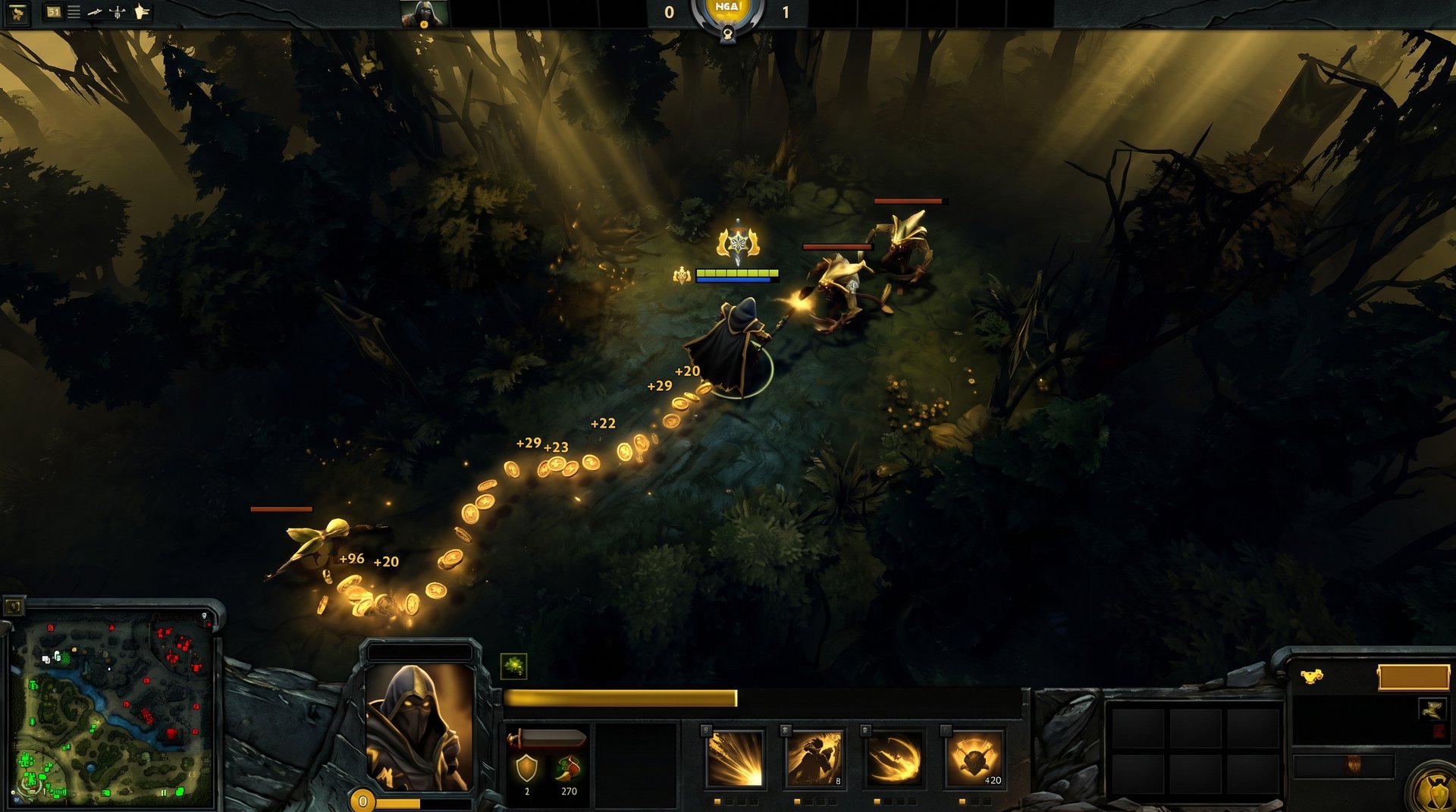
If you could only fix one thing about your Archon gameplay, make it farm efficiency. This is not a controversial statement among Dota coaches — it is close to universal consensus. The reason is that farm efficiency is both a direct source of power and a proxy indicator for a dozen other skills.
A player who consistently hits 65 last-hits at 10 minutes is doing multiple things right simultaneously: they are not abandoning their lane unnecessarily, they are denying creeps to slow enemy farm, they are making good micro decisions on contested last-hits, and they are managing their positioning correctly to stay safe while farming. Farm numbers do not lie.
The 10-Minute Benchmark
Your first target should be hitting 65 last-hits by the 10-minute mark on your primary role. This is achievable on carry and mid in most games with proper lane mechanics. For supports, the equivalent metric is denies — aim for 15+ denies per game in the early lane phase, which forces your opponent to lose lane XP and slows their item timings.
To improve your 10-minute number, spend 5-10 minutes in a custom lobby farming in the first wave, with no neutral camps, against 5 enemy creeps. This isolates the skill of last-hitting from game complexity. Do this three times per week. Within two weeks, you will notice a measurable difference in your lane performance in real games.
Triangle Farming vs Lane Priority
Once the lane phase ends, Archon carries often drift without a clear farming plan. The instinct is to follow the team. Legend carries instead execute a “triangle” — a predetermined circuit between the safe lane, the jungle triangle, and the secondary jungle — that they run on a loop until a fight starts or an objective window opens. This structured farming path means fewer idle seconds and more consistent item timing, and it requires you to develop a habit of knowing where the safe farm on your side of the map is at any given time.
You can read more about how top players approach MMR gain efficiently in our full MMR boosting guide, which covers both the mental side and the game-specific habits that Legend-plus players have built.
Jungle Timing and Stack Management
Archon carries often leave gold in the jungle by not stacking camps. A single stacked large camp at minute 7 is worth roughly 400-600 gold. Supports who understand this will stack for their carry — but the carry also needs to clear those stacks on time, not finish the lane wave and then forget the jungle. Build the habit of checking the minimap for orange dots (stacked camps) every time you finish a creep wave.
Hero Pool and Mastery: Why Less Is More
Archon players almost universally have too many heroes in their pool. The logic seems sound: if you can play 12 heroes, you can respond to any draft situation. In practice, the opposite is true. Playing 12 heroes at Archon means you are playing all of them at Archon level. Playing 2 heroes extensively means you can play those 2 at Legend level, and your weaknesses on draft counter situations become surmountable because your execution is sharp enough to compensate.
Building the 2-3 Hero System
Choose one core hero that suits your playstyle and that is strong in the current patch. Play it exclusively for 20 games. Track your personal benchmarks: last-hits, fight involvement, death count. After 20 games you will start to see patterns — specific situations where you consistently perform well and specific match-ups where you underperform. Now add one flex pick that covers the match-ups your main hero struggles against. That is your pool.
The most common mistake when building a hero pool is choosing heroes based on what you enjoy watching rather than what suits your current skill level. A hero like Invoker or Rubick punishes execution errors severely. For Archon, prioritize heroes where the ceiling is high but the floor is forgiving — think Lifestealer, Dragon Knight, or Snapfire in the current patch meta.
If you are unsure which hero pool makes the most sense for your playstyle, a single coaching session can give you that answer in 60 minutes. TeamSmurf’s coaches at our Dota 2 coaching service analyze your Dotabuff profile before every session and come in with a specific hero recommendation rather than generic advice.
Understanding the Current Patch Context
Hero pools need to be reviewed every major patch. A hero that was a reliable Archon carry in patch 7.36 may have been reworked into a different role by 7.41. Before committing to a hero, check its current win rate at the 2,000-3,000 MMR bracket using Dotabuff’s filter tools. Heroes that are performing above 52% win rate in your bracket are in a good state. Heroes below 48% are being dragged by the current meta, and you should factor that in when deciding whether to stick with them.
The Mental Game: Stopping the Tilt Spiral
The mental component of the Archon plateau is underestimated in almost every guide that focuses purely on mechanics. But the data from coaching sessions tells a clear story: players who tilt easily — who start playing worse after losing — are the ones who plateau the longest. The mechanical improvements mean nothing if every 3-game losing streak triggers a deathgrind of another 10 games played while mentally checked out.

The Two-Loss Rule
Adopt a strict two-loss rule: after two consecutive losses, stop playing for the day. This sounds simple. It is deceptively hard to follow because the emotional response to a loss is a strong urge to immediately queue for another game to “get it back.” That emotional state impairs decision-making measurably. Research on tilt in competitive games consistently shows that win rate drops significantly after a two-game losing streak. You are not playing to “get it back” — you are playing to dig the hole deeper.
The two-loss rule keeps your average game quality high and prevents the phenomenon of MMR craters that Archon players experience — those runs where you drop 200-300 MMR in a single afternoon.
Post-Game Review as a Mental Reset
Instead of immediately queuing after a loss, spend 5 minutes reviewing one specific decision in the replay. Not the whole game — one moment where you made a choice that in hindsight was clearly wrong. Name it concretely: “I engaged without vision at minute 22.” Write it down somewhere. This process converts the emotional energy from a loss into something productive, and it trains you to separate “I lost” from “I played badly,” which are not the same thing.
Separating Results from Inputs
You control your inputs: your positioning, your farm, your communication, your item choices. You do not control your teammates’ inputs. When you lose a game where you personally performed above your benchmark on every measurable metric, that is information worth noting — but it is not a reason to doubt your improvement. Over 20-30 games, the variance in teammate quality averages out. The persistent variable is you.
This framing is covered extensively in the article on overcoming rank confidence crises and deciding when to grind vs. coach vs. boost — a useful read for anyone who has been in Archon for more than 3 months.
Positioning and Macro Play: Moving With Purpose
In Archon, the most common positioning mistake is not individual overextension — it is passive positioning when the game requires active pressure. Archon supports sit in base after a teamfight win instead of pushing the advantage. Archon carries farm a jungle camp while the enemy is trying to break their high ground. Archon mids rotate to a fight that is already over instead of staying mid and taking the tower.
The 60-Second Rule
Train yourself to ask one question every 60 seconds: “What should I be doing right now?” If your answer is anything other than a specific named action — “I should be pushing the top lane with two heroes while mid defends bottom” — then you are playing on autopilot. The 60-second check is a habit that feels awkward for the first week and becomes automatic over time. It is the single habit most commonly cited by players who have climbed from Archon to Ancient as the thing that changed how they thought about Dota.
Objective Timing Windows
Archon games often fail to convert won teamfights into objectives because players do not know the timing windows. Here is the basic framework:
- After killing 3 or more enemies: Immediately take the nearest building or start Roshan if the timing aligns. Do not base. Do not regen. Move.
- After a Roshan kill: The team with Aegis has roughly 3-4 minutes of pressure window before the respawned Roshan becomes available again. Use that window on a specific lane, not random skirmishing.
- After a buyback-free victory: If the enemy team has used buybacks and your team has not, the next 3-4 minutes is a “free” window for high-ground attempts. Push immediately.
Rotation Discipline
One of the hardest Archon habits to break is the unnecessary rotation. A support who leaves bottom lane to gank mid at minute 5 without a guaranteed kill is losing both their carry farm potential and the mid tower pressure from the gank. Before you rotate, ask: “Is this a 70% chance or better kill?” If not, stay and provide lane pressure. Good rotations in Archon are about certainty, not optimism.
Vision and Warding: The Invisible Layer
Vision is Archon’s least glamorous improvement area and one of the highest-value ones. Archon supports typically place wards from memory — they know “the” ward spots. Legend supports place wards based on game state: where is the enemy offlane roaming? Is the enemy carry farming the triangle or pushing through the ancients? Where do I need vision to prevent the gank that is about to happen?
Reactive vs Proactive Warding
Most Archon warding is reactive: a player gets ganked, they say “we need wards,” and someone buys an observer. This is always one gank too late. Proactive warding means placing the ward before the gank by reading the enemy’s timing patterns. If the enemy mid hits level 6 and has an empty inventory at minute 7, a Smoke gank is incoming in the next 90 seconds. Place the ward before that window, not after.
Deward Priority
Dewarding is often skipped in Archon because it requires a sentry ward slot and the payoff is invisible — you remove vision the enemy has, and that is hard to feel the impact of immediately. But sustained dewarding of key spots is one of the most cost-effective actions a support can take. A sentry ward that removes the enemy’s high-ground ward before a push can be the difference between a successful high-ground attempt and a wipe, because it denies the defender’s 5-second advantage of seeing the push coming.
When to Consider Coaching or Boosting
Self-improvement is the ideal path, and everything in this guide gives you the tools to do that. But there are scenarios where outside help accelerates the process — or where the plateau has become a psychological block rather than a mechanical one.
Coaching: For Players Who Want to Understand
If you have been stuck at Archon for more than 3 months and you are actively trying to improve, a coaching session provides something this guide cannot: personalized diagnosis. A coach looking at your last 10 games can identify in 30 minutes exactly which habit is most responsible for your plateau. That targeted diagnosis is worth 50 games of self-review for most players.
TeamSmurf’s coaching specifically targets Archon-to-Legend transitions. Book a Dota 2 coaching session and the coach comes prepared with your Dotabuff stats, replay timestamps, and a specific action plan before the session even begins.
Boosting: For Players Who Want Proof of Concept
A different use case for professional Dota 2 boosting services is what we call “proof of concept” — playing games at a higher bracket to observe how Legend and Ancient players approach the game from inside a match, rather than watching a stream. Watching gameplay is passive. Playing alongside a booster in duo queue, or playing games at a slightly elevated calibration, creates active learning because you are forced to match the pace of better players. You cannot watch — you have to respond.
This is not the right approach for everyone, but players who learn better through doing than through watching consistently report faster improvement when they combine coaching with ranked game exposure at their target bracket.
If you are concerned about the safety side of using these services, the full breakdown of risks and how to evaluate providers is covered in our guide on whether Dota 2 boosting is safe in 2026.
The Right Time to Act
The signal that it is time to seek outside help is simple: if you have been at the same MMR range for more than 3 months despite active play (15+ games per week), the loop is not going to break itself. Something structural needs to change — either your habits, your hero pool, your mental framework, or your understanding of the bracket above you. Outside help is the fastest path to identifying which of those four things is the blocking factor.
Frequently Asked Questions
Ready to Break the Archon Wall?
Whether you want a coach to pinpoint exactly what is holding you back, or you want a professional boost to get your calibration off the plateau — TeamSmurf is the only Dota 2-only service with coaches who have played specifically in your bracket and know exactly where Archon players lose games.
Book a Coaching Session Get a Rank Boost