Hero Pool Design: 3-Hero System to Climb Faster

The single most common mistake that plateaued players make is having an undefined hero pool. They have eight to twelve heroes they “can play” but no clear framework for when to play which hero, no primary hero that drives their core decision-making, and no systematically chosen secondary heroes that cover the scenarios where the primary is banned or countered. This ambiguity is not a stylistic preference — it is a measurable disadvantage that costs approximately 3-5% win rate compared to players with a structured three-hero system.
This guide presents a specific framework for designing a three-hero pool optimized for climbing MMR in 2026’s meta. The framework addresses hero selection criteria, how to identify which role your pool should anchor around, how to select your three heroes to minimize overlap while maximizing coverage across match types, and how to develop each hero to the point where it drives results rather than just participation.
The framework is applicable across all brackets from Guardian through Ancient. Divine and Immortal players have already implicitly or explicitly developed this system — this guide makes it explicit and actionable for players below that range who are climbing deliberately.
Table of Contents
Why Three Heroes Is the Optimal Pool Size
The argument for a small hero pool is made regularly in climbing communities, but the specific number three is not arbitrary. It is the minimum number of heroes needed to handle the three scenarios that determine whether you have a viable pick in any given game: your primary hero is available, your primary is banned, and your primary is both available and countered by a specific enemy hero. A two-hero pool fails the third scenario. A five-or-more hero pool dilutes your mastery across too many heroes to maintain peak performance on any single one.
The Mastery Curve Problem
Hero mastery in Dota 2 is not linear. The first 30 games on a hero bring you from fumbling through abilities to executing the standard build reliably. Games 30-100 develop situational decision-making: when to adapt the item build, when to transition roles within the game, how to manage the hero’s specific power spike windows. Games 100-300 develop the micro-optimizations and hero-specific read of the game that make the hero genuinely climb-capable. Beyond 300 games, most players have internalized the hero well enough that further improvement is marginal without specific coaching intervention.
A player who spreads their games across eight heroes has an average of 50-100 games per hero — solidly in the “standard execution” range but not in the mastery range where the hero drives results. A player who concentrates on three heroes can have 150-300+ games on their primary and 50-100 on their secondaries within the same total game count.
The Draft Decision Simplification
A defined three-hero pool simplifies the most cognitively demanding part of ranked Dota 2: the draft. Instead of evaluating eight potential picks against the enemy draft in the 30-second pick window, you are evaluating three. This reduces draft-time decision fatigue and allows you to spend that mental energy on the draft strategy (when to pick, what to protect, what to reveal) rather than on hero selection itself. Immortal players have this system implicit — they know their hero before the draft begins in most scenarios.
Choosing Hero 1: Your Core Identity
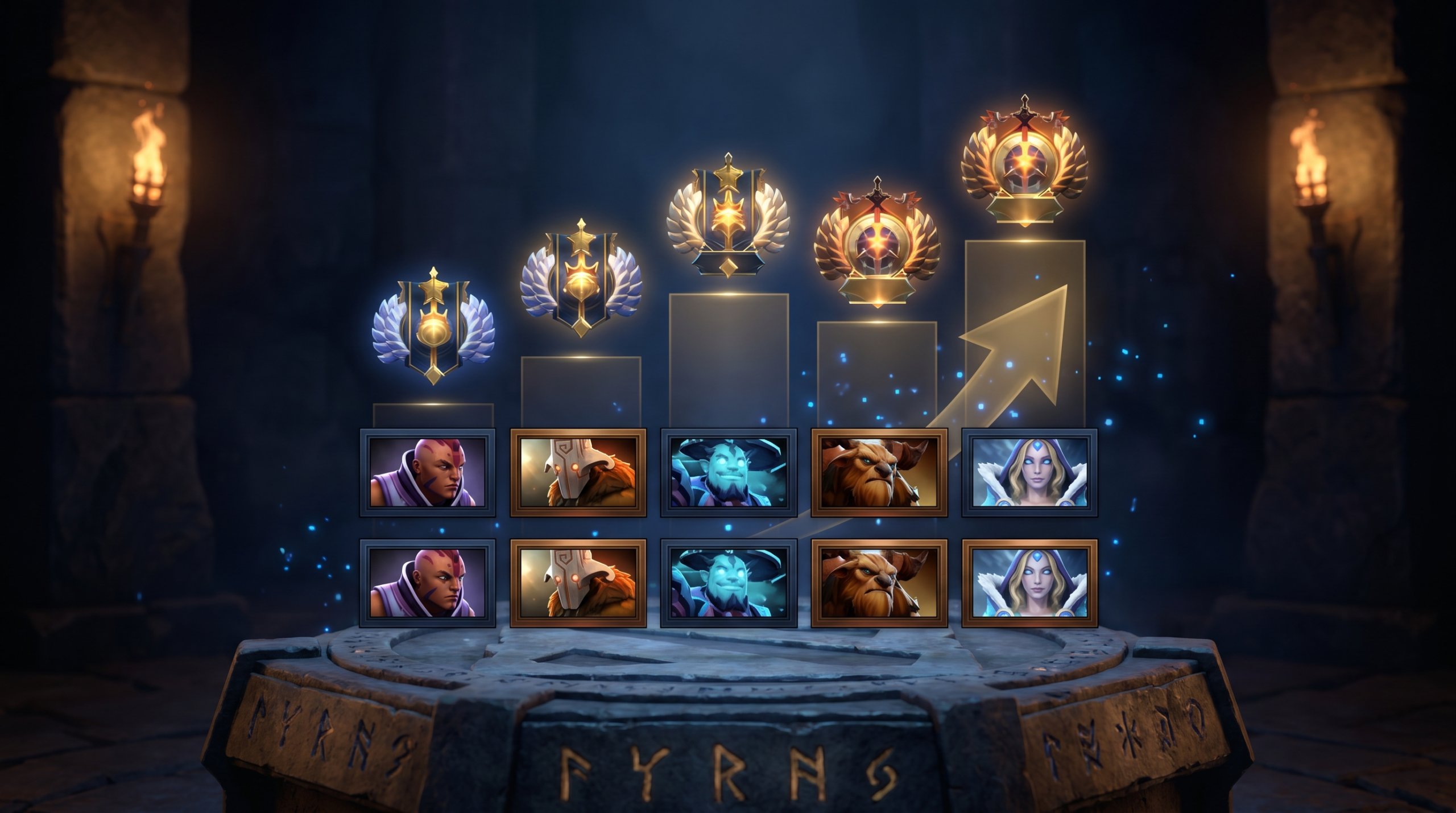
Your primary hero is the hero you will play in 60-70% of your games. It should satisfy three criteria: you currently have the highest win rate on it relative to games played, it is viable in the current meta (not top-tier necessary, but functional — a 2% below-average win rate is acceptable), and it covers your role preference in a way that makes you the primary decision-maker in fights or farm sequences. The last criterion is important: your primary hero should be one where your decision-making is the primary game-state determinant, not one where you are reactive to teammates.
Meta Viability Check
Checking whether your preferred primary hero is meta-viable in 7.41c is straightforward: look at the hero’s win rate at your bracket on a site like Dotabuff or Stratz. A win rate within 2% of 50% (48-52%) at your bracket is viable. Below 47% indicates a hero that is mechanically disadvantaged in the current patch meta and requires above-average skill to match the win rate of better heroes. If your preferred hero falls below 47% at your bracket, treat it as Hero 3 (counter-pick) and identify a higher-win-rate hero as your primary.
Role Sovereignty Criterion
Role sovereignty means your hero is the one making the primary impactful plays in your team’s win condition. A carry who farms to a 20,000 net worth lead and then five-hits enemies in teamfights has role sovereignty. A support who creates pickoffs through positioning and spell chains has role sovereignty. A mid hero who sets up the game’s critical fight timing through rotation and vision plays has role sovereignty. The key question: in games you win on this hero, is your hero the reason you won? If the honest answer is “no, my teammate carried,” this hero should not be your primary.
Recommended 2026 Primary Heroes by Role
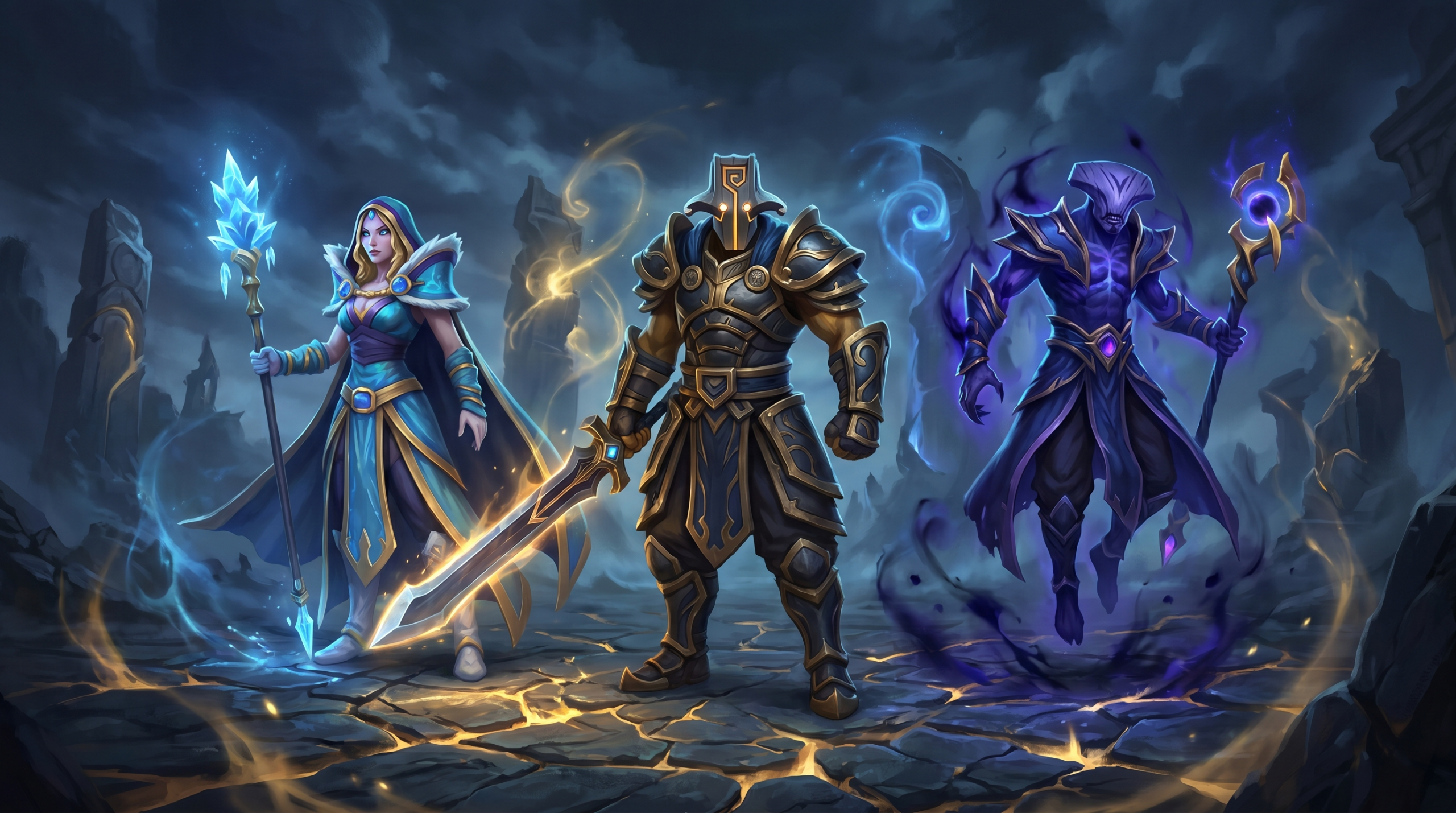
For position 1 (carry): Juggernaut remains one of the most forgiving and impact-consistent carries across all brackets through Archon-Ancient. Phantom Assassin at Archon-Legend due to high variance but high upside. Luna for teamfight-oriented carry players who want reliable win conditions in organized pushes.
For position 2 (mid): Storm Spirit for players who have invested 150+ games and enjoy high-mobility assassination. Dragon Knight for players who want a tanky mid that scales into teamfights. Outworld Destroyer in 7.41c is particularly strong and rewards players who play aggressively around the laning phase advantage window.
For position 3 (offlane): Axe for initiation-focused players who want a decisive teamfight role. Underlord for attrition-focused players who prefer a durable presence. Centaur Warrunner for players who want a simple kit with high impact initiation.
For position 4-5 (support): Crystal Maiden for players who want predictable impact. Witch Doctor for high-damage supports. Lion for players who prioritize disables and finishes.
Choosing Hero 2: Your Flex Option
Your second hero is your flex option — the hero you play when Hero 1 is banned or when the draft demands a different role or hero type. The flex hero should be within the same role as Hero 1 (do not make a carry player choose a support as Hero 2 — it splits your skill investment too broadly) but should address a specific meta scenario where Hero 1 underperforms.
Identifying the Coverage Gap
Review your last 20 losses on Hero 1. Identify the enemy hero compositions that caused those losses. The coverage gap is the hero composition pattern that Hero 1 is weakest against. Hero 2 should be stronger into that specific pattern. Example: if you play Juggernaut (Hero 1) and your losses cluster around games where the enemy had strong magic burst (Lion, Lina, Skywrath), Hero 2 should be a carry with higher innate magic resistance or spell immunity — Wraith King (Reincarnation provides backup), Anti-Mage (spell shield), or Phantom Assassin (Blur provides evasion against some magic). The coverage gap analysis makes Hero 2 selection systematic rather than based on preference.
Flex Hero Development Timeline
Hero 2 should reach 50-75 games before you rely on it in ranked. At that game count, you have seen enough game states to make reliable decisions under pressure. Developing Hero 2 in unranked matches while maintaining ranked focus on Hero 1 is the standard approach. Switch to Hero 2 in ranked only when you have reached that game threshold.
| Hero 1 | Common Weakness | Recommended Hero 2 |
|---|---|---|
| Juggernaut | Magic burst, silences | Wraith King or Anti-Mage |
| Storm Spirit | Physical damage, no lockdown to kill | Lina or Viper |
| Axe (offlane) | Kite-heavy enemy, poor against ranged | Dragon Knight or Doom |
| Crystal Maiden | High mobility enemy, hard to escape | Lion or Disruptor |
| Phantom Assassin | High armor, evasion counters, AoE | Terrorblade or Luna |
| Dragon Knight | High magic damage, no mobility | Void Spirit or Tinker |
Choosing Hero 3: Your Counter-Pick
Hero 3 is the hero you pick specifically to counter a known threat in the enemy composition. Unlike Heroes 1 and 2 (which are your primary identity and flex options), Hero 3 is situational — you play it in specific games where the counter-pick advantage is significant enough to justify switching out of your normal heroes.
The Counter-Pick Value Threshold
Counter-picking is only worth switching your hero when the counter advantage is more than 3-4% win rate improvement relative to picking your standard hero. Minor counter relationships (1-2% win rate delta) do not justify the mastery disadvantage of playing a hero outside your core pool. The threshold for triggering Hero 3 should be: the enemy has picked one or more heroes that specifically hard-counter your Hero 1 AND that counter is likely to be the primary game-state determinant in most game scenarios. Anti-Mage banning out Invoker qualifies. A single Lion in the enemy team does not.
Identifying Your Counter-Pick Hero
Your Hero 3 should be a hero you enjoy playing and have 30+ games on, that specifically addresses the hardest counter to your Hero 1. If your Hero 1 is Juggernaut and your primary counter is Disruptor (who can isolate you during Omnislash with Kinetic Field), your Hero 3 might be a hero that either does not care about Disruptor’s kit (Phantom Assassin can blur-dodge Static Storm hits) or one that directly punishes Disruptor’s positioning (Nyx Assassin who can burst Disruptor before their spells land).
Pool Stability Rule
Your Hero 3 should not change more than once per major patch. Frequently rotating your counter-pick hero means you never develop the mastery window on it that makes the pick effective. A Hero 3 with 20 games is less valuable as a counter-pick than a Hero 3 with 60 games that you have encountered in diverse scenarios. Stability in your Hero 3 slot is as important as in your Hero 1 slot.
Developing Each Hero to Climb-Ready Level
Having three heroes selected does not make them climb-ready. Development to climb-ready level requires a specific progression through three skill stages: mechanical competence, situational adaptation, and meta integration.
Stage 1: Mechanical Competence (0-30 games)
Mechanical competence means you can execute the hero’s standard skill and item build reliably under game-state pressure. You are not making build decisions during fights — the build is so internalized that item purchases are automatic. You can activate all of the hero’s active items and abilities correctly in the contexts they are most commonly used. At this stage, play unranked or low-stakes matches to accumulate repetitions without MMR cost.
Stage 2: Situational Adaptation (30-100 games)
Situational adaptation means you can identify when the standard build needs modification and execute the modification correctly. You understand which items to buy when the standard build’s timing is wrong for the game state. You can identify when your hero’s standard fight role is not available (your carry got countered in lane) and adapt your contribution to what the game actually needs. At this stage, you should be playing ranked with the hero and actively reviewing replays of your losses to identify adaptation failures.
Stage 3: Meta Integration (100+ games)
Meta integration means you understand how your hero fits into the current patch’s dominant win conditions and can position your hero’s power spikes relative to team fight timing and objective control. At this stage, the hero is a genuine climb tool — you are not just executing the hero, you are using the hero to execute a game plan. This is the stage where win rates climb consistently and the hero stops being “one of the heroes I play” and becomes “the hero I use to climb.”
Adapting Your Pool When the Patch Changes
Major patches (7.40, 7.41, etc.) can significantly shift the relative strength of heroes, making a previously-viable primary suddenly below-viable or making a previously-weak counter-pick extremely effective. The adaptation protocol should be conservative: do not abandon a hero after two games in a new patch. Wait until you have 10+ games in the patch before evaluating whether the patch has moved the hero outside the viable range.
The Meta-Drop Trigger
Abandon a hero from your pool only when: your win rate drops below 45% over 15+ patch-specific games, AND you can identify a specific mechanic change in the patch that explains the win rate drop (a nerf to the hero’s primary item, a meta shift toward a hero type that hard-counters your primary, or a change to the map or game mechanics that disadvantages your hero specifically). Abandoning a hero based on two or three losses is premature and restarts your development curve unnecessarily.
Mid-Patch Pool Addition Protocol
If a major patch buffs a hero that would fit your pool perfectly, resist the temptation to immediately add it to ranked play. Wait until you have 20+ unranked games on the hero in the new patch before bringing it into ranked. A newly-buffed hero that everyone is playing is not automatically a good ranked pick for you unless you already have the development base on it.
Pool Examples by Role and Bracket
Concrete pool examples for the most common role-bracket combinations, applying the framework above.
Carry (Position 1), Archon-Legend
Hero 1: Juggernaut (forgiving kit, consistent impact, viable into most drafts). Hero 2: Wraith King (covers games where magic burst is the primary threat — Reincarnation and Vampiric Aura provide insurance against the burst-down pattern that kills Juggernaut). Hero 3: Phantom Assassin (counter-pick into primarily physical teams where Blur’s evasion disrupts right-click carries that Juggernaut cannot outfight).
Mid (Position 2), Archon-Legend
Hero 1: Dragon Knight (tanky mid that scales into teamfights, relatively simple decision-making under pressure, viable in most metas). Hero 2: Outworld Destroyer (covers games where the enemy has a fragile mid that Dragon Knight cannot reliably kill in lane — OD’s Astral Imprisonment and Sanity’s Eclipse punish low-intelligence heroes). Hero 3: Viper (counter-pick into strength-based mids or carries that Dragon Knight would otherwise struggle to lane against — Viper Break shuts down passive abilities that many strength heroes rely on).
Support (Position 5), Archon-Legend
Hero 1: Lion (reliable stun + hex + Mana Drain, strong at all game phases, straightforward execution). Hero 2: Witch Doctor (covers games where your team needs more sustained teamfight damage — Death Ward in combination with Paralyzing Cask provides fight duration that Lion lacks). Hero 3: Disruptor (counter-pick into high-mobility enemies where Lion’s point-target Hex misses — Glimpse and Kinetic Field create hard CC without requiring precise targeting).
For players who want an Immortal analyst to specifically evaluate their current hero pool and recommend adjustments, our coaching sessions include hero pool analysis as a standard component. Our MMR boost replays also demonstrate which heroes Immortal players select in your specific bracket across different draft scenarios.
Ready to Skip the Grind?
Team Smurf’s Immortal boosters climb your MMR while demonstrating optimal hero pool selection at your bracket.
Get Your Boost Now Talk to Our Team