Is Coaching Better Than Boosting for Archon/Legend Players?

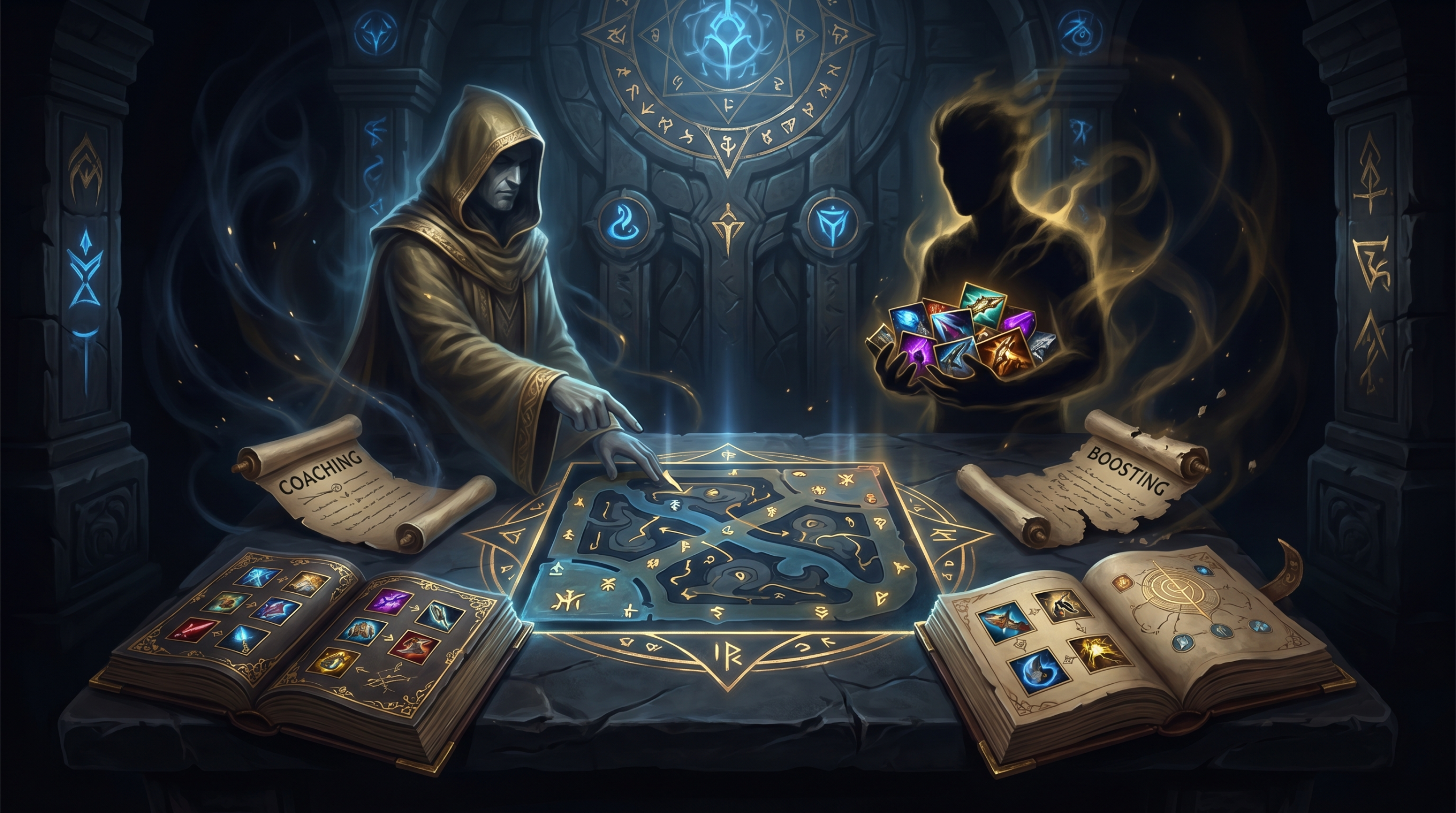
Archon and Legend are the most psychologically complex brackets in Dota 2. Players at this range have enough game knowledge to understand what they should be doing but lack the mechanical execution and decision-speed to do it consistently. This creates a unique problem when deciding between coaching and boosting: both services can advance your rank, but only one of them develops the underlying skills that make that rank hold.
This guide is an honest breakdown of when each service is the right tool for your specific situation, written from the perspective of operators who provide both. The answer depends on what is actually holding you back in the Archon-Legend range, and that differs significantly from player to player. We will cover what each service delivers, the specific problems each solves at this bracket, the ROI calculation, and when combining both creates the best outcome.
All coaching ROI estimates assume consistent application over 30-50 games. Boost timelines assume an Immortal booster at standard pace without express options. Your results will vary based on your play volume, hero pool stability, and implementation discipline.
Table of Contents
What Actually Holds Archon-Legend Players Back
Before choosing between coaching and boosting, correctly identify what is limiting your rank. Most Archon-Legend players have a mixed bag of issues, but one category typically dominates. The wrong diagnosis leads to the wrong service and wasted investment.
Category 1: Knowledge Gaps
Players held back by knowledge gaps know something is wrong but cannot articulate what specifically. They lose teamfights they felt they should have won. They buy items that seem reasonable but underperform in practice. They farm competently but lose during the 15-20 minute window when fights begin. The underlying issue is missing conceptual frameworks — when to fight versus when to farm, how to read enemy item timings, how to identify which hero on their team is the primary late-game win condition and position accordingly.
Knowledge gap players benefit significantly from coaching because a session identifies the specific missing framework and provides mental models to fill it. One solid coaching session on fight timing can change fight decisions in every subsequent game, compounding over hundreds of matches. A session might reveal that you are consistently engaging when both teams have identical cooldown states rather than waiting for your kit to be stronger than the opponent’s — that single framework correction is worth 150-300 MMR over time.
Category 2: Mechanical Ceiling
Some Archon-Legend players have adequate game knowledge but mechanical execution is the bottleneck. They understand they should last-hit more efficiently, but their hands or reaction time do not deliver it consistently under game-state pressure. They know they should dodge a stun with Puck’s Phase Shift, but the reaction window is too tight. Coaching can identify this problem but cannot directly solve it — mechanical improvement requires deliberate practice, not conceptual instruction. A coaching session that identifies three mechanical weaknesses is still valuable, but the fix is custom lobby drills, not more coaching sessions.
Category 3: MMR Misalignment
Some players are performing at a higher skill level than their MMR reflects. They have lost a calibration series badly, gone through a long tilt streak, or had an extended period offline that degraded their stats temporarily. Their fundamental skill level is Legend-Ancient, but their MMR shows Archon. These players are the clearest boosting candidates: the number needs to catch up to the skill, not the other way around.
What Coaching Delivers in This Bracket
Coaching is a skill transfer service. At its best, one hour from an Immortal analyst delivers specific, named corrections to your decision-making that you can apply in the very next game. At its worst, it is a general review that tells you what you already know without the specific frameworks that change behavior under pressure.
High-Leverage Coaching Areas for Archon-Legend
Quality coaching at this bracket focuses on three areas: hero-specific execution corrections, fight timing and engagement discipline, and farm efficiency without position sacrifice. These are where Archon-Legend players consistently leave rank on the table.
Hero-specific execution is the most immediate improvement vector. Identifying the 2-3 mechanics on your main hero that you are under-utilizing produces 100-200 MMR of improvement on heroes you are already proficient on. A coaching session on your Lina game might reveal that your Laguna Blade timing is consistently 2-3 seconds late in teamfights — waiting until enemies are already focused rather than initiating the burst. This single correction, consistently applied, improves your contribution in every game you play the hero.
Fight timing is a conceptual framework correction: understanding specifically when your hero’s power spike allows you to fight versus when the enemy has an advantage window. Most Archon-Legend players fight reactively, responding to fights that happen rather than creating fights when conditions favor them. A coaching session that maps your hero’s fight windows to item timings provides a decision rule applicable in real-time.
Coaching Limitations
Coaching does not boost your MMR directly. The improvement requires consistent application over 30-50 games before it shows in your rank. Players who take sessions but revert to pre-session habits gain very little. If your play volume is low (3-5 games per week), the ROI is lower than for high-volume players who can rapidly integrate new frameworks through repetition.
| Factor | Coaching | Boosting |
|---|---|---|
| Immediate MMR gain | No | Yes |
| Skill development | Yes (if applied) | Limited (replay study) |
| MMR stability | High (earned rank) | Depends on underlying skill |
| Time to 500 MMR | 2-4 months at moderate volume | 3-7 days |
| Cost per 500 MMR equivalent | $60-200 per coaching block | $95-155 direct |
| Best for knowledge gaps | Yes | No |
| Best for MMR misalignment | No | Yes |
What Boosting Delivers in This Bracket
Boosting is an MMR delivery service. In the Archon-Legend bracket, Immortal boosters operate at 65-75%+ win rates because the skill gap is substantial. Orders complete quickly with minimal risk compared to higher bracket boosts. The primary delivery is straightforward: a target rank reached within a predictable timeline.
The Replay Learning Opportunity
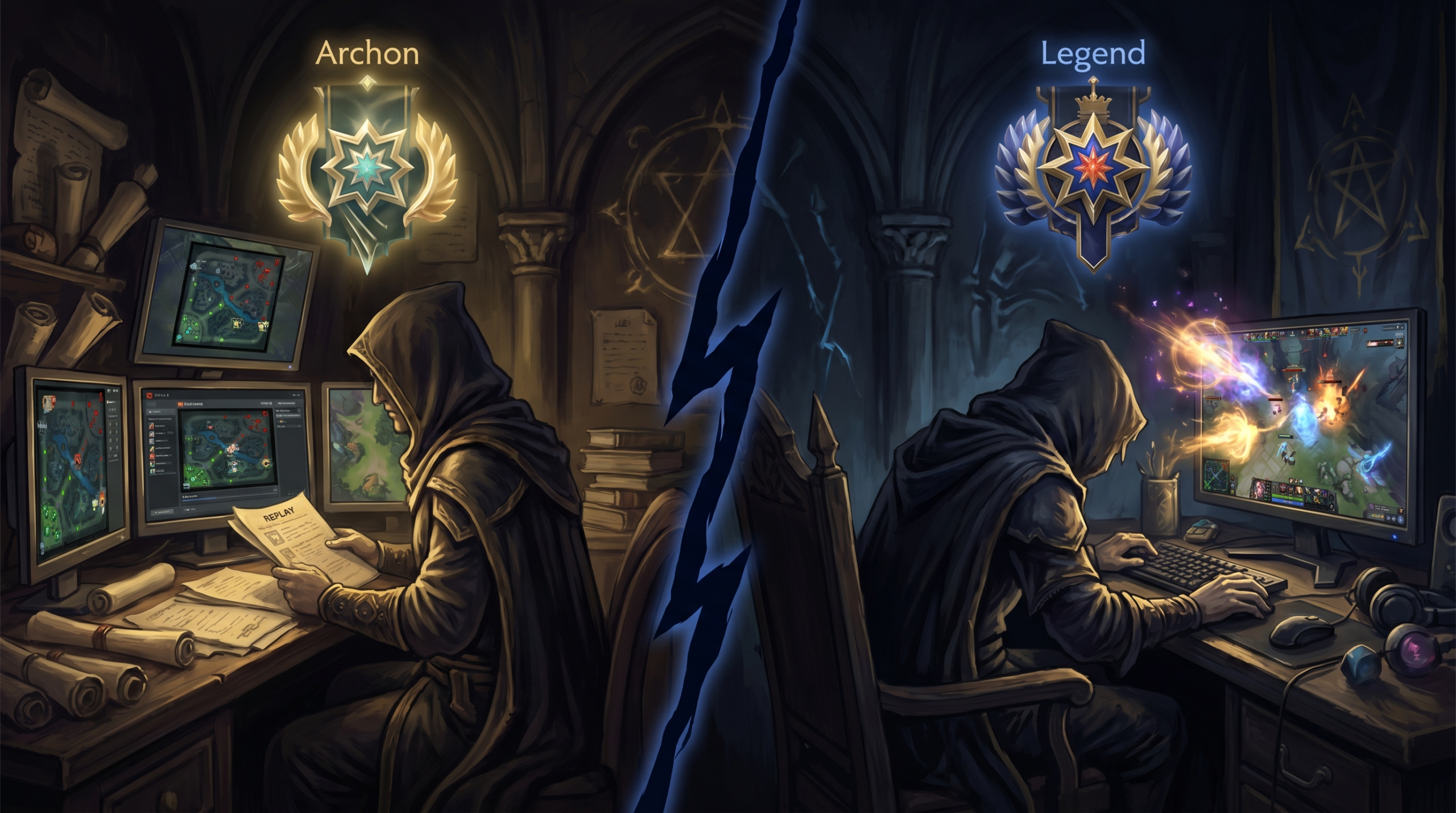
One underappreciated aspect of boosting for skill-conscious players is the replay archive. A boost order generates 20-40 games in your match history played by an Immortal booster on your account, in your bracket, against your typical opponents. These replays show how an Immortal player handles decision points you typically misplay. Farm paths, fight timing decisions, item sequences — all visible in your own match history on heroes you play. Players who actively review boost replays and identify specific decision differences extract genuine coaching value from the boost experience.
Psychological Reset Value
For players stuck in a specific MMR band for months, a boost provides a psychological reset. Playing at 2,500 MMR for six months of failed attempts creates a mental framework of “I am an Archon player.” Moving to 3,000 through any means reframes the player’s self-concept. Players who boost into Legend and consciously decide to maintain that rank often perform measurably better because they approach games from a Legend player’s identity rather than an Archon player who got lucky once.
ROI Comparison by Player Type
The correct choice depends on your player profile. Here are the three most common Archon-Legend player types and which service delivers better ROI.
The Knowledge-First Player
This player watches pro games, reads patch notes, understands theoretical correct plays. Their problem is executing the right decision under time pressure. For this player, coaching delivers highest ROI because it bridges the gap between theoretical knowledge and real-time application. The correction is behavioral — a coach identifies the specific decision trigger they are missing and provides a rule to apply in-game.
The Misaligned Player
This player genuinely belongs in a higher bracket but lost rank through external factors: bad calibration, a tilt streak, an extended absence, or low behavior score lobbies depressing win rate. For this player, boosting delivers highest ROI because it corrects a number that does not reflect their actual skill. Coaching would improve a player who is already at their correct bracket.
The Mechanical-Limited Player
This player has adequate game knowledge but physically cannot execute the micro required to maximize hero effectiveness. Neither coaching nor boosting directly addresses this limitation. The recommended path is targeted hero practice (single-hero focus, custom lobby drills) combined with a boost to stabilize rank at a sustainable level while the mechanical improvement develops.
When to Choose Coaching
Choose coaching when you can articulate what you are doing wrong but cannot fix it under game-state pressure. This is the prototypical coaching candidate — you have the meta-knowledge but not the real-time decision discipline. A session identifies the specific decision trigger you are missing and provides a rule to apply in-game.
Choose coaching when you want to sustainably climb beyond your current bracket without external assistance. If your goal is Legend 5 and you want to feel confident you belong there, coaching is the right tool. You will climb more slowly but stably, and the skill carries forward to the next bracket.
Choose coaching when you are willing to apply lessons actively over 30-50 games. Coaching is wasted on players who do not practice the corrections. If your commitment to implementation is high — you take notes, actively think about coaching points during games, review your own replays — coaching compounds significantly over time.
When to Choose Boosting
Choose boosting when your MMR does not reflect your actual skill. If you can routinely identify the correct play but still lose games due to teammate quality, behavior score issues, or calibration variance, your skill is ahead of your rank and boosting corrects that misalignment efficiently.
Choose boosting when you have limited play time and want maximum efficiency. Playing in Archon when you genuinely belong in Legend means spending limited play time in a lower-quality matchmaking pool with slower climb timelines. A boost moves you to the right environment faster.
Choose boosting when you have a deadline. Team qualifications, ranked events, or competitive reasons for needing a specific rank by a specific date are clear boosting use cases. Coaching cannot guarantee a timeline. Our Archon-Legend boost packages include express options with completion guarantees for deadline situations.
The Best Case: Combining Both Services
The highest-ROI approach for most Archon-Legend players who take their rank seriously is combining both services in sequence. The optimal order: coaching first to identify your primary knowledge gaps, then boosting to correct any MMR misalignment while you apply the coaching lessons in the new bracket.
This combination works because the coaching session makes you a more informed observer of your boost replays. You know what decisions to look for because the coach identified them. The boost delivers you to a bracket where your skill is more competitive, and the replays give you 20-40 examples of Immortal-level decision-making applied at your specific MMR range.
Our coaching service and MMR boost packages can be booked independently or combined. Contact our team to discuss the right sequence for your situation.
Tracking Progress After Either Service
One of the most common mistakes after purchasing coaching or boosting is failing to systematically track whether the investment is delivering results. Without measurement, you cannot distinguish between a skill improvement that is working and a normal variance period where your win rate happens to be positive. Both coaching and boosting produce results that look similar in the short term — a win rate improvement — but the underlying mechanism differs, and understanding which mechanism is driving your results tells you what to do next.
Tracking Coaching Results
After a coaching session, create a simple tracking document with the specific corrections you received. For each correction, note whether you applied it in each subsequent game and what the outcome was. Track your win rate before the session (last 20 games) and after the session (next 20 games) separately. If the win rate after is higher by more than 5%, the coaching is delivering results. If the difference is less than 5%, either the corrections are not being applied consistently or the identified issues are not the primary limiting factor — both of which suggest a follow-up session focused on implementation rather than new corrections.
The specific corrections to track might include: “Wait for enemy to use their initiation spell before committing to a fight” (fight timing correction), “Buy Blink Dagger before BKB when the enemy team is physical damage heavy” (item order correction), or “Farm the jungle camp adjacent to the lane before rotating mid” (farm efficiency correction). Named, specific corrections that can be tracked game-by-game are more useful than general principles like “play better in the early game.”
Tracking Boosting Results
After a boost order completes, the most important metric is MMR stability over the next 30-50 games. Download the match history for the week before and after the boost. Calculate your win rate in the 30 games after the boost and compare it to your long-term historical win rate. If your post-boost win rate is within 5% of your historical win rate, your skill is sustaining the new rank. If it drops more than 10% below your historical average, the boost has placed you in a bracket where you are meaningfully below the typical skill level and skill development work is needed to sustain the rank.
When to Get a Follow-Up Service
The decision about follow-up coaching or boosting should be data-driven, not emotionally-driven. If your 30-game post-boost win rate is below 48%, a coaching session is the right follow-up — the skill gap is real and measurable. If you completed coaching and your 30-game post-session win rate is above 53%, the coaching is working and more implementation time (not more sessions) is the right next step. If the win rate is flat (49-51%) after coaching, a different coaching focus or a different coach may produce better results.
The most important principle across both coaching and boosting is intentionality. Players who purchase either service with a clear goal, a measurement plan, and a commitment to applying what they learn or observe get dramatically better outcomes than players who purchase on impulse and return to identical habits immediately after. Use whatever service you choose deliberately, measure the results honestly, and adjust your approach based on what the data shows rather than how any individual game feels.
Ready to Skip the Grind?
Team Smurf provides both Immortal-rank coaching and professional MMR boosting for Archon and Legend players.
Get Your Boost Now Talk to Our Team