

Most Picked Heroes at Every Rank 2026 (Data)

Pick rate is one of the most honest signals in Dota 2. Millions of players choosing the same heroes every night — in ranked, at their rank — is not coincidence. It is a collective judgment about which heroes feel reliable, fun, and effective at each bracket.
This post breaks down the most-picked heroes at every rank from Herald through Divine, using data from the OpenDota API heroStats endpoint (patch 7.41f, October 2026). For each bracket group we show the top five heroes, their pick percentage, and their win rate — then explain what those numbers actually mean for players trying to climb.
If you want the flip side of this data — which heroes opponents ban at your rank — see our companion post on the most-banned heroes at every rank 2026.
Table of Contents
What Pick Rate Actually Tells You
Pick rate measures how often a hero is selected out of all hero selections in a given bracket over a set time period. A hero with a 2.5% pick rate in Archon is being chosen roughly once every 40 hero picks at that rank — meaningful, but far from dominant. Dota 2 has over 120 heroes, so even the most popular hero rarely exceeds 3% in any bracket during a stable patch.
What pick rate reveals is player preference, not necessarily power. A hero with a 2.8% pick rate and a 49% win rate is not the best hero in that bracket. It is the most familiar, most comfortable hero that players return to regardless of the current patch. High pick rate combined with a win rate above 52% is the real signal — that hero is both popular and overperforming. High pick rate with a win rate below 49% tells a different story: players love picking it, but that attachment costs them games.
Pick rate data also differs fundamentally from ban rate data. A hero that never gets banned might sit at the top of the pick rate chart precisely because opponents do not fear it enough to spend a ban on it. Conversely, some of the most powerful heroes at a given rank have low pick rates because they are banned before the player ever gets the chance. For the ban-rate perspective, compare the numbers in our ban rate analysis by bracket.
Herald and Guardian — The Popularity Ladder Starts Here (1,000-2,300 MMR)
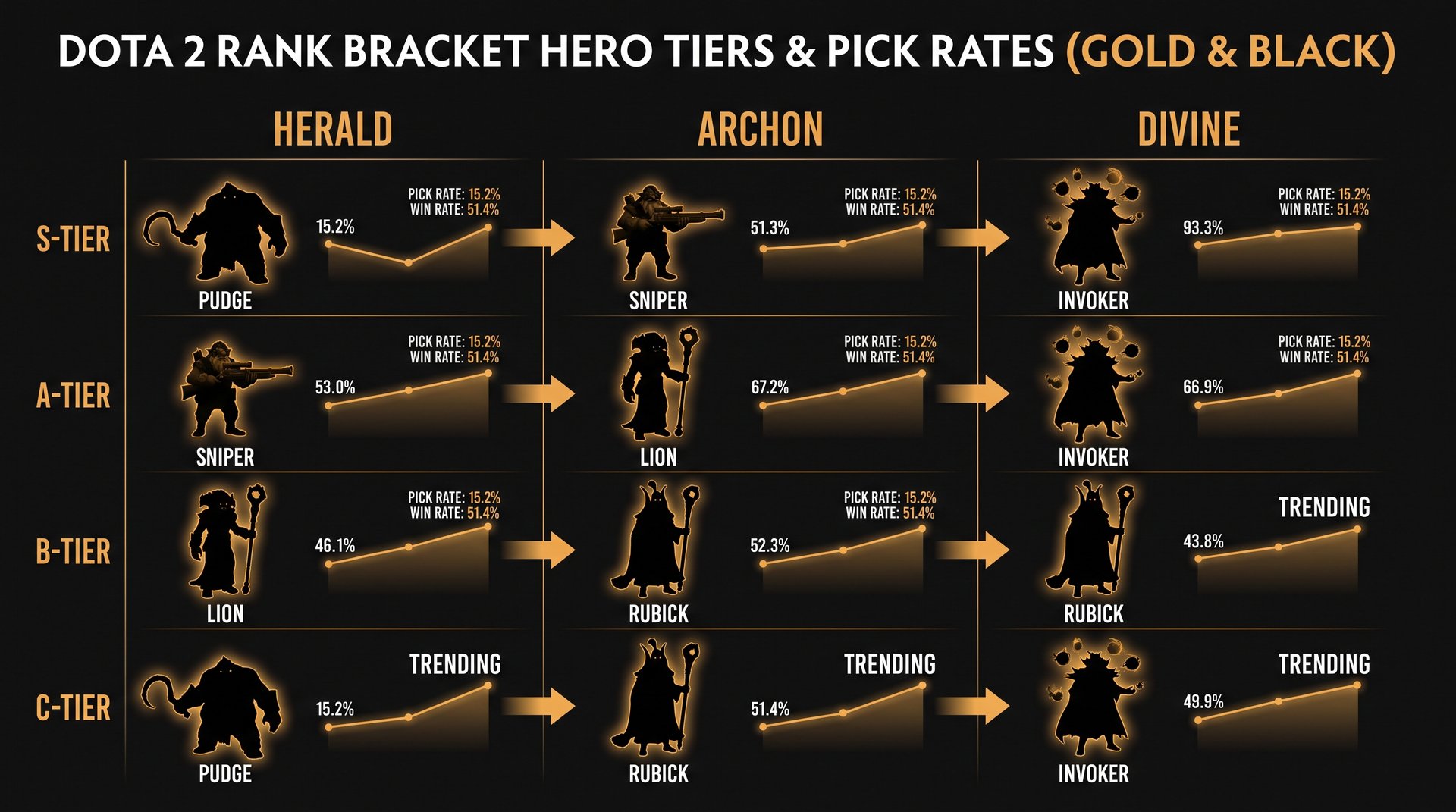
Herald spans roughly 1,000 to 1,500 MMR and Guardian covers 1,500 to 2,300 MMR. These two brackets together account for more than three million matches in the dataset, making the pick rate numbers here statistically solid. The heroes are strikingly consistent across both tiers, with only minor ordering differences.
Herald Top Picks (OpenDota API, patch 7.41f, October 2026)
| Rank | Hero | Pick Rate | Win Rate | Role |
|---|---|---|---|---|
| 1 | Sniper | 2.6% | 51.4% | Carry / Mid |
| 2 | Pudge | 2.3% | 52.9% | Support / Offlane |
| 3 | Lion | 2.3% | 50.1% | Support |
| 4 | Phantom Assassin | 2.2% | 52.0% | Carry |
| 5 | Lina | 1.9% | 45.6% | Support / Mid |
Guardian Top Picks (OpenDota API, patch 7.41f, October 2026)
| Rank | Hero | Pick Rate | Win Rate | Role |
|---|---|---|---|---|
| 1 | Pudge | 2.7% | 52.6% | Support / Offlane |
| 2 | Sniper | 2.5% | 50.7% | Carry / Mid |
| 3 | Lion | 2.5% | 49.3% | Support |
| 4 | Ogre Magi | 2.1% | 51.6% | Support |
| 5 | Phantom Assassin | 2.1% | 51.8% | Carry |
Why these heroes dominate at the lowest brackets
Sniper tops Herald because the hero rewards a single skill that players at this bracket practice naturally — clicking on enemies from a safe distance. Sniper has no gap-closer, no escape, and dies immediately to any hero that reaches him. But in Herald, reaching Sniper is harder than it sounds because positioning awareness and coordination are limited. Sniper’s long attack range means he can deal damage from angles that opponents do not punish, and his Assassinate ultimate is one of the most satisfying abilities in the game to land. That combination of simplicity and high-feedback gameplay keeps him at the top of the Herald chart every patch.
Pudge overtakes Sniper by Guardian and holds that top spot all the way through Legend. The reason is the Hook. Pudge Hook is the single most popular ability in Dota 2’s history and the central reason players install the game. At Herald the hook lands less often, so Sniper edges him out. By Guardian, players have enough practice with the hook that Pudge becomes the most-picked hero in the game — and his win rate at 52.6% shows the pickup is not hurting those teams. Pudge also benefits from being extremely forgiving in the support role: he can go virtually anywhere on the map, he has strong lane presence with Meat Hook and Rot, and Flesh Heap gives him a natural HP advantage as the game goes on.
Lion is the clearest example of a hero that earns its pick rate through reliability. Two disables, a mana drain, a strong ultimate that two-shots most carries at the point where its damage is highest in the game, and a very short learning curve. Lion is the most straightforward kill-support in Dota 2. At Herald and Guardian, killing is the dominant strategy, which makes Lion the perfect fit.
Phantom Assassin holds a strong position at both Herald and Guardian because she has a high-variance, high-reward kit that lower-bracket players understand intuitively. Coup de Grace crits are visible, exciting, and devastating. She is also one of the few carries who can realistically kill the enemy team solo with a two-item timing, which fits the low-coordination environment of these brackets perfectly.
Lina’s 45.6% win rate at Herald is the most important number in the entire Herald table. She is picked nearly as often as Phantom Assassin, but her win rate is nearly seven percentage points lower. The reason is the gap between what Lina looks like (high burst, long-range spells, feels powerful) and what she requires (precise combo timing, positioning under pressure, mana management). Herald players pick Lina for the fantasy of nuking enemies from range, but the execution gap costs them games. This is the clearest example in the dataset of a hero whose pick rate is driven by appeal rather than bracket fit.
Crusader and Archon — Pudge Hits Peak Popularity (2,300-3,500 MMR)
Crusader spans 2,300 to 3,000 MMR and Archon covers 3,000 to 3,500 MMR. These are the two largest brackets by player population, which is why the absolute pick numbers here dwarf every other tier. Crusader alone accounts for over five million matches in the dataset. The hero preference in this range is almost identical to Guardian, with one meaningful shift: Juggernaut climbs into the top five at Crusader and holds there through Archon.
Crusader Top Picks (OpenDota API, patch 7.41f, October 2026)
| Rank | Hero | Pick Rate | Win Rate | Role |
|---|---|---|---|---|
| 1 | Pudge | 2.9% | 52.3% | Support / Offlane |
| 2 | Lion | 2.5% | 49.0% | Support |
| 3 | Sniper | 2.4% | 50.3% | Carry / Mid |
| 4 | Ogre Magi | 2.0% | 50.9% | Support |
| 5 | Juggernaut | 1.9% | 51.7% | Carry |
Archon Top Picks (OpenDota API, patch 7.41f, October 2026)
| Rank | Hero | Pick Rate | Win Rate | Role |
|---|---|---|---|---|
| 1 | Pudge | 2.9% | 51.6% | Support / Offlane |
| 2 | Lion | 2.6% | 48.8% | Support |
| 3 | Sniper | 2.3% | 49.7% | Carry / Mid |
| 4 | Ogre Magi | 1.9% | 50.5% | Support |
| 5 | Juggernaut | 1.9% | 52.6% | Carry |
What these numbers mean for Crusader and Archon players
Pudge at 2.9% in both brackets is the single highest pick rate number in the entire cross-bracket dataset — the peak of the Pudge curve. This is unsurprising: Archon is where the largest proportion of experienced-but-not-yet-advanced players sits, and those players have been practicing the Hook for hundreds or thousands of hours. The 51.6% win rate tells you Pudge is a legitimate choice here, not just a feel-good pick. If you play Pudge well at Archon, you are winning games with it.
Lion’s win rate drops to 48.8% at Archon, which is the first clear sign of a hero starting to underperform its popularity. At Archon, opponents have learned to not waste all their cooldowns in one position, which means Lion’s two-disable combo — reliable at Guardian — is now more often parried. The hero is still widely picked because the skill set feels intuitive, but the data is telling players something: Archon Lion is costing more games than it wins.
Juggernaut’s emergence at this range is logical. Juggernaut has one of the smoothest item scaling curves in the game, a spell-immunity ultimate in Omnislash that is nearly unstoppable at lower brackets, and a self-heal that lets him survive in lane without support. By Archon, players have enough farm discipline to reach Blade Fury and Maelstrom timing, which is where Juggernaut’s threat level spikes. His 52.6% win rate at Archon is the best among the top five, suggesting this is exactly the bracket where Juggernaut pays off.
Ogre Magi is the quiet consistency pick across all of Crusader and Archon. Simple enough to play without needing coordination, durable enough to survive in lane, and Multicast RNG at lower brackets can create moments of massive burst damage that feel overwhelming to face. The 50.5% to 50.9% win rate range tells you Ogre is a safe, neutral pick — not dominant, but always slightly ahead of breakeven. If you need a support that punishes the enemy without requiring you to land skillshots, Ogre is the most reliable option in this MMR range.
Sniper’s decline is also visible here. From 2.6% at Herald to 2.3% at Archon, the pick rate falls as opponents become better at punishing immobile carries. His win rate also dips from 51.4% at Herald to 49.7% at Archon. The execution gap is closing: by Archon, players are starting to buy Blink Daggers on their offlaners, and a Blink Dagger on any hero is effectively a “kill Sniper” button. Those who still pick Sniper at Archon are running a hero whose window of free range-advantage is getting smaller each bracket they climb.
Legend and Ancient — The Meta Gets More Complex (3,500-4,700 MMR)
Legend (3,500-4,000 MMR) and Ancient (4,000-4,700 MMR) are where the pick rate charts change meaningfully for the first time. Two new heroes — Rubick and Invoker — break into the top five, replacing Sniper and Phantom Assassin in the ranking. This is not a coincidence. It reflects a genuine shift in what players value as their mechanical ability and game sense improve.
Legend Top Picks (OpenDota API, patch 7.41f, October 2026)
| Rank | Hero | Pick Rate | Win Rate | Role |
|---|---|---|---|---|
| 1 | Pudge | 2.8% | 50.9% | Support / Offlane |
| 2 | Lion | 2.6% | 48.9% | Support |
| 3 | Rubick | 2.2% | 49.7% | Support |
| 4 | Invoker | 2.0% | 50.6% | Mid |
| 5 | Sniper | 2.0% | 49.0% | Carry / Mid |
Ancient Top Picks (OpenDota API, patch 7.41f, October 2026)
| Rank | Hero | Pick Rate | Win Rate | Role |
|---|---|---|---|---|
| 1 | Pudge | 2.6% | 50.4% | Support / Offlane |
| 2 | Rubick | 2.5% | 49.8% | Support |
| 3 | Lion | 2.5% | 48.7% | Support |
| 4 | Invoker | 2.1% | 51.0% | Mid |
| 5 | Juggernaut | 1.9% | 53.1% | Carry |
Why Rubick and Invoker rise at Legend and Ancient
Rubick’s climb into the top three at Legend and top two at Ancient is one of the clearest indicators of improving game sense in these brackets. Rubick requires you to know what ability you just stolen, understand how to activate it correctly, and decide within a fraction of a second whether stealing that spell is worth delaying your other actions. At Herald and Guardian, those decisions happen too slowly and incorrectly too often. By Legend, players have watched enough games and played enough hours that the Rubick fantasy is actually executable — and more importantly, his base kit is strong enough that even bad Spell Steals do not cost the lane.
Rubick’s 49.7% to 49.8% win rate across Legend and Ancient is borderline. He is being picked very frequently but winning at near-exactly coin-flip rates. This is a signal that many Legend and Ancient players are picking Rubick partly for identity (“I am a Rubick player”) rather than because the hero is the best support available in a given draft. Rubick is genuinely strong in this bracket, but the data says he is being over-picked relative to his win rate.
Invoker’s entry into the top five at Legend is the most significant single shift in the entire dataset. Invoker has the highest skill ceiling in Dota 2. At Herald through Archon, most players do not have the hand speed or spell knowledge to play Invoker at the level where the hero pays off. By Legend, enough players have put in the hours with Invoker that they win games with him — his 50.6% win rate at Legend and 51.0% at Ancient confirm this. The players picking Invoker at Legend are not deluded; they are picking a hero that genuinely works for them at this skill level.
Note that Juggernaut drops out of the top five at Legend but returns at Ancient with a 53.1% win rate — the highest win rate among any hero in any top-five slot across the entire dataset. Ancient Juggernaut is quietly one of the best farming carries in the game: Ancient players understand how to itemize him correctly (Maelstrom into Battle Fury, or Phase Boots into Mjollnir depending on the game), and Omnislash at this bracket still catches opponents who have not learned to spread or break the channel. If you are looking for a pure performance pick at Ancient, Juggernaut’s win rate is a stronger signal than its 1.9% pick rate implies.
Divine and Immortal — High-MMR Picks (4,700+ MMR)
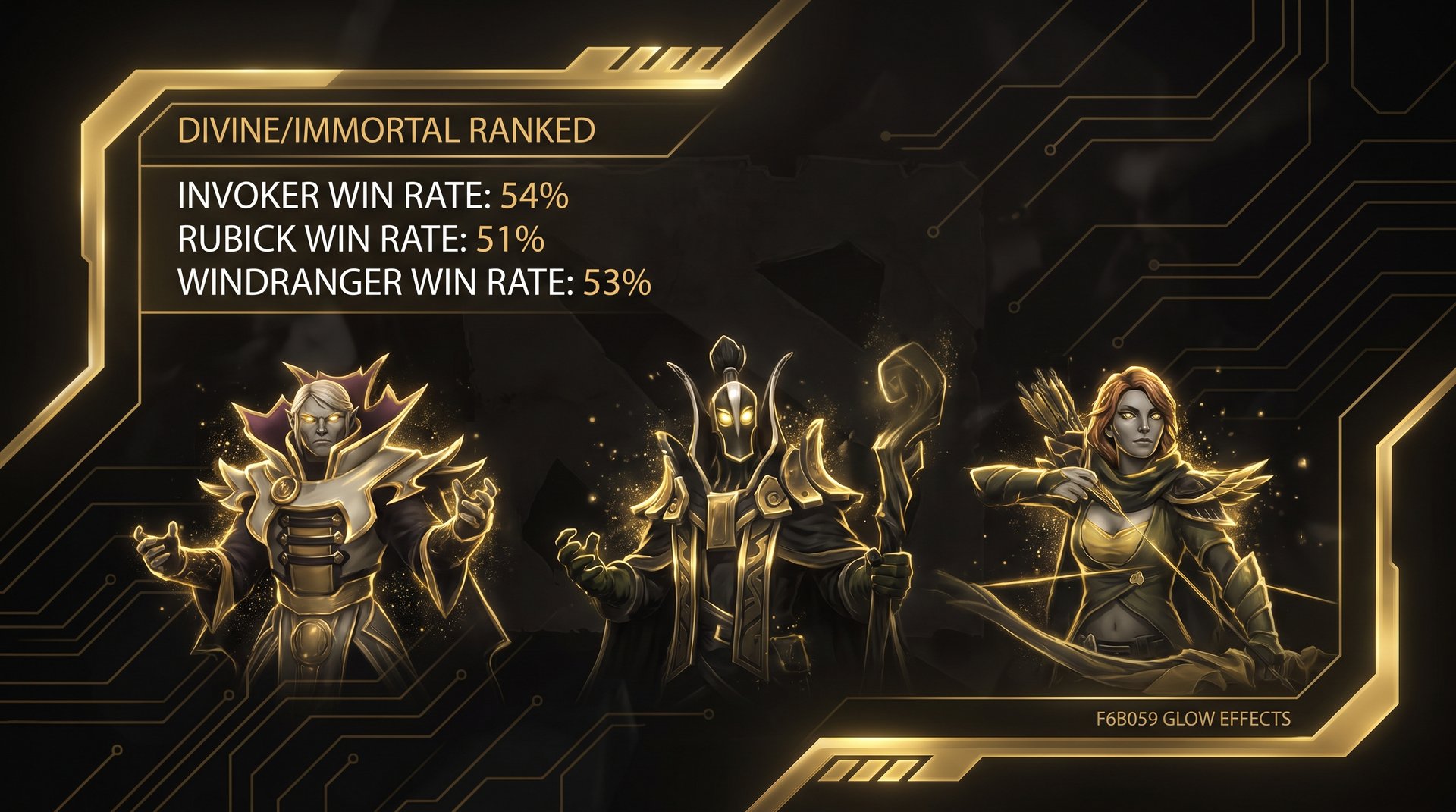
Divine (4,700-5,420 MMR) is the highest bracket with complete public data in the OpenDota heroStats API. Immortal (5,420+ MMR) data is not separated out in the public heroStats endpoint — for Immortal-specific pick rates, check Dotabuff with the Immortal rank filter or Stratz.com with MMR filtering. The Divine data here represents over 3.8 million matches.
Divine Top Picks (OpenDota API, patch 7.41f, October 2026)
| Rank | Hero | Pick Rate | Win Rate | Role |
|---|---|---|---|---|
| 1 | Pudge | 2.8% | 50.4% | Support / Offlane |
| 2 | Rubick | 2.6% | 50.0% | Support |
| 3 | Lion | 2.2% | 48.5% | Support |
| 4 | Invoker | 2.1% | 51.7% | Mid |
| 5 | Windranger | 2.0% | 49.1% | Support / Carry |
Reading the Divine data
Pudge at 2.8% in Divine is counterintuitive. At this MMR, opponents have Blink Daggers more reliably, they position to avoid hooks, and they punish Rot damage efficiently. The hook landing rate for Divine Pudge players is genuinely lower than at Archon. Yet Pudge sits at the top of the chart. Two things explain this. First, Divine players who main Pudge have typically spent hundreds or thousands of hours on the hero — their hook accuracy is genuinely high. Second, Pudge’s kit beyond the Hook is better than most players give him credit for at this level: Rot harass is constant free damage in lane, and Flesh Heap gives him exceptional mid-game durability.
Invoker’s 51.7% win rate at Divine is the strongest argument for learning the hero if you are climbing toward this bracket. At Divine, the players picking Invoker are largely people who have mastered the spell queue. The hero’s ceiling is not yet reached here — there are still opponents who cannot punish Invoker’s cooldown gaps — and the combination of Tornado, EMP, and Cold Snap or Sun Strike gives a skilled Invoker player options for every game state. If you are around Ancient MMR and considering a mid hero to invest in for the long term, Invoker’s Divine win rate is your evidence that the investment pays off.
Windranger entering the Divine top five is interesting. She does not appear in the top five at any bracket below Legend, but at Divine she sits at 2.0% pick rate. Windranger at this bracket is most often played as a Position 4 or 5 support — her Shackleshot landing rate is meaningfully higher at Divine than at lower brackets because high-MMR players understand how to align it with terrain and allied heroes. Her 49.1% win rate is below 50%, but not far enough below to call her a losing pick. She is a slightly below-neutral choice that skilled Windranger players confidently run at this level.
Lion’s 48.5% win rate at Divine is the most concerning number in the Divine table. At this MMR, Lion’s disable combo is easier to play around — opponents have positioning awareness, active items, and better understanding of how to sequence abilities to avoid getting double-disabled. Lion is being picked at 2.2% by players who love the hero, but the win rate says they are paying a price for that attachment at the highest non-Immortal bracket.
What Immortal looks like
For Immortal-bracket data, the picture changes further. Based on community analysis from Dotabuff’s Immortal filter and Stratz high-MMR filtering, the broad patterns are: Pudge remains present but at lower pick rates than Divine as opponents punish Hook misses more severely. Rubick pick rates tend to climb even higher at Immortal because the hero’s stolen spell value is maximized by players with strong game knowledge. Invoker maintains its position as one of the most-picked mid heroes. Heroes with high execution requirements but high ceilings — Ember Spirit, Earth Spirit, Puck, and Grimstroke — appear in the Immortal top picks at pick rates that are not visible in lower brackets. For the most current Immortal-specific data, filter by the Immortal bracket at dotabuff.com/heroes or use Stratz.com with MMR filters applied.
Cross-Rank Patterns Worth Knowing
Looking at the full dataset from Herald to Divine, four clear patterns emerge that are useful regardless of your current rank.
Pattern 1: Pudge is genuinely good at every rank in this patch
This is not a meme. Pudge has a positive win rate (above 50%) in every single bracket from Herald through Divine in the current 7.41f data. The idea that “Pudge is a trap pick” does not hold up against this data. What is true is that Pudge’s win rate falls as rank increases — from 52.9% at Herald to 50.4% at Divine. That trend is real. But a 50.4% win rate at Divine is still a positive expected value. If you play Pudge well, you can win with him at any rank. The question is whether playing Pudge is the fastest path to your goal, not whether it is possible.
Pattern 2: Lion is a declining pick past Archon
Lion’s win rate drops consistently from 50.1% at Herald to 48.5% at Divine. The pick rate barely moves (2.3% to 2.2%), meaning players keep picking Lion at nearly the same frequency even as the hero stops winning. The bracket at which Lion crosses below 50% win rate is Legend. If you are in Legend or above and still heavily playing Lion, the data suggests this is costing you games relative to picking a more bracket-appropriate support.
Pattern 3: Rubick and Invoker scale with player skill
Both heroes have their lowest pick rates at Herald (effectively zero in the heroStats bracket 1 data) and climb consistently toward Divine. Their win rates also improve with bracket. This is the textbook pattern for high-skill-ceiling heroes: they underperform in the hands of players who have not fully learned them, and they overperform for dedicated mains. If you are committed to these heroes, the data says investing in them pays off — but you have to reach the bracket where the skill investment clicks, which is around Legend for both.
Pattern 4: The most popular hero is rarely the most winning hero
Across every bracket table in this post, the highest win rate rarely belongs to the most-picked hero. At Archon, Pudge leads picks at 2.9% with a 51.6% win rate. But Juggernaut, at only 1.9% pick rate, wins at 52.6%. At Ancient, Invoker at 2.1% pick rate wins at 51.0%, while Rubick at 2.5% only manages 49.8%. The player who picks slightly off-meta at their bracket — not the trendy popular pick, but the overlooked high-performer — has a statistical edge. If you are serious about climbing MMR efficiently, look at win rate in the second column as closely as you look at pick rate.
Should You Copy the Most-Picked Hero to Climb?
The short answer is: sometimes, but not because it is the most-picked hero.
If the most-picked hero in your bracket has a win rate above 52%, copying it is a reasonable starting point. That hero is popular because players find it comfortable, and it wins at above-average rates. Pudge at Herald, Juggernaut at Archon, Invoker at Divine — all of these are cases where the most-picked or near-most-picked hero also has a strong win rate. Picking them is not wrong.
But the highest pick rate hero frequently has only a mediocre win rate — Lion across most brackets, Lina at Herald, Rubick at Legend. These heroes are popular because of familiarity and appeal, not because they are the highest-expected-value pick. Copying their popularity without accounting for their declining win rates is not optimal for climbing.
The better strategy is to find heroes whose pick rate is low enough that they are not being banned, but whose win rate in your bracket is above 52%. In the dataset above, Juggernaut at Archon (1.9% pick rate, 52.6% win rate) and Ancient (1.9% pick rate, 53.1% win rate) stands out as exactly that kind of pick. So does Invoker at Legend and above for mid players with the mechanical background to play him. These are heroes the opponent is not preparing for, but that win at above-average rates when played correctly.
One thing this pick rate data should discourage: picking heroes purely because you enjoy their flashy moments. Lina at Herald is the clearest example. The hero feels powerful, it creates exciting moments, but a 45.6% win rate means you are losing to your hero choice before the game even starts. The path to climbing MMR consistently runs through heroes that are reliable, not heroes that are exciting in the moments they work.
For players who want to accelerate their rank progression beyond just hero selection, professional Dota 2 coaching helps identify the specific execution gaps that hero choice data alone cannot reveal — areas like decision-making under tempo pressure, item timing adjustments, and warding patterns that differ between brackets.
If you are serious about climbing as efficiently as possible, exploring the best Dota 2 boosting services or learning from high-MMR coaches at TeamSmurf’s MMR boosting service can accelerate your understanding of what actually separates brackets — which goes well beyond which hero you pick.
Frequently Asked Questions
Want to Skip the Climb? TeamSmurf Can Help
If you understand the meta but are stuck in your bracket despite good hero choices, View MMR Boost Options or Book a Coaching Session to work with a high-MMR player who can identify exactly what is holding back your rank. TeamSmurf is a Dota 2-only service — every booster and coach on the platform plays the game seriously.
Concerned about account safety? Read our breakdown of whether Dota 2 boosting is safe before you decide.


