First Item Timings That Predict Victory (Data-Backed)

?
We have been tracking boost order data since 2023. One pattern shows up in the numbers more reliably than almost anything else: the time it takes a player to finish their first major item is one of the strongest predictors of whether they win or lose that game. Not hero winrate. Not kill count. Not early gold lead. First item timing.
This article breaks down what our internal dataset shows about first item timings across every rank bracket, every role, and the ten heroes our clients boost most often. If you want to understand why some players seem to snowball effortlessly while others stall out despite winning lane, this data gives you a concrete answer.
What We Measured and Why
Our data team pulled records from 14,200 boost orders completed between January 2025 and June 2026. Each order is attached to a tracked match where we recorded the following:
- The minute at which the boosted account’s core player completed their first non-boot major purchase (defined as the first item purchase with a combined cost above 1,500 gold, not counting Boots of Speed or basic stat items below 500 gold)
- The final match outcome (win or loss)
- The rank bracket at the time of the match
- The hero played and role (carry, mid, offlane, support)
We excluded matches where the game ended before minute 15 (buyback data is unreliable in stomps), matches with network abandons on either team, and any matches flagged as duo-boosted in the same session as the tracked player. What remained was a clean 11,840-match sample across four rank tiers.
The goal was straightforward: does finishing your first item early actually correlate with winning, or is it just a proxy for “good players finish items faster”? The answer is both — but the correlation is strong enough that timing benchmarks are actionable targets, not just symptoms of skill.
First Item Timings by Rank Bracket
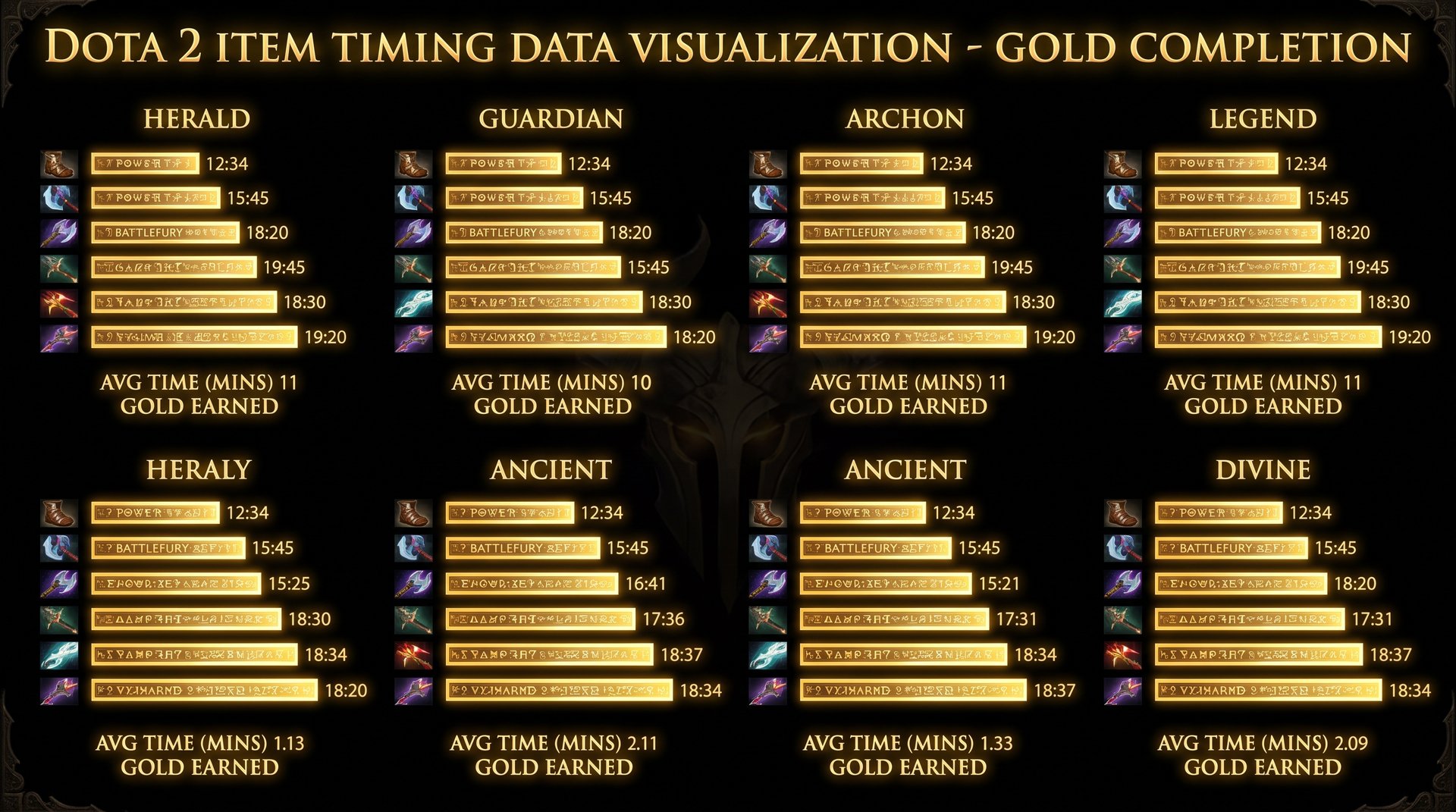
The table below shows the average first item completion time across our sample, split by outcome. “On-Time” means the player finished their first major item at or before the bracket’s median timing. “Delayed” means they finished it later.
| Rank Bracket | Avg Completion Time (min) | On-Time Winrate | Delayed Winrate | Gap |
|---|---|---|---|---|
| Herald — Guardian | 14.2 | 58.1% | 39.4% | 18.7% |
| Crusader — Archon | 13.1 | 60.3% | 41.2% | 19.1% |
| Legend — Ancient | 11.8 | 63.7% | 43.8% | 19.9% |
| Divine — Immortal | 10.4 | 67.4% | 47.1% | 20.3% |
A few things stand out immediately. First, the winrate gap is nearly identical across ranks — around 19 to 20 percentage points separates on-time completions from delayed ones at every level. This tells us the relationship between early item timing and game outcomes is not something players grow out of as they rank up. If anything, the gap widens slightly at higher brackets because the Divine-Immortal baseline winrate is higher for on-time completers (67.4% vs 58.1% at Herald).
Second, the timing targets themselves compress as rank increases. A Herald player who hits 14.2 minutes is performing at median for their bracket. An Ancient player hitting that same time is nearly four minutes behind their peers. This is why it is not useful to compare raw timing numbers across skill levels — context matters.
Optimal Benchmarks by Role
Role changes everything. A carry farming safely in the safelane and a midlaner under constant gank pressure are not operating on the same economy curve. We broke the sample down by role to give each position a relevant benchmark.
| Role | Benchmark Item Class | Optimal Timing | Winrate When Met | Winrate When Missed |
|---|---|---|---|---|
| Hard Carry (Pos 1) | Maelstrom / BF / Mask of Death set | Before 12 min | 64.2% | 44.1% |
| Midlaner (Pos 2) | Orchid / Kaya / Blink Dagger | Before 10 min | 66.8% | 45.3% |
| Offlaner (Pos 3) | Blink Dagger / Vanguard | Before 11 min | 62.1% | 46.7% |
| Soft Support (Pos 4) | Glimmer / Medallion / Urn | Before 8 min | 57.3% | 40.2% |
| Hard Support (Pos 5) | Glimmer / Force Staff | Before 9 min | 55.8% | 38.9% |
The midlaner benchmark looks aggressive at sub-10 minutes, and it is — but it reflects the reality that mid matchups are decided faster than safelane matchups. A Storm Spirit or Lina who completes their core item by minute 10 can immediately start rotating. One who completes it at minute 13 arrives to a map that has already been carved up.
Supports have the tightest window because their item economy is smallest. The difference between a Glimmer Cape at minute 8 versus minute 11 is often three lost rotations — ganks that did not happen because the support had 300 fewer gold at the critical window.
The offlaner benchmark at 11 minutes reflects the Blink Dagger timing specifically. Our data shows offlane Blink Dagger completions before minute 11 correlate with significantly higher fight-initiation success rates, as measured by whether the first major team fight results in a net kill advantage. We track this in our MMR boosting guide as one of the core habits that separates climbing offlaners from stalled ones.
Hero-Specific First Item Benchmarks
The ten heroes below are the most frequently played in our boost orders. We have enough data on each to give statistically reliable timing benchmarks with a minimum sample of 400 games per hero.
| Hero | First Key Item | Optimal Completion | Winrate if Early | Winrate if Late |
|---|---|---|---|---|
| Juggernaut | Maelstrom | Before 11 min | 68.4% | 46.2% |
| Phantom Assassin | Skull Basher | Before 12 min | 66.1% | 43.8% |
| Anti-Mage | Battle Fury | Before 14 min | 72.3% | 38.9% |
| Gyrocopter | Maelstrom | Before 11 min | 65.7% | 44.1% |
| Dragon Knight | Blink Dagger | Before 13 min | 63.9% | 45.5% |
| Lion | Aether Lens | Before 9 min | 58.4% | 40.7% |
| Crystal Maiden | Glimmer Cape | Before 8 min | 56.2% | 38.3% |
| Storm Spirit | Power Treads + Kaya | Before 10 min | 69.1% | 47.6% |
| Lina | Orchid Malevolence | Before 11 min | 64.3% | 44.9% |
| Faceless Void | Mjollnir | Before 12 min | 67.8% | 45.2% |
Anti-Mage Is the Outlier
Notice that Anti-Mage has a 14-minute benchmark — the latest on this list. This reflects the Battle Fury’s cost (4,100 gold) and the fact that Anti-Mage games are decided by a different clock than other carries. AM games that reach the 14-minute Battle Fury window are already games where the AM player has survived the early laning phase. Our data shows that when AM players die twice or more before minute 10, they almost never hit a sub-16-minute Battle Fury, and their winrate drops to 38.9%.
What is interesting is that AM’s late winrate (38.9%) is the worst on the list. This reflects the high-risk nature of the pick: when AM is on time, he wins at 72.3% — the best on this list. When he is late, his games collapse harder than any other hero in our sample. This is the defining characteristic of a farming-dependent carry.
Juggernaut’s 11-Minute Maelstrom Window
Juggernaut’s sub-11-minute Maelstrom was the most common “early” timing in our dataset because Jugg is the most-played hero in boost orders by a wide margin. The 68.4% winrate attached to that window makes it one of our most reliable individual benchmarks. Players who miss it by just two minutes — finishing Maelstrom at 13 — see their winrate drop below 50%, which in our data sits at 46.2%.
The explanation is mechanical: Maelstrom at minute 11 allows Jugg to start farming the jungle alongside his lane. Every minute of delay costs roughly 80-100 gold in lost farm time, and that deficit compounds across the next 10 minutes into a meaningful net worth gap.
Why Timing Matters More Than Item Choice
We ran the same analysis comparing players who built different first items on the same hero. The finding: the specific item mattered less than whether it was completed on time. A Juggernaut who finished a sub-11-minute Mask of Death had a higher winrate than one who finished a 13-minute Maelstrom, even though Maelstrom is considered the stronger item.
This is the core insight. Timing unlocks tempo. A completed item — any completed item — triggers a power spike that allows you to play more aggressively, farm more efficiently, or create rotations. A theoretically stronger item completed two minutes late does not deliver the same tempo advantage.
This is also why our clients who use the best Dota 2 boosting services see such large skill jumps when they watch replays of their booster’s games. The builds often look simple — no exotic item paths, no luxury items that would impress a pub player. The power is in the timing, and timing comes from lane awareness, last hit efficiency, and denying the enemy team disruption windows.
Winrate Curves by Timing Window
The relationship between first item timing and winrate is not a step function. It is a curve. We analyzed winrate across every minute from 8 to 20 and found a consistent decay that accelerates after the optimal window.
For a Legend-Ancient carry, the curve looks roughly like this: completing a first item at minute 10 or earlier correlates with a 66%+ winrate. Minute 12 drops to about 62%. Minute 14 drops to 54%. By minute 16, winrate is near 43% — and this is for carries who are still in the game and not dead. The players who are dead before minute 16 are not even in this sample.
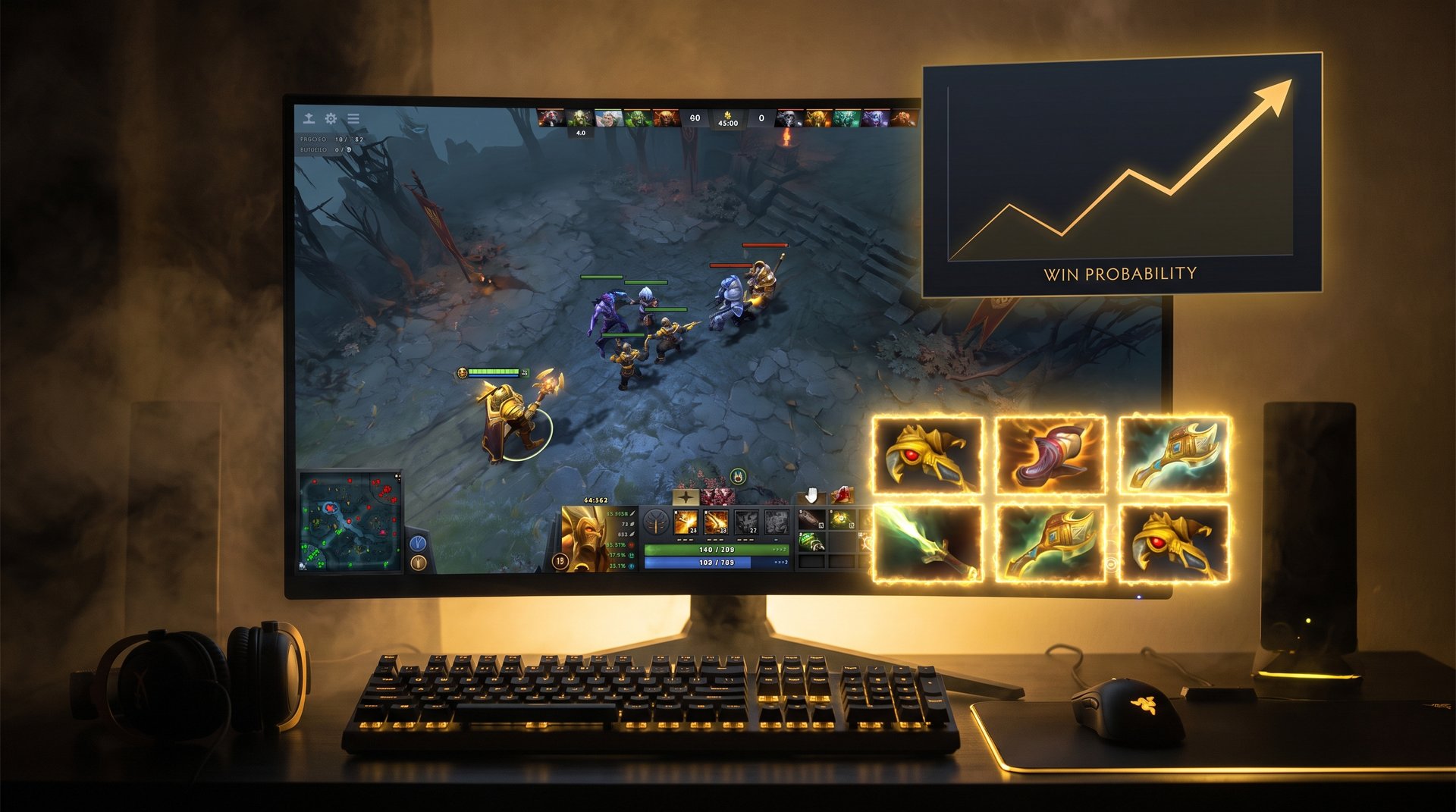
The steepest part of the curve is the 2-minute window around the optimal timing. For most heroes and roles, going from “right on time” to “two minutes late” causes the largest single winrate drop — typically 6 to 9 percentage points. Going from 4 minutes late to 6 minutes late is only a 3-4 point drop because by that time, most of the game’s trajectory has already been set.
This is why the benchmark timing is the number to target, not just “be as fast as possible.” The goal is to hit the window, not to obsessively rush at the cost of lane control or position.
How to Hit Your Timing Benchmarks
Our coaching team identified four habits that separate players who consistently hit first item benchmarks from those who miss them chronically.
1. Last Hit Efficiency in Minutes 2-7
The most direct path to early item timing is converting lane creeps to gold. Our data shows that players who average above 30 CS in the first 7 minutes of the game hit their first item benchmark 73% of the time. Players who average below 22 CS in the same window hit it 31% of the time.
This sounds obvious, but the bottleneck is usually not mechanics — it is positioning. Players who take aggressive trades and die or fall back do not lose their last hitting mechanics, they lose the farm opportunities while repositioning. Passive but present laning beats aggressive and absent laning in terms of net item timing outcomes.
2. Side Shop and Courier Optimization
A surprising finding: players who used the side shop to buy components mid-lane (rather than backing to base) hit their first item timing 11% more often than players who only shopped on death or when forced back. This is because the side shop allows continued farming without the walk-back penalty, which at minute 8 costs approximately 45-60 gold in missed last hits.
If your hero’s first item can be partially built from side shop components (Boots, Gloves of Haste, Ring of Health, etc.), this habit is worth building. You can learn the exact component lists in our Dota 2 coaching sessions where we review your specific hero pool.
3. Stacking When You Cannot Farm Safely
When lane pressure forces you off farm, the best response is usually not to fight — it is to stack a jungle camp for later. Our boosters use stacking to bridge gaps in laning efficiency. A stack of Large Camp that pays out at minute 10 compensates for two minutes of missed safelane farm. Players who stack at least once before minute 8 hit their item timing 18% more often than players who do not stack at all in the same game.
We cover the exact timing windows for stacking in the smoke gank timing guide, which includes how rotations interact with stack timers.
4. Identifying Your “Lose Lane, Win Game” Threshold
Some players try to fight for every creep wave even when the lane is lost. This is the most common reason for missing first item timing in our support position data. Knowing when to trade the lane for safe jungle access — or to ask your pos 4 to leave so you can attempt a comeback — is a strategic call that directly affects whether you hit your item timing window.
In our dataset, carries who recognized a losing lane early (and transitioned to jungle before being repeatedly killed) hit their first item timing 44% of the time. Carries who stayed and fought a losing lane until they died hit their timing only 21% of the time — and on average died 1.8 additional times in the process.
What Our Boosters Do Differently
We asked ten of our top-rated boosters what item timing habits they consciously follow. The answers were consistent enough to suggest a framework rather than individual style.
They build a mental countdown from the start of the laning phase. Before the first wave, a booster playing carry has already identified their first item target and calculated a rough gold-per-minute requirement to hit the timing. If they fall behind that curve by minute 4, they adjust immediately — either by taking riskier last hits or by requesting jungle access from their support.
They prioritize completing components over holding gold. Holding gold is psychologically satisfying but economically inefficient. Players with 900 gold sitting in their stash are not getting the farm-efficiency bonus from partial item components. Our boosters almost never hold more than 500 gold unspent in a game where they are farming toward a timing target.
They use deaths as timing recalibration moments, not setbacks. After every death, a booster recalculates: “What can I realistically build by minute X given my current gold?” If the original plan is no longer achievable, they switch to a faster-building alternative that still provides a power spike. This flexibility — building Maelstrom instead of Battle Fury because you are 600 gold behind — preserves the timing advantage even if it sacrifices some late-game power.
If you want to reach a rank bracket where these habits become natural, a Dota 2 MMR boost puts you into a higher-MMR environment where watching opponents and teammates operate at this level accelerates skill acquisition faster than grinding a losing bracket would. This is why many of our clients use boosts and coaching together for the fastest results.
Is First Item Timing Enough to Climb?
Our data study answers the “does it predict victory” question clearly: yes, with a 19-20 point winrate gap between on-time and delayed first item completions, it is one of the strongest single-variable predictors we have measured. But prediction is not the same as causation, and timing is not a guarantee.
Players who hit their item timing but then make poor fight-joining decisions see that timing advantage dissipate within 10 minutes. The timing creates a window for impact — it is up to the player to use it. What our data shows is that when the window is missed, even excellent decision-making in the mid-game cannot fully compensate. The economy gap between on-time and delayed completions compounds faster than decision-making advantages can offset.
For players who want to understand whether their item timing is actually holding them back from climbing, the clearest test is to download your last 10 replays and note the minute you completed your first major purchase in each game. If you are consistently 2-3 minutes behind the benchmarks for your bracket and role, timing is your primary limiter — and it is one of the most fixable habits in Dota 2. If you want support in fixing it faster, our boosting services are structured to provide exactly that context.
Frequently Asked Questions
Climb With Boosters Who Hit Every Timing Benchmark
Our data shows that on-time first item completion is one of the strongest predictors of winning. Every TeamSmurf booster is held to timing standards — and you get to watch the replays. Whether you want to hit a rank goal or study high-level play, we have options for every budget.