Buyback Math: When 2,500 Gold Saves the Game

You are 42 minutes into a close game. Your carry just died near Roshan. The enemy team has the Aegis, they are moving toward your high ground, and you are staring at a buyback option that costs 2,500 gold. Your team is screaming in the chat. You have 3.1 seconds to decide.
This is where Dota 2 is won and lost. Not in the laning phase, not in the teamfight, but in that single question: is 2,500 gold worth pressing right now?
The answer depends on math you should already know going into that moment. This guide breaks down the full buyback formula, every penalty attached to it, the exact thresholds where buyback costs spike, and the decision framework that separates Immortal players from the rest. We also cover what changed — and what did not change — in patches leading into 7.41.
Contents
- What Buyback Actually Does
- The Cost Formula Explained
- Buyback Cost by Net Worth
- The Gold Income Penalty
- Death-on-Cooldown: The +25 Second Rule
- Reliable Gold and Buyback Savings
- When to Press the Button
- When to Hold Buyback
- Role-by-Role Buyback Priorities
- Buyback Math Around Roshan
- The Most Expensive Buyback Mistakes
- Patch History: What Has Changed
- FAQ
What Buyback Actually Does
Buyback lets a dead hero skip their remaining respawn timer by paying a gold cost. The hero respawns at their team’s fountain immediately, ready to teleport back into the fight or walk toward a threatened objective.
The key word is “immediately.” In a game where a 45-minute respawn timer can be 90 seconds or longer, that instant resurrection is worth an enormous amount — but only if three conditions are true:
- You can reach the relevant fight or objective in time after respawning
- Your hero’s presence will change the outcome
- You can afford the gold cost without crippling your item progression
If any of those three are false, buyback is not saving the game. It is throwing 2,500 gold — or more — into a fight you cannot influence.
Buyback also comes with two significant penalties beyond the gold cost, which we will cover in detail below. Understanding those penalties is just as important as understanding when to pull the trigger.
The Cost Formula Explained
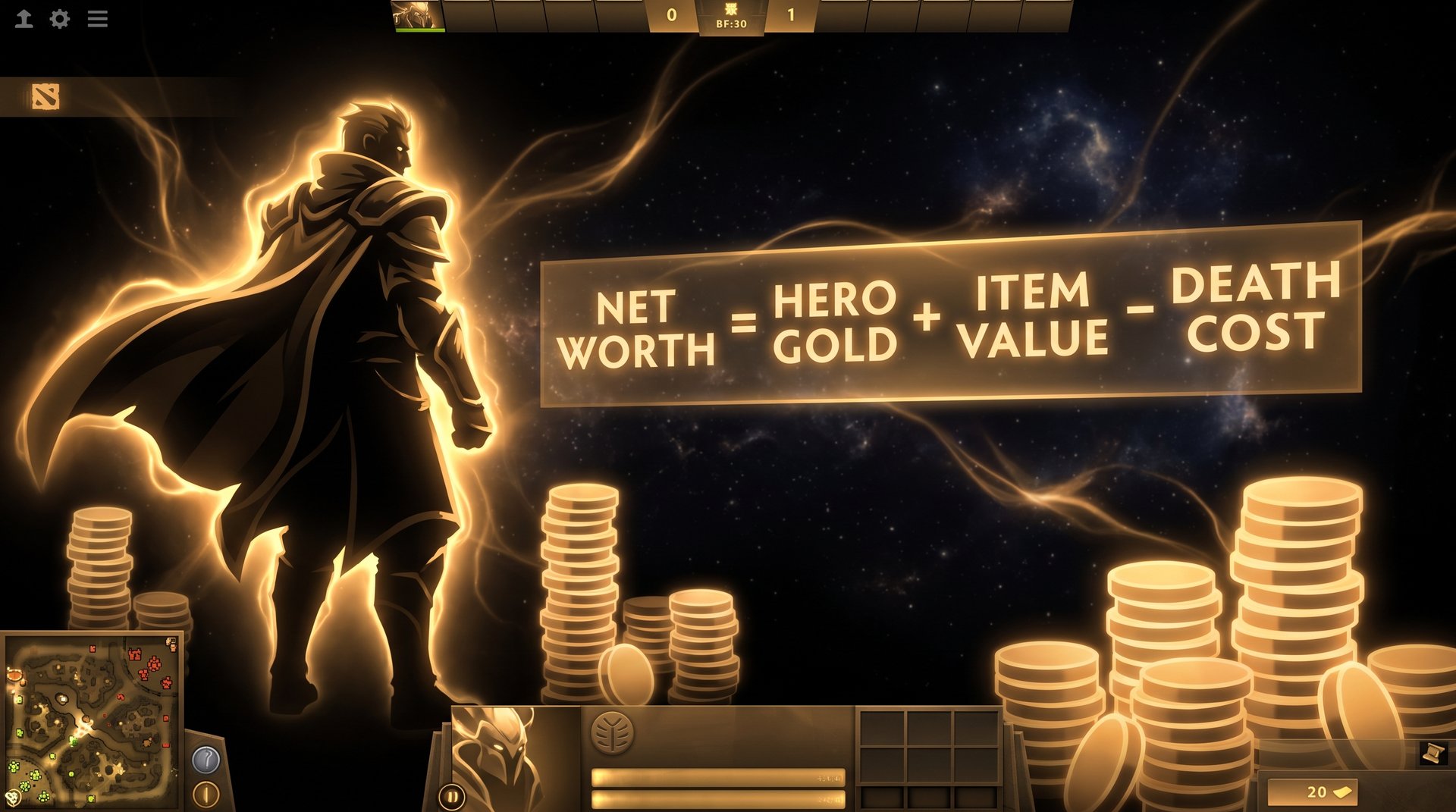
The current buyback cost formula in Dota 2 is:
Net worth equals the sum of your current gold on hand plus the total purchase price of all items you are carrying, including those in your stash, backpack, and courier.
The formula has gone through several iterations over Dota 2’s history. In earlier patches the divisor was 12, which made buyback significantly more expensive at high net worths. The shift to 13 in a later patch made it slightly more accessible for cores in the 25,000 to 40,000 net worth range — but the overall scaling curve still punishes rich heroes hard.
Patch 7.41 did not modify the buyback formula directly. The base cost of 200 gold and the net worth divisor of 13 remain unchanged as of the current patch. If you see other guides quoting different numbers, verify against the official Dota 2 patch notes before trusting them.
The practical consequence of this formula is that the more successful you are, the more expensive dying becomes. A carry sitting on 30,000 net worth pays roughly 2,500 gold to come back. A support with 8,000 net worth pays around 815 gold. The formula is deliberately designed to hurt cores more than supports, which creates an interesting asymmetry in late-game decision making.
Buyback Cost by Net Worth
The table below shows approximate buyback costs at common net worth milestones. These are based on the current formula (200 + NW / 13) rounded down to the nearest gold.
| Net Worth (Gold) | Buyback Cost | Typical Game Time | Common Role |
|---|---|---|---|
| 5,000 | ~585 gold | ~10 min | Support / early core |
| 8,000 | ~815 gold | ~14 min | Support mid-game |
| 12,000 | ~1,123 gold | ~18 min | Core mid-game |
| 16,000 | ~1,430 gold | ~22 min | Core timing spike |
| 20,000 | ~1,738 gold | ~28 min | Core with 2+ items |
| 24,000 | ~2,046 gold | ~33 min | Core post-core items |
| 29,900 | ~2,500 gold | ~40 min | Late-game carry |
| 36,000 | ~2,969 gold | ~45 min | Fully itemized carry |
| 45,000 | ~3,661 gold | ~55+ min | Ultra-late carry |
| 52,000 | ~4,200 gold | Very late | Fountain carry scenario |
The 2,500 gold threshold in our title corresponds to a net worth of exactly 29,900 gold — the point at which buyback costs 200 + floor(29,900 / 13) = 200 + 2,300 = 2,500 gold. For most carries, that net worth is reachable somewhere between minutes 38 and 45 depending on farm efficiency and kill gold.
This is why the late game creates so much buyback pressure. At minute 20, your carry might be buying back for 1,700 gold. At minute 40, the same hero is paying 2,500 or more. Meanwhile, the objectives that buyback is protecting — barracks, Ancient — are also at their highest value. The math tightens from both sides simultaneously.
The Gold Income Penalty After Buying Back
Pressing the buyback button does not just cost you the upfront gold. It also triggers an income penalty that lasts until the moment your natural respawn timer would have expired.
Specifically: after buying back, you cannot earn unreliable gold until your normal respawn timer runs out. Unreliable gold includes all income from last-hitting lane creeps, killing jungle neutrals, and earning bounty from hero kills. Reliable gold — which comes from passive income and some ability interactions — is unaffected.
Here is the practical math. Say you are a carry who dies at the 40-minute mark with a 70-second respawn timer. You buyback immediately. For the next 70 seconds after respawning, every creep you last-hit and every camp you clear gives you zero unreliable gold. The passive fountain gold trickles in, but the bulk of your income is frozen.
At 500+ GPM farm rates, that 70 seconds of frozen income represents roughly 580 gold of lost farm on top of the 2,500 you already paid. The real economic cost of that buyback is closer to 3,000 gold — and that is before accounting for the items you did not buy with the money spent.
The takeaway is not to avoid buyback. The takeaway is to account for the full cost, not just the number shown in the UI.
If your respawn timer is short (under 20 seconds), the income penalty is nearly irrelevant. If your timer is long (60 seconds or more), factor the lost farm into your buyback decision — especially if buying back just to “be present” rather than to defend a specific objective.
Death-on-Cooldown: The +25 Second Rule
Buyback has an 8-minute cooldown (480 seconds). If you die again before that cooldown expires, you trigger what experienced players call the death-on-cooldown penalty: your next respawn timer gets an additional flat 25 seconds added to it.
This is critical. Before patch 7.11, the penalty was calculated as a percentage of the remaining respawn time — which could be devastating in very late games. The current system uses a flat 25 seconds regardless of game time, which is more predictable and slightly more forgiving for very late-game diebacks.
But 25 seconds is still enormous. At minute 45, a carry hero’s base respawn time might already be 70-80 seconds. Add the +25 second cooldown penalty and they are sitting out for 95-105 seconds — nearly the same as a Reaper’s Scythe. That is long enough for the enemy team to take two or three objectives with no resistance.
The death-on-cooldown scenario is the most common buyback mistake at lower MMR brackets. A player buys back to defend a barracks, gets caught in a bad position 3 minutes later, and then dies again with buyback still on cooldown. The resulting 90+ second respawn gives the enemy team a completely free run at the Ancient.
If you buy back, your positioning priority immediately shifts to survival first, impact second. The value of your presence after a buyback is significant — but only if you survive long enough for your buyback cooldown to reset.
Reliable Gold and the Buyback Savings Strategy
Here is where the strategic depth of buyback really opens up. Reliable gold cannot be lost on death. Unreliable gold can be. When you die, the game deducts gold from your unreliable pool first — and if that runs out, it takes the remainder from reliable gold.
This means that a player who consciously saves 2,500 reliable gold maintains guaranteed buyback availability regardless of how they die, where they die, or what bounty the enemy collects. Professional players and high-MMR cores manage their reliable gold balance as carefully as their item build.
The two primary sources of reliable gold are:
- Passive gold income (the base rate that all heroes earn over time)
- Certain ability-based gold interactions (varies by hero)
The practical strategy for most cores is to build toward major items in stages, keeping enough reliable gold in reserve to cover buyback at any moment. This is why you will see Immortal players intentionally delay completing a small component item — not because they do not have the gold, but because completing it would drop their reliable gold below the buyback threshold.
At TeamSmurf, the coaches we work with call this “buyback discipline” — the habit of always knowing your exact buyback cost and your exact reliable gold balance before committing to any objective. Players who have read our MMR boosting guide know that macro discipline like this is what separates Divine players from Immortal, not mechanics alone.
When to Press the Button
Buyback is correct when all of the following are true simultaneously:
- An objective is being threatened right now — barracks, Ancient, or Roshan. If the enemy team is just farming after killing you, there is no immediate objective to defend.
- Your presence changes the outcome — if the fight is 4v4 and your team needs a fifth hero, you matter. If it is 4v3 and your team is winning, you may not change anything by joining.
- You can reach the fight in time — buying back at the fountain with no TP scroll and the enemy already inside your base is almost never correct. You will arrive to find an already-dead Ancient.
- The game is still winnable — if your team is down three sets of barracks and the enemy has Mega creeps, buyback will not reverse the trajectory. Spending 2,500 gold to die again in 20 seconds is not a strategy.
- You can afford it without destroying your next item timing — this is contextual. If you are 800 gold away from a Monkey King Bar and your carry needs it to counter the enemy Phantom Assassin, the timing matters. Sometimes the right play is to let the objective go, finish the item, and contest the next one.
The classic valid buyback scenario is the defensive base defense: your team is 4v5 or 4v4 at your high ground, the enemy is pushing barracks, and you have a TP scroll. You die initiating, you have 2,500 gold reliable, and your carry buying back is enough to hold the fight. Press it.
The classic invalid buyback scenario is the “I was just doing Roshan” death: you get caught out in the Roshan pit at minute 38, your team wins the team fight anyway, your death timer is 55 seconds, and you buyback just because you “feel” like you should be there. You spend 2,400 gold, miss 40 seconds of income penalty, and arrive to a won fight where your gold was the only thing that mattered.
When to Hold Buyback
Experienced carries and midlaners hold buyback as a deterrent, not just as a tool. When the enemy team knows your core has buyback available, they cannot simply kill you and push. They need to also track your buyback cooldown, track your team’s defenses, and calculate whether the push attempt succeeds even with you buying back.
This changes how objective fights are structured at the highest level. Teams with buyback available on their carry can take more aggressive fights near high ground, knowing that even if the core dies initiating, they can buy back and join the defense. Teams without buyback available play much more cautiously.
Specific situations where holding buyback is correct:
- You just died to a no-consequence kill — killed in your jungle with no objectives threatened, normal respawn timer is short. Buying back nets you 40 seconds of farm at the cost of 2,500 gold and 8 minutes of buyback availability.
- An Aegis is involved — if your carry has an Aegis and the fight is near objectives, the Aegis provides one free death. Use it first. Buying back while you still have an Aegis available is usually throwing gold.
- The fight is already won — if your team is comfortably ahead 4v4 and winning, your buyback is a safety net, not a decision you need to make. Stay dead and save the gold.
- Necrophos has Aghanim’s Scepter — if the enemy has Nec with Aghs, the Reaper’s Scythe disables buyback on the killed target. A coordinated enemy will always target your carry with this. Playing around this ability means making their Aghs completely wasted is one of the best strategic investments you can make. Use the correct Dota 2 macro strategies to identify Aghs Necrophos situations earlier.
Role-by-Role Buyback Priorities
Position 1 (Carry)
The carry should almost always have buyback available from the 35-minute mark onward. Their presence in base defense fights is worth more than any item they could buy with the equivalent gold. The carry’s buyback is also the most expensive on the team, so they need to plan for it proactively — keeping reliable gold reserves and making item purchases around the buyback cost, not despite it.
Position 2 (Midlaner)
The midlaner’s buyback value depends heavily on their hero and the game state. A magic-damage mid on full mana after a buyback is a complete reset. A physical mid with no mana items buying back into a 40-minute fight may contribute less. Midlaners need to self-assess honestly: “will my specific hero change this fight if I buy back right now?”
Position 3 (Offlaner)
Offlaners with initiation ability — Black Hole, Echo Slam, Meat Hook, Ravage — often have game-winning buybacks available even at lower net worths. The cost is manageable and the teamfight impact of landing a big ultimate on buyback can swing a fight entirely. Offlaners should buy back when their ultimate is ready and the fight is still live.
Position 4 (Soft Support)
Position 4 supports rarely have enough net worth to justify buybacks in the late game — the cost relative to their impact is too high. However, there are exceptions: Lion with Aghanim’s Scepter, Witch Doctor with Death Ward, Earthshaker with buyback into a 5-man Fissure. If the support’s ultimate is available and decisive, the lower cost (relative to the carry) makes it more efficient.
Position 5 (Hard Support)
Hard supports almost never buy back. Their net worth is low, so the cost is manageable, but their impact in late-game fights is usually limited compared to cores. The exception is a support with a game-winning save ability (Shallow Grave, Lotus Orb, Force Staff) when the enemy is targeting a key ally. In those cases, the support buying back to save the carry from a second death can be worth more than the carry buying back directly.
Buyback is efficient when…
- You are the carry or mid with a decisive ultimate ready
- A barracks or the Ancient is being attacked now
- You have a TP scroll or are close to the objective
- Your team is in a fight, not already dead or routed
- Reliable gold covers the cost without touching item builds
Buyback wastes gold when…
- No objective is being threatened this instant
- You arrive too late to change the outcome
- The enemy will kill you again before your cooldown resets
- You are under a Reaper’s Scythe death (buyback disabled)
- Your team was already going to win without you
Buyback Math Around Roshan
Roshan fights are the clearest example of where buyback math gets concrete. Consider the late-game scenario:
- Minute 43. Roshan is up. Your team starts the fight at the Rosh pit entrance.
- Your carry has 32,000 net worth — buyback costs about 2,661 gold.
- The enemy team forces a fight outside the pit. Your carry dies first.
- Your team wins the fight 4v5 and now faces a choice: take Roshan with 4 heroes and buy back the carry, or wait for the carry’s natural respawn (65 seconds) and take Roshan safely.
If the enemy team has all 5 heroes dead with long respawn timers, waiting 65 seconds is probably fine. If even one or two enemies have short timers and could return to contest, the carry’s buyback is worth considering — but only if they can reach Roshan before the enemy does, and only if the Aegis going to the carry changes a future fight.
The Aegis adds one free death. If your carry already has Aegis from a previous Roshan kill, buying back immediately after death is almost never correct unless your Ancient is being threatened. You have already insured against one death — you do not need a second insurance policy on top of it.
Professional teams track Roshan timers and buyback cooldowns simultaneously. This is the highest level of macro play that services like our Dota 2 boosting services train players to recognize in replays — the exact moment where the correct play was mathematically obvious, but went unnoticed in real-time.
The Most Expensive Buyback Mistakes
1. Panic Buyback with No Objective Threatened
You die. Your instinct says “I need to be alive.” You press buyback. But your team is just farming safelane creeps, no objective is being taken, and your respawn timer was only 45 seconds. You just paid 2,200 gold for 45 seconds of gameplay. That is roughly 2,933 gold per minute of life bought — the worst possible return on investment in Dota 2.
2. Buying Back Out of Range
You die at the enemy high ground while attacking their barracks. You buy back immediately. But you respawn at your own fountain, and the nearest teleport scroll puts you at your own barracks — the wrong side of the map. By the time you walk or teleport to the fight, the team fight is over and the barracks is gone. You paid 2,500 gold to watch it happen from a worse seat.
3. Buying Back into an Obvious Trap
Your enemy team kills you, then kites your four remaining teammates back toward your base while watching for your buyback. You buy back at the fountain, TP to your tier 3 tower, and immediately get killed by the waiting enemy team who expected exactly this. Now you have a 95-second death timer (base respawn + 25-second penalty), zero buyback available, and the enemy has a free Ancient.
4. Buying Back Without a TP Scroll
This sounds obvious but happens in the heat of the moment constantly. You buy back at fountain, you have no TP scroll, the nearest shop is under attack, and walking to the objective takes 25 seconds — long enough for the fight to have already been decided. Always confirm you have a TP before committing to a buyback unless you spawned within walking distance of the relevant fight.
5. Buying Back When Your Ultimate is on Cooldown
If you died immediately after using your main teamfight ability, buying back puts you in the fight with no ultimate available. Your presence may still matter for basic attacks and spells, but it is rarely worth 2,500 gold if the only thing missing from your team was a hero with a 45-second-remaining ultimate cooldown. In those cases, the 45 seconds you wait for the natural respawn is also the 45 seconds your ultimate needs to come back. Wait, and buy back when both you and your ultimate are ready.
Patch History: What Has Changed
The buyback formula has evolved significantly over Dota 2’s competitive life. Key historical changes:
| Patch / Period | Change |
|---|---|
| Early Dota 2 | Buyback cost formula used a different divisor (higher cost overall) |
| Patch 7.11 | Death-on-cooldown penalty changed from 25% of remaining respawn time to a flat +25 seconds. Buyback now reduces gold income (unreliable) until natural respawn would have ended. Divisor adjusted. |
| Later patches | Divisor refined to 13 (from 12), making mid-late game buyback slightly cheaper |
| 7.41 (current) | No changes to buyback formula. Base cost: 200. Divisor: 13. Cooldown: 8 minutes (480 seconds). Death penalty: +25 seconds flat. All mechanics unchanged from prior cycle. |
The major mechanical stabilization happened around patch 7.11, which is still the foundation of how buyback works today. The shift from a percentage-based death penalty to a flat 25 seconds made the system more predictable — particularly in very late games where percentage calculations could create extreme respawn times that felt unfair.
Patch 7.41’s main changes were elsewhere in the game: hero reworks, item balance, map geometry. Players who have checked for buyback changes in 7.41 and found nothing are correct — the formula is unchanged. Any guide or resource claiming otherwise should be treated with skepticism until verified against official patch notes at dota2.com/patches.
Frequently Asked Questions
Want to Make Fewer Buyback Mistakes?
Knowing the math is step one. Applying it correctly under pressure in real games is step two — and that is where most players stall. Our Dota 2 coaches at TeamSmurf specialize in identifying the exact macro decisions that cost players MMR, whether it is misused buybacks, poor objective timing, or gold mismanagement in the late game.
Browse our services or start with a coaching session to get targeted feedback on your actual gameplay.