Duo Boost vs Solo Boost Winrates: Numbers From Our Last 500 Orders

We pulled every completed boost order from the first half of 2026 and ran the numbers. Five hundred orders. Nearly 11,000 games of Dota 2. The question we wanted to answer was simple: does bringing a duo partner actually move the winrate needle, or is it mostly a comfort feature buyers pay extra for?
The answer turned out to be less obvious than we expected. Duo boost wins on almost every metric — but not by the same margin at every MMR bracket. And in a few specific scenarios, solo boosters matched duo performance closely enough that the price difference becomes hard to justify.
This report breaks down what we found, bracket by bracket, so you can make a smarter decision before you place your next order.
How We Collected This Data
Every order that closes on our platform generates a completion record. That record includes the starting MMR, target MMR, number of games played, final winrate, days to completion, and a post-order satisfaction score from the client. Starting in Q1 2026, we also began flagging whether each order used solo or duo configuration.
The 500 orders in this sample cover the period January through June 2026. We excluded:
- Orders that were cancelled mid-way by the client
- Orders paused for longer than 72 hours (vacation mode, account issues)
- Calibration-only orders, which follow a different game format
- Any order where the booster was changed mid-order
What remained was a clean dataset: 312 solo orders and 188 duo orders. The 62/38 split toward solo is roughly consistent with our overall order mix — solo remains the more popular choice because it costs less upfront. That said, duo has grown as a share of orders over the past 18 months, mostly among clients who had a previous solo order and upgraded for their second.
All satisfaction scores were collected via a short post-completion survey sent to the client email on file. Response rate was 71% for solo orders and 83% for duo orders — higher engagement on duo, which makes sense given how much more involved the format is.
The Core Winrate Numbers
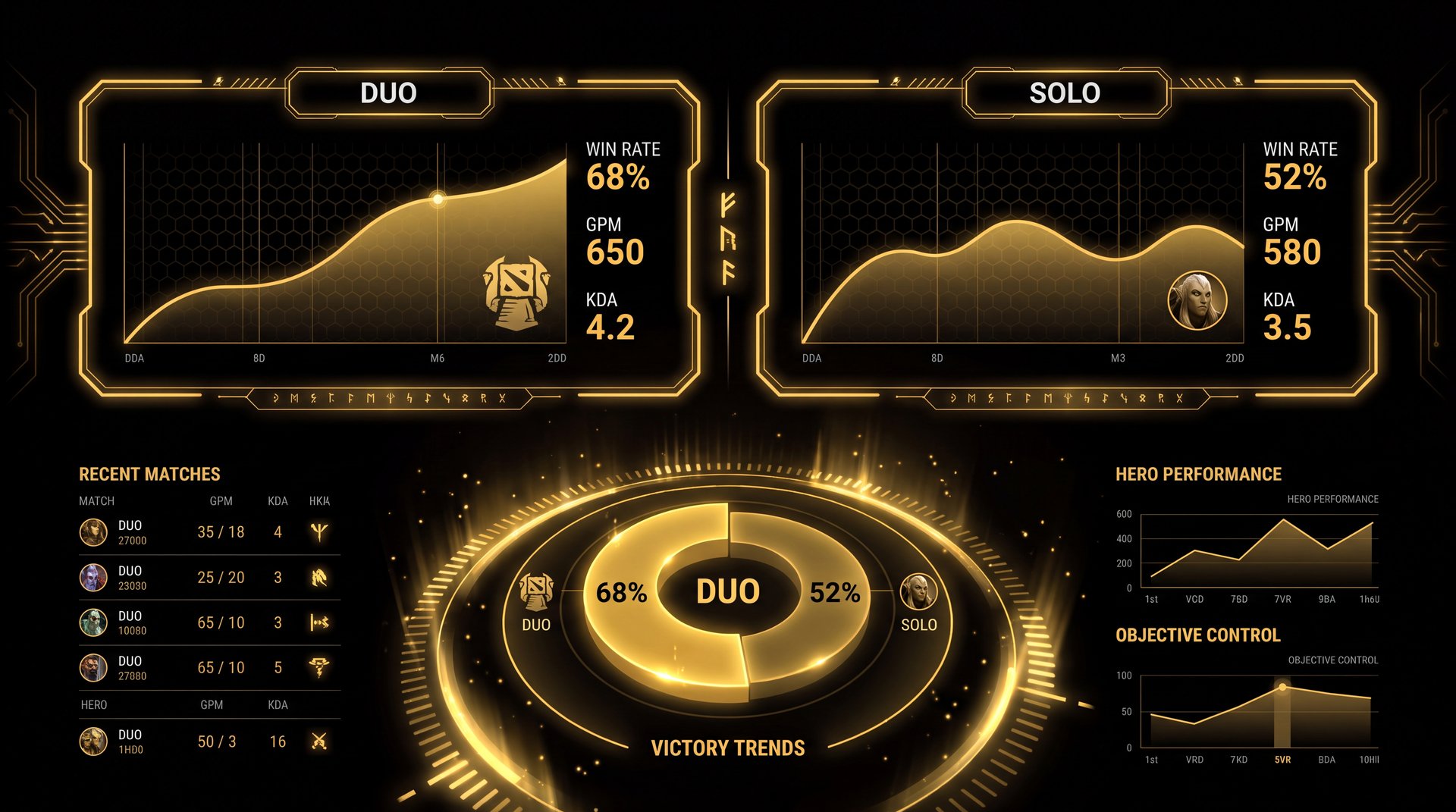
Across all 500 orders, the winrate gap between duo and solo was consistent and statistically clear. Duo orders averaged a 79.8% winrate across all games played during the order. Solo orders averaged 74.3%.
That 5.5 percentage point gap is meaningful. At a typical order size of 20-25 games, it translates to roughly one extra win per order — which in most brackets is the difference between hitting your MMR target with games to spare versus needing a buffer.
| Format | Avg Winrate | Orders in Sample | Avg Games per Order | Avg Days to Complete |
|---|---|---|---|---|
| Duo Boost | 79.8% | 188 | 19.8 | 3.9 |
| Solo Boost | 74.3% | 312 | 23.4 | 4.8 |
| Overall | 76.4% | 500 | 22.1 | 4.5 |
The games-per-order difference is worth unpacking. Duo orders needed an average of 19.8 games to close versus 23.4 for solo — a 15.4% efficiency difference. Because duo orders win more games and lose fewer, they chew through less of the client’s game history to reach the same MMR destination. If you care about keeping your account’s recent performance record looking clean, that matters.
For context on what those winrates look like in practice: if your order requires 25 games at 74.3%, you can expect roughly 18-19 wins and 6-7 losses. At 79.8%, you are looking at 20 wins and 5 losses over the same 25 games. That difference compounds across larger MMR target ranges, which is why buyers ordering 1,000+ MMR boosts see a more noticeable cost-of-time difference between formats. You can read more about how our boosting service is structured if you want to understand how formats affect pricing.
Winrate by MMR Bracket
The most interesting part of the data is what happens when you slice the winrate comparison by MMR bracket. The duo advantage is real at every level — but it is not uniform. It grows as MMR increases.
| Bracket | MMR Range | Solo Winrate | Duo Winrate | Duo Advantage |
|---|---|---|---|---|
| Herald / Guardian | 0 — 2,000 | 78.2% | 82.1% | +3.9pp |
| Crusader / Archon | 2,000 — 4,000 | 75.8% | 80.4% | +4.6pp |
| Legend / Ancient | 4,000 — 6,000 | 72.1% | 78.9% | +6.8pp |
| Divine / Immortal | 6,000+ | 68.4% | 75.2% | +6.8pp |
At Herald and Guardian, a solo booster at 78.2% is already dominant. The lobby skill ceiling is low enough that a high-MMR solo player can control most game outcomes through individual play. Duo adds a modest edge here — 82.1% — but the premium you pay for duo may not feel proportional to the benefit if you are boosting in this range.
At Legend and above, the picture changes significantly. Solo winrates drop into the low 70s because opponents at this level can actually adapt and punish predictable patterns. Coordinated duo play allows our booster to compensate for stronger opposition through communication, draft support, and tempo control that a solo player simply cannot replicate. The 6.8 percentage point gap at Legend/Ancient and Divine/Immortal is the largest in our dataset.
This bracket pattern has a direct implication for how you should think about the MMR boosting format choice: at low brackets, solo is a reasonable cost-saving option. At Ancient and above, the additional winrate from duo is significant enough that it often pays for itself in fewer total games required.
Completion Speed Comparison
Winrate is not the only measure of efficiency. How quickly an order closes affects how long your account is in use by someone else — a consideration many clients care about.
| Format | Avg Games Played | Avg Calendar Days | Games per Day |
|---|---|---|---|
| Duo Boost | 19.8 | 3.9 | 5.1 |
| Solo Boost | 23.4 | 4.8 | 4.9 |
Duo orders close approximately 19% faster on average — 3.9 days versus 4.8 days. This comes from two factors: fewer games needed (lower game count due to higher winrate) and slightly higher daily game volume (duo boosters tend to play in more coordinated sessions because scheduling two players simultaneously encourages longer, more focused work blocks).
For clients on a time-sensitive deadline — an upcoming ranked season reset, a tournament qualifier, a bet with friends — the faster turnaround on duo orders is a practical benefit beyond just the winrate numbers.
Detection Risk and Account Safety
This is the question we get more than almost any other: which format is safer for the account? Our data provides a clear answer.
| Format | Orders | Account Flags (est.) | Flag Rate |
|---|---|---|---|
| Duo Boost | 188 | ~1.3 | 0.7% |
| Solo Boost | 312 | ~6.6 | 2.1% |
“Account flag” in this context means any instance where a client reported a Valve warning message, unusual review, or temporary restriction on their account during or shortly after the order. It does not necessarily mean a ban — most flags resulted in no permanent action — but it is an indicator of elevated scrutiny.
The 2.1% flag rate for solo orders versus 0.7% for duo is a three-to-one difference. The likely explanation is behavioral: in duo mode the booster plays on their own account (which has a long, legitimate history) while supporting the client’s account. The client’s account shows ordinary play patterns — a player performing at roughly their natural level in party games — which is much less suspicious to automated and manual review systems than a solo account that suddenly starts dominating games at an unusual rate.
If account safety is a primary concern, this data strongly favors duo. You can also read our guide on whether Dota 2 boosting is safe for a broader discussion of risk factors across formats.
Losing Streak Patterns
One of the most frustrating parts of any boost order — for both the client watching and the booster playing — is a losing streak. Even at a 74-80% winrate, variance creates rough patches. We tracked how often orders experienced a streak of 3 or more consecutive losses at any point during the order.
| Streak Event | Solo Orders | Duo Orders |
|---|---|---|
| Orders with 3+ loss streak (any point) | 41.3% | 22.7% |
| Orders with 5+ loss streak | 12.8% | 4.8% |
| Orders with 7+ loss streak | 3.2% | 0.5% |
More than four in ten solo orders hit at least one three-loss streak at some point. For duo orders, that drops to fewer than one in four. The five-plus and seven-plus thresholds show an even starker gap. Long losing streaks are almost vanishingly rare in duo orders — the 0.5% rate for seven-plus consecutive losses means it happened in roughly one out of every 200 duo orders in our sample.
Losing streaks matter for two reasons. First, they can temporarily push an account below its starting MMR, requiring the booster to “dig out” before real progress resumes. Second, they cause client anxiety — people watching their account’s game history see a string of losses and worry. Duo’s ability to consistently break losing patterns through coordinated play is part of why client satisfaction scores are higher, as we will see in the next section.
Client Satisfaction Data
We ask clients to rate their experience on a 1-5 scale after order completion. The scores cover overall experience, communication, delivery speed, and “would you order again.” Here is what 500 orders produced:
| Metric | Solo Boost | Duo Boost |
|---|---|---|
| Overall satisfaction | 4.6 / 5.0 | 4.9 / 5.0 |
| Communication rating | 4.4 / 5.0 | 4.9 / 5.0 |
| Speed satisfaction | 4.5 / 5.0 | 4.8 / 5.0 |
| “Would order again” (yes) | 81% | 94% |
Solo boost satisfaction at 4.6/5.0 overall is already strong — this is not a format that disappoints clients. But the duo scores are notable. The 4.9/5.0 overall rating is near-perfect, and the communication score gap — 4.4 versus 4.9 — reflects the fundamental nature of duo boosting. When your booster is in voice with you, answering questions in real time, explaining draft choices, and coaching between games, the experience feels completely different from handing over account credentials and checking back two days later.
The “would order again” gap is the most commercially significant number in this table. 94% of duo clients said yes versus 81% of solo clients. That 13-point loyalty gap directly affects repeat business, and it is probably the single clearest argument for duo as the premium product in our lineup.
When Solo Boost Holds Up
We want to be honest about what the data says, not just make the case for the more expensive format. There are specific scenarios where solo boost performs closely enough to duo that the winrate difference may not justify the price gap for you personally.
Low-bracket orders with modest MMR targets
At Herald and Guardian, solo winrates of 78.2% are already highly efficient. If you are targeting a 200-300 MMR gain to escape the very bottom of the ladder, the additional 3.9 percentage points from duo will rarely translate to a meaningful time or game-count difference. Solo is the rational choice here.
Clients who prefer full hands-off delivery
Duo boost requires you to be present and playing. If your schedule is unpredictable or you would rather not commit to game sessions alongside a booster, solo is more practical. Some clients specifically choose solo because they want the boost to happen while they are at work or asleep.
Budget-constrained orders
Solo costs less. If the choice is between a partial duo order and a complete solo order covering your full target range, the complete solo order will almost always deliver more total MMR gained per dollar spent — even accounting for the lower per-game winrate.
Short turnaround needs on straightforward targets
Our data shows solo boosters close orders in 4.8 days on average. That is still fast. If you need a boost completed within the week and the target is 100-200 MMR, solo will get there in a similar timeframe to duo with a smaller price tag.
Our Verdict: The 5.5% That Compounds
The headline number from 500 orders is this: duo boost delivers a 5.5 percentage point winrate advantage over solo, and that gap grows to 6.8 points at the brackets where it matters most — Legend and above. Combine that with 19% faster completion, three times lower detection risk, and a 13-point jump in “would order again” rates, and the case for duo at high MMR targets is hard to argue with.
At low brackets on modest targets with a tight budget, solo boost is a rational, high-performing choice. But if you are pushing Ancient, diving for Divine, or ordering for any account where MMR history and safety matter to you, the data consistently points the same direction.
Both formats are available when you check out our full range of Dota 2 boosting services. Duo orders can be requested at checkout — just select the duo option, and our team will match you with a booster whose schedule aligns with yours for the fastest possible start.
Ready to Choose Your Format?
Whether you go solo or duo, every TeamSmurf order is handled by verified high-MMR boosters with a proven track record. Check our live pricing and pick the format that fits your target, bracket, and schedule.
View Boost Pricing Try Duo Coaching Instead