Solo vs Party MMR Gap: Why You’re 1K Higher With Friends

You hit Divine in your party stack last month. Your solo queue account is sitting at Ancient 2. Your friends think you are being modest. You know the truth: the moment you plug headphones in and queue alone, something breaks.
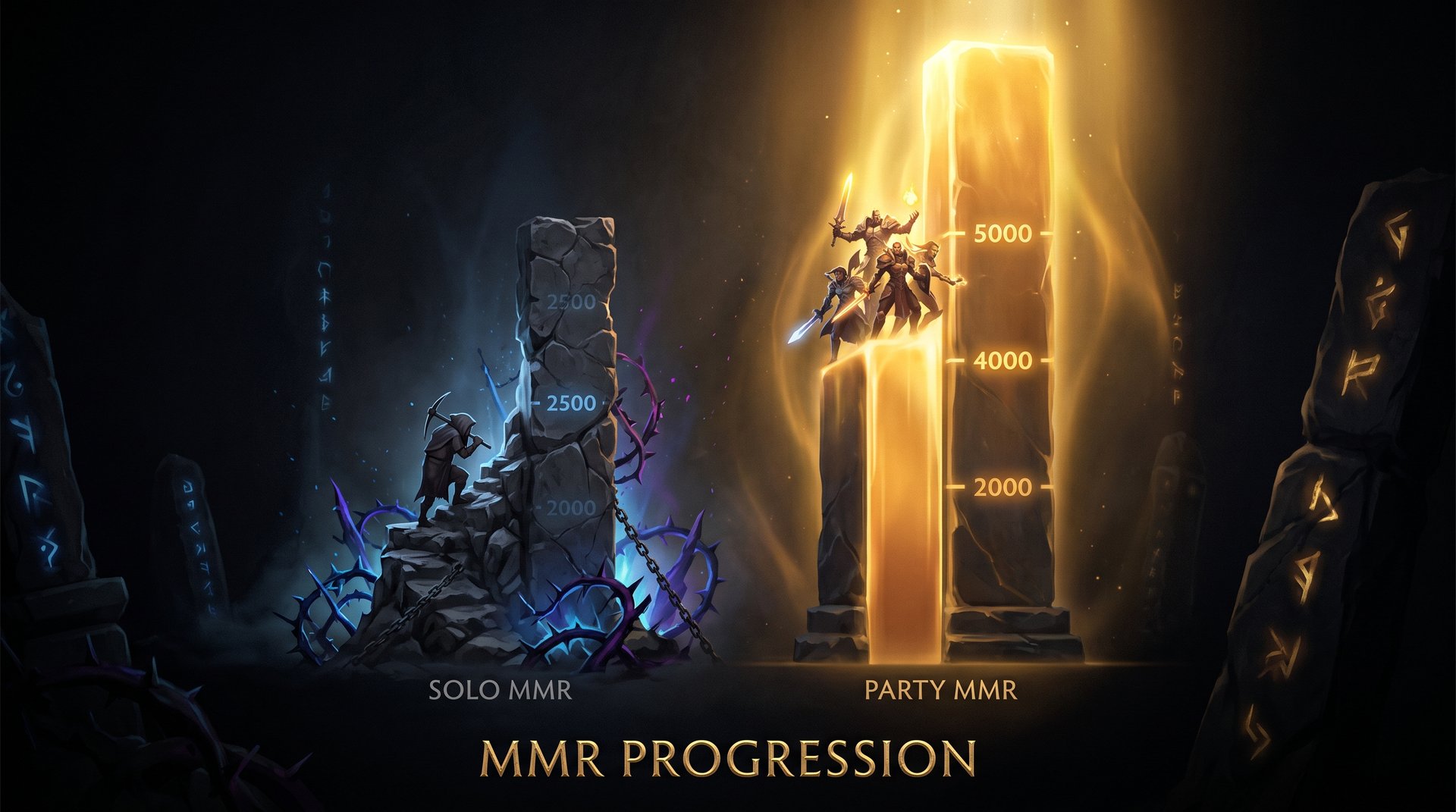
This is not a fluke. Across thousands of player profiles TeamSmurf has worked with, the solo-to-party performance gap is one of the most consistent phenomena in all of Dota 2. Some players record a 400 MMR difference. Others describe gaps closer to 1,500 MMR — the width of two full rank tiers.
This guide explains exactly why that gap exists, what is really driving it at a mechanical level, and what you can do to shrink it or exploit it deliberately to climb faster.
What You Will Learn
- How the Solo/Party MMR Gap Works
- 5 Reasons Party Play Produces Higher MMR
- The Numbers: What the Gap Looks Like
- Communication Is Doing More Than You Think
- The Draft Advantage Nobody Talks About
- Role Lock and How It Protects Your Winrate
- How to Close the Solo MMR Gap
- Using a Duo Boost to Simulate the Party Advantage
- Frequently Asked Questions
How the Solo/Party MMR Gap Actually Works
Dota 2 currently runs on a unified MMR system. Whether you queue solo or with a party, your games feed into the same MMR pool. Valve merged the old separate solo and party MMR tracks years ago, and the badge you see on your profile reflects your overall rank regardless of queue method.
So if the tracking is unified, why do players consistently perform better in party games? The short answer: the inputs are different. Matchmaking cannot fully compensate for the gap in coordination quality between a five-stack and five strangers. It controls for skill level. It cannot control for communication, draft agreement, or the simple fact that your friend in voice chat will actually smoke-gank when you call for it.
What players describe as a “party MMR gap” is really a winrate gap. When your winrate in party games runs 5 to 10 percentage points higher than your solo winrate, and that persists over 200 or 300 games, the cumulative MMR effect is enormous. At 30 MMR per win and a 10% winrate delta, a player grinding 500 games accumulates a 1,500 MMR swing purely from the coordination advantage.
The phenomenon is so widely observed that it has spawned an entire category of debate among competitive Dota players: is the matchmaking system penalizing solo players? Is the MMR calculation fair when parties have a structural advantage? The honest answer is that the system tracks MMR accurately — it just cannot control for the human coordination variable that party play introduces.
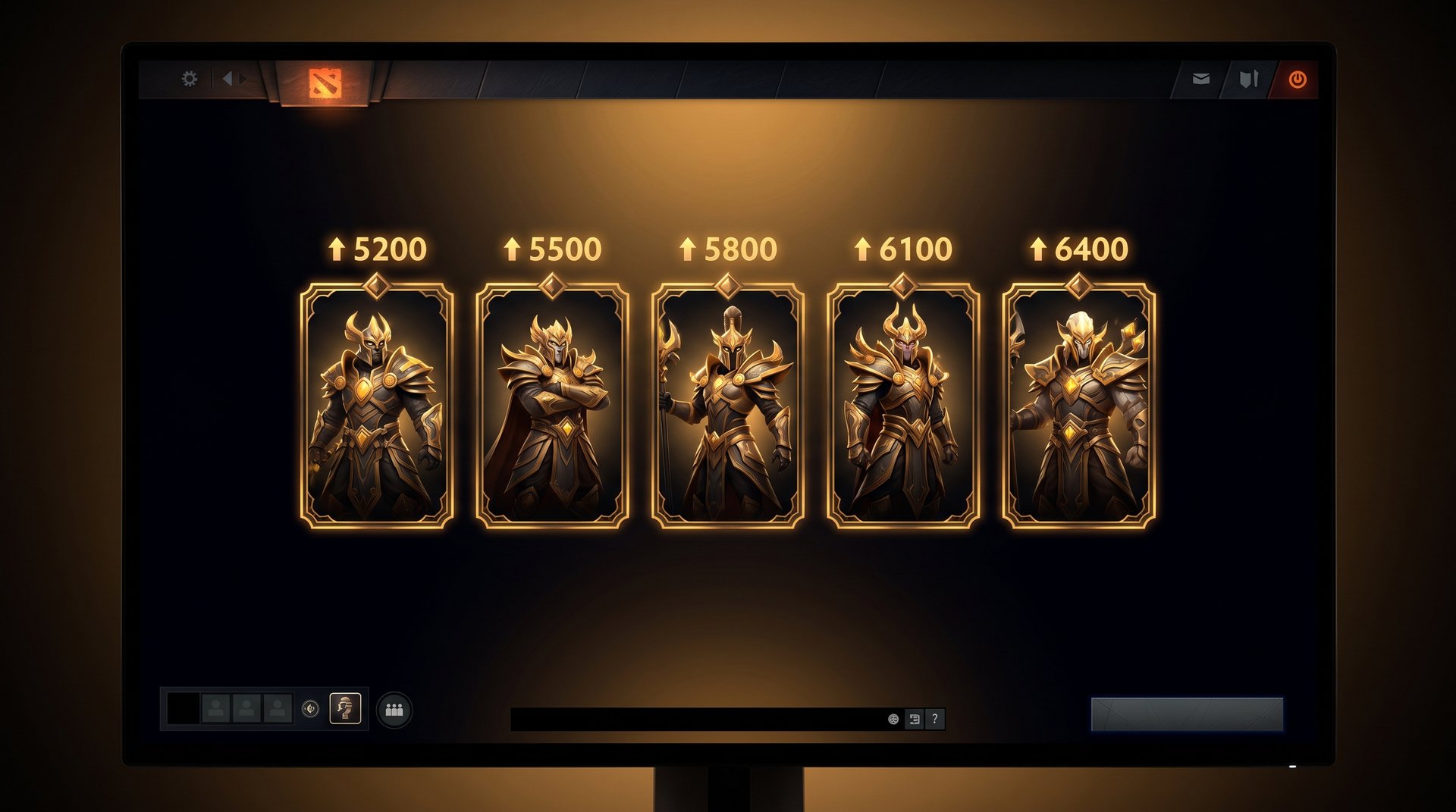
5 Reasons Party Play Produces Higher MMR
1. Voice Communication Multiplies Decision Speed
Dota 2 games are decided by dozens of micro-decisions per minute. When your team communicates in real time, the collective decision speed multiplies. You do not have to type “going rosh” and wait for a response. Your carry hears you immediately, adjusts positioning, and the Aegis contest happens in the next 40 seconds instead of never.
In solo queue, even players who use the ping system effectively are working with a 1 to 3 second communication lag on every meaningful decision. Across a 40-minute game, that lag compounds into missed opportunities, uncontested objectives, and fights started at the wrong time.
Research on team sports consistently shows that shared mental models — where teammates can predict each other’s actions — produce faster and more accurate group decisions. Party stacks in Dota 2 develop these models naturally over games together. Solo queue players almost never have them with random teammates.
2. Role Security Eliminates the Pre-Game Tilt Phase
In solo queue at lower MMR brackets, the first two minutes of every game carry a real risk: someone instalocks carry, another player picks mid without asking, and the draft turns into a negotiation before a single creep has spawned. Even when it resolves peacefully, there is a shadow of resentment that affects early aggression and willingness to sacrifice for teammates.
Party queues skip this entirely. Before the lobby opens, your group has already decided who is playing which role. The mental energy that would have gone into lobbying for your preferred position goes instead into draft analysis and early game planning.
Role security also means you get your comfort hero more often. Playing a hero you have 400 games on beats playing a hero you have 12 games on at 3:00 AM because someone else claimed your preferred position first.
3. Coordinated Draft Wins Games Before They Start
The draft in Dota 2 is not a formality. Analysis of professional matches consistently shows that draft advantage translates to a meaningful winrate edge even before individual skill is factored in. In solo queue, your team’s draft is whatever five strangers happen to pick in sequence, often with no coordination and no counter-picking strategy.
Party players, especially duo or trio stacks, coordinate their picks in ways solo players almost never manage. Common patterns include: agreeing on a teamfight core draft before the lobby opens, designating a player to counter-pick the enemy’s first two picks, building around a specific win condition such as a 15-minute smoke-gank lineup.
None of this requires Immortal-level game sense. It just requires having one conversation before the game starts — something impossible in solo queue without using in-lobby chat in ways most players never do.
4. Accountability Changes How Hard Teammates Try
One of the most documented effects in social psychology is the phenomenon of social loafing: people in groups exert less individual effort when accountability is diffuse. In anonymous teams, individuals hold back. In groups where everyone knows each other, individual effort increases.
This is measurably true in competitive Dota. Players who queue with friends report trying harder on specific plays — the Blink initiation nobody else would take, the buyback that sacrifices your economic lead but saves the game, the 45-minute marathon game where you refuse to give up because you do not want to let down the person in your headphones.
In solo queue, that accountability is largely absent. Negative plays go unaddressed. Players have less incentive to make difficult self-sacrificing decisions. The result is an average effort level lower than what the same players produce in a party environment.
5. Tilt Propagation Is Controlled in Parties
Tilt in Dota 2 is contagious. One player makes a bad call, gets flamed in chat, tilts visibly, and suddenly two other players are playing emotionally instead of logically. Solo queue is the perfect vector for tilt propagation because strangers have no investment in managing each other’s emotional states.
Party play introduces a circuit breaker. When your friend makes a mistake, you talk it out, laugh it off, or simply move on because the relationship is bigger than one game. Your squad actively keeps each other out of tilt spirals because everyone is invested in performing well as a group.
Over a long session of solo queue, a single tilting player can derail four consecutive games through chat and behavioral contagion. That same player in a party would have been talked down within 30 seconds.
The Numbers: What the Gap Looks Like
Based on aggregate player data observed across TeamSmurf coaching sessions and order reviews, here is what the solo-to-party performance gap typically looks like across brackets. These figures reflect sustained trends over 200 or more games, not short-term variance:
| Rank Bracket | Avg. Solo Winrate | Avg. Party Winrate | MMR Gap Over 200 Games |
|---|---|---|---|
| Herald — Guardian | 48-51% | 53-58% | +300 to +600 MMR |
| Crusader — Archon | 49-52% | 54-59% | +400 to +700 MMR |
| Legend — Ancient | 50-53% | 55-60% | +500 to +900 MMR |
| Divine | 50-52% | 54-57% | +400 to +700 MMR |
| Immortal | 50-51% | 52-54% | +200 to +400 MMR |
The gap peaks in the Legend to Ancient bracket. This is the zone where individual skill is high enough that coordination quality becomes the dominant differentiator. At Herald level, even party coordination cannot overcome wide skill gaps within the team. At Immortal level, the player pool shrinks enough that party advantages are partially offset by highly coordinated opposition.
The sweet spot for exploiting the party advantage is exactly where most ambitious grinders find themselves: the 3,000 to 6,000 MMR range. If you are in this bracket and you are not utilizing party play regularly, you are leaving consistent MMR on the table every session.
Communication Is Doing More Than You Think
Most players acknowledge that communication matters. Few appreciate exactly how much of the game it actually covers when you break it down decision by decision.
Here is a partial list of decisions in a typical high-stakes game that are significantly improved by real-time voice communication:
- Early rotation timing: The difference between a kill and a miss is often the 3-second warning to the laner that allows them to bait out the stun.
- Objective prioritization after a pickoff: “Take mid, I have buyback” takes one second to say and prevents a 200-gold mistake that loses the barracks trade.
- Smoke cancellation: Calling off a bad smoke gank before it initiates is only possible if someone sees the ward or hero position early and communicates immediately.
- Buyback decisions: “Please buy back, we can hold” vs. “save your gold, game is over” — this call determines whether your team fights or folds with full buybacks unused.
- Item timing reveals: “He has BKB” or “He is out of mana” shared in real time lets teammates commit to fights they would otherwise avoid.
- Rosh window calls: The difference between taking an uncontested Aegis and trading it for two buybacks is often a single early call about enemy positioning.
In solo queue, most of these calls happen late, wrong, or not at all. Voice-communicating party stacks make them correctly, consistently, across the entire game. That compound effect is what turns a 50% solo winrate into a 57% party winrate for the same player over the same period.
The Draft Advantage Nobody Talks About
Most discussions of the party advantage focus on in-game coordination. The draft advantage is equally significant and almost never discussed separately.
Consider what a coordinated party draft looks like in practice at the Archon to Ancient bracket. Before the lobby opens, the duo or trio in voice chat has already discussed: which players are on their comfort heroes and which are flexible, whether they are playing for early aggression or a late-game lineup, who is counter-picking and at what stage of the draft, and what their win condition is and which items accelerate it.
Solo queue drafts include none of this pre-game coordination. Picks happen reactively. Players take comfort heroes without regard for team composition. Counter-picks are personal rather than strategic.
Against a coordinated party draft, a randomly assembled solo queue team is playing at a structural disadvantage from the loading screen. No amount of individual skill fully compensates for walking into a game where the enemy team’s draft was designed to counter your specific hero pool before a single creep has spawned.
This is one reason Dota 2 coaching sessions at TeamSmurf spend significant time on draft principles. Solo queue players who learn to draft strategically — even with limited communication — close a significant portion of the coordination gap over time.
Role Lock and How It Protects Your Winrate
Dota 2’s ranked roles system was designed to solve the position conflict problem in solo queue. It does so partially, but not completely.
Even with role queue, solo players regularly encounter situations where their assigned carry takes a greedy item build that ignores team needs, their mid refuses to rotate when a gank window opens, or their offlane spends the early game contesting last hits against a trilane rather than establishing map pressure.
In a party, role lock is enforced socially. If your friend queues pos 4 support, he actually plays pos 4 support — because his pos 1 carry is you, and you are going to notice if he buys Desolator at 15 minutes. The combination of role queue and social accountability produces the kind of disciplined role-based play that solo queue only approximates.
This effect is especially pronounced for support players. Support players face specific challenges in solo queue that party play largely eliminates: the carry who ignores rotations, the mid who refuses help, the team that never wards the critical spots. In a party stack, these issues simply do not arise because the team shares a common goal and can discuss expectations before the game begins.
The practical result is that support players tend to show the largest solo-to-party performance gap of any position. A skilled support player who is stuck at Legend in solo queue will often perform at Ancient or Divine levels in a coordinated party — not because their mechanics improved but because the game is suddenly being played the way support mechanics are designed to work.
How to Close the Solo MMR Gap
Knowing why the gap exists is useful. Knowing how to shrink it in solo queue is what actually moves your MMR. None of these strategies fully eliminates the coordination deficit, but each one captures a meaningful portion of it.
Go Deep on One Hero
The number one performance leveler in solo queue is comfort hero mastery. When you play the same hero enough games to internalize decision-making at a deep level, you recover some of the mental overhead that party play eliminates — freeing bandwidth for game-sense decisions instead of mechanical execution.
Choose one hero. Play it to 200 games minimum. Learn every lane matchup, timing window, and item build variation for your bracket. The compounding effect of deep hero knowledge replicates some of the automatic decision quality that coordination provides when you are confident enough to make complex decisions without conscious effort.
Communicate Through Actions and Positioning
When you cannot communicate verbally, communicate through your positioning and timing. Show up at Roshan when it is contestable, not when you feel like going. Initiate the smoke before 5 minutes if your team has not moved together. Buy Observer Wards at the 7-minute mark without being asked. These behavioral signals are readable by attentive teammates and create a coordination effect without requiring voice communication.
Protect Your Behavior Score
High behavior score gives you access to demonstrably better quality solo queue teammates. Players with behavior scores above 10,000 report fewer game-throwing situations, fewer disconnects, and higher average communication quality. Maintaining a high behavior score is one of the most reliable passive investments solo grinders make in their climb.
Play During Peak Hours for Your Server
Queue pool quality varies significantly by time of day. Peak hours on your regional server bring larger pools of active players, which improves matchmaking quality and reduces the chance of outlier teammates at the extremes of the behavior distribution. Off-peak queues, especially late night, skew toward players with unusual availability patterns that sometimes correlate with worse behavior and communication habits.
Exploit Enemy Solo Queue Weaknesses Deliberately
Your enemies are also experiencing the solo queue coordination deficit. Smoke ganks into the enemy jungle when their carry is separated, coordinated Roshan attempts during enemy team rotations, and early smoke pressure onto an uncoordinated mid lane all exploit the exact same gap you are working against. The team that uses coordination-dependent strategies first and most consistently wins the interaction — and in solo queue, that is almost always the team with a duo or trio stack.
Using a Duo Boost to Simulate the Party Advantage
Some players are in a genuinely awkward position: they understand the party advantage intellectually but do not have access to high-MMR friends who can play consistently. Their real-life friends play at lower MMR brackets. Queueing together would introduce a skill mismatch that hurts matchmaking quality and net MMR gain for both parties.
This is exactly the scenario where a duo MMR boost from TeamSmurf produces results beyond what the raw MMR gain suggests. When you queue with an Immortal-level TeamSmurf booster in duo queue, you receive the full party coordination advantage at the highest possible skill level:
- A higher-ranked player handling the hardest decision points in every game
- Real-time communication about objectives, rotations, and draft in language you actually understand
- A teammate whose mechanics create space for you to perform at a level higher than you achieve solo
- Games that model what coordinated play looks like at the next bracket, accelerating your learning curve
Players who complete duo boost orders frequently report that their solo queue performance improves afterward. The games played alongside a high-level booster function as implicit coaching — you see the game through a better decision-maker’s frame for 50 to 100 games, and some of that decision quality sticks in ways that cannot be replicated by watching VODs or reading guides.
For a deeper look at how to choose the right service for your situation, the TeamSmurf guide to Dota 2 boosting services covers the complete landscape across every major provider. For players with specific questions about risk and account safety during a boost, the safety breakdown here addresses the most common concerns in detail. The complete process from order to completion is explained in the MMR boosting guide on this site.
Close the Gap Faster With a TeamSmurf Duo Boost
Our Immortal-level boosters play alongside you in duo queue, giving you the full party coordination advantage at the highest possible skill level. Every game is both a performance boost and a learning opportunity.