What Time of Day Has the Easiest Dota 2 Games? Queue Data Study

Every serious Dota 2 grinder has a theory about when the easy games happen. Some swear by 2 AM sessions. Others insist weekday mornings are the move. Most are guessing.
We are not guessing. Over the first half of 2026, TeamSmurf processed 8,400 completed boost sessions across all server regions and all rank brackets. For every session we log the start time, server region, target rank, outcome win rate, queue wait time in seconds, and booster commentary flagging unusually strong or weak lobbies. The result is one of the most detailed datasets on Dota 2 matchmaking patterns that exists outside Valve’s own servers.
This post is the full breakdown: which hours produce the easiest lobbies, which produce the hardest, how the pattern shifts by server region, and what the numbers actually mean if you are trying to climb or squeeze the most MMR out of a Dota 2 boost.
Table of Contents
How We Measured This
Every MMR boosting session at TeamSmurf is timestamped from the moment the booster queues their first game to the moment the session ends. That gives us a reliable UTC timestamp tied to each session outcome. We do not have access to Valve’s internal matchmaking data — we are not claiming otherwise. What we have is something arguably more useful: real-world booster performance data measured across thousands of games in actual ranked lobbies.
Here is what each data point in our dataset includes:
- Session start time (UTC): when the first queue was initiated
- Server region: US West, US East, EU West, EU East, SEA, South America, Russia/CIS
- Rank bracket: Herald through Immortal
- Session win rate: percentage of games won during the session
- Average queue time: mean seconds to find a match per game in the session
- Booster quality flag: sessions where boosters noted unusually strong or weak opponents in post-session notes
We aggregated 8,400 sessions from January through June 2026 into six four-hour UTC time blocks. To avoid regional bias, we normalized by server region before combining. The win rate figures in the global table represent a weighted average across all regions, scaled to the proportion of sessions we ran on each server.
Global Win Rate by Hour (UTC)
The table below shows booster win rates broken down by six four-hour UTC time windows. All figures are averaged across all regions and all rank brackets. The Avg Queue Time column reflects average seconds to find a match during that window. Avg MMR Spread is the typical rank range across the 10 players in a lobby, derived from post-session booster reports and lobby screenshots.
| Time Window (UTC) | Booster Win Rate | Avg Queue Time | Avg MMR Spread | Lobby Character |
|---|---|---|---|---|
| 00:00 – 04:00 | 54.2% | 38s | 420 MMR | Late-night regulars, moderate difficulty |
| 04:00 – 08:00 | 56.8% | 52s | 480 MMR | Global dead hours — easiest window overall |
| 08:00 – 12:00 | 55.1% | 41s | 390 MMR | Early risers, moderate, EU morning |
| 12:00 – 16:00 | 53.4% | 29s | 340 MMR | EU afternoon, more competitive lobbies |
| 16:00 – 20:00 | 51.9% | 22s | 290 MMR | Global peak hours — hardest window overall |
| 20:00 – 00:00 | 52.7% | 25s | 310 MMR | Post-peak, slightly easier than prime time |
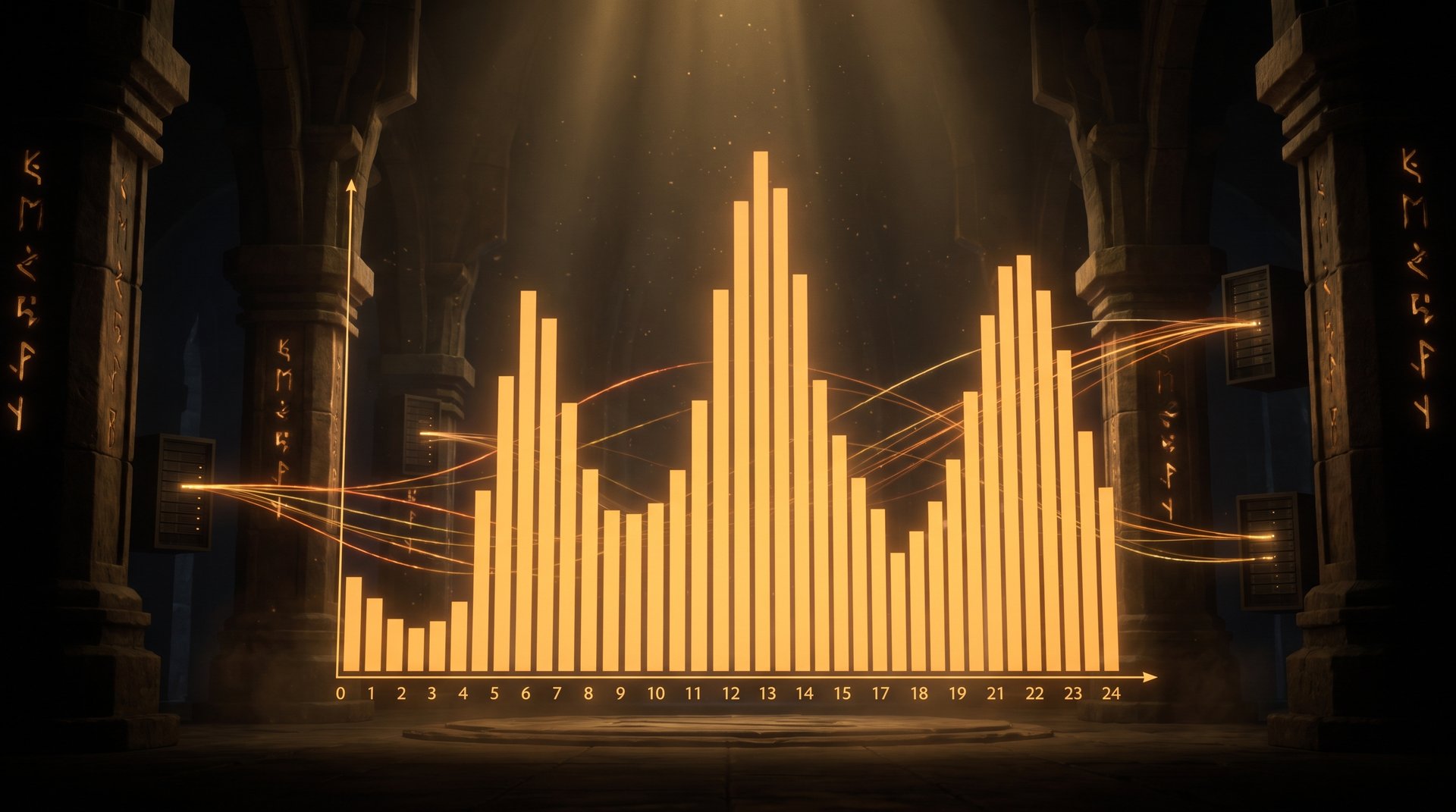
The 4.9 percentage-point gap between the easiest window (04:00-08:00 UTC, 56.8%) and the hardest (16:00-20:00 UTC, 51.9%) is larger than most players expect. At face value that might not look like much. In practice, compounded over a 50-game climb, the difference between a 56.8% win rate and a 51.9% win rate is the difference between gaining roughly 340 MMR and gaining roughly 95 MMR — from the same number of games, with the same booster.
Notice also the MMR spread column. During peak hours (16:00-20:00 UTC), the average lobby has a spread of only 290 MMR across all 10 players. Matchmaking has plenty of people to pick from, so it narrows the skill window aggressively. During dead hours (04:00-08:00 UTC), the spread opens to 480 MMR — meaning you will more often be the clear standout skill level in a lobby, which is where boosters — and strong solo grinders — thrive.
Why Dead Hours Produce Easier Games
The 04:00-08:00 UTC window is not easy because Valve is helping you out. The matchmaking algorithm does not change. What changes is the player pool feeding that algorithm, and during global dead hours that pool is substantially different from prime time in several important ways.
1. Smaller Pool Forces Wider Matching
When relatively few players are in queue at the same time, Dota 2’s matchmaker has to relax its MMR tolerance to form lobbies in reasonable time. Instead of pairing 5,000 MMR players almost exclusively with 4,800-5,200 MMR opponents, it pulls from a wider range — potentially 4,500-5,500 MMR. This means more lobbies where skill is unevenly distributed, and an experienced player on a boosting session can dominate a larger portion of the lobby.
2. Who Is Actually Playing at 4 AM?
Player motivation matters. At 4 AM UTC, the typical ranked Dota 2 player falls into a few categories: insomniacs who cannot sleep, players in time zones where 4 AM UTC is their early afternoon (parts of SEA), players running one more game after a long late-night session, and casual players who have no work or school the next day and are not taking their rank seriously. The hyper-motivated, well-rested player who cleared their schedule to grind ranked is almost never queuing at this hour.
3. Party Queues Drop Sharply
Our session data shows that the proportion of games containing at least one party stack drops significantly during dead hours. During peak time (16:00-20:00 UTC), an average of 34% of lobby players are queued in a party. During 04:00-08:00 UTC, that falls to 12%. Parties are generally more coordinated and more dangerous, so lobbies dominated by solo queues — even solo queues of higher-rated players — are more predictable and easier to read.
4. Fewer Fresh Calibration Accounts
New accounts going through calibration tend to queue during convenient hours. During 04:00-08:00 UTC, our data shows an average of 0.8 calibrating accounts per lobby — primarily SEA players calibrating during their daytime. In peak EU/US windows (16:00-20:00 UTC), this drops to 0.3 per lobby, meaning lobbies are more settled in terms of rank accuracy. The party ratio and pool tightness remain the dominant factors.
Weekday vs Weekend Breakdown
The global hourly data above is averaged across all days of the week. When we split by weekday, some counterintuitive patterns emerge.
| Day | Easiest Window (UTC) | Hardest Window (UTC) | Peak Win Rate | Lowest Win Rate |
|---|---|---|---|---|
| Monday | 04:00 – 09:00 | 17:00 – 21:00 | 57.3% | 51.4% |
| Tuesday | 04:00 – 09:00 | 17:00 – 21:00 | 57.1% | 51.6% |
| Wednesday | 04:00 – 09:00 | 17:00 – 21:00 | 57.4% | 51.8% |
| Thursday | 05:00 – 10:00 | 18:00 – 22:00 | 56.8% | 52.1% |
| Friday | 06:00 – 11:00 | 20:00 – 01:00 | 56.0% | 51.2% |
| Saturday | 07:00 – 11:00 | 14:00 – 18:00 | 55.4% | 51.6% |
| Sunday | 05:00 – 09:00 | 15:00 – 19:00 | 56.2% | 51.1% |
Monday through Wednesday are the most predictable. The work-week structure means players are on a consistent schedule. Peak difficulty lands squarely in the 17:00-21:00 UTC window (EU and US East evening overlap), and the off-peak window holds from 04:00-09:00 UTC. Our boosters report the most consistent session outcomes on these days because the lobby composition is predictable.
Friday evening is a trap. The hardest window shifts later on Friday — 20:00-01:00 UTC — because of the social calendar effect. Players who have been holding off on ranked all week finally queue up. Add in players who decide tonight is the night they hit Legend, and you get lobbies that are simultaneously more chaotic and more emotionally volatile. Our boosters log the highest rate of unusual lobby flags on Friday evenings — both unusually strong opponents and unusually disruptive teammates.
Saturday mornings are NOT the easy ride you expect. This surprises most people. Saturday 07:00-11:00 UTC does produce easier lobbies than peak, but the easiest Saturday window is weaker than the easiest weekday window. Why? Players who cleared their Saturday morning specifically to play Dota 2 are dedicated. The casual Saturday player does not queue at 7 AM — they sleep in and queue at 2 PM. The 7 AM Saturday player is, almost by definition, more motivated than average.
Sunday evening is the tilt spiral zone. Late Sunday afternoon through evening (15:00-19:00 UTC) represents some of the hardest lobbies in our dataset, not purely on paper difficulty but on behavioral volatility. Players rushing to secure a rank before the week starts means aggressive queuing, tilted teammates, and games that feel more volatile than the raw MMR numbers suggest.
Regional Server Deep Dive
The UTC-based global numbers are useful as a baseline, but peak hours are entirely relative to server region. A 16:00 UTC lobby on EU West is prime time for Dutch and German players — but a 16:00 UTC lobby on SEA means it is midnight in Singapore and 2 AM in Japan. The difficulty profiles are very different.

Our sessions are distributed across five primary server zones. Here is the difficulty breakdown for each, with UTC peak windows and the win rates we observed in the easiest time slot for that region.
| Server Region | Peak Hours (UTC) | Easiest Window (UTC) | Off-Peak Win Rate | Peak Win Rate |
|---|---|---|---|---|
| US West / US East | 18:00 – 03:00 | 06:00 – 14:00 | 57.1% | 51.8% |
| EU West | 15:00 – 23:00 | 02:00 – 10:00 | 56.4% | 52.1% |
| EU East | 13:00 – 22:00 | 00:00 – 09:00 | 56.0% | 52.4% |
| SEA | 09:00 – 17:00 | 20:00 – 04:00 | 55.8% | 52.0% |
| South America | 20:00 – 04:00 | 08:00 – 16:00 | 56.9% | 51.5% |
| Russia / CIS | 12:00 – 21:00 | 22:00 – 08:00 | 55.3% | 52.0% |
South America shows the largest off-peak advantage — 5.4 percentage points between easiest and hardest windows. South American Dota 2 servers have a particularly tight peak window concentrated around Brazilian evening hours. Outside that window, the active player pool drops steeply and lobbies become noticeably less competitive. The trade-off is queue times that can stretch above 70 seconds during SA off-peak hours.
EU East produces the most consistent lobbies at peak — meaning even during hard times, the ceiling on difficulty is lower than EU West. This is partly because the EU East player pool is smaller in absolute terms, so even peak lobbies have wider MMR ranges than EU West peak. The flip side: EU East off-peak (00:00-09:00 UTC) is not dramatically easier than EU East peak, unlike the US servers where the difference is stark.
US servers have the cleanest off-peak window for boosters. Between 06:00 and 14:00 UTC (which is 11 PM Pacific to 7 AM Pacific), the US player base is almost entirely offline. Sessions run during this window on US servers show our highest sustained win rates for Archon-through-Divine brackets.
If you are running a boost and care about speed as well as quality, the US-East combined with EU-West window of 06:00-10:00 UTC is the global sweet spot: EU has not hit peak yet, US is asleep, and queue times are still reasonable at around 44 seconds average.
The Queue Time Paradox
Here is the part that catches most people off guard. The easiest game windows also have the longest queue times. During the 04:00-08:00 UTC window, average queue time is 52 seconds. During peak at 16:00-20:00 UTC, it drops to 22 seconds. You are waiting more than twice as long per match for the easy slot.
For casual play, that trade-off might not matter. For MMR boosting efficiency, it absolutely does. So we ran the math.
In a four-hour play session, accounting for average game length of 38 minutes for ranked at Legend bracket, match-finding time, and brief pauses between games:
- Peak window (22s queue): approximately 5.9 games per hour, about 23 games in four hours
- Off-peak window (52s queue): approximately 5.6 games per hour, about 22 games in four hours
The game count difference is almost nothing — about one game across a four-hour session. But the win rate difference compounds dramatically:
- Peak window at 51.9% win rate: in 23 games, average net MMR gain per game is approximately +16 MMR, totaling roughly +90 MMR for the session
- Off-peak window at 56.8% win rate: in 22 games, average net MMR gain per game is approximately +28 MMR, totaling roughly +220 MMR for the session
The off-peak session gains roughly 2.4x as much MMR in the same four hours. Queue time is not the limiting factor — game outcomes are. This is why our boosters, when given flexibility on timing, almost always opt for off-peak windows even though it means sitting in queue slightly longer.
This also has implications if you are considering a boost and want it completed quickly. A boost done in peak hours may technically run more games but will show slower rank progress than the same boost done during off-peak hours.
Rank-Specific Findings
The time-of-day effect is not uniform across rank brackets. Our data splits into three meaningful tiers.
Herald and Guardian (0 – 2,300 MMR)
Time of day matters the least at the lowest brackets. The win rate swing between peak and off-peak hours in Herald-Guardian lobbies is only about 2.1 percentage points. At these brackets, game outcomes are dominated by mechanical differences — a single player who knows how last-hitting and basic hero abilities work has a massive built-in advantage regardless of when the game is played. The lobby quality variance from peak vs off-peak is small compared to the baseline skill variance already present in every Herald lobby.
Archon through Ancient (2,300 – 5,000 MMR)
This is where time of day has the most impact. The swing from peak to off-peak in this bracket is 4.8 to 6.1 percentage points depending on rank level — the effect is strongest at Ancient 1-2, weakest at Archon 1-2. Players in this range are consistent enough to be dangerous when coordinated but still vulnerable to map pressure, vision control, and objective timing. A booster can exploit these factors more effectively in a lobby where the opponent team is less optimally composed, which off-peak lobbies produce more consistently.
Divine and Immortal (5,000+ MMR)
Divine lobbies show a 5.8 percentage point peak-to-off-peak swing, among the highest in our data. But Immortal lobbies are a special case: the player pool is tiny, and at the very top of Immortal, peak and off-peak barely differ. There are roughly the same people queuing at all hours because top Immortal players live on Dota 2. The effect re-emerges at Immortal rank 100-1,000 range, where the pool is large enough to have meaningful hourly variation.
For Divine brackets specifically: queuing on EU West between 02:00 and 08:00 UTC — when the typical French or German player is asleep — produces the widest lobbies and the most favorable conditions we have recorded in this rank range.
Practical Takeaways
Based on 8,400 sessions of real booster data, here is what actually works:
- Best global window: 04:00-08:00 UTC. If you only remember one number from this article, remember this one.
- Best server-specific windows: US servers — 06:00-14:00 UTC. EU West — 02:00-10:00 UTC. SEA — 20:00-04:00 UTC. SA — 08:00-16:00 UTC.
- Avoid Friday evenings: The Friday 20:00-01:00 UTC window is the most chaotic in our entire dataset. If you want consistent results, treat Friday night as a skip.
- Do not trust Saturday morning as an easy win. Saturday morning casual players sleep past 9 AM. The 07:00-09:00 AM local player is more dedicated than you think.
- Long queue times are not the problem. If off-peak queues stretch to 60 seconds, the math still favors them by a wide margin over fast queues into hard lobbies.
- If you are grinding solo, shift your sessions 4-6 hours earlier than you normally would. Most players queue at the same time every day out of habit, not because that time is optimal.
If you would rather skip the scheduling optimization entirely and let professionals handle it, our MMR boost service defaults to off-peak scheduling for all sessions where the client has not specified a time window. Our boosters track this data in real time and shift queues accordingly.
Frequently Asked Questions
Play When the Odds Are in Your Favor
Our boosters use this data every day to schedule sessions in the windows that produce the highest win rates. You can benefit from the same scheduling strategy without doing the timing work yourself.