


Dota 2 Game Modes Explained 2026: Every Mode, Which Affect MMR and Which to Play

Dota 2 ships with over a dozen distinct game modes — and if you have only ever queued ranked, you are leaving a huge chunk of the game unexplored. Some modes fast-track hero knowledge. Some exist purely for chaos. A handful affect your MMR. This guide covers every available mode in 2026: what each one does, how long games run, whether your medal is on the line, and which mode you should actually be playing right now.
If your only question is “which modes count for MMR?” jump straight to our dedicated breakdown: Which Game Modes Affect MMR in 2026? This article covers the full picture for every other question.
Contents
Every Dota 2 Game Mode at a Glance (2026)
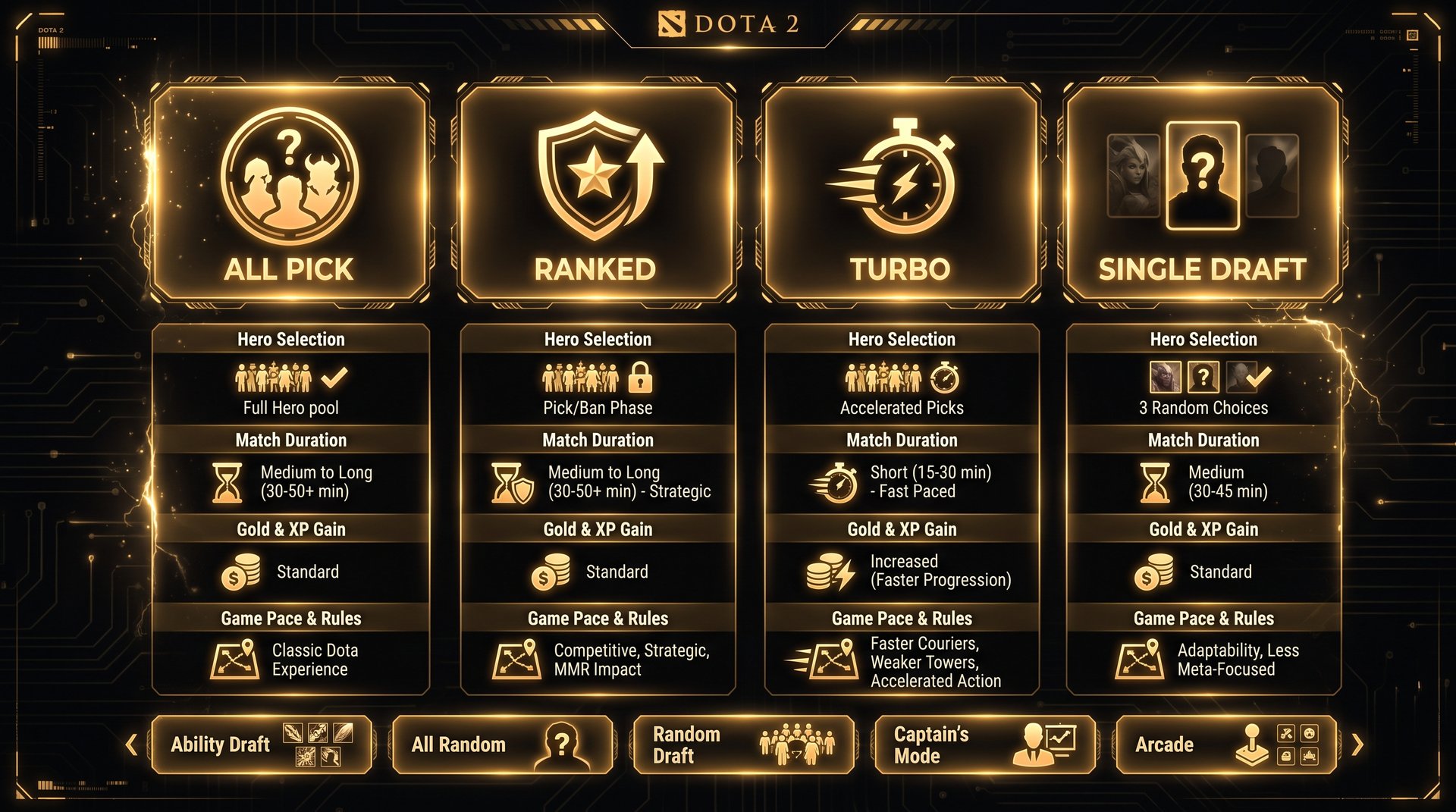
Before diving into each mode individually, here is the full comparison table. The MMR column answers the most common question outright — see the full MMR modes breakdown for more detail on how gains and losses are calculated.
| Mode | MMR Affected? | Avg Game Length | Best For |
|---|---|---|---|
| All Pick (Unranked) | No | 35–45 min | Trying new heroes, low-stakes practice |
| Ranked Matchmaking | Yes | 40–50 min | Climbing your medal |
| Turbo | No | 20–30 min | Quick games, hero testing |
| Single Draft | No | 35–45 min | Forced hero variety |
| Random Draft | No | 35–45 min | Balanced hero pools |
| All Random | No | 30–40 min | Chaos & pure fun |
| Captain’s Mode | Yes (ranked lobby) | 45–60 min | Competitive drafts, team practice |
| Captain’s Draft | No | 40–50 min | Draft practice with limited pool |
| Ability Draft | No | 35–50 min | Creative builds, entertainment |
| Least Played | No | 35–45 min | Expanding hero knowledge |
| 1v1 Solo Mid | No | 10–20 min | Laning mechanics, last-hitting practice |
| Battle Cup | Battle Cup tier only | 40–55 min | Weekly prize competition |
| Event Modes | No | Varies | Seasonal fun & cosmetic rewards |
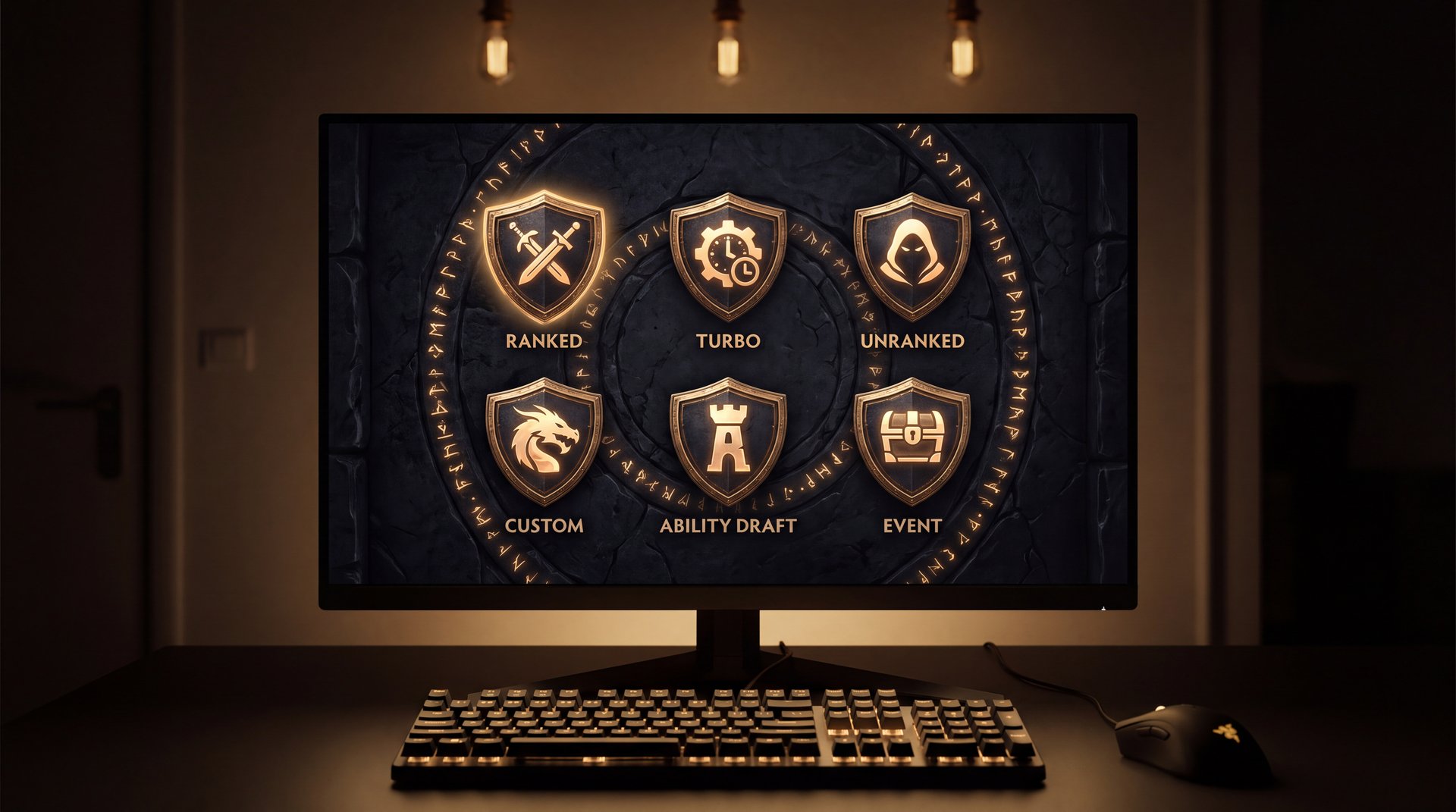
All Pick — The Default Unranked Mode
All Pick is the mode the game opens with. All 123+ heroes are available. Each of the ten players picks freely from the full roster, there is a 5-second lock-in window, and then the game starts. No bans, no restrictions, no MMR on the line.
What makes All Pick useful
Because nothing is at stake, All Pick is the right place to learn a new hero before taking them into ranked. You can experiment with unconventional builds, play off-role to fill a gap, or simply warm up before a serious session. Games run 35–45 minutes at most brackets.
The main downside of All Pick is that teammates care less about draft synergy. You will regularly see five carries or zero supports queued in the same game. If you want a proper draft environment, Ranked Matchmaking or Captain’s Mode are the right tools.
Ranked Matchmaking — The Only Mode That Matters for Your Medal
Ranked Matchmaking is the primary competitive mode and the only unambiguous way to earn or lose your MMR badge. In 2026 it uses role-based matchmaking: you select which positions you are willing to play before entering the queue, and the system matches you accordingly.
How the ranked draft works
Once a match is found, all ten players enter a picking phase that resembles All Pick with one key addition — a behavior-score-weighted banning system. Players with higher behavior scores get priority and may ban additional heroes. After bans, every player picks from the remaining pool in a snake draft order.
Win a ranked game and you gain approximately 20–35 MMR. Lose and you drop a similar amount. The exact figure depends on your uncertainty value, win streak, and relative team MMR — see our complete MMR climbing guide for the full formula breakdown.
When MMR climbs too slowly
If your current medal does not reflect your actual skill level — after a bad calibration, a losing streak, or returning from a break — the fastest route back to your correct rank is a professional Dota 2 MMR boost from a verified Immortal-level booster. TeamSmurf specialises exclusively in Dota 2 and handles every order in-house with VPN protection and a refund guarantee.
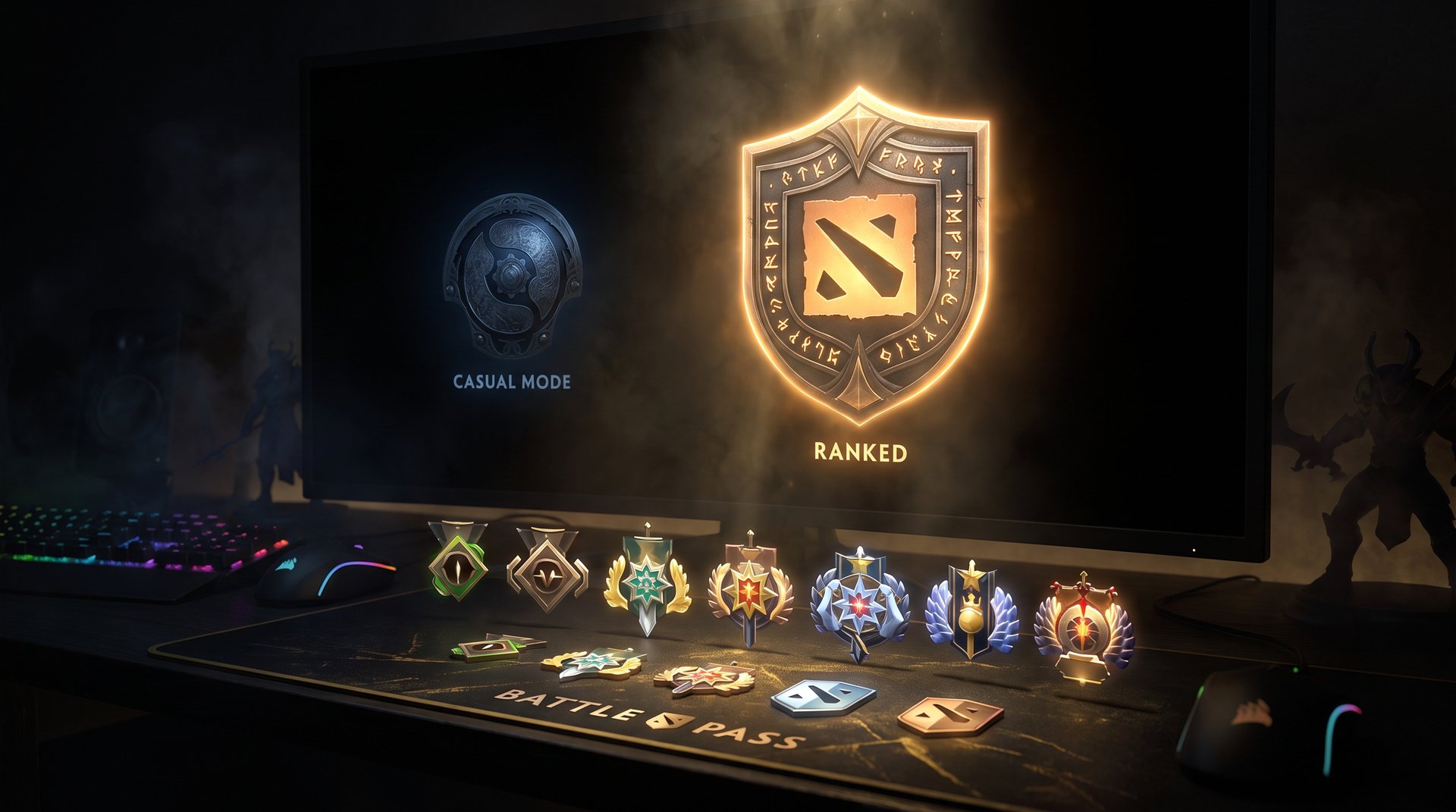
Turbo Mode — Fast Games, No MMR Pressure
Turbo is the second most popular mode in the game by queue volume. It runs on a modified ruleset that dramatically shortens matches: all heroes gain gold and experience at roughly double the normal rate, towers have reduced HP, and the Ancient takes more damage per hit.
What changes in Turbo
- Gold and XP gain: approximately 1.6x–2x normal rate
- Tower HP: roughly 60% of standard values
- Comeback mechanics are disabled
- The game ends faster, typically between 20 and 30 minutes
- No MMR is awarded or deducted — results have zero impact on your badge
Turbo does not transfer perfectly to ranked. The pacing is so different that you develop habits around fighting at 5 minutes that would be catastrophically wrong in a 45-minute ranked game. Use Turbo to learn ability combos and item interactions, not to develop game-sense.
For a full breakdown of what carries over from Turbo to ranked and what does not, see our dedicated Dota 2 Turbo Mode guide once it is live, and our research post on whether Turbo skill actually transfers to ranked.
Single Draft
In Single Draft, the game assigns each player three heroes at random from across the full roster. You must pick one of your three — there is no option to pick anything else. This is one of two “forced hero” modes alongside All Random.
Who Single Draft is for
Single Draft is ideal for players who have settled into a narrow hero pool of 3–5 heroes and want a soft push to try something new without the full chaos of All Random. You still get a choice — just a restricted one. Games run 35–45 minutes and have no MMR implications. The mode also rewards players who understand multiple roles, because there is no guarantee your three heroes will fit your preferred position.
One practical quirk: the three heroes the game offers are weighted by attribute type (one Strength, one Agility, one Intelligence by default, though this has been adjusted in patches). In practice you often get one “safe” pick and two surprises.
Random Draft
Random Draft narrows the hero pool to 50 randomly selected heroes, and then everyone picks normally from that smaller pool. Unlike Single Draft, you are not locked to specific heroes — you just have fewer options.
What Random Draft teaches
Random Draft is the closest unranked mode to a balanced competitive environment. Because the pool is limited, drafts tend to have more coherent synergies than All Pick, and players are pushed to learn how to counter-draft within constraints. It is a good warmup mode for Captain’s Draft practice. Games run 35–45 minutes and have no MMR impact.
The randomised pool changes each game, so you cannot predict which heroes will be available. This rewards players with broad hero knowledge over those who only know two or three picks.
All Random
All Random takes the randomness of Single Draft and removes the choice entirely. Every player is assigned a hero with no selection window. You play whatever the system gives you, full stop.
Games run 30–40 minutes and carry no MMR. All Random is pure entertainment — games tend to be chaotic, with unusual five-hero compositions that would never appear in a draft. It is also a fast way to see every hero in the game, which is useful if you are actively trying to expand your knowledge base beyond your current pool. Do not rely on teammates playing their assigned heroes well.
Captain’s Mode — The Competitive Standard
Captain’s Mode (CM) is the pick-ban format used in every professional Dota 2 tournament. Two captains — one per team — alternate banning and picking heroes in a structured sequence. The full order is three bans, three picks, three bans, two picks (commonly called the “3-3-3-2” format in 7.x).
CM in ranked play
Captain’s Mode is available in ranked matchmaking when you queue in a party and all players select it. In this context it does affect MMR for all participants. Outside of party ranked, CM is accessible as an unranked mode from the Find Match screen, and in custom lobbies.
For a deep dive into the pick-ban order, captain selection, and how pro teams structure their draft, see our full Captain’s Mode guide.
Why CM is worth learning
Even if you play 95% of your games in Ranked Matchmaking, understanding CM helps you think about drafting more deliberately. When you watch a professional game, every pick and ban has a reason. Learning to see those reasons makes you a better drafter in all modes. And if you ever enter team competitions or Battle Cup, CM knowledge is non-negotiable.
CM games run 45–60 minutes at most skill levels. The structured banning process adds 5–10 minutes to the start of the game.
Captain’s Draft
Captain’s Draft takes the structure of Captain’s Mode and applies it to a randomly generated hero pool of 27 heroes (9 per attribute in the classic version). Captains ban and pick from that limited pool rather than the full roster.
Captain’s Draft has no MMR impact. It is an excellent training ground for players who want to practice draft strategy without being overwhelmed by the full 120+ hero pool. Because the pool is smaller, individual hero matchups become easier to read and plan around. Games run 40–50 minutes on average.
Ability Draft
Ability Draft is one of the most creative modes in the game. A set of random heroes is assigned to players, but instead of keeping their native abilities, all abilities (Q, W, E, R, and sub-abilities) are thrown into a shared pool. Players then draft abilities one at a time, building whatever combination they want on their assigned hero body.
What makes Ability Draft worth playing
Ability Draft has a dedicated player base precisely because it produces outcomes that are impossible in standard play — a Sniper body with four different stuns, or a Juggernaut who can turn invisible and fire a global ultimate. For players who want to understand ability interactions, damage types, and how different mechanics stack, there is no better mode.
Games run 35–50 minutes and have no MMR impact. For a guide on the best ability combinations and the abilities everyone fights for in the draft, see our dedicated Dota 2 Ability Draft guide.
Least Played
Least Played forces you to pick from the heroes in your account that have the fewest games played. The exact cutoff varies, but in practice you are always choosing heroes you have played fewer than 5–10 times. It is a direct push to expand your knowledge base.
Least Played has no MMR impact. Games run 35–45 minutes. The mode is most valuable for players who are comfortable at their current rank but want to prepare for a wider hero pool in ranked. It eliminates the mental friction of “I should try new heroes” by making the decision for you.
One warning: at lower brackets, Least Played lobbies often involve players who genuinely have not touched their randomly offered heroes, which means games can be more chaotic than normal. Accept that and focus on your own performance.
1v1 Solo Mid
1v1 Solo Mid is a stripped-down mode where two players face off in a single mid lane, first to kill the other player twice or destroy the first tower wins. The mode loads only the mid lane — the rest of the map is inaccessible.
What 1v1 Solo Mid teaches
This mode isolates two of the most important early-game skills: last-hitting and trading. Because there are no teammates, no junglers, and no ganks, every outcome is determined entirely by your micro in lane. Players who want to improve their CS numbers or their trading efficiency in the mid lane will find 1v1 Solo Mid far more efficient than a full game.
Games last 10–20 minutes. There is no MMR impact. The mode has a smaller matchmaking pool than most, so queue times can be longer at off-peak hours.
Battle Cup — Weekly Competition Mode
Battle Cup is a weekly bracket tournament that Valve runs through the in-client system. Teams of five register, Valve places them into a tier based on median MMR, and the bracket plays out over several rounds on a designated weekend.
Does Battle Cup affect MMR?
Battle Cup does not affect your main ranked MMR. Instead, results earn Battle Cup trophy points, which track your all-time Battle Cup performance and contribute to a separate Battle Cup tier (Participant, Bronze, Silver, Gold, Platinum, Champion). Your Dota 2 medal is entirely unaffected by how you perform in Battle Cup.
For the full story on which modes count for your main medal, our guide on which game modes affect MMR covers Battle Cup, Turbo, Single Draft, and every other mode in detail.
Battle Cup games use Captain’s Mode. Teams that do not own a Battle Pass still participate in lower tiers. Average game length is 40–55 minutes due to the competitive format.
Seasonal Event Modes
Valve periodically releases limited-time event modes tied to seasonal content releases. Past examples include Dark Carnival (2026), Frostivus, Diretide, and various anniversary celebrations. Each event mode has unique mechanics that differ from standard Dota 2 — modified maps, custom objectives, or entirely new game loops.
Event modes never affect your main MMR or Battle Cup standing. They exist purely for entertainment and cosmetic rewards (cosmetics, points, unlock challenges). When a new event launches, Valve typically releases patch notes specific to the event that override certain standard mechanics for the duration.
If a major seasonal event like Diretide or Frostivus is currently running, check our Dota 2 event calendar for dates, how-to guides, and reward breakdowns.
Which Dota 2 Mode Should You Play?
The right mode depends entirely on what you are trying to accomplish. Here is a practical decision tree:
| Your Goal | Best Mode | Why |
|---|---|---|
| Climb your medal | Ranked Matchmaking | The only mode that actually moves your MMR |
| Learn a new hero safely | All Pick or Turbo | Low-stakes environment, full hero access |
| Improve laning mechanics | 1v1 Solo Mid | Isolated feedback loop, faster iteration |
| Expand your hero pool | Single Draft or Least Played | Structured exposure to unfamiliar picks |
| Understand drafting | Captain’s Draft or Captain’s Mode | Pick-ban forces draft thinking |
| Creative builds and fun | Ability Draft | Unique combos, no pressure |
| Quick session under 30 min | Turbo | Fastest full-game experience available |
| Team practice | Captain’s Mode (party ranked) | Competitive draft format, counts for MMR |
The ranked player’s mode stack
For most players who want to improve their ranked MMR, the optimal mode rotation looks like this: warm up in 2–3 Turbo games, then transition to ranked. Use All Pick for specific hero practice sessions mid-week. Dip into 1v1 Solo Mid when your laning feels shaky. Everything else is optional entertainment.
If your MMR has stalled despite putting in the hours, the issue is rarely your mode selection — it is usually an identifiable leak in mechanics, map awareness, or decision-making. Our MMR boosting and climbing guide walks through the most common culprits at each rank bracket.
And if you are below your true skill level after calibration and want to skip the grind, TeamSmurf offers fully verified Dota 2 MMR boost services carried out by Immortal-level players — no account sharing required unless you choose duo queue. Before any purchase, read our guide on whether Dota 2 boosting is safe and what to look for in a legitimate provider.
Frequently Asked Questions
Stuck Below Your True Rank?
Now that you know which modes actually move your MMR, you also know where the bottleneck is. If ranked games are not moving your medal in the right direction, our Immortal-ranked boosters can get you to your target fast and safely — with full VPN protection and a money-back guarantee.



