

Which Game Modes Affect MMR in 2026? Ranked, Turbo, Battle Cup, Events

One of the most common questions new and returning Dota 2 players ask is simple: does this game mode actually affect my MMR? The answer depends entirely on which mode you are playing. Turbo, Unranked, Battle Cup, events like Dark Carnival — none of these move your ranked MMR one point in either direction. Only Ranked matchmaking counts.
This guide gives you the definitive mode-by-mode answer in 2026, explains exactly why certain modes are excluded from the MMR calculation, and covers what each non-ranked mode is actually useful for. If you want to know whether turbo skill transfers to ranked — that is a separate question covered in our Turbo to Ranked guide. This page answers the binary question first: does this mode give MMR, yes or no.
Table of Contents
Quick Reference: Does This Game Mode Give MMR in 2026?
Before diving into the details, here is the complete answer at a glance. Every mode listed below has been verified against Dota 2 current matchmaking rules as of patch 7.41f.
| Game Mode | Gives Ranked MMR? | Notes |
|---|---|---|
| Ranked Solo | YES | Full MMR impact, wins and losses both count |
| Ranked Party | YES | Party MMR tracked separately from solo |
| Turbo | NO | No MMR impact of any kind |
| Unranked (All Pick) | NO | Practice only, no MMR change |
| Battle Cup | NO | Awards Battle Cup tiers, not ranked MMR |
| Dark Carnival (Event) | NO | Event-exclusive rewards only |
| Diretide / Frostivus | NO | Seasonal events — zero MMR effect |
| Ability Draft | NO | Non-standard mode, not ranked |
| All Random | NO | Unranked variant — no MMR |
| Custom Games (Arcade) | NO | Completely outside Valve matchmaking |
| Demo / Practice with Bots | NO | Offline — no impact whatsoever |
The rule is straightforward: if you selected the mode from the Ranked tab in the Find Match menu, it counts. If you chose it from Normal Match, Events, or Arcade, it does not. There is no grey area here — Valve designed these systems with a hard wall between ranked and everything else.
Ranked Solo and Party MMR: The Only Modes That Count
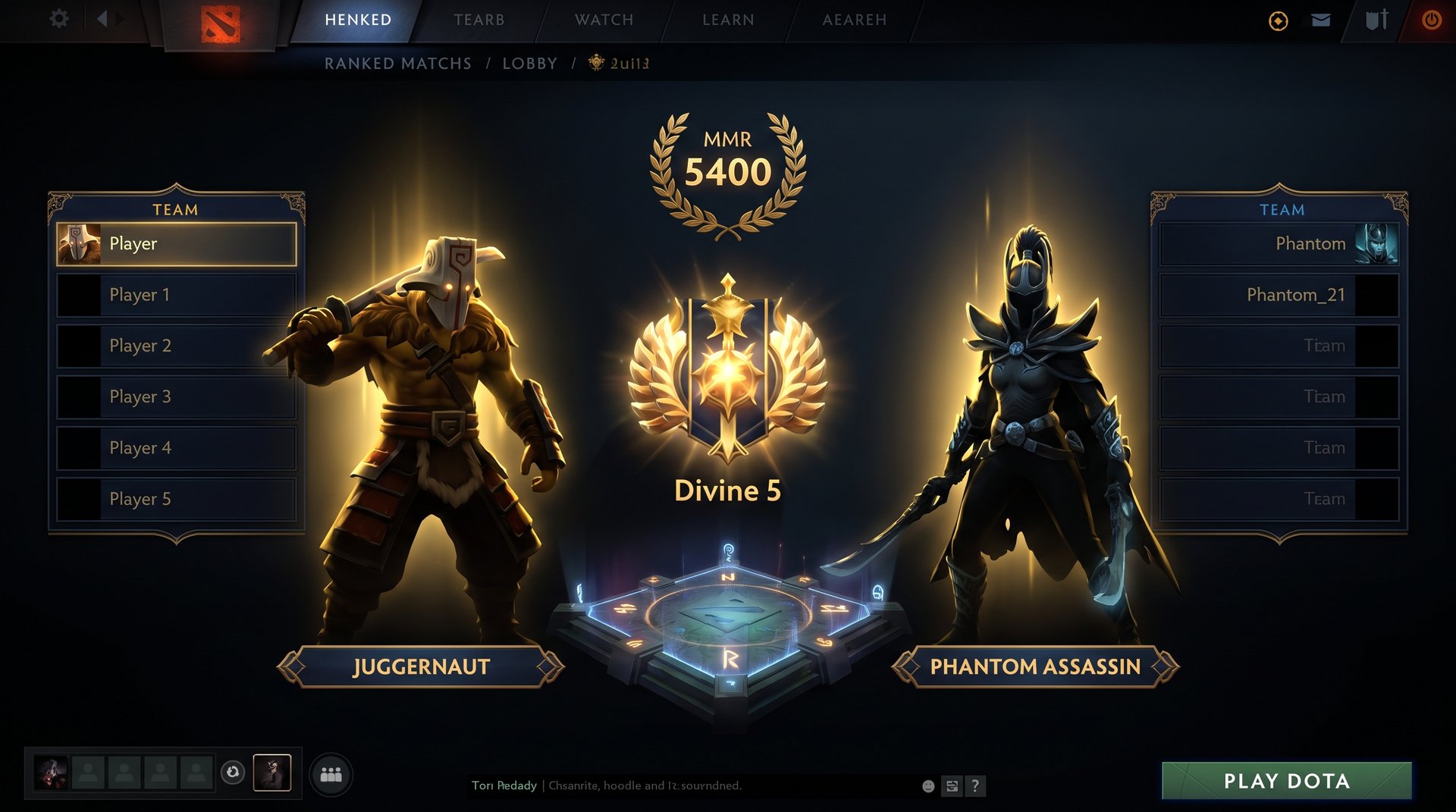
Ranked matchmaking is the only game mode in Dota 2 that modifies your MMR. When you queue for a ranked game, every result — win or loss — moves your rating up or down by a fixed amount. In 2026, the standard swing is +30 MMR for a win and -30 MMR for a loss, though Valve has adjusted these values at various points and the exact figure can vary during calibration windows.
Solo MMR vs Party MMR
Dota 2 tracks two separate MMR values when you play ranked:
- Solo MMR — applies when you queue alone or with one other player. This is the number most players refer to when they say “my MMR.” Solo MMR is the primary factor in badge rank calculations.
- Party MMR — applies when you queue with a full or partial party. Party MMR is tracked separately and does not directly influence your Solo badge. Many players find their Party MMR is lower because coordinated five-stacks face tougher opponents on average.
Both values are real ranked MMR. Both go up and down based on results. The distinction matters because a player can be Ancient in Solo MMR while sitting at Legend in Party MMR if they primarily grind solo.
How the MMR System Works in 2026
Valve overhauled parts of the ranked experience in late 2025 and early 2026. The current system places more weight on individual performance metrics alongside the win/loss outcome. If you have a particularly strong game — high net worth, key objectives, assists on your support — your MMR gain can be slightly above the flat 30. Losing while underperforming the lobby average can cost slightly more. The core mechanic is still win-based, but performance adjustments at the margins make consistent play more rewarding than raw game volume.
To understand how many wins you need to climb from your current bracket, see our breakdown of the winrate you need to climb from every bracket. If you are looking to accelerate that climb, our professional MMR boosting guide covers how the process works and what to expect.
Ranked Calibration and Recalibration
New accounts must complete a calibration series before their MMR is made visible. Valve uses this window to place you in an appropriate bracket based on performance. Recalibration events happen periodically and follow the same rules — only ranked games count. Playing 100 Turbo games before a recalibration window will not influence where you end up. Only your ranked game history matters to the calibration algorithm.
During calibration, the MMR swing per game can be larger than the standard 30 points, which means your rating can shift significantly in either direction within a short span. This is intentional — Valve wants to place calibrating players at their correct bracket quickly rather than having them spend months reaching their natural level.
Turbo Mode: Why It Does Not Give MMR
Turbo does not give MMR. Winning or losing a Turbo game has zero effect on your ranked rating. This is by design — Turbo was introduced as a faster, lower-stakes alternative to normal matchmaking for players who want a complete Dota 2 game in 20-25 minutes instead of 40-60. Because the game duration is compressed and resource values are inflated, Valve decided Turbo results should not carry the same weight as a full-length ranked match.
What Turbo Actually Changes
In Turbo mode, gold and experience income are dramatically increased, buildings have reduced health, and the overall pace of the game is roughly double that of a standard match. This changes the fundamental skill expression of many heroes. Carries reach their power spikes earlier, supports have less time for early-game impact, and comeback mechanics matter less because games end before the mid-game fully develops.
Because of these structural differences, Valve treats Turbo as a distinct format — closer to a scrimmage than a competitive match. The exclusion from MMR calculation is intentional and permanent. This has been the policy since Turbo launched in 2017 and no patch has changed it.
What Turbo IS Good For
Even though Turbo has no MMR effect, it is genuinely useful in specific situations:
- Learning a new hero: Turbo lets you experience a hero’s full item progression in a shorter window, which helps you understand power spikes faster than in full-length games.
- Trying a new role: If you main carry and want to learn support positioning, Turbo is a lower-stakes environment than ranked where mistakes cost you rating.
- Warming up before a ranked session: Many high-MMR players play one Turbo game before queuing ranked to get mechanics sharp without risking rating.
- Returning after a break: If you have not played in months, a few Turbo games help you readjust to current metas and mechanics before entering ranked.
- Testing hero builds: Turbo is the safest place to experiment with unusual item builds or new patch changes before committing to them in ranked.
For a deeper look at whether the skills you build in Turbo actually transfer to Ranked performance, read our dedicated article: Turbo to Ranked — Does Turbo Skill Actually Transfer? The short answer is yes, with important caveats around pacing and teamfight timing that make the transfer incomplete.
Battle Cup: Does It Give MMR?
Battle Cup does not give ranked MMR. Playing in a Battle Cup — whether you win your bracket or get knocked out in round one — has no effect on your Dota 2 MMR rating. This is one of the most commonly misunderstood points in the Dota 2 community because Battle Cup involves competitive brackets, structured rounds, and visible performance outcomes that feel exactly like a ranked ladder. But the underlying system is completely separate.
What Battle Cup Gives Instead: The Tier System
Battle Cup operates on its own tier ladder, separate from the MMR system entirely. The tiers run from Tier 1 (entry-level) up to Tier 8 (the highest, reserved for teams with 5 Immortal-bracket players). Winning your bracket at a given tier advances you toward a higher tier in future Battle Cups. The tier system tracks your Battle Cup competitive history — not your ranked MMR.
| Battle Cup Tier | MMR Bracket Requirement | Gives Ranked MMR? |
|---|---|---|
| Tier 1 | Herald / Guardian | NO |
| Tier 2 | Crusader | NO |
| Tier 3 | Archon | NO |
| Tier 4 | Legend | NO |
| Tier 5 | Ancient | NO |
| Tier 6 | Divine | NO |
| Tier 7 | Immortal (lower) | NO |
| Tier 8 | Immortal (top bracket) | NO |
Battle Cup rewards include cosmetic items, exclusive stickers, and progression within the Battle Cup tier system itself. None of these rewards include ranked MMR or have any influence over your position in the ranked ladder. Our upcoming post on Battle Cup November 2026 goes deeper into the tier structure, rewards, and registration process.
Why Players Confuse Battle Cup and Ranked
The confusion is understandable. Battle Cup uses a bracket format that mirrors real competitive tournaments. You face opponents roughly matched to your skill level (because teams are sorted into tiers by average MMR). You win or lose in front of other players. It looks like ranked. But the matchmaking pool, the result-recording system, and the reward pipeline are all completely different from the ranked MMR ladder. Valve deliberately built Battle Cup as a social competition event — something fun for friend groups and guilds — rather than a pathway to rank advancement.
If a teammate tells you that winning Battle Cup “counts for your MMR,” they are mistaken. The Tier 8 badge on your profile is a Battle Cup achievement, not a ranked indicator. Your MMR badge and your Battle Cup tier are two separate things displayed in two different parts of your profile.
Unranked Mode: No MMR Impact
Unranked (also called Normal Match or Normal All Pick) is the base Dota 2 experience with no stakes attached to results. Unranked games do not affect your MMR. You can play thousands of Unranked games and your ranked rating will be exactly where you left it. Unranked does use an internal hidden matchmaking score to create balanced games, but this is not the same as your visible ranked MMR and it does not feed into your badge rank.
Unranked is the right place to try experimental builds, test mechanics, or introduce Dota 2 to a new player who is not ready for the expectations of ranked. It is also the mode used by players who want to play without the psychological pressure of rating swings — some very high-MMR players use Unranked for off-hero experimentation precisely because losses carry no consequences.
Unranked MMR vs Ranked MMR
Valve tracks a separate hidden behavioral and skill score for unranked matchmaking to ensure games are reasonably balanced. This internal score does NOT equal your ranked MMR and is NOT visible to you in your profile. Changes in your unranked performance do not translate to ranked MMR changes. They are entirely separate systems that happen to use similar underlying logic.
If you are grinding ranked and want to understand the options for accelerating your climb, our overview of the best Dota 2 boosting services available in 2026 provides a detailed breakdown. Boosting can be a smart option when you want to break through a bracket ceiling and start learning the game at a higher MMR band with better teammates.
Event Modes: Dark Carnival, Diretide, Frostivus and Others
No Dota 2 event mode gives ranked MMR. This applies to every seasonal and limited-time event mode Valve has released, past and present. Dark Carnival (2025), Diretide, Frostivus, Aghanim’s Labyrinth, Siltbreaker — every one of them operates outside the ranked ecosystem.
What Events Give Instead
Event modes exist to deliver seasonal cosmetics, event tokens, and exclusive rewards only available during the event window. They typically feature custom game mechanics very different from standard Dota 2 — Diretide is a candy-collecting PvP mode, Aghanim’s Labyrinth is a co-operative dungeon crawler, Dark Carnival has its own carnival-game format. None of these mechanics translate to the ranked game in a way that would make them appropriate candidates for MMR impact.
The key things events give you:
- Exclusive cosmetics (hero sets, couriers, loading screens)
- Event tokens redeemable for rewards
- Event-specific progression systems, often level-gated
- Achievements and profile badges
None of these affect your ranked MMR or your badge rank. Your ranked position before an event begins will be identical to your ranked position when the event ends, assuming you played zero ranked games during the event period.
A Note on Future Events
Valve has not announced any upcoming event mode that would award ranked MMR. This would represent a fundamental change to how Dota 2’s competitive system works, and based on the game’s 10-year history, it is extremely unlikely. If Valve ever does introduce an event mode with MMR stakes, it will be front-page news — you will not miss it. For now, treat all events as MMR-neutral.
Ability Draft, All Random, and Other Non-Standard Modes
Dota 2 supports a handful of alternative draft and game modes beyond standard All Pick: Ability Draft, All Random, Random Draft, Least Played, and others. None of these give ranked MMR when played outside the ranked queue. They operate as normal-match variants with no rated outcome.
Ability Draft is particularly popular with experienced players as a break from standard gameplay — it creates interesting synergy puzzles without any MMR risk. All Random can be a fun way to force yourself to learn heroes outside your comfort pool. Both have genuine practice value for expanding your hero knowledge. But again, none of these modes touch your ranked rating.
Custom games (the Arcade) are even further removed — they run on entirely separate servers with their own progression systems. Valve has no involvement in custom game results, and there is no mechanism by which an Arcade game could affect your ranked MMR. Popular custom games like Dota Auto Chess variants, RPG modes, and custom survival games are entirely self-contained and have no connection to your Dota 2 ranked profile.
What Actually Moves Your MMR
Only ranked matchmaking changes your MMR. Every point you gain or lose comes from ranked games specifically. Here is how the system works in concrete terms:
- Win a ranked game: +25 to +30 MMR (exact amount varies based on performance and calibration status)
- Lose a ranked game: -25 to -30 MMR
- Abandon a ranked game: -30 MMR plus a low-priority queue penalty
- Win in any other mode: 0 MMR change
- Lose in any other mode: 0 MMR change
The math is unambiguous. Your ranked MMR is exclusively a function of your ranked game outcomes. If you have been playing Turbo for three months hoping it helps your MMR because you are “getting better at the game,” your ranked MMR is sitting exactly where you left it in your last ranked game. The practice value may be real — the MMR impact is not.
Optimizing Your Ranked Win Rate
Since only ranked games move your MMR, the question of how to gain MMR quickly is entirely about optimizing your ranked win rate. The most effective approaches backed by data from high-MMR players include:
- Narrow hero pool: Playing 3-5 heroes you know deeply beats playing 20 heroes at surface level. Every hero switch costs you mechanical efficiency.
- Role consistency: Switching roles game-to-game hurts more than most players expect. Your macro decision-making is role-specific.
- Quit conditions: High-MMR grinders track their mental state and stop playing when tilt sets in. Forced losses from tilted play are the biggest MMR drain for mid-bracket players.
- Replay review: Watching your own replays — specifically the 5-minute window around the turning point in losses — reveals patterns invisible during gameplay.
For players who want to improve their rank without grinding hundreds of games, working with a professional coach who can identify specific weaknesses in your ranked play is often the fastest path. Our guide on whether Dota 2 boosting is safe addresses common questions about account security and what to look for in a legitimate service.
Accelerating Your MMR: What TeamSmurf Offers
If you are stuck in a bracket and want to break through faster than solo grinding allows, TeamSmurf provides two specific services for Dota 2 players:
- MMR Boosting: A verified high-MMR booster plays ranked games on your account to advance your MMR to a target number. All boosters are screened Immortal-bracket players with proven win rates. Learn more at our Dota 2 MMR Boost page.
- Coaching: A Dota 2 specialist analyzes your replays and plays alongside you in ranked to identify and fix the specific habits preventing rank advancement. See our Dota 2 Coaching page for session options.
TeamSmurf provides boosting and coaching only — we do not sell accounts or offer match manipulation services. Every service is Dota 2 specific. We have been operating in this game since 2016 and our boosters are verified active Immortal players, not general esports freelancers picking up Dota 2 games between other titles.
Ready to Move Your MMR?
Whether you want to break a bracket ceiling or learn from someone who plays at the level you are aiming for, TeamSmurf has a service designed specifically for Dota 2 ranked progression. Every booster and coach is a verified Immortal-bracket specialist.


