How to Climb from Divine to Immortal as Pos 2 Mid

Mid lane at the Divine-to-Immortal threshold is a completely different game from every other bracket. Below Divine, you can win mid through superior mechanics alone — better last-hitting, better rune control, better harass patterns. At Divine, everyone has those mechanics. The difference between a Divine mid and an Immortal mid isn’t about laning skill — it’s about what you do with the advantages you create and how you control the tempo of the entire game.
I’ve spent thousands of hours analyzing mid lane replays across every rank, and the Divine bracket has a specific pattern that holds players back. It’s what I call the “lane winner, game loser” syndrome. Divine mid players frequently win their lane — they get the CS advantage, they secure runes, they hit their level timings — and then they proceed to lose the game because they don’t know how to convert lane dominance into map control.
This guide is going to fix that. Everything here is written from the perspective of what Immortal and leaderboard mid players do differently from Divine players. Not what’s different between Archon and Divine — what’s different in the final, hardest step of the ranked climb.
Table of Contents
- The Pos 2 Role at Divine — Why You’re Stuck
- Top 5 Heroes to Climb from Divine to Immortal as Mid
- 10 Critical Mistakes Divine Mids Make (That Immortals Don’t)
- Phase-by-Phase Guide: Laning Through Late Game
- The Teammate Problem: Account Buyers and Boosted Players at Divine
- Realistic Timeline: How Long Will This Take
- FAQ
The Pos 2 Role at Divine — Why You’re Stuck
Position 2 is the highest-impact role in Dota 2 for climbing MMR. It’s also the hardest to play correctly at the Divine level because the role demands simultaneous excellence in three different areas: laning mechanics, tempo control, and late-game decision-making. At lower brackets, you can compensate for weakness in one area with strength in another. At Divine, you need all three.
The Tempo Problem
The single biggest difference between Divine and Immortal mid players is tempo control. Tempo is the rhythm of the game — who’s dictating the pace, who’s reactive versus proactive, who’s playing on their terms versus being forced to play on the opponent’s terms.
An Immortal mid player controls tempo from minute one. They decide when the laning phase ends. They decide when the first tower falls. They decide when Roshan happens. They set the pace that the entire game follows. A Divine mid player reacts to tempo instead of setting it. They farm until the game tells them to fight, rather than creating the fight timing that benefits them most.
This isn’t about being aggressive versus passive. Some tempo-controlling plays are passive — choosing NOT to fight because the enemy wants you to, and instead farming until your power spike, is a tempo play. The key is that you’re making deliberate decisions about game pace based on your hero’s strengths, rather than just responding to whatever happens.
Lane Dominance Isn’t Enough
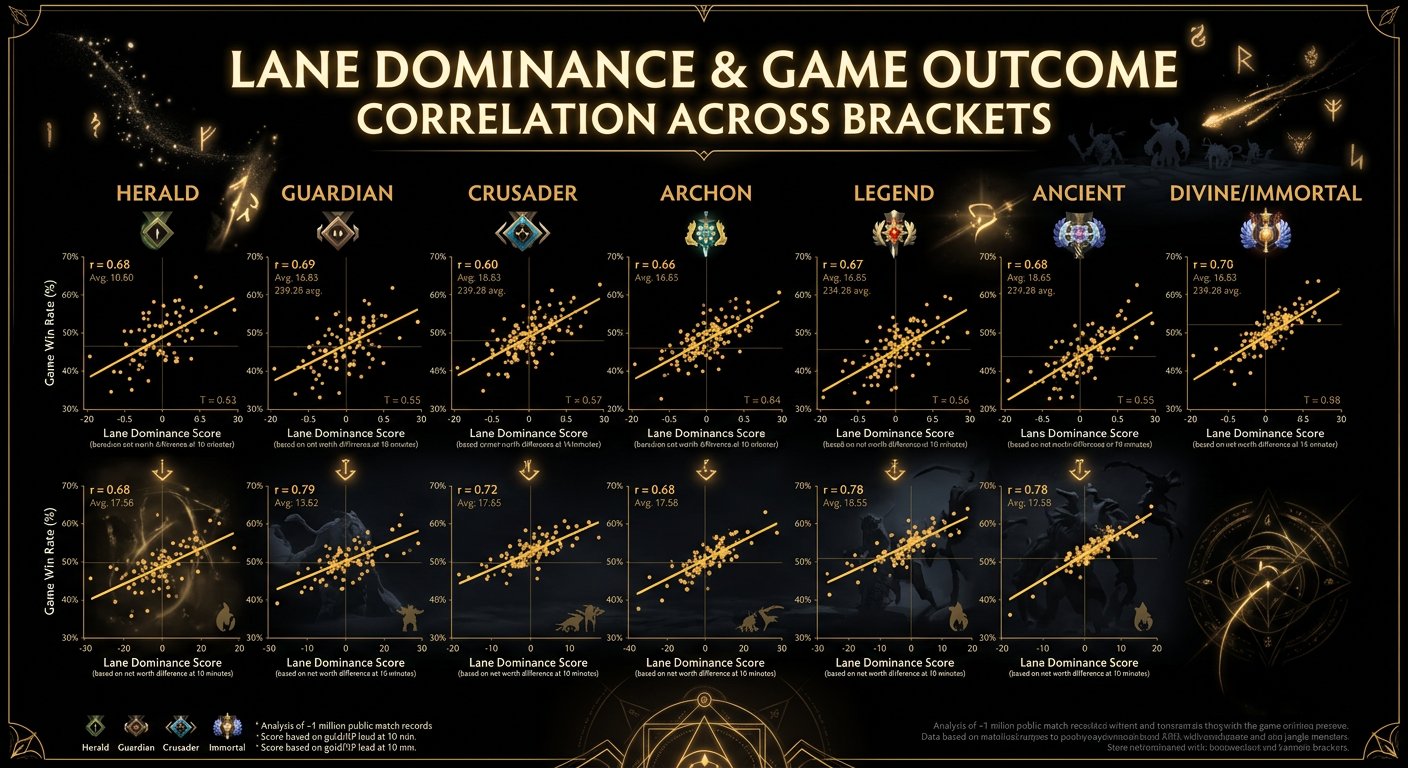
Here’s a stat that surprises people: in Divine bracket, the mid player who wins the lane wins the game only about 55-58% of the time. That’s barely better than a coin flip. Compare that to Ancient bracket, where winning mid correlates with winning the game about 62-65% of the time.
Why the difference Because at Divine, the other four players on each team are also competent. Even if you crush the enemy mid, their carry might be farming efficiently, their supports might be making good rotations, and their offlaner might be pressuring your carry. Winning mid gives you an advantage, but it’s what you do with that advantage in the next 10 minutes that determines the game outcome.
The Two Types of Mid Players Stuck at Divine
Type 1: The Lane Dominator. This player wins lane 60%+ of the time but has a sub-52% overall win rate. They’re mechanically excellent but don’t convert advantages. They win lane and then either farm passively (losing their timing window) or force fights they can’t win (throwing their advantage). The fix for this player is learning tempo and rotational play.
Type 2: The Team Fighter. This player lives for the 5v5 team fight. They group with their team at 15 minutes and fight constantly. They occasionally have incredible games where they go 15-2, but they also have terrible games where they go 3-9 because they forced fights without enough items. The fix for this player is learning when to farm and when to fight — the discipline to say “this fight isn’t worth my time.”
Identify which type you are and focus on fixing your specific weakness. Trying to improve “generally” is too vague. You need targeted improvement.
Top 5 Heroes to Climb from Divine to Immortal as Mid
Hero selection at mid is more important than any other lane because you’re in a pure 1v1 matchup for the first 8-10 minutes. Picking a hero that you can win lane with AND that has a clear game plan is essential.

1. Ember Spirit
Ember Spirit is the quintessential “Immortal mid” hero because he rewards every single skill that separates Divine from Immortal. Map awareness (Remnant placement), tempo control (when to gank vs. farm), mechanical skill (Sleight + chains combo), and late-game decision-making (itemization choices) — Ember tests everything.
Why he works at this bracket: Ember can play at any pace. Against a lineup that wants to fight early, Ember can play the Maelstrom into Aghanim’s build and match their aggression. Against a lineup that wants to farm, Ember can play Battlefury and outscale while also cutting waves and pressuring lanes. This flexibility means you’re never truly countered as long as you adapt your build.
Key timings: Level 6 power spike is when you start looking for kills. Maelstrom by 13-14 minutes. Aghanim’s Scepter by 22-24 minutes. Once you have Aghanim’s, you should be controlling 2-3 lanes simultaneously with Remnants and Sleight of Fist.
Advanced tip: Remnant management is what separates Divine Ember players from Immortal ones. Immortal players always have a safety Remnant placed in a safe location before they go aggressive. They also use Remnants as farming tools — drop a Remnant in one lane, walk to another lane, farm it, then Remnant back. This lets you farm two lanes in the time it takes a normal hero to farm one. Practice the “triangle Remnant” pattern: place a Remnant in your triangle, go push a lane, and Remnant back when threatened. This alone will add 100+ GPM to your Ember games.
2. Storm Spirit
Storm is the ultimate “if I’m better than my opponents, I win” hero. His skill ceiling is practically infinite. At the Divine level, most Storm players are competent — they can zip in, kill someone, and zip out. But Immortal Storm players operate on a different level entirely.
Why he works at this bracket: Storm punishes positioning errors, and Divine players still make positioning errors. If someone stands too far forward, Storm kills them. If someone uses their stun before Storm commits, Storm kills them. If someone doesn’t carry a defensive item, Storm kills them. The hero is a tax on every small mistake.
Key timings: Level 6 is a massive power spike. Kaya by 10-12 minutes. Orchid/Bloodstone by 18-20 minutes. Storm’s mid-game timing (15-25 minutes) is when he’s strongest relative to the rest of the game, so use this window to secure kills, take towers, and gain map control.
Advanced tip: Mana management is the #1 skill on Storm. Divine Storm players zip too far, use too much mana, and then can’t finish kills or escape. Immortal Storm players calculate their zips — they know exactly how far they can zip with their current mana pool and still have enough to escape. Practice this by consciously calculating your mana before every fight: “I have 1,500 mana. Long zip costs 350. I can zip in, Electric Vortex, Overload, and zip out with 400 mana remaining.” This mental math becomes automatic with practice.
3. Templar Assassin
TA is the highest lane-dominance mid hero in Dota. She wins almost every lane matchup with her Refraction damage and Psi Blades harassment. At Divine, TA is a climbing machine because she translates lane dominance into tower damage and Roshan control better than any other mid hero.
Why she works at this bracket: TA has a clear, simple game plan: win lane, take mid tower, rotate to jungle and triangle, hit Roshan at 18-20 minutes, push high ground with Aegis. This clarity of purpose is actually an advantage at Divine because complex game plans require team coordination, which is unreliable in pubs. TA’s plan works even if your team doesn’t cooperate.
Key timings: Desolator by 14-15 minutes. Blink Dagger by 18-20 minutes. Roshan at 18-22 minutes. BKB by 24-26 minutes. TA’s power curve peaks at 20-30 minutes, so you need to be pressuring objectives during this window.
Advanced tip: Psi Blade angles in lane are the difference between winning lane by 5 CS and winning lane by 20 CS. Immortal TA players position themselves to Psi Blade through every last hit into the enemy hero. The splash damage from Psi Blades combined with Refraction bonus damage chunks enemy mids for 100+ HP per last hit. If you can land 10 Psi Blade splashes in the first 4 minutes, most enemy mids are forced to retreat and miss an entire wave. Practice positioning in custom lobbies until Psi Blade angles are instinctive.
4. Invoker
Invoker is the highest skill-ceiling hero in Dota and rewards mastery more than perhaps any other hero in the game. A truly excellent Invoker player can solo carry games in ways that no other mid hero can match.
Why he works at this bracket: Invoker has answers to everything. Need AoE Meteor + Deafening Blast. Need lockdown Cold Snap + Tornado. Need push Forge Spirits + Alacrity. Need save Tornado + Ghost Walk. No other hero in Dota has this breadth of tools. At Divine, where game states are complex and unpredictable, having the right tool for every situation is enormously powerful.
Key timings: Hand of Midas by 6-7 minutes (if going Exort). Boots of Travel by 14-16 minutes. Aghanim’s Scepter by 22-25 minutes. Invoker is a scaling monster — every level and every item makes you significantly stronger. Your job in the early game is to farm efficiently and not die, then gradually take over the game as your invoke cooldown decreases and your spell arsenal grows.
Advanced tip: Pre-invoking spells is the hallmark of an expert Invoker player. Before a fight, you should have two spells ready — your initiation spell (usually Tornado or Ice Wall) and your follow-up (usually Meteor or EMP). The moment the fight starts, cast both spells immediately, then invoke your third spell (usually Deafening Blast or Cold Snap) during the chaos. Divine Invoker players waste 2-3 seconds mid-fight trying to invoke the right spell. Immortal Invoker players have their first three spells pre-planned and execute them in under 2 seconds. This speed difference often determines who wins the fight.
5. Queen of Pain
QoP is the most consistent mid hero for climbing because she’s strong at every phase of the game and doesn’t require complex setups to be effective. She blinks in, deals massive AoE damage, and blinks out. Simple, effective, and deadly in the right hands.
Why she works at this bracket: QoP’s laning phase is strong against almost every matchup thanks to Shadow Strike’s sustained damage and Blink’s escape. She can play both aggressively (early orchid into kills) and safely (farm with scream, fight with ulti), which gives you flexibility to adapt to each game.
Key timings: Witch Blade or Orchid by 12-14 minutes. Aghanim’s Scepter by 20-22 minutes. Scythe of Vyse by 28-30 minutes. QoP’s power is relatively smooth — she doesn’t have extreme spikes or valleys — which makes her feel consistent game to game.
Advanced tip: Blink positioning in fights is what separates good QoP players from great ones. Don’t blink into the middle of the enemy team to Scream. Blink to the edge of the fight, Scream from maximum range, and keep your Blink available for escape. The only time you should Blink aggressively is for a guaranteed kill on a high-priority target. Immortal QoP players use Blink defensively far more than offensively — they position themselves to deal damage without committing, which means they survive fights and deal damage over the full duration rather than dying in the first two seconds.
10 Critical Mistakes Divine Mids Make (That Immortals Don’t)
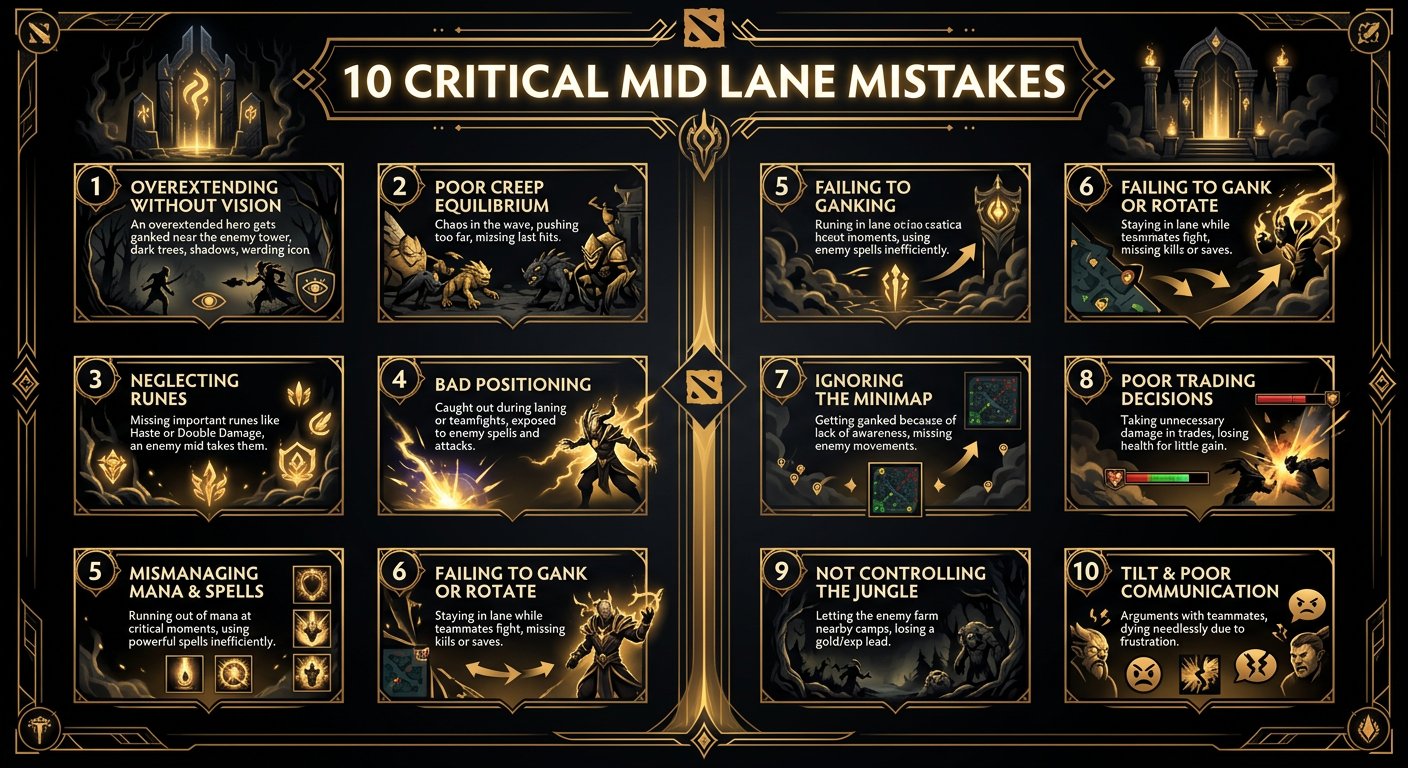
Mistake #1: Winning Lane but Losing Tempo
This is the #1 issue at Divine mid. You win lane, you’re level 9 when the enemy mid is level 7, you have a CS advantage — and then you go to the jungle and farm for the next 10 minutes. Meanwhile, the enemy mid rotates to a sidelane, gets two kills, takes a tower, and suddenly the gold advantage from your lane win is gone.
The fix: after winning lane, immediately look for a rotation that converts your level/item advantage into an objective. Push out the mid wave, walk to a sidelane, get a kill, take a tower. Then farm. The order matters — objective first, farm second. Not farm first, objective never.
Mistake #2: Ignoring Power Runes
At Divine, mid players sometimes skip power runes because they don’t want to lose lane CS. This is a catastrophic error. A Haste or Double Damage rune at 6 minutes can translate into a kill worth 300+ gold and a tower worth 500+ gold for the team. That’s worth more than the 2-3 creeps you’d miss by walking to the rune.
The rule: always contest the rune at even-minute marks unless you would die doing so. If you can’t get the rune, push the wave so the enemy mid can’t get it for free either.
Mistake #3: Not Stacking Your Own Camps
Immortal mid players stack camps for themselves. They pull the medium camp at X:55 while walking to or from lane. They stack the ancient camp with abilities on certain heroes (TA traps, Invoker Forge Spirits, SF razes). These stacks translate into hundreds of extra gold that Divine mid players leave on the table.
Make stacking a habit. Every time the clock is near X:55 and you’re walking past a camp, pull it. Over a 30-minute game, this can add up to 1,000-2,000 extra gold — the equivalent of a free kill or two.
Mistake #4: Fighting Without Checking Enemy Items
Before every fight, Immortal mid players click on enemy heroes to check their items. Did the enemy carry get BKB Did the support buy a Force Staff Does the offlaner have Blade Mail These items completely change how you should approach the fight.
Divine mid players often engage based on “I have my items, let’s go” without checking what the enemy has. Then they die to a BKB they didn’t know about or get caught by a Blink they didn’t see. Make enemy item checks a pre-fight ritual. Every. Single. Time.
Mistake #5: Farming One Side of the Map for Too Long
Map presence is critical for mid heroes. If you’ve been farming your safelane jungle for 3 minutes straight, the enemy knows exactly where you are. They can smoke for you, push the opposite lane, or take Roshan. Your map presence is gone.
The fix: shift your farming between different areas of the map every 60-90 seconds. Farm mid, push the wave, rotate to jungle, TP to the opposite lane, push that wave, farm that jungle. This keeps the enemy guessing about your location and creates space for your team by forcing the enemy to respect your potential presence in multiple areas.
Mistake #6: Wrong Item Build for the Game
Divine mid players often follow the same item build every game regardless of the matchup. They build Aghanim’s because it’s “the build” without considering whether BKB or Blink Dagger would be more impactful in this specific game. Item builds should be responses to the game state, not predetermined plans.
Before buying your next item, ask: “What kills me in fights” and “What stops me from killing the enemy” The answers should determine your item choice. If you’re dying to stuns, buy BKB. If you can’t reach the enemy backline, buy Blink. If you need more damage, buy damage. Sounds simple, but the number of Divine players who buy items based on guides instead of game state is staggering.
Mistake #7: Not Using Scan
Scan is a free information tool that reveals enemy presence in an area. At Divine, it’s used maybe twice per game. At Immortal, it’s used 6-8 times. Before you push a dangerous lane, scan the nearby jungle. Before you start Roshan, scan the enemy’s common smoke routes. Before you farm the enemy jungle, scan the area.
The information from a single scan can save your life, and saving your life means saving 30-60 seconds of death timer and thousands of gold. Use scan aggressively and encourage your team to use it too.
Mistake #8: Predictable Rotation Timings
If you always rotate after your second rune, the enemy knows to expect you. If you always push mid and then go to the offlane, the enemy knows the pattern. Divine mid players develop habits that become exploitable.
Vary your rotations. Sometimes rotate at level 5 before the rune. Sometimes don’t rotate at all until 12 minutes and just out-farm everyone. Sometimes TP to the opposite side of the map from where you’d normally go. Unpredictability is a weapon.
Mistake #9: Dying to Ganks After the Laning Phase
The first 5 minutes of the game, you’re relatively safe because supports are busy in their own lanes. But from minutes 8-15, enemy supports start roaming, and mid heroes are the most common target. Divine mid players die to ganks in this window because they push the wave and then stand in the river or jungle without vision.
The fix: after pushing the wave, immediately retreat to a safe area or go to a part of the map with allied vision. If you don’t have vision of the enemy supports, assume they’re coming for you. This paranoia keeps you alive and keeps your gold advantage intact.
Mistake #10: Not Abusing Level Advantage
Mid heroes hit level 6 before anyone else in the game. This is a MASSIVE power spike. At Immortal, the moment a mid player hits 6, they’re looking for a kill — on the enemy mid, on a sidelane, anywhere. The level 6 timing is the most powerful window for mid heroes, and it should be used every single game.
At Divine, mid players hit 6 and keep farming because they want their first item. This wastes the strongest timing in the game. Even if you don’t get a kill, just showing up in a sidelane with your level 6 ability forces the enemy to play differently and creates space for your carry.
Phase-by-Phase Guide: Laning Through Late Game
Pre-Game: The Draft
Your climb starts in the draft screen. At Divine, many mid players pick their hero regardless of the enemy draft. Immortal mid players counter-pick when possible and always consider how their hero fits into the team composition.
Rules for drafting mid:
- If you can last-pick, do it. Mid matchups are binary — picking into a hard counter can cost you the game.
- If you have to pick early, pick a hero with few hard counters (Ember, QoP, Puck).
- Consider what your team needs. If your carry is a late-game hero, pick a tempo mid that peaks in the mid-game. If your offlaner is a teamfight initiator, pick a mid that follows up on initiation.
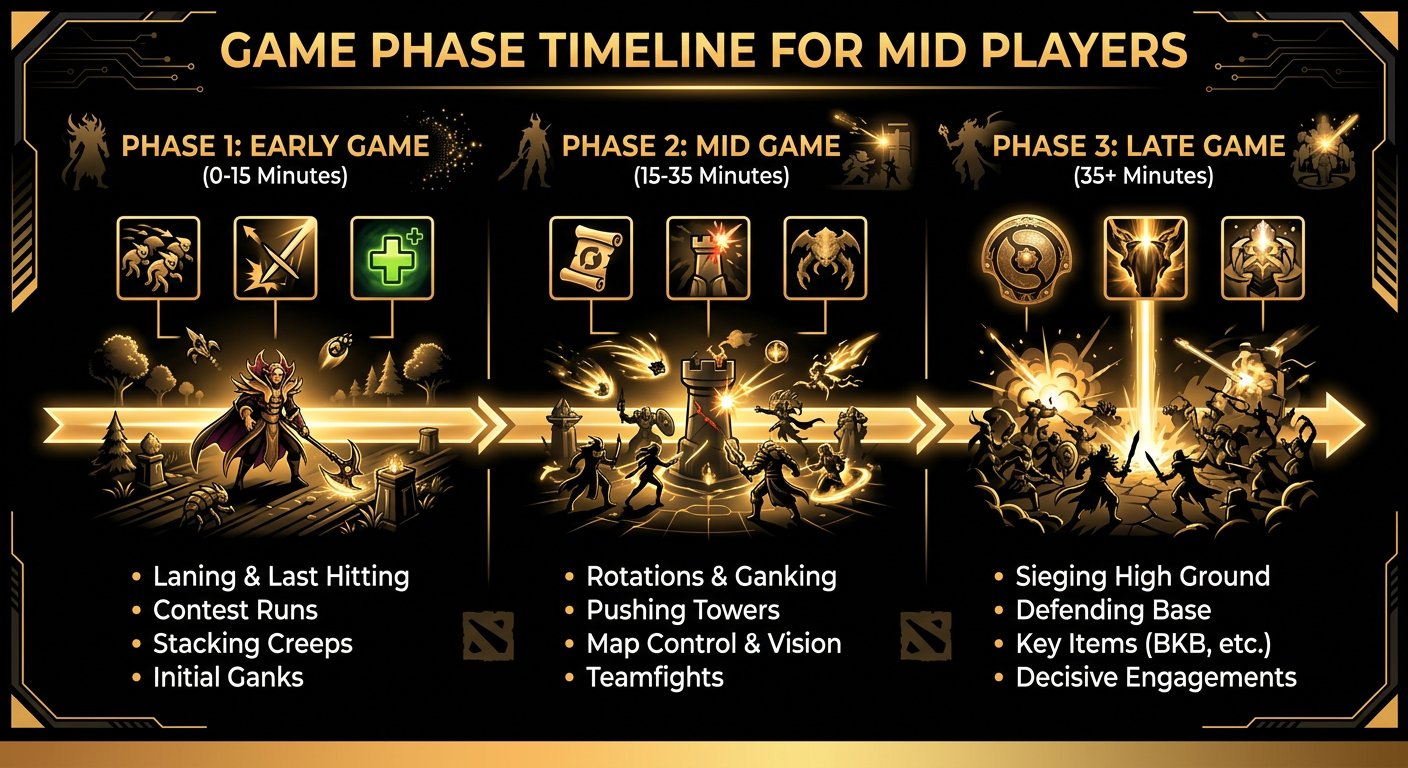
Laning Phase (0:00 – 8:00)
First two waves: Focus purely on securing ranged creeps and denying ranged creeps. The ranged creep is worth more XP and gold than the melee creeps combined. Whoever secures more ranged creep last hits in the first two waves typically controls the lane.
Creep aggro: Use creep aggro manipulation to last hit safely. Right-click the enemy hero to draw creep aggro, which pulls the wave toward you. This is the same mechanic carries use, but it’s even more important mid because the lane is shorter and positioning is tighter.
Rune control: At the 2-minute mark, you should be pushing the wave so you have time to grab the water rune. At even-minute marks after that, be aware of power rune spawns. Shove the wave with abilities before the rune spawns, then walk to secure it.
Level 6 timing: This is your first major power spike. As discussed above, use it immediately. Scan the sidelanes for kill opportunities. If none exist, use your ultimate to threaten the enemy mid — even if you don’t get a kill, forcing them to play defensively gives you free farm and lane control.
Early Mid-Game (8:00 – 18:00)
The rotation decision: After the laning phase, you have two options: continue farming mid and jungle, or rotate to a sidelane. The decision should be based on (a) whether you have a power spike that enables kills, (b) whether there’s a sidelane that’s killable, and (c) whether the potential reward outweighs the farm you’d miss.
Taking mid tower: The mid tower should be your first objective priority. It opens up the enemy’s jungle for your team, provides gold for everyone, and removes a safe area for the enemy mid. At Divine, mid towers often stand until 15+ minutes. At Immortal, they fall by 10-12 minutes because the mid player actively hits the tower whenever the lane is pushed.
Farming patterns: After taking mid tower, shift to a farming pattern that includes 2-3 camps between waves. Push mid wave, take two jungle camps, return to mid for the next wave. Or push mid, TP to a sidelane, push that wave, farm nearby camps, then walk or TP back to mid. The key is never standing idle — always be farming something while waiting for the next wave to push.
Late Mid-Game (18:00 – 30:00)
Team fight contribution: This is the phase where mid heroes are strongest. Your level advantage and item timing should make you the most impactful hero in team fights. Position yourself to maximize your spell impact while staying alive. For burst mids (QoP, Lina, Invoker), look for picks on isolated enemies. For sustained damage mids (Storm, Ember), look for extended fights where you can use your mobility to avoid damage while dealing it.
Objective timing: Coordinate with your team for Roshan. Mid heroes like TA and Invoker accelerate Roshan significantly. Having Aegis on your carry while your mid has full items is a massive power play that often results in high ground pushes.
Avoiding the “afk farming mid” trap: At this stage, you should be farming WITH purpose — every camp, every wave you farm should be leading to a specific objective. “I need 1,200 gold for BKB, then we fight at Roshan” is a plan. “I’m just farming jungle because I don’t know what else to do” is how you lose games.
Late Game (30:00+)
Your role changes. In the late game, mid heroes transition from primary damage dealers to utility/initiation providers (in most cases). Your BKB has fewer charges, the enemy carry has caught up in items, and fights are decided more by team coordination than individual hero power.
Key late-game principles:
- Save your abilities for the right targets. Using your burst combo on the enemy support is wasteful — use it on the enemy carry.
- Position carefully. You’re not the tankiest hero. Getting caught means your team fights 4v5.
- Buy items that help your team win fights, not items that look good on your stat screen. Refresher Orb for double Ravage on your Tidehunter is more valuable than another damage item on you.
- Buyback awareness — same as carries. After 35 minutes, dying without buyback can lose the game.
The Teammate Problem: Account Buyers, Boosted Players, and the Divine Ego
Mid lane attracts ego. It’s the “star” role, the 1v1, the position that everyone watches. At Divine, this ego problem is amplified because every mid player thinks they’re the best player in the lobby. This creates a specific team dynamic issue that doesn’t exist at other ranks.

The Mid Lane Ego Trap
When you lose lane as a Divine mid player, the instinct is to blame external factors — the enemy got a good rune, their support rotated, your hero is countered. Sometimes these are valid. But Immortal mid players have a different response to losing lane: they immediately shift to a plan B.
Plan B might be farming jungle until you catch up in levels. It might be rotating to a sidelane where you can contribute even without your usual power spike. It might be playing a more defensive role and enabling your carry instead of trying to carry the game yourself. Flexibility of ego is just as important as flexibility of gameplay.
Account Buyers and How They Affect Your Games
At Divine, you’ll encounter account buyers more frequently than at any other rank. Here’s how they typically affect mid players specifically:
- As your carry: An account-bought carry will farm slowly and miss timings. This means you need to be more self-sufficient. Build for solo kill potential rather than team-fight synergy.
- As your support: An account-bought support won’t stack for you, won’t ward for you, and might steal your farm. Accept it and adapt. You can’t control them.
- On the enemy team: An account buyer on the enemy team is a free win IF you exploit it. Identify the weakest player on the enemy team (usually the one dying most in the early game) and target them specifically. Feed off their mistakes.
How to Lead as Mid Without Tilting Your Team
Mid players are natural team leaders because they have the best game overview — they can see both sidelanes from their position, they hit level 6 first, and they control the tempo. Use this position to lead, not to dictate.
Good leadership: “I have ult, let’s smoke bot” / “I’ll push mid, play safe” / “Roshan in 2 minutes, gather”
Bad leadership: “Why aren’t you stacking for me” / “This carry is so bad” / “GG we lost because of offlane”
The difference between these two approaches is the difference between a Divine player and an Immortal player. One creates cooperation, the other creates tilt. And tilted teammates play worse, which costs you MMR.
Realistic Timeline: How Long Will This Take

Mid-Specific Climbing Speed
Mid players tend to climb faster than other roles when they’re genuinely above their bracket because mid has the most individual impact. A truly Immortal-level mid player in Divine can maintain a 58-63% win rate, which translates to the following timelines:
- At 58% win rate (3-4 games/day): ~3-4 months to climb 1,000 MMR
- At 60% win rate (3-4 games/day): ~2-3 months
- At 63% win rate (3-4 games/day): ~6-8 weeks
These numbers assume consistent play without extended losing streaks caused by tilt. The moment you start playing on tilt, your win rate drops to 40-45% and you lose MMR faster than you gained it.
The Plateau Points
Mid players typically plateau at two points during the Divine-to-Immortal climb:
First plateau: ~5,000-5,200 MMR. This is where the “good Divine” players sit. They have strong laning skills but haven’t mastered tempo control. The games start feeling harder because opponents are also good laners, so you can’t rely on lane dominance alone.
Second plateau: ~5,400-5,600 MMR. This is the “almost Immortal” zone. Players here have everything except consistency. They have Immortal-level games and then Divine-level games in the same session. The fix is usually mental game — consistency of focus, avoiding tilt, and maintaining decision quality across many games.
When you hit a plateau, consider investing in professional coaching. A coach who reviews your replays can identify your specific bottleneck within one or two sessions, which is far more efficient than trying to figure it out yourself over weeks of grinding.
When Solo Queue Isn’t Enough
Sometimes the grind is too long and too mentally draining. If you’ve been stuck at the same MMR for months and you’re burning out, MMR boosting can bridge the gap. Many of our clients combine boosting with coaching — they get boosted to their target rank, then use coaching sessions to develop the skills to maintain and continue climbing.
Frequently Asked Questions
Almost never. Mid matchups are heavily influenced by hero picks. If you first-pick and get hard countered, you’ve given yourself a 40% win rate before the game starts. If possible, pick your mid hero in the second round of picks or as the last pick. If you must pick early, choose a versatile hero like Ember Spirit or Puck that doesn’t have hard counters.
Create custom lobbies with cheats enabled and practice the first 5 minutes of laning against the hero you struggle with (play both sides). You can also use the “mid only” custom games to get rapid repetitions of laning phase. But the most effective practice is simply playing ranked and focusing on improving one aspect of the matchup each time.
Cheese picks like Meepo and Broodmother can work at Divine, but they’re inconsistent because they’re often banned or countered. If you can play one of these heroes at a very high level AND you’re good at identifying when to pick them, they can accelerate your climb during the games where they work. But they shouldn’t be your primary heroes — they should be pocket picks for specific situations.
Very important. Divine is the bracket where communication starts to actually work because most players understand game concepts. Calling your plays (“I’m going for rune bottom, careful mid”) and coordinating smokes and objectives can dramatically improve your win rate. The mid player who communicates their plan wins more than the mid player who plays in silence.
This is the true test of a great mid player. When both sidelanes lose, you have two options: (1) accelerate your own farm to become the team’s win condition, or (2) rotate to the least-lost sidelane and try to salvage it. The choice depends on your hero — tempo mids should rotate, farming mids should accelerate. Never try to save a completely lost lane — the enemy will be too strong and you’ll die too. Target the lane that’s slightly behind, where your rotation can tip the balance.
Consistency comes from routines. Play the same number of games at the same time of day. Warm up with one practice lobby before ranked. Always take a break after two losses. Review one replay per day. These habits create a stable mental foundation that prevents the wild swings between “I’m playing great” and “I’m playing terrible” that characterize Divine players.
Final Thoughts
The mid lane at the Divine-to-Immortal threshold is the purest test of Dota skill. It demands mechanical precision, strategic depth, emotional control, and the ability to lead a team of strangers toward a common goal. Every game is an exam, and the questions change every time.
But here’s the good news: you’re already Divine. You already have 90% of what it takes. The remaining 10% — tempo control, fight selection, map-wide farming efficiency, and mental consistency — is learnable. It just requires deliberate practice and honest self-assessment.
Pick your three heroes. Master their matchups. Learn their timings. Control the tempo. And most importantly, stay consistent. Immortal isn’t a destination — it’s a confirmation that you’ve been playing at that level consistently enough for the number to catch up.
Ready to accelerate your climb Our Dota 2 coaching service pairs you with Immortal and leaderboard players who specialize in mid lane development. Or if you want to skip the grind and focus on improvement, check out our MMR Boost service.

Ready to Climb Start Your Journey Today
Team Smurf offers professional coaching with Divine and Immortal players, plus safe, reliable MMR boosting to help you reach your target rank.
Written by Team Smurf’s Immortal-rank analysts — Rankings last verified February 2026