How to Climb from Divine to Immortal as Pos 1 Carry

The jump from Divine to Immortal is the single most brutal MMR climb in Dota 2. It’s not even close. Going from Archon to Legend You just need to learn to farm. Legend to Ancient Improve your teamfight positioning. Ancient to Divine Develop game sense. But Divine to Immortal You need to master everything — and then do it consistently across hundreds of games against players who also know everything.
I’ve coached over 200 Divine carry players trying to break into Immortal, and the pattern is always the same. They have the mechanics. They understand the game. But they’re missing the 5% of optimization that separates a 5,000 MMR player from a 6,000 MMR player. That 5% is what this guide is about.
This isn’t a beginner-friendly guide. I’m not going to explain what last-hitting is or why you should buy BKB. If you’re Divine, you already know the fundamentals. What I’m going to show you is the elite-level decision-making framework that Immortal carries use every single game — the stuff that doesn’t show up in replays unless you know exactly what to look for.
Table of Contents
- The Pos 1 Role at Divine — What’s Actually Holding You Back
- Top 5 Heroes to Climb from Divine to Immortal as Carry
- 10 Critical Mistakes Divine Carries Make (That Immortals Don’t)
- Phase-by-Phase Guide: Laning Through Late Game
- The Teammate Problem: Account Buyers and Boosted Players
- Realistic Timeline: How Long Will This Take
- FAQ
The Pos 1 Role at Divine — What’s Actually Holding You Back
At Divine rank, every carry player thinks their issue is either (a) bad teammates or (b) not enough hero pool variety. Both are wrong. The real issue at Divine is efficiency under pressure — the ability to maintain optimal play when the game isn’t going according to plan.
Let me break this down. In a comfortable game where you win your lane, get free farm, and your team creates space — every Divine carry looks like an Immortal player. The difference shows up in the ugly games. The games where you got zoned in lane. The games where your mid lost. The games where the enemy has three heroes that want to kill you. That’s where Immortal carries separate themselves.
Efficiency Is Not Just About GPM
When I say efficiency, I don’t just mean gold per minute. I mean decision efficiency — the number of correct decisions made per minute. An Immortal carry averages something like 8-12 meaningful micro-decisions per minute during the farming phase. Where to stand in lane. Whether to draw aggro. When to pop a clarity versus ferrying one. Whether to push the wave before the rune spawn or after. Whether to take the small camp or the large camp between waves.
A Divine carry makes maybe 5-7 of these decisions per minute, and some of them are suboptimal. Over a 30-minute game, that’s potentially hundreds of small inefficiencies that compound into a 1,000-2,000 gold deficit compared to where an Immortal player would be with the same game state.
The “Comfortable GPM” Trap
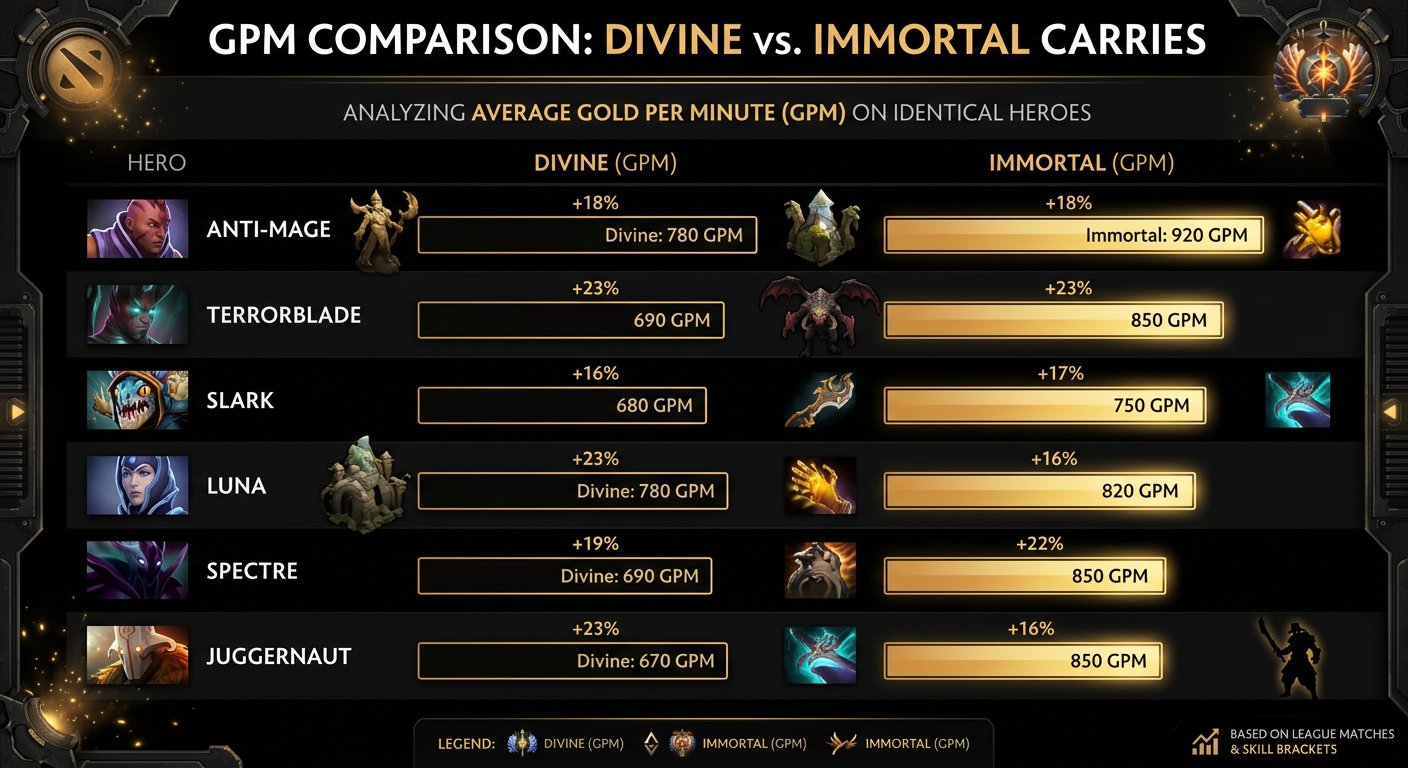
Here’s a pattern I see constantly at Divine. A carry player averages 650 GPM on their best heroes. They feel good about that number. But here’s the thing: 650 GPM in Divine means you’re farming at roughly the same rate as everyone else. You’re not creating a gap. You’re treading water.
Immortal carries on the same heroes in the same matchups average 700-750 GPM. That extra 50-100 GPM doesn’t come from being mechanically faster at hitting creeps. It comes from never wasting time. They never walk between camps without a purpose. They never stand in lane waiting for the wave when they could be stacking. They never take fights that don’t give them more than farming would.
Map Awareness as a Carry
This is the single most underrated skill for carry players at this bracket. Divine carries check the minimap reactively — they look when they hear a ping or when something catches their peripheral vision. Immortal carries check the minimap proactively on a rhythm. Every 3-5 seconds, their eyes flick to the minimap. Not to look for ganks — to process information.
Where are the enemy heroes showing How long since the enemy 4 was visible Did the enemy mid just use their TP Is there a lane pushing toward the enemy that nobody is going to This information feeds directly into farming decisions. If three enemies show on the opposite side of the map, an Immortal carry instantly pushes out a dangerous lane and takes enemy jungle camps. A Divine carry stays in their safe jungle and misses the window entirely.
Understanding Your Win Condition
Every game has a win condition for the carry, and it’s not always “farm until six-slotted and fight.” Sometimes your win condition is “get BKB and fight at 22 minutes because the enemy carry outscales you.” Sometimes it’s “split push with Manta and avoid fights until 35 minutes.” Sometimes it’s “take Roshan at 25 minutes and push high ground.”
Divine carries tend to have a default game plan that they follow regardless of the actual game state. They get their farming item, they farm until their fighting item, then they fight. This rigid approach costs hundreds of MMR. Immortal carries are constantly re-evaluating their win condition based on how the game is developing, and they adjust their item builds and timings accordingly.
Top 5 Heroes to Climb from Divine to Immortal as Carry
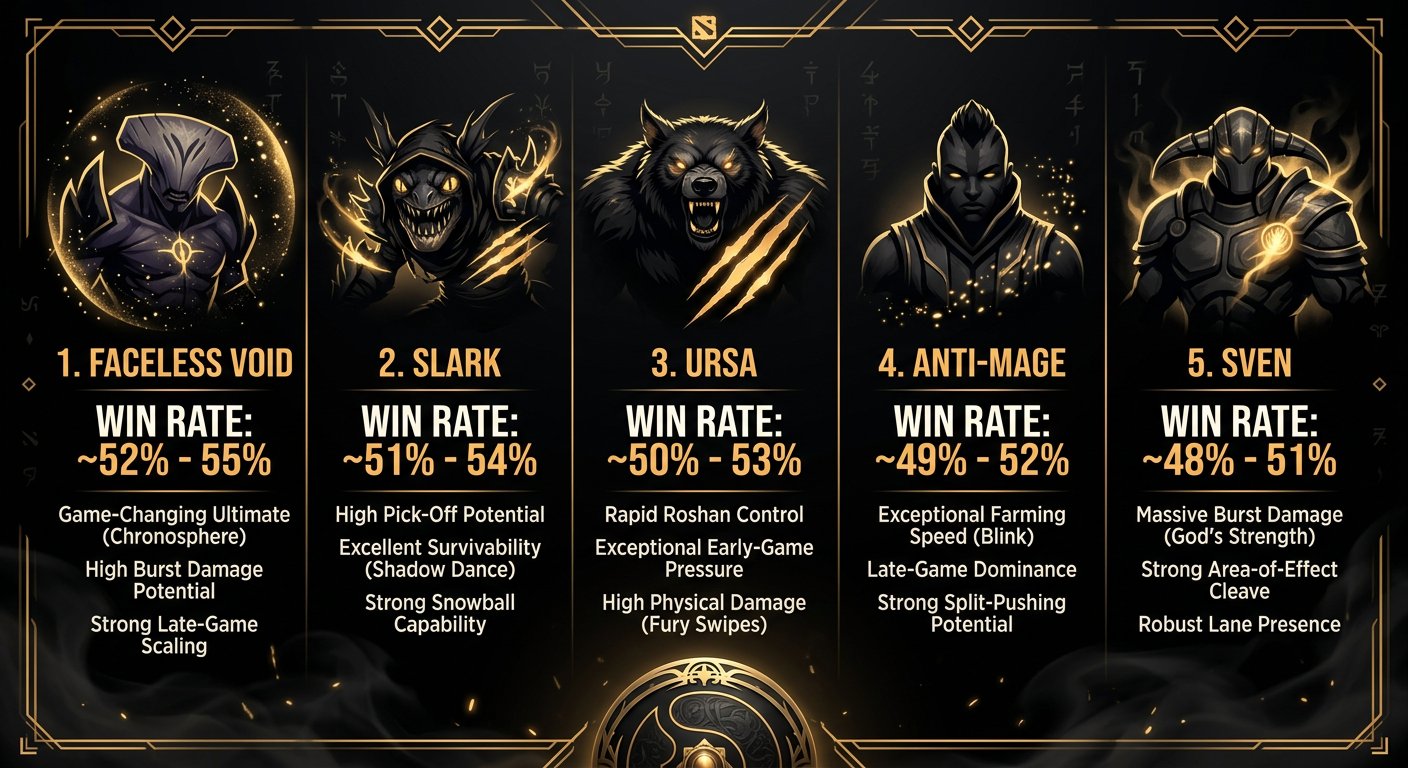
Hero choice matters more at this bracket than anywhere else in Dota. At lower ranks, you can win with anything because the skill gaps are larger. At Divine, the margins are thin enough that hero matchups and meta relevance genuinely impact your win rate. Here are the five heroes I recommend for climbing, and why.
1. Naga Siren
Naga is the ultimate “I’m better than everyone in this lobby” hero. She rewards micro skill, farming efficiency, map awareness, and split-push decision-making — all of the things that separate Divine from Immortal. If you’re truly playing at an Immortal level, Naga lets you express that in ways that other carries don’t.
Why she works at this bracket: Divine players still struggle to coordinate against Naga’s split push. Even when they know what you’re doing, they often can’t execute the response properly. Naga creates dilemmas that require team coordination to solve, and team coordination is the weakest link in Divine pubs.
Key timings: Radiance timing at 16-18 minutes means you’re on track. If you’re getting it before 16, you’re stomping. After 20, you’re behind and need to recalibrate. After Radiance, your GPM should skyrocket to 800+ if you’re farming correctly with illusions across all three lanes and both jungles.
Advanced tip: The difference between a Divine Naga and an Immortal Naga is illusion micro during fights. Immortal Naga players send illusions behind the enemy to cut off retreat paths, use Sleep offensively to isolate targets, and use Song to reset fights rather than just as an escape. Practice setting up your illusion grid with control groups until it’s muscle memory.
2. Faceless Void
Chronosphere is the single most game-changing ability in Dota, and at Divine, players still don’t respect the threat radius enough. Void’s strength at this bracket is that a well-placed Chrono can win a game against any draft, regardless of the gold difference.
Why he works at this bracket: Void punishes the clumping that still happens at Divine. Even players who know they should spread out will group up at Roshan, in choke points, and during high ground pushes. One good Chrono on three heroes ends the game.
Key timings: Maelstrom + BKB by 22-24 minutes. This is your power spike. You don’t need Mjollnir, you don’t need Aghanim’s. You need BKB so you can walk into Chrono range without getting stunned before you cast it. The number of Divine Void players who try to Chrono without BKB is staggering.
Advanced tip: Stop using Chrono as your initiation tool. The best Void players use Chrono as a counter-initiation or a follow-up. Let the enemy commit to a fight, let them use their spells, then Chrono when their key abilities are on cooldown. This is a complete mindset shift from “I need to land a big Chrono to start the fight” to “I need to land the right Chrono at the right time.”
3. Phantom Lancer
PL is the hardest carry to deal with when played correctly, because he requires specific itemization and coordination to counter. At Divine, teams often fail to draft or itemize for PL, giving you free wins in the right games.
Why he works at this bracket: PL’s strength scales directly with your ability to manage illusions during fights. The mechanical skill ceiling is extremely high. If you can consistently control PL at a high level, you’re getting more out of the hero than 95% of Divine players can.
Key timings: Diffusal Blade by 16 minutes. This is non-negotiable. After Diffusal, you’re looking for fights with your team. PL is not a passive farmer — he’s an active carry who fights from the mid-game onward. Mana burn plus illusion generation in fights is your identity.
Advanced tip: Use Doppelganger proactively in fights, not reactively. The moment you enter a fight, start planning your Doppelganger repositioning. Use it to dodge key spells — not after you’ve already been hit by them. The best PL players also use Doppelganger to refresh their illusion army mid-fight, casting it on top of enemies to generate a fresh wave of illusions.
4. Terrorblade
Terrorblade is the ultimate “punish greedy drafts” carry. If the enemy doesn’t have strong burst damage and AoE, TB becomes unkillable with Sunder and overwhelms with Metamorphosis pushes. At Divine, drafts are often greedy enough for TB to thrive.
Why he works at this bracket: TB is the best tower-taking carry in the game. At Divine, teams often win fights but fail to capitalize by taking objectives. TB doesn’t have that problem — if you win a fight, you take a tower. If you win two fights, you take a lane of barracks. The hero converts advantages into wins more efficiently than almost any other carry.
Key timings: Dragon Lance + Manta by 20-22 minutes. This is your Metamorphosis push timing. When Meta is off cooldown, you should be hitting a tower. When it’s on cooldown, you should be farming. This rhythm — farm, push, farm, push — is how TB games play out.
Advanced tip: Sunder timing is everything. Divine TB players Sunder too late — they wait until they’re almost dead and then panic Sunder. Immortal TB players Sunder at about 30-40% HP, which gives them a larger HP swing and more time to continue fighting. Also, remember that Sunder goes through BKB at higher levels. Use this to catch enemies off guard.
5. Juggernaut
Juggernaut is the most reliable carry in Dota for climbing because he has no truly terrible matchups and is relevant at every stage of the game. He’s not as flashy as the other heroes on this list, but his consistency is unmatched.
Why he works at this bracket: Juggernaut’s kit — Blade Fury for laning, Healing Ward for sustain, Omnislash for kill threat — means you always have options. You can fight early, farm mid-game, and carry late. You’re never irrelevant. In a bracket where games are volatile and unpredictable, this versatility is incredibly valuable.
Key timings: Battlefury by 14-16 minutes, Manta by 22-24 minutes. Or Phase + Maelstrom by 12 minutes for a fighting build. The build should adapt to the game — if you need to fight early, go Maelstrom. If you have space, go Battlefury. This flexibility is what makes Juggernaut so strong.
Advanced tip: Spin TP is the most underused skill combination in Divine. If you’re about to die, you Spin and TP simultaneously. The magic immunity from Blade Fury protects your TP from most disables. At Immortal, players do this instinctively. At Divine, carries forget about it in the heat of the moment and die unnecessarily.
10 Critical Mistakes Divine Carries Make (That Immortals Don’t)
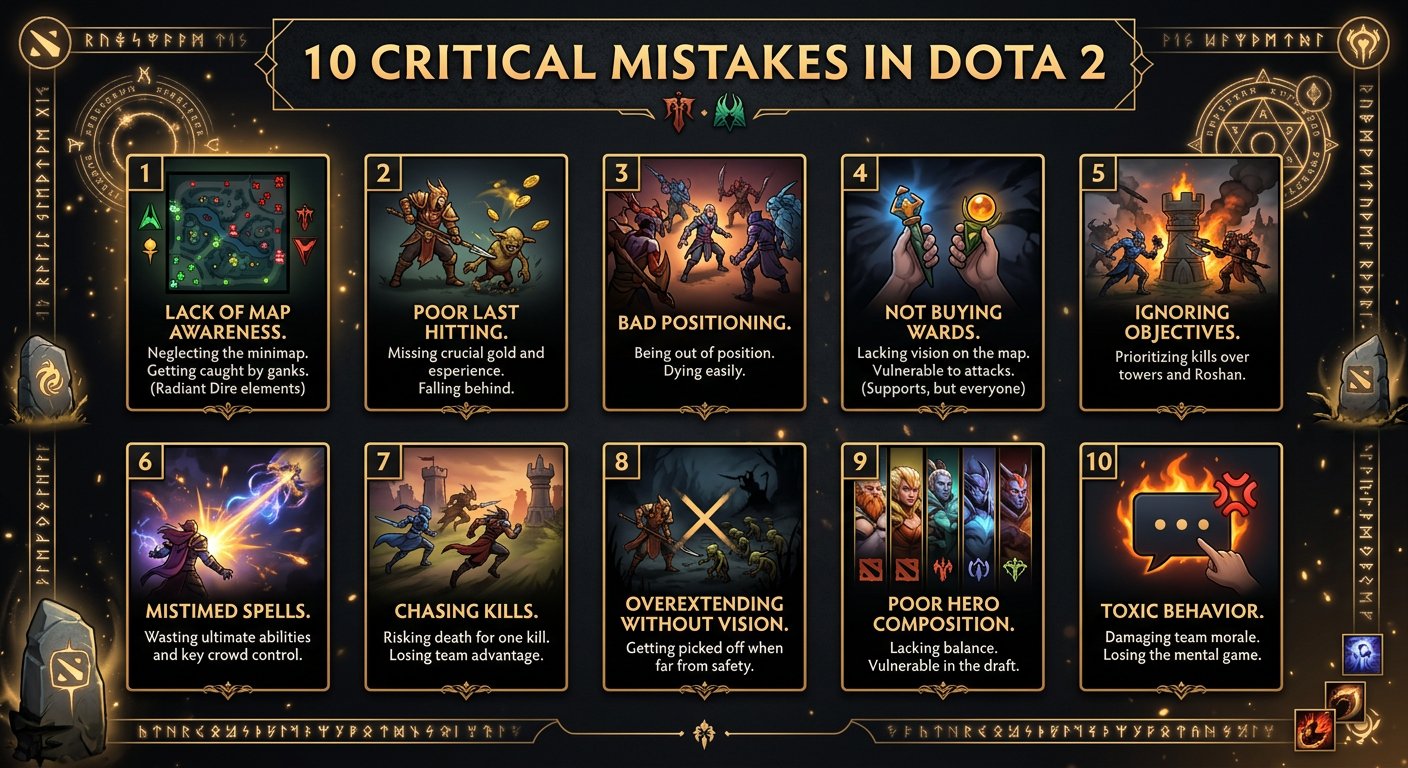
These aren’t beginner mistakes. These are the subtle, high-level errors that cost you 50-100 MMR over dozens of games. Fixing even three or four of these will noticeably improve your win rate.
Mistake #1: Farming the Wrong Side of the Map
This is the most common mistake and the most impactful. At Divine, carries often farm based on convenience — they go to whichever jungle is closest or whichever lane is pushed toward them. Immortal carries farm based on information.
The principle is simple: farm the side of the map where you’re most protected. If your team is grouped on the left side of the map, you should be farming the left jungle or the left lane. If enemies are missing from the map, you should be farming closer to your towers, not pushing out dangerous lanes. The gold you lose by farming “safe” areas is vastly less than the gold you lose by dying in a dangerous spot.
The advanced version of this: farm the opposite side of the map from where the enemy wants to fight. If their team wants to take Roshan, you push the far lane. If their team is pressuring your safelane towers, you’re taking their offlane tower. This forces them to choose between their objective and dealing with you, and either choice is good for your team.
Mistake #2: Not Hitting Your Item Timing Windows
Every carry hero has power spike timings based on their item progression. Divine carries often miss these windows by 2-3 minutes because of small farming inefficiencies. Those 2-3 minutes don’t seem like much, but they mean you’re fighting with your power spike when the enemy already has their counter-item, or they mean you’re farming when you should be pushing your advantage.
Track your item timings obsessively. Write down your target timings for each hero and compare your actual timings after every game. If your Battlefury timing is consistently 17 minutes when it should be 14, you need to analyze your replays to find where you’re losing time. Common culprits: walking between camps instead of using abilities to farm, missing last hits under tower, and not stacking camps or asking your support to stack.
Mistake #3: Taking Bad Fights Because Your Team Pings
This is a mental game issue more than a mechanical one. At Divine, your teammates will ping you to fight constantly. Sometimes they’re right. Often, they’re wrong. The skill is knowing the difference.
Here’s the framework: before joining a fight, ask yourself three questions. (1) Do I have a relevant power spike right now (2) Is this fight at an objective that matters (3) Can we actually win this fight If the answer to any of these is no, keep farming and mute anyone who flames you. Your job is to win the game, not to appease your teammates’ desire to brawl at 15 minutes when you have a Battlefury and brown boots.
Mistake #4: Predictable Farming Patterns
If you farm the same pattern every game — same camps, same rotation, same lane shove timing — good players will notice and punish you. Divine carries tend to develop muscle memory patterns that they follow unconsciously. Immortal carries vary their patterns based on the enemy’s likely movements.
The fix: after each death, review whether your farming pattern was predictable. If you died in the same area of the map where you always farm at that game time, you have a pattern problem. Force yourself to vary your rotation. If you normally go triangle lane jungle, try lane enemy jungle triangle. Keep the enemy guessing.
Mistake #5: Not Pressuring Towers When You Should
Divine carries love to farm. They’ll farm when they should be pushing, farm when they should be at Roshan, and farm when they should be taking barracks. The fear of “going too early” causes Divine carries to miss windows that Immortal carries take automatically.
The rule of thumb: if you have a major item advantage and the enemy carry doesn’t have their own power spike yet, you should be pressuring objectives. If you just got your BKB and the enemy carry is still farming their third item, that’s your window. Push. Fight. Take Roshan. Convert your advantage into buildings. Buildings don’t expire — gold advantages do, because the enemy is also farming.
Mistake #6: Wrong BKB Timing
This is maybe the single most impactful item timing decision for carry players, and Divine players get it wrong constantly. They either buy BKB too early (before they have enough damage to use the BKB window effectively) or too late (after they’ve already died three times without it).
The heuristic: if the enemy has two or more stuns or disables that can target you in fights, BKB should be your second major item. Not third. Not fourth. Second. Yes, this means sometimes getting BKB before your farming item is complete. An alive carry with BKB does more damage than a dead carry with Butterfly.
Mistake #7: Not Farming During Downtime in Fights
Immortal carries never stop farming, even during fights. While they’re waiting for their BKB cooldown, they’re farming the nearest camp. While they’re walking to a fight, they’re clearing a wave on the way. While their team is posturing before a Roshan contest, they’re taking the adjacent jungle camps.
This “incidental farming” adds up to thousands of gold over the course of a game. Every second your hero is idle is gold wasted. If you’re standing behind your team waiting for a fight to start, you’re losing gold. Walk back, take a camp, and then walk forward again. The fight won’t start in the 5 seconds you’re gone, and if it does, TP in.
Mistake #8: Dying With Buyback on Cooldown
After the 30-minute mark, dying without buyback available is often game-losing. Divine carries don’t think about buyback cooldown when making decisions. They die, buy back, die again, and then lose because they’re dead for 80 seconds with no buyback.
The rule: after 30 minutes, if your buyback is on cooldown, you play like a coward. Farm safe areas. Don’t push dangerous lanes. Don’t take risky fights. Stay alive until buyback is available again. Once buyback is available, you can play more aggressively because you have a safety net. This single behavior change will win you games.
Mistake #9: Ignoring Lane Creep Equilibrium
This is a laning phase mistake that has massive downstream effects. Divine carries sometimes push the lane unintentionally through over-harassing or pulling aggro at the wrong time, which causes the wave to push toward the enemy tower where they’re vulnerable to ganks and can’t safely farm.
Immortal carries maintain creep equilibrium obsessively in the first 5 minutes. They pull aggro to manipulate the wave position. They know exactly how many attacks they can throw at the enemy without pushing the wave. They call for their support to pull or deny based on the wave state. This level of control means they rarely get ganked in lane and consistently hit their early item timings.
Mistake #10: Playing Too Many Heroes
This is the most controversial point but the most important for climbing. At Divine, you should have a pool of 3-4 carry heroes that you play at an Immortal level, not 8-10 heroes that you play at a Divine level. Depth beats breadth for climbing.
When you play the same hero 200+ times, you develop an intuitive understanding of your power levels at every game state. You know exactly when you can fight, when you can farm, and when you can take objectives. With a hero you’ve played 30 times, you’re guessing. At the Divine-to-Immortal threshold, guessing costs MMR.
Phase-by-Phase Guide: Laning Through Late Game
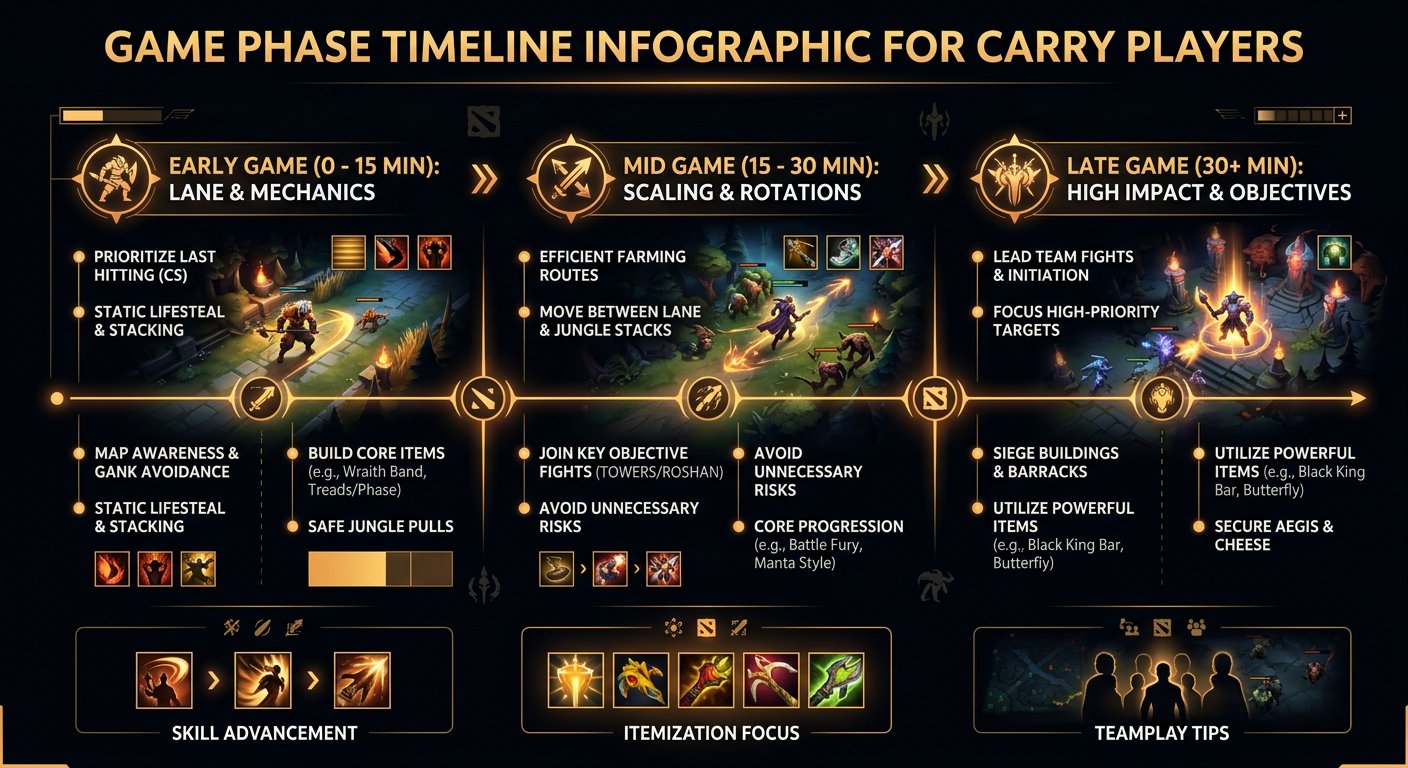
Let’s break down how an Immortal carry thinks through each phase of the game. This isn’t about specific hero abilities — it’s about the universal decision-making framework that applies to every carry.
Laning Phase (0:00 – 8:00)
The priority order: Don’t die > Get last hits > Deny creeps > Harass enemy > Secure runes
That priority order might seem obvious, but Divine carries violate it constantly. They go for a last hit that puts them in danger. They try to harass when they should be denying. They leave lane for a rune when the lane state needs attention.
Creep aggro mechanics: At this level, you should be using creep aggro manipulation on almost every last hit in a contested lane. Right-click the enemy hero to draw aggro, then back up to pull the wave toward you. This lets you last hit safely and keeps the wave in a favorable position. Repeat every wave. Immortal carries do this automatically — it’s muscle memory. If it’s not muscle memory for you yet, practice it until it is.
Communication with your support: Your lane partner is crucial in the first 5 minutes. Tell them what you need. If you need pulls, say “pull.” If you need them to zone, say “zone.” If the lane is impossible and you need to jungle, say “leave lane.” Don’t expect them to read your mind. Clear communication is a massive edge at this bracket where most players stay silent and then flame afterward.
Recognizing when the lane is lost: If you’re dying in lane or can’t get more than 50% of last hits, the lane is lost. Don’t stubbornly stay. Rotate to the jungle with a quelling blade and start stacking for yourself. A carry who’s farming jungle at 4 minutes is in a better position than a carry who’s feeding kills in lane at 4 minutes. This adaptability is crucial.
Early Mid-Game (8:00 – 18:00)
The transition: This is the phase where you shift from laning to farming patterns. Your first tower is either still standing or it’s fallen, and that determines your farming geography.
If your tower is up: Continue farming the safe lane and your triangle. Stack camps when possible. Push the wave out past the river, then rotate to camps. This is the standard pattern and it should feel comfortable.
If your tower is down: This is where Divine carries struggle. The instinct is to retreat to the jungle and farm passively. The Immortal response is to shift your farming to the enemy’s jungle. If your safelane tower is gone, the enemy offlaner has moved on. Their jungle is now available for you to farm. Push the wave past where your tower was, take the enemy’s camps, and TP back to safety if threatened.
TP usage: At this bracket, your TP cooldown should never be wasted. Every TP should either save your life, get you to a fight that you can win, or move you to a farm-dense area faster than walking. If you TP to a lane and then walk to the jungle, you might have been better off walking to the lane and saving your TP. Think about TP efficiency constantly.
Power spike awareness: When you complete a major item (Battlefury, Maelstrom, Manta, BKB), ask yourself: does this item change what I can do If you just got BKB, maybe you should fight. If you just got Battlefury, definitely keep farming. Match your behavior to your current power level.
Late Mid-Game (18:00 – 30:00)
This is where games are won or lost at Divine. This is the phase where team coordination matters most, and it’s the phase where Divine players make the most mistakes.
Objective-based farming: Stop farming aimlessly. Every farming decision should connect to an objective. You’re farming these camps because your BKB is 800 gold away and then you’re fighting at Roshan. You’re pushing this lane because it pressures a tower that forces rotations. Farming without purpose is a Divine habit. Farming with purpose is an Immortal habit.
Smoke awareness: After 20 minutes, you should expect enemy smoke plays. If multiple heroes are missing and you’re in an aggressive position, assume a smoke gank is coming. Back up. Farm a safe camp. Let the smoke expire. If the enemy wastes a smoke on empty map space, they’ve wasted 50 gold and 90 seconds of five heroes’ time. That’s a massive win for you.
Roshan timing: Roshan spawns and respawns should be on your mental calendar at all times. If Roshan is alive and you have a power spike, taking Roshan should be your highest priority. Aegis on a carry is worth more than any single item in the game. It lets you fight without fear of death, which completely changes the dynamic of team fights.
When to stop farming and group: This is the hardest decision for carry players. The answer depends on your hero and your items, but the general rule is: group when you have your core fighting items and the enemy is contesting objectives you care about. Don’t group to defend a Tier 1 tower at 25 minutes — it’s not worth it. Do group to defend your high ground or contest Roshan.
Late Game (30:00+)
The carry’s late game is all about buyback management and fight selection.
Always have buyback gold. After 30 minutes, unreliable gold doesn’t matter because you should always have 5,000+ gold reserved for buyback. This is non-negotiable. If you have 4,500 gold and a 5,000 gold item you want to buy, you wait. Buyback is more important than any item.
Fight selection: In the late game, one fight decides the game. Don’t take coin-flip fights. Take fights where you have an advantage — Aegis, number advantage, high ground defense, better initiation. If the enemy wants to fight on their terms, don’t accept. Counter-offer by split-pushing or pressuring a different objective. Force them to fight on your terms.
Itemization in the ultra-late: At 40+ minutes, think about what kills you in fights and buy the item that prevents it. Not the item that gives you the most DPS — the item that keeps you alive. A carry who survives the fight and hits for 200 damage wins. A carry who dies in 2 seconds and hits for 400 damage loses. Survivability scales harder than damage in the ultra-late game because fights are decided by who lives, not who deals more damage on paper.
The Teammate Problem: Account Buyers, Boosted Players, and Tilters
Let’s talk about the elephant in the room. Divine bracket has the highest concentration of account buyers and boosted players in all of Dota 2. It’s the first “prestigious” rank — the one that people want on their profile — so it’s the most common target for boosting services. And it’s the bracket where those boosted players land when they start losing.
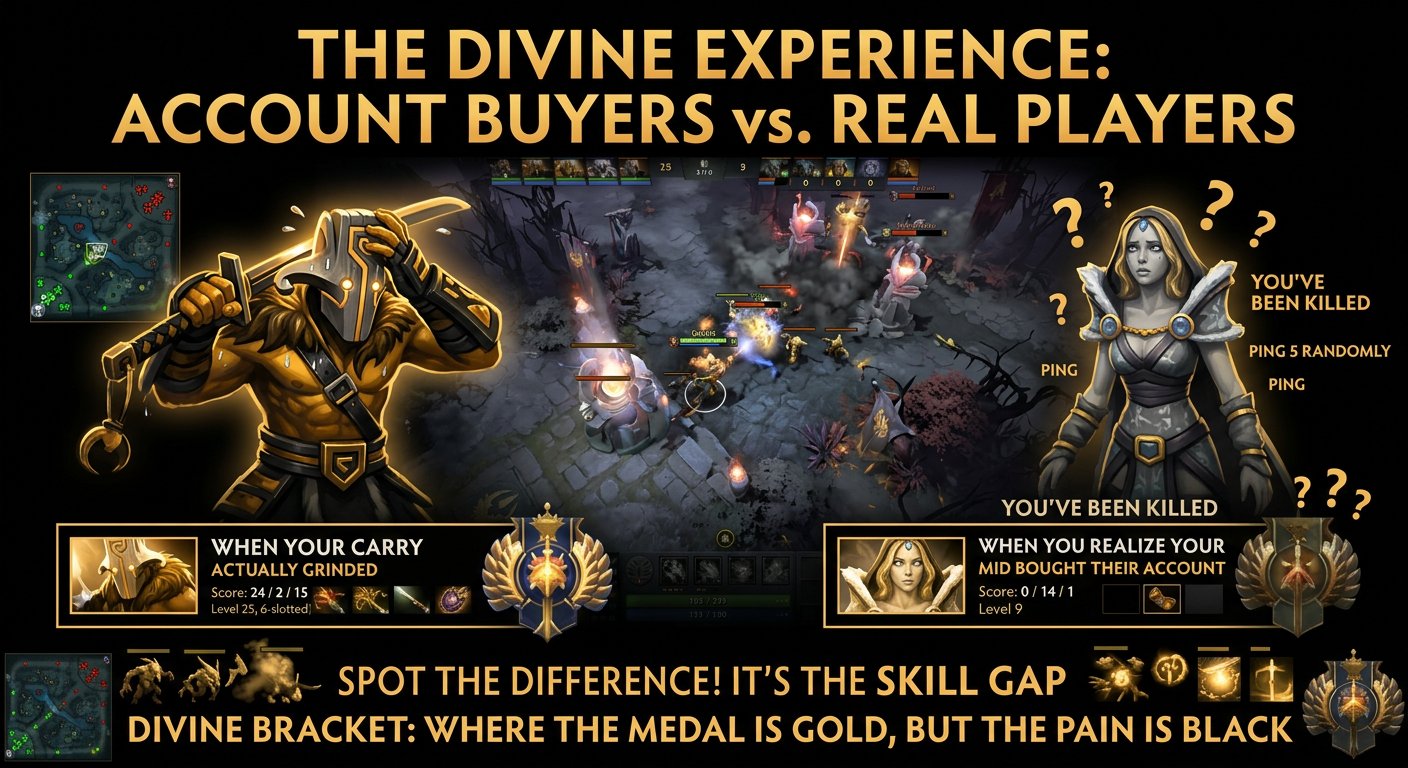
Here’s the hard truth: you cannot control your teammates. You will get account buyers. You will get tilters. You will get players having their worst game. The enemy team gets them too. Over hundreds of games, the distribution evens out. The only constant is you.
How to Win Despite Bad Teammates
Communication is prevention. At the start of every game, during the draft phase, communicate your plan. “I want to farm for 20 minutes and then fight with BKB.” This sets expectations. When your team knows what you’re doing and why, they’re less likely to tilt because they understand the plan.
Adapt to your team, don’t expect them to adapt to you. If your mid player is playing aggressively and creating space, farm faster and hit your timings early. If your support is passive and not stacking, stack for yourself. If your offlaner keeps feeding, play safe and wait for the enemy to make mistakes. Don’t rage about what your team should be doing — work with what they are doing.
Mute liberally. The moment someone says something toxic or unconstructive, mute them. Don’t mute everyone at the start — communication is valuable — but mute the first sign of toxicity. Your mental state directly affects your play quality, and protecting it is protecting your MMR.
Recognize unwinnable games and move on. Some games are not winnable. Maybe two lanes lost hard, maybe your draft is terrible, maybe someone is intentionally griefing. In these games, your goal shifts from “win this game” to “maintain my mental state for the next game.” Don’t tilt over an unwinnable game. Play it out, learn what you can, and queue again with a clear head.
The Carry’s Responsibility in Team Dynamics
As the Position 1, your team looks to you for late-game decision-making. Even if nobody says it, your teammates are watching your movements and following your lead after 25 minutes. If you walk toward Roshan, they’ll often follow. If you push a lane, they’ll create space elsewhere. Use this implicit authority responsibly.
Ping your items when you complete a power spike. Type “I have BKB, let’s fight” or “Roshan now.” Simple, clear communication makes an enormous difference. You’d be surprised how willing Divine players are to cooperate when someone communicates a plan clearly and confidently.
Realistic Timeline: How Long Will This Take
Let’s be honest about expectations. The climb from Divine to Immortal is not fast. It’s not something that happens in a week or even a month for most players.
The Numbers
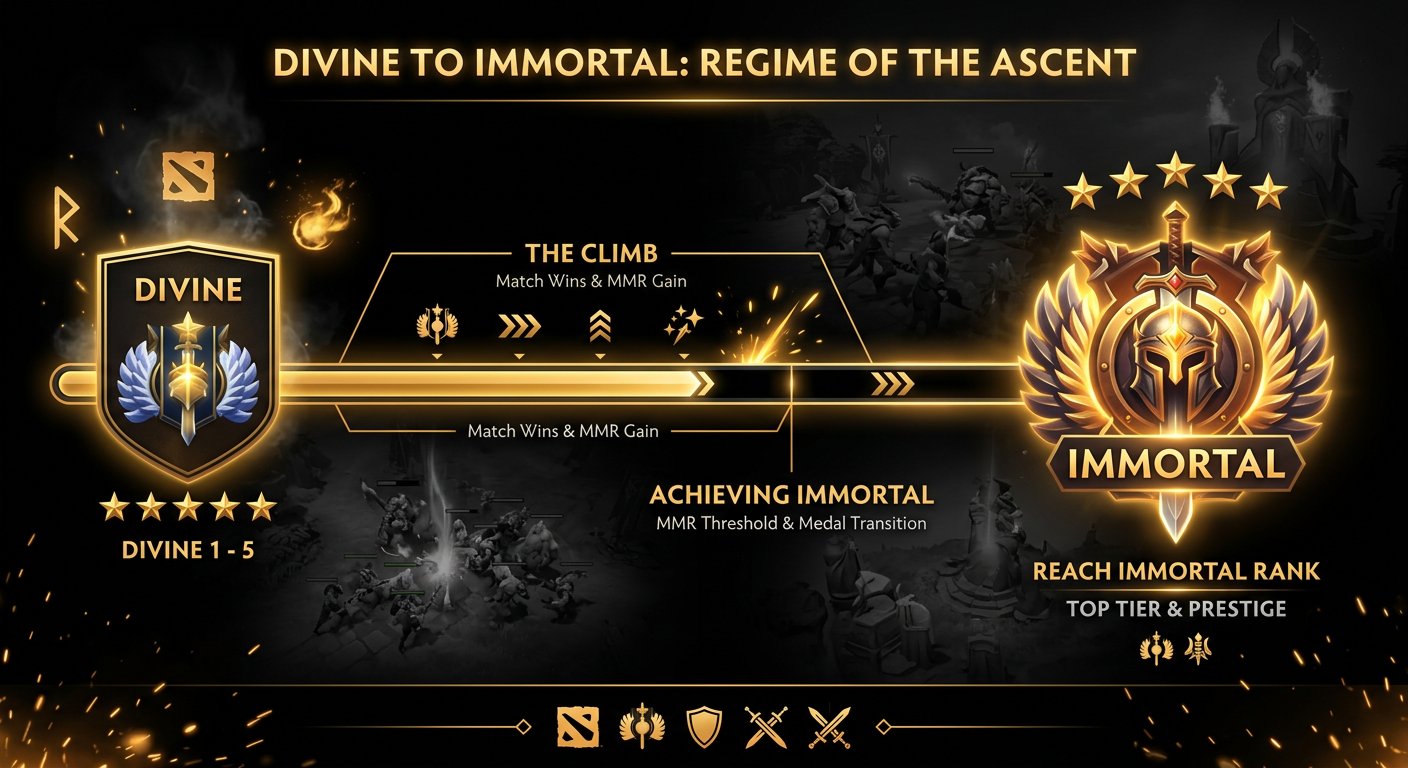
Divine starts at roughly 4,620 MMR and Immortal begins at approximately 5,420 MMR (these numbers shift with each season). That’s about 800 MMR you need to gain. At a 53% win rate — which is what a player who “deserves” Immortal typically has while climbing through Divine — you gain about 30 MMR per 100 games (assuming +30/-30 per game). That means:
- At 53% win rate: ~2,650 games to climb 800 MMR. This is if you’re barely above breakeven. It’s technically possible but would take years.
- At 55% win rate: ~800 games. Playing 3-4 games per day, this takes about 6-8 months.
- At 58% win rate: ~320 games. Playing 3-4 games per day, this takes about 2-3 months.
- At 60%+ win rate: ~200 games. This is the fastest realistic pace. About 2 months.
If you’re truly playing at an Immortal level, a 58-62% win rate in Divine is realistic. If you’re hovering around 50-52%, you’re not quite at the level yet — you need to continue improving before the climb happens naturally.
The Plateaus
Expect to plateau. Almost everyone hits a wall somewhere between Divine 3 and Divine 5. The games get harder, the opponents get smarter, and your usual strategies start getting punished. When you hit a plateau, it means you’ve reached the limit of your current skill set. This is when you need to add something new — a new hero, a new farming pattern, better map awareness, or improved fight positioning.
Consider getting professional coaching when you hit a plateau. A high-MMR coach can watch your replays and identify the specific weaknesses that are holding you back. It’s much faster than trying to self-diagnose, and the investment pays for itself in time saved.
Accelerating Your Climb
If you want to reach Immortal faster, here’s what works:
- Reduce your hero pool. Play 3 heroes. Master them completely. Don’t pick anything else unless your three are all banned.
- Play at consistent times. Same time of day, same number of games. This puts you in a rhythm and reduces variance in your play quality.
- Review every loss. Not every game — every loss. Watch the replay at 4x speed and identify the three biggest mistakes you made. Write them down. Don’t repeat them.
- Take breaks after two losses in a row. Tilt is the #1 MMR killer. Two consecutive losses mean your mental game is compromised. Stop, do something else for 30 minutes, then come back.
If climbing solo feels too slow and you want to accelerate the process, professional MMR boosting can help you reach your target rank while you focus on improving your skills for maintaining it.
Frequently Asked Questions
Carry has more individual impact on game outcomes, but it also requires more consistent performance. Support is more forgiving of individual mistakes but harder to carry games with. Neither is strictly easier — it depends on your strengths. If you’re mechanically skilled and have good farming patterns, carry is probably the faster climb. If you’re better at game sense and coordination, support might suit you better.
Spam 2-3 heroes. Diversity is valuable in professional Dota where opponents study your profile, but in pubs, depth of mastery is more impactful than breadth. You want to be playing on autopilot mechanically so your mental bandwidth is free for decision-making.
Important but not decisive. A bad draft at Divine can still win because execution matters more than composition. That said, don’t intentionally pick bad matchups. If the enemy last-picks your hard counter, adjust your item build and playstyle rather than tilting about the draft. A 45% matchup played well is better than a 55% matchup played on tilt.
This varies by region, but generally, early afternoon to early evening local time gives you the best game quality. Late night queues (after midnight) tend to have more varied skill levels, more smurfs, and more tilted players. Find the window that works for your schedule and stick with it.
Yes, but with a specific focus. Don’t watch a full pro game passively. Instead, download a replay of a pro player playing your hero in a matchup you struggle with. Watch only the laning phase and the first 20 minutes. Focus on their farming patterns, their positioning, and their item timing. One targeted replay review is worth more than ten casually watched pro games.
Losing streaks are inevitable. The key is limiting their length. After two consecutive losses, take a mandatory break of at least 20-30 minutes. If you lose three in a row, stop playing ranked for the day. Your skill doesn’t change game to game, but your mental state does, and mental state has a massive impact on performance at this bracket where margins are thin.
If your goal is to reach Immortal and you believe your skill level supports it but the grind is taking too long, MMR boosting can save you hundreds of hours. Many players combine boosting with coaching — they get boosted to the rank they’re targeting, then use coaching to develop the skills to maintain it. It’s a legitimate shortcut for players who value their time.
Final Thoughts
Climbing from Divine to Immortal as a carry is the hardest test of individual skill in Dota 2. It requires not just mechanical excellence, but mental fortitude, decision-making precision, and the discipline to play consistently over hundreds of games.
The players who make it to Immortal aren’t the ones with the best reflexes or the highest APM. They’re the ones who make fewer mistakes, who farm more efficiently, who take better fights, and who never stop improving. Every game is a learning opportunity. Every loss contains a lesson. The climb is long, but for players who are willing to put in the work, Immortal is absolutely achievable.
Start today. Pick your three heroes. Review your last five losses. Identify one habit to fix. And then play with intention. That’s how you get to Immortal.
If you want to accelerate your journey, check out our MMR Boost service or work with our professional Dota 2 coaches who specialize in helping Divine players break through to Immortal.

Ready to Climb Start Your Journey Today
Team Smurf offers professional coaching with Divine and Immortal players, plus safe, reliable MMR boosting to help you reach your target rank.
Written by Team Smurf’s Immortal-rank analysts — Rankings last verified February 2026