How to Climb from Ancient to Divine as Pos 2 Mid in Dota 2 (2026 Guide)

Mid lane at Ancient bracket is a paradox. You’re good enough to win lanes, outplay opponents mechanically, and carry games when ahead — but you’re stuck. You know you’re better than your rank suggests, yet the MMR needle barely moves. Welcome to the most frustrating skill bracket in Dota 2.
Here’s what nobody tells you about the Ancient-to-Divine mid gap: it’s not about laning. Ancient mid players can trade, deny, secure runes, and hit their timings. The gap is about what you do with the advantage you create. Divine mid players convert a won lane into map control, objective damage, and team empowerment. Ancient mid players convert a won lane into… more farming.
This guide is specifically designed for Pos 2 players who’ve hit a wall between Ancient and Divine. We’re going deep on draft intelligence, lane manipulation, rotation timing, smoke play, tempo control, and the mental shifts required to break through to that Divine star. No generic advice — only advanced concepts for players who already understand the basics.
The Ancient Mid Player vs. The Divine Mid Player
Before we get into specifics, let’s establish what exactly separates these two brackets at the Pos 2 level. Understanding the gap is the first step to closing it.
Map Impact After Laning
The most significant difference between Ancient and Divine mid players is post-laning impact. Both brackets win lanes at roughly similar rates — Ancient mid players are mechanically competent. But look at the map state at minute 15:
An Ancient mid who won lane typically has their first major item and is either still farming mid or rotating to jungle camps. They’ve maybe taken the enemy mid tower but haven’t translated that into map control elsewhere.
A Divine mid who won lane has their first item, has rotated to kill 1-2 heroes in other lanes, secured the enemy mid tower, and is creating a “dead zone” in the enemy’s side of the map where it’s unsafe for enemies to farm. The net worth might be similar, but the map control is vastly different.
Tempo Sensitivity
Divine mid players understand tempo — the rhythm of the game and when windows of opportunity open and close. They know that minutes 10-15 on heroes like Spirit Breaker, Puck, or Queen of Pain represent peak power spikes, and they squeeze every drop of impact from those windows.
Ancient mid players often lack this urgency. They’ll hit a power spike and farm for another 3-4 minutes instead of immediately capitalizing. In Dota 2, a timing is like a coupon with an expiration date — use it or lose it.
Draft Understanding
Ancient mid players pick heroes they’re comfortable with. Divine mid players pick heroes that synergize with their team and exploit the enemy draft. The difference sounds subtle but it’s enormous. Picking your comfort hero when the game demands something different is a major reason Ancient players stagnate — they’re playing their game, not THE game.
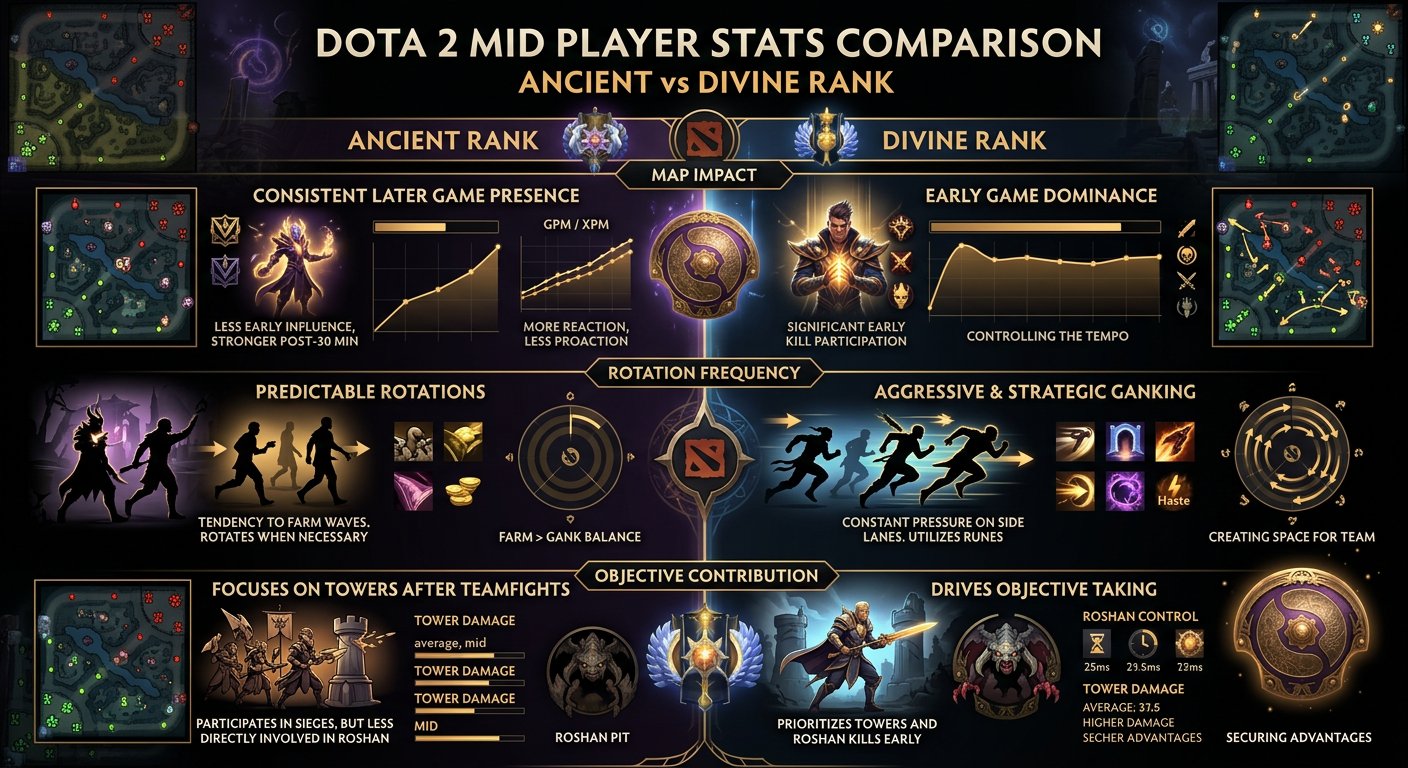
Top 5 Heroes to Climb from Ancient to Divine as Mid
1. Puck
Puck is the quintessential Divine-level mid hero, and there’s a reason it appears in nearly every high-MMR game. Puck rewards everything that separates Ancient from Divine players: map awareness, timing, initiation decision-making, and tempo control.
Why Puck is the #1 climbing hero for mid:
- Dream Coil forces fights on YOUR terms — you dictate when and where the fight happens
- Phase Shift + Orb provides extreme survivability, reducing your death count
- Puck’s power spike at Witch Blade/Blink (12-16 minutes) coincides with the perfect rotation window
- The hero enables your team rather than requiring your team to enable you
- Puck punishes the #1 Ancient habit: poor positioning in teamfights
The Divine Puck pattern: Win or go even in lane Get Witch Blade at 9-12 minutes Rotate to the enemy’s weakest lane Secure a kill Take their tower Smoke mid with your support Take another objective Get Blink by 15-17 minutes Start forcing fights with Dream Coil. This pattern creates a snowball of map control that Ancient teams struggle to respond to.
Critical Puck mechanic: Orb juking. At Ancient level, you can dodge 70% of enemy abilities just by using Illusory Orb aggressively. Launch the orb over terrain, Phase Shift the incoming stun, then jaunt to the orb’s location. This makes you nearly unkillable in the hands of a practiced player.
2. Spirit Void / Void Spirit
Void Spirit is the aggressive tempo mid that punishes the Ancient bracket’s biggest weakness: lack of coordinated response to ganking pressure. Once Void Spirit has level 6 and a casual Kaya, the entire map becomes a kill zone.
The Void Spirit climbing playbook: Max Resonant Pulse for lane sustainability Hit level 6 Immediately start rotating with Astral Step. The key at this bracket is understanding that Void Spirit’s strength is constant map presence. You’re not a farming mid — you’re an assassin. Your GPM comes from kills and assists, not jungle camps.
Remnant management: The difference between a good and great Void Spirit is remnant management. Always keep one remnant as an escape. Ancient Void Spirit players use all their remnants offensively and die. Divine players use two offensively and keep one for survival. This single habit will cut your deaths in half.
Item progression: Kaya Boots of Travel Eul’s/Orchid (game-dependent) Aghanim’s Scepter Shiva’s Guard. Boots of Travel is the key item — it turns you into a global threat that can farm a lane, TP to a fight, get a kill, and TP back to farming within 30 seconds.
3. Invoker
Invoker is the highest-skill-ceiling hero in Dota 2 and arguably the strongest climbing hero for players willing to invest the practice time. At Ancient level, most players don’t know how to play against a competent Invoker — they don’t respect Cold Snap’s kill threat in lane, they don’t dodge Sun Strike, and they group up for Chaos Meteor + Deafening Blast combos.
Which Invoker to play: At Ancient bracket, Quas-Wex Invoker is stronger for climbing than Quas-Exort. QW Invoker creates map-wide pressure with Tornado + EMP from level 4 onwards, generates kills through Cold Snap + Urn, and provides teamfight control with Tornado + Deafening Blast. QE Invoker is more farm-dependent and requires better team coordination to utilize Sun Strike + Forge Spirit aggression.
The QW rotation timing: At level 4-5, you have Tornado + EMP + Cold Snap available. This is your first rotation window. Identify which side lane has the enemy pushed up (check minimap constantly) and move toward them. Tornado + EMP + Cold Snap is a near-guaranteed kill on any hero without a mobility spell. One successful rotation with a kill and tower damage sets the tempo for the entire game.
Advanced technique: Sun Strike last-hit on enemy lane heroes. Even as QW Invoker, keep Sun Strike invoked as your secondary spell. Whenever you see an enemy in another lane fighting your teammates, throw a Sun Strike. At Ancient level, players rarely dodge it because they don’t expect global damage from a QW Invoker. Even one lucky Sun Strike kill is a massive gold and morale swing.
4. Templar Assassin
TA is the “win lane, win game” hero, and she excels at the Ancient bracket because her gameplay pattern is straightforward but devastating when executed properly. Lane dominance Roshan Push with Aegis End.
Why TA works at Ancient:
- Refraction makes laning absurdly safe while dealing bonus damage
- Psi Blades spill damage is difficult for Ancient players to play around
- TA takes Roshan faster than almost any other mid hero
- The hero’s game plan is linear and doesn’t require complex decision-making
- Ancient teams are slow to buy armor and defensive items against physical damage
The TA timing: Hit level 6 by 5:30-6:00 Secure power rune Kill enemy mid or rotate to a sidelane Get Desolator by 14-16 minutes Take Roshan immediately Push with Aegis. This timing is almost unbeatable at Ancient level because teams don’t have the coordination to contest an early Roshan against TA.
Trap placement: TA traps are free wards. Place them at rune spots, in the enemy jungle, and near objectives. At Ancient level, enemies almost never clear TA traps, giving you permanent vision of key areas. This vision advantage alone wins games.
5. Queen of Pain
QoP is the all-around mid hero that excels at everything Ancient players struggle with: wave push, rotations, teamfight damage, and survival. She’s rarely a bad pick and scales well from the laning phase through the late game.
QoP’s climbing advantage: Blink (the ability) provides a built-in escape that reduces deaths dramatically. At Ancient level, carries die too often (we know this from the statistics). QoP’s Blink means you almost always have an escape option, which keeps your death count low and your GPM high.
The QoP mid-game pattern: Push waves with Shadow Strike + Scream of Pain Blink to the nearest jungle camp Farm it while the next wave arrives Push the wave again. This “wave-then-camp” pattern generates 600+ GPM while keeping constant lane pressure. When a fight opportunity appears, Blink in, Scream + Sonic Wave, then Blink out. You contribute massive damage without committing to dangerous positions.
Item build for climbing: Witch Blade Kaya and Sange Aghanim’s Scepter Scythe of Vyse/Shiva’s. The Kaya and Sange timing (around 18-20 minutes) is your peak power spike. With level 15+ and KnS, your Sonic Wave deals enormous damage and the spell lifesteal keeps you alive.
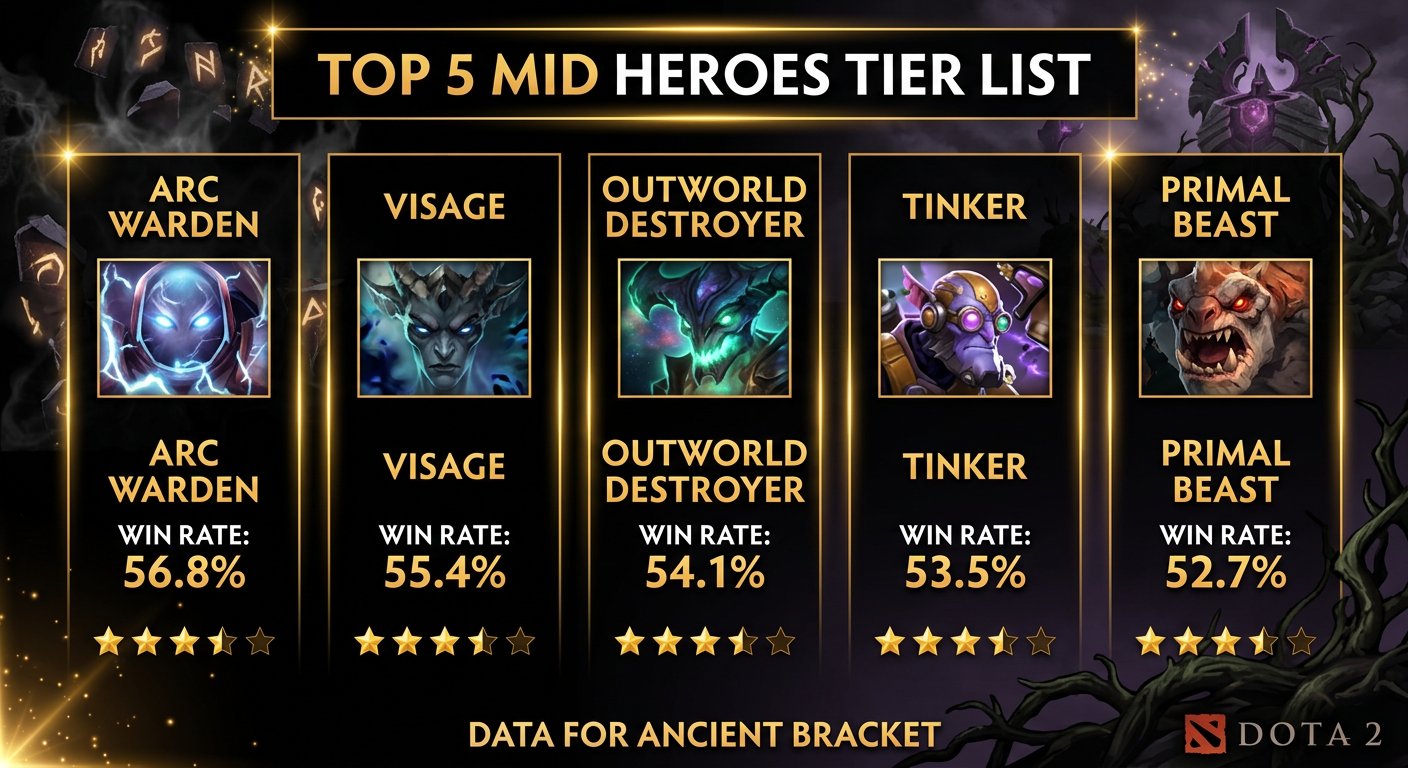
10 Critical Mistakes Ancient Mid Players Make
Mistake #1: Winning Lane, Losing Game
The most iconic Ancient mid mistake. You crush the laning phase — 20 CS lead, solo kill, tower damage — and then proceed to do nothing with the advantage. You farm mid for another 5 minutes, the enemy team regroups, and your lead evaporates. A won lane that doesn’t convert into map control is a wasted lane.
The fix: Set a mental timer: “I won lane, I have 5 minutes to convert this into something.” Take the enemy mid tower. Rotate to a sidelane for a kill. Secure Roshan. Push a tier 2. Do SOMETHING that translates your individual lead into a team advantage. If you’re still farming mid at minute 12 with a 2-level lead, you’re playing wrong.
Mistake #2: Poor Rune Control
Ancient mid players often lose rune fights because they don’t plan for them. They push the wave at 3:30 and then walk to the rune at 4:00, arriving late or without enough HP/mana to contest. Divine mid players start planning for the rune at 3:00 — pushing the wave, topping off HP with regen, and positioning to arrive at the rune spot at 3:50.
The fix: At the X:00 and X:30 marks (water runes), start pushing the wave aggressively at X-0:30. Arrive at the rune spot with full HP, mana, and the wave pushing into the enemy tower. If the enemy mid comes to contest, they lose CS. If they don’t, you get a free rune. This planning process should become automatic for every rune spawn.
Mistake #3: Ignoring Enemy Mid Rotations
When the enemy mid disappears from the lane, Ancient players often continue farming mid, hoping their team “figures it out.” Meanwhile, the enemy mid is getting a double kill in your safelane. When the enemy mid goes missing, you need to respond immediately.
The fix: The moment the enemy mid disappears, do one of three things: (1) Ping “Missing mid!” immediately and continue pushing the tower (converting their rotation into tower damage). (2) Follow their rotation if you can get there in time to counter-gank. (3) Rotate to the opposite side of the map for a counter-play — they gank your safelane, you gank their safelane. Option 1 is usually the best at Ancient level because your tower damage is guaranteed, while counter-ganks are uncertain.
Mistake #4: Inefficient Jungle Usage Between Waves
Ancient mid players often stand in lane waiting for the next creep wave. Divine mid players clear the wave in 3-4 seconds, then immediately farm 1-2 jungle camps before the next wave arrives. This “wave-then-jungle” pattern adds 100-150 GPM at zero cost.
The fix: Learn the timing of creep waves relative to nearby jungle camps. After pushing the mid wave past the river, you have roughly 15-20 seconds before the next wave arrives. Use that time to farm the nearest jungle camp (small camp on Radiant side, medium camp on Dire side). With most mid heroes, you can clear a camp and return to lane before losing a single creep.
Mistake #5: Predictable Smoke Rotations
When Ancient mid players rotate, they walk down the river in plain sight of enemy wards. They don’t buy their own smokes, they don’t communicate with supports for smoke ganks, and they don’t consider ward placement when moving.
The fix: Buy your own smokes. Yes, as a Pos 2. A smoke costs 50 gold. A successful smoke gank gives you 200-400 gold from the kill plus tower damage plus map control. The ROI is enormous. Smoke + rotate with your Pos 4 to a sidelane at minute 8-10 for a near-guaranteed kill. At Ancient level, enemies rarely deward the common rotation paths, so even walking through the jungle (without smoke) through less obvious routes often works.
Mistake #6: Building the Same Items Every Game
Ancient mid players have a default build they follow regardless of the game state. “I always go Witch Blade Blink BKB on Puck.” Divine players build reactively based on the game in front of them.
The fix: Before buying any item, ask yourself: “What do I need right now to win the NEXT teamfight” If the enemy has a fed PA, you might need Ghost Scepter before your next damage item. If the enemy has a Pugna who keeps decrepifying your target, you might need to skip your magic damage item and go for a physical one. Itemization should be a conversation with the game state, not a recipe you follow blindly.
Mistake #7: Losing Mid Tower Too Early
Ancient mid players sometimes lose their mid tower before minute 10, either through poor last-hitting (letting the wave push into their tower repeatedly), bad trades that force them out of lane, or not TPing back to defend. Losing mid tower early gives the enemy mid freedom to rotate without losing anything.
The fix: Your mid tower is worth more than a rune, a kill, or a jungle camp. If the enemy is pressuring your tower, TP back and defend it. If you’re losing the lane and the tower is threatened, call for a support rotation rather than abandoning it. Every minute your mid tower stands buys your team time and limits the enemy’s map control.
Mistake #8: Fighting Without Cooldowns
Ancient mid players fight when fights happen, regardless of whether their key cooldowns are available. They use Sonic Wave to farm a creep wave and then a fight breaks out and they’re useless for 100 seconds. Or they use Ravage to secure a single kill and then can’t fight for the next Roshan attempt.
The fix: Track your key cooldowns and communicate them to your team. If your ultimate is on cooldown, you should be farming, not fighting. If your BKB is on cooldown, avoid engagements. Use chat wheel phrases like “Ultimate is not yet ready” to let your team know when you can’t contribute to fights. Build your farming/fighting cycles around your cooldown timers.
Mistake #9: Not Punishing Enemy Greedy Picks
When the enemy picks a greedy, late-game mid like Medusa or Alchemist, Ancient mid players often just… let them farm. They don’t increase their aggression, they don’t pressure the lane harder, and they don’t rotate to shut down the enemy’s game plan. If the enemy picks greed, you need to punish it.
The fix: Against greedy mids, your game plan shifts to maximum aggression. Push the wave constantly, take runes, rotate to sidelanes, and pressure objectives. Every minute the game goes past 30 benefits the greedy hero more than you. Your job is to ensure the game doesn’t go past 30 — end it with your mid-game power spike or create such a large advantage that the late-game hero can never catch up.
Mistake #10: Dying to Ganks You Should Have Seen Coming
Mid is the most ganked lane in Dota 2. Ancient mid players die to rotations they could have predicted with better map reading. The enemy Pos 4 Earthshaker has been off the map for 30 seconds and is obviously coming mid, but you’re still pushed up without vision.
The fix: Develop a “missing hero radar.” Every 15-20 seconds, glance at the minimap and account for all five enemy heroes. If you can see 4 of them, identify which one is missing and assume they’re coming for you. Ward defensively (yes, buy your own observer ward for mid — it’s 0 gold now) and play on the side of the lane that’s furthest from the enemy’s likely gank path. If the enemy Pos 4 is missing from the bottom lane, they’re probably approaching mid from the bottom — play top-side of the river.
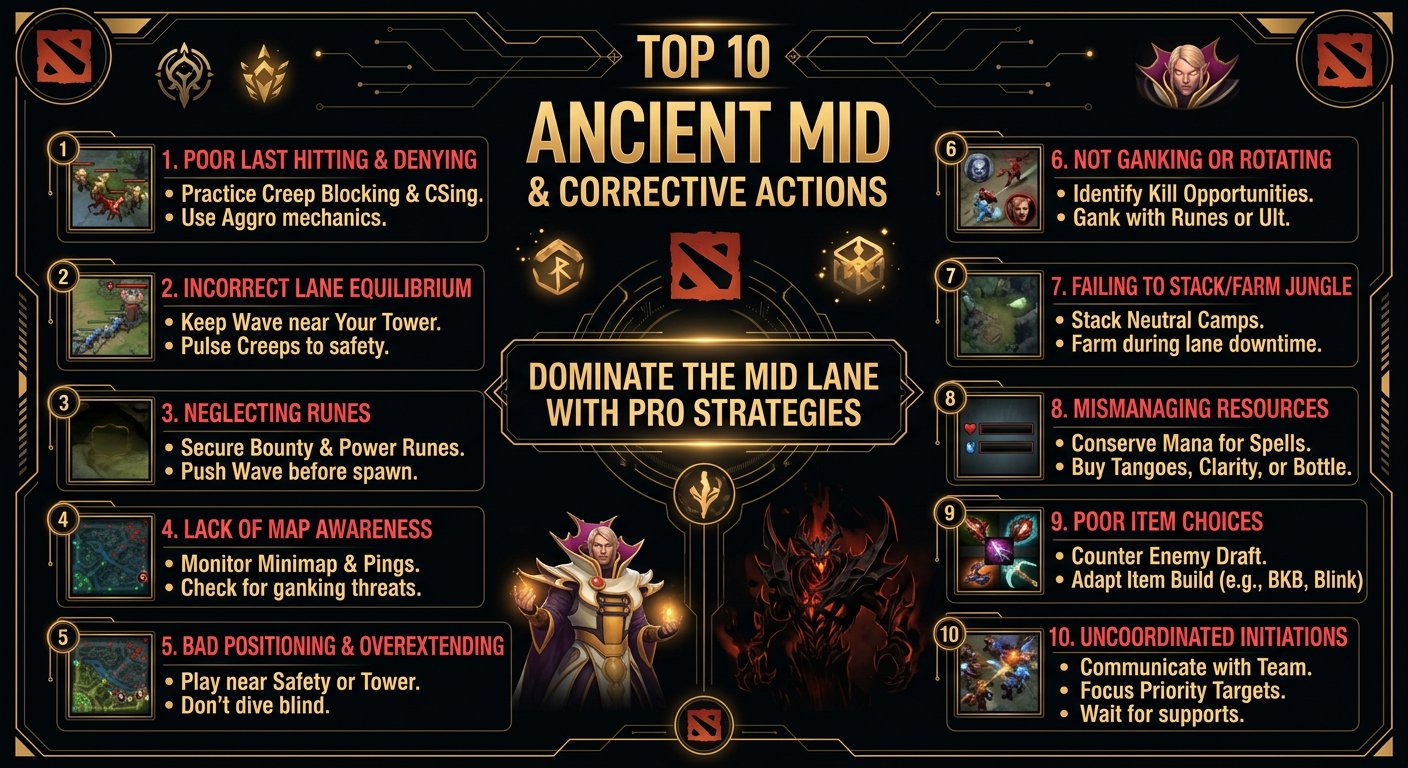
Phase-by-Phase Guide: Playing Mid from Ancient to Divine
Pre-Game: Draft Intelligence (Hero Select)
Before the game even starts, you should be analyzing the draft for three things: (1) Who is their mid likely to be (2) What is my team’s win condition (3) When does my team want to fight
Counter-picking considerations: At Ancient level, you often get to see the enemy mid before picking. Use this advantage. Common mid matchup knowledge that matters:
- Puck destroys low-mobility mids (Invoker, Shadow Fiend, Sniper)
- Huskar dominates most magic-damage mids (Zeus, Lina, Leshrac)
- TA loses to heavy harass heroes (Viper, Razor, Venomancer mid)
- QoP struggles against tanky mids who can sustain her harass (Dragon Knight, Huskar)
- Invoker loses to aggressive early-game mids who can interrupt his combo (Monkey King, Ember Spirit)
Team composition awareness: If your team has a hard carry who needs 30+ minutes (Spectre, Medusa, Terrorblade), pick a mid that creates space — Puck, QoP, Void Spirit. If your team already has an aggressive tempo carry (Ursa, Troll), pick a mid that scales and provides teamfight — Invoker, Lina, Zeus. Your pick should complement your team’s gameplan, not duplicate it.
Laning Phase (0:00 – 10:00)
Minute 0: Starting items and level 1 plan. At Ancient level, starting items are cookie-cutter for most players. But small optimizations matter: if you’re in a harass-heavy lane (against Viper, QoP), extra regen wins. If you’re in a last-hit contest (against SF, TA), extra damage wins. If you’re against a kill lane (Tiny, Skywrath duo mid), consider a Bracer for survival.
Minutes 1-4: Creep wave manipulation. This is where you establish lane dominance. The key mechanic that Ancient players underuse is creep aggro drawing. By right-clicking the enemy hero and immediately moving, you pull their creeps toward you without committing to a trade. This lets you control where the wave meets, secure easier last hits, and deny effectively.
Advanced technique: ranged creep manipulation. The ranged creep in each wave provides the most gold and XP. Prioritize denying the enemy’s ranged creep above all else. If you consistently deny their ranged creep for the first 4 minutes, you’ll have a 1-level advantage by minute 4 — enough to dominate the lane from that point forward.
Minutes 4-6: First rune fight and kill potential. At minute 4, the first power runes spawn. By this point, you should be level 5-6 on most mids, with a clear idea of whether you can kill the enemy mid. If you have kill potential, play aggressively after securing the rune. If you don’t, use the rune for sustain and continue farming.
Minutes 6-10: Rotation window. This is the critical decision point. Do you stay mid and take the tower Or do you rotate to a sidelane for a kill The answer depends on three factors: (1) Can you kill the enemy mid and take the tower If yes, do that — it’s the highest value play. (2) Is a sidelane kill guaranteed (enemy pushed up, no detection, your target has no escape) If yes, rotate. (3) Neither Keep farming mid and jungle, hit your item timing, and rotate at 10-12 minutes instead.
Early Mid-Game (10:00 – 20:00)
This is where mid players make or break games. Your laning advantage means nothing if you don’t convert it into map control during this window.
The rotation protocol: Every 2-3 minutes during this phase, you should be making a play on the map. Rotate to a sidelane, pressure a tower, or take a Roshan. Between plays, farm efficiently — clear mid wave, take a jungle camp, repeat. The goal is to maintain 500+ GPM while creating chaos for the enemy team.
Smoke timing: At Ancient level, smoke ganks happen but they’re poorly timed. The ideal smoke timing for mid is right after you complete a key item — Blink Dagger, BKB, Orchid, etc. Smoke + your new item = kill potential that the enemy doesn’t expect because they haven’t checked your inventory.
Tower pressure priority: After the mid tower falls, the priority is: (1) Enemy offlane tier 1 tower (opens the safe jungle for your carry). (2) Enemy safelane tier 1 tower (denies the enemy carry a safe farming area). (3) Tier 2 towers (only if your team has a significant advantage and can push together). Don’t throw away your advantage by diving tier 2 towers at minute 15 — take the outer towers methodically first.
Late Mid-Game (20:00 – 30:00)
Objective-focused play: By minute 20, the game transitions from “make plays” to “take objectives.” Your role as mid depends on your hero:
- Tempo mids (Puck, QoP, Void Spirit): Initiate fights near objectives. Your job is to start the fight, burst down a key target, and create space for your carry to deal damage.
- Scaling mids (Invoker, TA, Lina): Farm aggressively but join fights with your team. You’re approaching your peak power — use it.
- Utility mids (Magnus, Enigma mid): Your team’s fight depends on your abilities. Position carefully, wait for the perfect opportunity, and execute your combo flawlessly.
Roshan control: If you’re a mid who can take Roshan (TA, Invoker with Forge Spirits, any mid with BKB + damage), you should be actively working toward Roshan during this window. Coordinate with your carry — even a simple “Rosh” in chat is enough at this bracket.
Late Game (30:00+)
In late-game scenarios, the mid player’s role shifts based on the game state. If your carry is online and strong, you transition to a utility/initiation role — Scythe of Vyse, Shiva’s Guard, Refresher Orb. If your carry is behind and you’re the strongest core, you take on the primary damage role.
The buyback rule: After 30 minutes, always have buyback. This is non-negotiable for mid players, just as it is for carries. Your death without buyback at 35 minutes can mean a lost set of barracks or a lost game.
High-ground defense/offense: As a mid, you’re often the hero with the best high-ground defense (wave clear, burst damage, long-range spells). If your team is defending, position yourself to clear waves efficiently without exposing yourself. If your team is pushing, use your abilities to initiate or poke the enemy under tower before committing to a full fight.
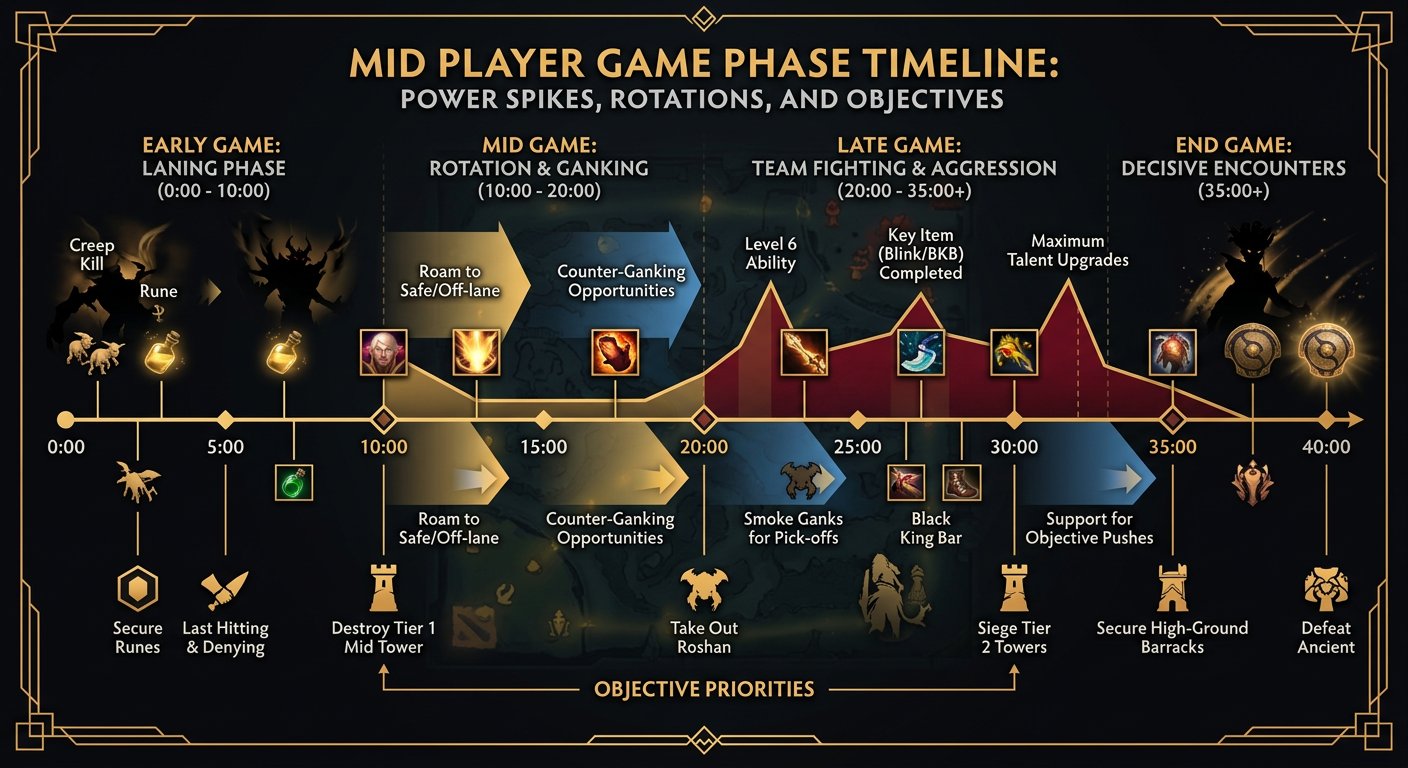
Dealing with Difficult Teammates as Pos 2
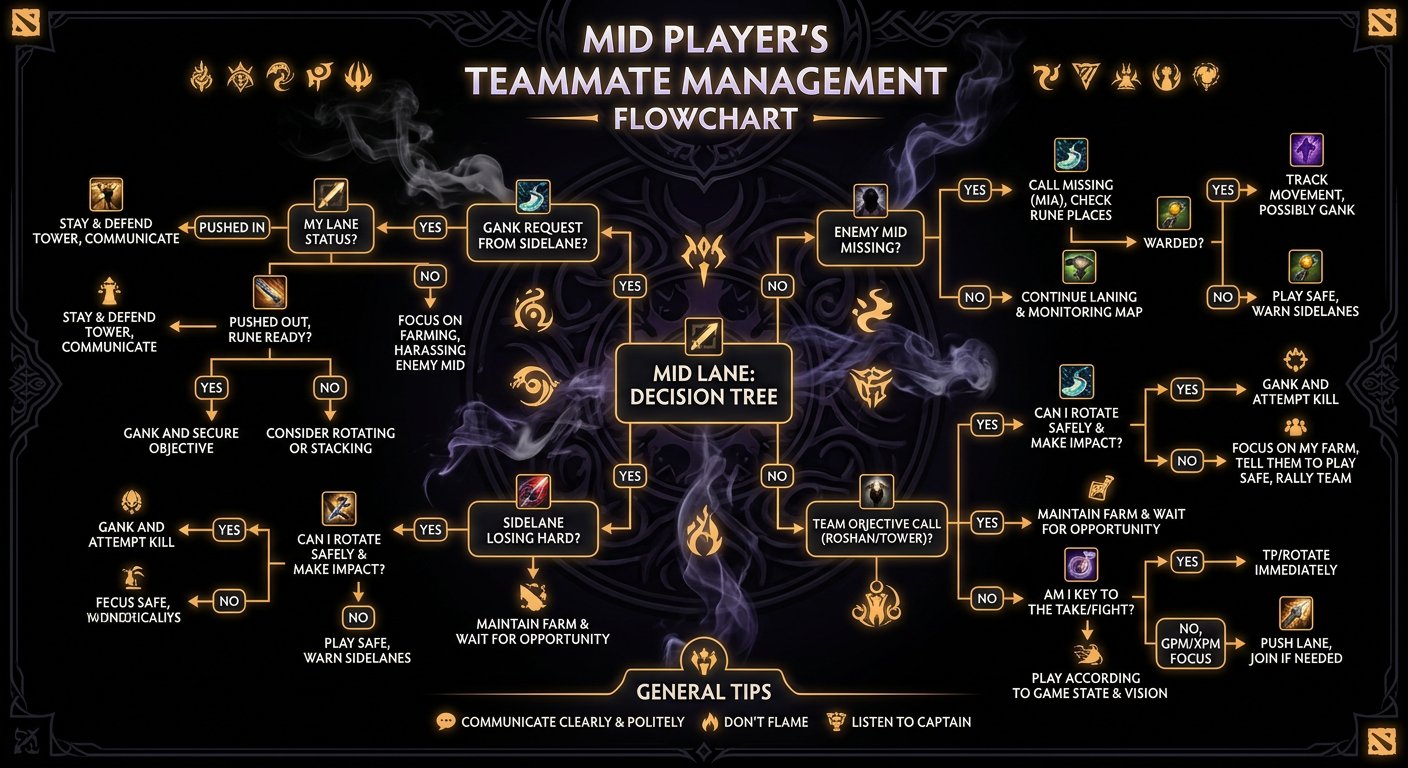
Mid lane comes with a unique psychological burden: everyone watches the mid player. If you die in lane, your team notices. If the enemy mid rotates and gets kills, your team blames you. This pressure creates a feedback loop where Ancient mid players play conservatively to avoid blame, which actually reduces their impact.
When Your Sidelanes Lose
The most common scenario: you won mid, but both sidelanes lost. Now the enemy carry is farmed, the enemy offlaner is strong, and your team is looking at you to “carry” the game.
The response: Don’t panic. A won mid with lost sidelanes means the game depends on your tempo. You need to accelerate — push your advantage immediately rather than farming for late game. Take fights that are favorable, secure Roshan with Aegis, and create space for your carry to catch up. If you wait too long, the enemy’s farmed cores will overwhelm you regardless of your mid advantage.
When Your Team Won’t Group
At Ancient level, teams often refuse to group for objectives even when they have a clear advantage. Your Pos 3 is farming jungle, your carry is farming the opposite side of the map, and nobody responds to your “push” ping.
The response: Stop trying to force it. Instead, adapt to your team’s pace. Farm efficiently, maintain vision control (yes, buy wards), and wait for the enemy to make a mistake. At Ancient level, enemies WILL make mistakes — they’ll push too far, they’ll farm without vision, they’ll split up. Capitalize on these mistakes with pick-offs rather than trying to force 5-man pushes your team isn’t ready for.
When You Lose Mid
It happens. Even at Divine level, you’ll lose mid sometimes — bad matchup, enemy support rotation, unlucky rune RNG. The key is how you respond.
The response: Don’t stay and die more. Rotate to the jungle, farm your core item, and look for plays on other lanes. A mid who loses lane but gets a double kill in the safelane at minute 10 has recovered completely. The worst thing you can do is stay in a lost lane, die again, and fall further behind. Cut your losses, farm efficiently, and find your impact elsewhere on the map.
Muting and Mental Resilience
As the mid player, you’ll receive more criticism than any other role. Teammates will blame you for everything from lost lanes to missed last hits to global warming. Mute aggressively and focus on your game. The mental energy you spend reading complaints is energy you’re not spending on map awareness and decision-making. Mute all chat at the start of the game if necessary — your performance matters more than your team’s opinion of it.
Realistic Timeline: Ancient to Divine as Mid
Mid is arguably the fastest-climbing role because of its high individual impact. A strong mid player can single-handedly control the tempo of a game, which translates to a higher win rate than other positions.
- At 53% win rate: 200-300 games (3-5 months at 2-3 games per day)
- At 55% win rate: 120-180 games (2-3 months)
- At 58%+ win rate: 70-100 games (1-2 months)
Mid players typically achieve slightly higher win rates than other positions during climbing phases, so expect to be on the faster end of these estimates if you’re genuinely improving. The key indicator that you’re climbing efficiently is your deaths per game — if your average deaths are dropping below 5, you’re on the right track.
The Ancient 5 wall: Most mid players hit a wall around Ancient 5 (4,200-4,400 MMR). This is where Divine players start appearing in your games, and the skill gap becomes apparent. If you’re stuck here, focus specifically on post-laning impact and rotation timing — these are the skills that Divine mid players have that Ancient mid players lack.
Accelerating the climb: If you’re stuck and want to break through faster, professional coaching from a Divine or Immortal mid player can be transformative. A coach can watch your replays, identify your specific weaknesses, and give you personalized exercises to improve. It’s the fastest way to bridge the gap between Ancient and Divine.
Frequently Asked Questions
Tempo mids (Puck, QoP, Void Spirit) are generally better for climbing because they allow you to control the game’s pace. Scaling mids (Invoker, TA, SF) can work but they require your team to create space for you, which is unreliable at Ancient level. If you can only play one style, choose tempo — it gives you agency regardless of teammate quality.
Dual mid happens occasionally at Ancient level. If the enemy sends two heroes mid, don’t panic. Farm what you can, don’t die, and call for help from your Pos 4 or Pos 5. The enemy is sacrificing a support from another lane to pressure you — your sidelanes should win. If your team doesn’t help, farm the jungle and wait for the dual mid to break up (they always do). You’ll be slightly behind but not catastrophically so.
Absolutely. At Ancient level, supports don’t always ward optimally for mid. Buying a single observer ward for your mid lane provides information about ganks that can save your life (worth 300+ gold in avoided deaths). Buy wards for yourself — it’s the highest ROI purchase in the game.
Pick Invoker when your team needs teamfight control AND scaling damage. Invoker provides both, but he requires 15+ minutes to come online. If your team has no other late-game insurance (greedy carry, aggressive offlaner), Invoker is excellent. If your team needs early aggression, pick something else.
Very important for the first 10 minutes, less important after. Perfect last-hitting in the laning phase creates a level and gold advantage that translates into kill potential. After minute 10, your GPM comes more from rotations, kills, and jungle farming than from lane CS. Focus your practice time on the first 10 minutes of last-hitting — that’s where the returns are highest.
If you’re Ancient 4-5 and feel you’re close but can’t break through, an MMR boost to low Divine can be reasonable — especially if you’re performing well but dealing with unlucky teammates. However, the climb itself is a learning experience. If you’re Ancient 1-3, there are fundamental skills to develop first, and coaching is a better investment.
Final Thoughts: Dominating Mid from Ancient to Divine
The Ancient-to-Divine mid climb is about evolving from a “lane player” to a “game player.” You already have the mechanics to last-hit, trade, and secure runes. What you need is the macro understanding to translate lane advantages into map control, objectives, and team empowerment.
Focus on three things: (1) Reduce your deaths to below 5 per game. (2) Rotate at least twice before minute 15 to create map impact. (3) Take objectives after every successful fight — don’t let advantages dissolve by returning to farming.
The gap between Ancient and Divine isn’t as wide as it feels. It’s a series of small improvements — better rotation timing, smarter item choices, more disciplined fight selection — that compound into a significant win rate increase. Master these fundamentals, and that Divine star is closer than you think.
Want to accelerate your climb TeamSmurf offers professional Dota 2 coaching with Divine and Immortal mid players who can analyze your specific gameplay and create a personalized improvement plan. If you’re looking for a faster path, our MMR boosting service delivers safe, reliable rank-ups. Start your journey to Divine today.
Ready to Climb Start Your Journey Today
Team Smurf offers professional coaching with Divine and Immortal players, plus safe, reliable MMR boosting to help you reach your target rank.
Written by Team Smurf’s Immortal-rank analysts — Rankings last verified February 2026