How to Climb from Divine to Immortal as Pos 3 Offlane

The offlane is the most misunderstood role in Dota 2, and at Divine rank, that misunderstanding is exactly what keeps players from reaching Immortal. Most Divine offlaners think their job is to “win the lane and initiate team fights.” That’s about 40% of the job. The other 60% — map pressure, item timing disruption, tower aggression, and space denial — is what separates Divine from Immortal.
I’ve analyzed thousands of replays of Divine offlaners who eventually broke through to Immortal, and the transformation is always the same. They stop thinking of themselves as a “tanky initiator” and start thinking of themselves as the game’s pace-setter. The offlaner decides when the laning phase ends. The offlaner decides which towers fall first. The offlaner decides whether the enemy carry gets a free 25 minutes of farm or a miserable 25 minutes of pressure. That’s the job.
If you’re Divine and you’re reading this, you’re probably already good at Dota. You know how to lane, you know how to initiate, you know your hero pool. What I’m going to show you is the layer of strategic thinking that turns a “good offlaner” into an Immortal one.
Table of Contents
- The Pos 3 Role at Divine — What Immortal Offlaners Do Differently
- Top 5 Heroes to Climb from Divine to Immortal as Offlane
- 10 Critical Mistakes Divine Offlaners Make (That Immortals Don’t)
- Phase-by-Phase Guide: Laning Through Late Game
- The Teammate Problem: Account Buyers and the Offlane Experience
- Realistic Timeline: How Long Will This Take
- FAQ
The Pos 3 Role at Divine — What Immortal Offlaners Do Differently
Let me start with a controversial statement: most Divine offlaners are too passive. They win the lane — or at least survive it — and then they start playing like a support. They follow their team around, they wait for fights, they initiate when their team is grouped. This is reactive offlane play, and it caps your MMR at Divine.
The Proactive Offlaner Mindset
Immortal offlaners are proactive. They don’t wait for fights — they create the conditions for fights. They don’t follow their team — they set the direction and their team follows. They don’t wait for the enemy carry to leave the lane — they force the enemy carry out of the lane.
This mindset shift changes everything about how you play the game. Instead of asking “where should I be” you ask “where does the enemy NOT want me to be” and then you go there. Instead of asking “should I fight” you ask “what objective can I threaten that forces a fight on my terms” This is the proactive offlane mentality.
The Three Jobs of Position 3
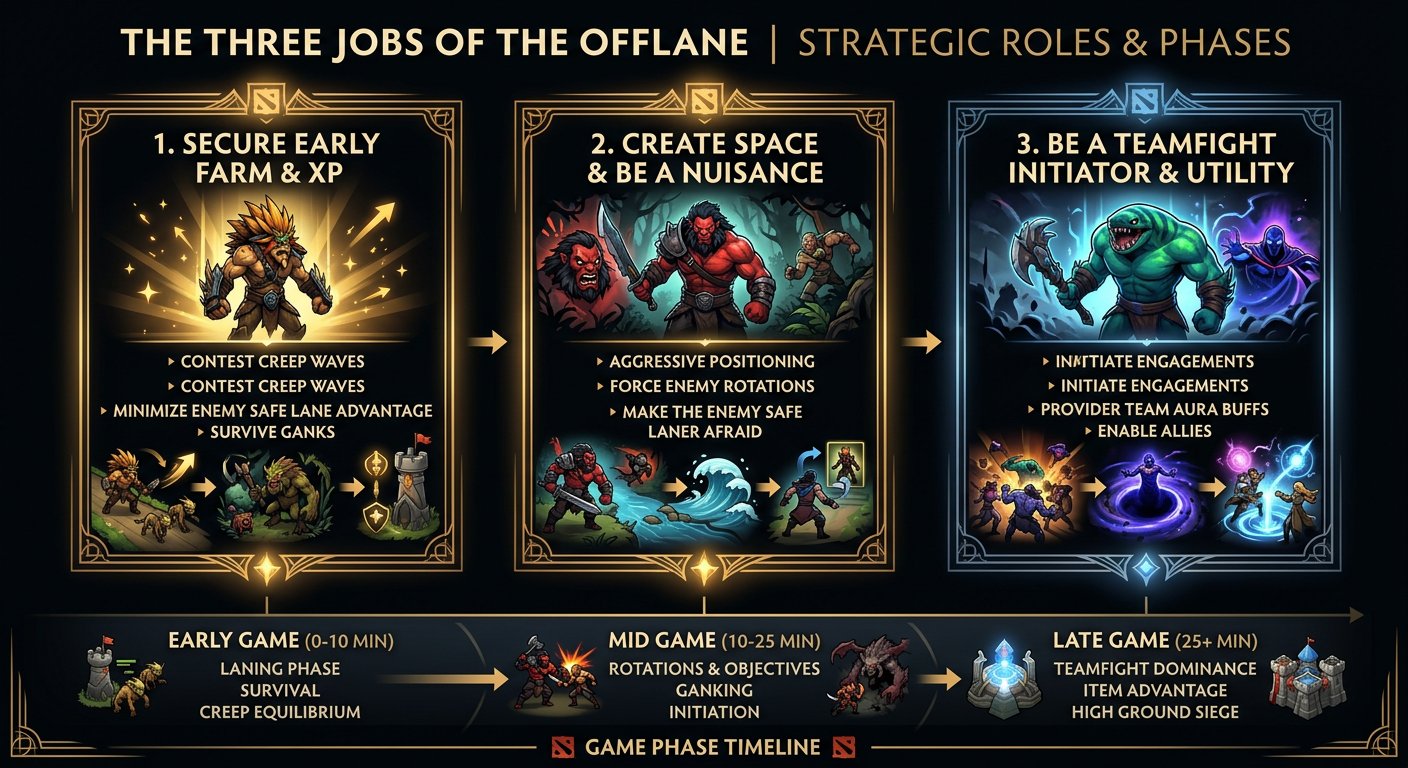
At the Immortal level, the offlaner has three distinct jobs that change throughout the game:
Job 1 (0-10 minutes): Ruin the enemy carry’s game. Your laning phase goal isn’t to “survive” or even to “win the lane.” It’s to make the enemy carry’s first 10 minutes as miserable as possible. Every last hit they miss, every HP regen item they’re forced to buy, every time they’re zoned to jungle early — that’s your doing. An enemy carry who’s farming jungle at 6 minutes instead of freely last-hitting in lane is a carry who hits their Battlefury 3 minutes late. That 3 minutes ripples through the entire game.
Job 2 (10-25 minutes): Control the map. After the laning phase, your job is to be the most annoying hero on the map. Push lanes, pressure towers, force rotations. If the enemy has to send two heroes to deal with you, that’s two heroes not pressuring your carry. If the enemy ignores you, take their tower. Either outcome is good for your team.
Job 3 (25+ minutes): Enable your carry. In the late game, your job shifts to creating the conditions for your carry to deal damage. This means initiating at the right time, soaking damage and spells, and using your utility items (Pipe, Crimson Guard, Lotus Orb) to keep your team alive. You’re the bodyguard, the initiator, and the frontline all in one.
Why “Space Creation” Is Misunderstood
Every offlaner at Divine talks about “creating space,” but most of them don’t actually understand what it means. Creating space doesn’t mean dying on the enemy side of the map so your carry can farm. That’s feeding with extra steps. Creating space means forcing the enemy to respond to you in a way that gives your team an advantage.
Good space creation: You push the enemy safelane tower, forcing two enemy heroes to TP to defend. While they’re TPing, your mid takes a free tower on the other side of the map. That’s space creation — you traded your time for a net positive for your team.
Bad space creation: You walk into the enemy jungle, die to three heroes, and say “at least my carry got free farm.” Your carry was going to farm anyway. You just gave the enemy team 300 gold and a 30-second safety window. That’s not space — that’s a donation.
Top 5 Heroes to Climb from Divine to Immortal as Offlane
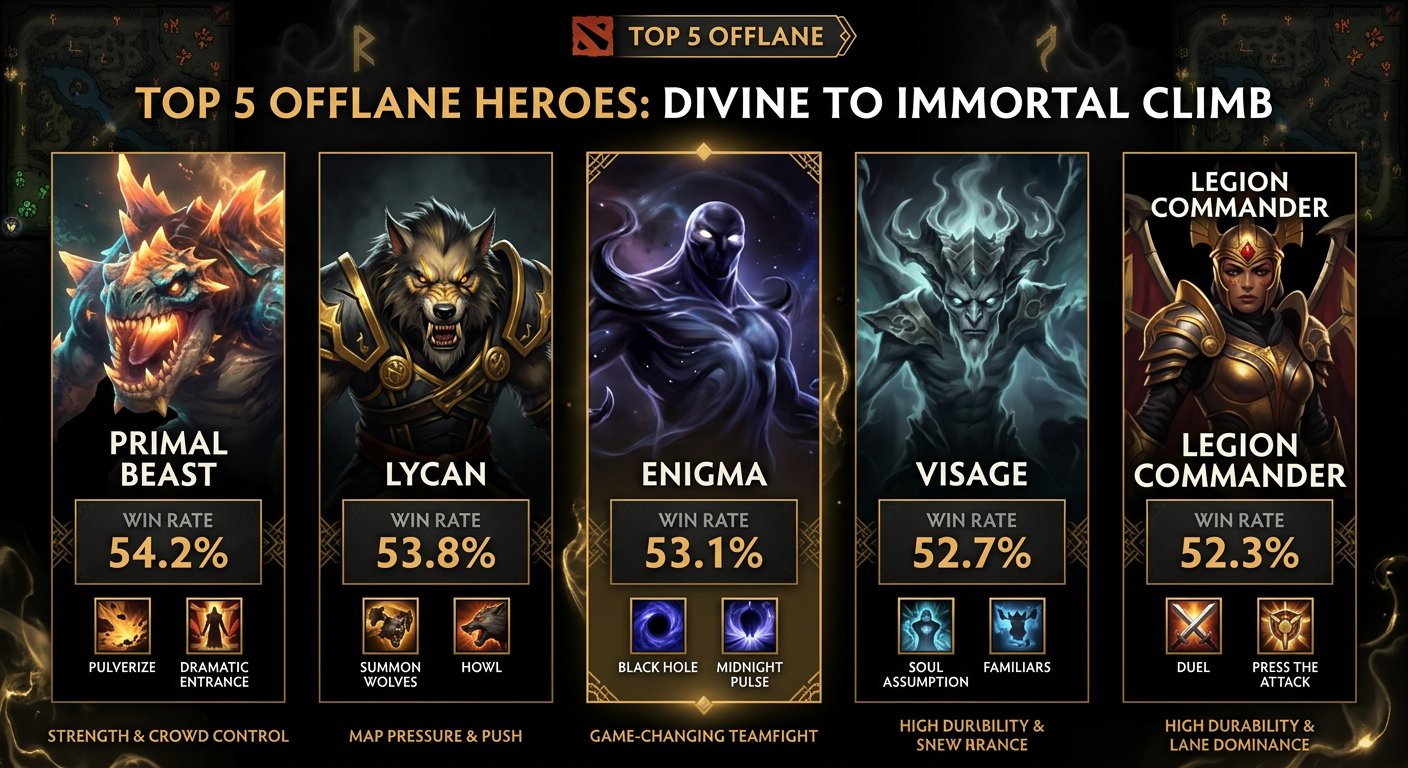
The best offlane heroes for climbing share common traits: they can win or survive most lane matchups, they have team fight impact, and they can pressure towers. Here are the five I recommend.
1. Beastmaster
Beastmaster is the quintessential proactive offlaner. His kit is built for pressuring towers, controlling the map with vision, and locking down key targets. At Divine, Beastmaster is incredibly effective because he punishes teams that don’t react to his tower pressure.
Why he works at this bracket: Beastmaster takes towers faster than almost any other offlaner thanks to his summons and Inner Beast aura. At Divine, teams often don’t rotate to defend towers early enough, giving Beastmaster free objectives. And even if they do rotate, Roar is one of the best single-target disables in the game for punishing anyone who shows up alone.
Key timings: Helm of the Overlord by 14-16 minutes. This is your power spike — with a dominated creep, your push becomes nearly unstoppable. After Helm, immediately start pressuring the enemy safelane tower if it’s still standing. Aghanim’s Scepter by 22-25 minutes gives you a second Roar charge, which is game-changing in fights.
Advanced tip: Hawk micro is the most underutilized part of Beastmaster’s kit at Divine. Immortal Beastmaster players have their Hawk scouting enemy movements constantly — hovering over the enemy jungle, watching Roshan pit, scouting ahead of pushes. This free vision is worth more than a ward because it moves with the information you need. Assign your Hawk to a control group and actively manage it throughout the game.
2. Axe
Axe is the ultimate “force fights on your terms” hero. Call forces the enemy to attack you, Berserker’s Call pierces BKB, and Counter Helix punishes anyone who tries to man-fight. At Divine, Axe’s simplicity is his strength — you don’t need fancy combos, you need perfect timing on Blink + Call.
Why he works at this bracket: One good Blink + Call on two or three heroes wins any team fight. At Divine, players still clump enough for multi-hero Calls to happen regularly. And Axe’s lane presence is oppressive against melee carries — if the enemy picks Spectre or Anti-Mage, Axe makes their life miserable.
Key timings: Blink Dagger by 12-14 minutes. This is your “I win fights now” timing. After Blink, look for picks on isolated heroes and force team fights at objectives. Blade Mail by 16-18 minutes makes your Call into a damage reflect threat that can kill squishy heroes during the Call duration.
Advanced tip: Call timing is everything. Divine Axe players Blink + Call the moment they see an enemy. Immortal Axe players wait for the perfect moment — when the enemy carry uses their BKB, when the support steps too close to the front, when two heroes overlap on the minimap. Patience on Blink + Call increases the average value of each Call dramatically. One Call on the enemy carry + support at 25 minutes is worth more than three Calls on the enemy offlaner throughout the mid-game.
3. Mars
Mars combines initiation, team fight control, and lane dominance into one package. Arena of Blood is one of the most impactful ultimates in Dota, and God’s Rebuke gives Mars excellent farming speed and harass in lane.
Why he works at this bracket: Arena of Blood creates “mini-Chrono” moments where enemies inside the Arena can’t escape and enemies outside can’t help. At Divine, teams still struggle to play around Arena — they either clump inside it (getting combo’d with your team’s AoE) or scatter outside it (leaving isolated targets to die).
Key timings: Blink Dagger by 14-16 minutes. Phase Boots + Soul Ring gives you the mana sustain to spam spells in lane. After Blink, your initiation range becomes massive — Blink + Arena + Spear is a guaranteed kill on any squishy target.
Advanced tip: Spear geometry. The best Mars players don’t just Spear enemies into walls — they Spear enemies into Arena walls. This means casting Arena first, then Spearing someone into the Arena rim for a guaranteed 2-second stun. This combo is extremely difficult for enemies to react to and creates a near-guaranteed kill setup for your team. Practice the Arena + Spear timing in custom lobbies until it’s muscle memory.
4. Tidehunter
Tidehunter is the most reliable team fight offlaner in Dota. Ravage is the highest-impact AoE stun in the game, Kraken Shell makes you nearly impossible to harass out of lane, and Anchor Smash reduces enemy carry damage significantly.
Why he works at this bracket: Ravage is so game-changing that even if everything else goes wrong, one good Ravage can win a fight and swing the game. At Divine, the margin between winning and losing is often one team fight — and Tidehunter gives you the best single-button team fight contribution in the game.
Key timings: Blink Dagger by 14-16 minutes. Refresher Orb by 28-32 minutes. The Blink + Ravage combo is your primary contribution, and landing it on 3+ heroes is an instant fight win. Refresher doubles your impact — two Ravages in one fight is practically an auto-win.
Advanced tip: Don’t Ravage first. This is counter-intuitive, but the best Tidehunter players often wait for the enemy to commit before using Ravage. If you Ravage first, the enemy can BKB through it or simply not engage. But if you wait for the enemy to jump in, THEN Ravage, you catch them with their abilities on cooldown and their BKB not yet activated. The patience to hold Ravage for 3-5 seconds into a fight is what separates Divine Tide from Immortal Tide.
5. Enigma
Enigma is a unique offlaner who combines jungle farming speed with the single most powerful team fight ultimate in Dota. Black Hole, when landed correctly, wins games regardless of gold difference.
Why he works at this bracket: Enigma can recover from any bad lane because Eidolons allow fast jungle farming. Even if you lose the lane badly, you can farm jungle and hit your Blink timing only 1-2 minutes late. And once you have Blink + Black Hole, you’re the most dangerous hero on the map. At Divine, players respect Black Hole but still make positioning errors that give you openings.
Key timings: Blink Dagger by 10-12 minutes (Enigma farms fast). BKB by 18-20 minutes. Refresher by 28-32 minutes. Enigma’s power spikes are tied entirely to items, which is why his farming speed is so important — faster items = earlier power spikes = more won fights.
Advanced tip: Midnight Pulse + Black Hole combo is the true damage source. Always cast Midnight Pulse before Black Hole — the percentage-based damage from Pulse during the full duration of Black Hole melts even the tankiest heroes. Divine Enigma players forget Pulse in the heat of the moment and leave 30-40% of their damage on the table. Additionally, consider using BKB before Blink + Black Hole to prevent interrupts. The BKB + Blink + Pulse + Black Hole combo takes practice but is unstoppable when executed correctly.
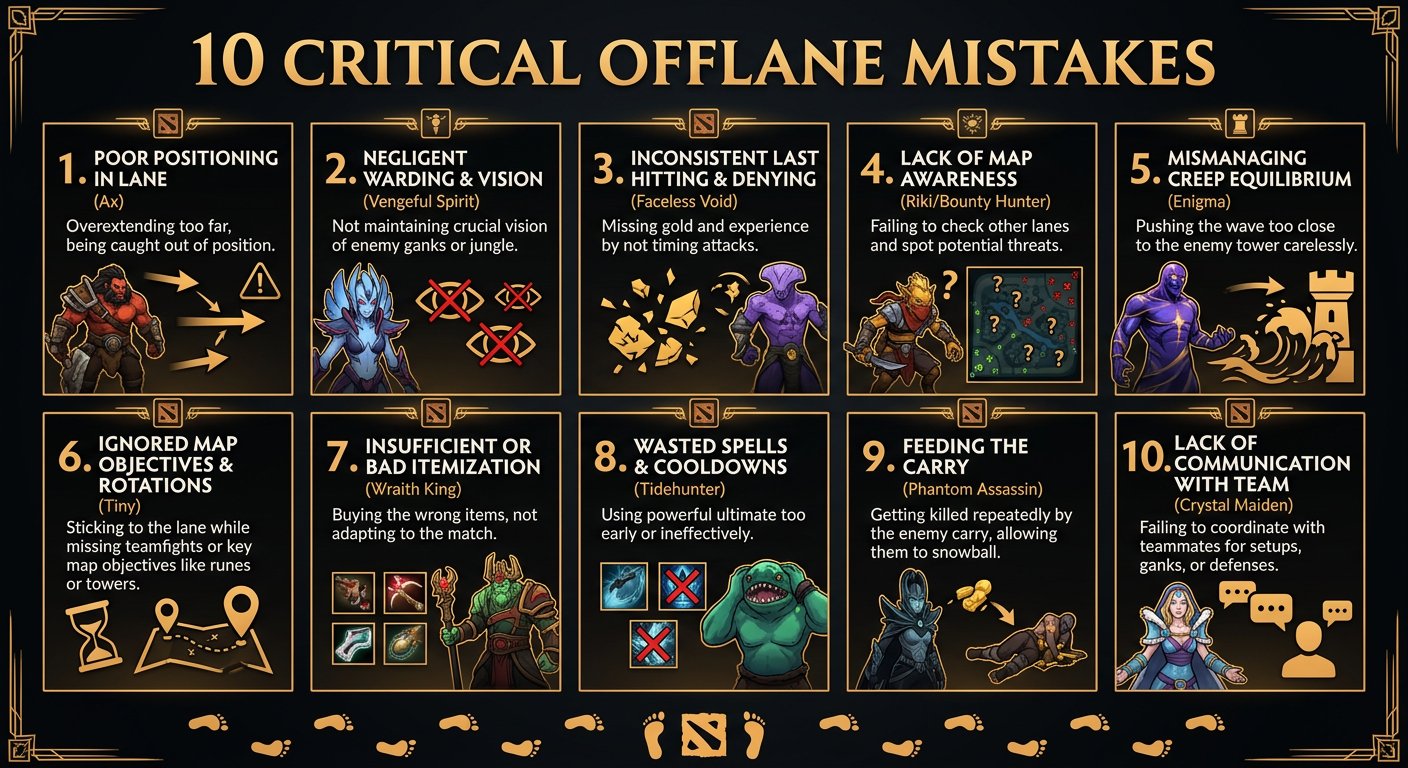
10 Critical Mistakes Divine Offlaners Make (That Immortals Don’t)
Mistake #1: Not Pressuring the Enemy Carry Enough in Lane
Divine offlaners are too focused on their own farm. They last hit, they deny, they try to get a comfortable lane. But the offlane isn’t about YOUR farm — it’s about THEIR carry’s farm. If you’re getting 60 CS in 10 minutes but the enemy carry is also getting 60 CS, you’ve failed your job.
Immortal offlaners sacrifice their own CS to harass, zone, and threaten the enemy carry. They’d rather have 40 CS while the enemy carry has 30 than have 60 CS while the enemy carry has 55. The carry’s farm matters more than yours because carries scale harder with gold. Disrupt them.
Mistake #2: Staying in Lane Too Long
There’s an optimal time to leave the offlane, and it’s usually between minutes 6-10 depending on the matchup. If you’ve taken the enemy safelane tower, leave immediately and start pressuring mid or the enemy triangle. If the tower is still up but the enemy carry has started jungling, leave and go cut waves or pressure elsewhere.
Divine offlaners often stay in lane until 12-14 minutes, passively farming and trading hits with the enemy carry. This is a waste of your time. Once the lane equilibrium stabilizes and neither side can kill the other, you should be rotating to create impact elsewhere on the map.
Mistake #3: Building Carry Items
This is a bracket-specific problem. Divine offlaners see their strong lane performance and think “I’m strong, I should build damage.” So they buy Desolator, Assault Cuirass, Daedalus — carry items that maximize their personal damage. This is almost always wrong.
Your job is to enable your team, not to be a second carry. Utility items like Pipe of Insight, Crimson Guard, Lotus Orb, and Heaven’s Halberd provide more net team benefit than any damage item. The exception is heroes like Enigma who need BKB for their combo — but even then, the item serves a utility purpose (combo completion), not a damage purpose.
Mistake #4: Poor Initiation Timing
Initiating too early or too late loses fights. Divine offlaners often initiate the moment they have Blink in range, without considering whether their team is in position to follow up. A 3-man Ravage is useless if your team is 2,000 units away and can’t capitalize.
Before initiating, check three things: (1) Is your team close enough to follow up (2) Do you have the mana/cooldowns for your full combo (3) Will this initiation lead to an objective If any answer is no, don’t initiate. Wait. Patience is the highest-value skill for initiating offlaners.
Mistake #5: Not Cutting Waves
Wave cutting is one of the most powerful tools in the offlaner’s arsenal, and Divine players barely use it. By TPing behind the enemy tier 1 or tier 2 tower and killing the creep wave before it reaches the tower, you deny the enemy carry farm AND push the wave into the tower, which damages it over time.
At Immortal, offlaners cut waves whenever they can’t productively lane. If the enemy safelane is too dangerous to fight in, cut behind it. If the enemy tower is low, cut waves to chip it down with creep damage. If your team needs space, cut waves to force rotations. It’s a versatile tool that most Divine offlaners neglect.
Mistake #6: Ignoring Tower Damage
Towers win games. Not kills, not farm — towers. Every tower you take removes safe space for the enemy and opens jungle access for your team. Divine offlaners don’t hit towers enough. They take fights near towers without actually attacking the tower afterward. They push waves to towers and then leave instead of hitting the tower.
Make a conscious effort to hit towers whenever you can. After winning a fight Hit the tower. After a successful gank Hit the tower. Enemy heroes are on the other side of the map Hit the tower. The difference between 3,000 tower damage and 8,000 tower damage per game is often the difference between winning and losing.
Mistake #7: Dying Without Purpose
As discussed in the “space creation” section, dying is only valuable if it creates a tangible benefit for your team. Diving the enemy carry under tower, dying, and giving away 400 gold isn’t creating space — it’s feeding. Before any aggressive play, ask: “If I die here, does my team get something worth more than what I’m giving the enemy”
If you’re trading your death for a tower, that’s worth it. If you’re trading your death for two enemy kills, that’s worth it. If you’re trading your death for nothing except “they had to rotate to kill me,” that’s almost never worth it.
Mistake #8: Not Using Smoke Effectively
Offlaners should be initiating or participating in 60%+ of their team’s smoke plays. At Divine, smoke is underutilized — teams buy maybe 3-4 smokes per game when they should be buying 8-10. As the offlaner, you should be the one buying and calling for smokes.
The ideal smoke play at this bracket: smoke as 3-4 heroes, walk toward an objective (tower or Roshan), catch an enemy hero who’s farming alone, kill them, take the objective. Simple, repeatable, and devastatingly effective. Call for smokes after every respawn of the smoke item in the shop.
Mistake #9: Not Communicating Cooldowns
Your team needs to know when your big abilities are available. If Ravage is on cooldown, your team shouldn’t take fights. If Black Hole is up, your team should look for opportunities. Immortal offlaners constantly communicate their cooldown status — “Ravage up in 20 seconds, wait” or “BKB ready, let’s go.”
This communication shapes your team’s behavior. When they know your cooldowns, they can make better decisions about when to fight and when to disengage. Without this information, they’re guessing — and guessing at Divine costs games.
Mistake #10: Not Adapting Build to Game State
Your item build should change based on the enemy draft and game state. If the enemy has heavy magic damage, Pipe comes before Blink. If the enemy has a fed right-click carry, Heaven’s Halberd might be more important than your usual progression. If your team has no save, Lotus Orb might be necessary.
Divine offlaners often follow the same build path regardless of the game. They always go Phase Blink Pipe Assault Cuirass, or whatever their standard build is. Immortal offlaners assess each game independently and buy the items that will have the most impact in THIS specific game, not the items they’re used to buying.
Phase-by-Phase Guide: Laning Through Late Game
Pre-Game: Drafting the Offlane
The offlane pick is usually in the first phase of the draft. This means you’re picking before you know the enemy carry, which makes versatile heroes more valuable. When picking your offlane hero, consider:
- Lane matchup flexibility: Can your hero handle both melee and ranged carries Does your hero have a way to deal with strong dual lanes
- Team fight contribution: Does your hero provide initiation, crowd control, or aura support for your team
- Tower damage: Can your hero threaten towers Heroes that can’t push towers are significantly weaker offlaners because they can’t convert lane wins into objectives.
- Synergy with your pos 4: If your support is an aggressive lane hero (Tusk, Clock), pick an offlaner who can follow up on aggression. If your support is a passive lane hero (Rubick, Shadow Demon), pick an offlaner who can survive alone.
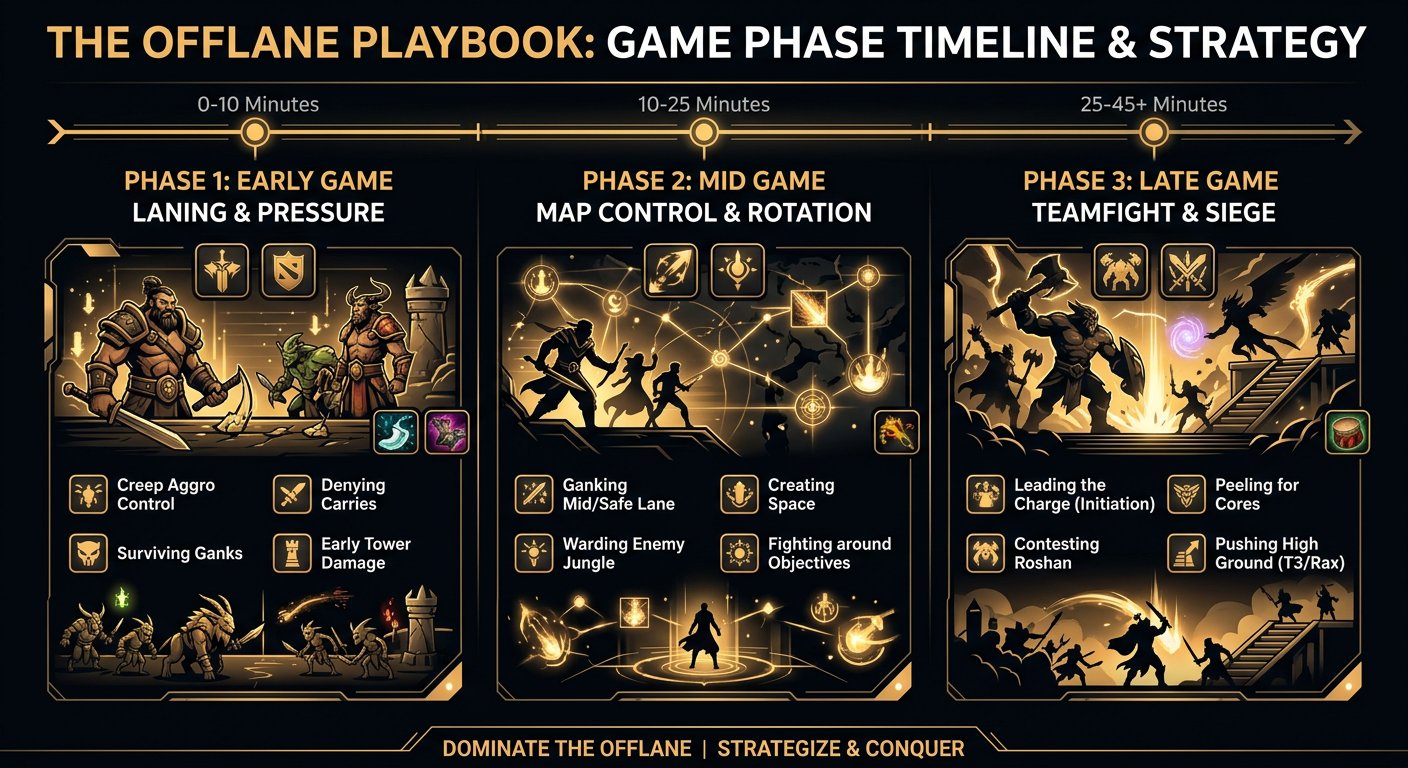
Laning Phase (0:00 – 8:00)
The first wave: Contest every last hit. The first wave sets the tone for the entire lane. If you dominate the first wave, the enemy carry’s support will panic and play more aggressively, which opens them up to mistakes. If you lose the first wave, the enemy gets comfortable and the lane becomes harder.
Trading efficiently: As an offlaner, you usually have more HP regen than the enemy carry (tangos, ring of protection, stout shield). Use this to trade aggressively. Take a hit to secure a last hit. Trade right-clicks when the enemy goes for a deny. The goal is to stay at 60-70% HP while keeping the enemy carry at 40-50% HP. This health differential is what lets you threaten kills.
Kill timing: Most offlane kill opportunities happen at levels 3 and 5, when you have two points in your primary nuke and your support has their stun. Communicate with your pos 4: “I’ll stun at level 3, be ready.” Coordinated kill attempts at these timing windows are highly effective because the enemy carry and support don’t expect aggression at these specific levels.
When to pull: If the wave is pushing toward the enemy tower and you can’t contest, pull the enemy’s large camp to reset the wave. This is an advanced technique that many Divine offlaners don’t use consistently. It denies the enemy carry a full wave of experience and gold while giving you the jungle camp.
Early Mid-Game (8:00 – 18:00)
Tower pressure: After the laning phase, your first priority is taking the enemy safelane tier 1 tower. This opens their jungle and removes a safe farming area. If the tower has 40%+ HP, consider whether you can chip it down by cutting waves or pressuring with catapult waves.
Map movement: Once you’ve taken the safelane tower (or abandoned the attempt), move to the mid lane and pressure that tower. The offlaner’s mid-game rotation is: offlane tower mid tower enemy triangle invasion. Each step removes more safe space for the enemy and creates more map control for your team.
Smoke plays: This is your window for offensive smokes. At 10-15 minutes, most heroes are at their most vulnerable — supports don’t have their saves yet, carries don’t have BKB, and vision is usually sparse. Buy a smoke, rally 2-3 teammates, and go kill someone. These plays are how you convert lane advantages into game advantages.
Farming between objectives: While moving between objectives, clear camps and waves for gold. You don’t need as much gold as your carry, but you do need your key items (Blink, Pipe, BKB). Farm efficiently between plays — don’t walk between lanes with nothing to kill. Always be clearing something.
Late Mid-Game (18:00 – 30:00)
Team fight positioning: In the mid-game, you’re the frontline. Your positioning should be ahead of your team but not so far ahead that you get caught alone. The ideal distance is 500-800 units ahead of your carry — close enough that you can initiate quickly, far enough that you absorb the first wave of enemy spells instead of your carry.
Aura item timing: Your utility items should be completed by 25 minutes. If you still don’t have Pipe/Crimson Guard by this point, you’re farming too slowly or buying the wrong items. These aura items transform team fights by providing 200-400 effective HP to every teammate. That’s the equivalent of giving everyone on your team a free item.
Roshan: As the offlaner, you should be calling for Roshan at every opportunity. After winning a fight Roshan. After getting a pick Roshan. After the enemy carry dies Roshan. Immortal offlaners average significantly more Roshan kills per game than Divine offlaners because they prioritize it higher.
Late Game (30:00+)
Your damage falls off — your utility doesn’t. In the late game, your right-click damage becomes irrelevant compared to the enemy carry. That’s fine. Your job isn’t to deal damage — it’s to create the conditions for your carry to deal damage safely. Use your abilities to lock down threats, use your aura items to protect your team, and position yourself to absorb key enemy abilities.
Buyback priority: As the offlaner, your buyback is less critical than your carry’s but more critical than your supports’. Keep buyback gold after 35 minutes, but don’t hoard gold at the expense of buying items. If you need to choose between buying a Refresher and keeping buyback, buy the Refresher — your combo is worth more than your buyback in most games.
High ground defense: If you’re defending high ground, your positioning changes from frontline to defensive. Stand in choke points, use your abilities to clear creep waves, and save your big ultimate for when the enemy commits to the push. Don’t waste Ravage on a creep wave — wait for the enemy to dive.
The Teammate Problem: Account Buyers and the Offlane Experience
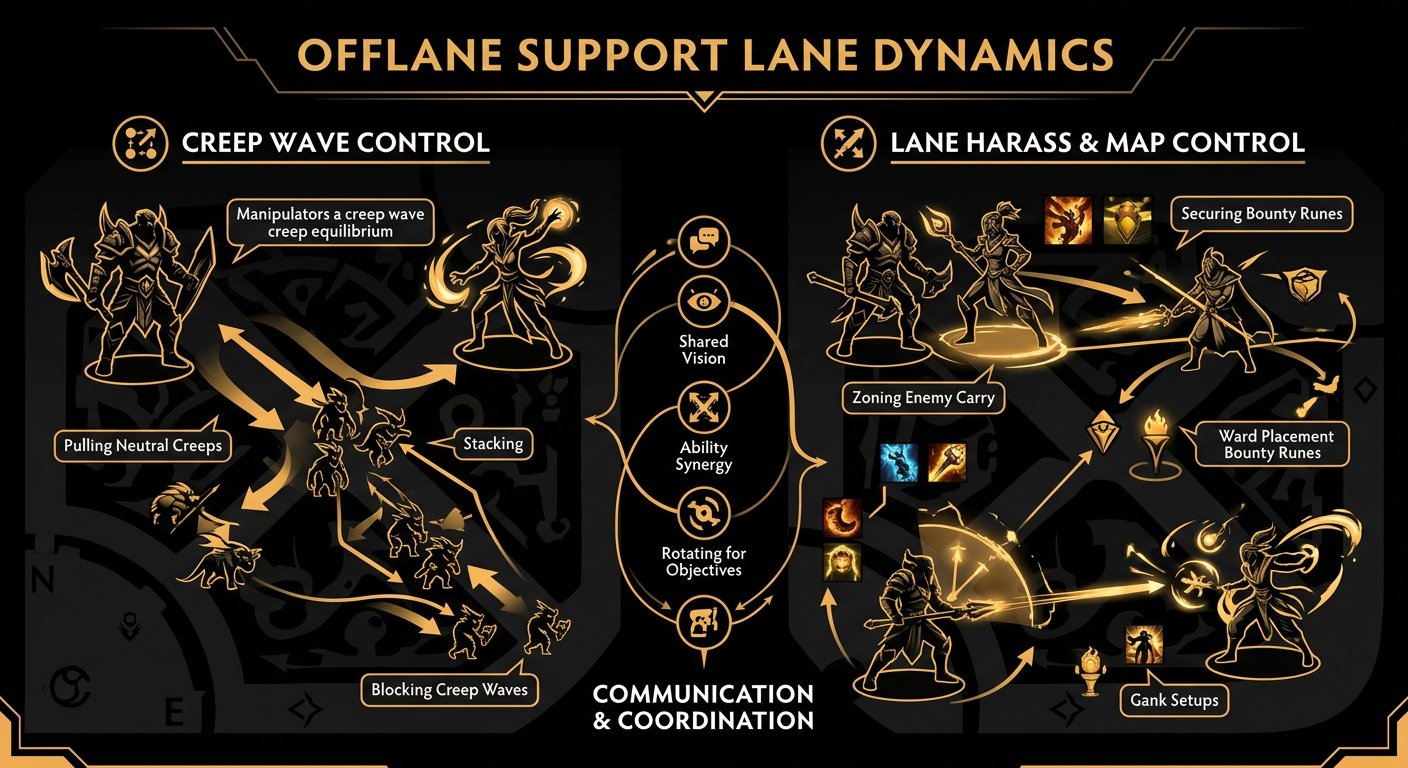
The offlane at Divine has a unique teammate challenge: your Position 4 support. The quality of your lane is heavily dependent on your lane partner, and at Divine, the variance in support quality is enormous. You’ll have games with a stellar pos 4 who controls the lane, stacks camps, and secures kills. You’ll also have games with a pos 4 who leeches XP, doesn’t trade, and abandons the lane at the first sign of difficulty.
When Your Pos 4 Is Bad
This happens frequently at Divine, especially with account buyers who play support because they think it’s “easier.” When your pos 4 isn’t helping in lane, you have two options:
Option 1: Solo lane. Ask them to leave. Literally type “go gank mid, I’ll solo.” A solo offlaner getting full experience is often better than a duo lane where the support is useless. You’ll hit level 6 faster, and the support can hopefully contribute somewhere else on the map.
Option 2: Jungle early. If the lane is completely unplayable solo (enemy has a kill lane with an aggressive support duo), go to the jungle. Farm the large camp and small camp between waves. You’ll lose some lane farm but you’ll stay alive and hit your item timings only slightly delayed.
When Your Carry Is an Account Buyer
If your pos 1 carry is clearly underperforming (bad CS, poor decision-making, dying repeatedly), your role shifts from “enable the carry” to “become the win condition.” Some games, you need to build more selfishly — Blink + BKB + damage items — because your carry isn’t going to carry, and you need to fill that gap. Recognize this early and adapt your build accordingly.
Communicating Without Tilting
Offlaners who communicate effectively win more. Simple callouts like:
- “Tower in 2 waves if we stay”
- “I have Blink, smoke for me”
- “Pipe in 500 gold, wait for me”
- “Their carry has no BKB, focus him”
These short, actionable messages give your team direction without being preachy or commanding. Avoid negative communication (“our carry is bad,” “why are you there”) — it only creates tilt and guarantees a loss.
Realistic Timeline: How Long Will This Take
Offlane Climbing Speed
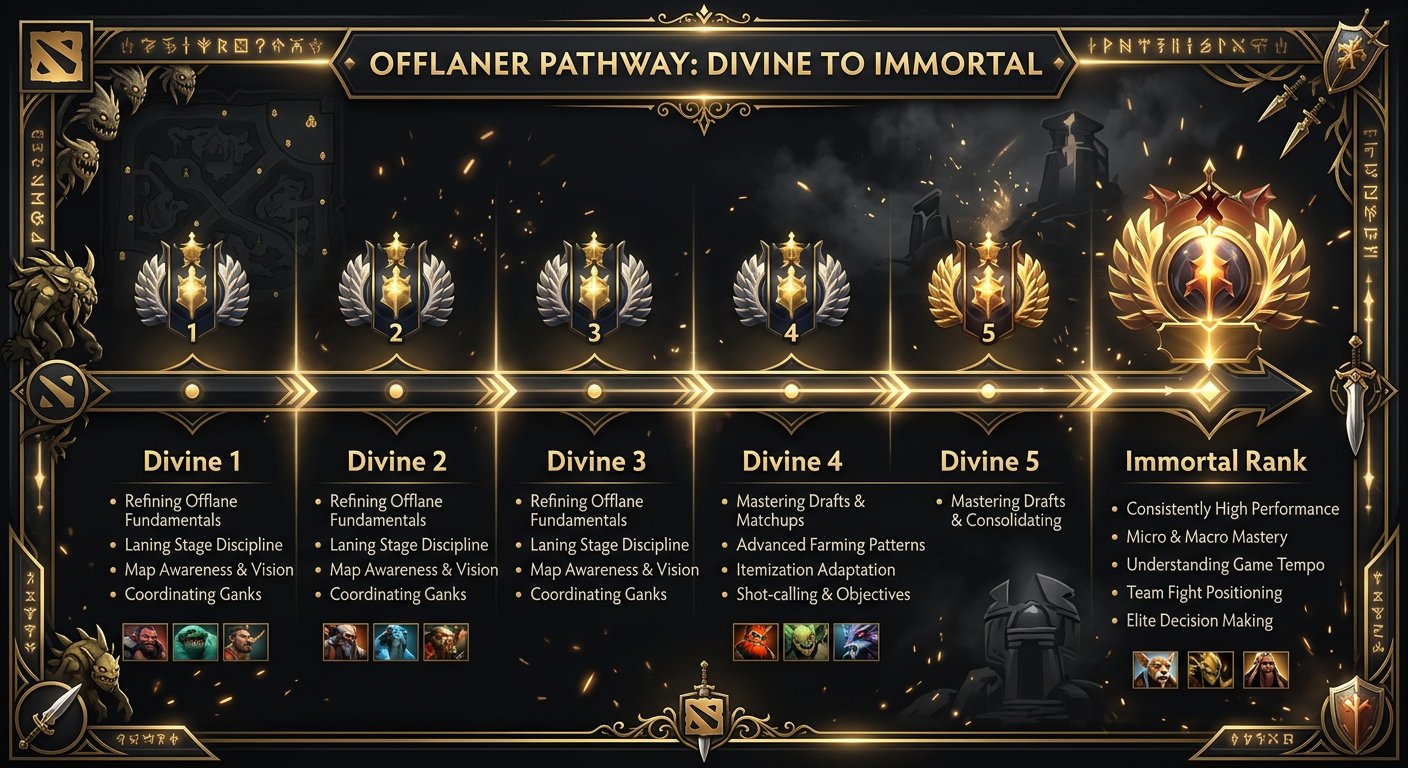
Offlane is the second-fastest role for climbing (after mid) because of its early-game impact. A truly Immortal-level offlaner in Divine can maintain a 56-60% win rate, which translates to:
- At 56% win rate (3-4 games/day): ~5-6 months to climb 1,000 MMR
- At 58% win rate (3-4 games/day): ~3-4 months
- At 60% win rate (3-4 games/day): ~2-3 months
The variance is higher for offlaners than for mid or carry because the offlane is more team-dependent. Your impact is significant but it’s filtered through your team’s ability to capitalize on the space and opportunities you create. Some games, your perfect initiation is wasted because your team doesn’t follow up. This variance makes the climb feel more volatile, even if your average win rate is positive.
Plateaus for Offlaners
First plateau: ~5,000 MMR. This is where “good laners who don’t know what to do afterward” get stuck. If you’re plateauing here, your issue is mid-game decision-making — what to do between minutes 10 and 25.
Second plateau: ~5,400 MMR. This is where “good players who tilt too easily” get stuck. At this level, your gameplay is Immortal quality when you’re in a good mood, but you have too many games where frustration tanks your performance. The fix is mental game work.
If you’re stuck at a plateau and can’t break through, professional coaching is the fastest way to identify and fix your specific weaknesses. Our coaches specialize in offlane development and can review your replays to pinpoint exactly what’s holding you back.
Accelerating the Climb
For offlaners, the most effective way to accelerate your climb is to develop a signature hero — one hero that you play at a level significantly above your current rank. If you can play Axe at an Immortal level, for example, and you pick Axe in 70% of your games, your win rate on that hero alone might be 62-65%, which carries your overall win rate high enough for a relatively fast climb.
If the grind is too long and you want to reach your target rank while continuing to improve, consider our MMR Boost service. Many players use boosting as a bridge — they get to Immortal and then maintain it through continued improvement.
Frequently Asked Questions
Yes. Offlane is the second-best role for climbing after mid. Your early-game impact is massive — you control the enemy carry’s game, you dictate tower timings, and you initiate team fights. The role has high agency, which means your individual performance has a strong correlation with game outcomes.
Aura offlaners (Tidehunter, Underlord, Centaur) are more consistent and team-friendly. Damage offlaners (Night Stalker, Primal Beast) are more variable — they carry harder when ahead but contribute less when behind. For climbing, consistency is king, so aura offlaners are generally better unless you’re significantly above your bracket.
If the enemy sends three heroes to your lane, your mid and carry should have free lanes. Your job is to soak as much XP as possible without dying. Stay in XP range (1,500 units from dying creeps), use the jungle, and be patient. Trilanes are the enemy investing three heroes to shut down one — if you don’t die, they’re losing the trade.
If the enemy carry has a strong defensive support (like Dazzle or Oracle) and you can’t threaten kills, shift to farming. Focus on getting your key items as fast as possible and look for impact through rotations instead of lane pressure. Not every lane is winnable — recognizing this early saves you from feeding kills in a lost cause.
For initiation-based offlaners (Axe, Tidehunter, Mars, Enigma, Sand King), Blink is the single most important item in your build. It should be your first major item in almost every game. The difference in team fight impact between an offlaner with Blink and without Blink is enormous — it’s the difference between reliable initiation and hoping the enemy walks into your abilities.
Ranked roles is better for climbing because you’re guaranteed your position. In classic queue, you might get forced into support, which slows your climb if offlane is your strongest role. The slight increase in queue time for ranked roles is worth the consistency of always playing your best position.
Final Thoughts
The offlane at the Divine-to-Immortal threshold is about one thing: proactive impact. You’re not a passive frontliner waiting for fights — you’re the engine that drives your team’s game plan. You pressure towers, you force rotations, you initiate fights, and you create the conditions for your carry to thrive.
The offlaner who breaks into Immortal is the one who stops asking “what should I do” and starts declaring “this is what we’re doing.” Lead from the front. Pressure relentlessly. Communicate clearly. And when the game gives you an opening — take it, don’t wait for permission.
The climb is long but the offlane rewards those who play with intention and aggression. Every game is an opportunity to practice the proactive mindset that defines Immortal offlane play.
Need help breaking through Our Dota 2 coaching service connects you with Immortal and leaderboard offlaners who can review your replays and develop a personalized improvement plan. Or check out our MMR Boost to reach your target rank faster.
Ready to Climb Start Your Journey Today
Team Smurf offers professional coaching with Divine and Immortal players, plus safe, reliable MMR boosting to help you reach your target rank.
Written by Team Smurf’s Immortal-rank analysts — Rankings last verified February 2026