How to Climb from Ancient to Divine as Pos 1 Carry in Dota 2 (2026 Guide)

Ancient bracket is where Dota 2 stops being about individual mechanics and starts being about understanding the machine. You can last hit. You can use BKB. You’ve probably got a few thousand hours under your belt. But you’re stuck — hovering between Ancient 3 and Ancient 5, watching that Divine star slip away game after game.
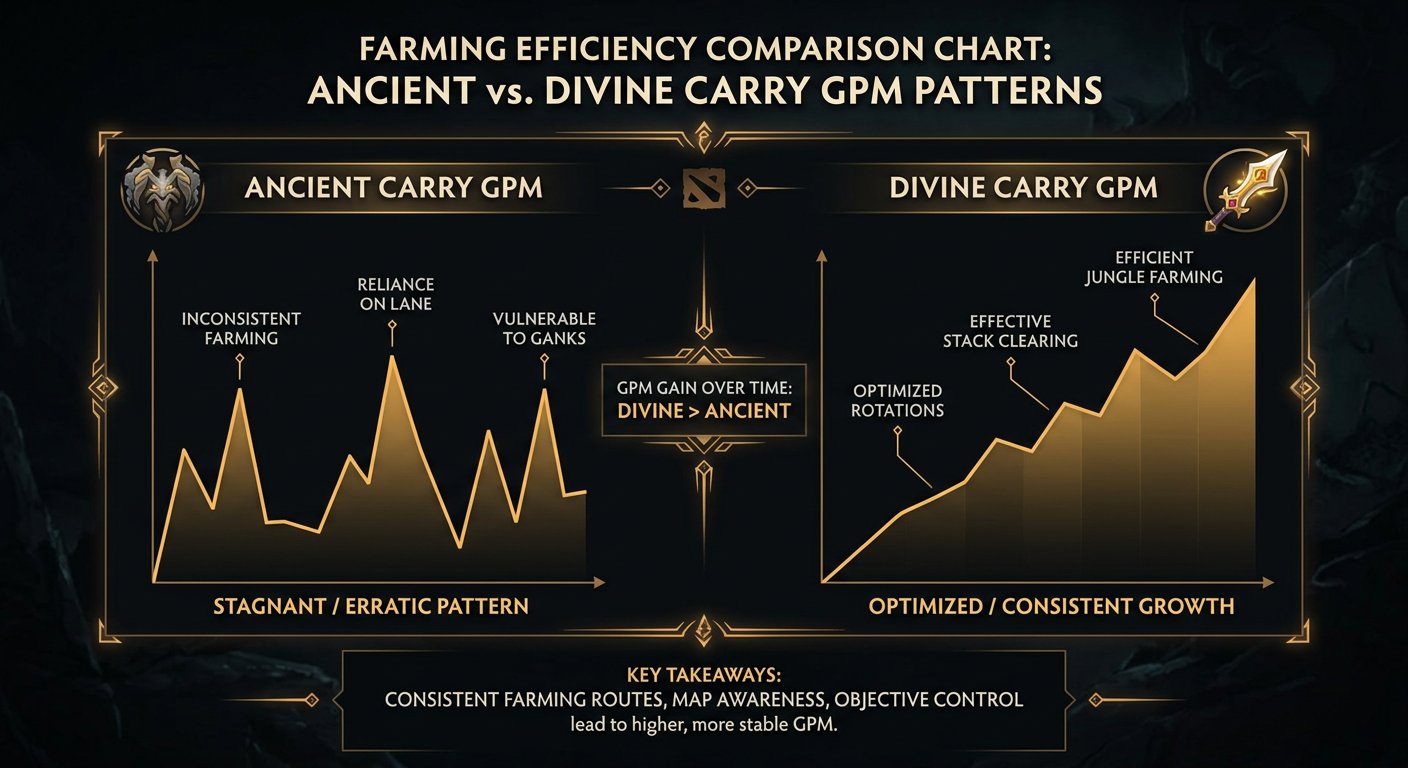
Here’s the uncomfortable truth: the gap between Ancient and Divine carry players isn’t mechanical skill — it’s decision-making efficiency. Divine carries don’t farm faster because they click better. They farm faster because they make fewer wasted movements, read the map more accurately, and commit to fights at the right time instead of the “maybe I should TP” time.
This guide breaks down exactly what separates Ancient Pos 1 players from Divine Pos 1 players — the drafting nuances, the farming patterns, the fight timing, and the mental framework you need to cross that threshold. If you’ve been hardstuck Ancient, this is your roadmap.
Understanding the Ancient to Divine Carry Gap
Let’s start with data. At Ancient rank (approximately 3,850–4,400 MMR), the average carry player has solid fundamentals: 55-65 last hits at 10 minutes in a free lane, reasonable item timing on meta heroes, and basic understanding of power spikes. At Divine (4,400–5,420 MMR), those numbers shift meaningfully — 65-80 last hits at 10 minutes, consistently faster item timings by 1-3 minutes, and crucially, far fewer deaths in the mid-game.
The single biggest statistical difference between Ancient and Divine carries Deaths per game. Ancient carries average 6-8 deaths. Divine carries average 4-5. That’s not because Divine players are more cautious — it’s because they understand when they’re vulnerable and when they’re not. Every unnecessary death as a carry costs you roughly 30-60 seconds of farming time plus gold loss, which compounds over a 40-minute game into a 2,000-4,000 net worth swing.
The Three Pillars of Divine-Level Carry Play
1. Map Efficiency: Divine carries don’t just farm — they farm in patterns that simultaneously apply pressure, create space, and position them for objectives. Every movement between camps has a purpose. If you’re walking between jungle camps without hitting a lane creep wave on the way, you’re bleeding gold.
2. Fight Selection: Ancient carries join fights based on proximity. Divine carries join fights based on outcome probability. The question isn’t “can I TP to this fight” — it’s “does TPing to this fight result in a net positive outcome for my game” Sometimes the answer is farming a full jungle rotation while your team trades 3-for-3 across the map.
3. Tempo Reading: Every Dota game has a rhythm. There are windows where your team is stronger and windows where the enemy is stronger. Divine carries instinctively feel these rhythms and adjust their aggression accordingly. Ancient carries often play at one speed regardless of game state.
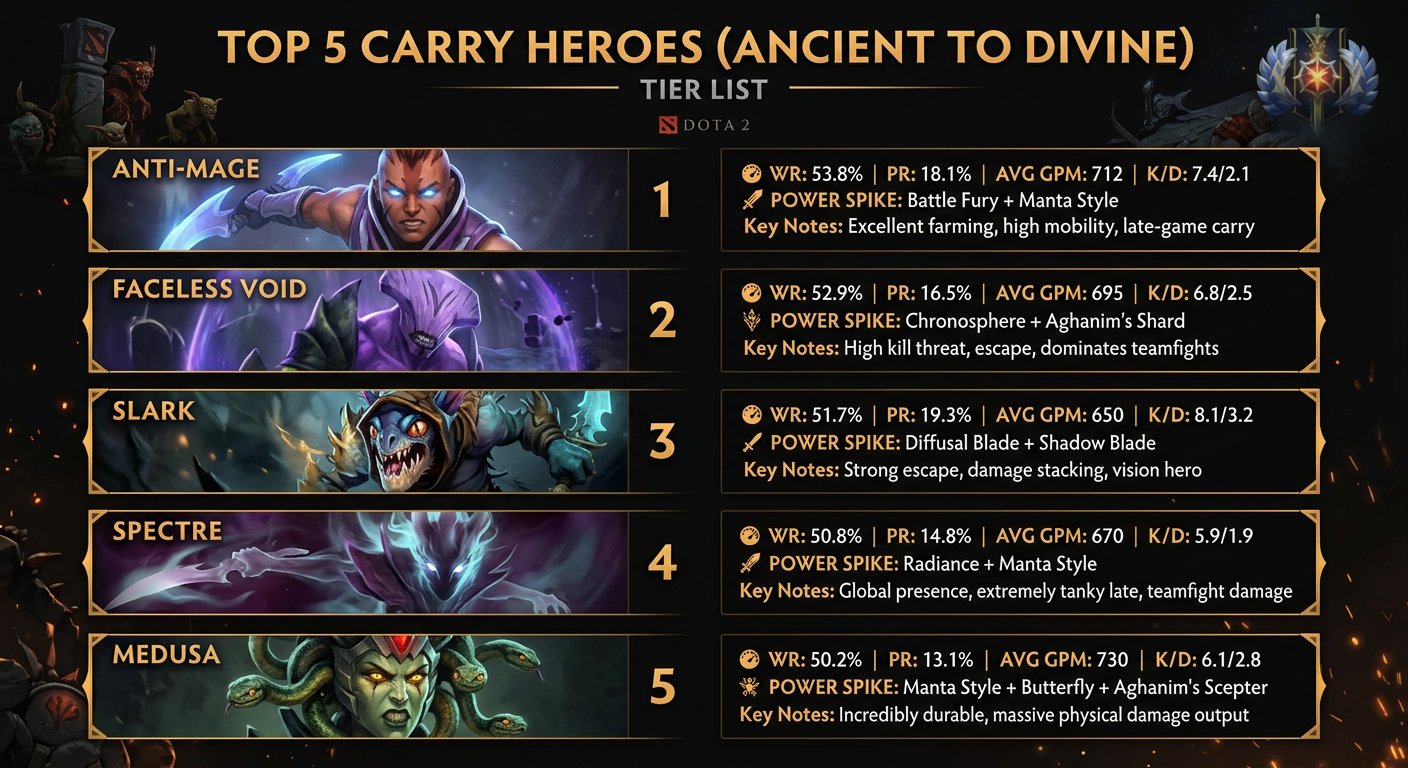
Top 5 Heroes to Climb from Ancient to Divine as Carry
Hero selection matters enormously in the Ancient bracket because your teammates are competent enough to enable you but inconsistent enough that you need self-sufficiency. The best climbing heroes balance strong laning, independent farming, and fight contribution without relying on perfect team coordination.
1. Faceless Void
Faceless Void remains the premier carry for climbing through Ancient for one simple reason: Chronosphere is the most game-deciding ultimate in Dota 2, and its impact scales with your decision-making, not your team’s coordination.
At Ancient level, teams struggle to coordinate around complex teamfight setups. Chronosphere eliminates that problem — you decide when the fight happens, who gets caught, and how it plays out. A well-placed Chrono on 2-3 enemies at the 25-minute mark with Battlefury/Maelstrom + BKB online wins teamfights regardless of what your teammates are doing.
Why Void works at this bracket:
- Time Walk provides incredible survivability, reducing your death count (the #1 metric to improve)
- Chronosphere punishes Ancient-level positioning mistakes — enemies at this bracket still clump in fights
- The hero farms reasonably fast with Battlefury and can accelerate mid-game
- Time Dilation is devastatingly strong against spell-dependent offlaners in lane
- You control your own timing — don’t need to wait for teammates to initiate
Key Ancient-to-Divine Void tip: Stop using Chrono to catch 5 heroes. At Divine level, the best Chronos catch 2-3 key targets while leaving your teammates outside to deal damage. Practice identifying the 1-2 heroes you MUST catch (usually the enemy’s highest-damage core) and build your positioning around isolating them.
2. Juggernaut
Juggernaut is the Swiss Army knife of carry heroes and arguably the safest Pos 1 pick in the game. His laning is strong, his farming is decent, his fighting is flexible, and Blade Fury provides a built-in “get out of jail” card that Ancient players desperately need.
The Ancient-to-Divine Juggernaut evolution: Ancient Juggernauts use Omnislash as their primary fight contribution. Divine Juggernauts understand that Omnislash is often a cleanup tool, and the real fight contribution comes from right-clicking with high attack speed while Blade Fury zones supports.
Build Battlefury into Manta/Sange and Yasha, then assess: do you need Basher for lockdown, or Butterfly for survivability At this bracket, Butterfly rush after Battlefury can single-handedly win games because Ancient players often lack the coordination to build multiple MKBs.
Healing Ward mastery: This is the single most underutilized ability in Ancient bracket. A well-placed Healing Ward during a siege or Roshan fight provides 5% max HP per second to your entire team. That’s essentially a free Mekansm every 3 seconds. Place it behind trees, not in the open.
3. Phantom Assassin
PA thrives in the Ancient bracket because she punishes one of the most common Ancient mistakes: poor target prioritization and lack of MKB awareness. Ancient players consistently underestimate PA’s burst damage potential and delay their MKB purchases, giving you a massive window of effectiveness.
The critical PA skill for climbing: Blur’s active component. Using Blur to disappear from the minimap and farm enemy jungle or approach fights unseen is a Divine-level technique that Ancient PA players almost never utilize. When you activate Blur and walk into the enemy jungle at 20 minutes with Desolator + BKB, you’re playing a completely different game than the PA who only uses it passively.
Draft consideration: PA is not a blind first-pick hero. She’s strongest when the enemy has 1 or fewer natural MKB builders. Look at the enemy draft — if they have heroes like Monkey King, Troll, or Windranger who naturally build MKB, PA becomes significantly worse. Pick her when the enemy relies on spell damage or heroes that prefer other items.
4. Wraith King
Wraith King is the “error-correction” carry. His ultimate literally gives you a second chance when you make a mistake, which is invaluable during the learning process of climbing from Ancient to Divine. But beyond that safety net, WK is genuinely powerful at this bracket.
Why WK dominates Ancient games:
- Reincarnation forces the enemy to commit more resources to killing you, buying space for your team
- Skeletons provide insane farming speed and push pressure that Ancient teams struggle to deal with
- Wraithfire Blast is a point-and-click stun — no skill-shot consistency issues
- The hero is straightforward enough that you can focus on macro decisions rather than mechanical execution
- Radiance build creates overwhelming map pressure that Ancient teams can’t efficiently answer
The climbing build: Radiance Assault Cuirass Overwhelming Blink. This build turns WK into an unstoppable pushing machine. With Skeletons and Radiance, you shred towers. With Assault Cuirass, your team fights better around you. With Blink, you close on targets instantly. Ancient teams almost never have a coordinated answer to a WK blinking on their backline with Radiance burn.
5. Terrorblade
Terrorblade is the highest-ceiling carry on this list and the one that will teach you the most about efficient farming patterns. TB’s illusions let him farm multiple locations simultaneously, which is the core skill that separates Ancient from Divine carries — map efficiency through multi-location farming.
The TB farming pattern that wins games: Send your illusion to a dangerous lane to push it out. Farm the safe jungle with your main hero. When the illusion wave crashes into the tower, TP to another lane. This three-location farming pattern can push your GPM above 800 consistently, which is virtually unlosable at Ancient level.
Sunder timing: At Ancient bracket, players tunnel-vision on killing TB and forget about Sunder. Use this to your advantage. In fights, let your HP drop to 25-30% (dangerous but calculated), then Sunder the highest-HP enemy hero. This effectively heals you for 50%+ of your health while dealing the same in damage. It’s a 100%+ HP swing that Ancient players consistently fall for.
Meta awareness: TB is a Manta + Skadi carry in most games. The illusion damage from these stat items is enormous. Don’t get baited into damage items like Daedalus — your illusions don’t benefit from them. Stack stats: Dragon Lance Yasha Manta Skadi Butterfly.
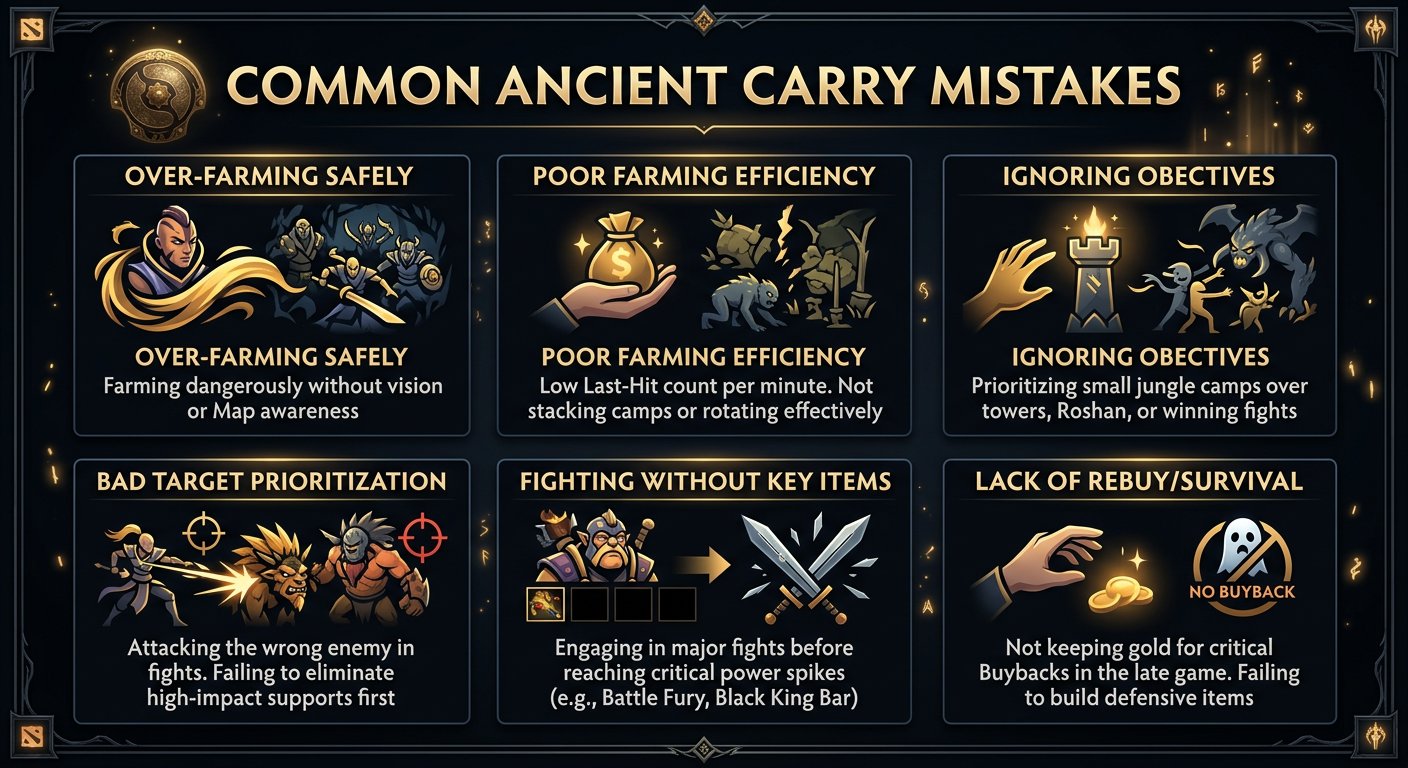
10 Critical Mistakes Ancient Carries Make (And How to Fix Them)
Mistake #1: Farming Without a Pattern
Ancient carries farm reactively — they see a jungle camp, they hit it. They see a creep wave, they take it. There’s no overarching pattern or route optimization. Divine carries have farming circuits: predetermined paths through jungle camps and lanes that maximize gold per minute while maintaining safe positioning.
The fix: Develop 2-3 farming circuits for each side of the map. A typical safe-side circuit: hit the medium camp take the lane wave hit the large camp move to the ancient camp return to lane. This takes roughly 60 seconds and covers 4 gold sources. Time your movements so you arrive at each camp just as it spawns. Practice these circuits in custom lobbies until they’re muscle memory.
Mistake #2: Taking Bad Fights Because Teammates Pinged
This is the single most MMR-losing behavior in Ancient bracket. Your Pos 3 initiates on two enemies at 18 minutes, pings you frantically, and you TP in — only to die because the enemy had buyback, or their mid rotated, or you simply weren’t strong enough yet. Not every fight is your fight.
The fix: Before TPing to any fight, do a rapid mental checklist: (1) Do I have my current power spike item (2) Are all five enemies accounted for on the map (3) Does winning this fight lead to an objective If any answer is “no,” keep farming and mute the pings. You’ll lose some fights you could have won, but you’ll avoid far more deaths than you’ll miss kills.
Mistake #3: Not Stacking for Yourself
At Ancient level, supports stack occasionally but inconsistently. Divine carries don’t rely on supports for stacks — they stack for themselves during their farming circuits. Every time you pass a camp at :53-:55 and don’t stack it, you’re leaving 100-200 gold on the table.
The fix: Integrate stacking into your farming pattern. When your circuit takes you past a camp at roughly :50, detour slightly to stack it. On heroes with AoE (Battlefury carriers, TB, Luna), stacking ancients and clearing them at 15-20 minutes can be a 1,000+ gold swing that accelerates your next item by 1-2 minutes.
Mistake #4: Static Lane Equilibrium Management
Ancient carries understand last hitting and denying, but they don’t actively manipulate lane equilibrium. They don’t pull creep aggro to reposition the wave, they don’t intentionally shove waves before jungle rotations, and they don’t single-pull the hard camp to fix a pushed lane.
The fix: Master these three techniques: (1) Creep aggro tricks — right-click an enemy hero anywhere on the map to draw creep aggro toward you, repositioning the wave. Do this repeatedly to pull the wave closer to your tower. (2) Shove-and-rotate — push the wave into the enemy tower quickly, then immediately rotate to jungle. The enemy carry misses CS to tower while you farm two locations. (3) Self-pulling — if your wave is pushing, pull the hard camp yourself at :15/:45 to reset equilibrium.
Mistake #5: Predictable Farming Locations
Ancient carries farm the same areas for the entire game. The enemy team learns your patterns by 15 minutes and starts placing wards or setting up ganks in your farming zones. Divine carries alternate between safe-side and dangerous-side farming based on enemy movements.
The fix: Use this rule — farm where the enemy isn’t, and push where the enemy’s cores want to farm. If you see 3 enemies on the top half of the map, farm the bottom jungle aggressively. If the enemy carry is farming their safe-side jungle, push the wave into their safe-side tower to disrupt their pattern. This “inverse farming” concept is one of the most impactful macro skills you can develop.
Mistake #6: Ignoring BKB Timing
Ancient carries buy BKB too late. They want to finish their damage item first — “just let me finish Butterfly, then I’ll get BKB.” By that point, the enemy has already won 2-3 teamfights and taken map control. In the Ancient bracket, the team that uses BKB first usually wins the mid-game.
The fix: Your second major item should almost always be BKB. The exceptions are extremely rare (maybe you’re a Lifestealer with Rage, or you’re so far ahead that you can skip it). Here’s the litmus test: if the enemy has any two of these — stun, slow, silence, hex — you need BKB. That’s almost every game.
Mistake #7: Poor Roshan Awareness
At Ancient level, carries treat Roshan as an afterthought — something you do when someone pings it. Divine carries treat Roshan as a strategic objective that they actively work toward. The difference is enormous: Aegis on a carry with their core items is often the single strongest timing in a game.
The fix: After completing your first major fighting item + BKB, immediately assess Roshan. Can you take it Do you have enough damage Is the enemy likely to contest If you can take Rosh, do it — even if your team isn’t fully committed. Ping it once, walk in, and start hitting. Your team will follow. The Aegis timing window (roughly 20-28 minutes on most carries) is your highest-impact moment.
Mistake #8: Not Cutting Waves During Sieges
When your team is pushing high ground, Ancient carries stand with their team and hit the tower. When the enemy defends, you’re all in one cluster, vulnerable to AoE ultimates. Divine carries cut the wave behind the enemy tower, denying the enemy team reinforcement creeps and creating a numbers advantage.
The fix: With Aegis or a survivability advantage, move behind the enemy tier 3 tower and kill the incoming creep wave. This denies the enemy team the creeps they need to safely defend (no creeps = tower takes more damage, enemy has no safe position to stand). It also forces enemies to turn around and deal with you, opening space for your team to push.
Mistake #9: Tilting After a Bad Lane
Ancient carries lose mental composure after a bad laning stage. They got killed twice, they’re behind on CS, and they spend the next 10 minutes playing frustrated — making aggressive plays to “catch up” that only put them further behind. Bad lanes are recoverable. Bad mentals are not.
The fix: Have a “bad lane protocol.” If your lane is lost by minute 5 (you’ve died, you’re zoned, the enemy has kill threat), rotate to the jungle immediately. Don’t stay and feed more. Farm the small and medium camps, stack the hard camp for later, and focus on hitting your first item timing 2-3 minutes late rather than 10 minutes late because you kept dying. A carry who farms jungle from minute 5 to 15 is infinitely more useful than one who dies 4 times trying to stay in a lost lane.
Mistake #10: Never Checking Enemy Inventories
Ancient carries rarely click on enemy heroes to check their items. This means they don’t know when the enemy gets key items (BKB, MKB, Silver Edge) and can’t adjust their play accordingly. Divine carries check enemy inventories every few minutes.
The fix: Every time there’s a fight or you see an enemy hero on the minimap, click on them and check their items. This information directly impacts your decisions: if the enemy carry just finished MKB, your Butterfly is devalued. If the enemy support has Ghost Scepter, you need Nullifier or Diffusal. If the enemy initiator has Blink, you need to play further back. This intelligence-gathering habit alone can push your win rate up 3-5%.
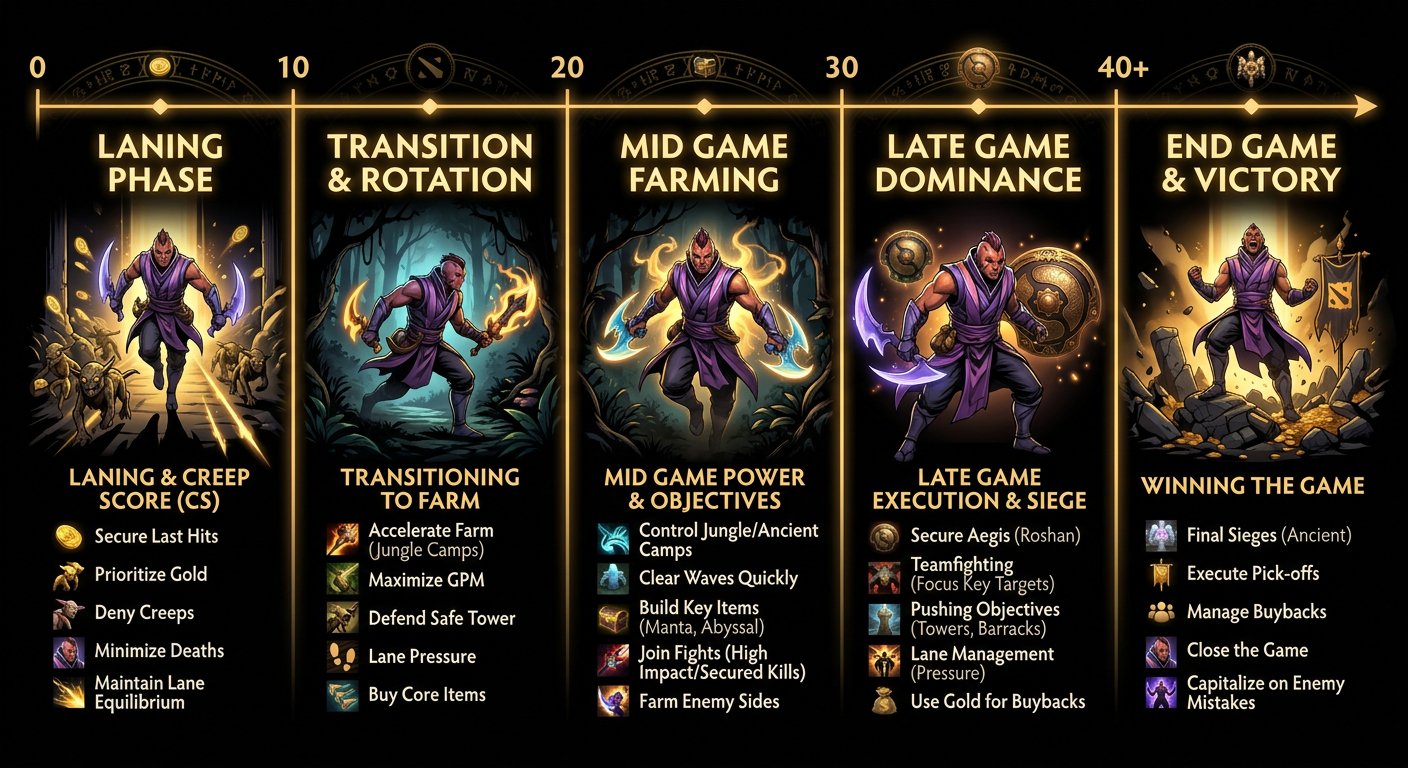
Phase-by-Phase Guide: Playing Carry from Ancient to Divine
Laning Phase (0:00 – 10:00)
The laning phase at Ancient level is more contested than lower brackets. Offlaners know how to trade, supports rotate, and kills happen frequently. Your goal as a carry isn’t to “win the lane” — it’s to extract maximum resources while dying zero times.
Minutes 0-2: Establish the baseline. The first two creep waves tell you everything about the lane. Is their offlaner aggressive Does their support have kill threat Can your support trade effectively Based on these answers, you’ll know if you’re in a winning, neutral, or losing lane. Adjust immediately — don’t wait until minute 5 to realize you’re in trouble.
Minutes 2-5: Manipulate equilibrium. This is where Ancient and Divine carries diverge. Divine carries actively control where the creep wave meets. If you’re winning, pull the wave toward your tower to extend the lane and create kill threat under tower. If you’re losing, push the wave into the enemy tower to get a free jungle rotation. Use creep aggro tricks every 2-3 seconds during this phase — it’s the most mechanically demanding part of the laning stage.
Minutes 5-7: The catapult timing. The first catapult wave (5:00) is a mini power spike. If you’ve been pressured, the catapult helps you shove the wave into the enemy tower, buying you time to farm jungle. If you’re winning, the catapult wave threatens to take a significant chunk of the enemy tower. Play around this timing — it’s more impactful than most Ancient players realize.
Minutes 7-10: Transition planning. By minute 7, you should know exactly where you’re going next. Are you staying in lane for another 3-5 minutes because you’re farming well Are you rotating to the jungle full-time because the lane is lost Are you moving to the offlane because your Pos 3 wants to join the team Make this decision at minute 7, not minute 12.
Early Mid-Game (10:00 – 20:00)
This is the phase where most Ancient carries stagnate. The laning phase is over, fights are breaking out, and there’s constant pressure to TP to skirmishes. Your job during this phase is to farm at maximum efficiency while showing to fights that are clearly favorable.
The triangle concept: Control one triangle of the map (your safe-side jungle + the adjacent lane). Push the lane out, farm the three jungle camps, push the lane again. This rotation gives you roughly 500-600 GPM if executed efficiently with zero deaths. The triangle is your default — you only leave it for Roshan, tier 1 towers with your team, or guaranteed kills.
TP discipline: You have two TP scrolls (you should always carry two). The first is for farming efficiency — TPing to a pushed lane to collect the wave. The second is for emergencies — TPing to defend a tower or join a fight. Never use both TPs aggressively. If you TP to a fight and it goes badly, you need that second TP to escape or farm a different area.
Smoke awareness: At Ancient level, teams start using smokes but poorly. They smoke as 5 and wander around for 60 seconds looking for a fight. As a carry, you need to be aware of when the enemy has smoke (check their support inventories) and position accordingly. If you haven’t seen the enemy supports for 30+ seconds and they have gold for smoke, assume you’re being hunted. Move unpredictably.
Late Mid-Game (20:00 – 30:00)
This is your peak impact window. By minute 20-25, you should have your core fighting items (typically 2 major items + BKB) and be ready to take objectives. The team that takes Roshan and a set of barracks during this window usually wins at Ancient level.
Roshan timing: As mentioned earlier, Roshan is your primary objective after completing your fighting items. Coordinate with your team (even a simple “Rosh” chat wheel message is enough), secure Aegis, and immediately pressure the enemy’s weakest lane of barracks. Don’t farm for another 5 minutes after getting Aegis — that’s wasting the most valuable resource in the game.
Aegis push protocol: With Aegis, your team pushes. You stand in front. You absorb the enemy’s initiation, die (with Aegis), and your team cleans up while the enemy’s cooldowns are spent. Alternatively, if you can hit the tower safely, do so — but be prepared to eat the initiation. The Aegis is meant to be used aggressively, not as a safety net for farming.
High-ground decision making: If you’ve taken Roshan and won a fight, you have approximately 30-50 seconds to decide: push high ground or take outer towers In Ancient bracket, the answer depends on the death timers. If 2+ enemies have 40+ second death timers, go high ground. If only 1-2 are dead with short timers, take the outer towers and back off. Failed high-ground pushes lose more Ancient games than almost anything else.
Late Game (30:00+)
If the game reaches 30+ minutes, the dynamics shift significantly. Buybacks become the primary resource, items approach six-slot, and single fights decide the outcome. At this stage, your death without buyback available is a potential game-ending mistake.
Buyback management: After 30 minutes, always have buyback gold available. Always. If you have 5,000 gold and buyback costs 4,000, you have 1,000 gold to spend — not 5,000. This is non-negotiable. The number of Ancient games lost because a carry spent their buyback gold on a component is staggering.
Pick-off avoidance: Late-game deaths are catastrophic. Farm only in areas where you have vision. Never walk into fog without your team. Use illusions, summons, or abilities to scout before moving. If you have to choose between farming a dangerous camp for 200 gold or waiting in safety, choose safety every single time.
Objective focus: In the late game, the only things that matter are Roshan and barracks. Kills that don’t lead to Roshan or barracks are meaningless. Before committing to a fight, ask: “If we win this fight, do we get Roshan or barracks” If the answer is no, the fight might not be worth taking.
How to Deal with Inconsistent Teammates at Ancient Level
Let’s be real: one of the biggest frustrations of climbing through Ancient is teammate inconsistency. Your support might be excellent at warding but terrible at positioning. Your mid might dominate the lane but never join fights. Your offlaner might pick a carry hero in the offlane and farm all game. These are realities you need to work around, not fight against.
The Support Problem
Ancient supports are mechanically competent but strategically inconsistent. Some games your Pos 5 pulls perfectly, wards optimally, and creates the space you need. Other games, they leech XP in lane, block your jungle camps with wards, and dive the enemy tower at level 2.
The solution: Be self-sufficient in lane. Learn to farm under pressure without support help. If your support is playing well, great — leverage their space. If they’re not, don’t flame — just adjust. Buy your own sentry for the lane. Pull the hard camp yourself if needed. Farm jungle earlier than planned if the lane is untenable. The less you depend on your support, the more consistent your laning will be.
The Mid Problem
Ancient mid players either stomp or get stomped — there’s rarely a middle ground. When your mid is losing, the enemy mid rotates to your lane with a level advantage, and suddenly your “safe” lane becomes a kill zone.
The solution: Watch the minimap for the enemy mid. If your mid dies at minute 6, the enemy mid will likely rotate within the next 2-3 minutes. Be prepared to farm jungle, stay under tower, or rotate to a different part of the map. Don’t be the carry who dies to the rotating mid because they weren’t paying attention.
The “Everyone Wants to Carry” Problem
In Ancient bracket, you’ll frequently encounter games where your offlaner picks a greedier hero than ideal, or your Pos 4 is building damage items instead of utility. The farm map gets crowded, and suddenly you’re competing with your own team for resources.
The solution: If your team is greedy, you need to be the one who adapts. Consider fighting-oriented builds that come online faster (Maelstrom instead of Battlefury, Drum + BKB rush instead of farming items). Play around your team’s power spikes — if your offlaner has their core item at 18 minutes, group with them and fight. Trying to out-farm your own teammates is a recipe for losing.
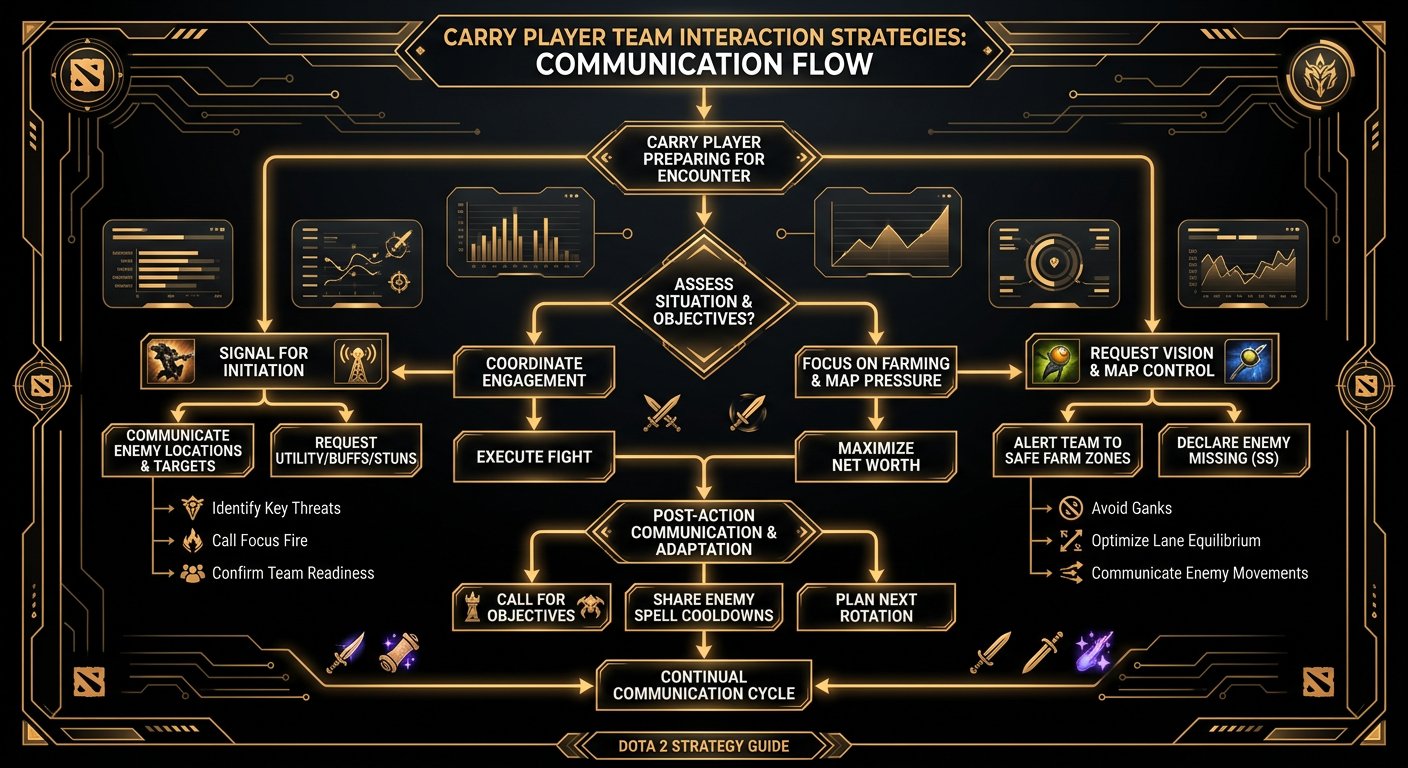
Communication That Actually Works
At Ancient level, excessive communication often backfires — pings get muted, chat gets ignored, and voice chat devolves into arguments. Here’s what actually works:
- Single-ping objectives: One ping on Roshan. One ping on a tower. That’s it.
- Chat wheel timings: “I need X more gold for my item” chat wheel is more effective than typing “don’t fight yet.”
- Strategic info drops: “Enemy has smoke” or “Rosh in 60 seconds” in team chat provides value without being bossy.
- Mute early: If a teammate starts being toxic, mute immediately. Don’t engage. The MMR you save from not tilting is worth more than any communication you’d miss.
Realistic Timeline: Ancient to Divine as Carry
Let’s set honest expectations. Climbing from Ancient 1 to Divine 1 is approximately 600-800 MMR, which at a 53-55% win rate (a good climbing rate) takes:
- At 53% win rate: Roughly 200-300 games, or 3-5 months of regular play (2-3 games per day)
- At 55% win rate: Roughly 120-180 games, or 2-3 months of regular play
- At 58%+ win rate: Roughly 70-100 games, or 1-2 months of regular play
Most players who successfully climb from Ancient to Divine do so over a 2-4 month period. The climb isn’t linear — you’ll have winning streaks and losing streaks. The key is consistency: playing your best Dota every game, reviewing your losses, and not giving up during inevitable downswings.
The plateau phenomenon: Many carries hit a plateau around Ancient 4-5 (roughly 4,200-4,400 MMR). This is where the matchmaking starts mixing in Divine players, and the difficulty spikes. If you plateau here, focus specifically on the mistakes listed above — particularly fight selection and farming efficiency. These two skills are the most common bottlenecks at this exact MMR range.
What to do during losing streaks: If you lose 3 games in a row, stop playing ranked for the day. Review the replays of those 3 games, identify one thing you did wrong in each, and focus on fixing those specific issues in your next session. Grinding through a losing streak rarely ends well.
If you’re struggling to break through or simply want to accelerate your climb, consider professional Dota 2 coaching. A Divine or Immortal coach can identify your specific weaknesses in 1-2 sessions and give you a personalized improvement plan that generic guides can’t provide.
Frequently Asked Questions
Juggernaut and Faceless Void are the safest spam picks because they’re rarely banned, work in most lineups, and have built-in survivability. If you’re looking for a single hero to master, Juggernaut has the fewest hard counters and the most consistent performance across different game states. However, the best approach is a hero pool of 3-4 carries that cover each other’s weaknesses.
In Ancient bracket, first-picking a carry is risky because the enemy can counter-pick. However, first-picking a flexible carry like Juggernaut, Wraith King, or Faceless Void is relatively safe because these heroes don’t have hard counters. Avoid first-picking heroes like PA (countered by MKB) or Terrorblade (countered by burst magic damage) — save these for later picks when you can see the enemy draft.
At Ancient level, the mid-game matters significantly more than the laning stage. Even if you lose the lane badly, efficient jungle farming from minutes 5-20 can recover your game. Conversely, winning the lane and then dying 3 times in the mid-game erases your advantage. Focus 30% of your energy on laning and 70% on mid-game execution.
Join fights when: (1) you have a completed major item, (2) your BKB is available, (3) the fight is near an objective you want, (4) you can see that winning the fight is likely. Keep farming when: (1) you’re 500+ gold from your next item, (2) your BKB is on cooldown, (3) the fight is in a random location with no objective payoff, (4) you can’t see all five enemies on the map.
An MMR boost can get you to Divine, but the real question is whether you can maintain that rank. If you’re Ancient 5 and consistently performing at Divine level but struggling with the final push, a boost to low Divine can put you in the right bracket. However, if you’re Ancient 1-3, there’s genuine skill development needed, and coaching is likely a better investment alongside the climb.
Build around them, don’t ignore them. If you’re PA against MKB builders, you need to end the game before minute 30 — play aggressively with early BKB + Desolator. If you’re Terrorblade against heavy magic burst, consider early BKB before Manta. Every counter-pick has a window of vulnerability — find it and exploit it before their counter fully comes online.
Watch one replay per day of a game you lost. Specifically, find every death and ask yourself: “What information did I have (or could have had) that would have prevented this death” You’ll find that 80% of your deaths were preventable with better map awareness or decision-making. Fix those, and your win rate will climb.
Final Thoughts: Your Path from Ancient to Divine
Climbing from Ancient to Divine as a carry is a journey that requires patience, self-awareness, and a commitment to improving specific skills. It’s not about playing more games — it’s about playing better games. Focus on reducing deaths, optimizing farming patterns, choosing fights wisely, and reading the map like a Divine player.
Remember: every Divine carry was once stuck in Ancient. The difference between those who climbed and those who stayed isn’t talent — it’s the willingness to identify mistakes, practice fixes, and maintain mental discipline through the inevitable setbacks.
Ready to accelerate your climb TeamSmurf’s professional coaching service pairs you with Divine and Immortal carry players who can review your replays, identify your specific weaknesses, and create a personalized improvement plan. Or, if you want to skip the grind entirely, our MMR boosting service can get you to Divine quickly and safely. Whatever path you choose, the Ancient-to-Divine climb is within your reach — start today.
Ready to Climb Start Your Journey Today
Team Smurf offers professional coaching with Divine and Immortal players, plus safe, reliable MMR boosting to help you reach your target rank.
Written by Team Smurf’s Immortal-rank analysts — Rankings last verified February 2026