How to Climb from Ancient to Divine as Pos 3 Offlane in Dota 2 (2026 Guide)

The offlane is the most misunderstood role in Dota 2 — especially at Ancient bracket. Most Ancient offlaners think their job is to “win the lane and then fight.” That’s half right. The full picture is infinitely more nuanced, and understanding that nuance is exactly what separates an Ancient 3 offlaner from a Divine one.
Here’s the core truth: The Pos 3 offlaner is the team’s tempo controller. You don’t just fight — you decide WHEN your team fights, WHERE your team fights, and what the enemy carry is allowed to do. At Divine level, offlaners don’t just win lanes; they systematically dismantle the enemy’s game plan by controlling vision, threatening towers, and creating pressure asymmetries across the map.
This guide is for Ancient offlaners who are tired of winning lanes and still losing games. We’re going to break down the draft intelligence, lane manipulation, mid-game pressure patterns, and team coordination skills that will push you from Ancient to Divine.
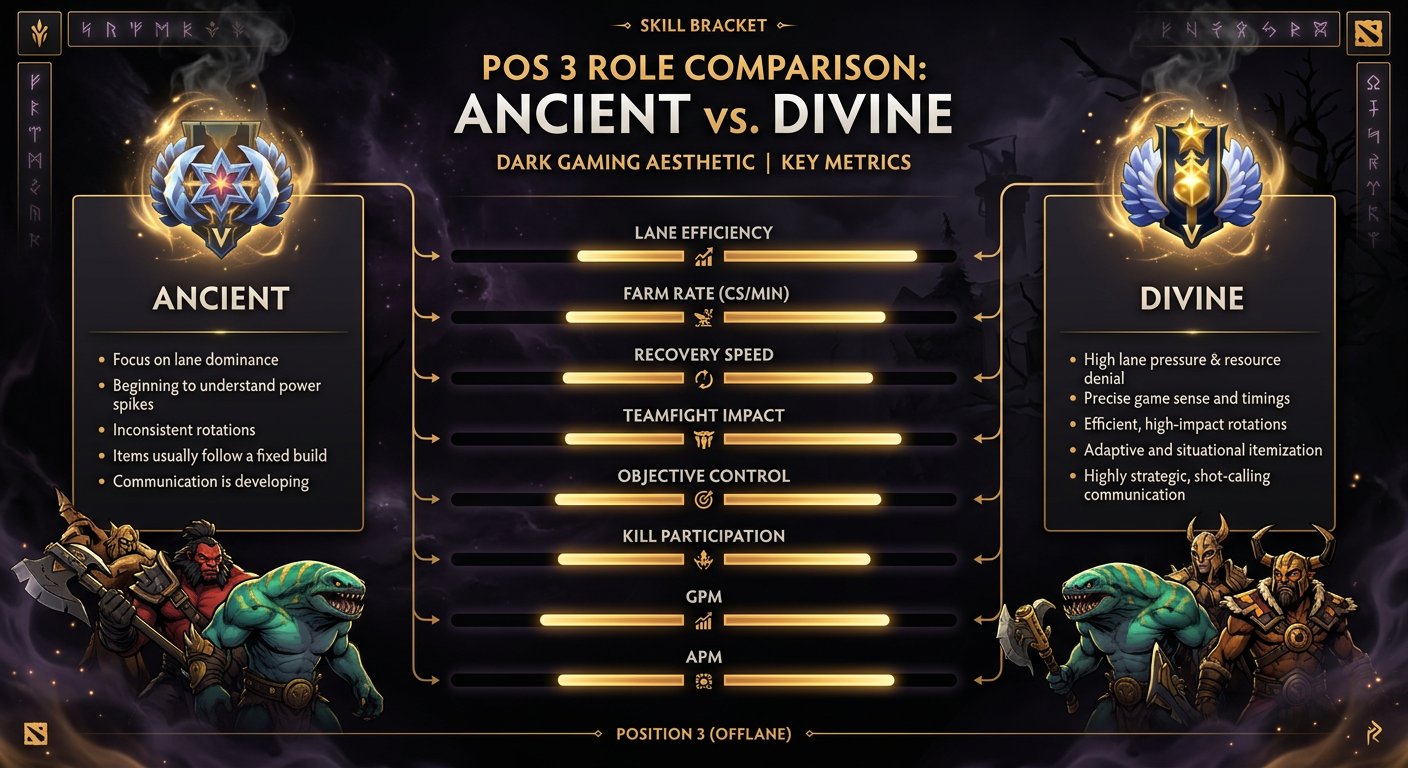
Understanding the Pos 3 Role at Ancient vs. Divine
At Ancient level, the offlaner is typically the “second core” — a hero who lanes well, builds fighting items, and joins teamfights. This is fine, but it’s incomplete. At Divine level, the offlaner fills a much more complex role: space denier, tempo setter, and strategic catalyst.
Space Denial vs. Space Creation
Most guides talk about “creating space.” But the offlaner’s primary function isn’t creating space for your team — it’s denying space from the enemy. There’s a crucial difference. Creating space means making plays that attract enemy attention. Denying space means directly preventing the enemy carry from farming safely.
When you push the enemy safelane tower at minute 8, you’re not “creating space” for your carry — you’re denying the enemy carry their safe farming area. When you cut creep waves behind the enemy tier 2, you’re not making a flashy play — you’re literally removing gold from the enemy carry’s income. Divine offlaners think in terms of denial, not just aggression.
The Aura Carrier Concept
At Divine level, the offlaner is understood to be the team’s “aura carrier” — the hero who builds items that benefit the entire team (Pipe of Insight, Crimson Guard, Assault Cuirass, Guardian Greaves, Vladmir’s Offering). These items don’t show up on the scoreboard, but they win teamfights by providing 20-30% damage reduction or attack speed to your entire team.
Ancient offlaners often skip aura items in favor of more “fun” builds — Blink Dagger into damage items, or greedy farming items. This is one of the most impactful changes you can make to your game: build for your team, not for yourself. A Pos 3 Tidehunter with Blink + Pipe + Refresher wins more games than one with Blink + Daedalus + Assault Cuirass, even though the second build has a higher DPS number on paper.
The Initiator Problem
Ancient offlaners often think initiation means “jumping on the enemy.” It doesn’t. Good initiation means starting a fight at the right time, in the right place, on the right target. A Tidehunter Ravage on 5 enemies in a random jungle fight is worse than a Ravage on 2-3 enemies near a tower you want to take. The Divine offlaner initiates with purpose — every initiation should lead to an objective.
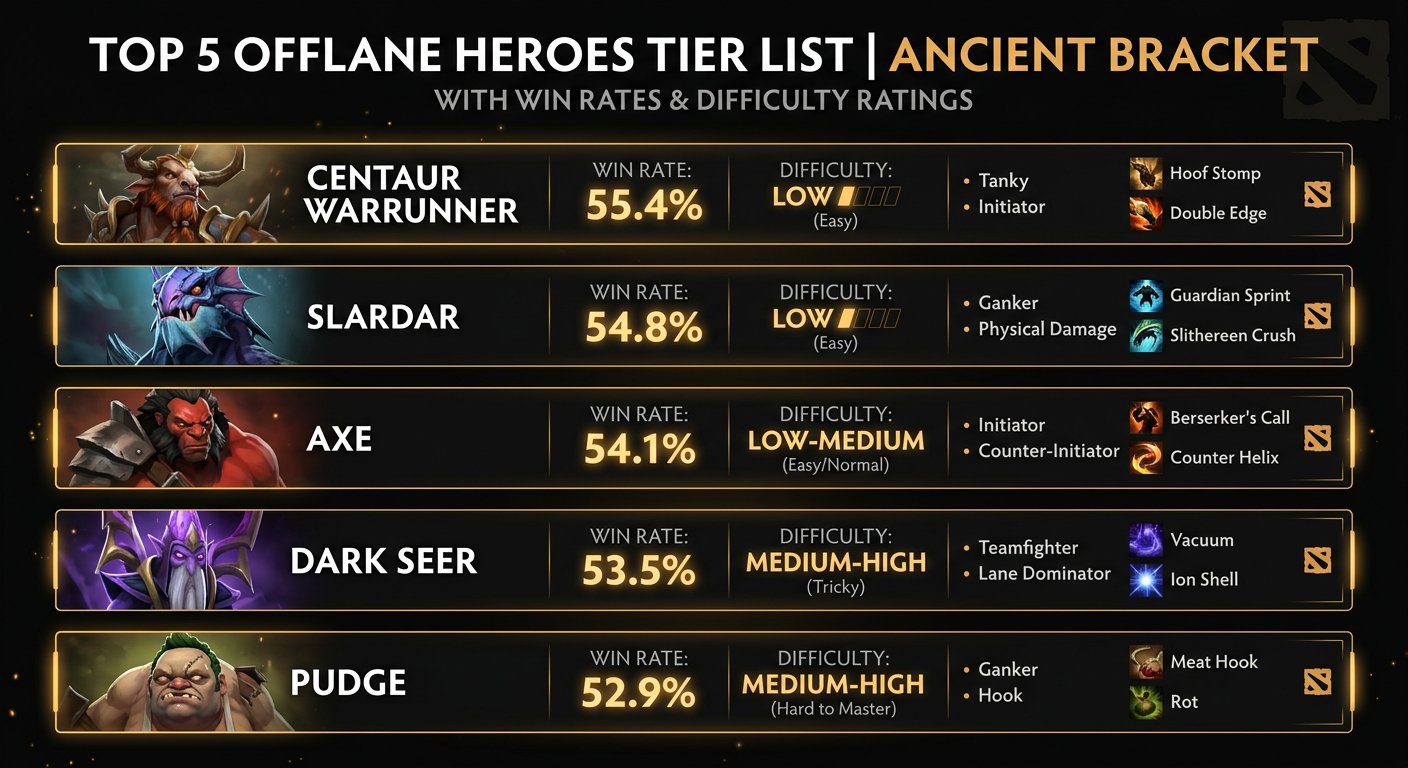
Top 5 Heroes to Climb from Ancient to Divine as Offlane
1. Beastmaster
Beastmaster is the ultimate climbing offlaner because he provides everything the Pos 3 role demands: lane dominance, scouting, pushing power, and single-target lockdown. At Ancient level, Beastmaster’s Hawks provide vision that compensates for your supports’ inconsistent warding — you become your own vision provider.
Why Beastmaster dominates Ancient bracket:
- Wild Axes destroy creep waves instantly, allowing you to shove and pressure towers from minute 5
- Call of the Wild Hawk provides free, mobile vision that Ancient teams rarely bother to kill
- Primal Roar is a BKB-piercing stun that goes through everything — it’s the most reliable initiation tool in the game
- The hero transitions naturally into aura items (Helm of the Overlord, Assault Cuirass, Aghanim’s)
- Beastmaster takes towers faster than any other offlaner with his summons
The Beastmaster gameplan: Win lane through creep wave manipulation with Axes Hit level 6 Push the enemy safelane tower with your boar and teammates Transition to mid-game by controlling vision with Hawks and threatening the enemy carry with Roar Build aura items Initiate fights with Roar on the enemy’s most important hero.
Advanced technique: Use the Hawk to scout Roshan, enemy jungle stacks, and smoke movements. At Ancient level, enemies almost never kill the Hawk, giving you permanent intelligence that your team desperately needs.
2. Axe
Axe is the quintessential “lane dominator” offlaner and one of the strongest climbing heroes at any bracket. His laning is oppressive, his mid-game initiation is devastating, and Culling Blade provides a mechanic that Ancient players consistently misplay against — they don’t respect the kill threshold.
The Axe climbing pattern: Dominate lane with Counter Helix and Battle Hunger Get Blink Dagger by 12-15 minutes Start calling fights with Berserker’s Call Build Blade Mail Become an unkillable frontliner who forces the enemy to commit resources to killing you.
Lane domination technique: At level 1-3, stand between the enemy creep wave and the enemy carry. Every time they try to last hit, they take Counter Helix spins. If the support tries to help, they take spins too. This is Axe’s unique power — he doesn’t need to hit creeps to win the lane. He just needs to stand near them.
Blink Call discipline: The biggest mistake Ancient Axe players make is Calling too many heroes. A 5-man Call sounds impressive but often gets you killed because the enemy team has too much damage to burn through your Blade Mail. The optimal Call catches 2-3 heroes — ideally the enemy carry and one support. Your team follows up while the remaining enemies scramble to help.
3. Tidehunter
Tidehunter is the safest offlaner in the game and provides the most game-changing teamfight ultimate available to the Pos 3 role. At Ancient level, Ravage wins teamfights that you have no business winning — a well-timed Ravage can swing a fight from a 3v5 disadvantage to a clean team wipe.
Why Tide works for climbing: Kraken Shell makes you nearly impossible to kill in lane. Anchor Smash reduces enemy attack damage by 60%, neutering the enemy carry’s last-hitting. And Ravage… Ravage is Ravage. It’s the panic button that wins lost fights, secures Roshan, and breaks high ground.
The Tide tempo: Survive lane (you always do) Get Blink at 14-18 minutes Find a fight where the enemy groups up Blink Ravage Take an objective Repeat every 150 seconds. The simplicity of this pattern is its strength — there’s less room for errors, and the payoff is enormous.
Refresher Orb timing: At Ancient level, getting a Refresher Orb on Tidehunter by 28-32 minutes is often game-ending. Double Ravage in a single fight is something Ancient teams simply cannot handle. After Blink + one defensive aura item, rush Refresher. The double Ravage timing is your “I win” button.
4. Centaur Warrunner
Centaur Warrunner is the tanky frontliner who turns average Ancient teams into aggressive, tower-pushing machines. His Stampede ultimate is one of the most impactful team-movement abilities in the game, and at Ancient level, teams rarely play around it optimally.
Centaur’s climbing advantage: Stampede provides a global engagement/disengage tool that compensates for your team’s poor positioning. Teammate caught out of position Stampede saves them. Enemy team retreating Stampede runs them down. Ancient teams waste multiple ultimates trying to catch heroes you can simply Stampede away from.
The Double Edge laning pattern: At level 3, Double Edge + Hoof Stomp combination deals approximately 350 magic damage, which kills most support heroes or brings them to dangerous HP levels. At Ancient level, supports often disrespect Centaur’s kill threat and stand too close. Punish them every time with Stomp Double Edge right clicks.
Item build: Vanguard Blink Pipe/Crimson (game-dependent) Aghanim’s Scepter Heart of Tarrasque. The Aghanim’s Scepter upgrade to Stampede (adding damage return) is devastating in teamfights — every enemy hit dealt to your stampeding teammates reflects damage back. Ancient players don’t realize how much damage they’re taking from Stampede return and often kill themselves hitting your team.
5. Mars
Mars is the offlaner for players who want aggressive, playmaking gameplay with strong laning and teamfight control. Arena of Blood is one of the most visually clear and impactful ultimates in the game, and at Ancient level, players consistently misplay inside it.
Why Mars climbs:
- Spear of Mars provides a long-range stun that catches enemies at Ancient-level positioning
- God’s Rebuke deals massive damage and knocks creeps back, giving excellent farming speed
- Bulwark provides directional damage reduction that Ancient players often don’t play around correctly
- Arena of Blood creates a zone that traps enemies and blocks projectiles — it’s a teamfight arena on your terms
The Mars combo: Blink Arena of Blood Spear of Mars God’s Rebuke. This combo traps 1-3 enemies inside the Arena, stuns the primary target against the Arena wall, and deals significant AoE damage. At Ancient level, teammates who are inside the Arena have a significant advantage because enemy projectiles (right clicks, spell projectiles) are blocked by the wall.
Lane tip: Mars’s God’s Rebuke has a massive crit multiplier that Ancient carries often underestimate. Trade aggressively with Rebuke — the damage is higher than most non-critical right clicks from carries at early levels. Combine with Spear for kill threat starting at level 3.
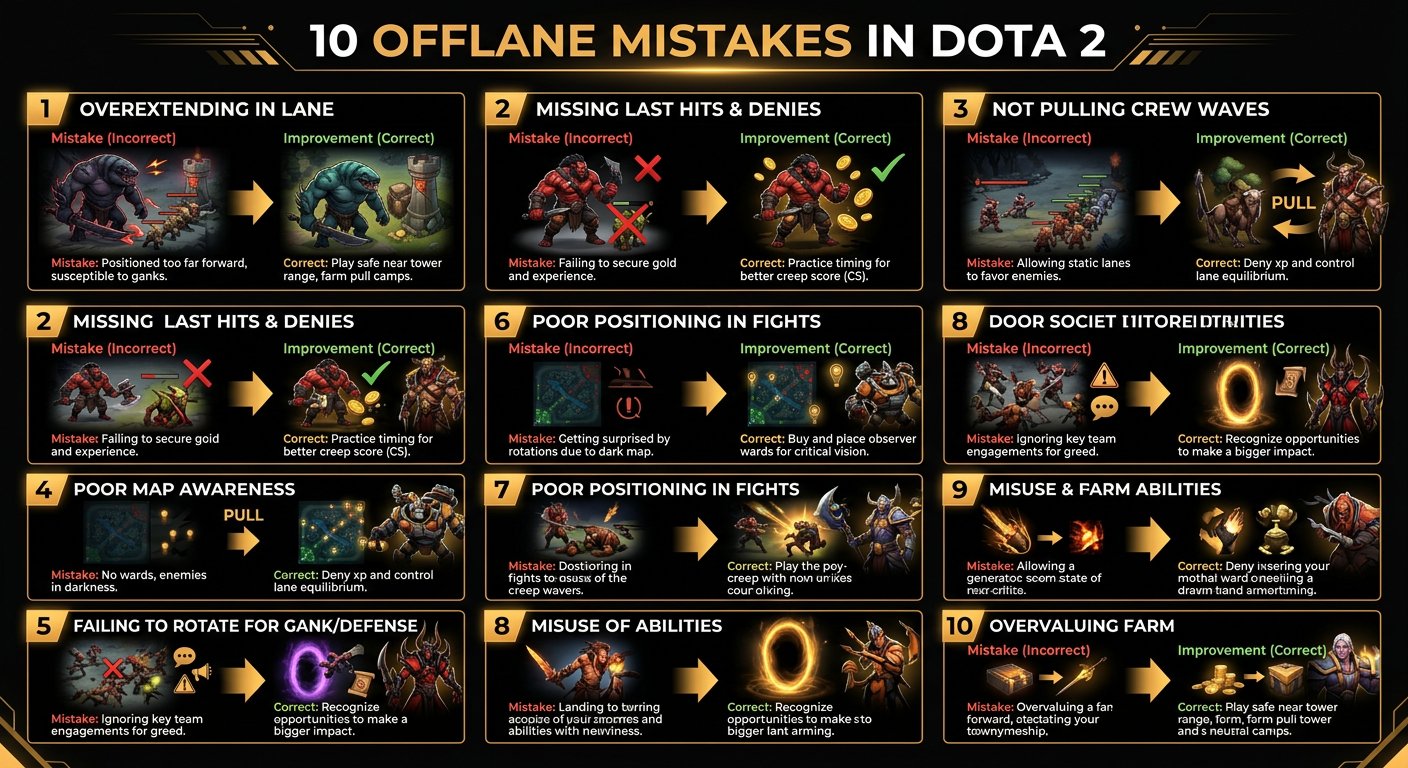
10 Critical Mistakes Ancient Offlaners Make
Mistake #1: Playing the Offlane Like a Carry
The number one mistake. Ancient offlaners prioritize farming over impact. They win the lane, push the tower, and then… go jungle. They farm a Blink Dagger, farm a BKB, farm an Assault Cuirass. By the time they’re “ready to fight,” the game is already decided.
The fix: After pushing the enemy safelane tower, your job is NOT to farm. Your job is to create pressure. Move to another lane and pressure that tower. Place aggressive wards in the enemy jungle. Smoke with your Pos 4 and hunt the enemy mid. Start doing things that directly hurt the enemy’s game plan. Your item timings should come from fight participation, not jungle farming.
Mistake #2: Not Cutting Creep Waves
Creep cutting is one of the most powerful offlane techniques, and Ancient offlaners almost never do it. By standing behind the enemy tier 1 tower and killing their incoming creep wave, you: (1) deny the enemy carry a full wave of gold and XP, (2) push your own wave into their tower for damage, and (3) force the enemy to respond to you, creating space elsewhere.
The fix: Learn when to cut waves. The ideal timing is minutes 4-7, after you’ve established lane dominance but before the tower falls. Walk behind the enemy tower (through the jungle or along the edge of the map) and intercept the creep wave. With most offlane heroes, you can tank one wave with tangoes and kill it before the next arrives. The enemy carry is forced to choose: come deal with you (losing CS to tower) or stay in lane (losing the wave entirely).
Mistake #3: Building Greedy Instead of Utility
Ancient offlaners love damage items. Shadow Blade Slardar. Desolator Underlord. Radiance Centaur. These builds are fun but they’re suboptimal — your team already has two cores building damage (Pos 1 and Pos 2). What your team lacks is defensive auras and utility items.
The fix: Default to aura items unless you have a specific reason not to. The priority order for most offlaners is: Blink Dagger Pipe of Insight (vs magic damage) or Crimson Guard (vs physical damage) Assault Cuirass or Guardian Greaves. These items might not be flashy, but they provide 10-20% more effective HP to your entire team, which translates directly into teamfight wins.
Mistake #4: Fighting Without Your Team’s Commitment
Ancient offlaners initiate fights that their team isn’t ready for. You Blink Ravage 3 enemies but your carry is farming the opposite side of the map. You Call 2 heroes with Axe but your supports are retreating. The initiation was perfect — the timing was terrible.
The fix: Before initiating, check two things: (1) Are your key teammates within 1500 range (Can they follow up within 2-3 seconds) (2) Is anyone typing, shopping, or clearly not paying attention If your carry just TPed to a different lane, don’t start a fight. Wait 15 seconds for them to arrive, then go. A slightly delayed initiation with 4 teammates is infinitely better than a perfect initiation with 2.
Mistake #5: Not Pressuring the Enemy Carry’s Farm
After the laning phase, Ancient offlaners often forget about the enemy carry entirely. They focus on their own game — farming, fighting, taking objectives — while the enemy carry quietly farms for 20 minutes and becomes unstoppable.
The fix: Your #1 job as an offlaner is to limit the enemy carry’s farm. This means: (1) Pushing waves into the enemy’s safe farming areas to force them to farm in dangerous positions. (2) Placing aggressive wards in the enemy jungle (buy them yourself — it’s 0 gold for observers). (3) Smoking into the enemy jungle with your Pos 4 to hunt the carry. (4) Threatening towers so the enemy team has to defend rather than protect their carry’s farm. If the enemy carry has free farm for 25 minutes, you’ve failed your primary job regardless of your KDA.
Mistake #6: Ignoring Lane Equilibrium Early
Ancient offlaners often auto-attack the creep wave, pushing it under the enemy tower where the carry farms safely. This is the opposite of what you want — you want the wave close to YOUR tower, where you can farm safely and the enemy carry is in danger of ganks.
The fix: For the first 3-4 minutes, focus on pulling the creep wave toward your tower. Use creep aggro to drag the wave closer to your side. Only last-hit, don’t auto-attack. If the wave is pushing toward the enemy, pull the nearby hard camp to reset it. The ideal lane position is 500 units from your tower — close enough that you can retreat to tower if ganked, far enough that the tower doesn’t interfere with your last-hitting.
Mistake #7: Dying for Tower Damage
Ancient offlaners sometimes decide to “trade their life for tower damage” — diving past the tier 1 tower to hit it while the enemy kills them. This is almost never worth it. A tier 1 tower has 1800 HP. If you deal 300 damage to it and die, you’ve lost 400+ gold and 30 seconds of time for 300 damage that your team could deal in the next push anyway.
The fix: Tower damage should be risk-free or near risk-free. Push the wave into the tower, hit it while the creeps tank, and leave when the enemy threatens to kill you. Come back next wave and do it again. This patient, wave-by-wave approach takes 2-3 minutes longer to destroy the tower but costs you zero deaths.
Mistake #8: Not Communicating Your Initiation Plan
Ancient offlaners Blink in and expect their team to react. Divine offlaners ping their target, say “go” on voice chat, and then Blink in. The difference in team response is massive.
The fix: Before a fight, communicate your plan. Even a simple “I Blink Call the carry” or “I Ravage when they group” in voice chat sets your team’s expectations. If you’re not using voice, ping the target and use the “Initiate!” chat wheel command. This 2-second communication investment increases your team’s follow-up rate from 60% to 90%.
Mistake #9: Picking Offlane Heroes That Don’t Initiate
Windranger Pos 3. Weaver Pos 3. Nature’s Prophet Pos 3. These heroes CAN be played offlane, but they don’t provide what your team needs — initiation, frontline, and aura carrying. Picking a “carry” hero in the offlane forces your Pos 4 or Pos 5 to be the initiator, which usually doesn’t work.
The fix: Stick to traditional offlaners who provide initiation and frontline: Axe, Tidehunter, Mars, Centaur, Beastmaster, Slardar, Legion Commander, Underlord, Sand King. These heroes are designed for the Pos 3 role and their kits naturally transition into the teamfight initiator your team needs. Save the creative picks for when you’re Divine — right now, consistency is king.
Mistake #10: Giving Up After a Lost Lane
Not every offlane goes well. Sometimes the enemy trilanes you, sometimes your Pos 4 abandons you, sometimes the matchup is terrible. Ancient offlaners who lose lane often tilt and play passively for the rest of the game.
The fix: A lost offlane is NOT a lost game. Unlike carry, the offlaner doesn’t need to “win” the lane to be useful. If you lose the lane, rotate to the jungle, get your Blink Dagger (even if it’s 2-3 minutes late), and look for a big teamfight ultimate. One good Ravage or Call can erase a lost laning stage entirely. The offlaner’s teamfight contribution is less dependent on farm than any other core role.
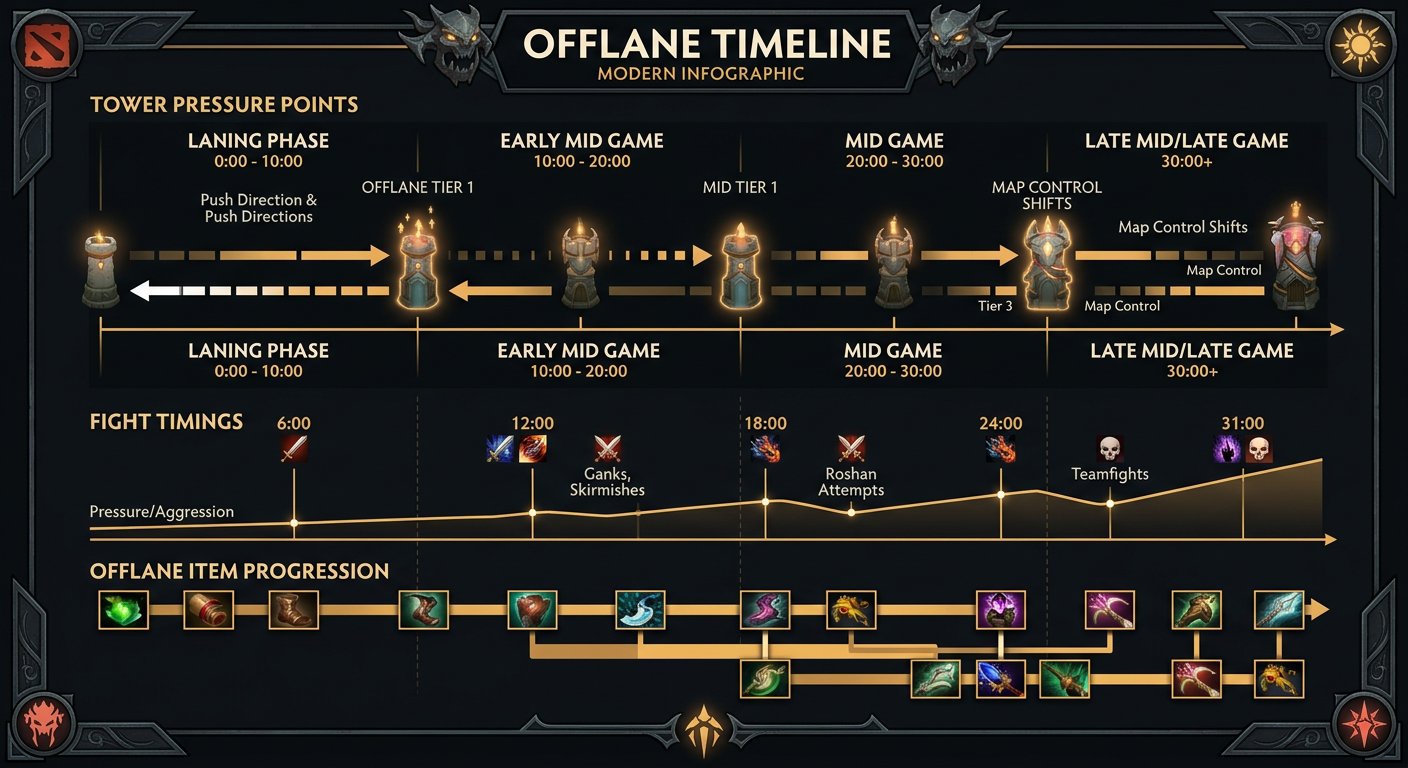
Phase-by-Phase Guide: Playing Offlane from Ancient to Divine
Draft Phase: Picking the Right Offlaner
Draft intelligence is crucial for offlaners because your pick directly affects two things: (1) how well you can lane against the enemy carry, and (2) how much teamfight you provide.
Counter-picking the enemy carry: If the enemy picks a melee carry (Troll, Ursa, Slark), pick heroes that kite effectively — Centaur, Mars, Batrider. If the enemy picks a ranged carry (Drow, Luna, Sniper), pick heroes that gap-close — Axe, Clockwerk, Spirit Breaker. If the enemy picks an escape carry (Weaver, Anti-Mage, Juggernaut), pick heroes with lockdown — Beastmaster, Slardar, Legion Commander.
Team synergy: Look at what your team needs. If you have a Faceless Void carry, your team already has a massive teamfight ultimate — you don’t need Tidehunter. Pick something that provides what’s missing: aura carrier, save, or catch. If your mid is a farming hero (Invoker, TA), your team needs an aggressive offlaner who creates space early — Axe, Mars, Beastmaster.
Laning Phase (0:00 – 10:00)
Minutes 0-3: Establish lane dynamics. The first three minutes determine the laning phase. Assess the enemy support: are they aggressive (Undying, Jakiro) or passive (Crystal Maiden, Witch Doctor) Against aggressive supports, play safe and trade efficiently. Against passive supports, pressure the carry directly.
Creep pulling: The enemy support will try to pull the hard camp to deny you XP and gold. Your job is to contest these pulls or, better yet, use them to your advantage. If the enemy pulls, let their creep wave push into your tower — you get free last hits under tower while the enemy carry is pushed up and vulnerable. If you can, block the enemy small camp with a sentry ward to prevent easy pulls.
Minutes 3-7: Win condition assessment. By minute 3, you should know your lane’s win condition. Can you kill the carry Can you zone them from CS Or are you simply trying to survive and reach level 6 Adjust your play accordingly:
- If you can kill: Play aggressively. Trade your HP for the carry’s HP, knowing your support can enable the kill.
- If you can zone: Stand between the carry and the creep wave. Force them to take damage for every last hit.
- If you’re surviving: Focus on XP, not gold. Stay in XP range even if you can’t get last hits. Levels are more important than items for most offlaners.
Minutes 7-10: Tower pressure. By minute 7, the enemy support often rotates to help other lanes. This is your window to pressure the enemy tier 1 tower. Push the wave into the tower and hit it whenever the carry can’t threaten you. If the carry is still in lane with their support, call for your Pos 4 or mid to rotate — a 3-man tower push at minute 8 can take the tower in one attempt.
Early Mid-Game (10:00 – 20:00)
This is the offlaner’s most impactful phase. The laning stage is over, you have your core initiation item (Blink or similar), and the map is opening up. Your priorities during this phase, in order:
- Secure the enemy safelane tower (if not already done). This is priority #1 — it opens the enemy jungle for invasion.
- Control the enemy jungle with vision. Place aggressive observers in the enemy jungle. This limits the enemy carry’s safe farming area.
- Pressure other outer towers. Rotate to the mid lane or safelane and pressure those towers. Don’t wait for your team to group — push the wave, hit the tower, force rotations.
- Smoke ganks on the enemy carry. Coordinate with your Pos 4 to smoke into the enemy jungle and kill their carry. At Ancient level, carries farm predictable patterns — exploit this.
- Build your first aura item. Pipe if the enemy has magic damage, Crimson if physical. This item should be completed by minute 18-22.
The pressure triangle: As an offlaner, you should always be doing one of three things: pushing a wave, threatening a tower, or hunting an enemy hero. If you’re in the jungle farming a camp, something has gone wrong. The jungle is for your carry and your mid — you should be on the map creating pressure.
Late Mid-Game (20:00 – 30:00)
Transition to teamfight mode. By minute 20, your team should be grouping for objectives. Your role in teamfights is to: (1) Initiate or counter-initiate. (2) Absorb the enemy’s damage and abilities. (3) Provide aura benefits to your team.
Roshan role: As the Pos 3, you’re typically the tank for Roshan. Stand in front, absorb Roshan’s attacks, and keep an eye on the entrance for enemy contests. Your aura items (Assault Cuirass, Vladmir’s) help your team take Roshan faster.
High-ground execution: When pushing high ground, the offlaner goes first. You absorb the enemy’s initiation with your tankiness and BKB, then your team follows up. If you die, your team uses the space created by the enemy’s spent cooldowns to take the objective. If you survive, you’ve created a won teamfight on the enemy’s doorstep.
Late Game (30:00+)
In the late game, the offlaner’s role depends on the game state. If you’re ahead, continue initiating and pushing. If you’re behind, your role shifts to protecting your carry — using your abilities to peel for them rather than diving the enemy backline.
Buyback discipline: As an offlaner, your buyback is less critical than your carry’s but still important. After 30 minutes, maintain buyback gold if possible. Your buyback into a re-initiation (Blink Ravage with buyback) can turn a lost fight into a won one.
Item adaptation: In the late game, consider switching from aura items to more selfish survivability. Heart of Tarrasque, Linken’s Sphere, or Lotus Orb can keep you alive long enough to use your abilities twice in a fight, which is often the difference between winning and losing.
Dealing with Difficult Teammates as Pos 3
The Pos 4 Problem
Your lane partner is the most impactful variable in your offlane experience. A good Pos 4 enables kills, controls pulls, and creates a 2v2 (or 2v1) dynamic. A bad Pos 4 feeds, steals XP, and leaves at minute 3 to “roam” without accomplishing anything.
The solution: Communicate your lane plan at the start. “I need you to pull their hard camp at :15” or “Let’s kill at level 3, I stun first.” If your Pos 4 isn’t cooperating, adapt your play — don’t try to force a playstyle that depends on a partner who isn’t executing. Switch to a solo playstyle: farm safely, reach level 6, and look for plays elsewhere on the map.
When Your Carry Doesn’t Push Advantages
You’ve created enormous space — killed the enemy mid twice, pushed two towers, placed aggressive wards. But your carry is still farming jungle at 25 minutes with no intention of joining the team. This happens at Ancient level constantly.
The solution: If your carry is farming, protect their farm instead of forcing fights. Create a defensive perimeter around their farming area with wards and your presence. Take fights only when they happen near your carry’s location, so they can TP in and clean up. Adapt to their pace rather than trying to change it.
When Nobody Follows Your Initiation
You Blink in, Ravage 4 heroes, and your team is 2000 units behind you, not following up. You die, the Ravage is wasted, and your team blames you for “going in alone.”
The solution: Initiate ONLY when your team is within follow-up range (1500 units max). If your team is further away, don’t go. It doesn’t matter if the perfect initiation is available — a wasted perfect initiation is worse than no initiation at all. Wait for your team to be in position, even if it means the “perfect” opportunity passes.
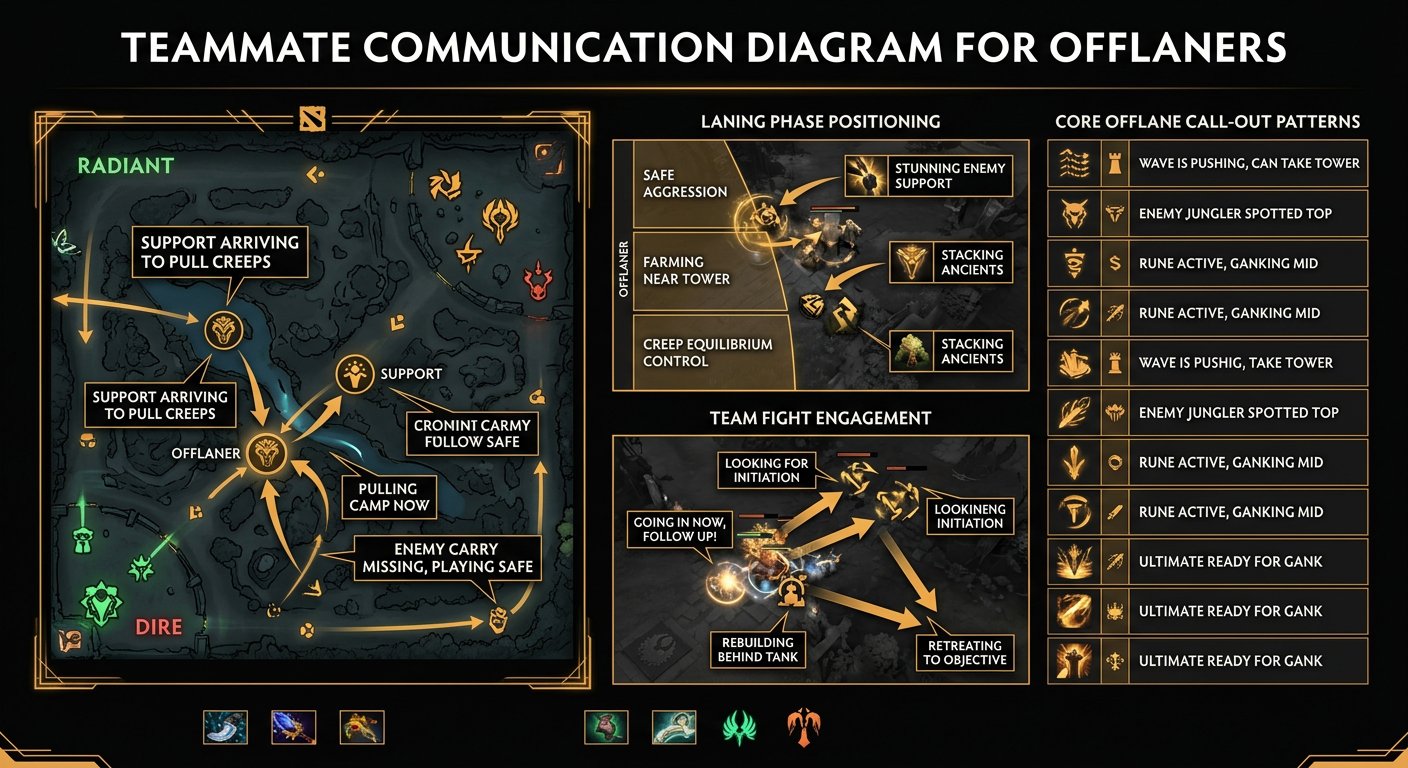
Realistic Timeline: Ancient to Divine as Offlane
Offlane is often the fastest-climbing role for players who understand macro strategy, because the Pos 3’s impact on the game is front-loaded — you create advantages early that snowball the entire team.
- At 53% win rate: 200-300 games (3-5 months at 2-3 games per day)
- At 55% win rate: 120-180 games (2-3 months)
- At 58%+ win rate: 70-100 games (1-2 months)
Offlane players who master the “deny space” mentality often see immediate win rate jumps of 3-5%. The reason is simple: at Ancient level, most offlaners play passively after laning, so an active, space-denying offlaner is a massive anomaly that enemy teams don’t know how to handle.
The plateau: Offlaners typically plateau around Ancient 4-5, where Divine-level carries start appearing. These carries are harder to bully in lane and farm more efficiently. If you’re stuck here, focus on improving your teamfight initiation and aura item timing — these skills matter more at higher MMR than lane domination.
If you want to accelerate your climb, professional coaching from a Divine or Immortal offlaner can provide specific, actionable feedback on your replays. Or, if you’re close to Divine and want to push through the final stretch, our MMR boost service can help you reach that milestone.
Frequently Asked Questions
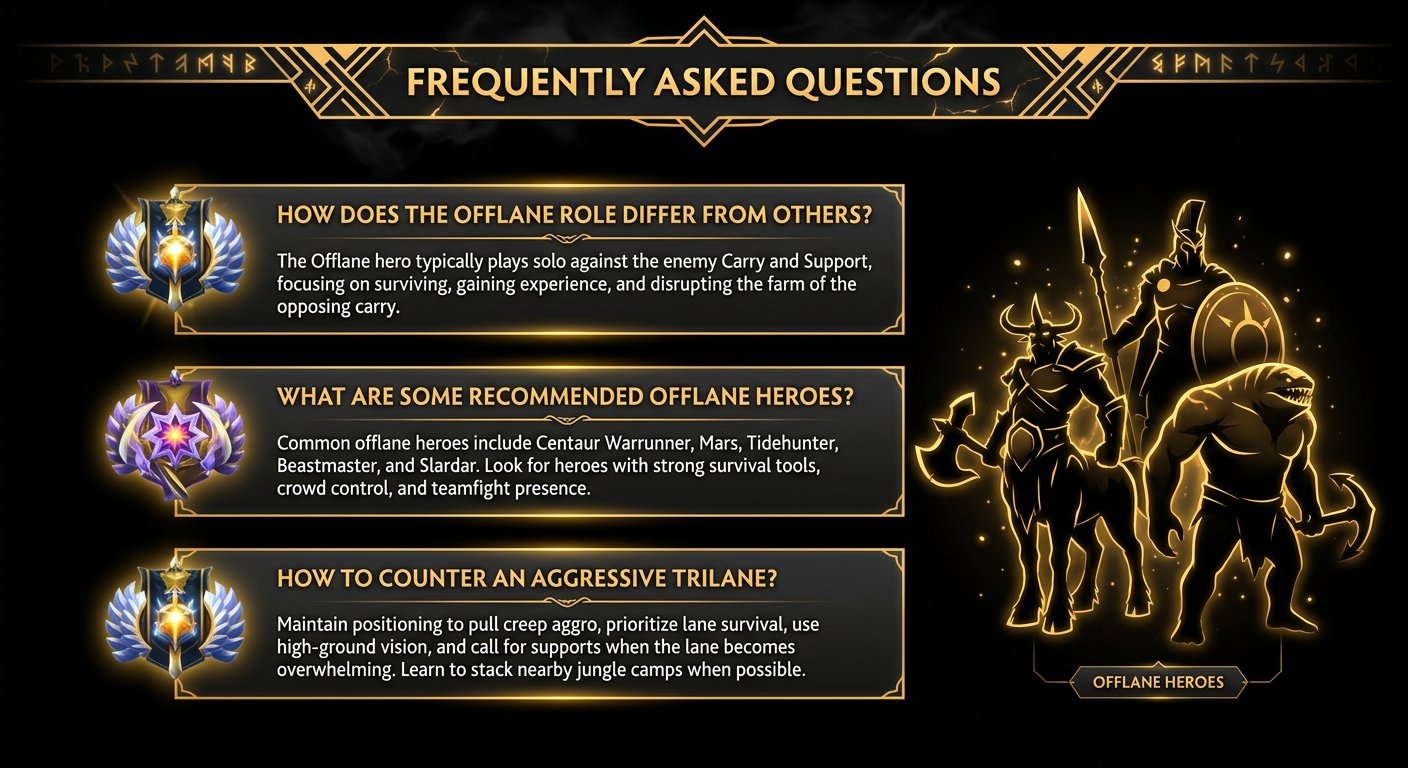
Tank offlaners with initiation (Axe, Tidehunter, Centaur, Mars) are significantly better for climbing. They provide the teamfight structure that Ancient teams lack. Damage offlaners (Windranger, Weaver, Nature’s Prophet) require your team to provide initiation from other roles, which is unreliable at Ancient level.
Leave the offlane when: (1) you’ve taken the tier 1 tower, (2) you’ve reached level 6+, or (3) the lane is completely unwinnable and you’re not getting XP. After leaving, rotate to mid or the enemy jungle — don’t go to your own jungle unless you need a specific item to function.
Extremely important on most offlaners. Blink Dagger is the single most impactful item for initiation-based heroes. The timing of your Blink (ideally 12-16 minutes) often determines whether you’re effective in the mid-game. Rush it after boots and one small item (Bracer, Soul Ring, etc.).
Aura items in 90% of games. The only exceptions are when your team already has an aura carrier (Pos 5 with Mek, Pos 4 with Vlads) or when you need specific damage items to function (Legion Commander needs Blink + Blade Mail before auras). Default to Pipe/Crimson AC Guardian Greaves.
If the enemy trilanes your offlane, don’t try to fight it. Soak XP from range (stay within 1500 units of dying creeps), pull the hard camp for yourself if possible, and communicate to your team that the enemy safelane support isn’t in their lane — your carry should be dominating 1v1. A trilaned offlaner who reaches level 6 without dying has actually “won” the trilane because the enemy invested too many resources into shutting you down.
Final Thoughts: Mastering the Offlane to Reach Divine
The offlane is the role of strategic impact. You don’t carry games through damage — you carry them through tempo control, space denial, and teamfight initiation. At Ancient level, most offlaners understand laning but fail to translate lane advantages into game advantages. The Divine offlaner understands that pushing a tower, placing an aggressive ward, or killing the enemy carry in their jungle creates more value than any amount of jungle farming.
Focus on three things: (1) Always be creating pressure — pushing waves, threatening towers, hunting carries. (2) Build for your team — aura items win more games than selfish damage builds. (3) Initiate with purpose — every fight should lead to an objective, not just kills.
The climb from Ancient to Divine as an offlaner is about becoming a strategist, not just a fighter. Master these concepts, and you’ll find the Divine rank within your grasp.
Ready to climb TeamSmurf offers expert coaching with Divine and Immortal offlaners who specialize in macro strategy and teamfight execution. For those looking to reach Divine faster, our MMR boosting service provides safe, reliable rank advancement. Your Divine rank awaits — start today.
Ready to Climb Start Your Journey Today
Team Smurf offers professional coaching with Divine and Immortal players, plus safe, reliable MMR boosting to help you reach your target rank.
Written by Team Smurf’s Immortal-rank analysts — Rankings last verified February 2026