Why High Winrate Heroes Still Lose in Your Bracket

You open Dotabuff, filter by this week, find a hero sitting at 57 percent win rate in your patch, lock it in three games straight, and lose every single one. The next morning you check again — still 57 percent — and you wonder if the stat is even real. It is real. It just does not apply to you in the way you think it does.
This guide is a complete breakdown of why hero win rates are one of the most misread metrics in Dota 2, how bracket-specific variables distort the data in ways Dotabuff cannot show you, what hero types consistently mislead mid-tier players, and how to build a hero pool that will actually improve your personal win rate rather than chasing numbers that belong to someone else’s skillset and rank.
Table of Contents
- The Sample Bias Problem: Whose Win Rate Are You Reading?
- Bracket-Specific Skill Curves and Why They Flatten Your Stats
- Three Hero Categories That Consistently Mislead
- Patch Context and Short-Window Inflation
- Building a Hero Pool That Actually Wins for You
- How to Track and Interpret Your Own Win Rate Data
- When Stats Alone Cannot Fix the Problem
- Frequently Asked Questions
The Sample Bias Problem: Whose Win Rate Are You Reading?
Every win rate number published on Dotabuff or Stratz represents an average across the entire player pool that queued the hero. When Dotabuff says Morphling sits at 54 percent this week, it is aggregating games from 1,000 MMR all the way through Immortal. The problem is that the distribution of players picking Morphling is not uniform across brackets — it is heavily skewed toward high-MMR players who understand the hero mechanically.
Morphling’s micro-management requirements, the Waveform positioning decisions, the Attribute Shift timing during burst windows, and the replicate target selection are skills that take hundreds of games to internalize. High-rank players who understand these mechanics pick Morphling and win at a high rate. Low-rank players who see “54 percent” and pick Morphling for the first time contribute losses to the pool without moving the average much because they are a small fraction of the total sample.
This creates a structural lie in the data: you see the aggregated win rate of an expert player base, then apply it to your own bracket where those conditions do not exist. The actual win rate for a first-time Morphling player at 2,000-2,500 MMR is almost certainly 35-42 percent. The stat is accurate as published but completely misleading as a decision-making tool for most players.
How the Sample Gets Distorted Further
Beyond the average-across-all-ranks problem, sample bias compounds in several other ways. First, counters are not randomly distributed. Niche heroes that excel against specific lineups maintain high win rates partly because the player community learns to pick them into favorable matchups. A player at 5,000 MMR picking Tinker understands draft matchups; a player at 2,200 MMR picking Tinker is often doing so blind to the lineup context.
Second, pick frequency matters enormously. Heroes with very low pick rates (under 3 percent of games) are almost always being picked by specialists — people who have played that hero 200 or more times and have climbed on it. Meepo’s win rate is a textbook example. In any given week, Meepo sits between 44 and 48 percent win rate despite being genuinely overpowered in skilled hands because the sample is overwhelmed by players who are not Meepo specialists. The reverse is also true: heroes with very high pick rates (Pudge, Sniper, Phantom Assassin) have their win rates dragged down by the huge volume of inexperienced players picking them, but the experienced players within that pool are still winning at high rates.
Third, regional variation is invisible in global stats. The Dota 2 meta in Southeast Asia, Eastern Europe, and South America plays out differently at the same MMR bracket because the communication style, draft tendencies, and game pacing differ by region. A hero that dominates in one region may be useless in another, but the aggregated global stat conceals this entirely.
Bracket-Specific Skill Curves and Why They Flatten Your Stats
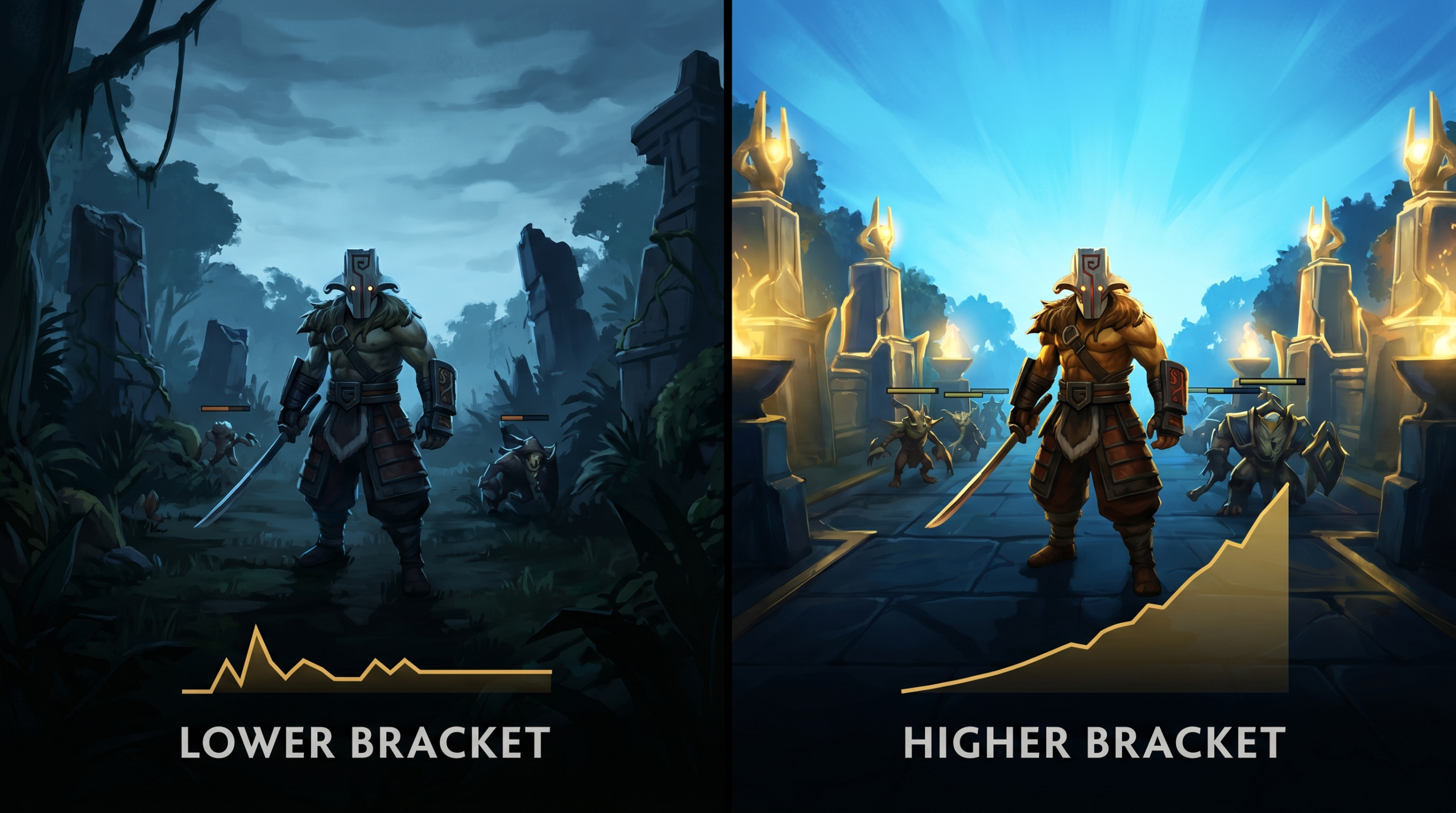
Every hero has a skill curve — the relationship between games played on the hero and personal win rate with it. Simple heroes like Dragon Knight or Viper have short, steep skill curves: you can reach near-ceiling performance within 30-50 games because the decision space is limited. Complex heroes like Invoker, Earth Spirit, or Arc Warden have long, gradual curves that may not reach ceiling performance until 300-500 games.
Your bracket determines where the ceiling of your skill curve sits, independent of how many games you play. A player at 2,500 MMR who plays 400 games of Invoker will improve but will reach a ceiling below what the same hero achieves in the hands of a 5,000 MMR player who has the map awareness, reaction time, and decision-making framework to fully leverage Invoke’s output. The bracket itself is the constraint, not the hero games played.
The 3,000-3,500 MMR Ceiling Problem
The 3,000-3,500 MMR range is where bracket-specific skill curves cause the most damage to players relying on published win rates. At this bracket, players are skilled enough to partially execute complex hero mechanics but lack the game-sense to use those mechanics at the right moments. This creates a specific pattern: a hero like Storm Spirit or Puck is played reasonably well mechanically but loses because the player is using blink-initiation or position-5-roaming at the wrong moments, not because of execution failure.
Published win rates for Storm Spirit and Puck look strong because the high-rank sample dominates. At 3,000-3,500 MMR, both heroes consistently underperform their published rates for most players. The skill required to make them work is not raw mechanical execution — it is the moment-selection of when to commit, which is a game-sense skill that takes significantly longer to develop than mechanical skill.
Meanwhile, heroes like Mars, Dragon Knight, and Centaur Warrunner punch above their published rates at this bracket because their value does not depend on moment-selection. You throw Spear of Mars toward a high-ground cliff, you initiate when your team is nearby, and the hero does what it promises. The skill curve is short and the ceiling at 3,000-3,500 MMR is near-maxed for most players within 40-60 games.
Three Hero Categories That Consistently Mislead
After years of tracking bracket-level data, three specific hero categories stand out as the most consistent sources of misleading win rate reads for mid-tier players.
Category 1: Farming Cores That Need Net Worth Leads
Anti-Mage, Medusa, Spectre, Naga Siren, and Terrorblade all share one critical dependency: they need a net worth lead to function as advertised. These heroes win games by building toward a power spike that invalidates the enemy team’s ability to fight. At high MMR, their teams understand how to protect the farming window, apply pressure to prevent enemy smoke-and-gank attempts, and transition into late-game fights at the right timing.
At 2,000-3,000 MMR, the farming window is chaotic. Vision control is poor, teammates frequently fight without you, and the enemy team applies random pressure that cannot be predicted or coordinated against. Anti-Mage at 28 minutes with 430 GPM is on track for a high-MMR game but losing in a low-MMR game where the enemy team already has four rax down. The hero’s win rate at high MMR does not account for the team coordination scaffolding that makes the farming window viable.
The tell: if you play a farming core and frequently find yourself at your expected net worth but losing because “teammates fed,” the problem is not your teammates. The problem is that the hero requires a meta-game of draft coordination and game pacing that your current rank does not provide. Switching to a self-sufficient carry like Wraith King, Ursa, or Lifestealer will immediately improve your win rate because those heroes can impose their own fight timing rather than depending on team coordination to protect a farming window.
Category 2: Position 4 Roamers That Need Lane-First Foundations
Earth Spirit, Spirit Breaker, Pudge, and Bounty Hunter all have high playbooks but the same fundamental problem at mid-tier: they are only as good as the lanes they roam from. At 5,000-plus MMR, a roaming position 4 Earth Spirit coordinates with the safe lane dual and the mid to create specific kill windows at minute 2, 4, and 6 that are pre-planned in draft. The team knows the plan.
At 2,500-3,500 MMR, the roam happens without coordination. Earth Spirit rolls in to a lane where the offlaner is already dead, or where the enemy support has a Glimmer Cape at minute 4, or where the carry is simultaneously fighting a 1v2 with no follow-up. The roam creates chaos without kills. Meanwhile, your safe lane has a position 5 who left after level 2 and a carry now in a 1v2 situation.
The published win rate for roaming supports is inflated by coordinated teams at high MMR. At your bracket, the same roaming playstyle will frequently generate zero value while creating deficits in the lanes you leave. The bracket-appropriate version of this role is a babysitting position 4 or 5 — a hero like Witch Doctor, Ancient Apparition, or Lion that can generate lane value through stunlocking without requiring coordination signals from teammates.
Category 3: Meta Flavor Heroes During Their First Two Weeks
Every patch has heroes that spike to 56-60 percent win rate within the first 14 days because the player pool has not yet adapted counters. Valve patches Primal Beast’s Onslaught damage, immediately thousands of games are played against players who have not yet learned to position away from cliffs. The win rate spikes. Two weeks later, the counter-play is common knowledge and the win rate settles 6-8 points lower.
If you pick up a meta hero based on its week-one stats and start playing it in week three, you are playing a hero that has already been figured out against you while you are still on the learning curve yourself. The double disadvantage — you are learning while enemies are counter-drafting — produces results far below the win rate that initially attracted you.
The correct approach is to identify meta heroes not from current week stats but from their three-to-four week average once the adaptation has occurred. A hero maintaining 54 percent at week four is genuinely strong. A hero at 58 percent in week one and 49 percent by week four was a temporary spike you should have ignored.
Patch Context and Short-Window Inflation
Win rates on platforms like Dotabuff can be filtered by time window, and most players default to “this week” or “this month.” These short windows are the most dangerous for decision-making because they capture patch recency effects, meta discovery periods, and tournament influence.
When The International occurs, the heroes played in the tournament immediately spike in pub pick rate and, for approximately 72 hours, in win rate — because the first wave of players imitating pro play are often the higher-skill segment of the community who watch the tournament. Then the second wave of players who see the heroes being picked start picking them without the requisite knowledge, and the win rate normalizes or drops.
A more reliable signal is the 90-day average win rate filtered to your MMR bracket, cross-referenced with pick rate trend. A hero that has maintained 53-55 percent over 90 days with stable or increasing pick rate is a genuinely strong hero in the current meta, not a short-term inflated outlier. This combination — sustained win rate plus growing pick rate — indicates that the hero is being discovered by a widening player base and still winning, which means skill requirements are not as steep as the complex-hero categories discussed above.
| Win Rate Window | Reliability | Why |
|---|---|---|
| This Week (7 days) | Very Low | Captures patch recency, tournament spikes, and adaptation lag |
| This Month (30 days) | Moderate | Smooths out week-one spikes but still affected by patch release timing |
| 90 Days | High | Reflects actual meta stability across full patch cycle |
| All-time | Low | Mixes multiple patch metas and power levels that are no longer relevant |
Building a Hero Pool That Actually Wins for You
The alternative to chasing published win rates is building a personal meta — a small pool of heroes that overperform at your specific bracket based on your playstyle, mechanical strengths, and game-sense level. A personal meta typically consists of three to five heroes across two roles, with one hero per role designated as a primary specialist pick.
Step 1: Identify Your Mechanical Strengths
Before choosing heroes, audit what you actually execute well. If your last 100 games show consistent last-hitting above 60 CS at 10 minutes, you have good enough mechanics for farming cores. If you frequently land spells in teamfights but struggle with solo skirmishes, initiation heroes suit you better than skirmish carries. If your position-based plays (cliff jumps, high-ground defense, ramp angles) consistently generate value, position-heavy heroes like Tidehunter or Magnus will overperform for you because your spatial awareness is ahead of your bracket.
Most players skip this step and pick heroes based on what they watch in pro play. The result is picking heroes that require skills they have not developed yet, then attributing losses to bad matchups or teammates rather than the underlying skill mismatch.
Step 2: Choose Heroes With Short Skill Curves at Your Bracket
Within your mechanical strengths, prioritize heroes that reach ceiling performance within 40-60 games at your bracket. For mid players with strong mechanical execution, this means heroes like Shadow Fiend, Death Prophet, or Leshrac — heroes where the value output is mechanically determined and does not depend heavily on complex decision chains. For position 3 players, this means Centaur Warrunner, Tidehunter, or Axe before it means Legion Commander or Underlord.
You will feel more limited by this constraint than it actually limits you. A player with 200 games of Centaur Warrunner at 3,000 MMR is a player who has climbed to 3,500-4,000 on that hero and understands the bracket deeply enough to start adding complexity. A player with 20 games each of 15 different heroes has learned nothing deeply and climbs nothing.
Step 3: Validate With Personal Data, Not Published Data
Track your own win rate over minimum 30 games on each hero before drawing conclusions. A 20-game sample is meaningless — the variance in team quality alone can swing 20 games by 30 percent in either direction. At 30 games with a consistent drafting approach (picking the hero into matchups it is designed for), you will have a statistically meaningful baseline that tells you whether the hero is working for you at your bracket.
If you are consistently 5 or more percentage points below the hero’s published 90-day rate, the hero is not in your personal meta right now. Park it. Return when you have improved the specific skill the hero requires. If you are at or above published rate, you have identified a bracket edge — a hero that fits your specific skillset better than average and should become a primary specialist pick.
If you need to accelerate this process significantly, the fastest path to meaningful MMR gain is through a professional coaching session where an Immortal-rank coach can immediately identify your mechanical gaps and prescribe the two or three heroes that fit your current skill profile rather than your aspirational one. This saves 50-100 games of trial-and-error data collection on the wrong heroes.
How to Track and Interpret Your Own Win Rate Data
Most players have no systematic approach to tracking their performance data. They look at their overall win rate across all heroes and interpret it as a measure of their skill, when in reality it is a measure of their hero selection choices as much as their skill.
The Minimum Viable Tracking System
Once a week, export your last 100 games from Dotabuff and sort by hero. For each hero with 15 or more games, record: win rate, average KDA, average GPM, average XPM, and average match duration. Create a simple spreadsheet with these columns and add new data weekly.
After four weeks, you will have a clear picture of which heroes are producing wins for you versus which ones are consuming games without returns. This four-week snapshot is your actual personal meta and should be the primary driver of your hero selection, not the global published stats.
| Hero | Your WR | Published WR | Gap | Action |
|---|---|---|---|---|
| Hero A | 60% | 53% | +7% | Primary specialist pick — play more |
| Hero B | 52% | 51% | +1% | Secondary pick — maintain in pool |
| Hero C | 41% | 54% | -13% | Drop from active pool, revisit later |
Red Flags in Your Personal Data
Watch for specific patterns that indicate systemic problems rather than hero problems. If your win rate drops uniformly across all heroes in a two-week window, you have a game-sense regression problem — possibly from playing too many games per day (fatigue), after-loss tilt affecting decision-making, or a patch change that shifted the meta in a direction that disadvantages your playstyle. No hero swap will fix this.
If your win rate drops specifically on your previously strong heroes, you have been counter-drafted into or the meta shifted against your style in that role. Check recent patches for nerfs to heroes in your pool and consider whether the meta has moved toward counters of your primary picks.
If your win rate is stable but below 50 percent across the board, you have a fundamental skill gap that hero selection cannot solve. This is the moment when a structured coaching engagement produces maximum return — an Immortal coach can identify exactly which mechanic or decision pattern is generating the losses across all heroes, which is the common thread beneath the surface-level hero variance.
When Stats Alone Cannot Fix the Problem
There is a scenario where optimizing hero selection and tracking data will not meaningfully improve your MMR: when the gap between your current bracket and your target bracket exceeds your current rate of skill development. This happens to players who are improving but slowly, or who are stuck in a bracket where their team-level disadvantages (poor coordination, high variance in teammate quality) are consistently outweighing their individual skill gains.
In this situation, the most efficient path to your target MMR is not 300 more games of data collection — it is using a professional MMR boost service to reach the bracket where your actual skill level is competitive, then continuing to improve from that baseline. This approach is particularly effective when you know your skill ceiling has genuinely exceeded your current rank but the variance in team quality at your bracket is creating a MMR floor that does not reflect your ability.
Alternatively, if calibration is the issue — if you started at a bracket lower than your actual skill level and have not been able to climb through the variance — a calibration service performed by Immortal-rank boosters ensures your base MMR reflects your true competitive level from which data-driven climbing becomes far more effective.
Ready to Skip the Grind?
Team Smurf’s Immortal boosters handle your MMR while you focus on actually improving your game.