

Stuck at Same MMR Diagnostic Tree (Mechanical vs Macro vs Mental)

“Stuck at the same MMR” is one of the most frustrating experiences in competitive Dota 2. You play game after game, you win some and you lose some, and the number barely moves in either direction. Most players in this situation attribute it to bad teammates, poor luck with matchmaking, or the vague sense that they are not “playing their best.” Most of these attributions are incorrect — or at least incomplete.
Being stuck at a specific MMR is almost always a diagnostic problem before it is a solution problem. You are stuck because a specific category of mistake is causing a win rate close enough to 50% that your MMR remains flat. The mistake is systematic — it appears in most of your games, not just occasionally — but its exact nature determines the correct fix. Applying mechanical fixes to a macro problem, or working on game sense when the actual issue is tilting under pressure, produces no improvement because the fix does not address the cause.
This guide presents a complete diagnostic tree that identifies whether you are stuck due to a mechanical problem, a macro problem, or a mental performance problem. Each branch of the tree has sub-diagnostics and specific actionable corrections. Work through the tree honestly and you will identify the real cause of your MMR stagnation within 30 minutes. If after running the diagnostic you want a faster path to a new MMR bracket, Team Smurf’s MMR boost service can bridge the gap while you address the root cause.
Table of Contents

Before Running the Diagnostic
The diagnostic tree works only on a sufficient sample size. Before concluding that you are stuck at a specific MMR, verify that you have played at least 20 ranked games in the last 30 days at your current bracket and that your win rate across those 20 games is between 45% and 55%. A player who has played 3 games and lost all 3 is not stuck — they are in a short-term variance event. A player at 52% win rate across 20 games is not stuck — they are climbing slowly but consistently.
The stuck condition requires: 20+ games played, a win rate between 45% and 55% (not a climbing or dropping trend), and a consistent hero pool (if you switched heroes dramatically in the middle of the 20 games, the data is mixed and the diagnostic is less reliable).
Data Collection Before the Diagnostic
Before starting the diagnostic tree, gather the following data from Dotabuff or the Dota 2 client. You will need: your personal win rate by game duration (do you win more games that last less than 30 minutes or more than 40 minutes?), your death count per game average, your last hit count at 10 minutes average (for carry/mid), your net worth rank average (are you typically 1st, 3rd, or 5th in net worth on your team?), and your most common game-ending scenario (do your losses typically end from enemy team fights won, high ground sieges, or a deathball that you cannot counter?)
These five data points will tell you more about your stuck pattern in 5 minutes of analysis than 10 games of play without a diagnostic framework.
Symptom Identification: The First Branch
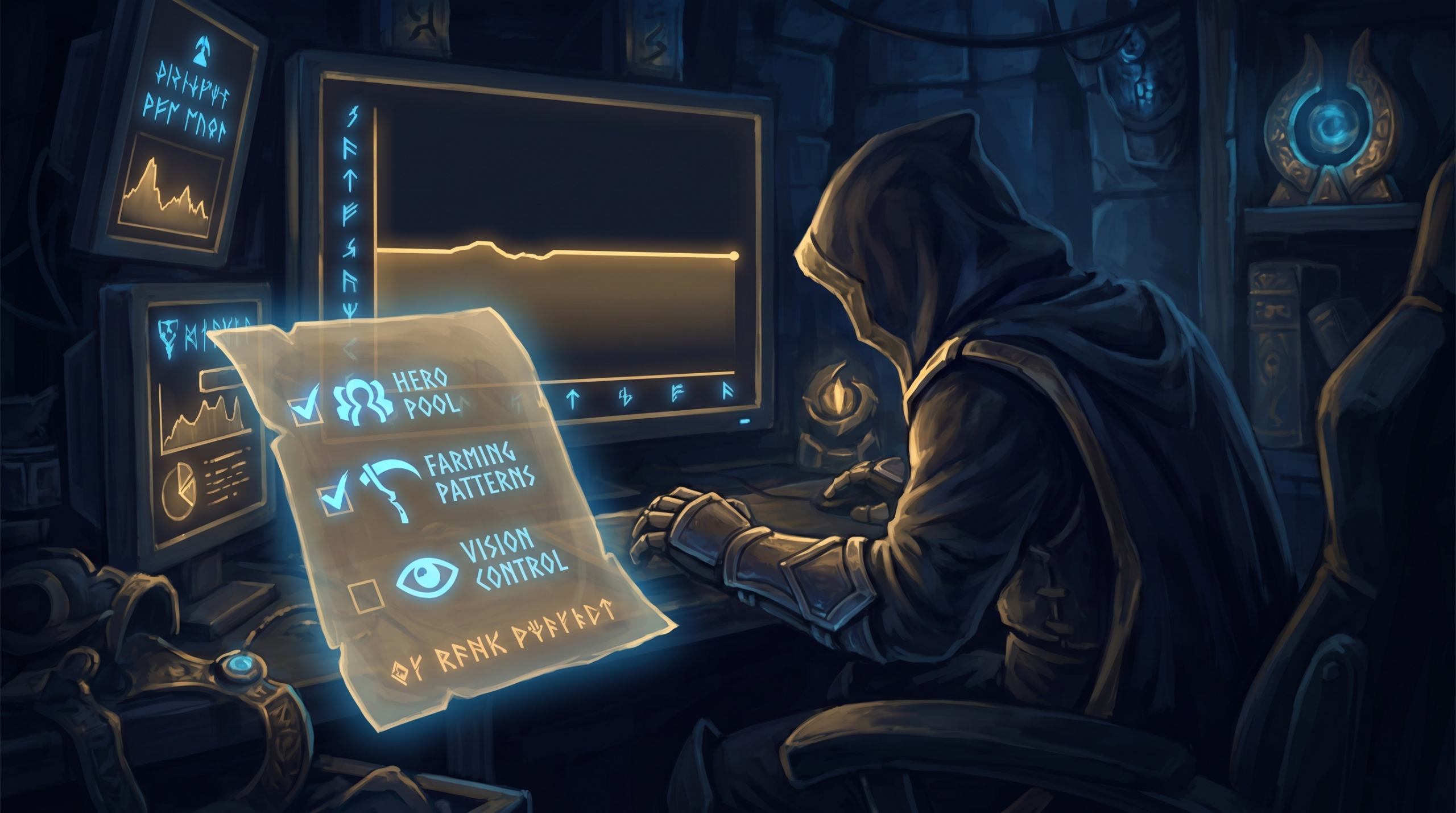
The first branch of the diagnostic tree identifies which of the three major problem categories is most likely causing your stagnation. Answer the three questions below honestly based on your data, not your impression of your own play.
Question 1: Are you losing in laning phase consistently?
Check your Dotabuff data for laning phase performance. If your last hits at 10 minutes are consistently below the median for your hero (you can find hero-specific median stats on Stratz.com), or if your deaths before minute 15 average more than 1.5 per game, you are losing laning phase. This points toward the Mechanical Branch.
Question 2: Are you winning (or breaking even in) laning phase but losing games?
If your laning stats are acceptable but your games consistently drift toward losses in the 25-40 minute range, the laning phase is not the bottleneck. Something in the mid-game decision-making is converting promising game states into defeats. This points toward the Macro Branch.
Question 3: Is your performance highly inconsistent between sessions?
If you sometimes have 3-win sessions and sometimes have 4-loss sessions with little correlation to time of day, opponent quality, or hero selection, and this variance is larger than you would expect, your performance is inconsistent in a way that suggests a mental performance component. This points toward the Mental and Consistency Branch.
If you answered yes to more than one question, proceed through all relevant branches. Multiple issues can be present simultaneously, and the compound diagnostic section addresses how to prioritize when that is the case.
The Mechanical Branch
Mechanical issues are skills that require physical execution: last-hitting timing, ability cast timing, item activation, and positional micro-management. The key characteristic of a mechanical problem is that it occurs even in situations where you know the correct action — the gap is between knowing and doing, not between understanding and knowing.
Sub-Diagnostic M1: Last-Hit Consistency
Open a practice lobby and attempt to achieve 80 last hits by the 10-minute mark with no opponents or allies (free farm). If you cannot consistently hit 80 last hits in free-farm conditions, your last-hit mechanics are below the threshold for your target bracket. The correct fix is daily last-hit practice in a practice lobby or bot game for 15 minutes before your ranked session — not playing ranked games and hoping the mechanics improve through exposure.
If you can achieve 80 last hits in free-farm conditions but not in normal games, the gap is game-specific: harassment management, creep aggro control, or wave state awareness is limiting your last-hit performance. This is a different fix — focused on reading the lane state rather than on the last-hit animation itself.
Sub-Diagnostic M2: Ability Timing and Accuracy
Review three replays and record your stun or initiation ability accuracy. For each ability cast, mark whether it hit the primary target, missed entirely, or hit the target but at a non-optimal moment (Earthshaker Fissure placed such that the target can walk around it, Lion Impale cast too early before the target was in range). Calculate the percentage of optimal casts.
Immortal-level players typically achieve 75-85% optimal ability casts. Players at the 2,000-3,000 MMR range who are stuck typically show 40-60% optimal ability casts on their primary initiation or disable ability. Improvement from 40% to 65% optimal casts often produces a visible win rate improvement because optimal casts convert kills and optimal misses convert deaths.
Sub-Diagnostic M3: Item Activation Timing
As described in the replay review SOP, evaluate whether your BKB activations (carry) or your Force Staff activations (support) are proactive or reactive. Reactive item activation — using an item in response to something that has already happened rather than in anticipation of something that is about to happen — is one of the most common mechanical gaps at the 3,000-5,000 MMR range and one of the most impactful to address.
The fix for reactive item activation is mental model improvement rather than mechanical practice: you need to develop a faster threat-recognition pattern so that you activate items at the moment you recognize the threat rather than at the moment the threat lands. This is developed through deliberate replay review of fights where item timing was suboptimal, not through playing more games without the specific focus.
The Macro Branch
Macro issues involve decision-making about resources, objectives, rotations, and game state management. The key characteristic of a macro problem is that you are winning individual moments (lane, fight) but losing games because of the decisions made between those moments.
Sub-Diagnostic A1: Farm Path Optimization
Using Dotabuff or Stratz, compare your gold per minute at the 20-minute mark to the median GPM for your hero at your bracket. If your GPM is more than 15% below the median, your farm path has a significant gap. The most common farm path errors at the 3,000-5,000 MMR range are: returning to base too frequently for small health and mana regeneration when staying in the jungle would be more efficient, farming neutral camps that require traveling far across the map when closer camps are available, and responding to ganks in other lanes by rotating when the rotation produces less value than staying and farming.
Replay review of the 15-minute to 25-minute window with a focus specifically on your hero’s movement path — not what happens at each location, but the path itself — reveals farm path inefficiency quickly. Watch your hero move around the map and ask: is there a shorter path between these two farm locations? Was this rotation worth the travel time?
Sub-Diagnostic A2: Objective Timing and Calling
Examine your win rate by game duration more carefully. If you win a significantly higher percentage of games under 30 minutes than games lasting 35-45 minutes, you are better at executing in the phase where you have a lead than at converting that lead into closing objectives. The lead conversion gap is a specific macro issue.
The most common lead conversion failure modes are: waiting for a “perfect” team fight opportunity after winning Roshan instead of immediately taking a tower with Aegis advantage, allowing the enemy team to buy defensive items (Black King Bar, Butterfly, Linken’s Sphere) while farming camps instead of pressing the tower, and retreating to base after winning a fight instead of immediately pushing the wave into the tower.
Sub-Diagnostic A3: Rotation Decision Quality
For mid and support players: open three replays and identify every rotation decision in the minute 8 to minute 18 window. For each decision, evaluate: did you rotate, and should you have? Should you have rotated but did not? For each rotation that occurred, assess whether the outcome was net positive (the rotation value exceeded the farm or experience cost of leaving your lane).
Players at the stuck-MMR bracket typically show a pattern of either over-rotating (leaving their lane too often, falling behind in farm and experience) or under-rotating (missing kill or objective opportunities because they stayed in lane too long). Identifying which pattern applies to you determines the adjustment: a more disciplined “farm first” rule for over-rotators, or a “rotation trigger” rule for under-rotators.
The Mental and Consistency Branch
Mental performance issues are the most commonly denied cause of stuck MMR because players find it difficult to separate their emotional response to games from their evaluation of their own performance. The key characteristic of a mental performance issue is high variance: game quality that fluctuates dramatically based on factors that should not affect gameplay ability, such as time of day, recent losses, or frustration with teammates.
Sub-Diagnostic P1: Tilt Detection
Review the sequence of your last 20 games chronologically. Identify any sequence of 3 or more consecutive losses that occurred within the same play session (same day). For each of these sequences, evaluate whether your death count increased across the sequence (the classic tilt signal — deaths go up as the session continues in a losing streak).
If you identify a pattern of increasing deaths across consecutive losses in the same session, you are tilting into aggressive plays as the session deteriorates. The fix is a hard session limit: never play more than 2 consecutive losses in the same session without a 30-minute break. This single rule change, applied consistently, eliminates the multi-game tilt cascade and prevents the worst-case MMR loss sessions.
Sub-Diagnostic P2: Time-of-Day Performance Variance
Export or manually record your last 30 games with the time of day they were played. Calculate your win rate for games played before 8pm versus after 10pm in your timezone. If there is a significant performance gap by time of day (more than 10 percentage points difference), you have a physical performance component to your stuck MMR. The fix is restricting your ranked play to your high-performance window and moving low-performance hour play to unranked.
Sub-Diagnostic P3: Consistency of Hero Execution
Calculate your win rate on your primary hero broken down by whether you first-picked the hero versus picked it later in the draft. First-pick games typically allow you to play your prepared game plan; later-pick games require adaptation to the enemy draft. If your win rate on your primary hero drops dramatically when you pick them later in the draft (more than 15 percentage points), your hero execution is not yet flexible enough to adapt to adverse matchups.
The fix for this is matchup-specific preparation: learn the 3-5 most common heroes that counter your primary hero and practice the specific item or positional adjustments that reduce those counters’ effectiveness. This preparation work is exactly what Dota 2 coaching sessions focus on most productively — matchup-specific adaptation for a player’s specific hero pool.
| Symptom | Branch | Sub-Diagnostic | Primary Fix |
|---|---|---|---|
| Below-median last hits at 10 min | Mechanical | M1 | Daily last-hit practice, 15 min pre-session |
| Low ability accuracy on stuns | Mechanical | M2 | Replay review ability timing, 3 games |
| Reactive item activations | Mechanical | M3 | Threat-recognition replay review, anticipatory activation habit |
| Below-median GPM at 20 min | Macro | A1 | Farm path movement review, identify inefficient routes |
| Low win rate in 35-45 min games | Macro | A2 | Post-fight objective conversion habit, Aegis timing |
| Rotation over/under-frequency | Macro | A3 | Rotation trigger rules, farm-first or rotation-window rules |
| Deaths increase across losing sessions | Mental | P1 | 2-consecutive-loss session limit with 30-min break |
| Win rate gap by time of day | Mental | P2 | Restrict ranked to high-performance hours |
| Win rate drop on non-first-pick hero | Mental | P3 | Matchup-specific preparation for top 3-5 counters |
Bracket-Specific Diagnostic Patterns
Different MMR brackets have characteristic stuck patterns. Understanding which patterns are most common at your current bracket helps prioritize the diagnostic tree branches.
Herald and Guardian (0-2,000 MMR)
At Herald and Guardian, stuck MMR is most commonly caused by mechanical floor issues — specifically last-hit consistency and ability cast accuracy. Players at this bracket who are stuck almost always identify a mechanical sub-diagnostic as their primary cause. The secondary issue at this bracket is tilt — short sessions with controlled mental states have a disproportionate positive impact because the variance from mechanical errors is high enough that tilt-induced additional errors produce dramatic win rate drops.
Crusader and Archon (2,000-4,000 MMR)
Crusader and Archon is the bracket where macro problems first become the dominant stuck pattern. Mechanical floors are sufficient for this bracket for most players, but objective timing, rotation decisions, and farm path optimization vary enormously. Players at this bracket who are stuck and have acceptable mechanical stats almost always show a macro sub-diagnostic pattern. The most common specific issue at Archon is post-fight objective conversion failure — winning team fights but failing to push the resulting advantage into structures.
Legend and Ancient (4,000-6,000 MMR)
At Legend and Ancient, the stuck pattern shifts significantly toward consistency and hero-specific preparation. Players at this bracket typically have solid mechanics and acceptable macro but show high variance performance and specific hero matchup failures. Sub-diagnostic P3 (win rate on non-first-pick hero) is the most commonly identified issue at this bracket. Hero pool depth — not just primary hero mastery but effective secondary hero performance — is the primary differentiator.
Divine and Immortal (6,000+ MMR)
At Divine and Immortal, the stuck pattern is almost exclusively optimization rather than fundamental skill gaps. Players at this bracket who are stuck are typically losing marginal advantages in areas like item build optimization for specific matchups, draft adaptation against specific enemy hero combinations, and timing-window precision. Calibration services can be relevant at this bracket for players whose displayed rank has drifted from their actual performance level after a break.
When Multiple Issues Are Present
Most players who run this diagnostic honestly identify more than one issue. The correct response to multiple identified issues is prioritization, not simultaneous treatment. Attempting to address mechanical, macro, and mental issues at the same time divides improvement effort across three fronts and produces insufficient progress on all three.
The prioritization rule is: mechanical issues first, mental issues second, macro issues third. This order reflects the dependency structure of the three areas. Mechanical execution determines the floor of what macro decisions can accomplish — it is not possible to fully implement macro improvements if mechanical execution is inconsistent enough to cause fights you should win to be lost. Mental consistency determines whether you can execute mechanical and macro improvements under pressure — even correct mechanical and macro decisions fail during tilt states. Macro decisions build on top of reliable mechanical execution and mental consistency.
Building Your Action Plan From the Diagnostic
After completing the diagnostic tree, build a 4-week action plan based on your primary identified issue. The plan follows the structure of the 5-game weekly improvement system: one focus area per week, tracked with a specific metric, reviewed after 5 games.
Week 1 is dedicated entirely to validating the diagnostic. Use the focus area tied to your primary finding and collect 5 games of metric data. If the data confirms the diagnostic finding (you see the specific behavior you expected to see), proceed to addressing it in Week 2. If the data does not confirm the finding, return to the diagnostic tree and re-examine your initial symptom identification — the primary issue may be in a different branch.
Week 2 and Week 3 are the behavioral change implementation weeks. This is where you apply the specific fix identified in the diagnostic and track whether the metric improves across the two weeks. Expect 2-3 weeks of effort before seeing a reliable MMR movement of 50+ MMR in the direction you intend.
Week 4 is the re-evaluation week. Run the diagnostic again on fresh data from the last 20 games. The primary issue from 4 weeks ago should now show a different data pattern. If it does, the fix is working. If it does not, the fix was incomplete or the diagnostic was pointing at a symptom rather than the underlying cause.
Ready to Skip the Grind?
Team Smurf’s Immortal boosters handle your MMR.
Get Your Boost Now Talk to Our Team



