The Highest MMR Ever Recorded (and Who Holds It Now)

The highest MMR ever recorded in Dota 2 is not held by a casual grinder. It belongs to elite professionals who have pushed the ranked system far beyond what the community thought was achievable. In 2024 and 2025, the record was broken twice in rapid succession — first when the 16,000 barrier fell for the first time, then when 17,000 MMR was crossed just over a year later.
This article covers the full record history, who currently holds the marks, what separates these players from everyone else, and what it actually means to operate at the outer edge of Dota 2’s matchmaking system. All milestone figures cited here are drawn from verified DOTABUFF data and coverage by major esports outlets including Strafe, Blast.tv, and Hawk Live.
In This Article
- What Is MMR and Why Does the Record Matter?
- How the Immortal Leaderboard Works
- The Record-Breaking Timeline
- Yatoro: First to 16,000 and 17,000
- Other Players at the Summit
- Top Milestones Table
- The Controversy: Legit Records vs Boosted Accounts
- What It Takes to Reach 15,000+ MMR
- Does High MMR Mean Best Player?
- The Current State of the Leaderboard
- Frequently Asked Questions
What Is MMR and Why Does the Record Matter?
MMR stands for Matchmaking Rating. It is a single number that reflects your solo performance across ranked games in Dota 2. Every win adds to it, every loss subtracts from it, and the amount gained or lost per game is influenced by how confident the system is in your current rating. At lower levels, the system is still calibrating you and swings are larger. At the top, progress is slow and deliberate — each game is against opponents who are also among the best players in the world.
The record for highest MMR matters to the community for the same reason world records matter in any competitive arena: it marks the outer edge of human performance within a defined system. The climb from 5,000 MMR to 10,000 is considered extraordinary. Getting from 10,000 to 15,000 borders on absurd. Past 16,000, fewer people have gone than have climbed Everest.
Unlike a single tournament win — which can be influenced by bracket luck, meta timing, and team coordination — the MMR leaderboard reflects sustained individual excellence across thousands of games. A player sitting at 17,000 MMR has won more games against the best public-match opponents in the world than he has lost, on a consistent basis, over a very long time. That kind of sustained dominance is genuinely rare.
It also sets an absolute ceiling reference point for the community. When people debate how high MMR can go, or what skills separate Immortal players from each other, the record holders define the outer boundary of what the system can measure.
How the Immortal Leaderboard Works
The Immortal medal does not have a fixed MMR ceiling. Once you cross the Immortal threshold (roughly 5,600-5,800+ MMR in recent seasons, depending on the region), your star progress is replaced by a leaderboard position. Valve displays the top 500 solo-queue players in each region on a live leaderboard that updates hourly.
To appear on the leaderboard at all, you need a verified phone number linked to your account, at least 100 lifetime ranked games played, and an MMR that places you in the top 500 of your server. Below the leaderboard cutoff, Immortal players are ranked by MMR but not shown publicly. Above it, your position is visible to everyone.
The gap between a fresh Immortal at 5,700 MMR and the player sitting at leaderboard rank 1 is larger than the gap between Herald 1 and Legend 5. As of April 2026, more than 10 EU players sit above 15,000 MMR — a number that would have seemed impossible five years ago. The EU server hosts the highest concentration of top-ranked players globally, partly because it pools talent from both Eastern and Western Europe, and partly because many professional players live or bootcamp there.

The Record-Breaking Timeline
The history of the highest MMR in Dota 2 is a gradual escalation punctuated by sudden leaps. For years, 11,000 MMR was considered the ceiling of what any human could realistically sustain against top-tier opponents. Then players pushed past 12,000, then 13,000, and the question shifted from “can anyone reach that number” to “what comes after it.”
Each milestone was treated as an endpoint until the moment it was broken. The table below covers the major confirmed milestones in the history of high-MMR Dota 2 play.
| Milestone | First Known Achiever | Approximate Date | Region |
|---|---|---|---|
| 10,000 MMR barrier broken | Resolut1on | 2016 | EU |
| 11,000 MMR (sustained) | Multiple top pros | 2017-2018 | EU / SEA |
| 12,000 MMR | Topson | 2019 | EU |
| 13,000 MMR | Various EU top pros | 2021-2022 | EU |
| 14,000 MMR | Various EU top pros | 2022-2023 | EU |
| 15,000 MMR (first to reach) | Yatoro and others | 2024 | EU |
| 16,000 MMR (world first) | Yatoro | November 28, 2024 | EU |
| 17,000 MMR (world first) | Yatoro | December 10, 2025 | EU |
Each step up the ladder came faster than the one before it. The 10,000 barrier took years from the game’s competitive peak to fall. The 16,000 barrier fell in 2024, and 17,000 was crossed just over a year later. Whether the ceiling continues rising at this pace depends on whether the current generation of elite players continues grinding ranked at this level — and whether the matchmaking pool at the very top remains competitive enough to produce meaningful win rates.
Yatoro: The Man Who Set Both Records
Ilya “Yatoro” Mulyarchuk is a Ukrainian carry player who achieved his greatest competitive fame as the position 1 for Team Spirit. He was part of the Team Spirit roster that won The International 10 in 2021 and The International 11 in 2023 — making him a two-time world champion. When he is not competing, he grinds ranked matchmaking with a methodical, data-driven approach that the Dota 2 community has documented in detail.
On November 28, 2024, Yatoro became the first player in Dota 2 history to cross the 16,000 MMR mark. He achieved this milestone on Drow Ranger — one of his signature carries — and the community watched via live tracking sites as he pushed past 15,900, then 15,950, and finally over 16,000. Every major Dota 2 outlet covered the moment within hours. His final MMR after crossing the line was confirmed at 16,031.
The stat that makes this most remarkable is his preparation period. In the 8 days before reaching 16,000, Yatoro played 75 public games at a 78.67% win rate. That is not a lucky streak. That is what playing at a level an entire tier above your opponents consistently looks like: near-80% win rates against the best players in the world over a sustained stretch of games.
Then, on December 10, 2025, Yatoro broke his own record: he became the first player to reach 17,000 MMR. The gap between these two milestones spans just over a year — faster progression than many expected. Both records are verified by DOTABUFF, Strafe.com, Hawk Live, and Blast.tv, among others. These were set on his primary verified account, not on a smurf or boosted account.
Other Players at the Summit
Yatoro set both all-time first-to records, but he is not the only player to operate at the extreme top of Dota 2’s ranked system. A small group of elite professionals have reached or approached the 17,000 MMR level and compete regularly for the top positions on the EU leaderboard.
Nightfall (Egor Grigorenko) — Aurora
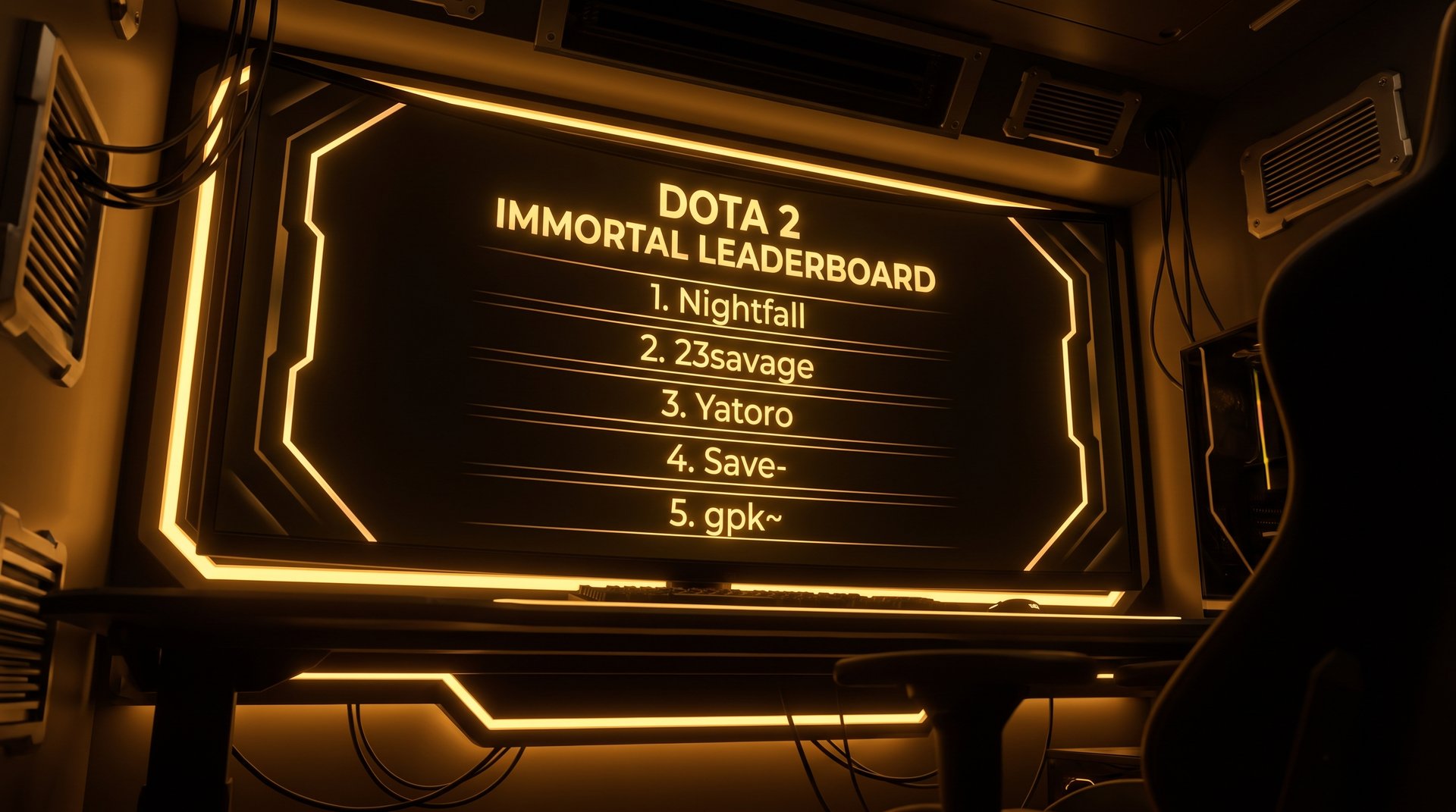
Egor “Nightfall” Grigorenko, playing for Aurora Gaming, is one of the most consistent leaderboard performers in recent seasons. He also reached 17,000 MMR — joining Yatoro in that exclusive bracket — and as of March 2026 held the number 1 position on the EU Immortal leaderboard after overtaking Nisha. Nightfall’s ability to sustain a top-1 or top-3 position across full competitive seasons — while also competing in tournaments — is arguably as impressive as his peak MMR.
Nisha — Team Liquid
Michal “Nisha” Jankowski, playing mid for Team Liquid, has been one of the most consistent leaderboard presences in European Dota 2 for several years. He and Nightfall traded the number 1 spot regularly in early 2026. Nisha’s approach to ranked play is calculated: he picks heroes that give him maximum individual impact and avoids games where the outcome is largely outside his control.
TaiLung — HEROIC
As of early 2026, TaiLung (representing HEROIC) secured a consistent top-3 position on the EU leaderboard. He is one of the newer entrants to the extreme-high-MMR bracket and represents the continued pressure from younger professional players who entered the competitive scene after the modern ranked format was established.
Paparazi
Paparazi is a Chinese carry player whose peak MMR placed him ahead of Yatoro’s rating at certain points in 2023-2024. His ability to grind to comparable heights from the CN server — historically less dense with top-end opponents than EU — demonstrated that extreme MMR is achievable across different regional conditions, provided the skill ceiling and game volume are both present.
Satanic — Parivision
Satanic has been a consistent presence in the top 10 of the EU leaderboard through 2025-2026. He represents the second tier of extreme MMR: players who may not hold the all-time record but who sustain 14,000-16,000 MMR across extended periods, which is itself a remarkable achievement.
Top MMR Milestones in Dota 2 History
| Player | Peak MMR (Confirmed) | Team (2026) | Region | Notable Milestone |
|---|---|---|---|---|
| Yatoro | 17,000+ (world first) | Team Spirit | EU | First to 16k (Nov 2024) and 17k (Dec 2025) |
| Nightfall | 17,000+ | Aurora | EU | EU leaderboard rank 1 (March 2026) |
| Nisha | 15,000+ | Team Liquid | EU | Consistent top-2 in 2025-2026 |
| TaiLung | 15,000+ | HEROIC | EU | Top-3 EU leaderboard (early 2026) |
| Paparazi | 15,000+ | Independent | CN / EU | Surpassed Yatoro’s rating at peak (2023-2024) |
| Satanic | 14,000-16,000 | Parivision | EU | Consistent top-10 through 2025-2026 |
| Topson | 12,000+ (historical) | Retired / Various | EU | First player widely confirmed at 12k+ (2019) |
| Resolut1on | 10,000+ (historical) | Retired | EU | First to break the 10k barrier (2016) |
It is important to distinguish between peak MMR and current MMR. A player can reach 16,500 in January and be at 14,800 by March after a normal variance period. The leaderboard reflects current ratings, not historical peaks. All-time peaks are tracked by community sites and esports reporters at the time they happen.
The Controversy: Legitimate Records vs Boosted Accounts
Not every account at the extreme top of any leaderboard belongs to a professional playing on their own account. The Dota 2 community has documented cases where accounts were pushed to extraordinary MMR levels through professional boosting — meaning one elite player grinding games on behalf of an account owner to inflate the account’s rating.
One notable case that received significant coverage involved an account named “El Tio Bounty,” widely believed to be the product of professional MMR boosting, which climbed past records set by pro players. The community response was largely negative — not because boosting services do not exist or are universally condemned, but because leaderboard manipulation by a boosted account dilutes the meaning of a publicly tracked ranking system. Valve has taken action against known boosted accounts by removing them from official leaderboards in past seasons.
This distinction shapes how you should read the phrase “highest MMR ever recorded.” The uncontested legitimate records belong to Yatoro: first to 16,000 (November 2024) and first to 17,000 (December 2025), both set on his verified primary account under active, competitive conditions. These records are what the Dota 2 community and esports outlets refer to when discussing the absolute ceiling of ranked play.
If you want to understand what legitimate professional Dota 2 boosting services look like compared to leaderboard manipulation, the difference is purpose: our boosters at TeamSmurf work on client accounts to help them reach a personal target MMR, not to manufacture fake leaderboard entries or public records.
What It Actually Takes to Reach 15,000+ MMR
The gap between an average Immortal player (around 5,700-7,000 MMR) and a 15,000+ player is not simply a matter of playing more games. It requires a combination of factors that are genuinely rare in the global population of Dota 2 players.
Full-time volume against elite opponents
Players in the 15,000+ bracket play at the highest MMR tier available, consistently, for years. Yatoro played 75 games over 8 days at nearly 80% win rate before crossing 16,000 — a pace that represents full-time professional effort. Even players with the ceiling to reach those ratings can fail to do so if they lack the time investment or if their professional team schedule limits ranked play.
Role mastery and deep hero flexibility
At 15,000 MMR, opponents understand most standard tricks. You cannot win games by mechanical execution alone. You have to out-draft, out-rotate, out-adapt, and out-read opponents who are themselves among the top 50-200 players globally. The highest-MMR players typically maintain a flexible pool of 10-20 heroes at an elite level, plus situational picks for unusual draft needs. Specializing too narrowly makes you predictable at this level; being too broad dilutes your depth on the heroes you play most.
The right server and opponent quality
EU is not the only server with top-tier players, but it has the densest concentration. Playing at 15,000 MMR on EU means every opponent has likely played thousands of games at a professional level. There are no easy matchups. On smaller or lower-population servers, reaching comparable leaderboard positions is possible with lower absolute MMR because the opponent pool is shallower — but the skill required to hold a high EU leaderboard position is a distinct and higher bar.
Consistency, not streaks
A 10-game win streak at any level is possible. Maintaining a positive win rate over 500 to 1,000 games against elite opponents is the mark of genuinely high-ceiling play. Players who spike to a high MMR through a short variance streak tend to regress to their mean; players who belong at that level defend it over time. Yatoro’s record was not built on a single run. It was built on years of sustained top-level ranked play.
If you want to close the gap between where you are now and Immortal, a professional MMR boost from TeamSmurf places elite-level players directly on your account to move you through the ranks efficiently. You can also review whether Dota 2 boosting is safe before making a decision.
Does the Highest MMR Mean the Best Player?
This question gets debated every time a new record is set. The correct answer is: highest leaderboard MMR and “best Dota 2 player in the world” measure different things, and both measurements are meaningful.
MMR in solo ranked is a measure of individual performance in public matchmaking under current conditions. It rewards personal decision-making, hero mechanics, map awareness, and consistency. It does not directly measure: team draft strategy, communication in organized play, pressure management under TI stakes, or the ability to execute coordinated team combos the way high-level competitive Dota 2 requires.
Yatoro winning TI twice demonstrates elite team play at the highest competitive level. Yatoro reaching 17,000 MMR demonstrates elite solo performance in public matchmaking. These reinforce each other, but they are distinct measurements. N0tail, one of the most decorated captains in Dota 2 history, was never a top-20 MMR player at his competitive peak. That did not make him a worse captain or a less successful competitor.
What the highest MMR does tell you: this player, in solo public matchmaking against the best available opponents, wins at an extraordinary rate over a sustained period. That is a real and meaningful statement about individual Dota 2 ability — it simply does not capture the full picture of what makes a team dangerous in tournament play.
The Current State of the Leaderboard (Mid-2026)
As of early-to-mid 2026, the top of the EU immortal leaderboard is a rotating competition between a small group of elite professionals. Nightfall (Aurora) and Nisha (Team Liquid) have been the two most consistent top performers in the first half of 2026, trading the rank 1 position multiple times. TaiLung (HEROIC) and Satanic (Parivision) appear regularly in the top 10.
The threshold to appear on the leaderboard at all — the top 500 players in a region — sits at different MMR values depending on the server. On EU, leaderboard entry typically requires approximately 7,000-8,500 MMR in competitive recent seasons. On lower-population servers, the cutoff can be as low as 5,500-6,000 MMR. These thresholds shift as the player pool grows and as top players continue pushing higher.
The “10,000 MMR club” remains the major milestone marker in community discussion. Estimates suggest fewer than 400-500 players globally have ever reached and sustained 10,000 MMR in competitive ranked play. Above 15,000, the number who have ever legitimately reached that level is small enough to count by hand. Above 16,000, the count drops to single digits of confirmed cases.
The overall trajectory of the leaderboard ceiling has been consistently upward. Whether 18,000 is eventually reached — and by whom — remains an open question, but based on the speed of recent record progression, the answer is likely “yes, eventually.”
If reaching your personal MMR ceiling is the goal, TeamSmurf’s Dota 2 MMR boost service connects you with players operating at the Immortal level who know the matchup data, the meta, and the fastest path through each bracket. We are a Dota 2-only operation — every booster on our roster actively plays at Immortal level.
Frequently Asked Questions
Want to Reach Your Own MMR Ceiling?
The players in this article have spent years grinding to where they are. If you want to reach your personal target MMR faster — whether that means breaking into Archon, hitting Divine, or cracking early Immortal — TeamSmurf connects you with players who operate at this level every day.
We are a Dota 2-only service. Every booster on our roster plays at Immortal rank. No outsourcing, no bots, no account theft risks.