10,000 Hours and Still Archon: The Uncomfortable Truth About Talent

You have 10,000 hours in Dota 2. You have watched the pro replays. You have read the patch notes. And you are still Archon. If that sentence makes your stomach drop, you are not alone — and the reason is not what most guides tell you.
This article breaks down the uncomfortable science behind why hours alone fail to move the needle, what “talent” actually means in the context of skill development, and the specific adjustments that separate players who climb from players who grind forever in place.
Table of Contents
The 10,000-Hour Myth, Properly Explained
Malcolm Gladwell popularized the idea that 10,000 hours of practice in any domain produces mastery. The figure came from research by Anders Ericsson, who studied elite performers in chess, music, and sports. But here is what Gladwell left out of his retelling, and what Ericsson himself spent years correcting: the 10,000 hours only produce mastery when those hours are filled with deliberate practice — not when they are spent doing the same thing, the same way, against the same kind of opposition, with no structured feedback.
Ericsson’s original finding was not “10,000 hours makes you great.” It was “the best performers in a given field had accumulated roughly 10,000 hours of deliberate practice by their mid-twenties.” The word deliberate is doing all the heavy lifting, and it is the word everyone skips.
In Dota 2, passive grinding — queueing up, playing your comfort heroes, dying to the same mistakes, tilting after two losses — is not deliberate practice. It is repetition. Repetition embeds habits. If those habits are wrong, repetition embeds wrong habits more deeply with every game. After 10,000 hours of that, you have not practiced for 10,000 hours. You have practiced one bad hour ten thousand times.
This distinction matters because it reframes the question. If you are stuck at Archon, the problem is almost certainly not that you need more hours. The problem is what you have been doing with the hours you already have.
Five Hidden Reasons You Are Not Climbing
1. Passive Repetition vs Deliberate Practice
The most common trap in Dota 2 skill development is treating playing the game as equivalent to practicing the game. They feel identical — both involve launching Dota 2 and pressing buttons — but they are cognitively different activities.
Deliberate practice means selecting a specific weakness, designing your session around exposing and correcting it, reviewing what happened, and adjusting. Passive repetition means loading into a ranked game, reacting to what happens, and logging off. One of these builds skill. The other builds familiarity with your current level of skill, which is not the same thing.
If you queue ranked without a pre-session focus (for example, “today I am practicing safe lane CS under pressure in a bad matchup”), you are playing, not practicing. Both activities are legitimate, but only one will move your rank.
2. Skill Ceiling Without Awareness
Every player has a real-time skill ceiling — the upper limit of what they can process and execute under game conditions. This ceiling is not fixed permanently; it can be raised. But it cannot be raised by doing things that fall well below it. If your comfort heroes, your preferred roles, and your familiar matchups all sit comfortably inside your current ceiling, you will never push against it hard enough to expand it.
Players who climb consistently are almost always playing in a zone of productive difficulty — games where they are slightly over their heads, where they have to think harder, adapt faster, and make decisions under more pressure than they are comfortable with. That discomfort is not a sign that you are playing badly. It is the signal that growth is actually happening.
3. Mental Models That Stopped Updating
Dota 2 is a game with significant patch variance. The item builds, the hero meta, the laning conventions, and the power spikes that defined optimal play two years ago may be actively counterproductive now. A player who internalized the correct mental model for 7.30 and stopped updating it is not playing with 10,000 hours of current Dota 2 knowledge. They are playing with an outdated model and applying it to a different game.
This is more subtle than just “read the patch notes.” Mental models govern your instincts. If your instincts tell you to take a specific fight at a specific timing because that is when the window opens, but the current patch has shifted that window, your instincts will lead you wrong and you will not understand why. Updating mental models requires deliberate study of current high-MMR play, not just skimming the patch summary.
4. The Comfort Hero Trap
Having a hero pool is good. Having a hero pool that never expands or challenges you is a ceiling. Comfort heroes give you maximum mechanical execution, but they also let you avoid learning the things that are hardest for you specifically.
A support player who only plays Ogre Magi and Earthshaker avoids the entire decision space of position-4 roaming heroes. A carry player who only plays farming carries avoids the mental model of early-aggression carries. The hours accumulate on the comfort heroes, but the gaps in understanding never close. Eventually you reach a rank bracket where the opponents’ understanding of those gaps exceeds your comfort hero’s ability to paper over them, and you stop climbing.
5. Missing the Feedback Loop
Feedback is the core mechanism of skill development. Without feedback, you cannot correct errors, because you cannot distinguish errors from correct play. In most skill-development domains, feedback comes from coaches, teachers, or structured evaluation. In Dota 2, most players attempt to generate all their own feedback from inside the game — which is nearly impossible when you are also trying to play.
The post-game scoreboard is not feedback. Win rate is not feedback. Neither is your MMR trend over two weeks. Real feedback is specific: here is what you did wrong at minute 14, here is why it was wrong given the game state, here is what correct play looks like instead. Without that specificity, you cannot learn from your mistakes systematically. You can only notice you keep losing — which is not an actionable insight.
Is There a Real Talent Ceiling?
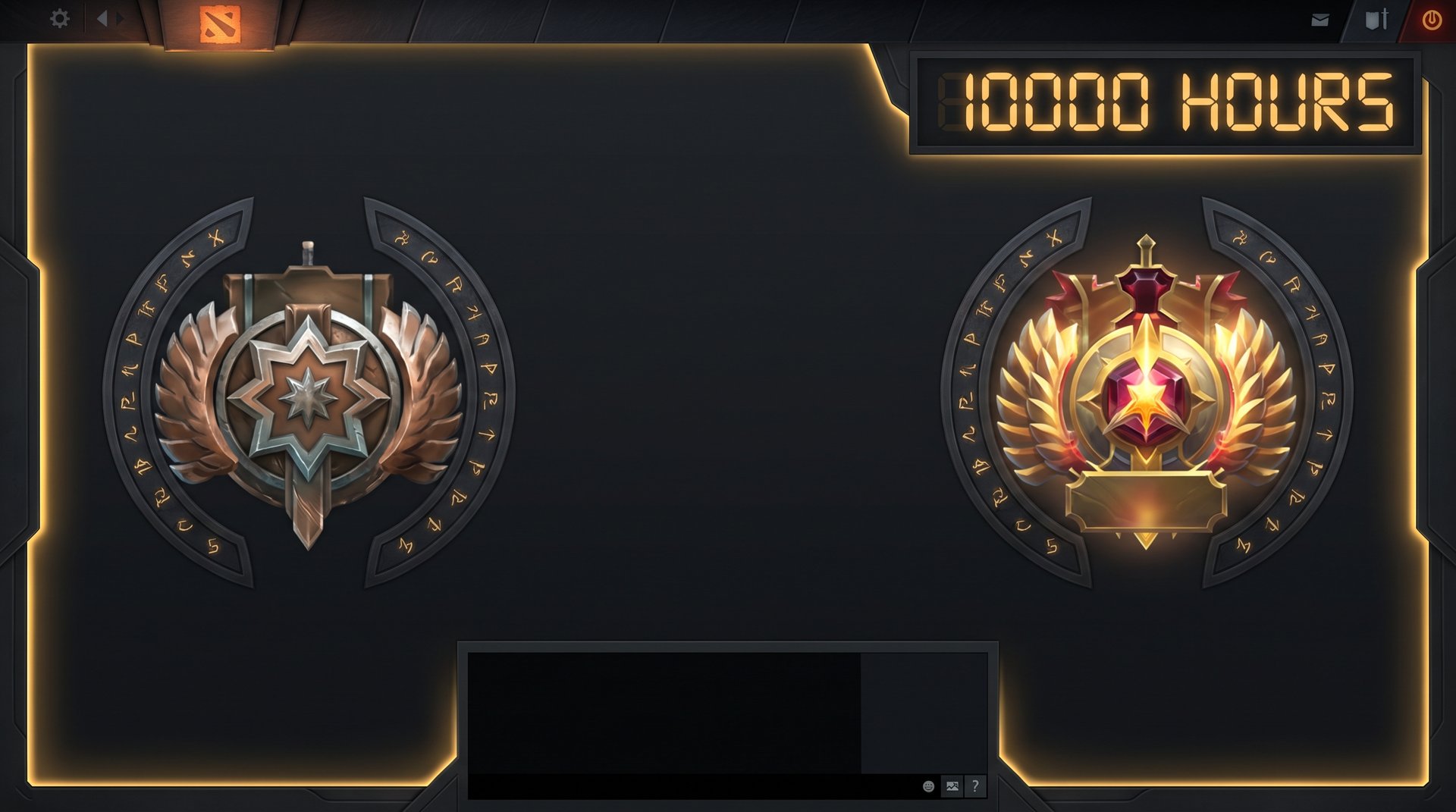
This is the uncomfortable part. Yes, there is a real talent component to Dota 2 performance. Processing speed, working memory capacity, spatial reasoning, and pattern recognition all vary between individuals and all contribute to high-MMR play. The research on skill acquisition is consistent: given equivalent practice quality and volume, individuals vary in how fast they improve and how high their ceiling ultimately sits.
But here is what the talent research also says: virtually no Archon player is anywhere near their genetic ceiling. The cognitive and perceptual demands of reaching, say, 5,000 MMR are well within the range of most adult humans who are not dealing with significant processing or attention disorders. The players who plateau at Archon are almost never limited by their neurological ceiling. They are limited by their practice quality, their mental habits, and the feedback loops (or absence of them) that govern their development.
Put plainly: if you are stuck at Archon with 10,000 hours, talent is probably not the constraint. The constraint is almost certainly methodological. You have the raw capacity to climb. You do not have the right system for using that capacity.
Deliberate Practice vs Passive Grinding: A Comparison
The table below shows the practical differences between passive grinding and deliberate practice in a Dota 2 context. These are not abstract distinctions — they map to specific behaviors you can change this week.
| Dimension | Passive Grinding | Deliberate Practice |
|---|---|---|
| Session goal | Queue ranked, see what happens | Specific focus area defined before the game |
| Hero selection | Comfort picks, highest win-rate heroes | Heroes that stress your weakest skill |
| Post-game review | Check KDA, move on | 10-15 min replay review of decision errors |
| Feedback source | Self-generated, intuition-based | Coach, mentor, or structured self-review framework |
| Emotional response to mistakes | Frustration, blame attribution | Curiosity, systematic error logging |
| Mental model updating | Passive absorption from games | Active study of high-MMR replays + patch analysis |
| Hours needed to climb one rank | Hundreds (if ever) | Dozens (when applied correctly) |
| Relationship to discomfort | Avoided | Sought as a signal of growth |
The contrast is stark. The passive grinding column describes how most Dota 2 players approach their time in the game. The deliberate practice column describes how players who reliably climb approach it. The difference is not talent. It is not hours. It is method.
How to Audit Your Own Hours
If you are unsure which column describes your current approach, a simple audit will tell you. For the next five games you play, track the following:
- Pre-game focus: Did you define a specific skill you were working on before the game started? (Yes/No)
- Post-game review: Did you watch any portion of the replay with the intent to identify a specific mistake? (Yes/No)
- Error logging: Did you write down or note a concrete mistake you made and what the correct play would have been? (Yes/No)
- Comfort zone: Did you queue your comfort hero in your comfort role? (Yes = passive; No = deliberate)
If you answered Yes to fewer than two of the first three questions, and Yes to the fourth, you are grinding passively. Your hours are not working for you. That is fixable — but it requires acknowledging the problem first.
The second part of the audit is reviewing the nature of your mistakes. Are you making the same types of errors game after game? Dying to the same types of engagements? Missing the same itemization windows? If the answer is yes, that is evidence that you have a systematic gap in your understanding or execution — and that systematic gaps require systematic solutions, not more repetition of the activity that produced them.
This is also where the TeamSmurf boosting services can provide a secondary benefit beyond rank alone: playing in a boosted environment temporarily exposes you to the decision-making patterns of higher-MMR gameplay, which can update your mental models faster than playing at your current level. That said, passive exposure to higher-level games is not enough on its own. The review and analysis have to happen for the pattern absorption to convert into retained skill.
What Archon Players Are Actually Missing
After reviewing patterns across thousands of Archon-bracket replays, a few consistent gaps emerge. These are not the things Archon players think they are missing (mechanics, hero knowledge, farm efficiency). These are the things they are actually missing:
Macro Timing Awareness
Archon players consistently make individual-level decisions (when to fight, when to fall back, what item to buy) without integrating macro timing into those decisions. They think about the fight in front of them, not about what that fight costs in terms of objective timing. High-MMR players are always asking: “If I take this fight and it goes 60 seconds, what does that cost me in terms of Roshan timer, tower timing, and buyback economics?” Archon players are asking: “Can I win this fight?”
Resource Allocation Under Uncertainty
Dota 2 involves constant decision-making under incomplete information. Where is the offlane hero? Is the enemy support rotated? High-MMR players have internalized models for estimating those unknowns and adjusting their resource allocation accordingly. Archon players typically play as if they can see the whole board when they can’t — making decisions based on what they know, ignoring what they don’t. This produces predictable mistakes.
Tilt Recognition and Session Management
The data on tilt in Dota 2 is consistent: after two consecutive losses, win rate drops measurably for most players. The MMR boosting guide on TeamSmurf touches on this, but the principle is broader than boosting: tilt degrades decision quality, and degraded decision quality produces more losses, which produces more tilt. The players who climb out of Archon are not always the ones with the highest skill ceiling. They are often the ones with the best tilt management — specifically, the ones who stop playing before the tilt spiral takes over.
Hero Matchup Understanding Depth
Archon players know their heroes. They do not know their heroes against specific opponents. The difference is substantial. Knowing you play Juggernaut does not tell you what to buy when the enemy support is Ancient Apparition, what timing window you have against a Huskar, or when to use Blade Fury offensively vs defensively against a Bane. This depth of matchup knowledge only comes from deliberate study, not from playing the hero in hundreds of games where those specific matchups happen incidentally.
How Coaching Breaks Stagnation
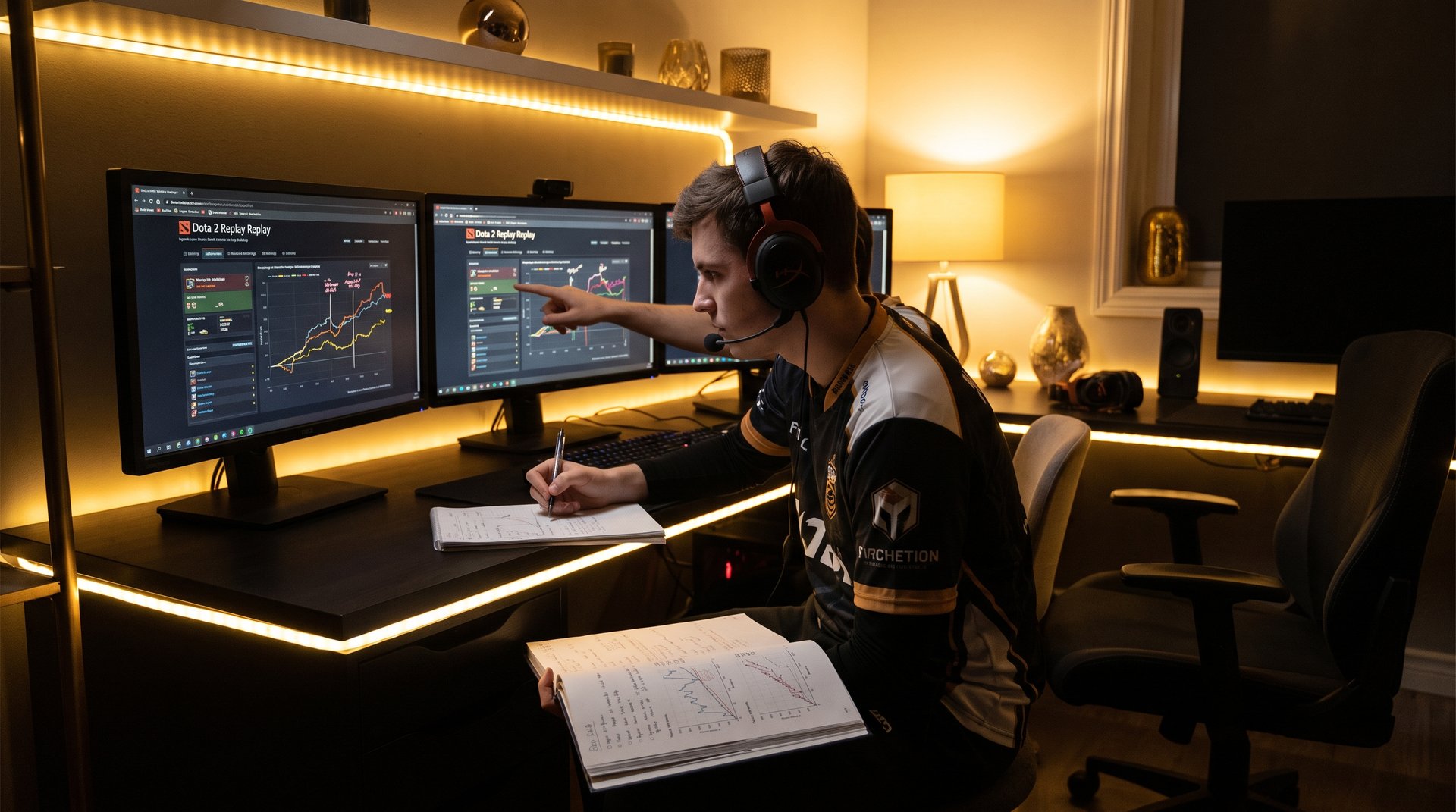
The single most consistent intervention for players stuck at a given bracket is not more hours. It is structured coaching with replay review. This is not a controversial finding in skill development research — it matches the patterns seen in every high-stakes domain from chess to athletics to music. External feedback from a more skilled observer systematically surfaces errors that the player cannot see themselves.
In Dota 2, this means a high-MMR coach watching your replay and identifying the specific decision points where your play diverged from optimal — and why. Not “you played badly,” but “at minute 9 you were farming the jungle camp while the enemy support was visible on the minimap walking toward your carry. The correct call was to rotate immediately because the farm value of that camp was lower than the defensive value of preventing a kill on your carry.”
That level of specificity is what creates real skill development. It closes the feedback loop. It connects the mistake to the consequence and to the correct alternative. Without that loop, you are trying to improve without being able to see what needs improving.
The question of whether Dota 2 boosting is safe comes up often in the context of account services, but coaching is universally considered the cleanest path to genuine improvement. It does not change your rank directly — it changes the skill that determines your rank. For players who want both the rank and the genuine skill to hold it, coaching combined with deliberate practice between sessions is the highest-efficiency path available.
Stop Grinding the Same Mistakes Into Your Muscle Memory
If you have put in the hours and the rank is not moving, the issue is not your commitment. It is the method. TeamSmurf connects you with high-MMR coaches who will review your replays, identify your specific error patterns, and give you a concrete practice plan to close them.
For players who want the rank while working on the skill, our boosting services can bridge the gap — handled by Immortal-bracket players who know what your bracket’s opponents are thinking before they do.
Book a Coaching Session View Boosting OptionsThe Path Forward: Practical Steps Starting Today
The theory above is only useful if it translates into behavior change. Here is what the next week of Dota 2 looks like if you take this seriously:
- Pick one skill gap to focus on. Not your mechanics. Not your farm efficiency. One specific decision-making pattern that you know you get wrong. Rotate timing. Buyback decisions. Tilt recognition. One thing.
- Review one replay per day. Watch it with the specific question: “How many times did I violate the principle I am working on?” Log the count. If you do not review, you do not learn.
- Stop playing on tilt. Define your session exit rule before you start. Two losses in a row is a reasonable default. When you hit it, stop. Log the session, what you worked on, what you noticed.
- Get external feedback within two weeks. It does not have to be a full coaching package. One replay review session with a coach who has at least 500 MMR on you will surface things you cannot see on your own.
- Adjust your hero pool toward productive difficulty. Play one hero per week that is outside your comfort zone but relevant to a skill gap you are working on. The discomfort is the point.
None of this requires quitting your job and going pro. It requires treating your Dota 2 hours as an investment rather than a hobby. Investments have returns when you manage them with intention. Hobbies are fine as they are, but they do not compound. If you want to climb, you need the investment mindset applied to the hours you already have.
The 10,000-hour player who is still Archon is not a failure. They have demonstrated enormous commitment to the game. What they need is not more commitment. They need to redirect the commitment they already have into a different kind of engagement with the game — one that is systematic, reviewed, and slightly uncomfortable by design. That is what climbing looks like. Not grinding. Growing.