Why Valve Will Never Fully Fix Matchmaking (An Insider View)

Every few months a wave of posts floods the Dota 2 subreddit: “Valve finally fixed matchmaking!” Then, within two weeks, the same players are back complaining that solo queue is unplayable, that smurfs are everywhere, and that the algorithm somehow keeps putting the worst performer on the losing team. If you have played this game for more than two years, this cycle is utterly familiar.
This article is not a rant. It is an analysis. After years of tracking patch notes, reading Valve developer blogs, and following the experiences of thousands of players who use boosting and coaching services, we have a clear-eyed view of why Dota 2 matchmaking stays broken — not because Valve is incompetent, but because the incentives, the technical constraints, and the social dynamics of a live service game make a truly fixed matchmaking system nearly impossible to deliver. We will walk through every layer of that argument.
The Problem Is Not What You Think
Most players frame matchmaking failures as a technical problem: Valve has not built the right algorithm. The solution, in this view, is obvious — smarter math, more data, faster iteration. If only Valve hired better engineers or spent more time on the system, it would work.
That framing is wrong, and understanding why requires separating three distinct things that people conflate when they say “matchmaking is broken”:
- Match quality — whether the ten players in a game are genuinely evenly matched in skill.
- Match feel — whether the game subjectively felt fair, regardless of what the numbers say.
- Player satisfaction — whether the player is happy after the match.
Research on competitive games consistently shows that players attribute wins to skill and losses to bad teammates or bad luck. This is called the self-serving bias, and it is almost universal. It means that even a technically perfect matchmaker — one that produces genuinely 50-50 outcomes — will be perceived as broken by a large fraction of players at any given time, simply because the nature of losses feels unfair.
Valve knows this. Their 2017 matchmaking blog post acknowledged it directly. The problem they are trying to solve is not purely algorithmic. It is partly psychological, partly social, and partly structural. And the structural part is where the real fix lives — if a fix even exists.
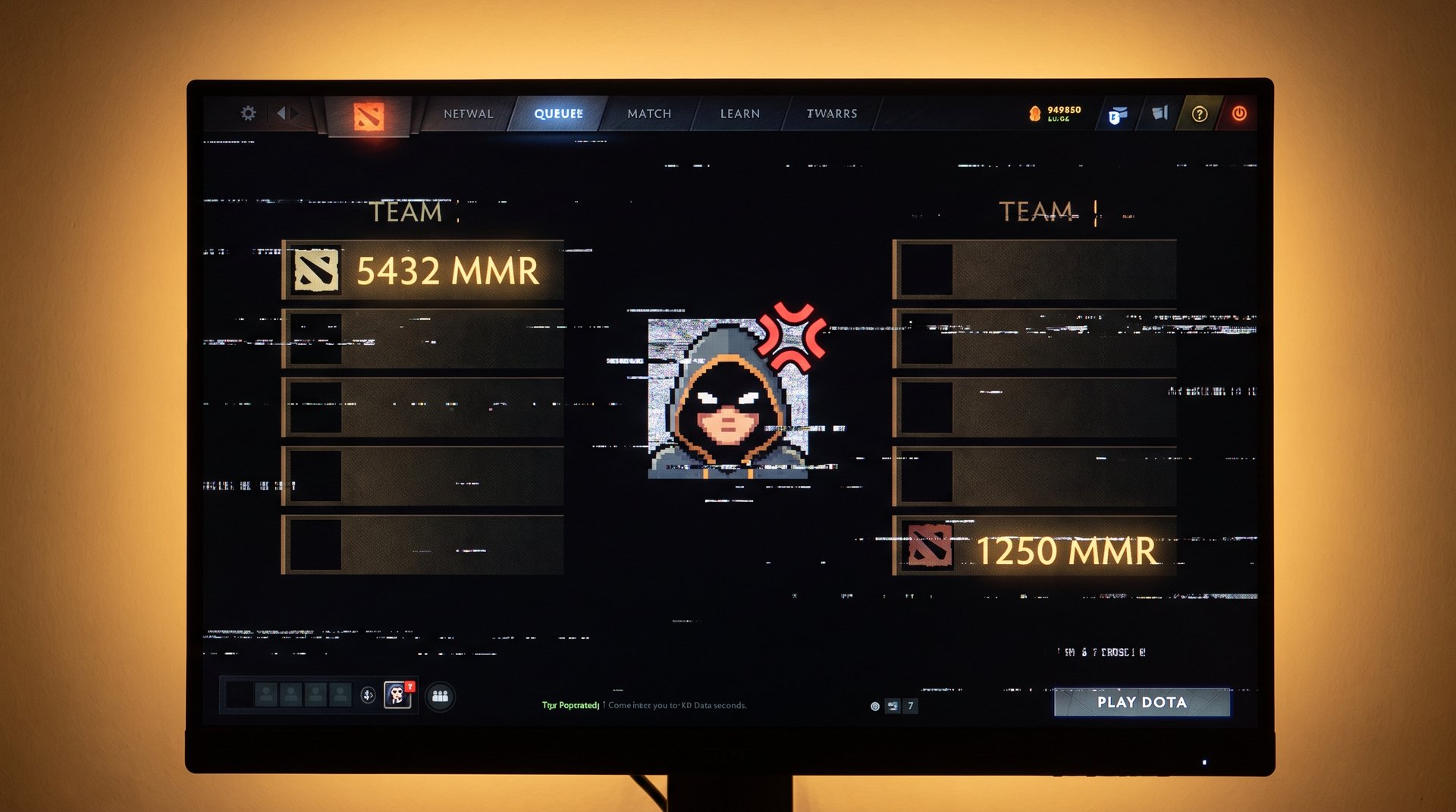
Valve’s Structural Incentives Work Against Fixing Matchmaking
To understand why Valve cannot fully fix matchmaking, you need to understand what Valve is actually optimizing for as a company. Valve is not a publicly traded company with quarterly earnings targets, which gives them more freedom than most studios — but they still answer to economic reality. Dota 2 is a free-to-play game. Its revenue comes from cosmetics, the Battle Pass (or equivalent seasonal content), and the ecosystem of in-game items.
That revenue model has a direct implication: player engagement matters more than match quality. A player who is frustrated with matchmaking but keeps logging in to try again is still a monetizable player. A player who quits is not. Valve’s incentive is to keep the experience just good enough that players stay, but never so good that the grind disappears and there is no emotional hook to keep spending.
This is not a conspiracy theory. It is basic product design. Here is how it plays out specifically:
| Valve Goal | Matchmaking Implication | Net Effect on Players |
|---|---|---|
| Keep queue times short | Wider MMR spread per match accepted | More stomps, less competitive balance |
| Retain new players | New accounts face softer opponents early | Smurfs and new accounts distort low brackets |
| Sell seasonal content | Rank resets drive engagement spikes | Calibration seasons create instability for months |
| Maintain large playerbase | Region pools never split too finely | Wide skill variance in niche regions and off-peak hours |
| Minimize bans | Low ban rates keep playerbase size up | Griefers and smurfs persist longer than they should |
Every single one of these choices makes individual match quality worse. And every single one is rational from a business standpoint. Valve is not making these trade-offs out of negligence — they are making them deliberately, because the alternative (stricter matchmaking, smaller but fairer pools, aggressive bans) would shrink their active playerbase and hurt revenue.
The Free-to-Play Smurf Funnel
The clearest example of structural incentive failure is the smurf problem. Dota 2 has always had smurfs — high-MMR players on fresh accounts — but in a free-to-play game the friction of creating a new account is essentially zero. Phone number verification was added in 2019 and then progressively weakened as it caused legitimate new players to bounce. The result: smurf creation remains trivially easy.
Why does Valve not simply require ranked play to go through a verified account with hundreds of hours? Because doing so would dramatically reduce new player conversion. New players who bounce before hitting ranked are still potential cosmetic buyers and Battle Pass purchasers. Tightening the gate to ranked would help experienced players — the ones who already own cosmetics and have spent money — while hurting acquisition metrics. The math does not favor the fix.
If you are dealing with smurfs in your bracket and want to escape their influence on your MMR, our guide to the best Dota 2 boosting services covers your options for playing at a more representative rank.
Technical Constraints Nobody Talks About
Even if Valve wanted to fix matchmaking purely as a technical project, they would face constraints that most players never think about. Understanding these makes the task look much harder than “just build a better algorithm.”
Sample Size and MMR Confidence Intervals
MMR is an estimate, not a measurement. The Glicko-based system (which Dota 2 uses in some form) assigns every player not just a rating but a confidence interval around that rating. A player with 50 ranked games has a much wider confidence interval than a player with 500 games. When you put ten players in a match, you are not matching ten known quantities — you are matching ten probability distributions that may overlap significantly.
In a game where each match is 40-60 minutes and involves heroes, items, and team compositions with enormous variance in outcome, the signal-to-noise ratio is inherently low. It takes dozens of games to update a player’s MMR in a statistically meaningful way. This means the system is always working with stale or uncertain data. No amount of engineering fully fixes this; it is a property of the game itself.
The Consistency Problem
A single Dota 2 player’s skill level varies significantly based on hero, role, time of day, physical state (tired, caffeinated, distracted), and team communication. A player rated at 4,500 MMR on their peak hero might play at 3,800 MMR effectiveness on an unfamiliar hero in a secondary role at midnight. The MMR system cannot account for these within-player variances because it has no way to observe them directly.
Valve’s role-specific MMR (introduced in 2019) was an attempt to address the role-consistency problem. It helped but created new issues: players calibrated poorly in some roles, the system was gamed by role-switching strategies during calibration, and the complexity increased queue time in smaller regions. Every fix introduced a new constraint.
Region and Time-of-Day Pools
At any given moment, the number of players queuing in each server region at each MMR bracket is finite. In Southeast Asia at peak hours, there may be thousands of players queuing near 3,000 MMR. In South America at 3 AM, there may be dozens. The algorithm cannot conjure players from nowhere. When pool size drops below a threshold, it has two choices: wait longer (increasing queue time, which Valve’s data shows dramatically increases abandonment) or accept worse matches (increasing MMR spread).
Valve has consistently chosen to accept worse matches rather than long queues. This is actually the correct choice from a user-experience standpoint — most players prefer a slightly unfair match now to a fair match in 15 minutes — but it means the system will always produce stomps during off-peak hours and in smaller regions.
Behavior Score and Smurf Detection: Two Systems Valve Cannot Win
The Behavior Score Arms Race
Valve introduced behavior score in 2018, grouping players by communication reports, abandons, and commends. The idea was to isolate toxic players from the general population. It worked to some extent — low-behavior-score games are noticeably worse in communication and gameplay quality. But it created an arms race.
Players learned to commend-farm, mutual-report, and use third-party tools to check behavior scores. Streamers in low-behavior-score lobbies for content created incentives for others to deliberately tank their scores for the “experience.” Valve had to constantly adjust the weight of different signals, and the system is still gamed regularly enough that it does not fully separate bad actors from the general pool.
Smurf Detection Limits
Detecting smurfs algorithmically is genuinely hard. The signals are:
- Win rate significantly above what the current MMR predicts
- Last-hit and kill participation numbers inconsistent with calibration games
- Hero pools and game sense suggesting prior experience
- Unusual purchase patterns (optimal item builds without hesitation early on)
The problem is that each of these signals also applies to a legitimately improving player on a hot streak, or a returning player who took a two-year break. False positive detection is costly — banning or fast-tracking a legitimate new player’s MMR based on a smurf signal damages trust. So Valve calibrates the smurf detector conservatively, which means many actual smurfs go undetected long enough to ruin dozens of games for honest players.
Curious about how boosting services navigate this landscape? Our MMR boosting guide explains the mechanics in detail.

The Playerbase Is the Most Unpredictable Variable
Here is something the algorithm-optimization crowd consistently misses: the matchmaker is not playing against a fixed opponent. The playerbase is a living system that responds to and games every change Valve makes. This is not a solvable problem in the engineering sense — it is an ongoing adversarial relationship.
Consider what happened after Valve introduced the “avoid as teammate” feature. The intention was to let players avoid people they had a bad experience with. Within weeks, coordinated groups were using it to target specific streamers or players they disliked, effectively soft-banning them from matches with their social circles. The feature had to be limited and eventually reworked.
Or look at the calibration game system. Every time Valve adjusts how many games it takes to calibrate, players game the new system. When phone verification was required, verification sharing services appeared within days. When party MMR was adjusted to separate from solo MMR, players found exploits in the party queue to manipulate solo ratings.
The playerbase does not just passively receive matchmaking changes — it actively probes and exploits them. This means Valve is perpetually reacting to a population of actors who have strong incentives to break the system and significant time to find ways to do so.
How Patch Churn Continuously Resets Matchmaking Progress
Dota 2 is a game of enormous complexity. With 120+ heroes, hundreds of items, and a map that changes every major patch, the strategic meta is never stable. This is actually one of Dota’s great strengths as a competitive game — it stays fresh year after year. But it is terrible for matchmaking stability.
Every major patch changes which heroes are strong, which strategies are viable, and therefore which players will overperform or underperform relative to their historical MMR. A player who was accurately rated at 4,000 MMR in patch 7.38 may be genuinely stronger or weaker in patch 7.41d simply because their hero pool shifted in power. The matchmaker does not know this. It takes weeks of games across the playerbase for the ratings to adjust to a new meta.
Valve releases major patches roughly every 8-12 weeks. If it takes 4-6 weeks for ratings to stabilize after a patch, then matchmaking quality is degraded for 40-75% of each patch cycle. And during major patches — like the ones that accompany The International or Esports World Cup seasons — the hero pool changes radically enough that entire MMR brackets shift. The calibration period after a major patch is when matchmaking complaints peak, and it is not because Valve made the system worse. It is because the game changed.
| Phase of Patch Cycle | Matchmaking Quality | Primary Reason |
|---|---|---|
| First 2 weeks post-patch | Poor | Meta is unsettled, MMR not yet adjusted |
| Weeks 3-5 | Improving | High-MMR players establish new meta, ratings shift |
| Weeks 6-9 | Best of cycle | Ratings accurate, meta understood |
| Final weeks before next patch | Declining | Fatigue, off-meta experiments, players queueing less |
This means even if Valve perfected the matchmaking algorithm today, match quality would still degrade for weeks after every major patch. The constant content updates that keep Dota 2 alive are structurally incompatible with stable matchmaking.
How Other Games Handle It — And Why Dota Is Harder
Players often point to games like League of Legends, Valorant, or CS2 as examples of better matchmaking. There is some truth to this, but the comparison obscures important differences.
League of Legends has a much larger playerbase, which means deeper queues at every MMR bracket and region. More players per bracket means better match quality at the margins. Dota 2 has never had League’s population density, and in 2026, the gap has grown wider. You cannot import League’s matchmaking quality without importing League’s playerbase first.
Valorant uses a stricter account verification system (tied to a single account per device via Vanguard) that makes smurf creation much harder. It also has less hero-interaction complexity, which means the skill signal from each game is cleaner. Riot has also shown willingness to accept longer queue times to maintain match quality. These are all choices Valve could theoretically make — but each one has a cost that Valve has decided is too high.
CS2 (Counter-Strike 2) benefits from a game where the fundamental mechanics change very slowly. Valve does not rework the map pool or introduce new abilities every two months. The skill signal per game is high and the meta is stable. Dota 2 is structurally incapable of replicating this stability while remaining the game it is.
What You Can Actually Do While Matchmaking Stays Imperfect
Accepting that Valve will not fully fix matchmaking does not mean accepting a permanently bad experience. There are meaningful actions you can take to improve your outcomes within the constraints of the current system.
Play During Peak Hours in Your Region
This single change makes a measurable difference. Queue during peak hours and you get access to a larger player pool, which means the algorithm can find better matches without widening the MMR spread. For most regions, peak hours are early evening on weekdays and all day on weekends. Avoid late-night queuing if you have a choice.
Narrow Your Hero Pool
The variance problem cuts both ways. If you are on a hero you know deeply, you are more predictably effective, which means your MMR is a more accurate reflection of your skill. A narrower hero pool also makes you less susceptible to meta shifts — if you play 3-4 heroes, at least one of them is usually competitively viable regardless of the current patch.
Solo vs. Party Queue Strategy
Solo queue is where MMR matters most and where your own performance has the highest impact on outcome. Party queue introduces coordination advantages but also creates bracket distortions when mixed-MMR parties are placed. If your goal is accurate calibration, solo queue is cleaner. If your goal is enjoyment and consistent communication, party queue with similar-MMR friends is better even if the matches are slightly less calibrated.
Address Your Behavior Score
Behavior score affects which players you are matched with, not just your access to features. Players with scores above 9,000 consistently report better average game quality than those in the 7,000-8,000 range. Commending players you have good experiences with, avoiding reports for in-game disagreements, and not abandoning games all help over time.
Consider Coaching for Faster Improvement
If your MMR genuinely does not reflect your skill — which the matchmaking system may take a long time to correct — a coaching session can identify and fix the specific mechanical or decision-making issues holding you back. This is particularly valuable after a major patch, when your old patterns may no longer fit the new meta.
You can also read our analysis of whether Dota 2 boosting is safe if you are considering other options to break out of a bracket that does not reflect your current skill level.
Manage Your Expectations About the System
This may be the most important point. If you are going into every match expecting the system to produce a perfectly balanced 50-50 outcome, you will be disappointed constantly. If you go in expecting the system to produce something approximately fair over a large enough sample, you will be more accurate and less tilted. The variance in individual Dota 2 games is enormous. Over 100 games, a better player will rise. In any single game, chaos is a real factor.
Play at Your True MMR — Not the Bracket Matchmaking Stuck You In
If the system keeps undermeasuring your skill, you do not have to grind through dozens of unfair games to break out. TeamSmurf connects you with verified high-MMR players who can help you reach the bracket where you genuinely belong — fast, discreet, and with real gameplay accountability.
Want a faster path up? We also offer expert coaching sessions where former pro and high-MMR players analyze your replays and build a personalized improvement plan for the current patch.
View Boosting Services Read the MMR Guide