Dota 2 Patch Notes Explained: How Balance Updates Shape Your MMR

Every few months, Valve releases a Dota 2 patch that reshapes the entire game. Heroes get buffed and nerfed. Items are reworked. Map changes alter farming patterns and ward spots. The meta shifts, and players who adapt quickly climb MMR while those who stick to outdated strategies stagnate. Understanding how to read patch notes, identify what changes actually matter, and adapt your hero pool accordingly is one of the most underrated skills in Dota 2.
This guide covers everything you need to know about Dota 2 patch notes: how to interpret them, which changes have the biggest impact, how the meta evolves after major patches, strategies for adapting your hero pool, and a retrospective on the most impactful patches in Dota 2 history. Whether you’re a casual player who skims patch notes or a dedicated climber who wants to exploit new meta trends before everyone else catches on, this article will sharpen your understanding of how balance updates work.
Table of Contents
How to Read Dota 2 Patch Notes
Dota 2 patch notes can be overwhelming. A major patch might contain hundreds of individual changes spanning general game mechanics, items, and every hero in the roster. Reading patch notes effectively means knowing what to focus on and what to skim.
The Anatomy of a Patch
Most major Dota 2 patches follow a consistent structure:
- General Changes: Game-wide mechanics like gold/XP formulas, tower stats, creep behavior, map changes, and neutral item adjustments. These are often the most impactful changes because they affect every game.
- Item Changes: Buffs, nerfs, reworks, and new items. Item changes affect multiple heroes at once, making them high-impact.
- Hero Changes: Individual hero buffs, nerfs, ability reworks, and talent changes. This is the longest section but varies in impact — some heroes receive minor number tweaks while others are fundamentally reworked.
What to Read First
When a patch drops, prioritize your reading in this order:
- General changes first: Map changes, creep changes, and economy changes affect every game. Read these carefully.
- Item changes second: A single item buff/nerf can make or break multiple heroes. If Mekansm gets buffed, every Mek carrier becomes stronger. If BKB gets nerfed, every BKB-dependent carry is affected.
- Your hero pool third: Check the heroes you play most frequently. Did they get buffed Nerfed Did their core items change
- Meta heroes fourth: Check the most popular heroes in the previous meta. If they got nerfed, the meta will shift. If they were untouched, they’ll likely remain strong.
- Everything else: Skim the remaining hero changes for anything that jumps out — major ability reworks, large number changes, or talent overhauls.
Understanding Numerical Changes
Not all number changes are created equal. Here’s how to gauge the significance of numerical adjustments:
| Change Size | Example | Impact Level | Notes |
|---|---|---|---|
| Tiny (1-5%) | Base damage +2, armor +0.5 | Low | Usually negligible in practice; may affect last hitting threshold |
| Small (5-10%) | Ability damage +20, cooldown -2s | Moderate | Noticeable in-game, may shift close matchups |
| Medium (10-20%) | Ability damage +50, mana cost -30 | High | Significantly changes hero viability |
| Large (20%+) | Ability rework, major stat overhaul | Very High | Can make or break a hero entirely |
Context matters enormously. A +2 base damage buff on a hero who struggles with last hitting (Shadow Fiend with low base damage) is more impactful than the same buff on a hero who already last hits easily. A -2 second cooldown on a 10-second ability (20% reduction) is much more significant than -2 seconds on a 60-second ability (3.3% reduction).
Reading Patch Notes Like a Pro
Professional players and analysts read patch notes differently than casual players. Here’s their approach:
- Identify the “winners” and “losers”: After reading through changes, create a mental list of heroes that got significantly stronger (winners) and weaker (losers). The winners will dominate the new meta.
- Look for synergies: Sometimes individual changes seem small but combine to make a hero much stronger. If a hero gets +5 base damage AND their core item gets buffed AND a competing hero gets nerfed, that hero is a big winner even though no single change was huge.
- Consider indirect effects: A nerf to Anti-Mage doesn’t just make Anti-Mage weaker — it makes heroes that Anti-Mage countered stronger (because their counter is now less threatening). Always think about the ripple effects.
- Check the numbers yourself: Don’t rely on community reactions. Reddit and social media tend to overreact to changes. Do the math yourself and form your own conclusions.
What Changes Matter Most
Not all patch changes have equal impact on the meta and your MMR. Here’s a hierarchy of change types ranked by their effect on the game.
Tier 1: Game-Changing (Always Pay Attention)
Map Changes: Any change to the Dota 2 map — new pathways, altered jungle camp positions, changed ward spots, new Roshan pit layout — fundamentally alters how the game is played. Map changes affect farming patterns, gank routes, ward placements, and team fight locations. When the map changes, your muscle memory for movement and warding needs to be relearned.
Economy Changes: Changes to passive gold, creep bounties, kill gold formulas, or comeback mechanics alter the fundamental economy of the game. If passive gold increases, supports become stronger. If kill gold increases, aggressive play is rewarded. If comeback mechanics are buffed, late-game heroes become relatively stronger because they can always catch up.
New Heroes/Items: Entirely new additions to the game create unexplored interactions and often dominate the meta until they’re properly balanced. New heroes are typically released slightly overtuned to encourage players to try them.
Ability Reworks: When a hero’s ability is fundamentally changed (not just number tweaks, but an entirely new ability or completely reworked mechanic), the hero needs to be reevaluated from scratch. Reworks can turn a bottom-tier hero into a top pick overnight.
Tier 2: Significant (Usually Important)
Item Reworks/New Build Paths: Changes to item recipes, build paths, or stats affect every hero that buys those items. A reworked Sange and Yasha affects every strength carry. A cheaper BKB changes every mid-game team fight.
Multiple Small Buffs to One Hero: A hero that receives buffs to base stats, ability numbers, AND talents in the same patch is almost always being intentionally pushed into the meta by Valve. These “omni-buffed” heroes are excellent picks for the first few weeks after a patch.
Significant Numerical Changes: Large changes to ability damage, cooldowns, mana costs, or stat growth. A 20% cooldown reduction on a key ability changes how a hero plays.
Tier 3: Moderate (Worth Noting)
Talent Changes: Talent adjustments affect hero power at specific level thresholds. A stronger level 10 talent makes the early-mid game better; a stronger level 25 talent makes the ultra-late game better. Talent changes are important but less impactful than ability changes.
Aghanim’s Scepter/Shard Changes: New or reworked Aghs/Shard abilities can create entirely new playstyles for heroes. When a hero receives a game-changing Aghs, it affects both their viability and their item build.
Small Number Tweaks Across Many Heroes: Patches that make small changes to 50+ heroes are “balance patches” designed to level the playing field. No single change is huge, but the cumulative effect shifts the meta gradually.
Tier 4: Minor (Usually Ignorable)
Cosmetic/UI Changes: Visual updates, HUD changes, and cosmetic additions don’t affect gameplay.
Bug Fixes: Most bug fixes are minor, but occasionally a fix removes an unintended interaction that was being exploited (e.g., fixing a broken combo or an unintended ability interaction). Read these carefully.
Tiny Numerical Changes to Non-Meta Heroes: +1 armor on a hero that nobody plays is effectively meaningless. These changes accumulate over patches until the hero eventually becomes viable, but they rarely matter individually.
How the Meta Shifts After Patches
The “meta” (metagame) refers to the prevailing strategies, hero picks, and playstyles that dominate at any given time. After a major patch, the meta goes through a predictable evolution cycle.
Phase 1: Chaos (Days 1-7)
The first week after a major patch is characterized by experimentation and confusion. Players try new builds, test buffed heroes, and explore changes. Win rates fluctuate wildly as the community figures out what works. This phase is actually the best time to climb MMR if you’ve done your homework:
- Most players haven’t read the patch notes thoroughly
- You can exploit buffed heroes before they become popular picks/bans
- Counter-strategies haven’t been developed yet
- Players who stick to outdated builds are at a disadvantage
Phase 2: Discovery (Weeks 2-4)
During the discovery phase, the community begins identifying the strongest heroes and strategies. Pro players stream new builds, content creators publish tier lists, and certain heroes emerge as dominant picks. Win rates begin to stabilize, and the meta starts taking shape.
Key behaviors during this phase:
- One or two heroes emerge as “broken” — much stronger than intended, with 55%+ win rates
- Popular streamers influence the meta by showcasing specific heroes and builds
- Counter-picks for the emerging dominant heroes begin to gain popularity
- Item builds standardize as the community discovers optimal paths
Phase 3: Optimization (Weeks 4-8)
The optimization phase is when the meta solidifies. The best heroes, builds, and strategies are well-known. Tier lists are published and widely accepted. Most players are playing “meta” heroes and builds. Win rates stabilize.
During this phase, climbing MMR requires either:
- Playing the meta heroes at a high level
- Mastering counter-strategies against the meta heroes
- Finding niche picks that the meta overlooks
Phase 4: Stagnation (Months 2-4)
Eventually, the meta becomes “solved” — everyone knows the best heroes, the best builds, and the best strategies. Games become predictable, and the community begins calling for a new patch. This phase can last months if Valve doesn’t release an update.
During stagnation, the best climbers focus on fundamentals rather than meta exploitation: last hitting, positioning, map awareness, and decision-making. These skills transfer across patches and are the true foundation of MMR climbing.
Phase 5: Minor Patch Adjustments
Valve typically releases small “letter” patches (7.35b, 7.35c, etc.) between major patches to address the most broken heroes or items. These patches make targeted nerfs to dominant heroes and buffs to underperforming ones, keeping the meta fresh without overhauling the game.
Adapting Your Hero Pool
One of the most important skills for consistent MMR climbing is maintaining a hero pool that adapts to meta changes. Here’s how to approach hero pool management across patches.
The Core Pool Strategy
Maintain a hero pool of 3-5 heroes per role that includes:
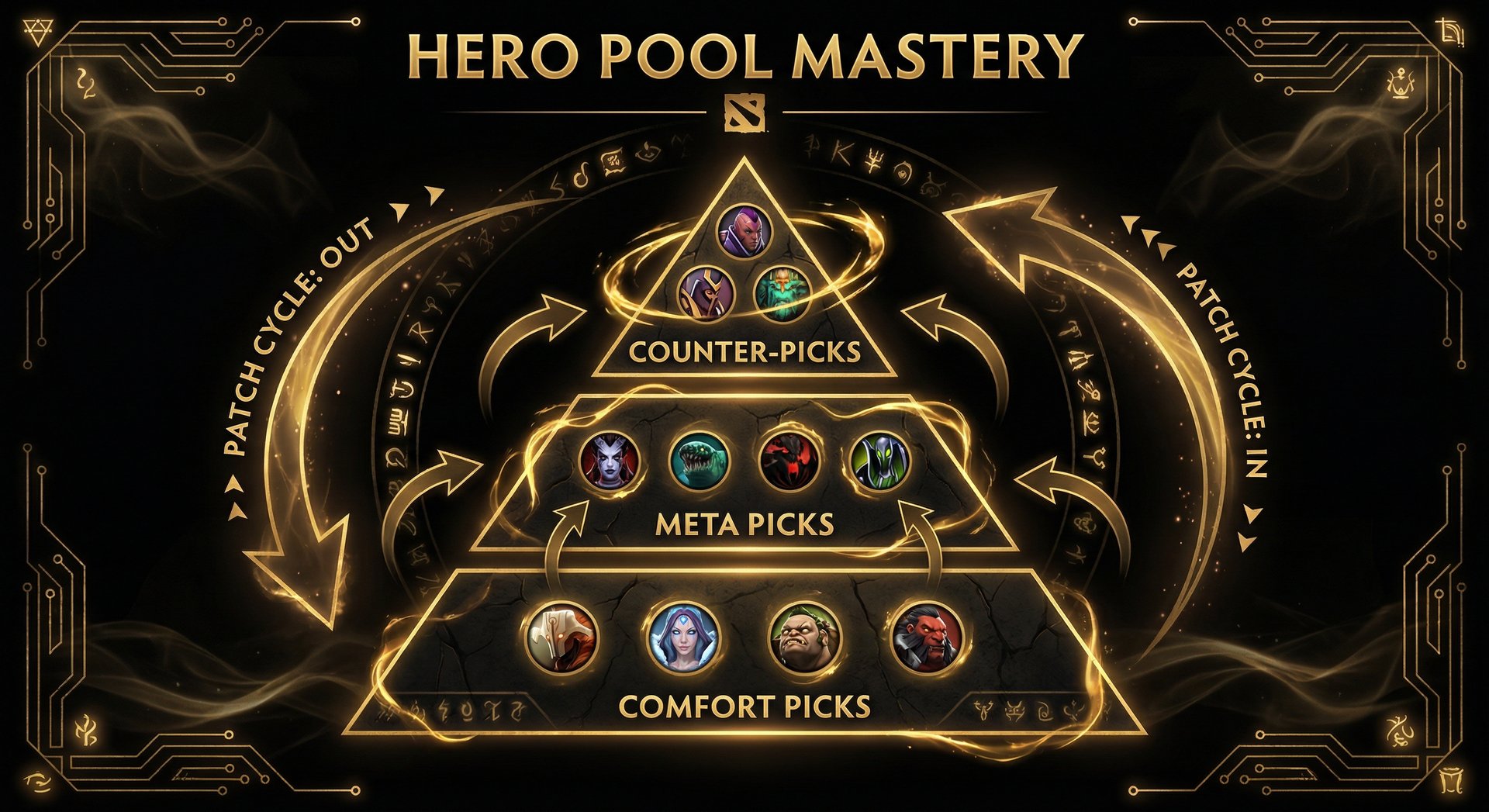
- 2-3 “comfort” heroes: Heroes you know inside out, regardless of meta. These are your go-to picks that you can perform well with even when they’re not optimal. Comfort heroes provide consistency.
- 1-2 “meta” heroes: Heroes that are currently strong in the patch. These rotate with each update. Adding 1-2 meta heroes to your pool gives you access to overtuned picks without abandoning your comfort zone.
- 1 “counter” hero: A hero that specifically counters the most popular meta pick. If the meta is dominated by Huskar, having an Ancient Apparition or Viper in your pool gives you a free win in specific games.
When to Add a Hero to Your Pool
Add a hero to your pool when:
- The hero receives significant buffs (Tier 2+ changes as described above)
- The hero’s core items get buffed
- The hero’s main counters get nerfed
- Professional players start prioritizing the hero in competitive play
- The hero’s win rate increases by 2%+ across all brackets
When to Remove a Hero from Your Pool
Remove a hero (or deprioritize it) when:
- The hero receives significant nerfs, especially to their core abilities
- The hero’s core items get nerfed
- New counter-heroes or items are introduced that specifically target the hero
- The hero’s win rate drops below 48% across brackets
- The hero becomes a popular ban target (meaning you rarely get to play it anyway)
The Danger of “Flavor of the Month” Heroes
Be cautious about jumping on “flavor of the month” heroes — heroes that become extremely popular after a patch but that you have no experience with. Playing a 55% win rate hero at 50% of your skill level doesn’t help your MMR. It’s better to play a 50% win rate hero at 100% of your skill level.
The exception is when a hero is so obviously overpowered that even mediocre play produces wins. This happens occasionally — when Valve over-buffs a hero or introduces a broken interaction. In these cases, spam the hero before the inevitable nerf.
Hero Pool by MMR Bracket
| Bracket | Recommended Pool Size | Strategy |
|---|---|---|
| Herald-Guardian | 2-3 heroes | Focus on simple, forgiving heroes. Meta doesn’t matter much — fundamentals win games. |
| Crusader-Archon | 3-5 heroes | Start adding meta heroes. Learn 1-2 counter-picks for popular heroes. |
| Legend-Ancient | 5-8 heroes | Meta awareness becomes important. Adapt pool with each major patch. |
| Divine-Immortal | 5-10 heroes | Deep understanding of matchups required. Meta exploitation is a key climbing tool. |
If you’re struggling to identify the right heroes for your bracket and playstyle, our coaching service includes hero pool recommendations based on your MMR, play history, and strengths. A coach can analyze your dotabuff profile and suggest heroes that match your tendencies.
Historical Impactful Patches
Looking back at the most impactful patches in Dota 2 history helps us understand how dramatic meta shifts can be and what types of changes produce the biggest effects. Here are the patches that defined eras of Dota 2.
Patch 7.00 — The New Journey (December 2016)
Arguably the most significant patch in Dota 2 history, 7.00 introduced:
- Talent Trees: Every hero received unique talents at levels 10, 15, 20, and 25, adding a new dimension to hero progression and build diversity
- Backpack Slots: Three additional inventory slots for item storage (items on cooldown when moved from backpack)
- Map Rework: Significant map changes including new pathways, altered jungle layouts, and Shrine buildings
- HUD Redesign: Completely new user interface
7.00 fundamentally changed how Dota 2 was played. Talent trees added meaningful choices at each level threshold. Backpack slots altered itemization strategy. The map rework changed every farming pattern and gank route. Players who adapted quickly to 7.00 gained a massive advantage over those who resisted the changes.
Patch 7.07 — Dueling Fates (October 2017)
- Introduced Pangolier and Dark Willow (two new heroes)
- Massive item reworks including Meteor Hammer, Spirit Vessel, and Aeon Disk
- Significant talent tree adjustments across the entire hero roster
- Turbo Mode introduction
Patch 7.20 — The Big One (November 2018)
- Near-total hero rework patch with 25+ heroes receiving ability reworks
- Deny mechanics changed to give deniers gold
- Multiple item reworks and new items (Kaya, Ring of Tarrasque combos)
- Armor formula change from 6% per point to a more complex calculation
7.20 was so dramatic that many players called it “Dota 3.” The sheer volume of changes meant that effectively every hero was different. Win rates fluctuated wildly for weeks. Players who invested time understanding the changes reaped enormous MMR gains.
Patch 7.23 — Outlanders (November 2019)
- Introduced Neutral Items — items that drop from neutral creeps with tier-based timing
- Outpost buildings added to the map
- Courier changes — each player gets their own courier
- Side shops removed
- New heroes: Void Spirit and Snapfire
Neutral Items were the most controversial addition in Dota 2 history, with many players arguing they added too much randomness. Regardless of opinion, neutral items fundamentally changed itemization, hero power curves, and late-game dynamics.
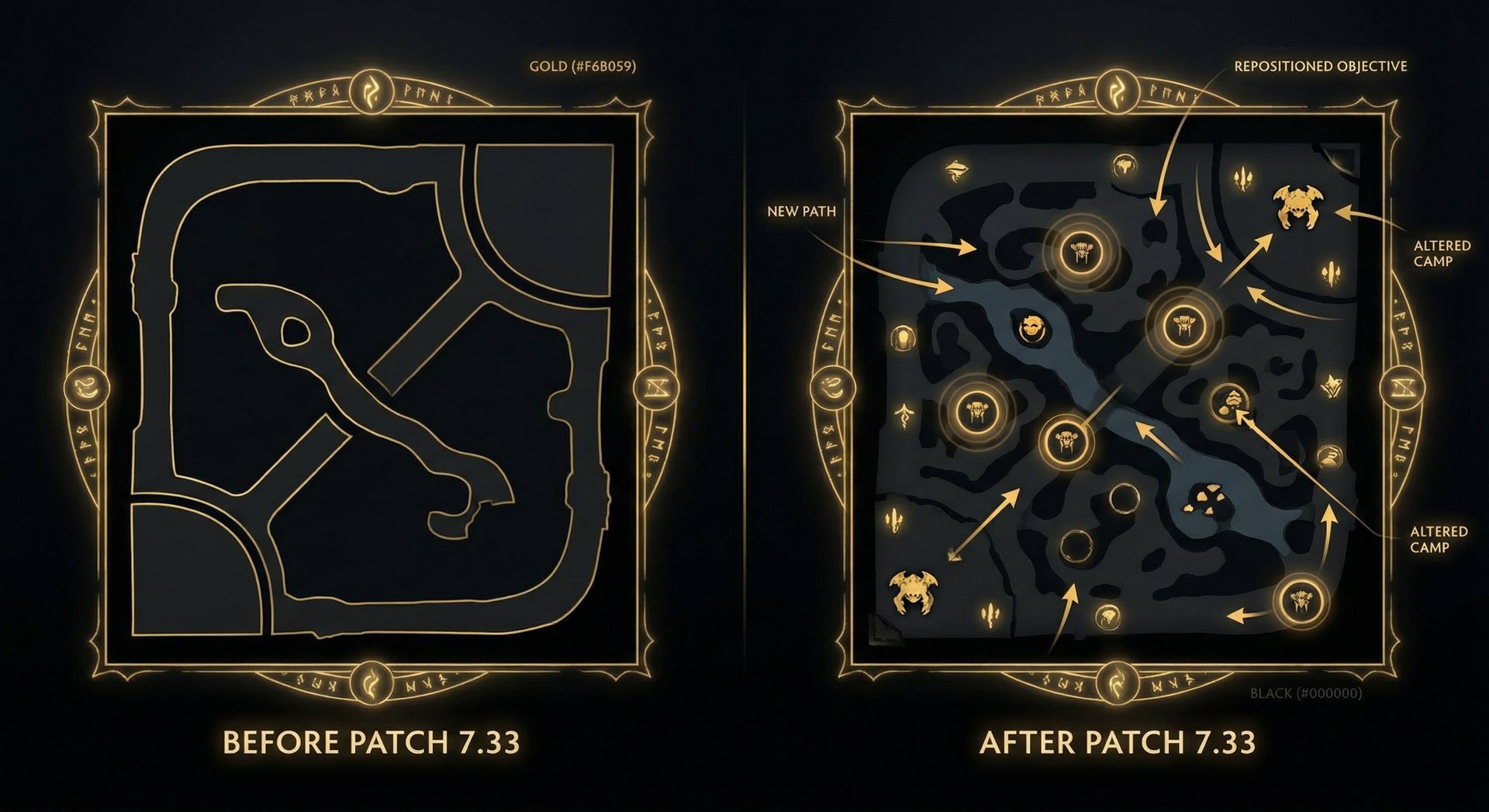
Patch 7.33 — New Frontiers (April 2023)
- Massive map expansion — largest map in Dota 2 history
- Twin Gate teleporters on the edges of the map
- Tormentor boss monsters
- Watchers providing vision
- Universal heroes class introduced
- Significant rework to numerous heroes’ attribute types
New Frontiers changed the physical layout of Dota 2 so dramatically that even veteran players felt like they were learning a new game. The expanded map altered farming patterns, warding strategies, and team fight locations. Heroes reclassified as “Universal” (gaining damage from all attributes) were fundamentally changed in how they scaled.
Lessons from Historical Patches
Several patterns emerge from these landmark patches:
- The biggest patches create the biggest climbing opportunities. When everything changes, the players who adapt fastest gain the most MMR.
- System changes (neutral items, talents, map reworks) are more impactful than individual hero changes. System changes affect every game; hero changes only affect games where that hero is picked.
- The meta takes 2-4 weeks to stabilize after major patches. The first two weeks are the wild west — anything goes.
- Overreaction is common. Community reaction to patches is often extreme. “Dota is dead” posts appear after every major change. They’re always wrong.
Patch Day Strategy: How to Exploit New Metas
When a new patch drops, here’s a step-by-step strategy for maximizing your MMR gain during the transition period.
Day 1: Read and Analyze
- Read the full patch notes — don’t skim
- Identify the biggest winners (heroes that received multiple buffs, heroes whose counters were nerfed)
- Identify the biggest losers (heavily nerfed heroes, heroes whose core items were changed)
- Check item changes and their ripple effects
- Note general/map changes that affect gameplay
Days 2-3: Test in Unranked
- Play 3-5 unranked games testing the biggest “winner” heroes
- Experiment with new item builds and ability builds
- Get familiar with any map changes or mechanical differences
- Identify which of the “winner” heroes feel good to play
Days 4-14: Exploit in Ranked
- Pick the strongest “winner” heroes in ranked
- Most opponents won’t have adapted yet — you have an information advantage
- Counter-pick the heroes that people are still playing from the old meta (which were nerfed)
- Expect higher win rates during this window
Weeks 3-4: Refine
- The meta is stabilizing — switch from exploitation to optimization
- Refine your builds based on what you’ve learned
- Add counter-picks for the emerging meta heroes
- Watch pro streams and tournaments to see how the best players are adapting
Months 2+: Master
- The meta is established — focus on mastering the current state
- Deep-dive into specific hero matchups and item builds
- Focus on fundamentals rather than meta exploitation
- Wait for the next patch to repeat the cycle
This cyclical approach to patches is how the most consistent MMR climbers operate. They don’t just play Dota — they study it.
Types of Patch Changes and Their Impact
Let’s break down the specific types of changes you’ll encounter in patch notes and how to evaluate their significance.
Base Stat Changes
Base stat changes (strength, agility, intelligence, base damage, base armor, movement speed) affect a hero’s fundamental performance:
- Base damage ±3: Affects last hitting in lane. A +3 base damage buff on a hero with 50 base damage is a 6% increase — meaningful for laning but minimal in fights.
- Base armor ±1: Approximately 6% more/less physical damage resistance. Significant for laning but decreasingly important as the game progresses.
- Movement speed ±10: Affects everything — chasing, escaping, farming efficiency, rotation speed. Movement speed changes are always significant.
- Stat gain per level ±0.3: Affects scaling. More strength gain means tankier late game. More agility gain means faster attack speed. These changes compound over 30 levels.
Ability Changes
Ability changes range from minor number tweaks to complete reworks:
- Damage ±20-50: Affects farming speed, kill potential, and harass. More significant on early-game abilities than late-game scaling abilities.
- Cooldown ±1-5s: Cooldown is one of the most impactful stats. A -2s cooldown on a 10s ability means you can cast it 20% more often — that’s a massive buff in sustained fights.
- Mana cost ±20-40: Affects sustainability and number of casts per mana pool. Mana cost reductions are most impactful for heroes with small mana pools (strength heroes).
- Cast range ±100-200: Affects safety and initiation potential. Range buffs are always good because they let you contribute from safer positions.
- Duration ±0.5-1s: Stun duration changes are among the most impactful. +0.5s on a 2s stun is a 25% increase in lockdown time.
Item Changes
Item changes have the widest-reaching effects because multiple heroes buy the same items:
- Recipe cost ±100-300: Changes the timing window for completing the item. A -200 gold recipe cost might mean getting the item 1-2 minutes earlier — significant for timing-based heroes.
- Stat changes: Affect every hero who builds the item. If Assault Cuirass loses 5 armor, every AC carrier is slightly weaker.
- New build paths: When an item’s components change, it can alter the entire build order for heroes who buy it.
- Reworks: Complete item reworks (new abilities, changed purpose) force the community to reevaluate item builds from scratch.
Reading Between the Lines
Experienced Dota 2 players don’t just read what the patch notes say — they read what they imply. Here’s how to extract deeper meaning from patch notes.
Identifying Valve’s Balance Philosophy
Valve’s balance team (primarily IceFrog) has consistent patterns:
- Nerf the most popular, not necessarily the strongest: Heroes with high pick rates get nerfed even if their win rate is average, because they’re “crowding out” other heroes.
- Buff forgotten heroes gradually: Underplayed heroes receive small buffs over multiple patches until they become viable. Watch for heroes that have received buffs in 2-3 consecutive patches — they’re being pushed into the meta.
- Rework rather than over-nerf: When a hero is fundamentally problematic, Valve prefers to rework their abilities rather than nerf them into uselessness. Reworks are opportunities for heroes to become meta-defining.
- Create diversity through item changes: When the meta gets stale, item changes are used to shake things up without dramatically altering hero balance.
Predicting the Next Meta
After reading patch notes, try to predict the new meta before playing. Ask yourself:
- Which heroes are the biggest winners (These will define the meta)
- What strategies do those heroes enable (Push, late-game, teamfight, etc.)
- What heroes counter the predicted meta heroes (These will rise as counter-picks)
- What items are stronger/weaker (This affects hero viability indirectly)
Your predictions won’t always be right, but the exercise of thinking through meta implications improves your understanding of Dota 2 at a systems level. This analytical mindset is what separates good players from great ones — and it’s a key focus of our coaching service.
Tracking Win Rate Changes After Patches
Use data tracking sites like Dotabuff, OpenDota, or Stratz to monitor win rate changes after patches. Here’s what to look for:
| Win Rate Change | Interpretation | Action |
|---|---|---|
| +3% or more | Hero is significantly stronger | Consider adding to your pool |
| +1-3% | Hero is somewhat stronger | Worth trying if it fits your playstyle |
| ±1% | Negligible change | No action needed |
| -1-3% | Hero is somewhat weaker | Deprioritize but don’t abandon if you’re good at it |
| -3% or more | Hero is significantly weaker | Consider removing from your pool |
Important caveat: win rate data in the first week after a patch is unreliable due to small sample sizes and experimentation. Wait 1-2 weeks for data to stabilize before making pool changes based on win rates.
Patch Adaptation by Role
Different roles are affected differently by patches. Here’s how each role should approach patch adaptation.
Position 1 (Carry)
Carries are most affected by item changes and farming mechanic changes. A carry player should prioritize reading item changes and economy adjustments. If farming items get cheaper (Battle Fury, Maelstrom), farming carries become stronger. If fighting items get buffed (BKB, Satanic), fighting carries become stronger. Adjust your hero picks accordingly.
Position 2 (Mid)
Mid laners are affected by mid-lane-specific changes (creep behavior, rune spawns, tower stats) and by the heroes that counter or enable them. Mid players should pay special attention to power rune changes, lane creep changes, and any adjustments to the mid lane geography.
Position 3 (Offlane)
Offlaners are affected by lane equilibrium changes, offlane-specific map adjustments, and utility item changes. If team-fight items (Pipe, Crimson Guard, Mekansm) get buffed, team-fight offlaners become stronger. If initiation items (Blink, Force Staff) get buffed, initiating offlaners benefit.
Position 4/5 (Supports)
Supports are most affected by ward changes, economy changes (bounty runes, passive gold), and support-specific item changes (Glimmer Cape, Force Staff, Aether Lens). Supports should also pay close attention to any changes that affect roaming, stacking, or pulling — these are the mechanics that define support play. Our calibration service accounts for current meta when performing calibration matches, ensuring optimal results on current patch.
Frequently Asked Questions
Conclusion: Patches Are Opportunities, Not Obstacles
Every Dota 2 patch is an opportunity disguised as disruption. While most players complain about changes, struggle to adapt, and lose MMR during transition periods, the informed player treats patches as a climbing tool. By understanding how to read patch notes, identifying the biggest winners and losers, adapting your hero pool, and exploiting the meta during the chaos phase, you can gain hundreds of MMR points that would take months of grinding to achieve otherwise.
The key mindset shift is viewing patches not as inconveniences but as information advantages. Every player has access to the same patch notes — but not every player reads them, analyzes them, or acts on them with purpose. Be the player who does, and the MMR will follow.
If you want expert guidance on navigating the current meta, our coaching service includes patch-specific sessions where Immortal-rank players break down the current meta, recommend hero pools, and analyze your games in the context of the latest balance changes. Climbing has never been more accessible — you just need to know where to look.
Ready to Climb Start Your Boost Today
Team Smurf is the #1 rated Dota 2 boosting service. Immortal-rank boosters, maximum safety, competitive pricing, 24/7 support.
Written by Team Smurf’s Immortal-rank analysts — Last verified February 2026