Dota 2 Draft Guide: How to Pick and Counter-Pick Like a Professional

In Dota 2, the battle often begins long before the first creep wave meets in lane. The drafting phase is where games are won and lost at every skill bracket–from Crusader pubs to The International grand finals. A well-executed draft can give your team a 10-15% win-rate advantage before a single spell is cast, while a poorly constructed lineup can leave you feeling helpless from minute zero.
Yet most players treat the draft as an afterthought. They instalock their favorite hero regardless of what the enemy picks, ignore banning opportunities, and never consider how their five heroes work together as a cohesive unit. If that sounds familiar, this guide is going to change the way you approach every single ranked game.
We’ve compiled insights from 8,000+ MMR players, professional drafting coaches, and our own team of boosters at TeamSmurf’s MMR Boosting service to create the most comprehensive Dota 2 drafting guide available. Whether you’re looking to climb from Guardian to Legend or push into Immortal, mastering the draft is one of the fastest ways to gain MMR.
Table of Contents
- Understanding the Draft Phases
- First Pick vs. Second Pick: Advantages and Strategies
- The Counter-Picking Matrix: How to Neutralize Enemy Heroes
- Flex Picks: The Secret Weapon of High-MMR Drafts
- Banning Strategy: Removing Threats Before They Appear
- Draft Archetypes: Building a Cohesive Game Plan
- Role-Based Drafting: What Each Position Should Prioritize
- Common Drafting Mistakes That Cost MMR
- Drafting in Ranked All Pick: Practical Tips
- Frequently Asked Questions
Understanding the Draft Phases
Before we dive into advanced strategy, you need to understand how the draft works in both Ranked All Pick and Captain’s Mode. While most pub players only experience All Pick, understanding Captain’s Mode principles will dramatically improve your drafting intuition.
Ranked All Pick Structure
In Ranked All Pick, the draft unfolds in alternating phases:
- Ban Phase: Each player nominates one hero for banning. Each nominated hero has a 50% chance of being banned. In higher MMR brackets, coordinated bans become incredibly powerful.
- Pick Phase 1: Teams alternate picks. The team that picks first is randomly determined. Each phase gives you a limited window to select your hero.
- Pick Phase 2: Remaining players pick their heroes in alternating order.
The critical insight most players miss: pick order matters enormously. Heroes picked early are visible to the enemy team, allowing counter-picks. Heroes picked late can be tailored to exploit weaknesses in the enemy lineup. This is why position 4 and 5 supports typically pick first, while mid and carry players pick last.
Captain’s Mode Structure
Captain’s Mode follows a more structured format used in professional and competitive play:
| Phase | Action | Team | Strategic Purpose |
|---|---|---|---|
| 1 | Ban | Both (2 each) | Remove top-tier or comfort picks |
| 2 | Pick | First Pick (1), Second Pick (2) | Secure contested/flex heroes |
| 3 | Ban | Both (2 each) | Target counter-picks and synergies |
| 4 | Pick | Second Pick (1), First Pick (2) | Build core lineup |
| 5 | Ban | Both (1 each) | Remove final counters |
| 6 | Pick | Both (1 each) | Last pick advantage–counter or complete lineup |
Even in All Pick, thinking about your draft in these terms–what information am I revealing, and what can I exploit from what the enemy has revealed–is the key to drafting intelligently.
The Information Game
Drafting is fundamentally an information asymmetry game. Every pick you make reveals information to your opponent. Every pick they make reveals information to you. The player who leverages this information better wins the draft.
This is why our Dota 2 coaching service emphasizes drafting as one of the first skills to develop. A coach can help you see draft patterns and counter-pick opportunities that aren’t obvious until someone points them out.
First Pick vs. Second Pick: Advantages and Strategies
The age-old debate in Dota 2 drafting: is it better to pick first or second The answer is nuanced and depends on the current meta, your team’s hero pool, and your bracket.
Advantages of First Pick
- Secure the most overpowered hero: In every patch, certain heroes sit at 55%+ win rates. First pick guarantees you get the most broken hero in the meta before it’s contested.
- Force the enemy to react: When you first-pick a strong, versatile hero, the enemy team must spend mental energy figuring out how to deal with it rather than executing their own game plan.
- Comfort pick security: If your mid player has an 80% win rate on a specific hero, first-picking it removes the risk of it being countered or stolen.
Advantages of Second Pick (Last Pick)
- Counter-pick the enemy core: Seeing the enemy’s carry or mid before making your final pick is enormously powerful. A hard counter in the mid lane can single-handedly win games.
- Complete your lineup with perfect synergy: Your last pick can fill whatever gap your team composition has–whether that’s initiation, save, wave clear, or physical/magical damage balance.
- Psychological advantage: The last-pick player knows exactly what they’re facing. There’s no guesswork.
First Pick Strategy by Bracket
| Bracket | Best First Pick Strategy | Reasoning |
|---|---|---|
| Herald–Guardian | Pick the highest win-rate hero | Counter-picking barely matters; raw hero power dominates |
| Crusader–Archon | Pick strong, hard-to-counter heroes | Players are beginning to counter but still inconsistent |
| Legend–Ancient | Pick flex heroes or contested supports | Counter-picking is common; flexibility is key |
| Divine–Immortal | Pick flex heroes that don’t reveal your lanes | Every pick is analyzed; lane assignments are fluid |
Heroes That Are Safe First Picks
Certain heroes are considered “safe” first picks because they have few hard counters, work in multiple roles, or are strong regardless of the enemy lineup:
- Marci: Can play position 1, 3, 4, or 5. Extremely versatile with strong laning and teamfight presence. Enemies can’t reliably counter her because they don’t know where she’s going.
- Pangolier: Playable as mid, offlane, or even position 4. His Rolling Thunder makes him relevant at every stage, and his counters (instant stuns, silences) are so general that they don’t force specific picks.
- Nature’s Prophet: A flex between offlane, mid, and support that can adapt to any playstyle–split push, teamfight, or global gank presence.
- Vengeful Spirit: Viable as position 2, 3, 4, or 5 with vastly different item builds. Provides aura, save, stun, and damage reduction regardless of role.
The Counter-Picking Matrix: How to Neutralize Enemy Heroes
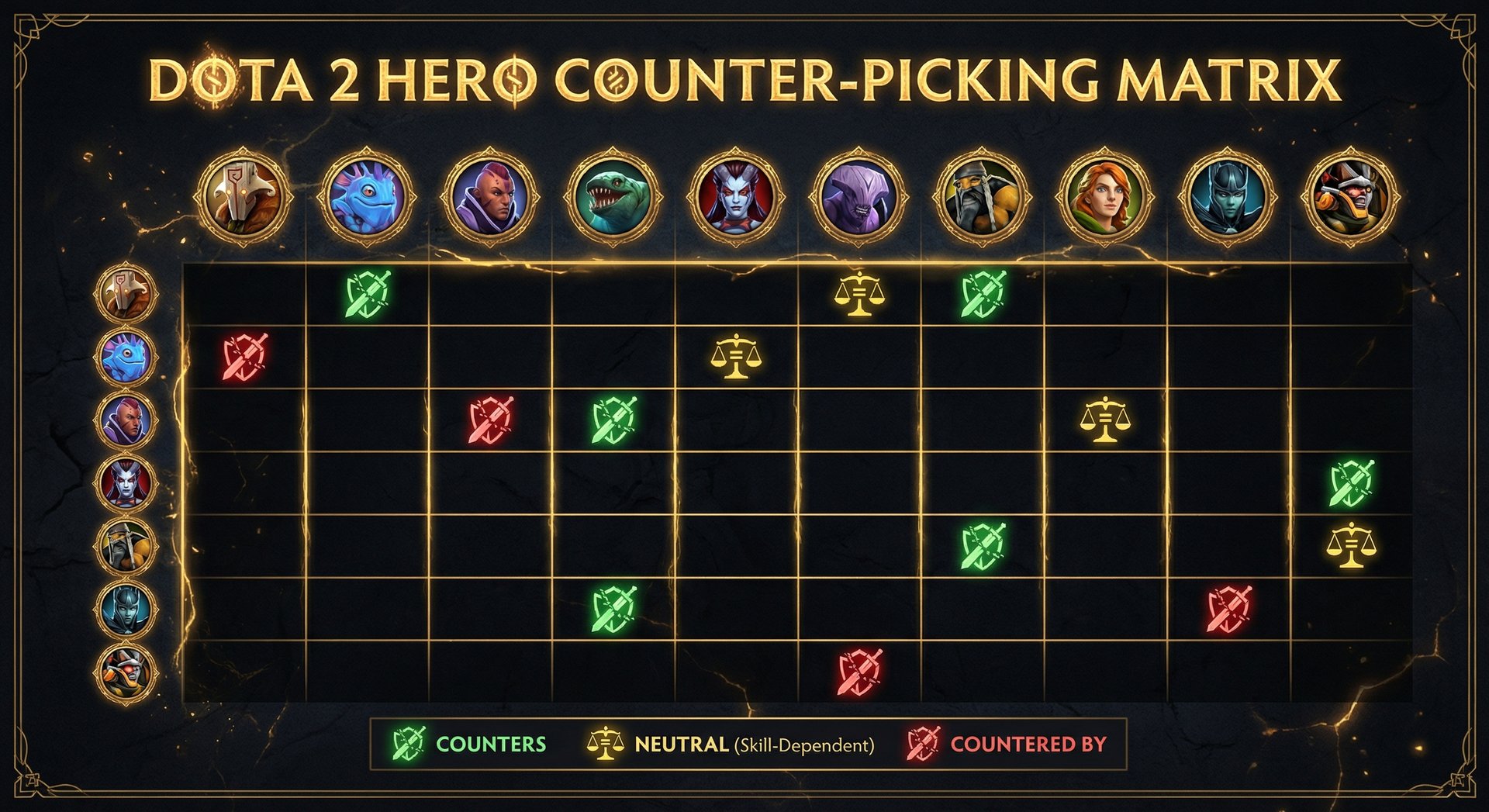
Counter-picking is the art of selecting heroes that mechanically or strategically neutralize what the enemy wants to do. This is where games are won in the draft, and it’s a skill that separates average players from those climbing rapidly through the ranks.
Types of Counters
Not all counters are created equal. Understanding the different types helps you evaluate how strong a counter-pick really is:
1. Hard Counters (Mechanical)
These are heroes whose abilities directly negate or punish a specific enemy hero’s kit. Hard counters typically give you a 5-15% win-rate swing in the matchup.
- Anti-Mage vs. Medusa: Mana Break and Mana Void directly target Medusa’s mana shield, her primary survivability mechanism.
- Ancient Apparition vs. Huskar/Alchemist: Ice Blast prevents all healing and regeneration, completely negating these heroes’ core survival strategies.
- Phantom Lancer vs. Earthshaker: Wait–this is actually the reverse. Earthshaker’s Echo Slam devastates illusion-based heroes. PL players dread seeing ES on the enemy team.
- Razor vs. most melee carries: Static Link drains damage from heroes who need to stay close to farm or fight, making traditional right-click carries feel useless in lane.
2. Soft Counters (Strategic)
These heroes don’t mechanically negate the enemy but create strategic problems that make their game plan much harder to execute.
- Nature’s Prophet vs. passive farming carries: NP punishes any team that wants to play slowly by constantly pressuring towers and forcing rotations.
- Spirit Breaker vs. greedy junglers: Charge of Darkness punishes heroes who want to farm alone in the jungle, and his global presence creates constant anxiety.
- Clockwerk vs. squishy backline heroes: Hookshot + Power Cogs isolates supports and squishy carries who rely on positioning to stay safe.
3. Tempo Counters
Some heroes counter others not through direct mechanical interaction but by exploiting timing windows.
- Huskar vs. late-game carries: Huskar wants to end the game by 25-30 minutes, before heroes like Spectre or Medusa come online. He “counters” them by making the game irrelevant for them.
- Broodmother vs. teams without AoE: If the enemy drafts all single-target damage, Brood’s spiderlings create an unstoppable push that ends games before the enemy can respond.
Counter-Picking Matrix for Common Pub Heroes
| Enemy Hero | Strong Counters | Why It Works |
|---|---|---|
| Phantom Assassin | Axe, Silver Edge carriers, MKB builders | Axe’s Counter Helix ignores evasion; break disables Blur; MKB pierces evasion |
| Huskar | Ancient Apparition, Timbersaw, Necrophos | AA stops healing, Timber deals pure damage, Necro’s Reaper ignores magic resistance |
| Broodmother | Earthshaker, Axe, Legion Commander | AoE abilities destroy spiderlings; LC gets massive Duel damage from killing spiders |
| Meepo | Winter Wyvern, Earthshaker, Ember Spirit | Wyvern’s ult makes clones kill each other; ES Echo Slam; Ember’s Sleight/Chains |
| Tinker | Spirit Breaker, Clockwerk, Storm Spirit | Global/long-range gap closers punish Tinker’s reliance on blinking to trees |
| Anti-Mage | Faceless Void, Bloodseeker, Disruptor | Chrono catches through Blink; Rupture punishes Blink; Glimpse catches split-pushers |
| Invoker | Nyx Assassin, Pugna, Silencer | Nyx’s Mana Burn scales with INT; Pugna’s Decrepify + Nether Ward; Global Silence |
| Medusa | Anti-Mage, Nyx Assassin, Diffusal carriers | Mana burn pierces Mana Shield’s effectiveness |
How to Counter-Pick in Real Time
Knowing counters on paper is one thing. Applying them in the heat of the draft is another. Here’s a practical framework:
- Identify the enemy’s win condition: Is their carry a late-game monster Is their mid a tempo hero Do they want to push early
- Choose the counter type that matches your team’s needs: Don’t just pick a hard counter to one hero if it ruins your team’s overall composition.
- Prioritize countering the enemy’s highest-impact hero: Countering the enemy mid or carry is usually more valuable than countering their position 5.
- Consider whether the counter works in YOUR role: If you’re position 5, picking Anti-Mage to counter Medusa doesn’t work. Pick within your role.
If you’re struggling to identify counter-picks in real-time, our coaching sessions include live draft analysis where a high-MMR player walks you through the decision-making process during actual games.
Flex Picks: The Secret Weapon of High-MMR Drafts
Flex picks are heroes that can be played in multiple roles or positions, making it impossible for the enemy to know your lane assignments based on the pick alone. This is the single most important drafting concept in high-level Dota 2.
Why Flex Picks Are So Powerful
When you pick Lina, for example, the enemy team has to consider:
- Is she going mid (Position 2)
- Is she playing carry (Position 1)
- Is she supporting (Position 4/5)
Each of these roles has different counters. A mid Lina is countered differently than a support Lina. By keeping the assignment ambiguous, you prevent the enemy from efficiently counter-picking.
Top Flex Picks by Versatility
| Hero | Viable Positions | Flex Rating (1-10) | Notes |
|---|---|---|---|
| Vengeful Spirit | 2, 3, 4, 5 | 9 | Completely different builds per role; aura always valuable |
| Mirana | 1, 2, 3, 4 | 9 | Arrow/Leap core kit works everywhere; ult is always game-changing |
| Marci | 1, 3, 4, 5 | 9 | Strong laner in every role; scales with or without farm |
| Lina | 1, 2, 4, 5 | 8 | High damage output regardless of farm; stun always useful |
| Pangolier | 2, 3, 4 | 8 | Rolling Thunder is role-independent; strong at all stages |
| Nature’s Prophet | 2, 3, 4, 5 | 8 | Global presence; adapts playstyle completely per role |
| Windranger | 2, 3, 4 | 7 | Shackle is always strong; Focus Fire scales with items or utility |
| Weaver | 1, 3, 4 | 7 | Aghs save is powerful support option; traditional carry also viable |
Using Flex Picks in Your Draft
The ideal drafting sequence using flex picks:
- Picks 1-2: Select flex heroes that can go to multiple lanes. This reveals minimal information.
- Wait for the enemy to commit: Once the enemy reveals their core heroes and likely lane assignments…
- Picks 3-5: Now assign your flex heroes to their optimal positions and fill remaining roles with targeted picks.
For example, your team picks Mirana and Marci in the first phase. The enemy sees this and doesn’t know your lanes at all. They pick Phantom Assassin carry and Invoker mid. Now you know:
- Mirana goes mid to pressure Invoker with arrows and burst.
- Marci goes position 4 to roam and create space.
- Your remaining picks can target PA specifically–maybe an Axe offlane and a Razor carry.
Banning Strategy: Removing Threats Before They Appear
Most pub players waste their bans. They either ban whatever tilted them last game or randomly select a hero they find annoying. Strategic banning is a skill that pays dividends every single game.
The Four Banning Philosophies
1. Meta Banning
Ban the statistically strongest heroes in the current patch. Check Dotabuff or OpenDota for current win rates and pick rates. Heroes with both high win rates AND high pick rates are prime ban targets.
2. Comfort Banning
Ban heroes that you or your team struggle against, regardless of their overall power level. If your entire team tilts when facing a Techies, banning Techies has psychological value even if it’s not meta.
3. Synergy Disruption
If the enemy first-picks a hero that has a well-known power combo, ban the partner. For example, if they pick Magnus, consider banning Ember Spirit, Juggernaut, or other heroes that benefit enormously from Empower and Reverse Polarity.
4. Self-Protection Banning
If you know what you want to pick, ban its hardest counter. Planning to play Meepo mid Ban Winter Wyvern. Going Broodmother Ban Earthshaker.
Banning Priorities by Phase
In Captain’s Mode, bans happen in three phases. Here’s what to prioritize in each:
| Ban Phase | Priority | Examples |
|---|---|---|
| First Bans (4 total) | Remove overpowered meta heroes and heroes you never want to face | Ban the hero with the highest win rate in your bracket; ban combo enablers |
| Second Bans (4 total) | Target specific counters to your already-picked heroes | If you’ve picked Huskar, ban Ancient Apparition; if you’ve drafted illusion heroes, ban Earthshaker |
| Final Bans (2 total) | Remove the last-pick counter that would destroy your lineup | Ban the one hero that completes the enemy’s draft perfectly |
Coordinated Banning in Ranked All Pick
In All Pick, each player’s ban has only a 50% chance of going through. But if multiple players ban the same hero, the probability increases. Before the game starts, communicate with your team:
- “I’m playing Huskar mid. Can someone else also ban AA”
- “Let’s all ban [broken hero of the patch] to guarantee it’s removed.”
This simple communication is something you’ll observe our boosters at TeamSmurf do consistently–it’s one of those small habits that adds up to significant MMR over time.
Draft Archetypes: Building a Cohesive Game Plan
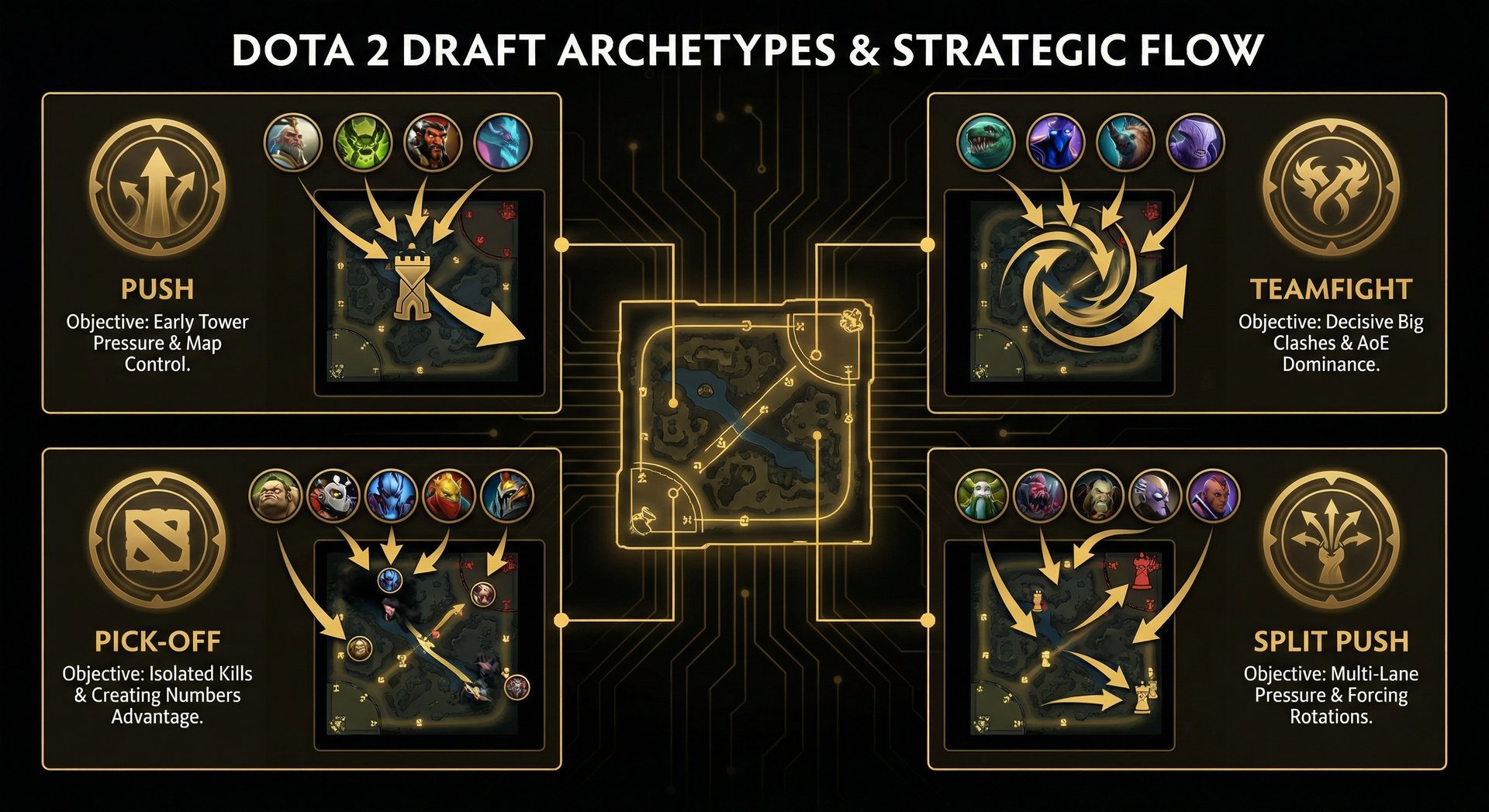
Individual hero picks matter, but the overall draft archetype determines your team’s win condition. Every game of Dota 2 should have a plan, and that plan is established in the draft.
Archetype 1: Push / Deathball
Win condition: Group up early, take towers, snowball into a 25-30 minute victory.
Key characteristics:
- Strong early/mid-game heroes that peak before 30 minutes
- Summons, auras, and abilities that damage buildings quickly
- Heroes that fight well under towers without needing full items
Example lineup: Lone Druid (carry), Death Prophet (mid), Beastmaster (offlane), Shadow Shaman (pos 4), Chen (pos 5)
How it wins: This lineup can take Roshan at 15-20 minutes, then push high ground with massive summon damage. Every tower kill accelerates the gold lead, making the team progressively harder to stop.
How it loses: If the enemy has strong high-ground defense (Tinker, Sniper, Techies) or can stall until 40+ minutes, the push lineup’s heroes fall off dramatically.
Counters to push: Wave-clear heroes (Tinker, Keeper of the Light), strong defensive ultimates (Underlord, Naga Siren), and heroes that punish grouping (Earthshaker, Enigma).
Archetype 2: Teamfight / 5v5
Win condition: Win decisive teamfights using powerful ability combinations, then take objectives off won fights.
Key characteristics:
- Multiple AoE stuns, damage, and control abilities
- Wombo-combo potential (abilities that chain together)
- Heroes that are stronger when grouped than when alone
Example lineup: Juggernaut (carry), Invoker (mid), Magnus (offlane), Enigma (pos 4), Warlock (pos 5)
How it wins: Reverse Polarity → Black Hole → Chaotic Offering → Meteor → Omnislash. One good teamfight ends the game. The threat of this combo forces the enemy to play scared and split up, which creates space for Juggernaut to farm.
How it loses: If the enemy avoids 5v5 fights and instead split-pushes, ganks isolated heroes, or drafts long-range poke that prevents initiation. Also vulnerable to Black King Bar timing–many wombo combos are countered when BKBs are fresh.
Archetype 3: Pick-Off / Gank
Win condition: Kill isolated heroes repeatedly, maintain map control through fear, snowball the advantage into objectives.
Key characteristics:
- High single-target burst damage
- Heroes with catch (stuns, slows, gap closers)
- Strong vision and scouting abilities
- Mobile heroes that can rotate quickly
Example lineup: Slark (carry), Storm Spirit (mid), Batrider (offlane), Spirit Breaker (pos 4), Bounty Hunter (pos 5)
How it wins: The team sets up deep wards, smokes, and constantly hunts. Bounty Hunter tracks targets for bonus gold, Spirit Breaker charges from across the map, Batrider lassos key heroes. The enemy can never farm safely. For a deeper dive into the movement and vision skills needed to execute this archetype, check out our coaching service–aggressive map play is one of the hardest skills to develop alone.
How it loses: If the enemy groups as five and forces fights, the pick-off lineup struggles in 5v5 because it lacks AoE damage and control. Also countered by strong save supports (Oracle, Dazzle) who can keep gank targets alive.
Archetype 4: Split Push / Rat
Win condition: Avoid direct fights, pressure multiple lanes simultaneously, and force the enemy to make impossible choices about where to defend.
Key characteristics:
- Heroes that push lanes quickly and escape easily
- Global or semi-global abilities
- Illusion heroes that can pressure lanes without risking the real hero
- Heroes that are hard to catch
Example lineup: Naga Siren (carry), Tinker (mid), Nature’s Prophet (offlane), io (pos 4), Keeper of the Light (pos 5)
How it wins: Naga sends illusions to push multiple lanes. Nature’s Prophet teleports to undefended towers. Tinker pushes one lane with March of the Machines then Travels to another. The enemy literally cannot defend everything, and their team slowly loses buildings while never getting a real fight.
How it loses: Heroes with strong wave clear can handle the split push. Aggressive teams that force fights early can end the game before the split-push lineup comes online. Heroes with long-range catch (Spirit Breaker, Storm Spirit) can punish isolated split-pushers.
Hybrid Archetypes
In practice, most drafts are hybrids. The best lineups have a primary game plan with a secondary fallback. For example:
- Teamfight + Push: Win a fight, then push immediately with summon/aura heroes. This is the most common archetype in competitive Dota 2.
- Pick-off + Split Push: Gank heroes to create number advantages, then use that advantage to push lanes safely.
- Push + Teamfight: Push as five, and if the enemy tries to defend, win the teamfight under their tower.
Role-Based Drafting: What Each Position Should Prioritize
Understanding what each role contributes to the draft is essential for well-rounded lineups.
Position 5 (Hard Support)
Typically picks first. Should prioritize:
- Strong laning to protect the carry
- Abilities that scale without items (heals, stuns, saves)
- Heroes that aren’t easily countered
Examples: Crystal Maiden, Witch Doctor, Jakiro, Shadow Shaman
Position 4 (Soft Support)
Usually picks second. Should prioritize:
- Playmaking potential and roaming ability
- Synergy with the offlaner for kill threat
- Heroes that can transition to semi-core with some farm
Examples: Earth Spirit, Tusk, Hoodwink, Rubick
Position 3 (Offlane)
Picks in the middle phase. Should prioritize:
- Frontline durability and initiation
- Auras and team utility items (Pipe, Crimson Guard, Vladmir’s)
- Heroes that create space regardless of farm
Examples: Axe, Tidehunter, Underlord, Mars
Position 1 (Carry) and Position 2 (Mid)
Should pick last whenever possible. Should prioritize:
- Counter-picking the enemy core or avoiding being countered
- Completing the team’s damage profile (physical vs. magical balance)
- Ensuring the team has a viable late-game win condition
If you’re a carry or mid player who consistently picks early and gets countered, you’re costing your team a significant amount of MMR. Many players who come to us for an MMR boost have this exact habit–and breaking it is one of the fastest ways to start climbing on your own.
Common Drafting Mistakes That Cost MMR
After analyzing thousands of games across all brackets, here are the most frequent drafting errors we see:
1. All Physical or All Magical Damage
If your entire team deals physical damage, the enemy buys one Assault Cuirass and your damage is halved. If your entire team is magical, a few BKBs make you useless. Always ensure damage type diversity.
2. No Stuns or Catch
A lineup of Drow Ranger, Sniper, Zeus, Pugna, and Jakiro has plenty of damage but almost no hard lockdown. Mobile heroes like Storm Spirit and Anti-Mage will destroy this team because they can never be caught. Aim for at least 2-3 reliable stuns in every lineup.
3. Five Greedy Heroes
When every hero needs significant farm to function, there isn’t enough gold on the map to support everyone. Lineups with five late-game heroes will be dominated in the early and mid-game. Balance greed with early-game strength.
4. Ignoring Lane Matchups
You can have a perfect overall team composition, but if your lanes are all losing matchups, you’ll be 10,000 gold behind before the teamfight phase even begins. Win at least two of three lanes in the draft.
5. Comfort Over Counter
Yes, playing your best hero is important. But if you’re last-pick carry and your best hero is hard-countered, picking it anyway because “I’m good at it” is a drafting error. Have a hero pool of at least 3-4 heroes per role.
6. Tunnel-Vision Counter-Picking
The opposite extreme is also harmful. Picking a hero solely because it counters one enemy hero, even though it has zero synergy with your own team, is a recipe for a disjointed lineup that falls apart in actual gameplay.
7. Not Considering Timings
If all five of your heroes peak at 35-40 minutes, and the enemy has a 20-minute push lineup, you’ll never reach your power spike. Ensure your draft has meaningful power spikes at multiple time windows.
Drafting in Ranked All Pick: Practical Tips
All the theory above is useless unless you can apply it in the chaotic environment of ranked matchmaking. Here are actionable tips:
Pre-Game Communication
- Call your role early: Use the role queue system and communicate your top hero picks in chat.
- Discuss bans: “I want to play X, can we ban Y” This one sentence can change the entire game.
- Coordinate pick order: Ask who’s comfortable picking early vs. who needs to pick late.
The 30-Second Decision Framework
When it’s your turn to pick and you have 30 seconds, use this framework:
- Seconds 1-10: What did the enemy pick What are their likely lanes
- Seconds 10-20: What does my team need (Stun Push Save Damage type)
- Seconds 20-30: What hero do I play well that fills this role and isn’t hard-countered
Building Your Counter-Pick Cheat Sheet
Create a document (or bookmark Dotabuff’s counter page) listing your top 5 heroes and their 3 hardest counters. Before every game, glance at what the enemy picked and cross-reference. Over time, this becomes second nature.
When to Abandon Your Plan
Sometimes the draft doesn’t go as planned. Maybe your intended pick was stolen. Maybe the enemy banned your comfort hero. In these moments:
- Don’t panic-pick a hero you don’t know.
- Fall back to a reliable hero that fits the team composition, even if it’s not optimal.
- A hero you’re comfortable with at 90% effectiveness beats a “perfect” counter you’ve played three times.
Cross-Referencing Your Draft with Other Skills
Drafting doesn’t exist in a vacuum. It interacts with every other skill in Dota 2:
- Itemization: Your draft determines what items you need to build. A team with no natural BKB-piercers needs items that provide control. Check out our guide to climbing MMR through better game sense for more on how draft and itemization connect.
- Map awareness: Push drafts need aggressive ward placement; split-push drafts need defensive vision. Your draft archetype should influence your vision game.
- Teamfighting: A pick-off draft should avoid 5v5 fights. A teamfight draft should force them. Your draft literally tells you how to play the mid and late game.
If you’re finding that your drafts look good on paper but you’re struggling to execute the game plan, consider a coaching session where we can analyze not just what you pick, but how you play after the draft.
Frequently Asked Questions
Conclusion: Win Games Before They Start
The draft is the first battle of every Dota 2 game, and it’s one of the only battles where information and planning matter more than reaction time and mechanical skill. By understanding draft phases, mastering counter-picks, leveraging flex heroes, banning strategically, and building cohesive team compositions, you can enter every game with a meaningful advantage.
Remember: you don’t need to master every concept in this guide overnight. Start by simply paying more attention during the picking phase. Think about what the enemy has picked, what your team needs, and how the heroes interact. Over time, these considerations become automatic, and you’ll find yourself climbing without even realizing it.
If you want to accelerate your improvement, consider our coaching service for personalized draft analysis, or check out our MMR calibration service to start your ranked journey from the best possible position. And if you’re stuck in a bracket that doesn’t reflect your true skill, our MMR boosting can help you reach the rank where drafting starts to truly matter.
Good drafting isn’t just about knowing which hero beats which. It’s about having a plan, communicating with your team, and making every pick count toward a unified game strategy. Master this, and you’ll find that many of your games feel won before the horn even sounds.
Ready to Climb Start Your Boost Today
Team Smurf is the #1 rated Dota 2 boosting service. Immortal-rank boosters, maximum safety, competitive pricing, 24/7 support.
Written by Team Smurf’s Immortal-rank analysts — Last verified February 2026