Dota 2 Low Priority Explained: Everything You Need to Know

Few things in gaming inspire as much dread as seeing that notification: “You have been placed in the Low Priority matchmaking pool.” Dota 2’s Low Priority (LP) system is the game’s most severe in-game punishment short of an outright ban, and for good reason — it’s designed to be unpleasant enough to deter the behavior that put you there in the first place.
But what exactly is Low Priority How does it work How did you end up here, and more importantly, how do you get out This comprehensive guide covers everything about the Low Priority system in 2026 — from the mechanics that trigger it to the strategies that will get you out as quickly as possible. Whether you’re currently stuck in LP, worried about ending up there, or just curious about one of Dota 2’s most infamous systems, this guide has you covered.
Table of Contents
- What Is Low Priority?
- How You End Up in Low Priority
- Low Priority Mechanics: Rules and Restrictions
- The Psychology of Low Priority
- How to Get Out of Low Priority
- Best Heroes for Winning LP Games
- Advanced Strategies for LP Survival
- How to Avoid Low Priority in the Future
- Low Priority and Behavior Score: The Connection
- When It Makes Sense to Get Professional Help
- Frequently Asked Questions
What Is Low Priority?
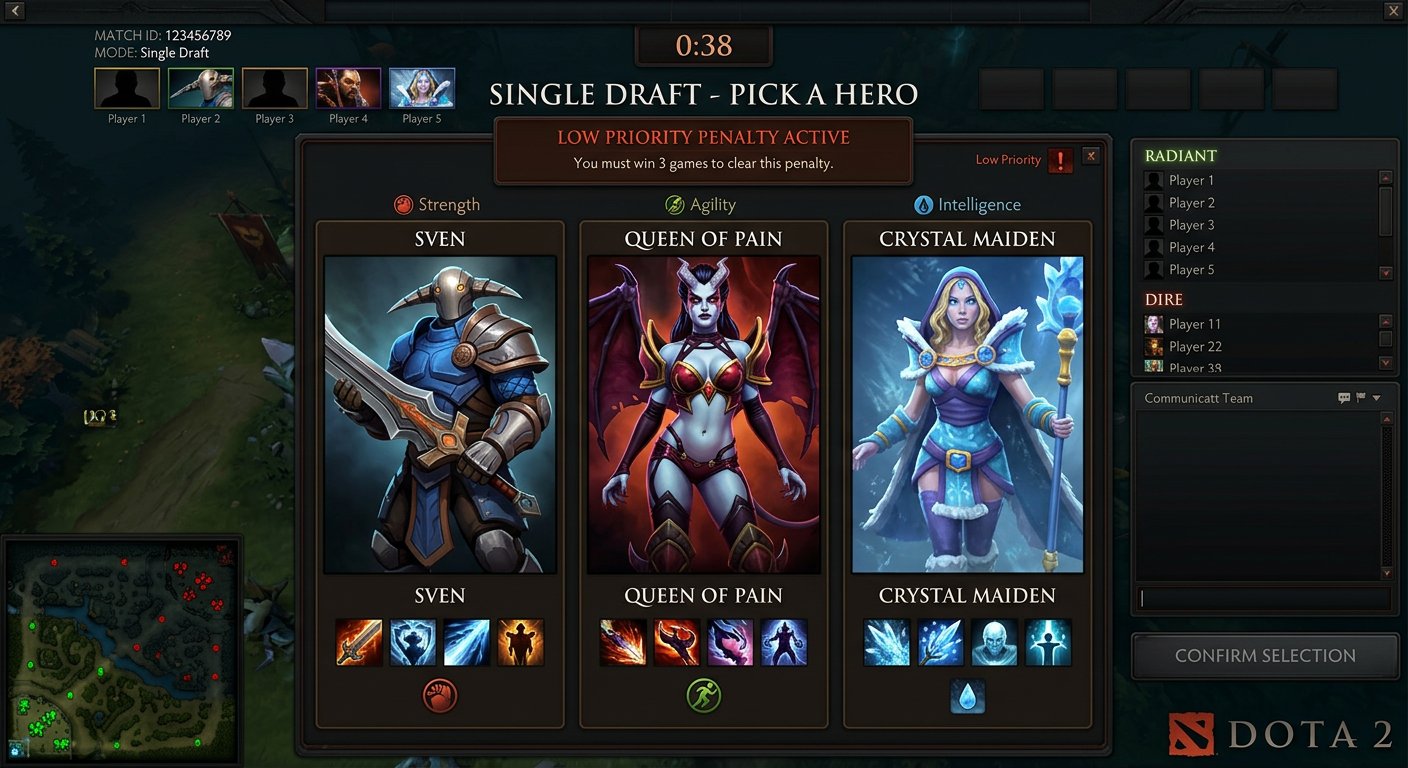
Low Priority is a separate matchmaking pool in Dota 2 that serves as a punishment queue for players who have repeatedly abandoned games, been reported excessively, or been convicted through the Overwatch system. When placed in LP, you are temporarily removed from the normal matchmaking pool and must win a set number of games in a restricted game mode — Single Draft — before being allowed to return to normal play.
The system was implemented early in Dota 2’s life and has undergone significant changes over the years:
- Original system (2013-2015): LP required playing (not necessarily winning) a set number of games in All Random mode. This was widely abused — players would queue, pick a hero, walk down mid and die repeatedly to end the game as fast as possible.
- Win requirement (2015+): Valve changed LP to require winning a specific number of games, making it impossible to simply throw your way through the punishment.
- Single Draft (2016+): The forced game mode was changed from All Random to Single Draft, giving players some agency in their hero selection while still restricting choices.
- Overwatch integration (2021+): LP assignments became more tied to Overwatch convictions, reducing the impact of false mass-reporting and improving accuracy.
- Current system (2024-2026): LP integrates with the broader behavior system including Behavior Score, Overwatch, and communication penalties to create a tiered punishment framework.
The key thing to understand about LP is that it’s not just a queue — it’s an experience. The players in LP are overwhelmingly there because they’ve exhibited toxic behavior, which means the games themselves are often chaotic, hostile, and deeply unpleasant. This is by design — the experience is supposed to make you reconsider the behavior that got you there.
How You End Up in Low Priority
Understanding exactly what triggers LP placement is crucial for both avoiding it and understanding the system’s logic. There are three primary paths to Low Priority:
1. Abandoning Games
This is the most straightforward path to LP. Abandoning means leaving a game before it’s finished, which can happen through:
- Disconnecting and not reconnecting within 5 minutes
- Manually leaving the game (clicking Disconnect)
- Being AFK for too long (the game’s AFK detection triggers after several minutes of no inputs including no experience gain)
- Failing to load into the game after accepting a match
Your first abandon in a period doesn’t immediately send you to LP — Valve understands that genuine disconnections happen. The system works on a rolling window, and the threshold is approximately 2-3 abandons within a 20-25 game window. However, this threshold decreases for repeat offenders. If you’ve been in LP recently, even a single abandon might send you back.
2. Excessive Reports
Being reported by a large number of unique players within a conduct summary window can trigger LP placement. This typically requires reports across multiple separate games — getting reported by all four teammates in one bad game usually isn’t enough on its own, but getting reported in 4-5 different games within a window likely will be.
Important nuances about report-triggered LP:
- Multiple reports from the same game count as a single report
- Party reports (4-stack reporting the solo player) carry reduced weight
- Reports from players who report excessively carry less weight
- Communication abuse reports alone typically don’t trigger LP (they trigger mutes instead)
- Gameplay/feeding reports are the primary LP triggers from the report system
3. Overwatch Convictions
Being found guilty through the Overwatch review system can result in LP placement, especially for intentional feeding or ability abuse verdicts. Overwatch convictions carry more weight than standard reports because they’ve been verified by community reviewers.
A single severe Overwatch conviction (e.g., clear intentional feeding throughout a game) can result in immediate LP placement even without other recent infractions.
The Escalation System
LP punishments escalate with repeated offenses. Here’s the general progression:
| Offense Number | LP Games Required | Additional Penalties |
|---|---|---|
| First LP (in recent history) | 1-3 wins | Behavior Score reduction |
| Second LP (within ~month) | 3-5 wins | Larger BS reduction, possible communication ban |
| Third LP (within ~month) | 5 wins | Significant BS reduction, extended communication ban |
| Repeated LP (chronic offender) | 5 wins | Potential matchmaking ban (hours to days), severe BS reduction |
The escalation system means that your first LP experience is relatively mild — win a game or two and you’re out. But chronic LP visitors face 5-win requirements that, given the chaotic nature of LP games, can take 10-20+ attempts to complete.
Low Priority Mechanics: Rules and Restrictions
When you’re in LP, several restrictions apply to your account:
Game Mode: Single Draft Only
All LP games are played in Single Draft mode, where each player is offered a random selection of three heroes — one from each primary attribute (Strength, Agility, Intelligence/Universal). This prevents players from spamming their best heroes and adds an element of unpredictability that makes the games harder to control.
No Ranked Matchmaking
You cannot queue for ranked matches while in LP. This includes all ranked modes — All Pick, Captain’s Mode, and role queue. Your ranked journey is completely paused until you clear your LP games.
No Battle Pass Progress
LP games don’t count toward Battle Pass challenges, daily hero challenges, or quest progress. Any in-game progression systems are effectively frozen while you’re in LP.
No Dropping/Trading Items
Some item-related features may be restricted during LP, though this varies and has changed over the years.
Win Requirement
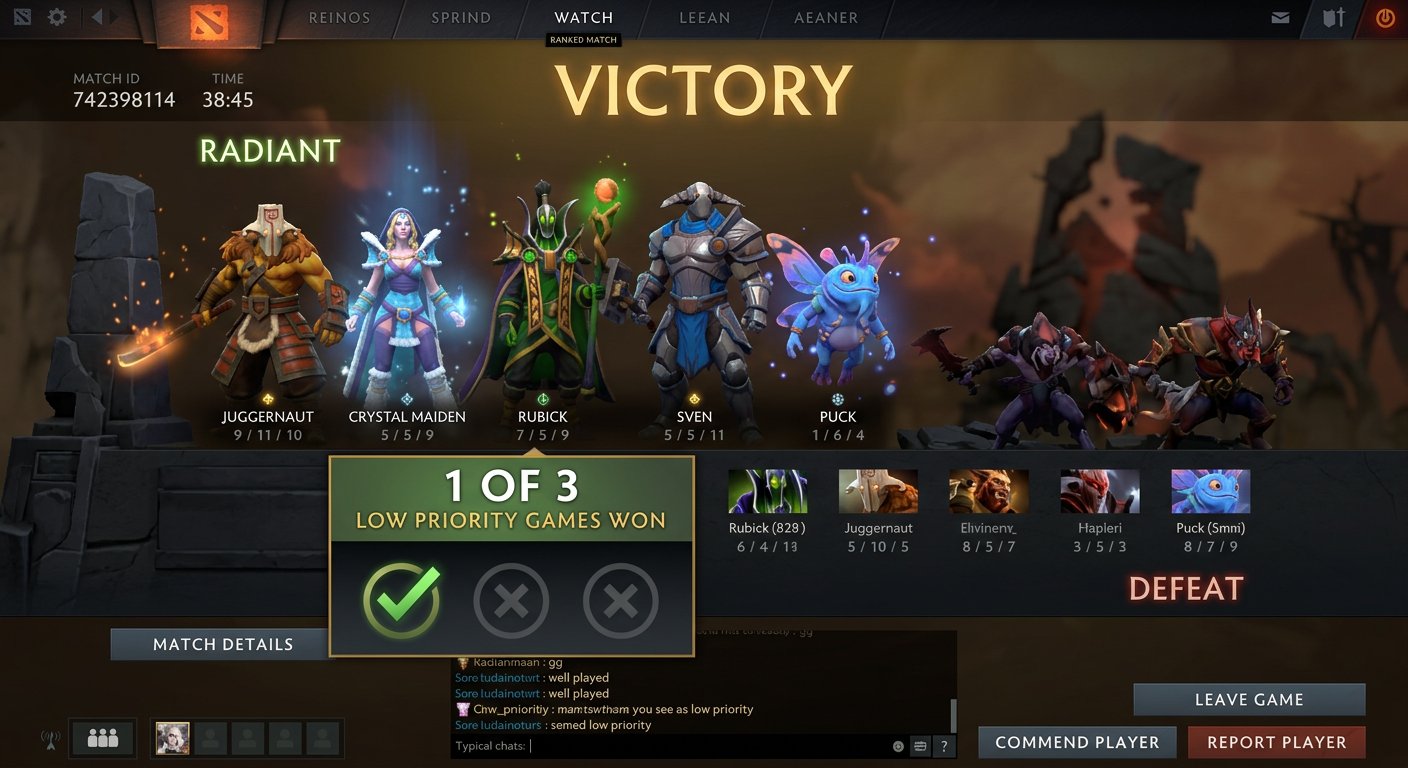
You must win the specified number of games. Losses don’t count toward your progress. This is what makes LP so time-consuming — in a pool full of players who are there because they grief and abandon, getting a win can require multiple attempts. It’s not uncommon for players to play 3-4 games for every 1 win, meaning a 5-win LP sentence might require 15-20 games to clear.
Queue Restrictions
While in LP, you can still party with friends, but anyone who queues with a LP player will also be placed in the LP matchmaking pool for that game. This means your friends are sharing your punishment if they choose to play with you — which can actually be helpful since having reliable teammates increases your win rate significantly.
No Coaching or Spectating
LP games cannot be coached (through the in-game coaching system) and have limited spectating options. These are small restrictions but add to the isolation of the experience.
The Psychology of Low Priority
Understanding the psychology of LP games is crucial for surviving them. The LP player pool has a unique psychological profile that affects every aspect of the game.
Who’s In Low Priority
The LP population breaks down into several categories:
- The Tilted Regular (~30-40%): Normal players who went on a bad streak, raged in a few games, and got enough reports to land in LP. These are usually your best teammates — they want to get out quickly and will try to play properly.
- The Chronic Abandoner (~20-25%): Players with unstable internet, real-life interruptions, or a habit of rage-quitting. They’re less toxic than flamers but have a non-trivial chance of abandoning your LP game, which wastes everyone’s time.
- The Griefer (~15-20%): Players who actively enjoy ruining games. They’re in LP because they genuinely grief, and being in LP hasn’t changed that behavior. They may still intentionally feed, steal roles, or destroy items.
- The Innocent (~10-15%): Players who ended up in LP through bad luck — a series of power outages, a string of false reports from party stacks, etc. They’re often the most frustrated players in the pool.
- The Smurfs/Boosters (~5-10%): High-skill players on alt accounts who landed in LP, or players whose accounts are being recovered by professional services. These players dramatically outclass the average LP player.
The Emotional Landscape
LP games are emotionally volatile because virtually every player is already frustrated before the game begins. They’re frustrated about being in LP, frustrated about previous games, and frustrated about the restriction on their account. This creates a tinderbox where even minor in-game setbacks can trigger extreme reactions.
Common emotional patterns in LP:
- Minute 0-5: Cautious optimism. Players pick heroes and lane relatively normally, hoping this will be the game they win.
- Minute 5-15: The tipping point. If the game goes well, morale holds. If it goes poorly, this is when the first player breaks — intentionally feeding, going AFK in jungle, or flaming in all chat.
- Minute 15-25: Cascading failure or resilience. Either the team holds together and pushes for a win, or multiple players give up and the game becomes a formality.
- Minute 25+: Survival mode. In LP games that go late, anything can happen because one team fight can end the game, and demoralized players can be rallied by a single good play.
Why LP Games Feel Different
Beyond the psychological factors, LP games genuinely play differently because of Single Draft. Players are forced onto unfamiliar heroes, which creates:
- More mistakes and misplays, leading to more one-sided lanes
- Less coordinated team compositions (no strategic drafting)
- More snowballing — when one team gets ahead, the disadvantaged team is less equipped to come back with unfamiliar heroes
- More chaotic team fights where players don’t fully understand their abilities’ interactions
How to Get Out of Low Priority
Getting out of LP requires a specific mindset and approach. Here’s a comprehensive strategy:
The Fundamental Rule: Win Your Lane
In LP, team coordination is unreliable. You cannot count on your teammates to rotate, ward, or make strategic decisions. The single most important thing you can do is win your lane decisively so that you’re strong enough to carry the game even if 1-2 teammates are performing poorly or actively griefing.
This means:
- Choosing the strongest hero from your three Single Draft options
- Taking a core position (mid or safe lane carry) whenever possible
- Focusing on last hits and denies to build an economic advantage
- Playing conservatively — don’t die to ganks, don’t overextend, don’t take unnecessary risks
Step-by-Step LP Exit Strategy
Step 1: Mental Reset
Before queueing for LP, take a break. Get a drink, stretch, clear your head. Going into LP already tilted is a recipe for disaster. Remind yourself that this is a temporary problem with a clear solution — win X games — and that every game brings you one step closer.
Step 2: Assess Your Draft Options
In Single Draft, you get one Strength, one Agility, and one Intelligence/Universal hero. Quickly evaluate:
- Which hero can I play most comfortably
- Which hero is strongest in the current meta
- Which hero can solo-carry if my team falls apart
- Which hero has the most self-sufficiency (farming speed, survivability, solo kill potential)
Step 3: Communicate Positively (or Not at All)
In LP, communication is a double-edged sword. Positive communication can rally your team, but any negativity will immediately trigger defensive hostility from teammates who are already on edge. Two valid approaches:
- Positive leader: Call plays, compliment good moves, suggest objectives. This works if you’re confident and the team is receptive.
- Silent carry: Mute everyone, play your game, win through superior play. This works if you’re mechanically skilled and prefer to avoid the emotional chaos.
Step 4: Focus on Objectives
LP games often devolve into aimless farming and random fights. Be the player who pushes the game toward a conclusion. After winning a fight, take a tower. After Roshan, push high ground. LP games that go past 40 minutes become increasingly volatile — end them as quickly as possible.
Step 5: Party Up If Possible
Having even one reliable friend in your LP games dramatically increases your win rate. If you can get a 2-3 stack, you have majority control over the team’s composition and strategy. Yes, your friends will play in the LP pool too, but for many players, that’s a small price to pay for faster LP completion.
Best Heroes for Winning LP Games
Since you’re limited to Single Draft, you can’t guarantee these heroes. But when they appear in your options, prioritize them:
Tier 1: Solo-Carry Powerhouses
| Hero | Role | Why They Dominate LP |
|---|---|---|
| Huskar | Mid/Carry | Dominates lane, snowballs hard, can end games by 25 minutes, punishes uncoordinated teams |
| Broodmother | Offlane/Mid | Creates immense pressure, hard to deal with without coordination, takes towers rapidly |
| Lycan | Offlane/Mid | Fastest tower-taker in the game, can end before the enemy team’s chaos materializes |
| Meepo | Mid | If you can play him, he overwhelms disorganized teams with map presence and farm speed |
| Templar Assassin | Mid | Dominates mid, takes Roshan early, pushes objectives quickly |
Tier 2: Reliable Self-Sufficient Picks
| Hero | Role | Why They Work in LP |
|---|---|---|
| Juggernaut | Carry | Self-sufficient with Healing Ward, Blade Fury for escape, solo kill potential with Omnislash |
| Wraith King | Carry | Hard to kill (two lives), simple to play, strong at all stages of the game |
| Necrophos | Mid/Offlane | Tanky, sustain-heavy, Reaper’s Scythe removes problem enemies for extended periods |
| Bloodseeker | Mid/Carry | Thrives in chaotic fighting environments (Thirst triggers constantly), strong laner |
| Clinkz | Mid/Carry | Invisible ganking, takes towers with Searing Arrows, hard to pin down |
Heroes to Avoid in LP
- Hard supports (CM, Shadow Shaman, Witch Doctor): You can’t rely on your carry to capitalize on your setup
- Team-dependent heroes (Io, Chen, Oracle): Their strength comes from synergy with competent teammates
- Late-game heroes (Spectre, Medusa, Anti-Mage): LP games are too volatile to farm for 30 minutes safely
- Complex heroes you’re not comfortable with: LP is not the time to learn a new hero
Advanced Strategies for LP Survival
The Timing Window Strategy
LP queue times vary dramatically by time of day and region. The best times to queue for LP are:
- Weekday afternoons (2-6 PM local): The LP pool is smaller, meaning you’re more likely to get matched with the “tilted regulars” who are trying to get out, rather than chronic griefers
- Avoid late night (midnight-4 AM): The late-night LP pool is dominated by the most extreme offenders and is the most toxic
- Weekend mornings: Decent window with a mix of players trying to clear LP before their weekend gaming sessions
The Anti-Grief Protocol
When a teammate starts griefing in your LP game, you have limited options. Here’s how to maximize your chances:
- Don’t engage. Don’t respond to their all-chat, don’t argue, don’t flame. Any attention fuels the behavior.
- Adjust your strategy. If your mid is feeding, take over mid farm when they abandon the lane. If your carry is griefing, transition to a carry build yourself.
- Play 4v6. Treat the griefer as a non-factor and focus on winning 4v5. It’s harder but not impossible, especially if the enemy team has their own griefer (which is common in LP).
- Capitalize on enemy griefing. Watch for signs that an enemy player is giving up. Push objectives immediately when you notice enemy team dysfunction.
The Item Build Approach
In LP games, your item builds should prioritize self-sufficiency over team coordination:
- BKB is essential on almost every core hero — you need to survive chaotic team fights where your team may not protect you
- Lifesteal/sustain items let you stay on the map without relying on supports for healing
- Split-push items (Boots of Travel, Shadow Blade, Blink Dagger) let you create pressure independently
- Avoid aura items that primarily benefit your team — invest in your own damage and survivability
How to Avoid Low Priority in the Future
Prevention is infinitely better than cure when it comes to LP. Here’s how to stay out permanently:
Technical Preparation
- Stable internet: If your connection drops frequently, use a wired connection instead of WiFi. Consider a backup mobile hotspot for emergencies.
- Power protection: Use a UPS (uninterruptible power supply) if power outages are common in your area. Even 10 minutes of battery backup is enough to finish most games or reconnect after a brief outage.
- System stability: Keep your drivers updated, run Dota 2 with adequate cooling, and close unnecessary background programs that might cause crashes.
- Time management: Don’t queue for a game if you have an appointment in 45 minutes. Dota games can last 60+ minutes, and leaving early is an abandon.
Behavioral Preparation
- Set a loss limit: Decide before you start playing how many games you’ll play if you’re losing. Two losses in a row Take a break. Three Stop for the day. Tilt accumulates across games.
- Mute proactively: If a teammate starts being negative in the first few minutes, mute them immediately. Don’t wait to see if they’ll get worse — they will.
- Never type in anger: If you feel the urge to type something toxic, close the chat. Walk to the kitchen. Get water. Come back. The urge will pass, and you’ll still have your Behavior Score.
- Report sparingly: Ironically, players who report frequently often end up with lower Behavior Scores themselves, partly because excessive reporting is correlated with other toxic behaviors.
The Two-Game Rule
A powerful mental framework: after every game, ask yourself “Am I emotionally ready for the next game” If there’s any doubt, stop. Come back later. Dota will be there tomorrow, but LP can take days to escape.
Low Priority and Behavior Score: The Connection
Low Priority and Behavior Score are deeply intertwined but separate systems. Understanding their relationship is critical:
- LP is triggered by Behavior Score thresholds: When your Behavior Score drops to certain levels (usually below ~4,000-5,000) and you accumulate reports or abandons, LP becomes increasingly likely.
- Being in LP further damages Behavior Score: Even if you play perfectly in LP, your score recovers very slowly. And if you get reported in LP (which is common even for good players), recovery stalls or reverses.
- Exiting LP doesn’t fix Behavior Score: Winning your LP games and returning to normal matchmaking doesn’t magically restore your BS. You’ll still be in the low BS bracket, which means lower-quality teammates, which means more frustration, which means more risk of landing back in LP.
This creates what the community calls the “LP cycle” — a self-reinforcing loop where LP damages BS, low BS creates toxic games, toxic games lead to reports or tilt-driven abandons, and those send you back to LP. Breaking this cycle requires either extraordinary patience and discipline, or outside help.
This is where services like professional LP removal provide their most significant value — not just getting you out of LP, but doing so with clean play that begins rebuilding your Behavior Score simultaneously. And once your BS is recovering, maintaining it becomes much easier because you’re matched with better teammates in the normal queue.
When It Makes Sense to Get Professional Help
LP is designed to be escapable through self-effort, and most players who end up there once can get out and learn from the experience. But there are scenarios where professional assistance becomes the practical choice:
Scenario 1: Deep LP + Low Behavior Score
If you’re looking at 5 LP wins required and your Behavior Score is below 3,000, you’re facing potentially 30+ games of LP followed by dozens more games of toxic normal matchmaking before things improve. For an adult with a job and limited gaming time, this could mean weeks of miserable experiences. Professional LP removal can resolve this in a fraction of the time.
Scenario 2: Technical Issues That Caused LP
If you ended up in LP because of ISP problems, power outages, or computer issues that you’ve since resolved, the punishment feels particularly unjust. Getting professional help to clear the LP and start fresh is a rational response.
Scenario 3: MMR Has Also Suffered
Low Behavior Score and LP often come alongside MMR decline — bad teammates and tilted play take a toll on your rank. If both your LP status and MMR need recovery, combining LP removal with an MMR boost addresses both problems simultaneously.
Scenario 4: The LP Cycle
If you’ve been in and out of LP multiple times and can’t seem to break the pattern, the underlying issue might be one of habit or mindset. In this case, professional coaching combined with LP removal can address both the immediate problem (getting out of LP) and the root cause (the behavior patterns that put you there). A coach can help you develop the mental frameworks and communication habits that keep you out of LP permanently.
Scenario 5: New Season Approaching
If a new Dota 2 season is about to start and you’re stuck in LP, you’ll miss your calibration games or play them with terrible Behavior Score, resulting in poor placement. Getting LP cleared before the season starts ensures you can calibrate with a clean slate.
Frequently Asked Questions
Ready to Improve Your Dota 2 Experience
Team Smurf offers professional Dota 2 services — Immortal-rank boosters, maximum safety, competitive pricing, and 24/7 support.