How to Recover from a Losing Streak in Dota 2: The Complete Mental Reset Guide

You’ve lost five games in a row. Your MMR has dropped 150 points. Every game feels rigged–terrible teammates, impossible enemy drafts, unlucky fights. You queue again anyway, determined to “win back” what you lost. And you lose again. Sound familiar
Losing streaks are the single most destructive force in a Dota 2 player’s ranked journey. Not because the losses themselves are catastrophic–150 MMR can be recovered in a couple of good sessions–but because of what losing streaks do to your mental state. Tilt, frustration, desperation, and ego-driven decision-making turn a 3-game losing streak into a 10-game catastrophe.
This guide isn’t just about “stop tilting.” It’s a comprehensive framework for understanding the psychology behind losing streaks, implementing concrete strategies to break them, using replay analysis productively (instead of as a blame exercise), developing queue discipline, adjusting your hero pool for recovery, and addressing the physical and mental health factors that most players completely ignore.
Every player loses streaks–including our professional boosters at TeamSmurf. The difference isn’t that they never lose; it’s that they know how to recognize, manage, and recover from losing phases systematically. This guide teaches you their framework.
Table of Contents
- The Psychology of Tilt: Why Losing Streaks Happen
- Recognizing Tilt Before It Destroys Your MMR
- Break Strategies: When and How to Step Away
- The Mental Reset Protocol
- Replay Analysis During Losing Streaks
- Queue Discipline: Rules for When to Play Ranked
- Hero Pool Adjustment During Recovery
- Physical and Mental Health Factors
- The Long-Term Mindset: Thinking in Seasons, Not Sessions
- Frequently Asked Questions
The Psychology of Tilt: Why Losing Streaks Happen
Before you can fix a losing streak, you need to understand why they happen–and why they tend to compound. The answer isn’t “bad luck” or “bad teammates.” It’s psychology.
The Negativity Bias
Humans are hardwired to give more weight to negative experiences than positive ones. In Dota 2, this means a single frustrating loss feels more impactful than three satisfying wins. After losing, your brain amplifies every negative aspect of the game: the feeding teammate, the lucky enemy Rosh snipe, the missed last-hit that cost you a key item.
This negativity bias carries into your next game. You start the game expecting things to go wrong. You interpret ambiguous situations negatively (“my support pulled at a bad time” instead of “they tried to help”). This negative lens affects your communication, decision-making, and willingness to cooperate–all of which reduce your win probability.
The Sunk Cost Fallacy
“I’ve already lost 100 MMR–I need to win it back before I stop.” This is the sunk cost fallacy applied to Dota 2, and it’s the primary driver of extended losing streaks. The MMR you’ve lost is gone regardless of whether you play another game. But the emotional need to “recover” drives you to keep queuing in a compromised mental state.
Here’s the truth: the best time to stop playing is after your second consecutive loss. Not your fifth. Not your eighth. Your second. Two losses in a row is the inflection point where tilt begins affecting your play, and every subsequent game has a lower expected win rate because of your deteriorating mental state.
The Dunning-Kruger Effect in Losses
When you lose, your brain looks for explanations. The easiest explanation is always external: “my team was bad.” This is sometimes true–Dota 2 is a team game, and you will have games with genuinely underperforming teammates. But the Dunning-Kruger effect means you’re likely overestimating your own performance while underestimating your contribution to losses.
A study of player self-assessment in competitive games found that players in losing streaks rate their own play as “good” or “excellent” 70% of the time, despite statistically performing below their average in multiple metrics (deaths, GPM, hero damage, tower damage). Your perception of your own play degrades during tilt, even as you feel like you’re playing well.
The Performance Anxiety Loop
Losing creates anxiety about losing more. Anxiety causes you to play more cautiously–or more recklessly, depending on your personality type. Both responses reduce your effectiveness:
- Over-cautious play: You stop taking fights your team needs to take. You farm too conservatively. You miss timing windows.
- Over-aggressive play: You dive under towers for risky kills. You fight 1v3 because you’re frustrated. You buy aggressive items when defensive ones are correct.
Both responses are tilt expressing itself through different playstyles. The common thread is that your decision-making is being driven by emotion rather than game state analysis.
Social Tilt: How Teammates Amplify Losing Streaks
Dota 2 is unique among competitive games because of its heavy team dependence. You need four strangers to cooperate for 30-60 minutes. During a losing streak, your tolerance for imperfect teammates drops to zero. You flame earlier, mute faster, give up sooner–and each of these behaviors reduces your team’s chance of winning.
Research on team dynamics in competitive gaming shows that teams with even one negative communicator have a 15-20% lower win rate than teams where all players remain neutral or positive. If you’re the tilted player sending negative messages, YOU are the “bad teammate” dragging down the team–not the opposite.
Recognizing Tilt Before It Destroys Your MMR
The most insidious aspect of tilt is that tilted players rarely recognize they’re tilted. They feel like they’re playing normally–or even better than usual because they’re “trying harder.” Recognizing tilt requires honest self-awareness and concrete indicators.
Physical Tilt Indicators
| Indicator | What It Looks Like | Why It Matters |
|---|---|---|
| Elevated heart rate | You can feel your heart beating during the hero selection screen | Anxiety is already affecting your decision-making before the game starts |
| Muscle tension | Clenched jaw, tight shoulders, gripping mouse harder than usual | Physical tension reduces fine motor control and reaction time |
| Shallow breathing | Breathing from your chest rather than your diaphragm | Reduced oxygen affects cognitive function and decision-making |
| Restlessness | Fidgeting, inability to sit still, pacing between games | Your body is in fight-or-flight mode–not a state for strategic thinking |
| Fatigue | Heavy eyelids, yawning, unfocused eyes | Fatigue reduces reaction time and game sense more than any other factor |
Behavioral Tilt Indicators
- Instant re-queuing: If you click “Play Dota” within 5 seconds of your last game ending, you’re not processing the loss–you’re compulsively chasing the next game.
- Blaming teammates in chat: If you typed any negative message to a teammate during the last game, you’re tilted. Non-tilted players either communicate constructively or stay quiet.
- Checking teammates’ profiles before the game: If you’re looking at teammates’ win rates and profiles to pre-judge the game outcome, you’re already in a negative mindset.
- Picking off-meta or “carry from support” heroes: “I’ll just carry the game myself since my teammates are useless” is a tilt-driven hero selection that almost never works.
- Muting everyone at the start: While muting toxic players is healthy, pre-muting your entire team before anyone has spoken is a sign you’re entering the game defensive and antisocial.
Cognitive Tilt Indicators
- Thinking “I deserve to be higher MMR”: This belief, when paired with losses, creates cognitive dissonance that manifests as frustration and blame.
- Replaying last game’s mistakes in your head: If you’re still mentally in the last game while picking heroes for the current one, you’re not present.
- Catastrophizing: “I’m going to lose this game too.” “This hero pick means we lose.” “GG” at minute 5.
- Comparing yourself to smurfs or boosters: “If I were really good, I’d carry this team.” You’re not a smurf–stop expecting smurf-level performance from yourself.
The Tilt Meter: Rate Yourself Honestly
Before every game, rate your current mental state on a 1-5 scale:
| Level | Mental State | Action |
|---|---|---|
| 1 – Calm | Focused, positive, ready to learn from any outcome | Queue ranked confidently |
| 2 – Slightly Frustrated | Mildly annoyed from last game but still rational | Take a 5-minute break, then queue |
| 3 – Tilted | Frustrated, blaming external factors, emotionally reactive | Stop ranked. Play unranked or take a 30-minute break |
| 4 – Angry | Hostile, ready to flame, making emotional decisions | Stop playing entirely. Do something else for 1-2 hours |
| 5 – Devastated | Feeling hopeless, questioning why you play, deeply upset | Log off for the day. Do not touch Dota 2 until tomorrow |
If you’re honest with yourself, this simple system prevents 80% of tilt-driven losses. The hard part is the honesty.
Break Strategies: When and How to Step Away
Taking breaks is the most effective anti-tilt strategy in existence. But not all breaks are equal. A productive break resets your mental state; a bad break just delays the tilt.
The 3-Loss Rule
Implement a hard rule: after 3 consecutive losses, stop playing ranked for the rest of the session. No exceptions. No “one more game.” This rule exists because the data is clear: your win probability after 3 consecutive losses drops significantly due to accumulated tilt, fatigue, and negative momentum.
Some players use a 2-loss rule, which is even more conservative and effective. Our coaching clients who implement the 2-loss rule consistently report higher monthly MMR gains than those who don’t.
Types of Effective Breaks
The 5-Minute Micro-Break
Stand up. Walk to another room. Get water. Look out a window. Stretch. This is enough to break the “instant re-queue” habit and give your brain a moment to reset. Use this between every game, win or lose.
The 30-Minute Active Break
Do something physically active: walk around the block, do pushups, take a shower, cook a meal. Physical activity reduces cortisol (stress hormone) and increases endorphins. After 30 minutes of physical activity, your mental state is dramatically better.
The 2-Hour Hobby Break
Engage in a completely unrelated activity: play a single-player game, watch a show, read a book, work on a project. This provides enough mental distance from Dota 2 that when you return, the emotional residue from losses has largely dissipated.
The Full-Day Break
If you’ve lost 5+ games in a day, don’t play again until tomorrow. Sleep is the ultimate mental reset. Your brain processes emotions during sleep, and the next day you’ll approach the game with fresh perspective and zero residual tilt.
What NOT to Do During Breaks
- Don’t watch your losses on replay immediately. You’re too emotionally invested to analyze objectively. Wait at least a few hours.
- Don’t browse Dota 2 Reddit or forums. Complaint threads and “this game is broken” posts reinforce negative thinking.
- Don’t spectate high-MMR games and compare yourself. This amplifies the feeling of inadequacy.
- Don’t queue unranked “to warm up” if you’re tilted. You’ll play tilted in unranked too, reinforce bad habits, and then carry that into ranked.
The Mental Reset Protocol
When you return to Dota 2 after a break, you need a deliberate mental reset–not just “feeling okay enough to play.” Here’s a structured protocol:
Step 1: Accept the Losses
Say this to yourself (seriously): “I lost X games. That happened. My MMR is now Y. This is my starting point.” The moment you stop trying to “recover” lost MMR and instead accept your current MMR as your baseline, the pressure disappears. You’re not playing to recover–you’re playing to improve.
Step 2: Set a Process Goal, Not an Outcome Goal
Don’t set a goal like “I need to win 3 games today to get back to X MMR.” This creates outcome-dependent anxiety. Instead, set process goals:
- “I’m going to focus on dying less than 5 times this game.”
- “I’m going to check the minimap every 3 seconds.”
- “I’m going to communicate positively with my team.”
Process goals are within your control. Wins are not. When you focus on controllable processes, wins become a natural byproduct.
Step 3: Play Your Best Role, Best Hero
After a losing streak is NOT the time to experiment. Play the role you’re most comfortable with and pick heroes from your top 3. Familiarity reduces cognitive load, which gives you more mental bandwidth for decision-making and map awareness.
Step 4: Mute the Noise
If you’re returning from a tilt break, consider muting all chat (including allied) for the first game back. This eliminates the possibility of teammates triggering your tilt. You can communicate with pings and chat wheel. Once you’ve won a game and feel stable, re-enable chat.
Step 5: Celebrate the Process, Not the Result
After the game, evaluate based on your process goal–not whether you won or lost. “I died only 3 times and checked the map consistently” is a success even if the game was a loss. This reframes losing from “failure” to “learning opportunity,” which is psychologically far healthier.
Replay Analysis During Losing Streaks
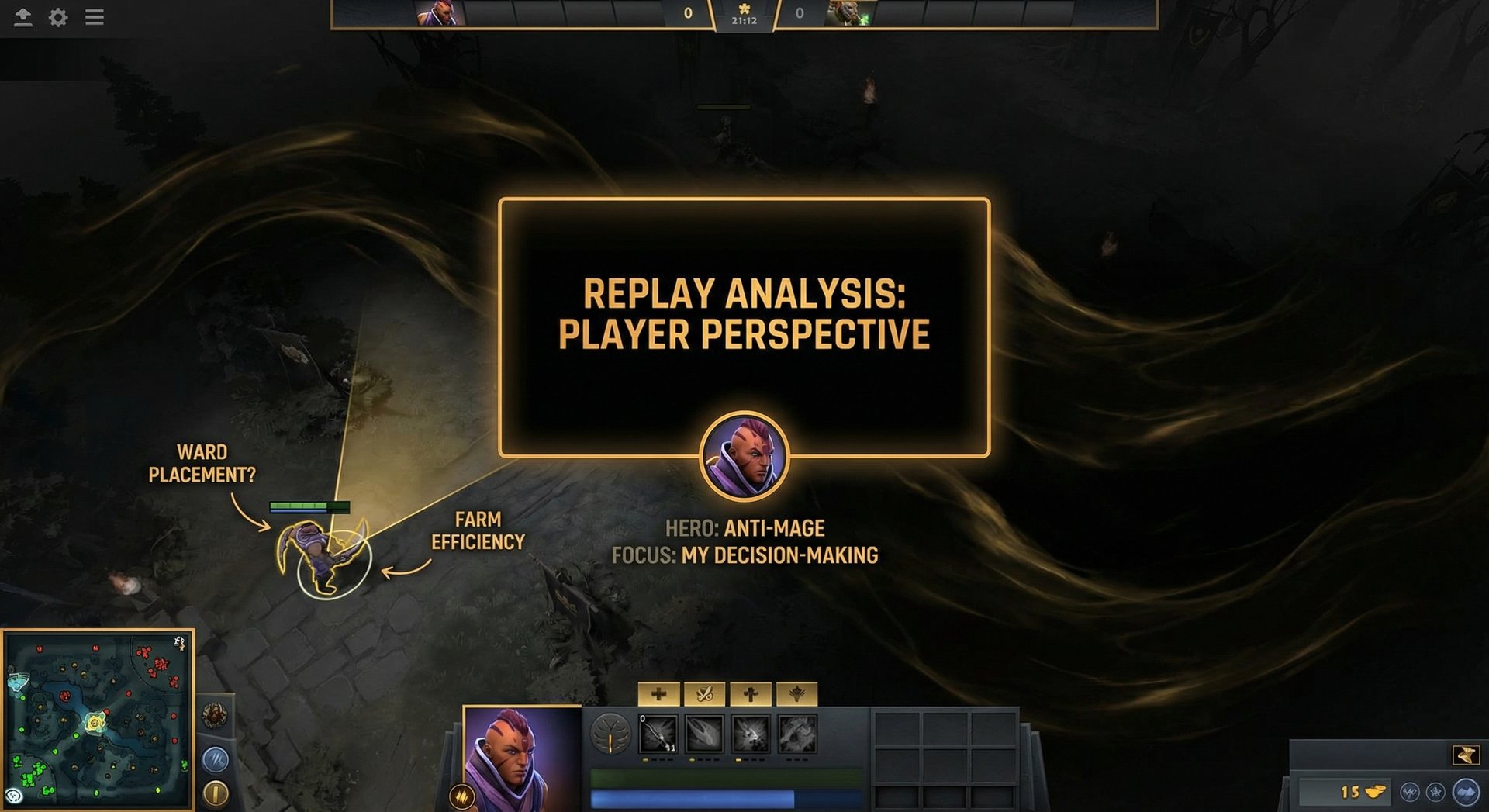
Replay analysis is the most powerful improvement tool in Dota 2–but during losing streaks, most players do it wrong. They watch replays to confirm their belief that teammates were the problem, not to identify their own mistakes.
The Productive Replay Analysis Framework
Wait at least 2-4 hours after a loss before analyzing the replay. Emotional distance is essential for objectivity. Then follow this structure:
Step 1: Watch Only Your Own Hero
Lock the camera on your hero. Ignore what teammates are doing. Focus exclusively on YOUR decisions:
- Where were you standing when you died Could you have been somewhere safer
- What items did you buy Were they optimal for this specific game
- How was your farming efficiency Were there wasted moments where you weren’t doing anything productive
- How many minimap checks can you count Did you miss warning signs before deaths
Step 2: Identify 2-3 Critical Decisions
Find the 2-3 moments where a different decision might have changed the outcome. These are usually:
- A death that gave the enemy a key objective (Roshan, tower, high ground)
- A teamfight where you used abilities in the wrong order or targeted the wrong hero
- A farming decision where you went to a dangerous part of the map
Step 3: Write Down the Lesson
Literally write it down. “I need to check the minimap before farming the enemy triangle.” “I should have bought BKB before my third item.” “I need to stop diving past tier 2 towers without vision.” Written lessons stick far better than mental notes.
Step 4: Watch One Thing Your Team Did Right
Even in losses, something went right. Maybe your support had perfect ward placement. Maybe your offlaner’s initiation was good but the follow-up was lacking. Finding positives in losses trains your brain to look for solutions rather than problems.
Replay Analysis Mistakes to Avoid
| Mistake | Why It’s Harmful | What to Do Instead |
|---|---|---|
| Watching teammates’ mistakes | Reinforces blame mentality; you can’t control their play | Focus on your own decisions exclusively |
| Analyzing immediately after the game | Emotional bias makes objective analysis impossible | Wait 2-4 hours or until the next day |
| Only analyzing losses | Misses the lessons hidden in wins (sloppy wins are common) | Analyze 1 win for every 2 losses you review |
| Analysis paralysis | Watching every second of a 50-minute game is overwhelming | Focus on 2-3 key moments only |
| Not writing anything down | “Mental notes” are forgotten within hours | Keep a simple text file or notebook with dated entries |
Productive replay analysis is a skill in itself. Our coaching service provides guided replay analysis where a high-MMR player watches your replays WITH you and identifies patterns you’d never notice on your own. This accelerates improvement dramatically compared to solo analysis.
Queue Discipline: Rules for When to Play Ranked
Queue discipline is the most impactful lifestyle change you can make to climb MMR. It’s not about playing more–it’s about playing at the right times and in the right conditions.
The Optimal Ranked Queue Conditions
| Factor | Good Condition | Bad Condition |
|---|---|---|
| Sleep | 7+ hours last night | Under 6 hours or feeling tired |
| Hunger | Had a meal within the last 2 hours | Hungry or running on junk food |
| Hydration | Water within reach; well-hydrated | Only energy drinks or coffee |
| Time | At least 2 hours available | Rushing to fit in “one quick game” |
| Mood | Neutral to positive | Stressed, angry, or sad from real-life events |
| Focus | No distractions; phone away | Multitasking with YouTube, phone, etc. |
| Warm-up | Played 1 unranked or demo mode warm-up | First game of the day is ranked |
| Time of day | Your most alert hours (varies by person) | Late night when you should be sleeping |
Time-of-Day Considerations
Match quality varies by time of day and region. Generally:
- Best times: Afternoon to early evening (2 PM – 8 PM). Largest player pool, best matchmaking quality.
- Worst times: Very late night (1 AM – 6 AM). Smaller player pool means wider MMR ranges in matches, more smurfs, and more tilted players who’ve been losing all day.
- Weekend mornings: Can be volatile. Some players play their best games here; others face more inconsistent teammates.
The Pre-Game Ritual
Develop a consistent pre-game routine:
- Physical prep: Use the bathroom, get water, stretch briefly.
- Warm-up: Play 10-15 minutes of demo mode practicing last-hits, or play one unranked/turbo game.
- Mental check: Rate your tilt meter (1-5). If you’re above 2, don’t queue.
- Set your process goal: “This game I’m focusing on [specific skill].”
- Queue.
This ritual takes 5-10 minutes but consistently improves game quality. Professional athletes have pre-game rituals. Dota 2 is a competitive sport–treat it like one.
The Post-Game Ritual
- Stand up and stretch. Even after wins.
- Rate the game: How was your performance on a 1-10 scale Did you achieve your process goal
- Check tilt meter: Has your emotional state changed Are you still in a good headspace for another game
- Decide to continue or stop: Based on tilt level, time remaining, and physical state.
Hero Pool Adjustment During Recovery
During and after losing streaks, your hero pool becomes a critical tool for recovery. What you pick–and what you avoid–can dramatically affect your ability to break the streak.
The Recovery Hero Pool
When recovering from a losing streak, your hero pool should have these characteristics:
- Comfort picks: Heroes you have 100+ games on and a positive win rate with. This is not the time for experimentation.
- Self-sufficient heroes: Heroes that can contribute to the game without relying heavily on teammate coordination. Heroes with strong laning, solo kill potential, and objective-taking ability.
- Simple mechanics: Avoid mechanically complex heroes (Meepo, Invoker, Earth Spirit) when tilted. Cognitive load from complex heroes competes with the mental bandwidth you need for decision-making and map awareness.
- Scaling heroes: Heroes that remain relevant regardless of how the early game goes. Even if the game goes poorly, a hero that scales gives you a chance to recover.
Recovery Heroes by Role
| Role | Recommended Recovery Heroes | Why They Work |
|---|---|---|
| Position 1 | Wraith King, Juggernaut, Lifestealer | Simple mechanics, built-in survivability, strong at all stages |
| Position 2 | Viper, Death Prophet, Zeus | Strong laners, straightforward game plans, hard to mess up |
| Position 3 | Axe, Underlord, Bristleback | Tanky, good team utility, punish enemy mistakes |
| Position 4 | Ogre Magi, Spirit Breaker, Tusk | High impact with simple execution, strong roaming |
| Position 5 | Warlock, Crystal Maiden, Jakiro | Easy to contribute with; game-changing ultimates |
Heroes to Avoid During Recovery
- Meepo: Extremely mechanically demanding; tilt destroys micro execution.
- Invoker: Complex spell combinations require clear-headed decision-making you don’t have while tilted.
- Chen: Micro-intensive and team-dependent–two things that don’t work during tilt.
- Techies: Requires patience and long-game thinking; tilted players lack both.
- Any hero you’ve never played in ranked: First-timing a hero while on a losing streak is a recipe for disaster.
Role Swapping During Streaks
If your losing streak is concentrated in one role, consider temporarily switching. A mid player on a losing streak might find success playing position 3 or 4 for a few games–the change of perspective breaks habitual patterns and reduces the psychological pressure of “carrying.”
However, don’t switch to a role you’ve never played. The goal is to change your perspective, not to add the stress of learning a new role to your already-stressed state.
If you’re stuck in a losing streak and want a fresh start, our calibration service can place your account at a rank that better reflects your current skill level, removing the psychological burden of “lost MMR.” Sometimes a fresh calibration is exactly the mental reset you need.
Physical and Mental Health Factors
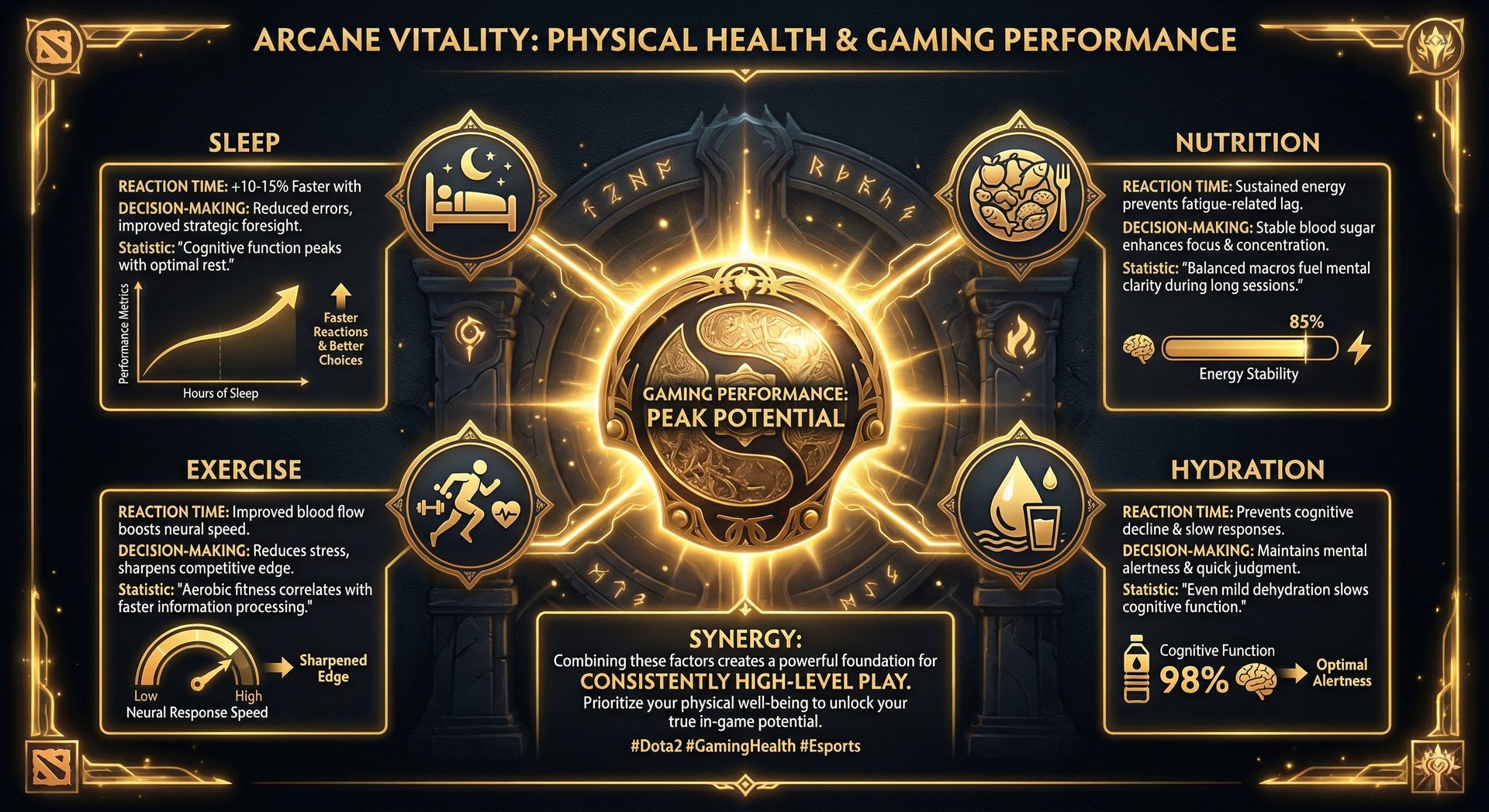
This is the section most Dota 2 guides skip entirely–and it might be the most important one. Your physical and mental state directly affect your gaming performance. Ignoring this is like trying to run a marathon while dehydrated.
Sleep: The Number One Performance Factor
Sleep deprivation is the single biggest performance killer in competitive gaming. Studies show that after 17 hours without sleep, cognitive impairment is equivalent to a blood alcohol content of 0.05%. After 24 hours, it’s equivalent to 0.10%–legally drunk in most countries.
What sleep deprivation does to your Dota 2 play:
- Reduces reaction time by 20-50%
- Impairs decision-making and risk assessment
- Decreases map awareness (reduced attention span)
- Increases tilt susceptibility (emotional regulation requires sleep)
- Reduces learning (your brain consolidates skills during sleep)
The sleep rule: Do not play ranked if you’ve had fewer than 6 hours of sleep. If you’re tired enough to yawn during the game, you’re too tired to play at your best.
Nutrition and Hydration
Your brain consumes 20% of your body’s energy. When you’re playing Dota 2, it’s working at maximum capacity. Fueling it properly isn’t optional–it’s a competitive advantage.
- Eat before playing: A balanced meal with protein, complex carbohydrates, and healthy fats provides sustained mental energy. Playing hungry reduces concentration and increases irritability (tilt).
- Stay hydrated: Keep water at your desk. Dehydration causes headaches, reduced concentration, and slower reaction times. Drink water, not just energy drinks or coffee.
- Limit caffeine before bed: If you’re playing evening sessions, excessive caffeine disrupts your sleep quality–which affects tomorrow’s performance.
- Avoid heavy meals during marathon sessions: A large meal diverts blood to digestion, making you sluggish. Eat moderate portions and snack on nuts or fruit.
Physical Activity and Posture
Sitting in a chair for 4+ hours causes physical discomfort that manifests as mental fatigue and irritability. Even short physical breaks make a measurable difference:
- Every hour, stand and stretch for 2 minutes. Focus on shoulders, neck, wrists, and back–the areas most stressed by gaming posture.
- Between games, do 10-20 pushups or squats. Physical exertion releases endorphins, reduces cortisol, and resets your physical state.
- Maintain good posture: Sit with your back straight, monitor at eye level, wrists neutral. Poor posture causes discomfort that accumulates into fatigue and tilt over long sessions.
- Exercise regularly outside of gaming: Players who exercise 3+ times per week report better in-game focus, lower tilt rates, and faster reaction times.
Mental Health Awareness
This needs to be said directly: if you’re using Dota 2 as an escape from real-life problems, losing streaks will hit you much harder. When your self-worth is tied to your MMR, every loss feels like a personal attack.
Signs that Dota 2 is affecting your mental health:
- You feel anxious when not playing (fear of “falling behind”)
- Losses affect your mood for hours after you stop playing
- You neglect real-life responsibilities to play
- You feel angry or hopeless after playing
- You’ve damaged equipment (keyboard, mouse, monitor) in frustration
If you recognize these signs, consider reducing your play time and speaking to a mental health professional. Dota 2 should be enjoyable–if it’s consistently causing distress, something needs to change. Your well-being is infinitely more important than your MMR.
The Ergonomic Setup
Physical comfort reduces fatigue-induced tilt:
| Element | Optimal Setup | Why It Matters |
|---|---|---|
| Chair | Adjustable, with lumbar support | Reduces back pain during long sessions |
| Monitor Height | Top of screen at eye level | Prevents neck strain from looking up or down |
| Mouse Position | Arm at 90-degree angle, wrist neutral | Prevents carpal tunnel and wrist fatigue |
| Keyboard Position | Slightly tilted, at elbow height | Reduces forearm strain during extended play |
| Room Lighting | Moderate ambient light, no glare on screen | Reduces eye strain and headaches |
| Room Temperature | Cool (68-72°F / 20-22°C) | Heat increases fatigue and irritability |
The Long-Term Mindset: Thinking in Seasons, Not Sessions
The most powerful mental shift you can make is to stop measuring your progress by individual sessions and start measuring it by months and seasons.
The Variance Reality
Dota 2 has significant variance (randomness) built into every game. Teammate quality, enemy quality, hero matchups, and countless in-game variables mean that even a player performing at their absolute best will lose 40-45% of their games. This means:
- A 55% win-rate player (which is EXCELLENT) will have 5-game losing streaks regularly. Statistics guarantee it.
- A 10-game losing streak, while painful, is a normal statistical occurrence over the course of 500+ games.
- Your “true skill” is reflected in your win rate over 100+ games, not in any single session.
The Monthly MMR Trajectory
Instead of tracking your MMR game-by-game, track it month-by-month. A player who gains 200 MMR per month is climbing at an excellent rate–even if within that month they had a week where they lost 300 MMR. The week-to-week noise is just variance. The monthly trend is signal.
Keep a simple log:
- January 1: 3,200 MMR
- February 1: 3,350 MMR
- March 1: 3,150 MMR (bad month–it happens)
- April 1: 3,500 MMR (great month)
Over four months, you climbed 300 MMR despite having a bad month. That’s the reality of improvement–it’s not linear. Losing streaks are part of the journey, not signs that you’re failing.
The Growth Mindset vs. Fixed Mindset
Fixed mindset: “I’m a 3K player. That’s my level.” This mindset treats skill as static. Every loss confirms you’re “stuck,” and every win is a lucky anomaly.
Growth mindset: “I’m currently at 3K and improving. Each game teaches me something.” This mindset treats skill as dynamic. Losses are learning opportunities, and improvement is expected with practice.
Players with a growth mindset recover from losing streaks faster because they don’t internalize losses as reflections of their worth. They see them as data points in a long-term improvement trajectory.
When External Help Makes Sense
Sometimes, despite your best efforts, you feel stuck. The losing streak won’t break, the MMR won’t climb, and you can’t figure out what you’re doing wrong. This is when external help provides the most value:
- Coaching: A fresh perspective from a high-MMR player who can identify patterns you can’t see yourself. Especially valuable for breaking plateaus and losing streaks.
- MMR Boosting: If your account is significantly below your current skill level (perhaps due to an extended tilt period or old calibration), boosting places you at a rank where games are more competitive and rewarding.
- Recalibration: A fresh calibration can provide the psychological reset of a “new beginning” without the baggage of 500 losses on your account history.
- Low Priority Removal: If tilt-driven behavior put you in low priority, getting out quickly lets you return to ranked and apply the lessons from this guide.
Frequently Asked Questions
Conclusion: The Streak Ends When You Choose
Losing streaks feel like they’re happening TO you, but in reality, you have far more control than you think. The games themselves might be influenced by variance–but how you respond to losses, when you queue, what mental state you play in, and how you analyze your performance are all within your power.
The core principles from this guide:
- Recognize tilt early using the physical, behavioral, and cognitive indicators.
- Stop playing after 2-3 consecutive losses. No exceptions.
- Take breaks that actually reset you–physical activity, sleep, unrelated hobbies.
- Use replay analysis for self-improvement, not blame.
- Practice queue discipline–only play when you’re physically and mentally ready.
- Simplify your hero pool during recovery periods.
- Address physical health factors–sleep, nutrition, exercise, and ergonomics.
- Adopt the long-term mindset. Track MMR monthly, not per-game.
Every professional, every high-MMR player, every booster at TeamSmurf has experienced losing streaks. What makes them successful isn’t avoiding losses–it’s managing the mental and physical response to losses so that temporary setbacks don’t become permanent declines.
The streak ends when you decide to play smarter, not harder. Take a break. Reset your mind. Come back fresh. The MMR will be there when you return–and this time, you’ll be ready to climb.
Ready to Climb Start Your Boost Today
Team Smurf is the #1 rated Dota 2 boosting service. Immortal-rank boosters, maximum safety, competitive pricing, 24/7 support.
Written by Team Smurf’s Immortal-rank analysts — Last verified February 2026