Dota 2 Behavior Score: The Complete Guide to Understanding and Maximizing It

If you’ve ever queued into a Dota 2 match and wondered why your teammates are flaming each other before the horn even sounds, there’s a hidden number working behind the scenes that explains everything: your Behavior Score. This single metric — ranging from 0 to 12,000 — shapes every aspect of your Dota 2 experience more than most players realize. It determines the quality of your teammates, your queue times, your matchmaking pool, and even your eligibility for certain features.
In this exhaustive guide, we’ll break down exactly how Dota 2’s Behavior Score system works in 2026, what affects it, how to raise it efficiently, and why it matters far more than your MMR when it comes to actually enjoying the game. Whether you’re sitting at a perfect 12,000 or stuck in the toxic trenches below 5,000, this guide has something for you.
Table of Contents
- What Is Behavior Score?
- How the Behavior Score System Works
- Behavior Score Ranges and What They Mean
- Everything That Affects Your Behavior Score
- Impact on Matchmaking and Game Quality
- Impact on Game Features and Rewards
- How to Raise Your Behavior Score Fast
- Common Myths About Behavior Score
- Behavior Score vs. MMR: Which Matters More
- When to Consider Professional Help
- Frequently Asked Questions
What Is Behavior Score?
Behavior Score (commonly abbreviated as BS) is Valve’s numerical rating of your conduct as a Dota 2 player. Introduced in 2017 and refined multiple times since, it serves as a reputation system that rewards positive behavior and punishes toxic conduct. Every player has a Behavior Score between 0 and 12,000, and it updates after every set of matches based on your recent conduct.
You can check your current Behavior Score by navigating to your Dota 2 profile and looking at the Conduct Summary section. This summary updates approximately every 15 matches (or roughly every 10-15 games in practice, since the window can shift) and shows you a breakdown of commends received, reports filed against you, and abandons committed.
The system exists because Valve recognized a fundamental truth about online gaming: skill-based matchmaking alone doesn’t create good games. Two players can be identical in MMR but wildly different in how they treat teammates. By separating toxic players from positive ones, Valve ensures that players who communicate well, play cooperatively, and avoid griefing get matched with others who do the same — and players who rage, abandon, or grief get grouped together in what the community often calls “the shadow pool.”
A Brief History of Behavior Score
Behavior Score wasn’t always visible to players. In Dota 2’s early years, matchmaking relied almost entirely on MMR with some hidden factors. The system evolved through several stages:
- Pre-2017: Hidden behavior metrics existed but weren’t shown to players. Reports and commends influenced matchmaking in opaque ways.
- 2017: Behavior Score became visible as a letter grade (A+ through F), giving players their first look at how Valve rated their conduct.
- 2018: The letter system was replaced with a numerical score from 1 to 10,000, providing more granular feedback.
- 2019: The cap was raised to 12,000 after community feedback that the old ceiling was too easy to reach and didn’t differentiate between good and excellent players.
- 2020-2023: Multiple adjustments refined how reports, commends, and game behaviors affected the score. The “overwatch” system was introduced, allowing the community to review reported cases and adding another layer to the enforcement system.
- 2024-2026: Further refinements to the Overwatch system, adjusted weighting of different report types, and improved detection of smurf accounts and coordinated abuse of the report system.
How the Behavior Score System Works
Understanding the mechanics behind Behavior Score is essential if you want to control it. The system is more nuanced than most players think, and knowing exactly what’s tracked can help you make better decisions in and out of game.
The Conduct Summary Window
Your Behavior Score updates based on a rolling window of your most recent matches — typically around 15 games, though Valve hasn’t disclosed the exact window publicly. After each conduct summary update, you’ll see:
- Commends received: The number of commendations from other players in the evaluation period
- Reports received: The number of valid reports filed against you
- Abandons: The number of games you left before they concluded
- Your updated Behavior Score: The new numerical value
Each of these factors carries different weight, and the system is asymmetric by design — it’s much easier to lose Behavior Score than to gain it. A single abandon can drop you by 500-1,000 points, while gaining that same amount back through clean play might take 15-25 games of perfect behavior.
How Points Are Calculated
While Valve keeps the exact formula proprietary, years of community testing and data collection have given us a strong understanding of how different actions affect your score:
| Action | Estimated Impact | Notes |
|---|---|---|
| Completing a game cleanly (no reports) | +10 to +25 per game | The baseline gain for simply playing without issues |
| Receiving a commend | +10 to +50 per commend | Diminishing returns from the same player; party commends weighted less |
| Receiving a report (communication abuse) | -100 to -200 | Less impactful than gameplay reports; stacks if multiple in one game |
| Receiving a report (gameplay/ability abuse) | -150 to -300 | Heavier penalty; Overwatch review can amplify or nullify |
| Abandoning a game | -500 to -1,000 | The single most damaging action; repeated abandons escalate penalties |
| Being convicted via Overwatch | -500 to -1,500 | Community-reviewed cases carry extra weight |
| Playing in Low Priority (winning) | Neutral to +10 | Completing LP games doesn’t directly boost BS much |
| Extended period of clean play | +200 to +500 per summary | Consistency over 15+ games is rewarded |
It’s important to note that these are approximations based on community research. Valve adjusts the weights periodically and doesn’t publish the exact numbers. However, the relative impact is well established: abandons are devastating, reports are painful, and recovery requires sustained effort.
The Role of Overwatch
Dota 2’s Overwatch system, introduced in 2021, allows experienced players with high Behavior Scores to review reported cases and render verdicts. When a player is reported for intentional feeding, ability abuse, or griefing, the replay may be sent to Overwatch reviewers who watch the footage and decide if the report was legitimate.
This adds an important layer of accuracy to the system. Before Overwatch, all reports carried similar weight regardless of whether they were justified. Now, a false report (someone reporting you just because you lost) is less likely to tank your score, while genuine griefing caught on Overwatch review will hit you harder than a standard report.
For players concerned about their Behavior Score, Overwatch is actually good news — it means that as long as you’re genuinely trying to play well and cooperate, false reports from salty teammates will have less impact on your score over time.
Behavior Score Ranges and What They Mean
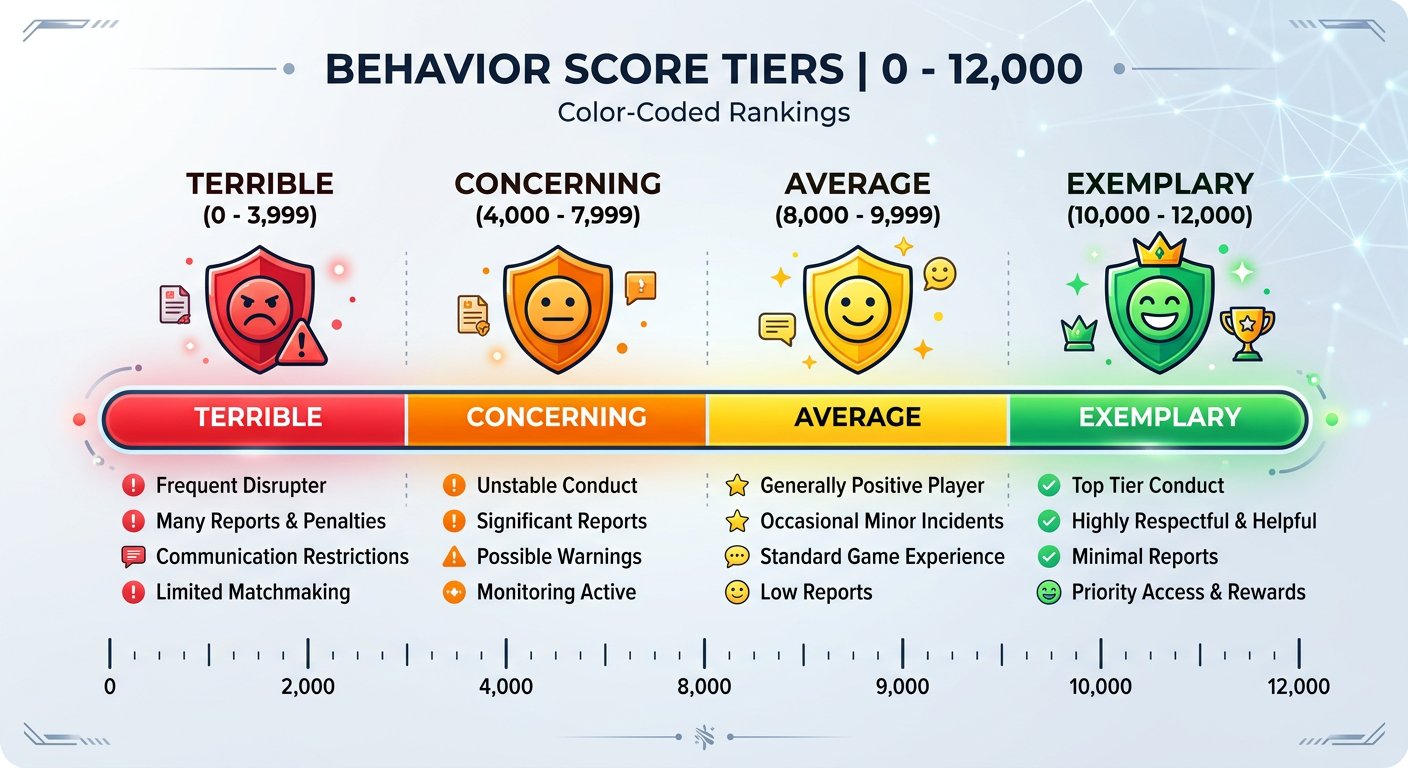
Not all Behavior Scores are created equal. The 0-12,000 range creates distinct tiers of player experience, and the difference between brackets is dramatic. Here’s what each range looks like in practice:
| Score Range | Tier | Experience | % of Players (Estimated) |
|---|---|---|---|
| 10,000 – 12,000 | Exemplary | Best matchmaking quality, shortest queues, access to all features, matched with cooperative players | ~50-60% |
| 8,000 – 9,999 | Good | Solid game quality with occasional toxic teammates, normal queue times | ~15-20% |
| 6,000 – 7,999 | Average | Noticeable increase in toxicity, more frequent flamers and griefers, slightly longer queues | ~10-12% |
| 4,000 – 5,999 | Below Average | Regularly toxic games, high likelihood of intentional feeders and abandoners, restricted features | ~5-8% |
| 2,000 – 3,999 | Poor | Extremely toxic environment, most games feature some form of griefing, very long queue times | ~3-5% |
| 0 – 1,999 | Critical | The “shadow pool” — nearly every game has multiple toxic players, absurdly long queues, essentially a different game | ~2-3% |
The most important threshold is around 10,000. Above this line, you’re in the majority pool with the best matchmaking experience. Below it, quality degrades rapidly — and once you fall below 8,000, the slide can become self-reinforcing because toxic teammates make you more likely to get reported yourself, even if you’re not the problem.
The “Shadow Pool” — Is It Real
The Dota 2 community has long theorized about a “shadow pool” — a separate matchmaking queue for extremely low Behavior Score players. While Valve has never officially confirmed this term, they have confirmed that Behavior Score is a primary matchmaking factor and that low-BS players are matched together. The practical effect is the same: below a certain threshold (roughly 3,000-4,000), you enter a matchmaking ecosystem that feels fundamentally different from normal Dota.
Games in the shadow pool are characterized by:
- Multiple players with open microphones playing music or screaming
- Intentional feeding from minute one
- Item destruction and ability griefing (Tiny airlines, Io relocate griefing, etc.)
- Coordinated abandons
- Extremely long queue times (15-30+ minutes for a single game)
- Wildly imbalanced matches due to the small player pool
For players trapped in this range, climbing out is one of the most frustrating experiences in gaming. Each game is a minefield where even perfect behavior might result in reports from teammates who report everyone regardless. This is where professional help like Low Priority removal services can provide genuine relief.
Everything That Affects Your Behavior Score
Let’s get comprehensive. Here is every known factor that influences your Behavior Score, organized by category.
Negative Factors (Score Decreasers)
1. Abandoning Games
This is the nuclear option for your Behavior Score. Leaving a game before it’s finished — whether voluntarily, through disconnection, or by being AFK for too long — is the single most damaging thing you can do. A single abandon can cost you 500-1,000 points and also sends you to Low Priority if you accumulate too many.
Important distinctions about abandons:
- Voluntary disconnect: Full penalty
- Network timeout (5+ minutes disconnected): Full penalty, regardless of reason
- AFK detection: If the game detects you’re not providing input for an extended period, you’ll receive an abandon
- Post-abandon in your game: If someone else already abandoned and the game is “safe to leave,” you can leave without penalty
- Before first blood: Early abandons (before first blood or within the first few minutes) still count as abandons for the leaver but don’t count as losses for the remaining team
2. Being Reported
Reports come in several categories, and each carries different weight:
- Communication Abuse: For excessive flaming, hate speech, or spam in text/voice chat. Lighter penalty on Behavior Score but can result in communication mutes.
- Intentional Ability Abuse: For using abilities to grief teammates (e.g., Pudge hooking allies into bad positions, Nature’s Prophet teleporting to block camps). Heavier penalty and may trigger Overwatch review.
- Intentional Feeding: For deliberately dying to the enemy team. The most serious report category, almost always triggers Overwatch review, and carries the heaviest score penalty if convicted.
Key details about how reports work:
- Multiple reports from the same game count as one report (you can’t be 4x reported by a party)
- Reports from players who report frequently carry less weight than reports from players who rarely report
- Reports that are validated by Overwatch carry more weight than unreviewed reports
- You have a limited number of reports to give out, and they replenish when your reports lead to action
3. Overwatch Convictions
Being found guilty through the Overwatch system carries an additional penalty on top of the report itself. This is Valve’s way of reserving the harshest punishments for behavior that the community has verified as genuinely toxic.
4. Communication Mutes
Receiving automated or manual communication mutes indicates a pattern of toxic chat behavior and can reduce your score incrementally.
5. Excessive Pausing
While pausing is a legitimate game mechanic, excessive tactical pausing (especially during enemy fights or crucial moments) can contribute to reports and indirectly damage your score.
Positive Factors (Score Increasers)
1. Completing Games Without Incident
Simply playing games from start to finish without being reported or abandoning is the most reliable way to increase your Behavior Score. Each clean game contributes a small but consistent positive gain.
2. Receiving Commends
When teammates commend you after a game, it provides a direct Behavior Score boost. Commends from non-party members carry more weight than commends from friends you queued with. Being a positive presence — calling out good plays, staying calm during losses, communicating constructively — naturally earns more commends.
3. Tipping and Being Tipped
While the direct impact on Behavior Score is minimal, being tipped during games is a soft signal of positive conduct that may influence the algorithm.
4. Playing Support Roles
This is somewhat controversial, but community data suggests that playing support roles (especially hard support, position 5) correlates with faster Behavior Score recovery. The theory is that support players are less likely to be reported (since they’re not expected to carry) and more likely to receive commends for warding, saving teammates, etc. Whether this is a direct mechanic or a correlation is debatable, but many players swear by it as a recovery strategy.
5. Using the Coaching Feature
Positively rated coaching sessions contribute to your Behavior Score. If you’re an experienced player, offering coaching to newer players is both altruistic and beneficial for your own score. For those looking to improve through coaching themselves, professional Dota 2 coaching offers a structured way to improve without the frustration of solo queue.
Impact on Matchmaking and Game Quality
Your Behavior Score’s most significant effect is on matchmaking. Valve has confirmed that Behavior Score is a primary factor in determining who you’re matched with — not just a tiebreaker, but a core parameter alongside MMR and role preferences.
Queue Times
The relationship between Behavior Score and queue time is roughly exponential. At 10,000+, you’ll find games in 2-5 minutes during peak hours. At 8,000, it might be 5-8 minutes. At 5,000, you’re looking at 10-15 minutes. Below 3,000, queue times of 20-30+ minutes are common, and the system may eventually relax its standards and match you with players of wildly different MMR just to fill a game.
Teammate Quality
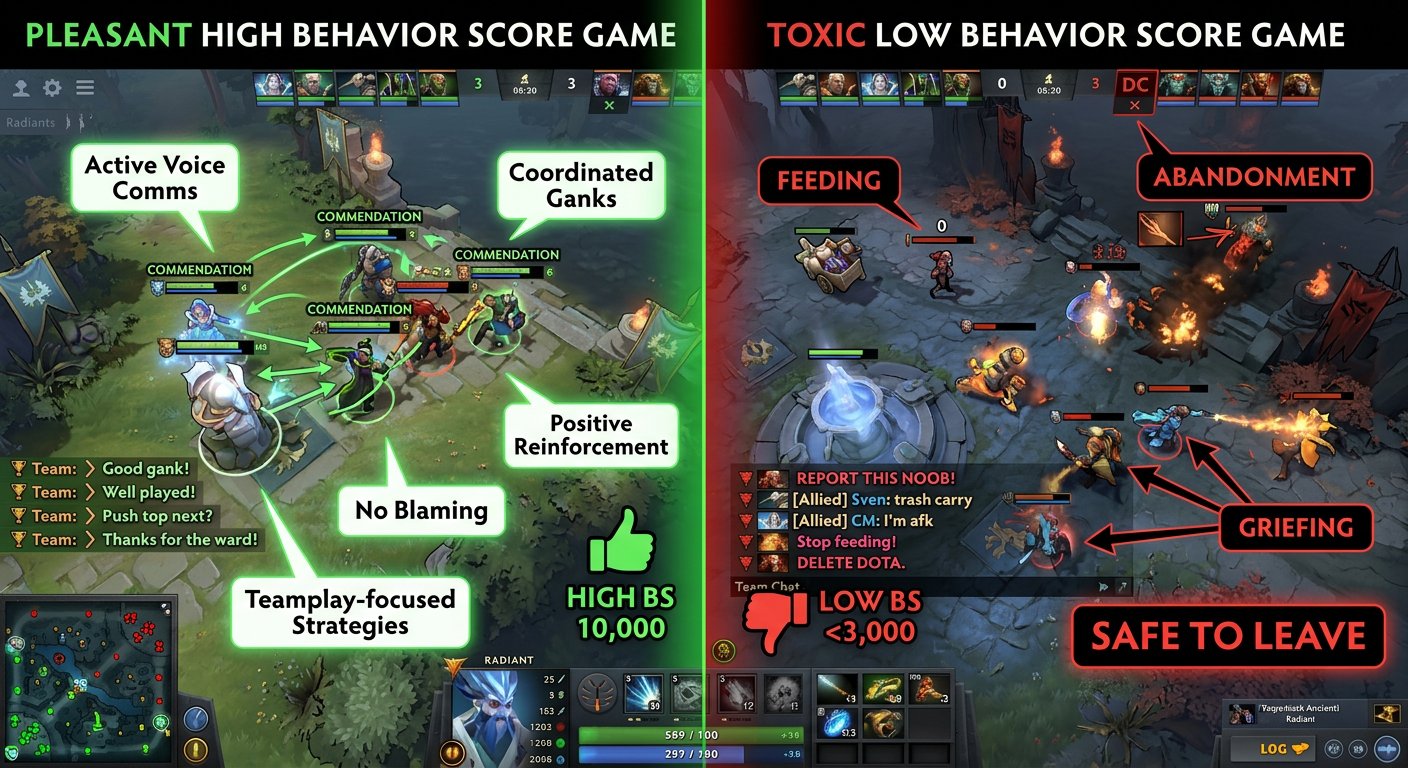
This is where the impact is most visceral. High Behavior Score games feel like a different game entirely compared to low BS matches. At 10,000+:
- Players communicate using the chat wheel and voice chat constructively
- Supports buy wards without being asked
- Players pick around their team composition
- Losses are accepted gracefully without finger-pointing
- Pauses are generally respected
Below 5,000:
- Multiple players fighting over mid or carry roles
- Intentional feeding after first blood
- All-chat flaming of both teammates and enemies
- Item breaking and courier feeding
- “GG end” calls at 5 minutes
The difference is so stark that many players describe it as feeling like completely different games. And the tragedy is that Behavior Score traps are self-reinforcing — playing in a low BS environment makes you more frustrated, which makes you more likely to behave in ways that lower your score further.
MMR Gain and Loss
While Behavior Score doesn’t directly affect how much MMR you gain or lose per match, it indirectly affects your win rate. Higher Behavior Score means better teammates, which means more cooperative games, which means more wins — especially in the brackets below Divine where individual skill advantage is smaller and team coordination matters more.
Many players who’ve used MMR boosting services report that their Behavior Score improved simultaneously, simply because the professional players handling their accounts play cleanly and earn commends. This dual benefit is often overlooked when considering the value of boosting.
Impact on Game Features and Rewards
Beyond matchmaking, Behavior Score affects access to several Dota 2 features:
Ranked Matchmaking
Players with very low Behavior Scores may face restrictions on ranked matchmaking. While the exact threshold fluctuates, players below approximately 3,000-4,000 BS have reported being temporarily locked out of ranked queue, forced to play unranked or turbo games until their score recovers.
Overwatch Participation
Only players with high Behavior Scores (generally 8,000+) are eligible to review Overwatch cases. This creates a positive feedback loop: well-behaved players get to participate in community moderation, which further incentivizes good behavior.
Matchmaking Pool Size
At high Behavior Scores, you have access to the largest matchmaking pool, meaning faster queues, better balanced games, and more accurate MMR matching. Low BS players draw from a tiny pool, resulting in unbalanced games on top of the toxicity.
Report Weight
Your Behavior Score influences how much weight your own reports carry. High BS players’ reports are taken more seriously because they report less frequently and more accurately. Low BS players who report constantly find their reports carry progressively less weight.
Drop Rates and Cosmetics
There’s community speculation — never confirmed by Valve — that Behavior Score affects cosmetic drop rates and random item distribution. While this remains unproven, Valve has previously tied positive behavior to reward systems in other games (CS2’s Trust Factor, for instance), so it’s not implausible.
How to Raise Your Behavior Score Fast
Whether you’ve had a bad streak of tilted games or you’re clawing your way out of the shadow pool, here’s a comprehensive strategy for raising your Behavior Score as efficiently as possible.
Step 1: Stop the Bleeding
Before you try to gain score, stop losing it. This means:
- Never abandon a game. If your internet is unstable, fix it before queuing. If you tend to rage-quit, you need to address that first.
- Mute yourself if needed. If you know you flame when tilted, disable your microphone and unbind your chat key. Zero communication is better than toxic communication.
- Don’t retaliate. If a teammate is griefing or flaming, mute them and play your game. Responding in kind gets you reported by everyone, not just the instigator.
Step 2: Choose the Right Game Mode
Not all game modes are equally efficient for Behavior Score recovery:
| Game Mode | BS Recovery Efficiency | Why |
|---|---|---|
| Turbo | Fastest games (15-25 min), still counts for conduct summary, lower stakes reduce toxicity | |
| Unranked All Pick | Full-length games that count fully, less pressure than ranked | |
| Ranked All Pick | Full weight but higher stress means more reports and tilt risk | |
| Single Draft (LP) | Required if in LP, but the environment makes clean play harder | |
| Ability Draft / Other Modes | Lower population means longer queues but generally less toxic |
Turbo mode is king for BS recovery. Games are short, stakes are low, and you can grind through your conduct summary window in a fraction of the time it would take in ranked. A dedicated Turbo grind can push through a 15-game conduct summary in a single evening session.
Step 3: Play Support
As mentioned earlier, playing support roles — particularly position 5 hard support — is widely considered the fastest way to recover Behavior Score. The reasons are practical:
- Support players are in high demand, so you get role queue bonuses
- Buying wards, pulling camps, and saving teammates with clutch abilities earns commends
- You’re less likely to be blamed for losses (the “blame the carry” mentality protects supports)
- Support gameplay is less tilt-inducing since you’re not expected to solo-carry
Heroes like Crystal Maiden, Witch Doctor, Ogre Magi, and Jakiro are excellent choices — they’re easy to play, impactful even from behind, and their kit naturally produces “commend-worthy” moments (big ultimates, saves, etc.).
Step 4: Actively Seek Commends
Don’t beg for commends — that’s annoying and counterproductive. Instead, do things that naturally earn them:
- Call “nice play” or “well played” when teammates make good moves
- Commend others first — people often reciprocate
- Stay positive in all-chat, even to enemies (“gg wp” at the end)
- Make obviously selfless plays (sacrificing yourself so a carry can escape, buying all the wards, etc.)
- Use voice chat positively — shotcalling, warning of ganks, suggesting Roshan timing
Step 5: Maintain Consistency
The Behavior Score system heavily rewards consistency. Playing 15 games over three days with zero reports is worth more than playing 50 games with occasional reports mixed in. The algorithm seems to place extra value on consecutive clean conduct summaries, with recovery accelerating over time if you maintain a streak.
Expected Recovery Timeline
| Starting Score | Target Score | Estimated Games Needed | Estimated Time (Turbo) |
|---|---|---|---|
| 9,000 | 10,000 | 15-30 games | 1-3 days |
| 7,000 | 10,000 | 50-80 games | 1-2 weeks |
| 5,000 | 10,000 | 100-150 games | 2-4 weeks |
| 3,000 | 10,000 | 150-250 games | 4-8 weeks |
| Below 2,000 | 10,000 | 250-400+ games | 2-4 months |
These timelines assume consistent clean play with zero reports and zero abandons. Any slip-up resets significant progress. For players deep in the hole (below 3,000), the grind can feel nearly impossible because the toxic environment actively works against recovery.
Common Myths About Behavior Score
There’s a lot of misinformation about Behavior Score in the Dota 2 community. Let’s address the most persistent myths:
Myth 1: “Reports don’t matter if you’re not guilty”
Partially true. Since the Overwatch system, false reports carry less weight. However, even unvalidated reports still have some negative impact on your score. The system isn’t perfect, and in lower BS brackets where people report more liberally, false reports are a real problem.
Myth 2: “Commend trading is the fastest way to raise BS”
Mostly false. Valve has implemented diminishing returns on commends from players you frequently commend (and who frequently commend you). While party commends count, they’re weighted less than commends from strangers. Commend-for-commend trading provides minimal benefit.
Myth 3: “Playing ranked gives more BS than unranked”
False. There’s no evidence that game mode type affects the rate of BS gain. Turbo is arguably better because you can get through the conduct summary window faster.
Myth 4: “You can never recover from below 3,000”
False, but understandable. Recovery is possible from any score, but the difficulty scales dramatically at lower levels. The toxic environment, long queue times, and constant reports make it feel impossible. Many players in this situation find it more practical to seek professional help or focus intensely on Turbo mode recovery.
Myth 5: “Behavior Score resets with new seasons”
False. While MMR calibration resets seasonally, Behavior Score carries over between seasons. Your conduct history follows you regardless of MMR resets.
Myth 6: “Muting all players protects your BS”
Indirectly true. Muting everyone doesn’t directly affect your BS, but it prevents you from being provoked into toxic behavior. It’s a valid strategy during recovery, though you lose the ability to coordinate with your team.
Behavior Score vs. MMR: Which Matters More
This is a question that divides the community, and the answer depends on what you value.
If your goal is game quality and enjoyment, Behavior Score matters more. A 3,000 MMR player with 12,000 BS will have dramatically more enjoyable games than a 3,000 MMR player with 5,000 BS. The same goes at every skill level — even Immortal players with low BS report miserable game quality.
If your goal is competitive achievement and climbing, both matter, but Behavior Score is the foundation. You can’t reliably climb MMR if your games are sabotaged by toxic teammates. Fixing your Behavior Score first creates the stable environment you need to focus on improving mechanically.
The ideal approach is to treat Behavior Score as the prerequisite for everything else. Get it to 10,000+, keep it there, and then focus on climbing your MMR with the advantage of good teammates and clean games.
When to Consider Professional Help
There are situations where self-recovery of Behavior Score is impractical:
- You’re below 3,000 BS and every game features griefers who report everyone regardless of behavior
- You’re stuck in Low Priority and can’t win the required games due to the chaotic environment
- You don’t have the time to grind 200+ Turbo games over several weeks
- Your MMR has tanked alongside your BS, creating a double problem
In these cases, professional services can provide a lifeline. TeamSmurf’s Low Priority removal service handles the LP games efficiently, while MMR boosting can simultaneously recover your rank. Professional players maintain clean behavior throughout, which means your Behavior Score naturally recovers alongside your MMR.
For players who want to fix the root cause rather than the symptoms, Dota 2 coaching provides personalized guidance not just on gameplay but on the mental aspects of Dota — managing tilt, communicating effectively, and building habits that naturally maintain a high Behavior Score.
Frequently Asked Questions
Ready to Improve Your Dota 2 Experience
Team Smurf offers professional Dota 2 services — Immortal-rank boosters, maximum safety, competitive pricing, and 24/7 support.