Lotus Pool Farming: Support Economy Done Right

Every three minutes, two pools on the Dota 2 map spawn free regeneration for any hero willing to step into them. Most cores know about it. Most supports, the players who need resources the most and have the fewest ways to generate them, walk right past. That gap is your advantage.
This guide breaks down exactly how Lotus Pools work in patch 7.41d, why the 7.41 countdown reversal mechanic changed the contest game entirely, and how a disciplined support player can turn reliable lotus farming into a secondary economy that keeps their team alive through every stage of the game — from the opening laning phase to a potential Block of Cheese in the late game.
What You Will Learn
What Is the Lotus Pool?
The Lotus Pool is a permanent map feature introduced in patch 7.33 that sits on both side lanes — Radiant bottom and Dire top — occupying the space where the old side lane shops used to be. Both pools are accessible to heroes from either team, and both spawn Healing Lotuses on an identical schedule throughout the entire game.
There is no interaction button. Since patch 7.38, collection is passive: walk into the center of the pool and stand there for 1.5 seconds, and a lotus is automatically granted to a random hero on your team who is also present. If multiple teammates are standing inside, the collected lotus is distributed randomly among them. For consecutive collections, each pickup is 30% faster than the previous one — the second takes 1.05 seconds, the third takes about 0.74 seconds, and so on. This means teams that stack up and collect several at once do so very quickly after the first.
Spawns happen on a strict three-minute cycle starting at 3:00. The spawn timer cannot be interrupted. Unlike neutral creep camps, the lotus will simply sit inside the pool indefinitely if nobody shows up to claim it — pools can accumulate up to six lotuses (an 18-minute backlog) before the cap stops further generation. Items left in the pool do not disappear.
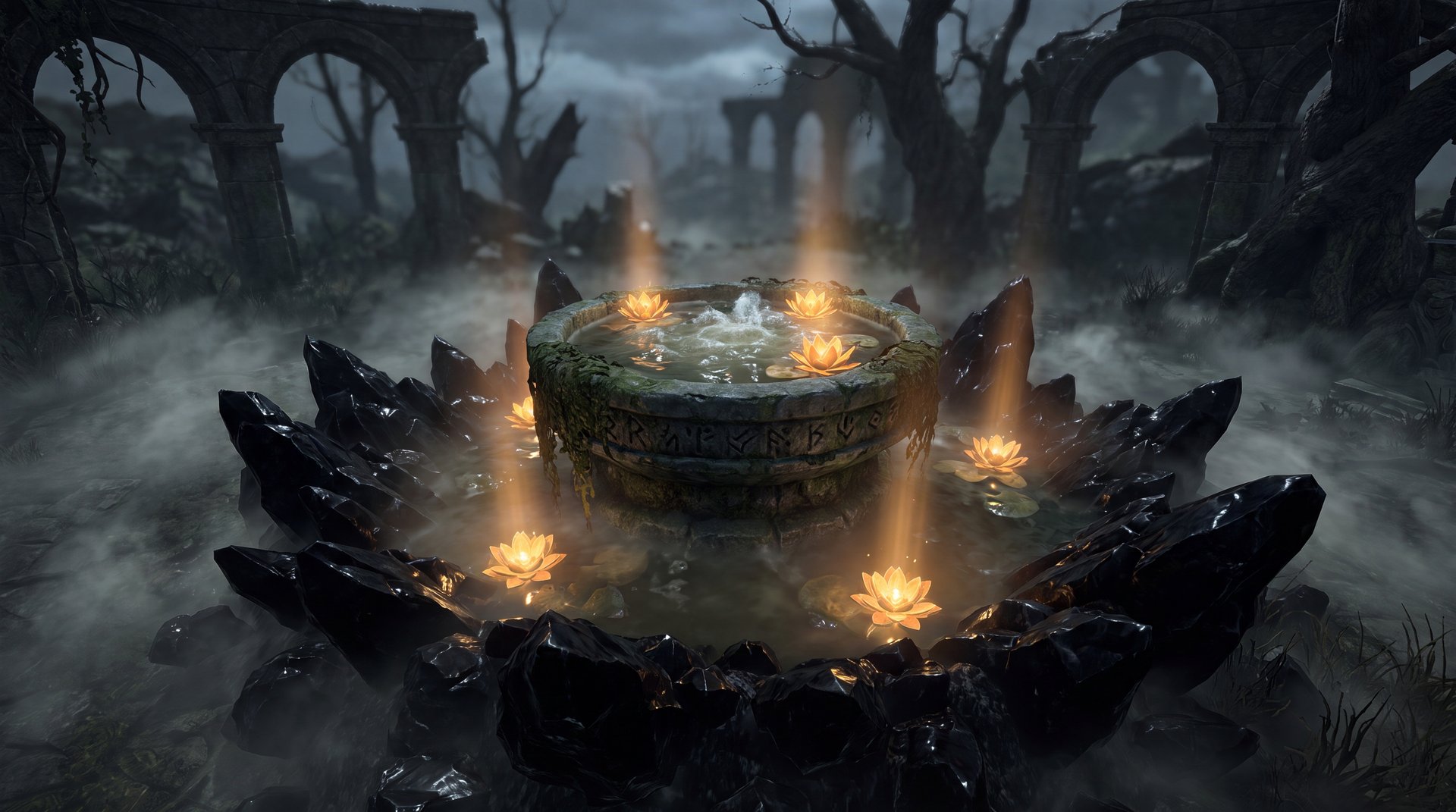
Pool Locations and Symmetry
The Radiant-side pool sits on the bottom lane near the Tier 1 tower area, accessible through a ramp system added in the 7.33 map rework. The Dire-side pool mirrors it on the top lane. Both are geometrically identical and operate on the same spawn timer. Neither team has a structural advantage in terms of pool placement — the distances from each fountain to each respective pool are roughly symmetric.
One key detail many players miss: you do not need to use your team’s “own” pool. A Radiant support who is farming near the Dire-side pool after a successful gank can collect from the Dire pool just as freely as from the Radiant one. The pools belong to whoever stands in them.
All Three Lotus Tiers Explained
Healing Lotus items evolve as the game progresses, both through automatic stacking in inventory and through timed upgrades tied to the neutral item schedule. Understanding all three tiers — and how to stack them — is the difference between using the pool as a minor HP top-up and turning it into a genuine item generation system.
| Lotus Tier | HP + Mana Restored | How Obtained | Stacking Rule | Available From |
|---|---|---|---|---|
| Healing Lotus (Stage 1) | 125 HP + 125 Mana | Collect from pool (0-36:59) | 3x combine into Great Lotus | 3:00 |
| Great Healing Lotus (Stage 2) | 400 HP + 400 Mana | 3x Stage 1 combine; pool spawns directly at 37:00 | 2x combine into Greater Lotus | ~6:00 if stacked; 37:00 from pool |
| Greater Healing Lotus (Stage 3) | 900 HP + 900 Mana | 2x Great Lotus combine; pool spawns directly at 60:00 | Does not stack further (separate slot) | ~9:00 if stacked; 60:00 from pool |
The cooldown between consecutive lotus uses is 5 seconds. You cannot use two lotuses simultaneously even if you hold both a Stage 1 and a Stage 2 — both share the same cooldown timer. One practical consequence: in a team fight, players should coordinate who uses their lotus when, because a single hero burning both a Great and a Stage 1 lotus in five seconds is less efficient than spreading the uses across the team.
Sharing Lotuses With Allies
Lotuses are shareable consumables. To use one on a teammate, hold Ctrl, press the item hotkey, then click the allied hero. This makes them valuable not just for the collector but for the whole team. A support with three Stage 1 lotuses can auto-combine them into a Great Lotus that restores 400 HP to a low-health carry — effectively delivering a free Salve-equivalent without spending a single gold piece.
Stacking Mechanics: What Actually Happens in Your Inventory
Multiple Stage 1 lotuses stack in a single inventory slot up to three, at which point they auto-combine into one Great Lotus. If you already have a Great Lotus and collect another Stage 1, the new one goes into a separate slot and begins its own stack toward the next combination. The same logic applies to Greater Lotus: additional Stage 1 or Stage 2 lotuses go into their own slots and stack independently.
The important restriction is that a Greater Lotus does not stack with anything. Once you have one, it sits in its own slot permanently until used or combined into a Block of Cheese.
The 7.41 Patch Change — How Enemy Presence Now Works
Before patch 7.41, when an enemy hero entered a Lotus Pool, the spawn countdown simply paused. Walk into the pool, the timer freezes until you leave. This made pool denial relatively low-cost: a single hero could stall out the spawn indefinitely by standing in the radius without any real commitment.
Patch 7.41, released in March 2026, changed this rule fundamentally: Lotus Pools (and Wisdom Shrines) now reverse their spawn countdowns when heroes from opposing teams are present, instead of pausing them. Time that had already accumulated toward the next lotus spawn is wound backwards at the same rate it would normally accumulate forward.
This change has two major implications for support play. First, using an enemy hero to deny a lotus takes significantly longer than before. If you send your pos 4 to stand in the enemy’s pool and contest it, you are committing real time to actually reverse meaningful progress — not just freeze a timer. Second, your own pool becomes harder for the enemy to disrupt passively. A single enemy scout standing in your pool at the last second used to nullify the spawn entirely; now they need sustained presence to erase the countdown you have already built up.
The net result is that aggressive, sustained pool denial requires more manpower and more commitment, which increases the value of simply being the first team to consistently collect your lotus every three minutes rather than trying to contest the enemy’s.
The Lotus Pool as a Support Economy Tool
Support heroes in Dota 2 are starved of gold by design. The pos 4 and pos 5 typically collect 100-200 gold per minute from lane creeps in the early game while buying wards, smoke, and consumables. A Great Healing Lotus bought from a shop costs 110 gold. A Greater Healing Lotus costs 500 gold. Getting those for free, on a three-minute cycle, represents meaningful budget relief.
Consider the math across a 30-minute game. A pool that spawns at 3, 6, 9, 12, 15, 18, 21, 24, 27, and 30 minutes generates 10 lotuses over that span from each side. If a support collects six of those ten (missing some due to fights or bad positioning), they receive six Stage 1 lotuses. That is two Great Healing Lotuses — 800 HP and 800 mana in total regeneration — without spending a single gold coin on consumables. At standard shop prices, those two Great Lotuses would cost 220 gold. Over the course of a game, disciplined lotus collection can effectively offset the cost of one or two small support items.
The real value, however, is not just the gold equivalent — it is the sustain timing. A 125 HP restore at minute 5 during a contested lane, delivered exactly when the support is at 200 HP and considering whether to back, can change the outcome of a gank, a tower dive, or a first blood opportunity. The gold value does not capture the timing value.

Early Game: Laning Phase Control
The first lotus spawns at 3:00. In most pub games at the Herald-to-Archon level, this lotus sits in the pool until someone accidentally walks past it well after minute 5. That is a missed opportunity. In games where both pos 5 players know what they are doing, the 3:00 lotus becomes a contested resource that can shape the entire laning phase.
When to Route Through the Pool
The standard rotation is to walk toward the pool at approximately 2:45, stand in the center at 3:00, collect the lotus, and return to lane. The round trip takes roughly 15-20 seconds depending on hero movement speed. For a pos 5 who is not actively needed in lane at that exact moment — for example, after a successful level 1 ward placement — this is almost always a correct rotation.
The key is not waiting for the 3:00 lotus exclusively. The 6:00 lotus is often more impactful because both carries now have their core level 3 skills, fighting is more intense, and 125 HP can represent the margin between trading successfully and dying. Supports who check the pool once and forget about it are leaving value behind every three minutes.
Best Support Heroes for Pool Control
The ideal pool-contesting support is one who can force the enemy out of the area quickly or who has movement speed and natural proximity to the pool during the laning phase. Heroes with strong laning presence near the side lane positions naturally pass by the pool more often. Some standout options:
- Crystal Maiden — slow movement speed is a liability for quick pool grabs, but Arcane Aura gives allies mana sustain that reduces dependence on the lotus mana component, letting CM prioritize HP recovery from shared lotuses more efficiently.
- Clockwerk — Hookshot and Battery Assault can clear an enemy out of the pool zone fast, making Clockwerk one of the best pool-denying pos 4 heroes in 7.41d. His rotation speed with Power Treads is also good.
- Shadow Demon — Disruption provides a brief window to collect without enemy interference. SD can also contest safely from range by applying Demonic Purge slows.
- Elder Titan — the slow movement speed of natural spirit makes ET a poor solo pool runner, but Echo Stomp can lock down an enemy who tries to sit in the pool to deny.
- Rubick — exceptional at pool rotations because Telekinesis clears enemies out of the pool zone on a short cooldown and Rubick’s move speed with arcane footwear is competitive.
Contesting the Enemy Pool in the Laning Phase
If your pos 4 has the mobility and tempo advantage in the early game, occasionally walking into the enemy’s pool at 2:45 to reverse their countdown is a legitimate disruption tactic. The enemy pos 5 must now either leave their carry to contest you, give up the lotus, or risk you reversing 1-2 minutes of spawn progress. This is most effective when your opponent’s support is weak, out of position, or already low on HP from a bad trade.
Do not overcommit to this strategy. If the enemy pos 4 is a hero with strong kill potential on yours — Lion, Shadow Shaman, or a Hoodwink with good starting items — getting caught alone in the enemy’s pool at minute 3 can result in a first blood that erases all the lotus value you were trying to generate.
Mid Game: Group Timing and Objective Control
Once the laning phase ends and heroes start rotating, Lotus Pool management shifts from individual support discipline to team coordination. The fundamental opportunity in the mid game is timing major objectives — Roshan, high-ground pushes, tower dives — around lotus spawns rather than missing them.
Reading the Pool Timer as a Team Resource
The lotus spawn timer is visible to all players on the minimap as a small indicator above each pool. In an organized or semi-organized team, the pos 4 or pos 5 should call out pool readiness before major objectives. “Pool ready in 30 seconds — let’s stack and collect before we hit Rosh” is the kind of callout that costs nothing and can give your whole team 125-400 extra HP going into a critical fight.
The mid game is also where the Great Healing Lotus combination starts to matter regularly. A support who has been collecting since minute 3 may already be sitting on a Great Lotus by the 9-12 minute mark (three collections combined). In a teamfight at minute 12, that 400 HP + 400 mana restoration on a key carry or offlaner can be the difference between a fight won and one thrown.
Farming the Pool as a Core During the Mid Game
Lotus Pool value is not exclusive to supports. Cores who are split farming near the side lanes — particularly carries farming the bottom safelane after winning the lane — should check the pool as part of their camp rotation. The pool sits adjacent to the side lane farm path and adds essentially zero movement-speed overhead if the carry is already in that area. A carry who picks up a lotus every 6-9 minutes while farming will burn fewer Mangoes and Clarities, keeping that gold on actual items.
Late Game: Greater Lotus and Block of Cheese
At 37:00, the Lotus Pool stops spawning Stage 1 Healing Lotuses and begins spawning Great Healing Lotuses directly. This single change doubles the per-collection value without any additional effort from the team. The same three-minute cycle now delivers 400 HP and 400 mana instead of 125. Teams that consistently collect the pool during the mid game are usually already sitting on combined Great Lotuses; the pool upgrade at 37:00 simply accelerates the accumulation of Greater Lotuses.
How to Build Toward Greater Lotus
The natural accumulation path without any special routing looks like this: collect Stage 1 lotuses at 3, 6, and 9 minutes — they auto-combine into a Great Lotus by the 9-minute mark. Collect three more at 12, 15, and 18 minutes — another Great Lotus by 18. Those two Great Lotuses then auto-combine into a Greater Lotus in inventory. By minute 18, a support who missed no collections will have a free Greater Lotus in their bag, restoring 900 HP and 900 mana on use. That is a Mekansm-level heal available on demand as a consumable.
In practice, some collections will be missed due to fights, ganks, or forgetting. But even collecting 60-70 percent of available lotuses over the first 20 minutes usually means reaching at least one Greater Lotus before the game hits its decisive late-game phase.

Block of Cheese: The End-Game Payoff
The Block of Cheese is one of Dota 2’s most unusual items. It is created by combining three Greater Healing Lotuses with Cheese — the consumable that drops from Roshan on his second and subsequent deaths. The resulting item grants a permanent 500 HP shield that regenerates 100 HP per second. The regeneration pauses for 5 seconds whenever the holder takes damage from an enemy hero, but the shield itself does not expire.
| Item | Components | Effect | When Relevant |
|---|---|---|---|
| Cheese | Drops from 2nd+ Roshan | Restores 1500 HP + 1000 mana instantly | Any stage where Rosh has died twice |
| Greater Lotus | 2 Great Lotus combined | Restores 900 HP + 900 mana | Available naturally by mid-late game |
| Block of Cheese | 3 Greater Lotus + Cheese | Permanent 500 HP shield + 100 HP/sec regen | Late game only; 2nd Roshan required |
The Block of Cheese is particularly effective on tanky heroes with damage reduction or status resistance — Ursa, Bristleback, and Timbersaw are examples where the passive regeneration from the shield combines with existing mitigation to make the hero almost unkillable in extended fights. However, any hero benefits from 500 bonus HP in a critical fight; even a squishy pos 5 who manages to acquire one becomes significantly harder to burst in the final teamfight.
Getting the Block of Cheese requires planning. Your team needs to force a second Roshan death to get the Cheese, and someone needs to be sitting on three Greater Lotuses at that moment. This means your support’s lotus discipline over the first 30+ minutes directly enables one of the game’s most powerful late-game items. It is not a coincidence — it is the deliberate design of a reward for consistent pool management.
How to Contest the Pool and Deny the Enemy
With the 7.41 reversal mechanic in place, pool denial requires real commitment. Here is what that looks like in different scenarios:
Scenario 1: Passive Denial — One Hero Occupying the Pool
Before 7.41, sending one hero into the enemy pool at the last 30 seconds of the spawn cycle would pause the timer and deny the lotus effectively. After 7.41, that same hero now needs to spend 30 seconds in the pool just to reverse the 30 seconds of spawn progress already accumulated — and then the countdown starts over when they leave. For the denial to achieve anything, the hero must stay in the pool longer than the time remaining on the spawn, which at late spawn stages means standing there for several minutes. This is almost never worth the lane or farm time lost.
Scenario 2: Active Denial — Killing or Zoning the Enemy at the Pool
The most efficient denial in the current patch is not staying in the pool but killing or forcing out the enemy hero who came to collect. If your pos 4 shows up at 2:50 and the enemy pos 5 is already standing in the pool waiting for 3:00, fighting them directly is more efficient than simply entering the pool yourself. Winning that fight takes the enemy support out of the lane and out of the pool without committing your own hero to a prolonged zone-hold.
Scenario 3: Trade Denial — Accepting the Enemy Gets Their Lotus
Given the cost of active denial after 7.41, the correct play in many situations is to let the enemy collect their pool lotus and focus on ensuring your own team collects consistently. A match where both teams collect their respective pools every three minutes is neutral in terms of lotus economy. A match where your team collects every cycle and the enemy does not is a meaningful advantage. Do not trade your own lotus income chasing a denial that costs more hero presence than the 125 HP is worth.
Common Mistakes by Rank
Herald to Crusader: Completely Ignoring the Pool
The most common mistake at low ranks is not knowing the pool exists or treating it as irrelevant. Players in this bracket often have unused lotus stacks sitting at cap for 10-15 minutes because nobody is collecting. If you are the only player in the game who consistently checks the pool, you have a free advantage that requires zero mechanical skill to execute.
Archon to Legend: Collecting But Not Stacking
Players in this bracket know to collect lotuses but often use Stage 1 lotuses immediately on minor HP deficits instead of letting three combine into a Great Lotus. Using a 125 HP lotus when you are at 700 out of 800 HP is almost always wrong. Save the stack, combine it, and use the Great Lotus on a more impactful moment — or share it with a carry who is at 30 percent HP heading into a fight.
Ancient to Divine: Over-Committing to Denial
Higher-rank players understand the pool and sometimes tilt into overly aggressive denial — walking into the enemy pool and sitting there long after the reversal mechanic has made the effort pointless. Spending 90 seconds of your pos 4’s time to deny one lotus worth 125 HP is a net negative when you could have used that time to pull a camp, place a ward, or stack for your carry.
Practical Per-Minute Checklist for Support Players
Consistent lotus collection comes down to building a habit around the three-minute timer. This table gives you a simplified framework for integrating pool management into a normal support game flow, accounting for typical support responsibilities at each stage.
| Time Window | Lotus State | Support Action | Priority |
|---|---|---|---|
| 0:00 – 2:45 | Not spawned yet | Place ward stack, stack camps at 0:53 if applicable | Ignore pool |
| 2:45 – 3:00 | Spawning at 3:00 | Route to pool center; collect at 3:00 | High if safe |
| 3:00 – 5:45 | Stage 1 collected; next at 6:00 | Return to lane; harass; rotate to mid if needed | Normal lane duties |
| 5:45 – 6:00 | Spawning at 6:00 | Check pool if not in active fight | Medium — fights take priority |
| 9:00 | 3rd Stage 1 auto-combines to Great Lotus | Note you now have Great Lotus in inventory | Passive — no action needed |
| Every 3-min cycle | New lotus spawning | Collect if route allows; share if ally needs HP more | Situational — read game state |
| 37:00+ | Pool spawns Great Lotus directly | Prioritize collecting — double value per spawn | Very high when safe |
| After 2nd Rosh | Cheese available | Hold for Block of Cheese if you have 3 Greater Lotuses | Situational — game-state dependent |
Integrating Lotus Pool Into Your Support MMR Climb
Lotus Pool discipline is a 0-gold habit. It does not require better mechanics, better game sense about fights, or better draft decisions. It requires remembering to check a location every three minutes. That accessibility makes it one of the most efficient improvements a support player can make, especially in the Herald-to-Ancient range where the habit is almost universally absent.
The support role has unique boosting considerations compared to carry positions — pos 5 and pos 4 climbs depend heavily on sustained utility across fights, and a support who consistently enters teamfights with 400+ more HP from Great Lotus collections simply survives longer and provides more value per game. Consistent pool collection is the kind of habit that does not show up in a highlight reel but shows up clearly in average game impact over 50-100 games.
If you are working on a broader understanding of what separates climbing supports from static ones, our complete MMR boost guide covers the habits that actually move the needle across each rank band. For players who want to understand whether the risk profile of optimizing for MMR externally aligns with their goals, this breakdown of how Dota 2 boosting safety works in 2026 covers the key questions honestly.
Players who want to understand the support role’s item choices more broadly — including when to prioritize utility over sustain — should also check our BKB vs Linken’s vs Lotus Orb decision guide, which covers how to choose the right defensive item for each game state, a decision every support faces regularly.
Frequently Asked Questions
Want Someone to Climb While You Study the Meta?
Understanding Lotus Pool mechanics is one piece of the support economy puzzle. If you want to reach a rank where the fundamentals actually matter — where teammates check the pool, stack camps, and play around objectives — a professional boost can get you into those lobbies faster.
TeamSmurf works exclusively with Dota 2 and uses verified high-MMR boosters who understand exactly the kind of strategic detail covered in guides like this one.