Dota 2 Boosting for Support Players: Yes, Pos 5 Boosts Exist

Ask anyone about MMR boosting and they will picture a carry player — a Phantom Assassin spammer or a Juggernaut one-trick blasting through Ancient. That picture leaves out roughly a third of every Dota 2 lobby. Support players — the ward-planters, the save-casters, the smoke-buyers — grind just as hard and suffer just as many frustrating losses. They deserve the same option.
Yes, pos 5 boosts exist. TeamSmurf runs dedicated support role boosters who play nothing but positions 4 and 5. This guide covers exactly what a support boost looks like, why the role is harder to climb in, which heroes professional-level support boosters use, and what timeline you should realistically expect before placing an order.
Table of Contents
Why Support MMR Is Harder to Grind
Carry players have a clean feedback loop: kill creeps, buy items, kill heroes, win buildings. The stat line reflects individual effort in a way that carry roles reward reliably. Support MMR is murkier. You can drop three perfect smokes, land every setup, hit every save — and still lose if your cores refuse to follow up. The MMR boosting guide explains this asymmetry in detail, but the core issue is simple: supports depend on teammates executing correctly more than any other role.
There are four structural reasons support climbing is harder than carry climbing at the same skill gap:
- Impact ceiling: A 7,000 MMR player in the 2,000 MMR bracket can single-handedly win games as a core by taking over the map. That same player in the support role is still limited by what their cores do with the space created. The gap narrows but never disappears.
- Comeback mechanics favor cores: Buyback, Aegis, and late-game item spikes are core tools. Supports who fall behind on net worth recover slowly and often become liabilities if the game goes late.
- Ward and vision value is invisible: A perfect ward rotation prevents ganks that never happen. Preventing something is nearly impossible to attribute in post-game stats. Teammates rarely know what they owe you.
- Role queue abuse in lower brackets: Players queue support to get into lobbies faster and then play selfishly, taking farm and fighting for last-hits instead of stacking and pulling. This leaves genuine support players babysitting low-priority cores who are farming badly anyway.
None of this means support is unplayable for grinding. High-skill support players do climb. But the process takes more games — sometimes 40-60% more games than an equivalent carry player at the same MMR gap. If your goal is to reach a specific rank before a season deadline, or to play with friends at a higher bracket, a professional boost is a practical shortcut that the carry-centric marketing rarely acknowledges applies equally to you.
What a Pos 5 Boost Looks Like
A support MMR boost runs identically to a carry boost from an account-safety and logistics standpoint. The difference is entirely in how the booster plays inside your account. Here is the full flow:
Step 1 — Order and account handoff
You specify your current MMR, your target MMR, and that you want the boost played in the support or pos 5 role. TeamSmurf matches you with a booster whose primary role is 4/5 rather than assigning whoever is available. After you hand over your credentials, account safety protocols kick in — VPN set to your country, incognito mode, offline status if requested.
Step 2 — Role queue selection and hero picks
The booster queues into the same role-queue system you use. They select position 4 or 5 depending on what serves the win condition best in a given game — most orders default to hard support (pos 5) unless the client specifies a preference. First picks frequently go to safe, high-impact support heroes (detailed in the hero pool section below).
Step 3 — Communication and progress updates
TeamSmurf boosters send progress updates after every session. You know the current MMR, the win rate, any unusual games (disconnects, server issues, unfavorable matchups), and the estimated games remaining. You can log in to check replays at any time. The booster will not play while you are online — scheduling coordination prevents overlap and keeps the account looking natural.
Step 4 — Delivery and handoff
When the target MMR is hit, the booster logs off and the account returns to you. Some clients use the final session window to ask their booster which heroes they found strongest and what habits made the biggest difference — it is an optional learning benefit that many support players take advantage of.
Solo vs. duo options
Support players have a specific advantage with duo boosting. Pairing with a booster who plays carry means you are the one at the keyboard — you play support while your duo partner stomps the carry role. Your support decisions get sharpened in a real game environment while the win rate is still controlled by a professional. Many support players prefer duo for the learning component, even at a slight cost premium.
| Boost Type | Best For | You Play? | Cost vs. Solo |
|---|---|---|---|
| Solo (pos 5) | Fastest MMR gain, account away | No | Base rate |
| Duo (you support) | Learning + MMR gain simultaneously | Yes | +20-30% |
| Duo (you core) | Support booster carries the game | Yes | +20-30% |
| Coaching only | Skill improvement, no MMR change | Yes | Per session rate |
Hero Pool Used by Support Boosters
Support boosters at TeamSmurf are not utility players who dabble in the role. They are specialists who have dedicated thousands of hours to the support position. Their hero pools are built around reliability across brackets — heroes that punish low-MMR mistakes while remaining strong against opponents who are playing better than average.
High-priority hard support (pos 5) picks
The best support boosters in 2026 consistently reach for a core group of heroes. These are not necessarily the pub-popularity leaders — they are the heroes that a high-skill player can snowball a game through at any MMR range.
- Crystal Maiden: Global presence through Arcane Aura, reliable stun, and an ultimate that punishes grouped enemies in low-bracket teamfights. CM rewards good positioning and punishes bad positioning from opponents predictably.
- Lion: The two-stun lockdown makes him lethal in coordinated ganks. Mana Drain destroys mana-dependent heroes in the early game. An experienced booster can chain stuns with minimal item investment for instant impact.
- Witch Doctor: Self-sufficient, punishing Maledict output against bunched enemies, and his ultimate is one of the highest single-target damage tools in the support pool. Consistent in any patch variant.
- Shadow Demon: Soul Catcher plus Disruption is a two-second guaranteed combo kill on most targets in the lower brackets. Shadow Poison provides consistent harass without mana cost concerns.
- Lich: Chain Frost punishes tight stacking that lower-bracket players do constantly. Frost Armor is underrated for reducing physical burst on carries. Strong in any meta because the ultimate scales with opponent mistakes.
- Ogre Magi: Nearly unkillable in the lane phase, Bloodlust provides one of the strongest early supports for an aggressive core, and Multicast makes Fireblast randomly devastating in extended fights.
Flex picks (pos 4) for aggressive boosters
When a booster takes position 4, the hero pool shifts toward heroes that can create independent pressure rather than purely enable a carry.
- Earthshaker: Echo Slam into a clumped team is a game-ending move. Low-bracket players cluster in constant teamfights, and an experienced Earthshaker spammer punishes this at every stage of the game.
- Sand King: Blink-Epicenter into a teamfight is the same concept as Earthshaker — punish grouping. Sand King additionally has strong offlane and support flexibility that lets a booster adapt to draft needs.
- Skywrath Mage: Celestial Wrath is one of the highest burst damage supports in the game. Paired with a setup ally, Skywrath simply erases targets. A high-skill booster can solo-kill out of position enemies reliably.
- Disruptor: Glimpse, Thunder Strike, and Kinetic Field produce an isolation setup that kills anyone caught out of position. Strong in the current role-queue meta where carry players often wander alone.
- Rubick: Spell steal rewards knowledge of the entire hero pool. A 7,000 MMR Rubick player knows 120 ultimate interactions and can swing teamfights with stolen abilities that the original caster never used properly.
Expected Timelines by Bracket
Timeline estimates for support boosts follow the same underlying math as carry boosts — win rate per game, average game length, and the size of the MMR gap — but support heroes have some specific factors that affect pace.
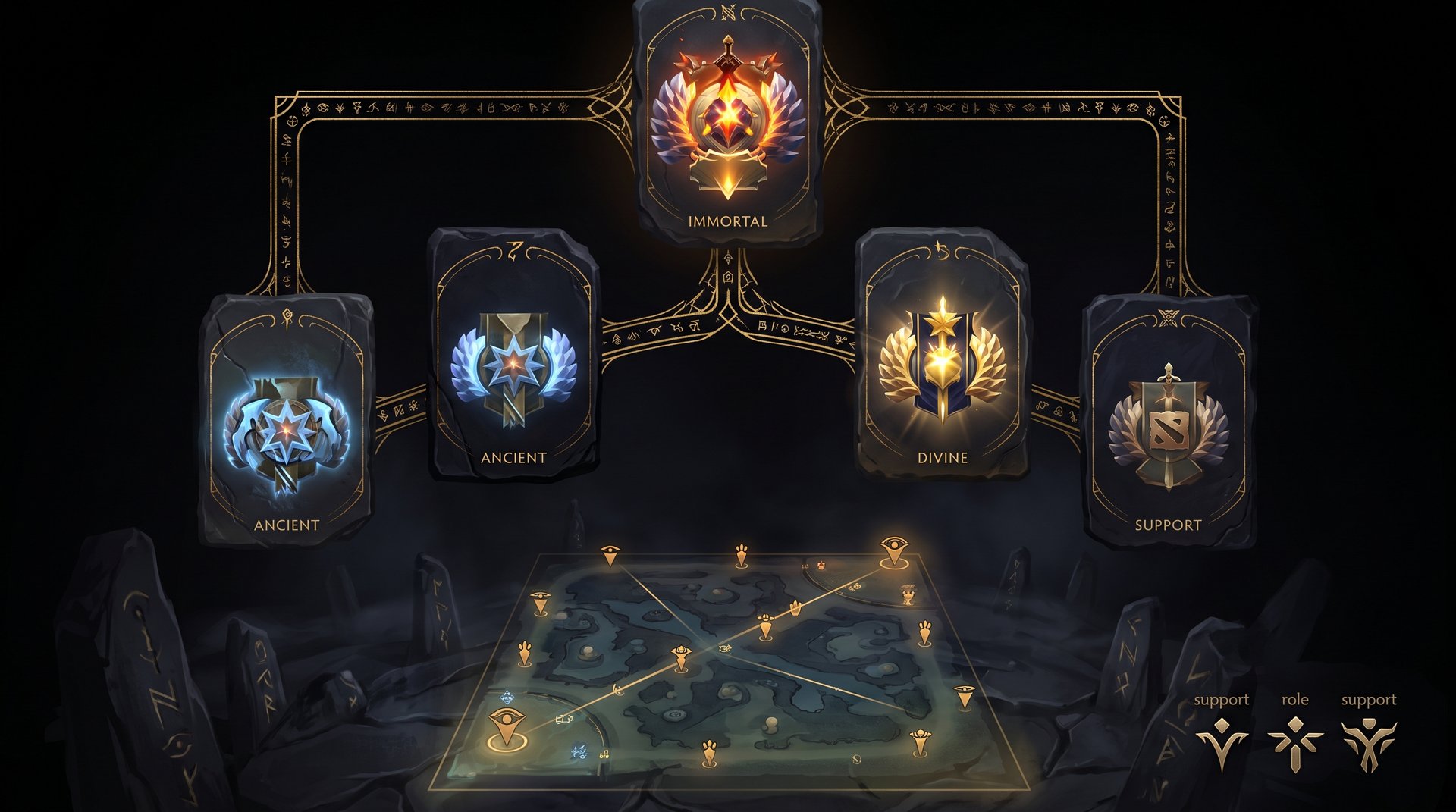
A support booster in the Crusader-Archon range (2,000-3,000 MMR) will typically achieve a higher win rate than in the Divine-Immortal range (6,000+), because the skill gap is larger relative to opponents. Game length in low-bracket lobbies tends to be longer due to hesitant decision-making, which extends hours-per-game but not games-per-day.
| MMR Range | MMR Gap | Estimated Games | Estimated Calendar Days | Win Rate Target |
|---|---|---|---|---|
| Herald – Guardian (0-1,500) | 500 | 15-25 | 3-5 days | 70-80% |
| Crusader – Archon (1,500-3,000) | 500 | 18-30 | 4-6 days | 65-75% |
| Legend – Ancient (3,000-5,000) | 500 | 22-35 | 5-7 days | 60-70% |
| Divine (5,000-6,500) | 500 | 28-45 | 7-10 days | 55-65% |
| Immortal (6,500+) | 200 | 20-30 | 7-12 days | 55-60% |
The ranges above assume a dedicated support booster playing 3-5 hours per day in the role. If you select a faster completion option (which means your booster prioritizes your account above others in the queue), timelines compress by roughly 30-40%. If you prefer a slower, less detectable pace with offline status enabled, add 2-4 calendar days.
Support boosts at the Immortal level are slower not because support heroes are weaker but because opponent quality at that bracket neutralizes the skill gap more efficiently. High-MMR players rotate to vision, track smokes, and punish overextension — the same tools a support booster uses are now in the hands of the enemy team.
TeamSmurf Dedicated Support Boosters
Most MMR boosting services assign whoever is available at the time of purchase. That works fine for carry roles where pool breadth is less critical, but it fails support players who need someone who understands vision denial, smoke discipline, and draft-dependent positioning at a deep level.
TeamSmurf takes a different approach. Support boosters are a separate pool from core boosters. Every booster in the support pool has reached Immortal rank playing primarily positions 4 and 5. They are tested on hero knowledge, ward placement rationale, and situational decision trees before being assigned support orders.
What TeamSmurf support boosters specialize in
- Laning phase control: Aggressive trilane setups, dual-lane harassment, and early tower dive timing decisions that most low-bracket cores never see coming.
- Vision networks: Professional-level ward placement covers the maximum number of rotations for the minimum ward count. This is a learned skill that takes years to develop — your booster brings that knowledge into your bracket.
- Smoke timing and path selection: Coordinated smokes in the midgame are a primary momentum driver in high-level Dota 2. A booster who understands smoke paths at the Immortal level creates kill opportunities that never appear in organic pub games at your rank.
- Draft flexibility: Support boosters communicate with the team in draft if the lobby permits, helping cores understand the game plan, or simply filling whichever support slot maximizes the draft’s win condition.
If you want to see their work in action before ordering, TeamSmurf offers coaching sessions with support specialists. One or two sessions reveal exactly what a high-MMR support player does differently — and that knowledge alone can shift your win rate even without a boost.
Should You Boost Your Support Account?
The honest answer is that a support boost makes more sense in some situations than others. Here is a framework for deciding.
Good reasons to order a support boost
- You want to play at your friends’ MMR bracket but cannot consistently grind there as support. A boost closes that gap permanently.
- Your core skills are already at a higher level than your MMR reflects (you played carry for years and recently switched to support). The boost moves you to the bracket where games feel correct.
- You are approaching a season calibration window and want a higher baseline before recalibration runs.
- You want to learn from the experience — especially relevant with a duo boost where you play support alongside your booster’s carry.
Situations where a boost may not be the right tool
- If you are trying to reach Immortal and your fundamentals are not there, a boost will deliver the number but the bracket will be unplayable for you. Coaching first, boost second is the better sequence.
- If you primarily want validation rather than a functional new MMR range, the boost delivers results but may not resolve the underlying satisfaction question.
- If your account has previous penalties or behavior scores near the penalty threshold, discuss account history with support before ordering.
The best Dota 2 boosting services should be transparent about both options. TeamSmurf recommends coaching alongside or before a boost for players trying to hold a new rank long-term — especially at the Ancient and Divine brackets where the game becomes heavily read-dependent.
Frequently Asked Questions
Ready to Climb as a Support Player?
Stop carrying the ward budget for teammates who do not rotate. TeamSmurf’s dedicated pos 5 and pos 4 boosters are Immortal-ranked support specialists — they know exactly how to turn vision and setup into consistent wins at every bracket.
Order a Support Boost Try a Coaching Session First