Dota 2 Teamfight Guide: Positioning, Target Priority & Execution

A 50-minute Dota 2 game often comes down to a single teamfight. One Ravage. One Black Hole. One perfectly placed Echo Slam. The winning team claims Roshan, pushes high ground, and ends the game–while the losing team watches their ancient fall. Teamfight execution is the most impactful skill in Dota 2, and yet it’s the least formally taught.
Most players approach teamfights with a vague sense of “use my spells and right-click someone.” But high-MMR teamfight execution is precise, choreographed, and systematic. Every player has a role. Every ability has an optimal timing. Every position on the battlefield matters. The difference between a 3K player and a 6K player in teamfights isn’t just mechanical speed–it’s the decision-making framework they use to process chaos and make the right play in milliseconds.
This guide breaks down every aspect of Dota 2 teamfighting: how to position before the fight begins, who to target first, what order to use abilities, the difference between frontline and backline roles, when to disengage, and how to execute devastating combos. Whether you’re an initiator, a carry, or a support, this guide will give you a concrete plan for every teamfight scenario.
Our MMR boosting team at TeamSmurf wins teamfights consistently across all brackets because they follow these principles. Let’s break them down.
Table of Contents
- Pre-Fight Positioning: Win Before the Fight Starts
- Initiation: Who Goes In, When, and How
- Target Priority: Who to Hit and Why
- Ability Usage Order: Maximizing Your Impact
- Frontline vs. Backline: Understanding Your Role
- Disengagement: Knowing When to Walk Away
- Wombo Combos: Chaining Abilities for Maximum Devastation
- Common Teamfight Errors and How to Fix Them
- Role-Specific Teamfight Guide
- Frequently Asked Questions
Pre-Fight Positioning: Win Before the Fight Starts
The outcome of most teamfights is determined before the first spell is cast. Pre-fight positioning–where each player stands relative to allies, enemies, and terrain–dictates who can initiate, who gets caught, and who survives.
The Positioning Triangle
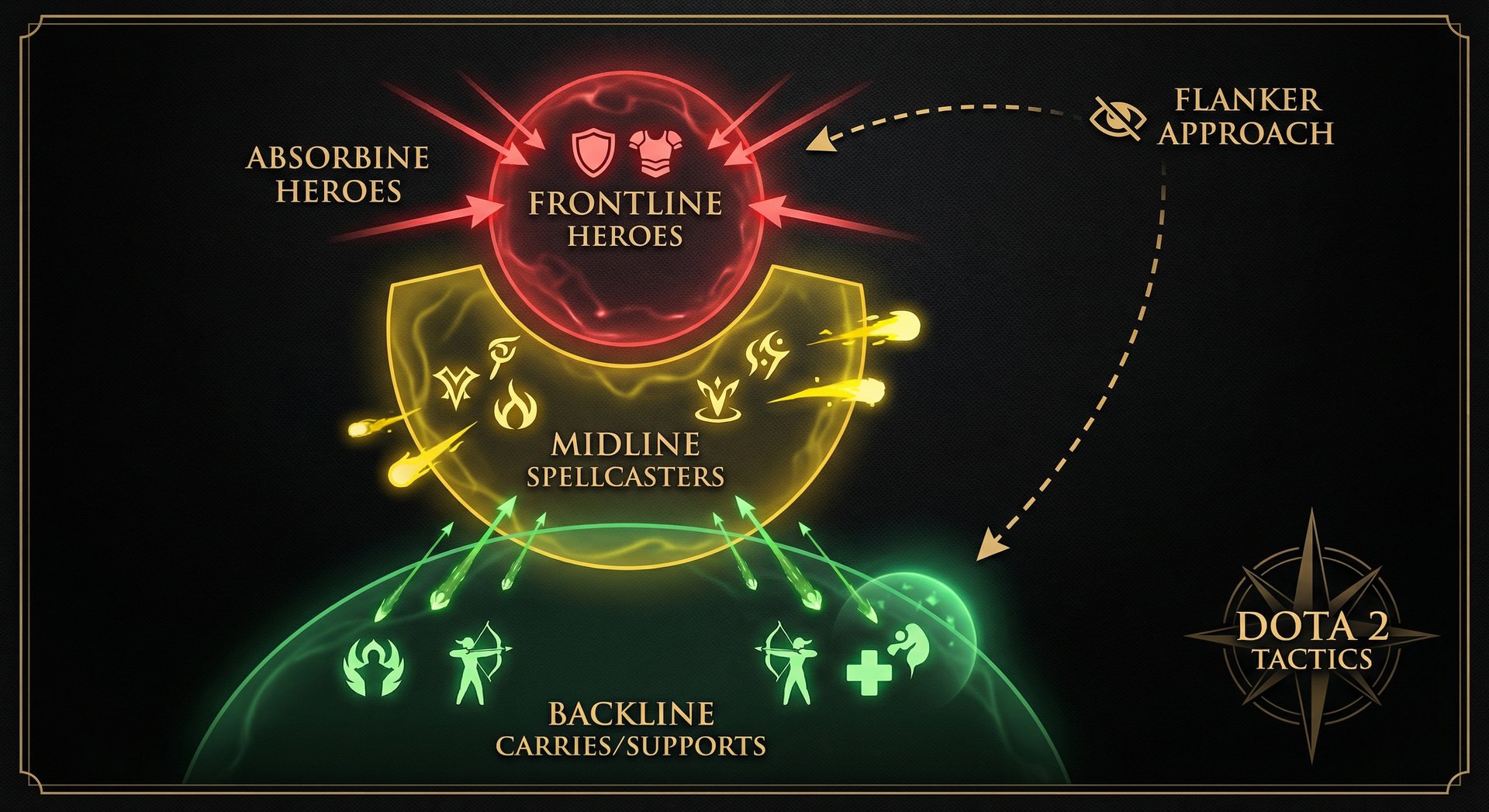
Think of your team’s positioning in three zones:
- The Frontline (Initiators + Tanks): These heroes stand closest to the enemy. Their job is to absorb initial damage, use crowd control, and create space for the backline. Typical heroes: Axe, Tidehunter, Mars, Centaur Warrunner, Bristleback.
- The Midline (Damage Dealers + Tempo Controllers): These heroes position behind the frontline but within range to deal damage and use abilities. They follow up on the initiation. Typical heroes: Storm Spirit, Lina, Puck, Queen of Pain, Ember Spirit.
- The Backline (Carry + Squishy Supports): These heroes position furthest from the enemy. The carry needs to stay alive to deal sustained damage. Supports need to stay alive to use their save abilities and items. Typical heroes: Sniper, Drow Ranger, Oracle, Dazzle, Crystal Maiden.
Pre-Fight Positioning Checklist
Before every teamfight, quickly assess:
| Question | If Yes | If No |
|---|---|---|
| Is my BKB ready | Position aggressively; you can commit to the fight | Position defensively; avoid being caught by magic damage |
| Is my initiator’s Blink Dagger off cooldown | Look for an aggressive Blink opening | Wait or force a fight through alternative means |
| Do we have vision of the enemy team | You can choose when and how to engage | Play cautiously; they might be setting up a counter-initiation |
| Are all five enemies visible | You know their positions; plan accordingly | Beware of flanks from missing heroes |
| Do we have Aegis/Cheese | Fight aggressively; you have a free death | Be more calculated; deaths are costly |
| Are we near our tower/base | Use tower damage as an advantage | You’re on their turf; need a clean initiation to win |
Terrain Awareness
Dota 2’s terrain dramatically affects teamfights:
- High ground advantage: Heroes on high ground have 25% uphill miss chance against them. Always fight from high ground when possible.
- Choke points: Narrow corridors (like jungle paths, Roshan pit entrance, base entries) amplify AoE abilities. Position your team to funnel enemies into choke points if you have AoE, or avoid choke points if the enemy does.
- Trees: Trees provide fog of war. Heroes can juke into trees to break line of sight. Initiators can hide in tree lines to set up surprise Blinks. Supports can position in trees to cast spells without being targeted.
- Roshan pit: Fighting inside the Roshan pit is extremely dangerous if the enemy has AoE. The confined space amplifies Echo Slam, Black Hole, and similar abilities. Only fight in Rosh pit if you’re confident you won’t get trapped.
The “Threat Range” Concept
Every hero has a “threat range”–the maximum distance from which they can initiate on or damage you. Understanding threat ranges is critical for pre-fight positioning:
- Axe with Blink: Threat range = Blink distance (1200) + Call radius (315) = ~1,500 units. Stay 1,500+ units away from potential Axe positions.
- Tidehunter with Blink: Threat range = Blink (1200) + Ravage radius (1250) = ~2,450 units. This is enormous–position accordingly.
- Storm Spirit: Threat range = effectively infinite (Ball Lightning has unlimited range with enough mana). You can’t outrange Storm; instead, you must have save abilities ready.
If you’re a carry player who keeps getting initiated on, you’re standing too close. If your threat range analysis says “Tidehunter can Blink-Ravage me from this distance,” move further back. This simple awareness prevents countless deaths.
Initiation: Who Goes In, When, and How
The initiation is the most critical moment of any teamfight. A good initiation wins fights your team has no business winning. A bad initiation loses fights you should have won easily.
Who Should Initiate
Your team’s designated initiator should have:
- A reliable AoE disable (stun, silence, or forced movement)
- A gap closer (Blink Dagger, innate mobility)
- Enough survivability to not die instantly after initiating
| Tier | Heroes | Initiation Tool | Reliability |
|---|---|---|---|
| S-Tier Initiators | Tidehunter, Enigma, Magnus | Ravage, Black Hole, Reverse Polarity | Game-ending when landed |
| A-Tier Initiators | Axe, Mars, Earthshaker | Berserker’s Call, Arena + Spear, Echo Slam | Very strong, slightly more conditional |
| B-Tier Initiators | Sand King, Centaur, Slardar | Epicenter, Stampede + Stomp, Crush | Good but requires specific positioning or setup |
| Counter-Initiators | Warlock, Naga Siren, Oracle | Chaotic Offering, Song, False Promise | Best used after the enemy commits first |
When to Initiate
The perfect initiation moment has these characteristics:
- Key enemy heroes are clumped: Initiating on one isolated hero is rarely worth using a big ultimate. Wait until 2-3 enemies are within AoE range.
- Your team is ready to follow up: An initiator who Blinks in while their carry is farming a jungle camp is dead. Make sure your team is grouped and aware of the plan.
- Enemy key abilities are on cooldown: If the enemy Tidehunter just used Ravage, it’s safe for YOUR team to go in without fear of counter-initiation.
- You have a numbers advantage: Initiating 5v4 or 5v3 is far safer than 5v5. Pick someone off first if possible, then initiate on the remaining enemies.
Initiation Execution
The mechanical execution of initiation follows a pattern:
- Pre-position: Move to a location where your Blink can reach the optimal target cluster. Use fog, trees, or smoke to avoid being seen.
- Signal your team: Ping your intention. Use chat wheel “I will initiate” or simply ping the target area.
- Wait for the moment: Patience is the hardest part. Wait until the clump happens, even if it takes 10-15 seconds of positioning.
- Execute: Blink → Ability → BKB (if needed). The entire sequence should take less than 0.5 seconds.
- Survive: After initiating, your job is to stay alive long enough for your team to follow up. Use defensive items (Blade Mail, BKB, Lotus Orb) to survive the retaliation.
Counter-Initiation: The Other Strategy
Not every team should initiate first. Sometimes the better strategy is to let the enemy initiate and then punish them:
- If the enemy has a stronger initiation ultimate (their Enigma vs. your Slardar), let them use their big spell first, survive it, and then counter-engage when their cooldowns are spent.
- Heroes like Oracle, Winter Wyvern, and Naga Siren excel at counter-initiation because their ultimates nullify the enemy’s initiation and turn the fight around.
- Counter-initiation lineups need strong save abilities (Shallow Grave, False Promise, Astral Imprisonment) to survive the enemy’s first wave of spells.
Target Priority: Who to Hit and Why
In the chaos of a teamfight, knowing who to target is often the difference between winning and losing. Hitting the wrong target wastes damage and time–two resources you can’t afford to waste.
The Target Priority Framework
Rank potential targets by asking these questions in order:
- Who is out of position The enemy hero who’s closest to you with no escape is the highest-priority target. It doesn’t matter if they’re the support–a quick kill creates a 5v4 advantage.
- Who has the highest impact if left alive If you can choose between targeting the enemy carry dealing massive damage and the enemy support, kill whoever is contributing more to the fight right now.
- Who has their key abilities on cooldown An Enigma who just used Black Hole is far less threatening than an Enigma holding it. Target heroes whose defensive cooldowns are spent.
- Who can you actually kill Don’t waste 10 seconds hitting a Bristleback’s back when you could kill their Crystal Maiden in 2 seconds. Kill what you can kill quickly, then move to harder targets.
Target Priority by Hero Type
| Priority | Target Type | Examples | Reasoning |
|---|---|---|---|
| 1 (Highest) | Squishy high-damage heroes in range | Sniper, Drow, Crystal Maiden, Shadow Shaman | Easy to kill, high fight impact if left alive |
| 2 | Key ability holders who’ve committed | Enigma after Blink, Axe after Call | Removing them prevents follow-up; they’re often vulnerable after initiation |
| 3 | Healing/save supports | Oracle, Dazzle, Witch Doctor | Their saves keep the enemy alive; removing them makes the rest of the fight easier |
| 4 | Enemy carry (if accessible) | PA, AM, Juggernaut | The primary damage source; but often hard to reach and tanky |
| 5 (Lowest) | Tanky frontliners | Bristleback, Timbersaw, Centaur | They WANT you to hit them; often have damage return or sustain mechanics |
The “Kill What’s Killable” Principle
In theory, you should always kill the highest-impact target. In practice, you should kill what you can actually kill in the fight’s timeframe. A 2-second support kill followed by a 5v4 fight is better than spending 10 seconds trying to kill a tanky carry while their team destroys yours.
This principle is especially important for carry players. Many carries tunnel-vision onto the enemy carry, ignoring the enemy support who’s standing right next to them and dealing massive spell damage. Kill the support in 2 hits, then turn onto the carry. Efficient target switching wins fights.
When to Switch Targets
Switch targets when:
- Your current target pops BKB (and you can’t pierce it)
- Your current target is saved (Ghost Scepter, Glimmer, Grave)
- A higher-priority target becomes accessible (enemy carry walks into range)
- Your current target has enough HP that killing them will take too long
Ability Usage Order: Maximizing Your Impact
The order in which you use abilities in a teamfight matters enormously. Using your ultimate first might seem instinctive, but often it’s wrong.
The General Ability Sequence
- Initiation ability (stun, disable, or gap closer)
- Defensive items (BKB, Blade Mail–use BEFORE dealing damage if you need them to survive)
- Damage abilities (nukes, damage-over-time, right-clicks)
- Ultimate (often saved for the optimal moment, not used immediately)
- Save items/abilities (kept in reserve for when allies are in danger)
Hero-Specific Ability Sequencing Examples
Axe (Initiator)
- Blink → Berserker’s Call (catch as many as possible)
- Blade Mail (during Call to reflect damage)
- Wait for enemy HP to drop below Culling Blade threshold
- Culling Blade the kill target (resets on kill–chain kills if possible)
Tidehunter (Initiator)
- Blink → Ravage (hit as many heroes as possible)
- BKB (if you have one, to prevent interruption)
- Anchor Smash (reduce enemy damage)
- Gush the primary kill target (armor reduction for your carry)
- Continue right-clicking or use Refresher for second Ravage
Crystal Maiden (Support)
- Frostbite the most dangerous target in range (disable first)
- Crystal Nova for AoE slow (reduce enemy damage output)
- Glimmer Cape on yourself or an ally in danger
- Freezing Field ONLY when the fight is committed and you won’t be immediately interrupted
- BKB (if you have one) to channel Freezing Field safely
Phantom Assassin (Carry)
- Wait for initiator to go in (do NOT be the first to enter)
- BKB when enemy disablers are focused on you
- Phantom Strike to the highest-priority killable target
- Stifling Dagger on fleeing enemies or secondary targets
- Satanic when HP gets low
- Switch targets once current target dies
The BKB Timing Question
When to pop BKB is one of the most important decisions in any teamfight:
- Pre-emptive BKB: Activate BKB before entering the fight to ensure you can use your abilities without interruption. Best for heroes who need to channel (Enigma, Crystal Maiden, Witch Doctor).
- Reactive BKB: Wait until the enemy uses their stun/disable on you, then BKB to remove it and gain spell immunity. Best for carries who want to bait out enemy abilities before committing.
- Never waste BKB on a lost fight. If three teammates are already dead and the fight is lost, save your BKB charges for the next fight. Each use reduces duration–wasting a charge is extremely costly.
BKB timing is one of the hardest skills to master and is a primary focus of our coaching sessions. A coach can watch your replay and pinpoint exactly when you should have used BKB in each fight.
Frontline vs. Backline: Understanding Your Role
Every hero in a teamfight has a designated zone. Playing in the wrong zone is one of the most common teamfight errors at all brackets.
Frontline Heroes
Who belongs here: Tanky initiators, offlaners, and melee cores with survivability.
Frontline responsibilities:
- Absorb initial damage and abilities
- Use AoE crowd control to disrupt enemy positioning
- Threaten the enemy backline (force them to retreat or reposition)
- Create space for YOUR backline to deal damage safely
- Buy aura items that benefit the entire team
Common frontline mistake: Chasing kills into the enemy backline while your own backline is unprotected. As a frontliner, your team’s squishy heroes need you more than the enemy’s fleeing support does.
Backline Heroes
Who belongs here: Ranged carries, squishy supports, heroes with channeled ultimates.
Backline responsibilities:
- Deal sustained damage from a safe distance
- Use save abilities (heals, disables, Force Staff) on frontline allies
- Avoid being caught by enemy initiators
- Maintain maximum attack range at all times
- Escape and survive if the frontline falls
Common backline mistake: Walking too far forward to “get a better angle.” As a backline hero, the safest hit is the best hit. Attack whoever is closest to you–don’t overextend to reach the enemy carry if it means entering their threat range.
The Flanker Role
Some heroes don’t fit neatly into frontline or backline–they’re flankers who attack from unexpected angles:
- Storm Spirit: Zips past the frontline to kill the enemy backline.
- Clockwerk: Hooks into the enemy backline, isolating a key target with Cogs.
- Spirit Breaker: Charges through the fight to hit the enemy carry or support from the side.
- Nyx Assassin: Approaches from invisibility to stun and burst a squishy target.
Flankers create chaos by forcing the enemy to fight on multiple fronts. A well-timed flank from Storm Spirit onto the enemy Crystal Maiden can completely change the dynamics of a fight.
The Peeler Role
Some heroes serve as “peelers”–their job is to protect the backline by removing threats that dive past the frontline:
- Oracle: False Promise on the carry when they’re dove. Fate’s Edict to disarm the diving enemy.
- Dazzle: Shallow Grave on the carry. Shadow Wave for heal/damage.
- Vengeful Spirit: Swap the diving enemy away from your carry.
- Lion/Shadow Shaman: Hex/Shackle the diving enemy to buy time for the carry to reposition.
In many pub games, no one plays the peeler role. The carry gets dove by an enemy Clockwerk, and all four teammates chase kills on the other side of the fight. If you’re a support player, protecting your carry is usually more impactful than dealing damage to the enemy.
Disengagement: Knowing When to Walk Away
One of the hardest skills in Dota 2 is knowing when a fight is lost–and not dying in a fight that’s already over.
Signs the Fight Is Lost
- Your initiator died without the enemy using their key abilities (they still have all cooldowns for you)
- Two or more teammates are dead and the enemy still has four or five heroes alive
- The enemy carry has BKB active and your team has no way to lock them down
- Your BKB is on cooldown and the enemy still has heavy magic damage
- The enemy has a significant HP advantage across their remaining heroes
How to Disengage
- Stop hitting and run. This sounds obvious but most players continue fighting in hopeless situations out of stubbornness or panic.
- Use TP scrolls. If you’re not being damaged for 3 seconds, you can TP to safety. Position behind trees or terrain to avoid being attacked while TPing.
- Use Force Staff/Pike on yourself. Push yourself 600 units away from the fight. This is often enough to break line of sight and escape.
- Use Glimmer Cape/Shadow Blade. Invisibility during disengagement buys critical seconds.
- Sacrifice one hero to save the rest. Sometimes one hero needs to stay behind and “tank” while the rest escape. This is usually the hero with the longest respawn timer who’s already low on HP.
The “Die to Win” Exception
Sometimes you SHOULD keep fighting even when the fight looks lost:
- When you have buyback and the enemy doesn’t
- When trading your life secures an objective (killing the enemy carry before dying)
- When running is impossible (you’re surrounded) and fighting gives a small chance of survival
- When your death triggers a benefit (Aegis resurrection, Wraith King passive, Vengeful Spirit illusion)
Wombo Combos: Chaining Abilities for Maximum Devastation
Wombo combos are coordinated ability chains that deal massive damage and control in a short window. They’re the highlight reels of Dota 2–and they’re the reason teamfight-oriented drafts are so popular.
The Anatomy of a Combo
Every combo follows this structure:
- Setup: A disable that holds enemies in place (stun, slow, root)
- Amplifier: An ability that increases damage taken (armor reduction, magic resistance reduction)
- Damage: AoE damage abilities that hit the controlled enemies
- Cleanup: Sustained damage to finish off survivors
Classic Wombo Combos
| Combo Name | Heroes | Sequence | Effectiveness |
|---|---|---|---|
| The Black Hole Special | Enigma + Dark Seer + Invoker | Vacuum → Black Hole → EMP + Meteor + Deafening Blast | |
| Magnus Cleave | Magnus + Ember Spirit | Reverse Polarity → Sleight of Fist (with Empower) | |
| Naga Setup | Naga Siren + Any AoE | Song of the Siren → Position AoE → Song ends → Meteor/Ravage/etc. | |
| Global Gank | Spirit Breaker + Zeus + Spectre | Charge → Haunt → Thundergod’s Wrath | |
| Echo Damage | Earthshaker + Phantom Lancer | Wait for PL illusions to swarm enemy → Echo Slam | (ironic counter) |
| Warlock Push | Warlock + Enigma + Jakiro | Black Hole → Chaotic Offering → Macropyre + Ice Path |
Building Your Own Combos
You don’t need a pre-planned wombo combo to chain abilities effectively. In every game, look for natural synergies:
- Any AoE stun + any AoE damage: Tidehunter Ravage + Gyrocopter Call Down. Sand King Epicenter + Luna Eclipse.
- Any repositioning + any AoE: Dark Seer Vacuum + anything. Mars Arena + anything inside it.
- Any save + any aggressive dive: Oracle False Promise on a diving Huskar. Io Relocate + any burst hero for a global gank.
The key is communication. Before the fight, tell your teammate: “I’ll Ravage, you follow with your ult.” This 3-second conversation can mean the difference between a perfectly executed combo and a chaotic mess where everyone uses their abilities independently. Learning to coordinate combos is something we prioritize in our coaching service.
Common Teamfight Errors and How to Fix Them
Error 1: The Support Who Hides Too Far Away
The problem: The support stands so far back that they can’t use their abilities on anyone.
The fix: Supports should be at the edge of cast range, not outside it. You need to be close enough to use your stun, heal, or save–but not so close that you’re the first to die.
Error 2: The Carry Who Fights First
The problem: The carry runs into the fight before the initiator, gets focused, and dies instantly.
The fix: Carries should NEVER be the first to enter a fight. Wait for your initiator to create space, then attack from the safest possible angle. Patience wins more fights than aggression for carry players.
Error 3: Ulting Too Early
The problem: Using your ultimate immediately, even when the enemy is spread out or your team isn’t ready to follow up.
The fix: Wait 2-3 seconds into the fight. Enemies clump up during fights (chasing or retreating), creating better ultimate targets. A Ravage that hits 5 heroes 3 seconds into the fight is worth infinitely more than a Ravage that hits 1 hero at the start.
Error 4: Chasing Kills Instead of Taking Objectives
The problem: Your team wins a fight 5-2, and instead of pushing a tower or taking Roshan, everyone chases the two fleeing enemies into their jungle.
The fix: After winning a fight, immediately assess: Can we Rosh Can we push a tower Can we push high ground Objectives win games; kills don’t. Getting two more kills but losing 30 seconds of push time is a net loss.
Error 5: Blaming Team After Lost Fights
The problem: After a lost fight, players immediately blame teammates instead of analyzing what went wrong.
The fix: Focus on what YOU could have done differently. Did you position correctly Did you target the right hero Did you use your abilities in the optimal order Self-analysis is the only way to improve. If self-analysis is difficult, our coaching provides external perspective.
Error 6: Fighting Without Key Abilities
The problem: Taking a fight when your Tidehunter’s Ravage has 20 seconds left on cooldown.
The fix: Before committing to a fight, check your team’s key cooldowns. If your initiation ultimate isn’t ready, avoid fighting unless forced. Communicate cooldown status: “Ravage in 15 seconds, wait.” This prevents premature engagements.
Role-Specific Teamfight Guide
Position 1 (Carry) Teamfight Guide
Your job: Deal the most sustained damage in the fight while staying alive.
Teamfight rules for carries:
- Never be the first to enter the fight
- Activate BKB before or immediately after being targeted
- Attack the nearest safe target (don’t tunnel-vision the enemy carry)
- Use Satanic/lifesteal when HP drops below 50%
- Retreat if the fight is clearly lost; your life is worth more than any other hero’s
Carries who consistently survive teamfights climb MMR fast. It’s not about getting rampage kills–it’s about being the last hero standing. This is why our boosters have lower death counts than average players at any given bracket.
Position 2 (Mid) Teamfight Guide
Your job: Provide burst damage and/or control at key moments.
Teamfight rules for mid:
- Look for kill opportunities on squishy targets
- Time your burst for after enemy BKBs expire
- If you’re a tempo mid (Puck, Storm), look for flanking angles
- If you’re a DPS mid (Shadow Fiend, Lina), position like a carry–backline, maximum damage uptime
Position 3 (Offlane) Teamfight Guide
Your job: Initiate, tank, and disrupt the enemy team’s plans.
Teamfight rules for offlaners:
- You are the initiator in most games–this is YOUR responsibility
- Wait for the right moment (don’t panic-Blink into one hero)
- Use aura items effectively (Pipe, Crimson, AC affect the entire team)
- After initiation, zone the enemy carry away from your own backline
- You can die in teamfights as long as your death creates space for your carry to clean up
Position 4 and 5 (Support) Teamfight Guide
Your job: Keep your cores alive. Use your abilities efficiently. Provide vision and information.
Teamfight rules for supports:
- Position at the edge of cast range–close enough to act, far enough to survive
- Prioritize SAVING allies over KILLING enemies (Force Staff your carry > stun the enemy support)
- Use your stuns/disables on heroes who are diving YOUR backline, not on frontline tanks
- Save Glimmer Cape/Force Staff/Grave for the carry, not for yourself (usually)
- Place aggressive wards during the fight or immediately after winning (while enemies are dead)
- Deward during fights if you can do so safely (enemy sentries visible)
Frequently Asked Questions
Conclusion: Master the Chaos
Teamfights are the most complex and impactful moments in Dota 2. They combine mechanical execution, strategic decision-making, team coordination, and split-second reactions into 10-30 seconds of controlled chaos. But “controlled” is the key word.
By establishing clear principles–position correctly before the fight, know your role (frontline/backline/flanker), target efficiently, sequence abilities optimally, and disengage when the fight is lost–you transform teamfights from coin flips into calculated advantages.
Start by focusing on one principle at a time. Spend five games exclusively working on pre-fight positioning. Then five games on target priority. Then five on ability sequencing. Building these habits one layer at a time creates a solid foundation that compounds into dramatically better teamfight performance.
If you want expert analysis of your teamfight play, our coaching service includes fight-by-fight replay breakdowns. For players looking to reach a bracket where teamfights are higher quality and more rewarding to play, our MMR boosting and calibration services can help you get there. And if low priority is keeping you from practicing in ranked, we’ve got that covered too.
Fight smarter. Position better. Win more teamfights. The MMR follows.
Ready to Climb Start Your Boost Today
Team Smurf is the #1 rated Dota 2 boosting service. Immortal-rank boosters, maximum safety, competitive pricing, 24/7 support.
Written by Team Smurf’s Immortal-rank analysts — Last verified February 2026