Dota 2 MMR Drop After Patch 7.41e: What Actually Happened

Your MMR number looks different after tonight’s Dota 2 update, and you are not imagining it. Valve’s Patch 7.41e “Summer Scrub” — released July 30-31, 2026 — includes a confirmed matchmaking change: Immortal Rank players had their MMR adjusted so that all players now sit between 1 and 9,500 MMR. This is an MMR squish, not a recalibration. Your relative rank and leaderboard position did not change. Below, we break down exactly what the official patch notes say, who is affected, why Valve did it, and what you should do right now.
What’s in This Guide
- What Actually Happened — The Short Answer
- What is Patch 7.41e and the Summer Scrub?
- The MMR Squish: Confirmed Details
- Who Is Affected?
- Why Valve Did This
- Full Matchmaking Changes Table
- TI 2026 Predictions — Does It Affect Your MMR?
- What You Should Do Right Now
- Removed Ranked Modes Explained
- How to Recover and Gain MMR Efficiently
- FAQ
What Actually Happened — The Short Answer
Valve released Patch 7.41e alongside the Summer Scrub 2026 on July 30-31. The patch contains hundreds of bug fixes and quality-of-life improvements. Buried in the matchmaking section is the change everyone is talking about: Immortal Rank players had their MMR numbers compressed. Every player is now between 1 and 9,500 MMR. The Immortal Draft cutoff remains at 8,500. Relative leaderboard positions are unchanged.
If your MMR number dropped tonight and you are an Immortal or high Divine player near the Immortal threshold, this is why. If you are in Herald through Legend, your specific MMR number was not modified by this change — though the broader ranked ecosystem shift will affect who you queue with at higher brackets.
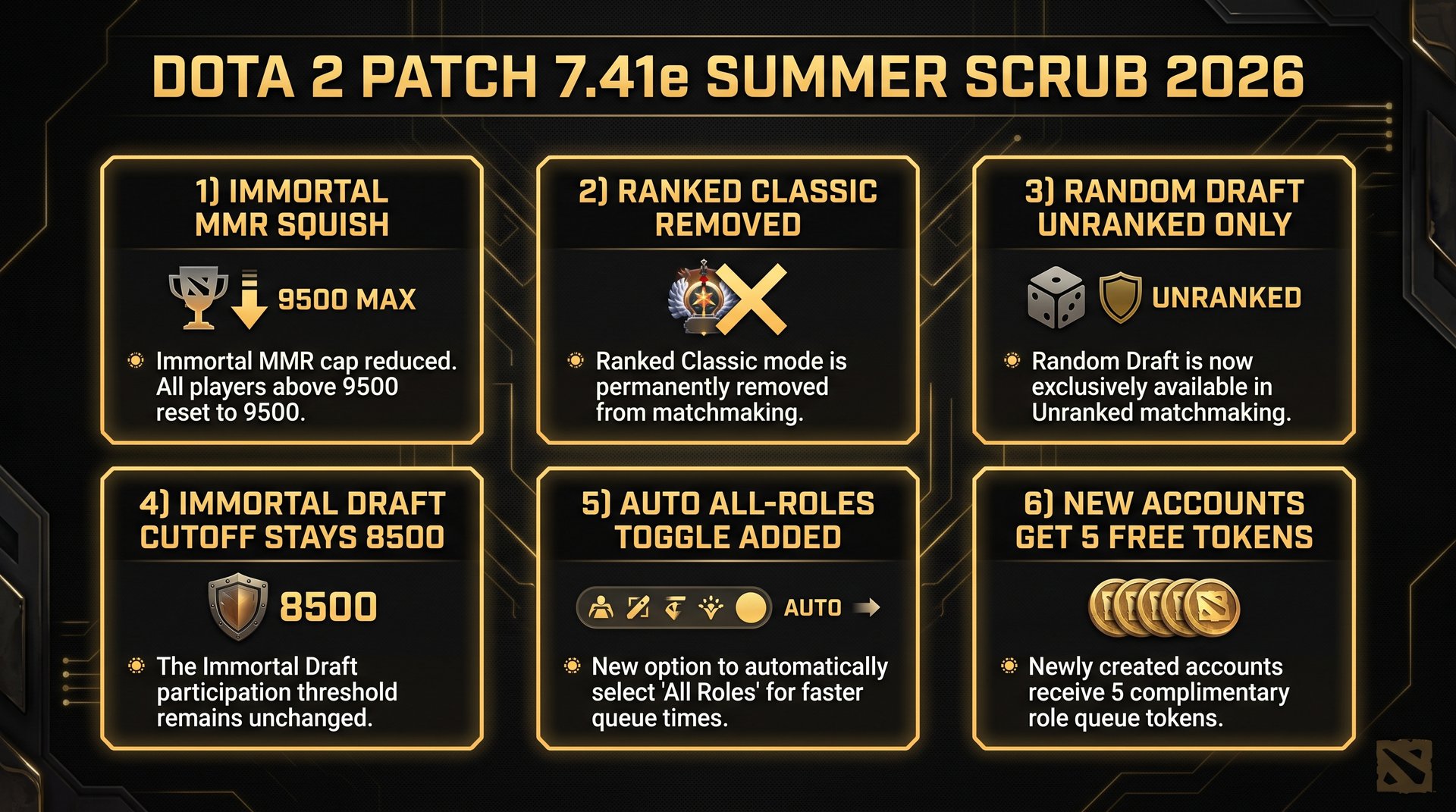
Six key changes in Patch 7.41e Summer Scrub — your quick reference before queuing ranked.
What is Patch 7.41e and the Summer Scrub?
Every year around The International, Valve ships what the community now calls a “scrub patch” — a large maintenance update that fixes bugs that have accumulated since the last major gameplay patch. The Summer Scrub 2026 is the biggest version of this tradition yet.
From the official Valve announcement (July 30, 2026):
“Dota is a complicated game, and while we greatly enjoy the creativity and diligence of the dedicated players who find intricate and absurd bugs, we also like fixing those bugs. So today we are also releasing the Summer Scrub, a huge collection of new features as well as fixes for gameplay and content bugs.”
The patch is numbered 7.41e, which means it is the fifth hotfix iteration of the 7.41 major patch. However, the scale of fixes is far beyond a normal hotfix — this is a dedicated bug-clearing operation. The full changelog lives at dota2.com/summerscrub2026 and covers:
- Gameplay bug fixes across dozens of heroes (Beastmaster, Morphling, Meepo gold exploit fix, Legion Commander Duel interactions, and many more)
- Item bug fixes (Parasma, Harmonizer, Soul Ring, Ironwood Nut)
- Ability Draft improvements and new draftable abilities
- Cosmetic and portrait fixes for over 30 heroes
- New Dota Plus feature: upgraded post-game breakdowns with Team Damage Mitigation, Ally Damage Contribution, and Dispel tracking
- Non-Hero Unit hotkey customization
- Matchmaking changes including the Immortal MMR squish
This patch launched alongside the TI 2026 Predictions, Fantasy, and Supporter Bundles — which are separate from the gameplay patch but arrived in the same update window. More on predictions below.
The MMR Squish: Confirmed Details
The Matchmaking section of the Summer Scrub 2026 official notes contains three sentences that are causing all the confusion tonight. Here they are, quoted verbatim:
Official patch notes — Matchmaking (dota2.com/summerscrub2026):
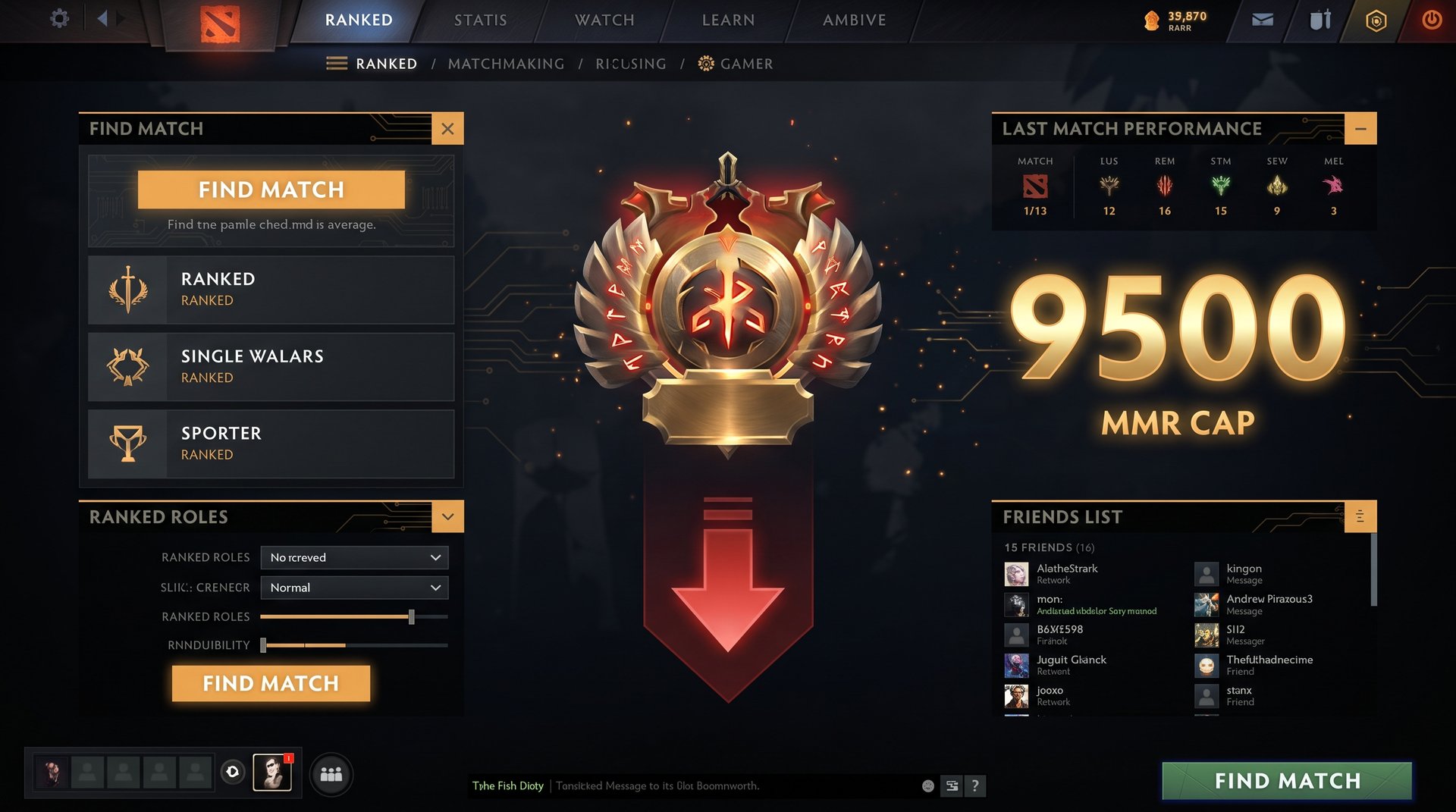
- “Immortal Rank players have had their MMR adjusted. All players are now between 1 and 9500 MMR.”
- “The cutoff for Immortal Draft is still 8500.”
- “Relative player placement and leaderboard positions are unchanged.”
What this means in plain English:
- Before tonight: Top Immortal players could have MMRs of 10,000, 12,000, or even higher. MMR numbers had been inflating upward for years with no ceiling.
- After tonight: The top of the ladder is capped at 9,500. Any Immortal player whose MMR was above 9,500 has been compressed downward to fit within the 1-9,500 band.
- Unchanged: The order of players on the leaderboard. If you were rank #1 on the Immortal leaderboard, you are still rank #1. The number next to your name is smaller, but your position is the same.
- Unchanged: The Immortal Draft cutoff at 8,500 MMR. This is the threshold above which players enter special Immortal matchmaking lobbies with additional scrutiny on hero selection.
What Does “All Players Are Now Between 1 and 9500 MMR” Mean?
This wording has created panic at lower ranks who wonder if their own MMR was modified. Based on the context — “Immortal Rank players have had their MMR adjusted” — the most accurate reading is that only Immortal players who had MMR numbers exceeding 9,500 were affected. If your MMR was already below 9,500, your number was not changed by this specific mechanic.
However, the knock-on effect for the broader player pool is real: with Immortal players compressed into a tighter band near the top, matchmaking pool dynamics shift slightly. Queue times and match composition for Divine and Immortal players may feel different in the days following this patch as the system recalibrates to the new distribution.
Who Is Affected?
| Rank Bracket | MMR Change Tonight | What You Should Do |
|---|---|---|
| Immortal (MMR above 9500) | MMR compressed to max 9500 | Check your new number — rank position is identical |
| Immortal (MMR below 9500) | No number change | Nothing — business as usual |
| Divine 5 (near Immortal threshold) | No direct change | Matchmaking pool may shift slightly — monitor queue times |
| Divine 1 through Divine 4 | No direct change | No action needed |
| Ancient through Herald | No change | No action needed |
If you are at Herald, Guardian, Crusader, Archon, Legend, or Ancient, your MMR number was not touched by this patch. The community reaction you are seeing on social media is dominated by Immortal players — which is why it feels like “everyone” lost MMR even when the change was limited to the top of the ladder.
What Players Are Saying
The r/DotA2 community reacted immediately when the Immortal MMR adjustment landed on July 30, 2026. The threads below capture the confusion, surprise, and mixed feelings from players who woke up to a different number on their profile.
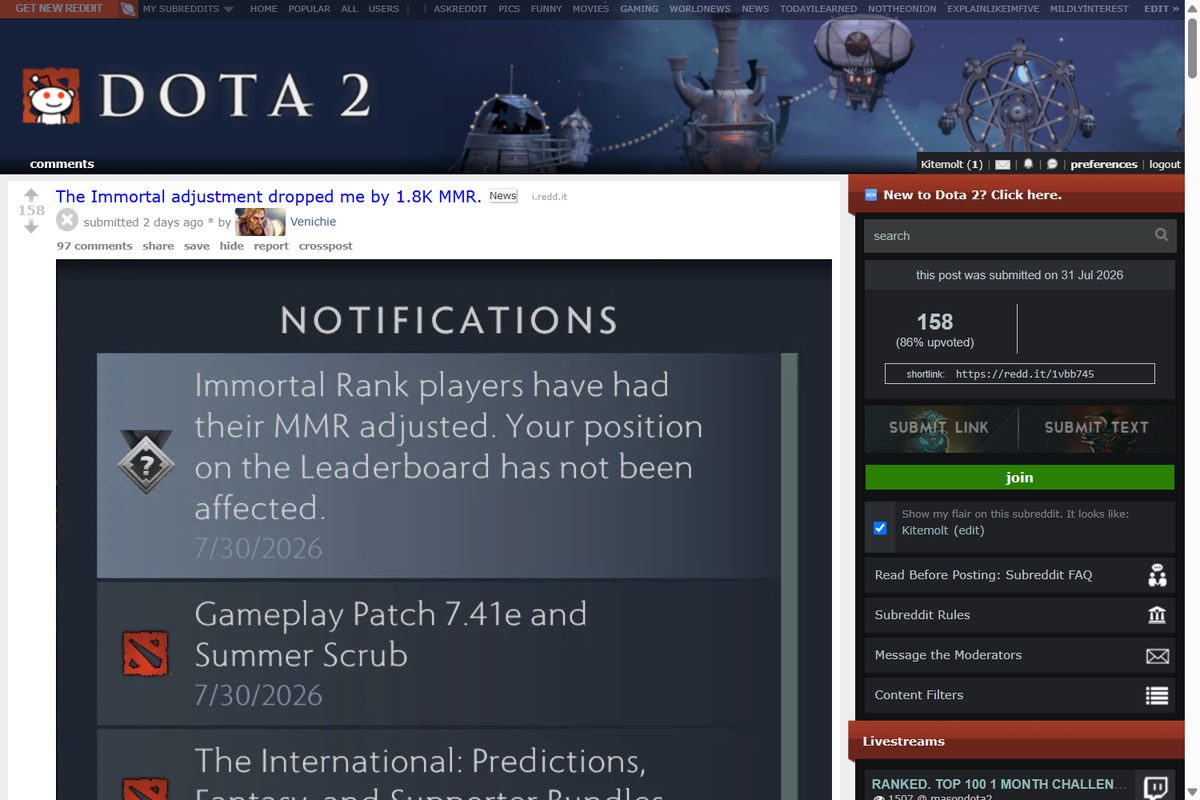
“The Immortal adjustment dropped me by 1.8K MMR.” — r/DotA2
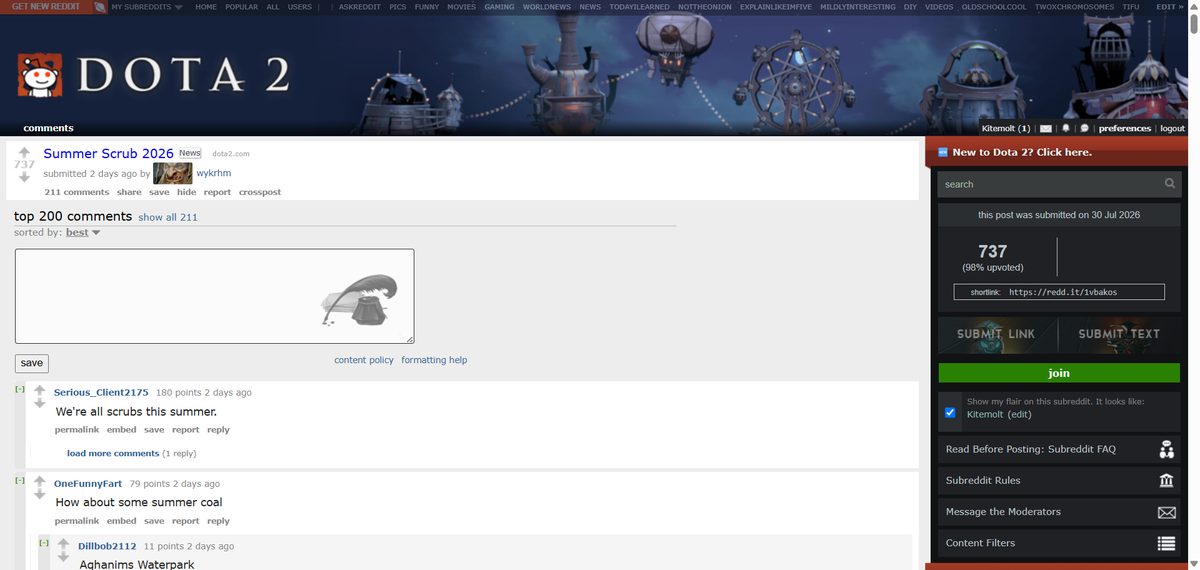
“Summer Scrub 2026” — r/DotA2
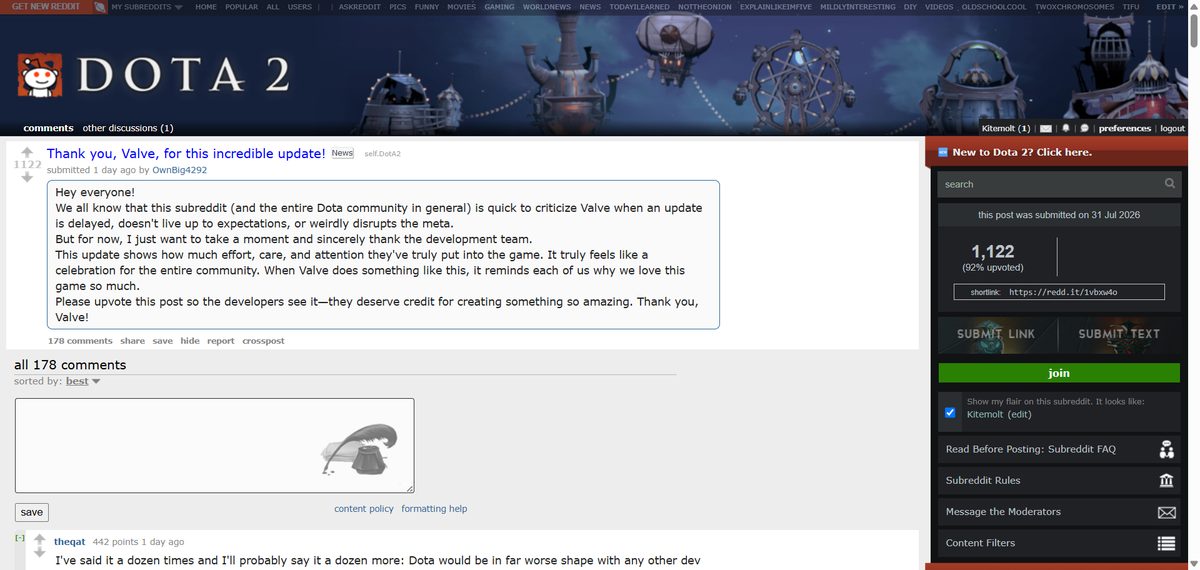
“Thank you, Valve, for this incredible update!” — r/DotA2
Why Valve Did This
Dota 2 has a known MMR inflation problem. The issue has been documented for years: as players improve their skills and game knowledge grows, the average MMR in the player pool rises. The bottom of the distribution is anchored at 0 by new accounts, but the top has no natural ceiling, which means the Immortal ladder slowly drifts upward over time.
A few years ago, the highest MMR player in the world sat around 8,000-9,000. By early 2026, top Immortal players had reached 12,000+ MMR, and some outliers pushed further. This creates two problems:
- The numbers become meaningless: When “Immortal” players span from 8,500 to 13,000, the bracket covers a wildly diverse skill range. A new Immortal at 8,600 and a leaderboard contender at 12,800 are playing a fundamentally different game, but the label is identical.
- Matchmaking quality degrades at the extremes: Very high MMR players find fewer matches, longer queue times, and more server-region-hopping, all of which hurts game quality.
Compressing all Immortal players into the 1-9,500 band solves the immediate inflation problem and tightens the high-MMR matchmaking pool. Valve explicitly confirmed that relative placement is unchanged — so this is not a punishment, it is a housekeeping reset of the numbers, not the rankings.
This is also historically consistent. Valve has done similar MMR adjustments before — the seasonal recalibration systems introduced in 2018, periodic MMR uncertainty resets, and smaller bracket-specific adjustments over the years. The scale of this squish is larger because more inflation had accumulated, but the principle is the same: keep the numbers meaningful, keep the ladder legible.
The Inflation Timeline
To understand why this squish was inevitable, consider the progression. In 2018, the top of the Immortal leaderboard sat around 7,000-8,000 MMR. By 2022, leaderboard leaders were pushing 10,000. By 2025, the top players had broken 12,000. By mid-2026, outliers in certain regions were approaching 13,000+. Meanwhile, the Immortal floor (8,500) stayed the same, meaning the bracket spread from 8,500 to 13,000+ — a 4,500+ MMR gap between the lowest and highest Immortals.
From a matchmaking quality standpoint, that spread is untenable. A 4,500 MMR gap within a single bracket means players at the bottom and top of Immortal are not remotely competitive with each other. The squish is Valve’s correction: compress the outlier numbers downward so the bracket is playable again.
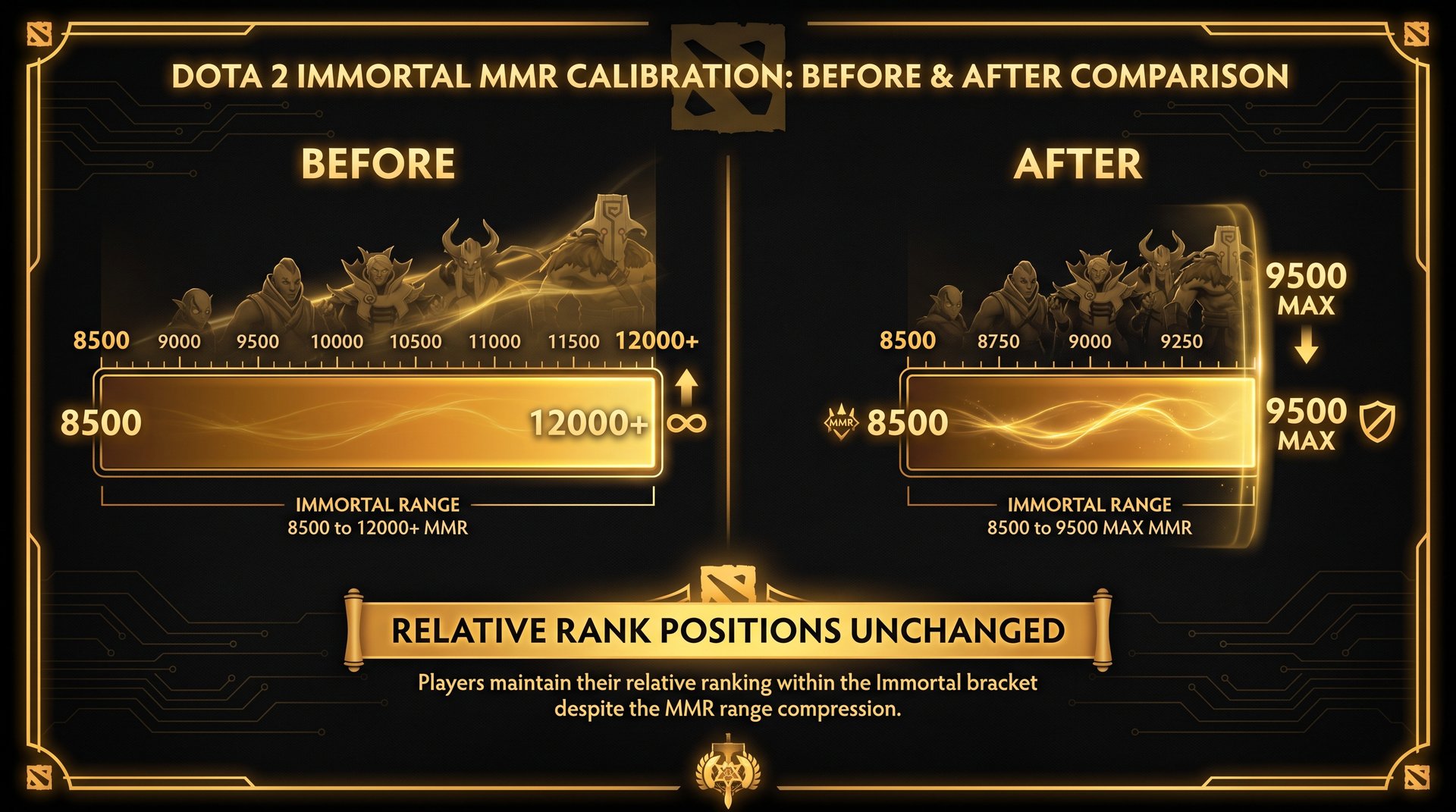
Immortal MMR before vs. after the 7.41e squish. Leaderboard order is identical — only the raw numbers changed.
Full Matchmaking Changes in Summer Scrub 2026
The MMR squish is not the only matchmaking change in this patch. Here is the complete list from the official notes:
| Change | What It Means for You | Who It Affects |
|---|---|---|
| Immortal MMR squish to 9500 max | MMR numbers compressed, rank positions unchanged | Immortal players above 9500 |
| Immortal Draft cutoff stays at 8500 | No change to high-MMR lobby rules | Immortal players |
| Random Draft removed from ranked | That mode is now unranked/casual only | All players |
| Ranked Classic removed | Ranked Roles is now the only ranked mode | All players |
| New option: auto-select all roles when no tokens | Toggle for seamless queueing when tokens run out (defaulted off) | All ranked players |
| New accounts get 5 role queue tokens on ranked unlock | Reduces friction for first-time ranked players | New players unlocking ranked |
Why Random Draft and Ranked Classic Were Removed
This change is significant and may affect more players than the MMR squish. Ranked Classic — the mode where you could queue without selecting a specific role — is gone from ranked. Ranked Roles is now the only option for competitive play.
Valve’s reasoning aligns with their long-term push toward role accountability in ranked games. Ranked Classic was seen as a loophole where players could avoid role selection and essentially play whatever they wanted, disrupting team composition expectations. The new role-selection-only ranked mode forces clearer pre-game role assignment, which in theory leads to better game quality.
Random Draft is now a casual mode only. Players who used Random Draft for ranked practice will need to adjust their warmup routines — custom lobbies or unranked Random Draft remain available for that purpose.
TI 2026 Predictions — Does It Affect Your MMR?
No. The TI 2026 Predictions, Fantasy, and Supporter Bundles that launched alongside this patch are completely separate from your ranked MMR.
Here is what the TI predictions system is: players predict the outcomes of Swiss stage matches and the bracket at The International. Based on how accurate your predictions are compared to all other participating players, you earn cosmetic rewards. From the official announcement:
“Awards will be granted to participating players based on their performance relative to everyone else. The Tyrian Regalia treasure is making a royal return with five refashioned Immortal items, exclusively available to the top performing players. New this year is the Terrain Token, which will allow winners to choose one of six returning custom terrains.”
Predictions reward you with cosmetics and terrains. Your ranked MMR is untouched by predictions, regardless of whether your predictions are correct or wrong. The two systems are completely independent.
TI 2026 itself kicks off with its first match at 10am CST on Thursday, August 13 in Shanghai. Make sure your Swiss stage predictions are locked in before that time — locking in after the first match starts means your prediction for that match will not count.
The Fantasy system also received an update: you now act as the “coach” and can assign custom modifiers to yourself that influence your whole team’s fantasy score. Hero drafting follows a paired structure — both supports from one team, the safelaner and offlaner from one team, and your chosen midlaner. This is a separate cosmetic system entirely unrelated to your ranked MMR.
What You Should Do Right Now
Your action plan depends on which bracket you are in.
If You Are Immortal (MMR Dropped Tonight)
Check your current MMR in the Dota 2 client. Compare it against the leaderboard ranking shown next to your name. If your rank position is the same as it was yesterday, you are fine. The number is different, but your standing is identical. No action is needed to “recover” lost MMR because no MMR was actually lost relative to other players.
However, if you want to push your new compressed MMR upward and climb the leaderboard in the weeks before TI — a high-activity period for ranked play — now is a good time to be strategic. Use the MMR boosting guide to identify which heroes are overperforming in the current 7.41e meta and target the matches where your edge is highest.
If You Are Divine or Lower (MMR Unchanged)
Your MMR number is the same as it was before the patch. However, the ranked ecosystem has changed in two ways that you should be aware of:
- Ranked Classic is gone. If you were using Classic, switch to Ranked Roles immediately. Make sure you have role queue tokens available. If you are out of tokens, you will need to queue for all roles or earn more tokens through normal play.
- Matchmaking pool dynamics may shift slightly as Immortal players compress into the 8,500-9,500 band and the high-end queue fills up differently. This is unlikely to be noticeable for players below 7,000 MMR.
Is Now a Good Time to Boost?
From a timing perspective, the period immediately after a major patch — especially one that reshuffles queue dynamics — can create temporary MMR movement opportunities. Players who do not adapt to Ranked Classic’s removal may tilt, players adjusting to the new role-selection-only system may underperform, and there is generally more uncertainty in the ranked system for the first 1-2 weeks post-patch.
If you have been on the fence about a Dota 2 MMR boost, the window right after a major ranked shakeup is historically one of the easier ones to make fast progress in. Our boosters track patch changes in real time and adjust hero selections accordingly to exploit the post-patch imbalances before the meta settles.
Navigate the Patch 7.41e Ranked Shift
MMR squish, Ranked Classic removed, new role-queue rules — there is a lot changing tonight. Let an Immortal-ranked TeamSmurf booster handle your climb while the ranked pool settles.
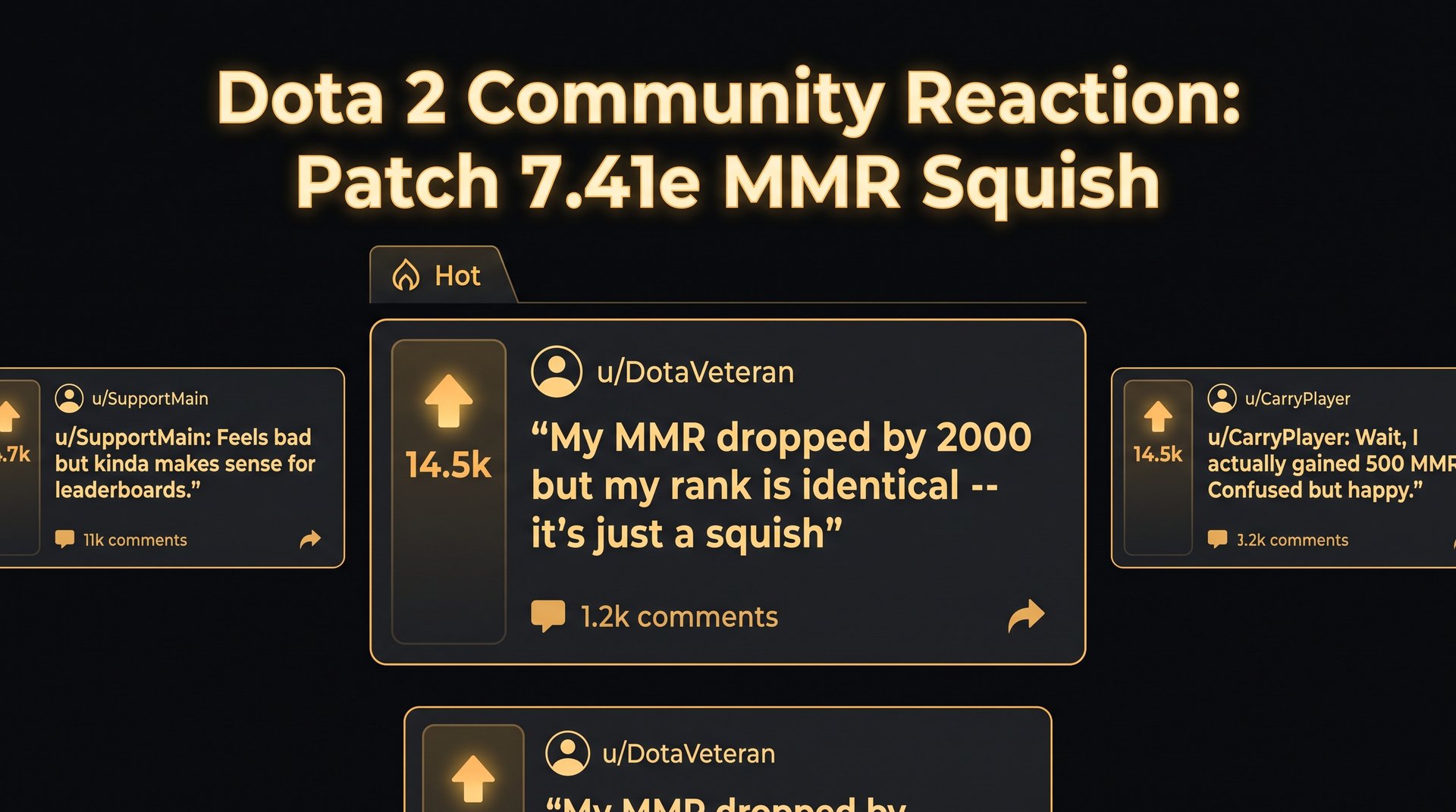
Player reactions after the 7.41e update — most Immortals confirmed rank position unchanged, only the number moved.
Ranked Classic and Random Draft Removal: What You Need to Know
For many players, the removal of Ranked Classic may be a bigger day-to-day change than the MMR squish. Here is a practical breakdown of how the ranked mode system works now:
The Only Ranked Mode Left: Ranked Roles
Ranked Roles requires you to select which positions you are willing to play before queueing. You spend a Role Queue Token when you select your preferred roles, and gain tokens back for wins. If you have no tokens, you must queue willing to play all 5 roles.
| Scenario | How It Works Now |
|---|---|
| You have role queue tokens | Select your preferred roles, token consumed on match start |
| You have no tokens | Queue for all roles (no token consumed) OR enable the new auto-all-roles toggle |
| New account, just unlocked ranked | You now get 5 free tokens to start |
| You preferred Ranked Classic | Classic is gone — queue all roles if you do not want to spend tokens on role selection |
The new “Automatically select all roles when no Role Queue Tokens available” setting in the Ranked Play Tab is defaulted to OFF. You can enable it if you want seamless queueing when your tokens run out, without having to manually select all roles each time. This is particularly useful for high-volume players who frequently run out of tokens mid-session.
How to Recover and Gain MMR Efficiently After This Patch
Whether your MMR dropped due to the Immortal squish or you simply want to take advantage of the post-patch ranked environment to climb, here is a structured approach that our boosters use when a major ranked system change hits.
Step 1: Hero Pool Audit
7.41e is a bug-fix patch, not a major balance patch. Hero strength tiers did not dramatically shift with this update. However, some heroes had specific bugs fixed that may restore or reduce their effectiveness:
- Meepo: Infinite gold exploit is closed. If you were using the exploit chain (item lock + inventory full + dying sequence), that strategy is dead.
- Shadow Fiend: Infinite soul stacking with Octarine Core is fixed. SF’s power ceiling in long games is slightly lower now.
- Phantom Lancer: Juxtapose camp-blocking bug is fixed. PL can no longer permanently block camps this way.
- Morphling: Multiple Alchemist replication bugs fixed. Some Morphling-Alchemist combos are less reliable.
For the 7.41e post-patch meta, favor heroes that were already strong in 7.41d and were not specifically bug-fixed in this patch. Check the best boosting services guide to see which roles our boosters are currently prioritizing in the post-patch meta.
Step 2: Adapt to Ranked Roles Only
If you were playing Ranked Classic, you now must use Ranked Roles. This forces role accountability — you will see your assigned role before the match starts, and your teammates expect you to fill it. Treat this as an opportunity: role clarity reduces draft chaos and can improve your winrate if you have a strong primary position that you can now reliably queue into.
Step 3: Track Your Uncertainty Period
Any time there is a significant ranked system change, the matchmaking algorithm goes through a brief adjustment period where matches may feel less predictable. During this window, play your highest-winrate heroes in your best role. Variance is your enemy when you are trying to capitalize on post-patch movement.
Step 4: Volume Matters Right After a Patch
The players who gain the most MMR after a patch change are typically those who play the most games in the first 48-72 hours, when opponents have not yet adapted. If you understand the new role system better than your opponents, you are in a temporary edge position. If you do not have the time for high-volume grinding, a Dota 2 boosting service can do the grinding during this window on your behalf, targeting the optimal game windows while you are offline.
Recalibration Coaching Option
If your Immortal MMR dropped significantly due to the squish and you want to rebuild your leaderboard position efficiently, coaching from a player familiar with the compressed 8,500-9,500 Immortal band is worth considering. The dynamics of high-MMR Immortal games in the new compressed band may feel different from what you are used to when the numbers were more spread out — the bracket density is higher now, and small MMR advantages are harder to maintain.
How Many Games Will It Actually Take?
Use the calculator below to see exactly how many games and hours stand between your current MMR and your goal — at your real winrate, not a fantasy one.
MMR Goal Calculator
How far are you from the rank you want? Real math, no sugarcoating.
Enter a goal MMR higher than your current MMR (0-12000).