8 Years of TI Winners: What the Data Shows

Eight years. Seven champions. One pattern hiding in plain sight.
Since TI8 in 2018, the Dota 2 community has watched seven different teams hoist the Aegis of Champions. Some were expected. Most were not. And a handful — OG in 2018, Team Spirit in 2021, Team Falcons in 2025 — rewrote what we thought we knew about TI.
This post breaks down every champion from 2018 to 2025 using verified data from Wikipedia TI articles. You will see the full champions table, the pre-tournament favorite conversion rate, how often the upper bracket winner takes the title, the defending champion curse in raw numbers, and what every pattern means for TI 2026 predictions.
No invented statistics. No speculation dressed up as fact. Just 8 years of what actually happened — cross-checked against Wikipedia sources for every TI.
What Is In This Post
- The Complete TI Champions Table 2018-2025
- How Often Does the Favorite Actually Win?
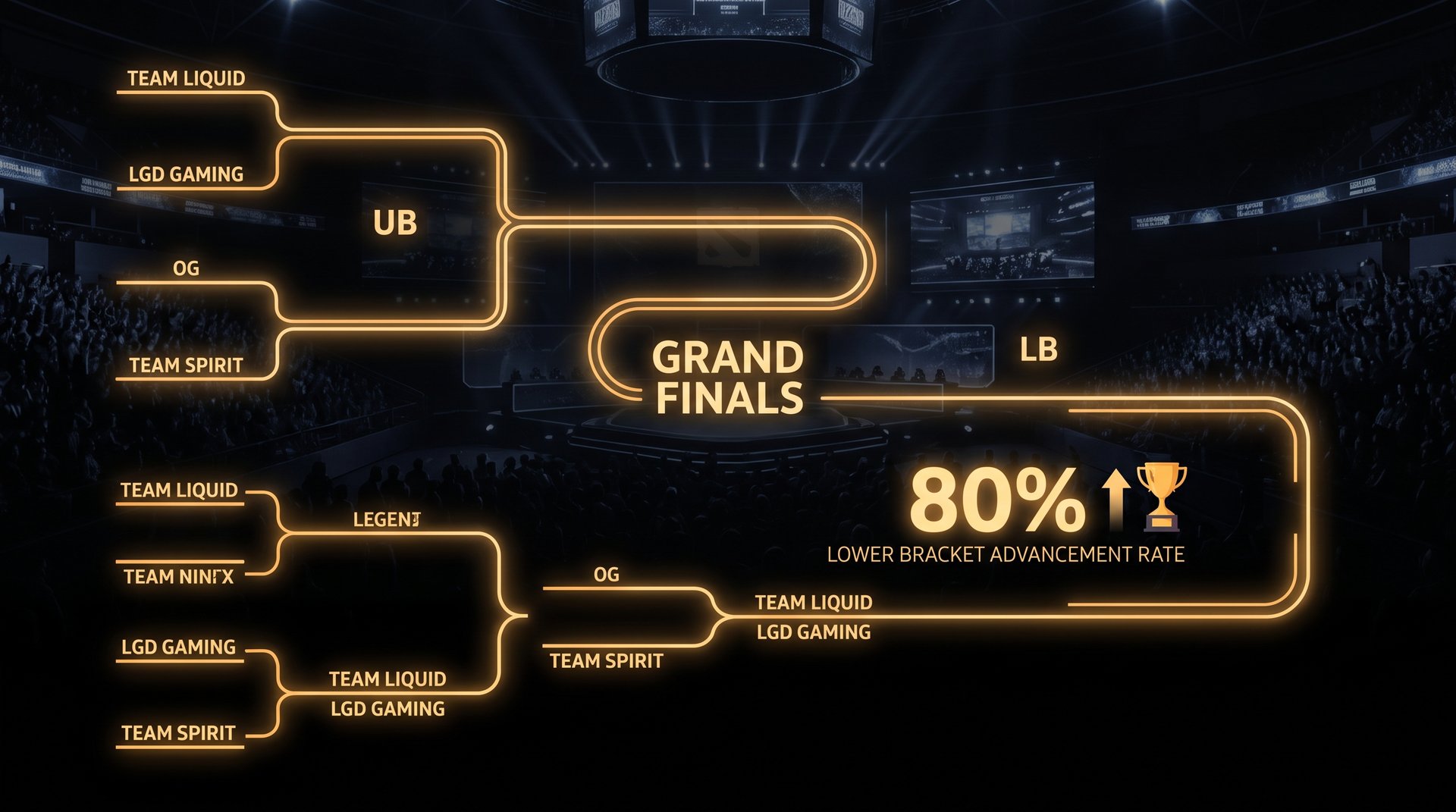
- Upper Bracket vs Lower Bracket — The 80% Rule
- The Defending Champion Curse
- TI Time Machine Widget
- Team Spirit — The Data’s Favorite Team
- Gaimin Gladiators — The Runner-Up Pattern
- What This Means for TI 2026
- Frequently Asked Questions
The Complete TI Champions Table 2018-2025
Eight TIs happened between 2018 and 2025 — though TI10 (2021) replaced 2020, which was cancelled due to the COVID-19 pandemic. The confirmed champions, verified against Wikipedia TI articles, are below.
| TI | Year | Champion | Runner-Up | Score | Bracket Path | Surprise Factor |
|---|---|---|---|---|---|---|
| TI8 | 2018 | OG | PSG.LGD | 3-2 | Upper Bracket winner | VERY HIGH — open qualifier, all-new roster |
| TI9 | 2019 | OG | Team Liquid | 3-1 | Upper Bracket winner | LOW — defending champs, Group B #1 seed |
| TI10 | 2021 | Team Spirit | PSG.LGD | 3-2 | Lower Bracket winner | VERY HIGH — unknown CIS squad, Group B #4 seed |
| TI11 | 2022 | Tundra Esports | Team Secret | 3-0 | Upper Bracket winner | LOW-MED — strong DPC season, Group B #1 seed |
| TI12 | 2023 | Team Spirit | Gaimin Gladiators | 3-0 | Upper Bracket winner | LOW — Group A #1 seed, dominant run |
| TI13 | 2024 | Team Liquid | Gaimin Gladiators | 3-0 | Swiss format era | MED — strong team but not dominant favorites |
| TI14 | 2025 | Team Falcons | Xtreme Gaming | 3-2 | Swiss format era | LOW-MED — EWC 2025 champions going in |
Source: Wikipedia articles for TI8 through TI14. Data verified August 2026. Bracket path data for TI13-TI14 is not confirmed because both used Swiss group stages and complete bracket path records were not accessible from available sources.
The Champions by Region
Region tells part of the story too. Of the seven champion teams between 2018 and 2025:
- OG (TI8, TI9): Western European roster, assembled globally with players from several countries
- Team Spirit (TI10, TI12): CIS / Eastern European, based in Russia
- Tundra Esports (TI11): Western European lineup
- Team Liquid (TI13): Western European organization
- Team Falcons (TI14): Middle East organization with an internationally assembled roster
Chinese teams have reached three of the seven Grand Finals in this era (PSG.LGD twice in TI8 and TI10, Xtreme Gaming at TI14) without winning. LGD Gaming is back at TI 2026 with a Shanghai home crowd behind them — a factor worth including in your analysis. Chinese fans at home TIs have historically been a significant atmospheric advantage.
Southeast Asian teams have not reached a Grand Final in this era. That historical absence does not mean they cannot in 2026, but the statistical precedent is not in their favor.
How Often Does the Pre-Tournament Favorite Actually Win?
This question is harder to answer than it looks, because “favorite” means different things depending on who you ask. Betting odds data was not accessible for this research. What the data clearly shows is group stage seed performance, and that is a useful proxy for expected tournament performance.
In the five TIs that used traditional round-robin group stages (TI8-TI12), the group stage #1 seeds won the tournament 3 out of 5 times — a 60% conversion rate. That is meaningful but far from certain.
| TI | Group A #1 Seed | Group B #1 Seed | Did a #1 Seed Win? | Who Won? |
|---|---|---|---|---|
| TI8 (2018) | Team Liquid | VGJ.Storm | NO — both eliminated before Grand Final | OG (Group B #4 seed) |
| TI9 (2019) | PSG.LGD | OG | YES (OG, Group B #1) | OG |
| TI10 (2021) | Vici Gaming | PSG.LGD | NO — PSG.LGD reached final but lost | Team Spirit (Group B #4) |
| TI11 (2022) | EG | Tundra Esports | YES (Tundra, Group B #1) | Tundra Esports |
| TI12 (2023) | Team Spirit | CNSA team | YES (Spirit, Group A #1) | Team Spirit |
Three group #1 seeds won TI across 5 traditional-format events: 60%. At TI8, both group-stage favorites were eliminated before the Grand Final. The team that won — OG — entered through the open qualifiers with a brand new roster that most analysts dismissed before the event.
TI9 and TI12 show the other extreme: the #1 seed was so dominant that they went on to win the event entirely through the upper bracket. Those are the “chalk” outcomes that make 60% feel deceptively safe.
The honest conclusion: being a group stage #1 seed gives you a 60% historical shot at the title in traditional format. That is meaningful but not definitive — especially when TI 2026 uses the Swiss system, where seed conversion statistics from the round-robin era do not directly apply.
Upper Bracket vs Lower Bracket — The 80% Rule
This is the strongest statistical pattern in TI history.
In the five TIs played under traditional double-elimination bracket format (TI8 through TI12), the team that won through the upper bracket won the championship 4 out of 5 times. That is an 80% historical rate. It is the single most reliable predictor found in TI data, and it has direct implications for how you should approach bracket predictions in 2026.
| TI | Year | UB Winner Won Championship? | Notes |
|---|---|---|---|
| TI8 | 2018 | YES — OG ran the upper bracket | OG was Group B #4 seed, not top seed |
| TI9 | 2019 | YES — OG repeated the UB run | OG was Group B #1 seed and defending champ |
| TI10 | 2021 | NO — LB winner Team Spirit won | The lone exception, Spirit entered as Group B #4 |
| TI11 | 2022 | YES — Tundra swept through UB | Tundra won 3-0 in Grand Final |
| TI12 | 2023 | YES — Spirit dominant UB run | Spirit swept Gaimin 3-0 from upper bracket |
Why the Upper Bracket Advantage Is Real
The structural advantage is significant and easy to understand. An upper bracket team arrives at the Grand Final having:
- More practice: They accumulate more competitive series in the bracket before the final, which sharpens execution
- More rest: LB teams play more series, sometimes back-to-back best-of-5s before the Grand Final
- One extra life: UB teams can drop to LB once before elimination — this safety net changes draft risk tolerance
- Psychological confidence: Entering the Grand Final with zero losses vs. entering it after clawing through the lower bracket are very different mental states
The one exception — Team Spirit at TI10 (2021) — is worth studying because it shows exactly what a LB run requires. Spirit entered as Group B seed #4. They were not considered serious championship contenders by most analysts. They survived the lower bracket by playing consistently better under pressure than anyone expected, adapting their draft more flexibly than any opponent anticipated, and winning a 3-2 Grand Final against PSG.LGD that required five games of individually remarkable play. That was a generational performance, not a replicable formula.
You can explore every TI bracket path on our TI Time Machine tool, which shows champion, seed, bracket path, and the pre-TI LAN result for every year from 2018 to 2025.
For TI 2026 bracket predictions, the 80% rule translates directly: whoever emerges as the dominant upper bracket team from the Swiss group stage is your highest expected-value champion pick. The Main Event still uses double-elimination, so the structural advantage still applies.
The Defending Champion Curse
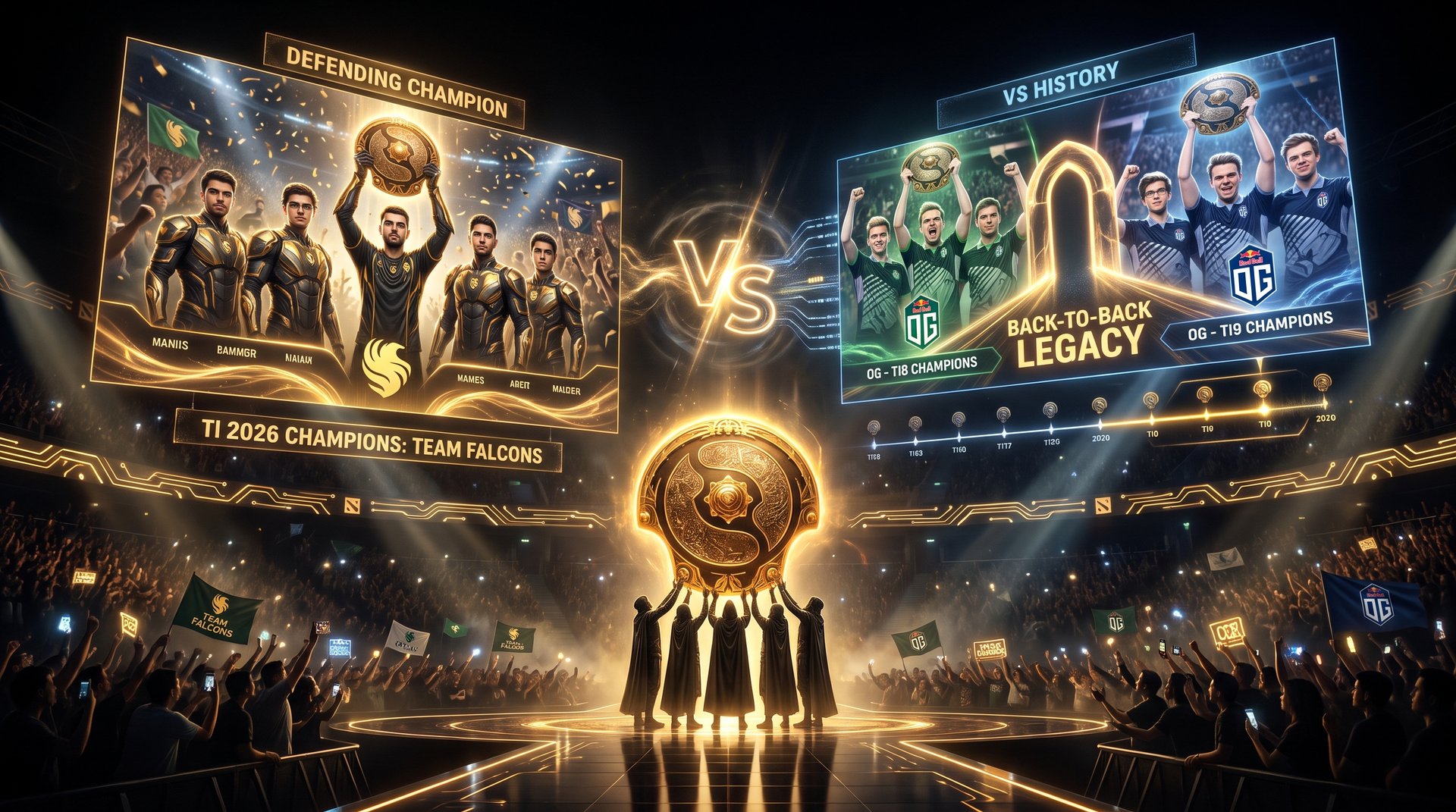
In seven championships between 2018 and 2025, exactly one team successfully defended their title: OG, who won TI8 (2018) and TI9 (2019) with the same core roster. Every other defending champion failed to win the following TI. That puts the defending champion success rate at 1 out of 7 attempts, or approximately 14%.
| Defending Champion | Their TI Win | Next TI Result | Defended? |
|---|---|---|---|
| OG | TI8 (2018) | Won TI9 (2019) — same core roster | YES — only back-to-back in history |
| OG | TI9 (2019) | Did not attend TI10 (2021) with original roster | NO — roster disbanded |
| Team Spirit | TI10 (2021) | Tundra won TI11 (2022) | NO |
| Tundra Esports | TI11 (2022) | Spirit won TI12 (2023) | NO |
| Team Spirit | TI12 (2023) | Team Liquid won TI13 (2024) | NO |
| Team Liquid | TI13 (2024) | Team Falcons won TI14 (2025) | NO |
| Team Falcons | TI14 (2025) | Competing at TI15 (2026) — TBD | TBD |
Why Defending Champions Almost Never Win
The reasons are structural, not just psychological. After winning TI, a champion team faces a uniquely difficult situation that every previous defending champion has been unable to fully overcome.
Full opponent study for 12 months: Every team in the next TI has analyzed the champion in detail for an entire season. Their draft tendencies, hero preferences, lane setups, late-game decision making — all dissected. The element of surprise that often helps tournament winners disappears completely.
Roster instability: Players frequently leave after winning the biggest event of their career. Coaches move on. Organizations offer different players more money. The exact combination that won is rarely preserved intact for the following year. This is what effectively ended the OG dynasty — not a loss in a match, but roster dissolution after TI9 when several key players retired or departed.
Meta shifts: Valve releases a TI patch roughly 10 days before the Main Event each year. The defending champion’s competitive strengths — heroes they mastered, draft strategies they developed — may have been specifically balanced out. A team that won on a specific meta gets no advantage from that meta in the next TI because the game has changed.
Mental reset required: This is the hardest factor to measure but coaches consistently reference it. After winning TI, the primary motivational driver for a professional roster — winning TI — has been achieved. Sustaining that level of hunger and preparation for a full additional year is genuinely difficult. Some teams have spoken openly about the motivational challenge of defending a championship they already won.
The Falcons Situation for TI 2026
Team Falcons arrive at TI 2026 as the defending champion after winning TI14 in 2025, and as EWC 2025 champions in the same year. They are currently ranked #4 in global GosuGamers standings as of July 2026. Among all teams that qualified for TI 2026, they trail only Team Yandex (#2 globally) in current ranking.
The case for Falcons repeating is the OG parallel: they are not just defending, they are currently dominant. They showed at TI14 that they can handle Grand Final pressure (3-2 versus Xtreme Gaming). Their EWC 2025 win demonstrated that they do not peak at TI alone — they have tournament-winning form across multiple events.
The case against them is the entire rest of TI history: six of seven defending champions failed to win the following TI. The base rate is unambiguous. Whether Falcons are the exception — the second-ever OG — is the central question of TI 2026. Our full analysis on this question is in Only OG Ever Won TI Back to Back. Can Falcons in 2026?
TI Time Machine — Every Year Side by Side
Use the interactive widget below to click through each TI year and see the champion, runner-up score, bracket path, group seed placement, and the key insight from each edition. The data matches the verified tables above.
TI Time Machine
Pick a year. Relive the drama — and spot the patterns before TI 2026.
Team Spirit — The Data’s Most Interesting Team
Of all the teams in modern TI history, Team Spirit has the most statistically unusual profile. They have won TI twice (TI10 in 2021, TI12 in 2023), with a championship gap in between. No other active team has multiple TI titles in this era.
Their two wins look completely different on paper:
TI10 (2021) — the impossible run: Spirit entered as Group B seed #4. They were not widely predicted to win. They ran the lower bracket from early in the Main Event and beat PSG.LGD 3-2 in a five-game Grand Final that many still consider one of the greatest championship series in Dota 2 history.
TI12 (2023) — the dominant run: Spirit entered as Group A #1 seed and won through the upper bracket with a 3-0 sweep of Gaimin Gladiators in the Grand Final. This was not a Cinderella story — it was a team at the absolute peak of their powers executing exactly as expected.
What connects both runs is draft adaptability. In both 2021 and 2023, Spirit demonstrated an ability to win on a wider hero pool than their opponents had prepared counter-strategies for. In TI10, that flexibility caught opponents off guard. In TI12, every team had studied them intensively and still could not stop the pattern.
Spirit is currently ranked #6 in global GosuGamers standings and has qualified for TI 2026. Their two-title history and current top-10 global form make them a credible contender even without being the statistically highest-ranked team in the field. If you are building a predictions bracket and need a pick that has both historical TI form AND current competitive standing, Spirit belongs near the top of your shortlist.
Want to analyze team drafts, hero pools, and meta adaptability the way TI teams do? TeamSmurf coaches work with players specifically on draft reading and hero matchup preparation — skills directly applicable to understanding how championship teams build their competitive advantage.
Gaimin Gladiators — The Runner-Up Pattern
No team in recent TI history has a more striking runner-up record than Gaimin Gladiators. They reached the Grand Final in both TI12 (2023) and TI13 (2024) — and lost both finals in sweeps.
| TI | Gaimin’s Result | Lost To | Score |
|---|---|---|---|
| TI12 (2023) | Runner-Up | Team Spirit | 0-3 |
| TI13 (2024) | Runner-Up | Team Liquid | 0-3 |
Both losses were 3-0 sweeps. Zero games won in either Grand Final. Two consecutive Grand Finals, two different champions, same outcome for Gaimin each time.
Gaimin did not qualify for TI 2026, which ends this runner-up streak without resolution. But the pattern tells you something important about TI tournament dynamics: there is a meaningful skill gap between reaching the Grand Final consistently and actually winning it. The preparation required to win a best-of-5 at maximum psychological pressure is different from the preparation required to win every series leading up to that final.
That distinction matters for 2026 analysis. Teams making their first or second Grand Final appearance at TI carry more uncertainty than teams like Spirit, who have demonstrated they can close out. When you are evaluating teams for your bracket picks, consider not just whether they can reach the final, but whether they have shown they can win it.
What the 8-Year Dataset Means for TI 2026
The Swiss group stage runs August 13-16 online. Top 8 advance to Shanghai for the Main Event, August 20-23. Grand Finals are August 23, 2026. Here are the specific, data-grounded insights for this year.
Target the Upper Bracket Path Team
This is the strongest single prediction rule available from TI history: whoever wins through the upper bracket at TI 2026 is your best historical bet for champion. 80% conversion rate over 5 traditional-format TIs. The Main Event still uses double-elimination format, so this structural advantage still applies. Use the Bracket Pick Helper tool to see exactly what each pick type has returned historically and what risk level it represents.
Apply Caution to the Falcons Pick
Team Falcons are strong, ranked #4 globally, and the defending champion. They should absolutely be in your top predictions. But the historical defending champion success rate is 14% (1 in 7 attempts). Pick them if you believe this specific roster is historically exceptional — and that is a reasonable belief given their 2025 performance. But if you prefer historical base rates, fading the repeat is the mathematically safer position.
Watch Team Yandex
The #1 ranked team in the world — PARIVISION — did not qualify for TI 2026. That makes the highest-ranked TI 2026 participant Team Yandex (#2 globally on GosuGamers). They are also likely to be undervalued in community picks because the team name is newer. If you are looking for a pick that combines strong current form with potential undervaluation, Yandex belongs in your considerations.
Do Not Underestimate Team Spirit
Two TI titles. #6 global ranking. Qualified for TI 2026. Spirit has proven they can win from the lower bracket (TI10, entering as #4 seed) or the upper bracket (TI12, as #1 seed). They are the only team besides OG with multiple TI championship wins in this era. History gives them a differentiated edge that current rankings alone do not capture.
LGD Gaming + Shanghai Home Crowd
LGD has historically been one of the strongest Chinese TI teams with multiple runner-up appearances. They will play in front of their home Shanghai crowd in August 2026. Home-city effects at TI are real in terms of crowd energy, scheduling comforts, and reduced travel fatigue. For a team with LGD’s TI pedigree playing at home, that combination deserves weight in your analysis.
Frequently Asked Questions
Climb MMR During TI 2026 Season
TI season is when Dota 2 pubs are most active — and most chaotic. If you want to push your rank while the top teams compete in Shanghai, TeamSmurf’s Dota 2 MMR boost service keeps your account safe and your progression real.