


Dota 2 Commend System Explained: What Commends Do and Whether They Raise Behavior Score

Commends in Dota 2 do raise behavior score, but only by a small amount per commend. The honest answer is that receiving commends moves your score upward while reports move it downward — and the negative weight of a single report is generally heavier than the positive weight of a single commend. Getting commended regularly helps maintain a healthy behavior score, but commends alone cannot rescue you from a badly negative score driven by repeated reports. If your score is suffering, stopping the reports is the priority; commends are the ongoing maintenance layer on top of that.
With that core answer out of the way, this guide covers how the commend system actually works, what each of the four commend types does, the limits and cooldowns you need to know, and the practical steps that get you commended more often.
What Is in This Guide?
How the Dota 2 Commend System Works
At the end of every Dota 2 match, the post-game screen gives you the option to commend any of your teammates. You can commend multiple people from the same match — there is no restriction forcing you to pick just one. Each commend is a positive signal that attaches to the recipient’s conduct summary and contributes a small upward nudge to their behavior score.
The system exists to balance out the report function. Without commends, the only social input players could give was negative. Valve added commends so players who put genuine effort into being good teammates — whether that means calling out objectives, explaining mechanics to a less experienced ally, or simply staying calm when things went sideways — would receive some recognition that the game tracks.
Commends are not public-facing in any significant way. You will not see a player’s commend count on their profile in a way that affects matchmaking. What the system does behind the scenes is feed into your overall conduct score, which Valve uses to determine which player pool you are placed in. High-score players get high-score lobbies; low-score players land in lower-quality pools. A consistent commend stream is one input among several that keeps that score in good shape.
Post-Game Timing
The commend option appears on the post-game screen immediately after a match ends. You have a window to commend your teammates — this window is time-limited and does not stay open indefinitely. If you close the post-game screen without commending, you cannot go back to commend that player for that specific match. The commend is tied to the match instance, not to the player’s profile as a standalone action you can take any time.
You can receive a maximum of one commend per player per match. If all four of your teammates try to commend you, you receive four commends from that single game. Each one counts independently and each contributes its own positive weight to your conduct score.
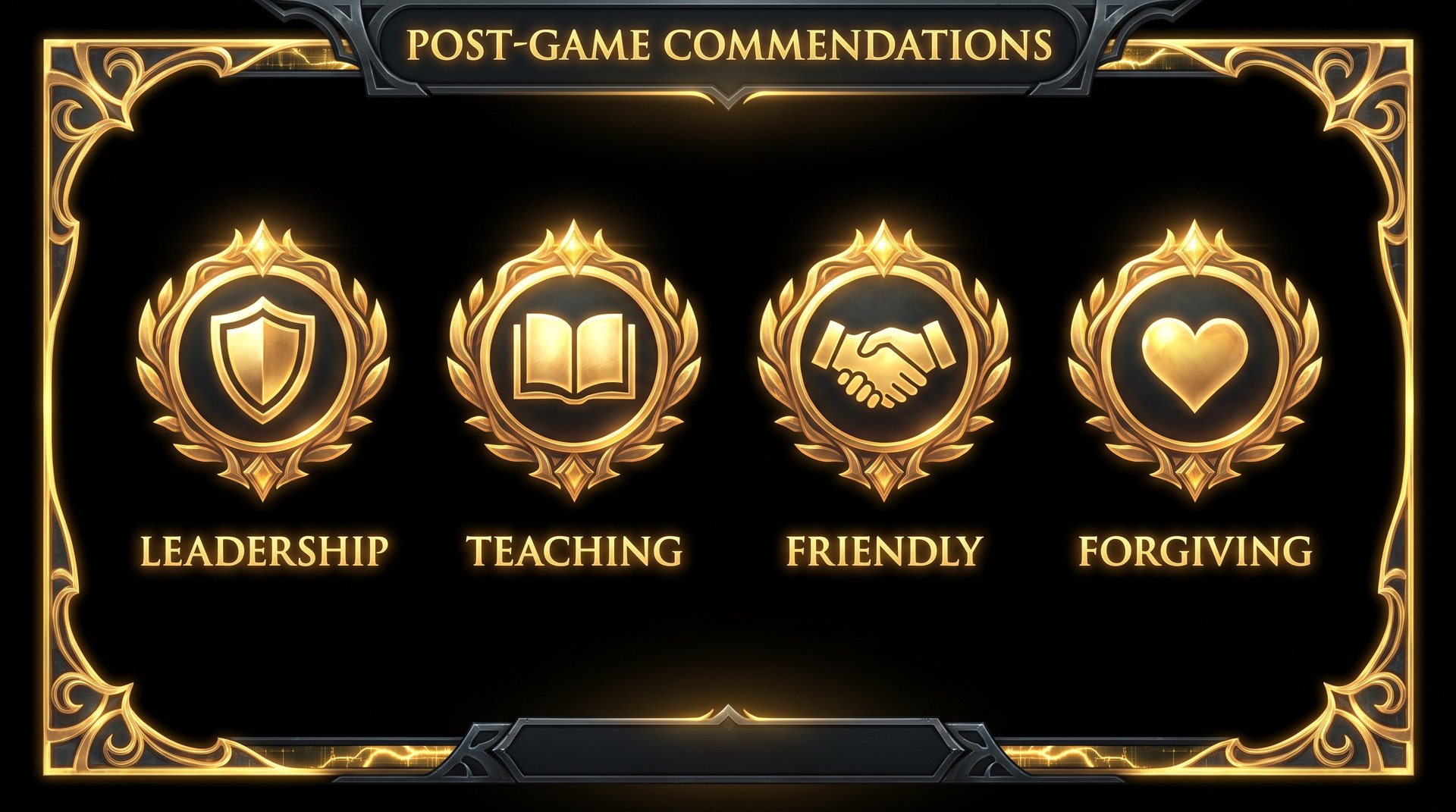
The Four Commend Types Explained
When you commend a teammate, you are asked to pick from four specific categories. Each one represents a different type of positive contribution the player made during the match.
| Commend Type | What It Recognizes | Who Usually Earns It |
|---|---|---|
| Leadership | Calling plays, pinging objectives, directing strategy during the match | Cores who make good macro decisions, supports who direct teamfights |
| Teaching | Explaining mechanics, offering advice, helping less experienced allies learn | Patient players who share knowledge without condescension |
| Friendly | Positive attitude, good communication, keeping the team atmosphere calm | Any player who stays constructive and avoids toxicity throughout |
| Forgiving | Not tilting after mistakes, accepting human error, moving on quickly | Players who respond to misplays with encouragement rather than flame |
Leadership
The Leadership commend goes to the player who drove the team’s decision-making. This does not require you to be the hard carry — supports who identify when to force a teamfight, players who spot and call a Roshan window, or anyone who kept the team focused on objectives rather than chasing kills can earn this. In practice, players with high map awareness and good communication are the most common recipients. Using the ping wheel intelligently, calling “defend” or “push now” at the right moments, and demonstrating that you understand the game at a tactical level all contribute to teammates identifying you as the Leadership commend target.
Teaching
The Teaching commend recognizes players who helped others improve during the match. This is relatively rare to earn because it requires actively explaining things rather than just playing well. If a teammate does not understand a mechanic — say, when to use a particular ability or why a certain item build is situationally wrong — and you explain it calmly and correctly, you have made a genuine contribution that many players will recognize and reward. Support players who explain warding theory, vision control, or lane behavior tend to earn this commend from newer allies who genuinely benefited from the advice.
Friendly
The Friendly commend is by far the most commonly given. It rewards players who are simply pleasant to share a match with. No toxicity in chat, no blaming after mistakes, constructive pings instead of question mark spams, and a generally positive attitude throughout all qualify. If you want to maximize commends, the Friendly category is where most of them come from. You do not need to perform extraordinary acts — you just need to not make the match worse for everyone else, which turns out to be a higher bar than it sounds in Dota 2 lobbies.
Forgiving
The Forgiving commend is earned specifically by players who respond well to adversity. When a teammate makes an obvious mistake — a bad teleport, a misused ultimate, a misread fight — how you respond determines whether you earn this commend. Players who type “np” or “my bad too” rather than writing a paragraph of criticism are the ones who receive it. In long or difficult matches where multiple misplays happened across the board, a player who never once placed blame and kept morale up will almost certainly get the Forgiving commend from at least one teammate.
Commend Limits and Cooldowns
The commend system has built-in limits to prevent abuse — specifically, to prevent organized commend-farming where players create accounts to spam each other with commends in isolation from real gameplay.
| Limit Type | Rule | Notes |
|---|---|---|
| Per-match cap | One commend received per player per match | Multiple teammates can each commend you; each counts |
| Giving limit | Daily cap on commends you can give | Prevents commend-farming and bot abuse |
| Recency window | Must commend before closing the post-game screen | No retroactive commending from match history |
| Match eligibility | Only matches you played together in are eligible | You cannot commend random players outside of shared matches |
The daily giving limit means that if you play many games back-to-back and commend freely, you will reach a cap after which you cannot give further commends until the cooldown resets. This limit affects givers, not receivers — you can receive unlimited commends in a day from all your different matches (though realistically you will not play dozens of games).
Behavior Score Impact: What the Data Shows
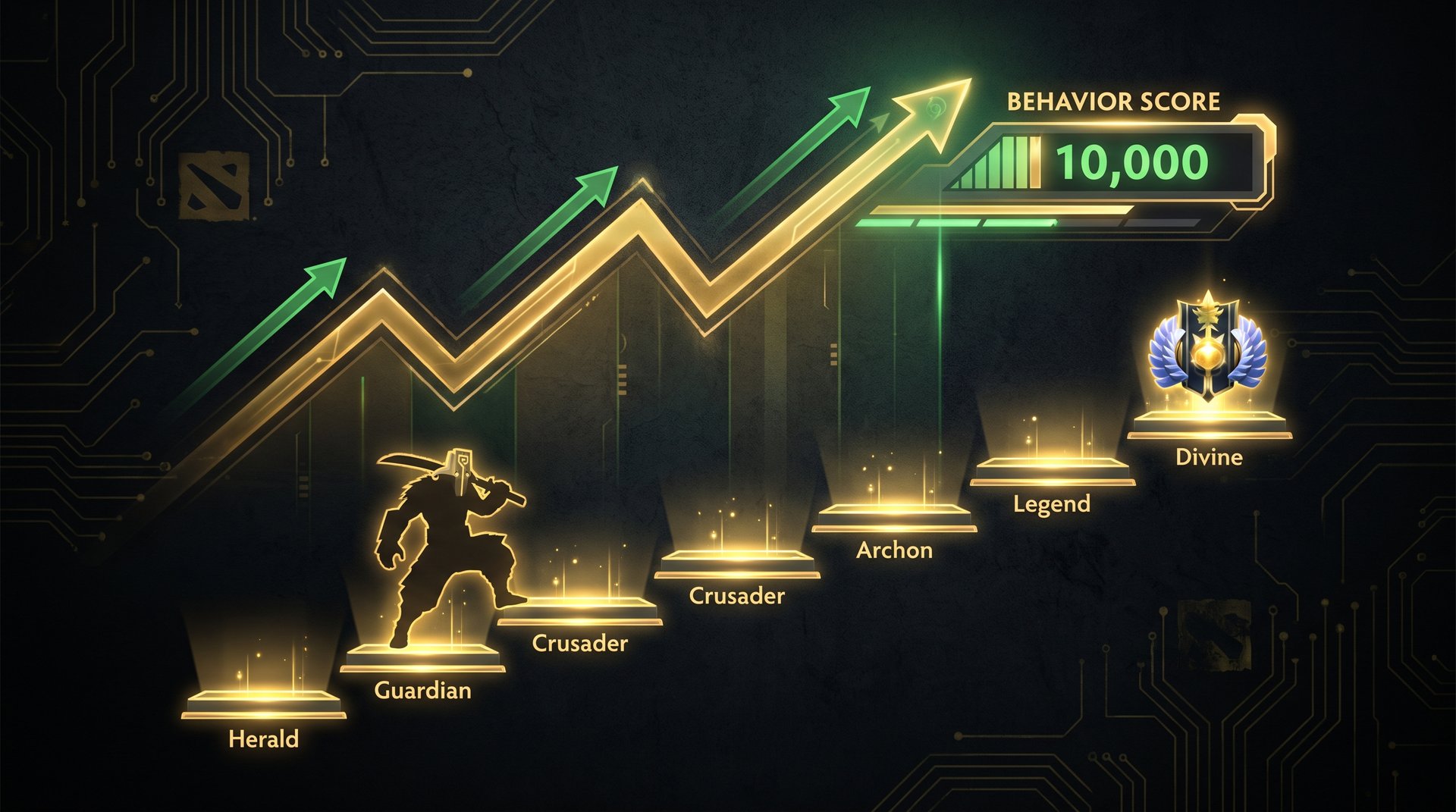
The specific numeric value that each commend adds to behavior score is not publicly documented by Valve. What is understood from community testing and observation is the directional relationship: commends move the score up, reports move it down, and the two forces do not cancel out equally.
Here is what the available community data and player testing suggests:
- Commends provide a small but real positive effect. Players who consistently receive commends across many games trend toward higher behavior scores over time compared to players who receive no commends with an otherwise identical report history.
- One report outweighs one commend. Anecdotal and aggregate player observations consistently show that a single report has a noticeably larger negative impact than a single commend has a positive one. This asymmetry is intentional — it makes the system more sensitive to bad behavior.
- Volume matters more than type. There is no documented evidence that a Leadership commend is worth more than a Friendly commend from a behavior score standpoint. All four types appear to function as equivalent positive signals to the conduct algorithm.
- Commends cannot rescue a deeply negative score alone. A player stuck at a very low behavior score due to many accumulated reports would need thousands of commend-positive games to recover, and that recovery path is unrealistically slow without also stopping the cause of the low score.
- Regular commends maintain a healthy score. For players already sitting at a good behavior score, consistent commends act as a buffer against the occasional bad game where frustration leads to a report. Think of them as ongoing maintenance rather than a recovery tool.
Commends vs. Reports: Understanding the Asymmetry
One of the most important things to understand about the Dota 2 conduct system is that it is asymmetric by design. Valve built it this way because the cost of a bad player experience is higher than the benefit of a good one, from a player retention standpoint. A player who gets griefed or harassed is more likely to quit the game than a player who gets commended is likely to stick around because of it.
This means the conduct score functions more like a penalty system than a rewards system. Your default state is “good standing,” and reports drag you downward. Commends bring you upward but from a weaker position than reports pull from the opposite side.
Practically, this translates to a simple priority ranking for players who want to stay in high-quality lobbies:
- First priority: avoid reports. Mute toxic teammates rather than engaging. Avoid chat when tilted. Do not spam pings in frustration. These behaviors are what triggers other players to report. Removing them from your game is more powerful than any amount of commend farming.
- Second priority: earn commends. Play in a way that makes teammates want to commend you. This is good for your score and it also, not coincidentally, tends to correlate with better team coordination and higher win rates.
- Third priority: know when to use tools. If you are in a game with a griefer, using the mute function early removes the temptation to fire back. A muted troll cannot tilt you into a reportable response.
For players who are seriously interested in the mechanics behind behavior score and what score bracket you are currently in, the full breakdown of how behavior score affects your Dota 2 experience covers thresholds, matchmaking pool differences, and what each score range looks like in practice. If your behavior score is already causing you to be matched with low-quality lobbies, that guide is the starting point for recovery.
How to Get More Commends
Getting commended more often is not purely about being skilled. Some highly skilled players receive very few commends while others who play at a lower skill level receive them consistently. The difference is behavior and communication style, not mechanical proficiency.
Play Roles That Enable Commend-Worthy Moments
Support roles — positions 4 and 5 — create the most opportunities to earn commends. You are warding, stacking, pulling, saving teammates with utility spells, and setting up kills that your cores get credit for. All of these actions are visible and appreciated. When a carry survives a gank because your Smoke or your Bloodstone proc saved them, they notice. When you place a critical ward that lets your team avoid a bad fight, the players watching the map notice. Support play generates Leadership, Teaching, and Friendly commend moments more naturally than farming a jungle for 40 minutes.
That said, a core player who communicates well and coordinates fights gets commended too. The role matters less than what you do within it.
Use Communication Tools the Right Way
The Dota 2 ping and chat wheel system gives you a full toolkit for in-game communication without requiring you to type. Using pings constructively — marking danger, marking objectives, alerting to enemy positions — is visible to your entire team throughout the match. Players who use pings intelligently are perceived as aware and helpful, which directly translates to Friendly and Leadership commends at the end.
Avoid question mark pings on teammates after mistakes. This is one of the fastest ways to convert a potential commend into a potential report. The ping that was meant to express frustration reads as mockery, and the teammate on the receiving end will remember it at the post-game screen.
Respond Well to Adversity
In a game as volatile as Dota 2, every match will have bad moments. Your response to those moments is one of the strongest signals you send about what kind of player you are. Here are the specific behaviors that earn Forgiving and Friendly commends:
- Responding to a teammate’s mistake with “no worries” or “we got it next” rather than analysis of what they did wrong.
- Keeping positive or neutral text in team chat even when the match is going badly.
- Avoiding the report button for minor annoyances — save it for genuine griefing.
- Saying GG at the end of matches regardless of outcome.
- Not abandoning games that are difficult but winnable.
Share Information Without Being Condescending
If you genuinely know something useful — an item timing, a position the enemy tends to take, a mechanic your teammate may not know — sharing it earns Teaching commends IF you do it without making the other player feel bad. The difference between “that item is wrong for this matchup, here is why” and “why did you build that lol” is the difference between earning a commend and earning a mute. Keep suggestions constructive, brief, and delivered without judgment about the person’s intelligence or experience level.
First Commend the Players You Want to Commend You
People who receive commends are more likely to give them. If you make a habit of commending teammates who performed well or who were positive throughout the match, you are creating a social dynamic where the people you commend are more likely to think of commending you in return — and more likely to remember you positively when making that decision. This is not manipulation, it is normal social reciprocity.
Why Your Behavior Score Matters More Than Most Players Realize
Players sometimes dismiss behavior score as a concern until they end up in a noticeably bad lobby and realize their score has dropped. Understanding what is actually at stake motivates the effort to both avoid reports and earn commends consistently.
Behavior score determines your matchmaking pool. At the highest score ranges, your average lobby quality — measured by cooperation, communication, and likelihood of players following through on matches without abandoning — is measurably better. At the lowest ranges, the pool is dominated by players who are there specifically because of repeated toxic behavior, and the game experience reflects that.
Your MMR gain rate is also affected in a less direct way. Players in better lobbies have better game experiences, communicate better, and tend to win matches that are theoretically winnable more often than players in toxic, chaotic lobbies. The score itself does not multiply MMR gains, but the quality of the pool it puts you in does influence your practical ability to climb.
For players who are already dealing with a compromised behavior score and want a faster path back to a better gaming environment, our Dota 2 coaching services can help accelerate MMR recovery with proper guidance on clean gameplay. The MMR boosting guide also covers what improvements in play quality look like at each bracket level.
Practical Strategies to Improve Your Behavior Score Using Both Sides
The most effective path to a healthy behavior score attacks both sides simultaneously: reducing reports while increasing commends. These strategies cover both.
Set Up Your Communication Defaults Correctly
Before your next game, think about your communication defaults. If you tend to flame in text chat when you are tilted, set your chat to All Chat only for things that genuinely need to be there, or switch to a “pings only” habit for in-match communication. You cannot be reported for text chat messages you did not send. Use voice chat or the chat wheel for coordination — these are also safer from a report perspective because voice chat reports require a separate step that fewer players take.
Build a Commend-Friendly Playstyle
Identify one or two specific changes you will make in every match that are likely to generate commends. Consistent warding as a support, consistent “take it easy” responses to mistakes, using positive pings after good plays by teammates — any of these small habits, done every match, adds up to a meaningfully higher commend rate over a large enough sample of games.
Understand the Safe Behavior Score “Buffer”
If your behavior score is currently healthy — above 8,000 in the old scale or equivalent in whatever system is current — maintaining it is much easier than recovering it. A single bad match where you said things you should not have will not tank your score if your average is high. The score has built-in inertia that resists single-game swings in either direction. Taking advantage of that buffer means staying mostly clean — you do not need perfection, you just need consistency to dominate occasional lapses.
Players at lower MMR brackets often deal with more inherently toxic lobbies that make staying clean genuinely harder. Knowing your trigger points and managing them — muting early, avoiding response to bait chat — is a skill just like last-hitting, and it develops with deliberate practice.
Struggling With Your Dota 2 Rank or Behavior Score?
TeamSmurf’s coaches help you climb the right way — better game sense, cleaner play, and a score that reflects the player you are becoming. Whether you need MMR help or guidance on consistent improvement, we work with players at every bracket.



