How to Climb from Divine to Immortal as Pos 5 Hard Support

If you’re trying to climb from Divine to Immortal as a Position 5 hard support, you’ve chosen the longest, most mentally demanding path in Dota 2. That’s not hyperbole — it’s mathematical reality. Pos 5 has the lowest individual game impact of any role, which means you need a higher true skill advantage to maintain the same win rate that a carry or mid player would have. It takes more games, more consistency, and more patience.
But here’s the thing that most people don’t tell you: pos 5 players who DO reach Immortal tend to be the best overall Dota players in the bracket. They understand the game at a deeper level than any other role because they can’t rely on mechanics or farm to compensate for bad decisions. Every advantage they create comes from pure game knowledge and decision-making.
This guide is the distillation of what Immortal pos 5 players do that Divine pos 5 players don’t. It’s not about ward spots or hero abilities — you already know those. It’s about the meta-skills of the position: resource allocation, information management, psychological leadership, and the art of enabling your four teammates to play their best Dota.
Table of Contents
- The Pos 5 Role at Divine — Why It’s the Hardest Climb
- Top 5 Heroes to Climb from Divine to Immortal as Pos 5
- 10 Critical Mistakes Divine Pos 5 Players Make
- Phase-by-Phase Guide: Laning Through Late Game
- The Teammate Problem: Account Buyers and the Support’s Burden
- Realistic Timeline: How Long Will This Take
- FAQ
The Pos 5 Role at Divine — Why It’s the Hardest Climb
Let me be direct with you: climbing as pos 5 requires you to be significantly better than your current bracket, not just marginally better. A carry player who’s 200 MMR above their bracket will climb. A pos 5 who’s 200 MMR above their bracket will hover. You need to be playing 400-500 MMR above your bracket to see consistent climbing results from the support position.
This isn’t because pos 5 is less important — it’s because pos 5’s impact is indirect. You don’t get kills, you don’t take towers, you don’t farm items. You enable other people to do those things. And enabling people who are at the same skill level as you is much harder than enabling people who are worse than you (because better players capitalize on your plays more consistently).
The Invisible Impact Problem
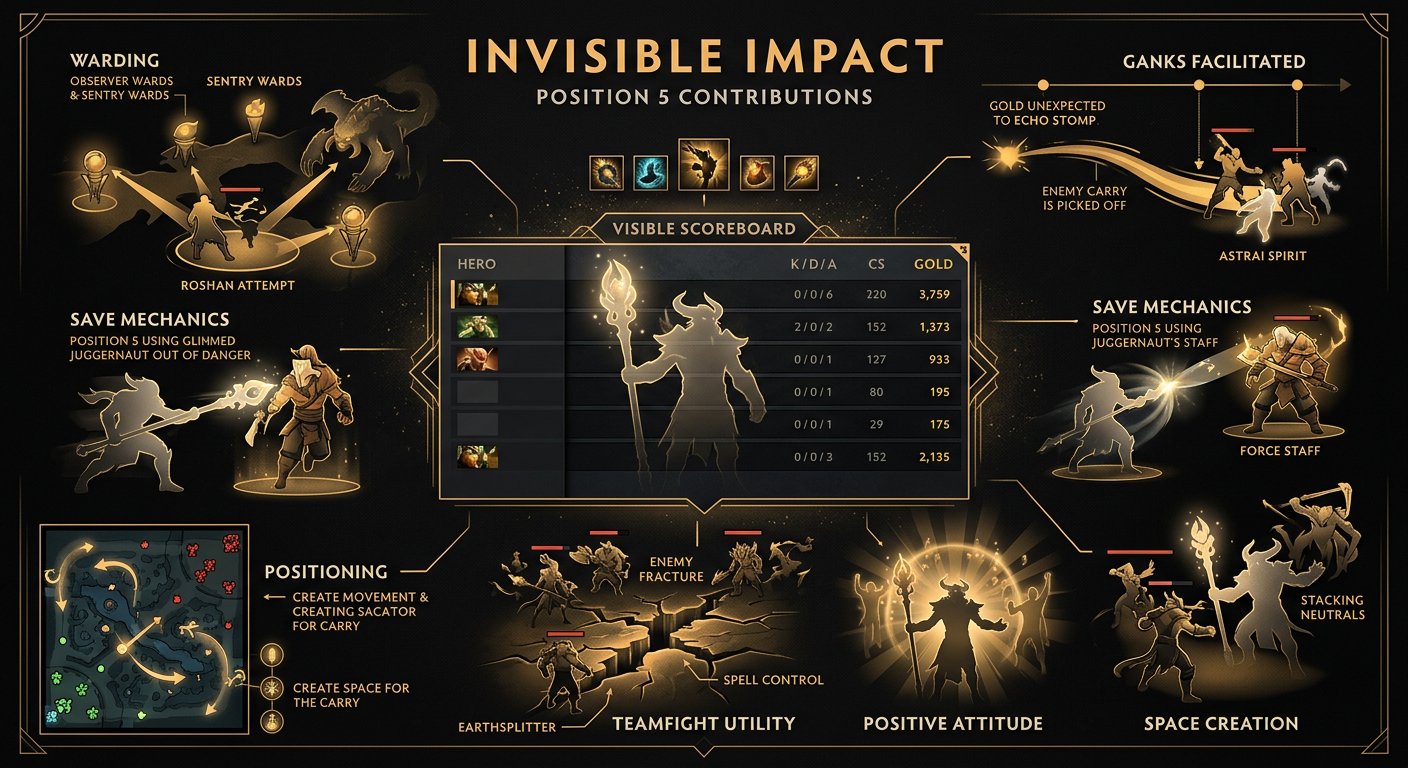
The core challenge of climbing as pos 5 is that your best plays are invisible. When you place a ward that prevents your carry from getting ganked, nobody notices — they just farm as usual. When you pull at the perfect time to maintain lane equilibrium, your carry doesn’t even realize the wave would have pushed otherwise. When you save your mid with a Glimmer Cape from 2,000 units away during a chaotic fight, the kill feed just shows your mid surviving — not your clutch save.
This invisibility has two consequences. First, you don’t get the psychological reinforcement of visible impact, which makes the role less satisfying and more prone to burnout. Second, your teammates don’t appreciate your contribution, which means they’re less likely to listen to your calls and more likely to blame you when things go wrong.
Accepting this invisibility is the first mental hurdle of climbing as pos 5. Your impact is real, but it’s measured in prevented deaths, accelerated farm timings, and information advantages — not in kill counts or tower damage.
What Separates Divine Pos 5 from Immortal Pos 5
After analyzing hundreds of pos 5 players across both brackets, the differences are consistent:
1. Lane control mastery. Immortal pos 5 players win their carry’s lane 60%+ of the time through superior trading, pulling, and zoning. Divine pos 5 players win the lane maybe 45-50% of the time. This single factor is the biggest difference — because when your carry wins lane, they hit their timings, and when they hit their timings, you win more games.
2. Information processing. Immortal pos 5 players process minimap information in real-time and make predictions about enemy movements. They call out missing heroes before they’re missing. They anticipate smokes. They position wards based on predicted enemy movements, not current ones.
3. Economic efficiency. Immortal pos 5 players are broke but never inefficient. Every gold piece is spent on the highest-impact item at that moment. They don’t save up 2,000 gold for a Glimmer Cape while carrying 0 wards and 0 dust. They maintain constant utility spending while slowly progressing their items in between.
4. Psychological leadership. Immortal pos 5 players manage their team’s mental state. They call for objectives to prevent aimless farming. They type “gj” after good plays to reinforce positive behavior. They stay calm when things go badly, which keeps the team from tilting. This “invisible captaining” wins more games than any ward placement.
The Support Mindset Shift
At Divine, most pos 5 players think of themselves as “the ward bitch” — the player who buys wards, follows the carry around, and hopes for the best. This is a loser’s mentality. Immortal pos 5 players think of themselves as the team’s strategic director — the player who sees the whole board, understands everyone’s power levels, and orchestrates the game plan.
You’re not a servant. You’re a general. The carry is your strongest piece, and your job is to deploy them effectively — not to mindlessly follow them around. This mindset shift changes everything about how you play the game.
Top 5 Heroes to Climb from Divine to Immortal as Pos 5
The best pos 5 heroes for climbing are the ones that maximize your ability to win lanes and save teammates. Individual kill potential doesn’t matter at pos 5 — what matters is how much you amplify your carry’s performance.
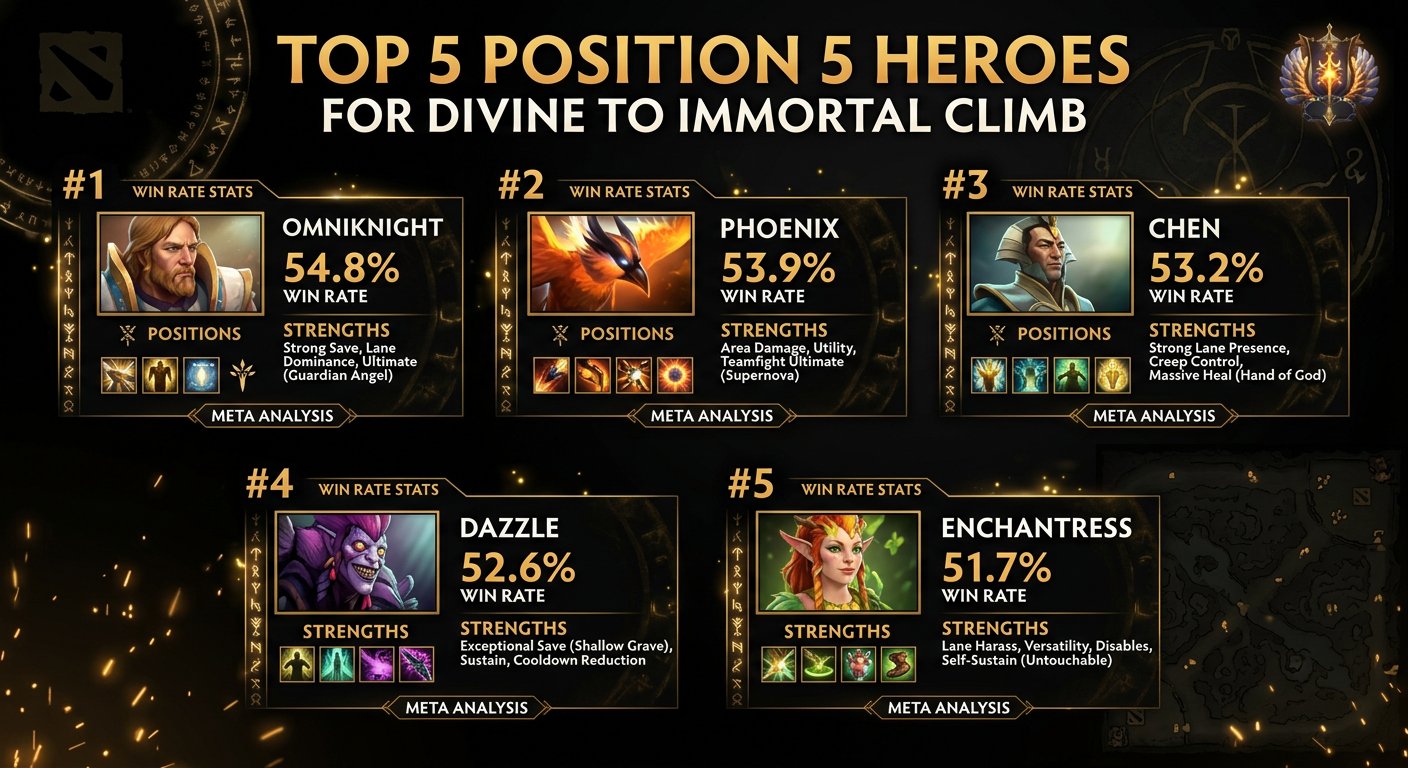
1. Warlock
Warlock is the most reliable pos 5 for climbing because he provides everything your team needs: lane sustain (Shadow Word), team fight impact (Fatal Bonds + Chaotic Offering), and lane dominance (right-click harass with his excellent base damage and attack animation).
Why he works at this bracket: Warlock’s Fatal Bonds is one of the most underrated abilities in Divine. When properly applied in a team fight, it amplifies your team’s damage by 20-25% across all bonded heroes. At Divine, teams often fight in clumps, which makes Fatal Bonds devastating. Combined with Chaotic Offering’s AoE stun, Warlock turns team fights into auto-wins if both abilities connect.
Key timings: Shadow Word at level 1 wins most lane trades — cast it on the enemy carry or support and your hero deals 15 damage per second for 12 seconds while healing if cast on allies. Chaotic Offering at level 6 is a massive power spike for team fights. Aghanim’s Scepter by 25-28 minutes gives you two Golems, which essentially doubles your team fight impact.
Advanced tip: Fatal Bonds timing is everything. Don’t cast Fatal Bonds before the fight starts — the enemy will scatter. Cast it DURING the fight when enemies are clumped and committed. The ideal Bond connects 3-5 enemy heroes during the first 2 seconds of a fight. Also, Shadow Word is better used offensively on the enemy than defensively on allies in many situations — the damage is constant and undodgeable, making it a guaranteed 480 damage nuke that also heals if you target an ally.
2. Dazzle
Dazzle is the ultimate “keep your carry alive” hero. Shallow Grave is the most powerful single-target save in Dota, and Shadow Wave provides both heal and damage in one ability. At Divine, where your carry’s survival is the #1 predictor of game outcome, Dazzle directly addresses the most important variable.
Why he works at this bracket: Shallow Grave single-handedly prevents your carry from dying in team fights. At Divine, enemies often dump all their damage on one target (usually your carry) and expect them to die. When that target doesn’t die because of Shallow Grave, the enemy has wasted all their cooldowns and your team cleans up. This dynamic wins fights that should be lost.
Key timings: Shadow Wave at level 1 provides both harassment and sustain in lane. Shallow Grave at level 6 is when you become a guardian angel. Solar Crest by 15-18 minutes amplifies your carry’s damage output while reducing the target’s armor. Aeon Disk by 25-28 minutes ensures you survive long enough to cast Shallow Grave in every fight.
Advanced tip: Pre-positioning for Shallow Grave is the hallmark of an expert Dazzle player. Before every fight, identify the most likely target for enemy focus (usually your carry or mid) and position yourself within cast range of them but far enough from the fight center that you won’t be stunned or killed before casting Grave. The 1,000 unit cast range means you should be about 800 units behind your carry at all times during fights. Also, Grave BEFORE the target is low, not after. If you wait until they’re at 100 HP, you risk them dying to a damage-over-time effect before your cast animation completes.
3. Witch Doctor
Witch Doctor brings both lane dominance and team fight damage from the pos 5 position. Maledict is the single highest damage non-ultimate ability in Dota when used correctly, and Death Ward shreds through teams in the right positioning.
Why he works at this bracket: Maledict is criminally underutilized at Divine. A successful Maledict on a hero who’s taking damage in a team fight deals 1,000+ damage over its duration. At Divine, players don’t respect Maledict enough — they don’t disengage when Maledicted, they don’t heal through it, and they don’t burst the Witch Doctor before he casts it. This oversight translates directly into free kills.
Key timings: Paralyzing Cask + Maledict at levels 2-3 is a kill combo in lane with any carry that has follow-up damage. Level 6 Death Ward is your team fight contribution — but only if you have a BKB or Glimmer to protect the channel. Aghanim’s Scepter by 24-26 minutes makes Death Ward bounce, essentially doubling its team fight damage.
Advanced tip: Death Ward positioning wins or loses team fights. Never channel Death Ward from the frontline — you’ll be instantly stunned. Position behind your team, behind trees, or on high ground where the enemy has to commit to reaching you. Use BKB before channeling if the enemy has stuns. The full duration of an uninterrupted Death Ward is one of the highest damage outputs of any ability in Dota. Protect the channel at all costs.
4. Shadow Shaman
Shadow Shaman is the best tower-pushing pos 5 in Dota. Mass Serpent Ward instantly threatens any tower, and Shackles provides the longest single-target disable in the game. For climbing, Shaman’s ability to convert kills into towers is invaluable.
Why he works at this bracket: At Divine, teams often win fights but fail to take objectives afterward. Shadow Shaman eliminates this problem. Win a fight, drop wards on a tower, tower dies. The hero converts team fight wins into structural damage more reliably than any other support. This accelerates the game and closes out wins before the enemy can come back.
Key timings: Ether Shock at level 1 for lane harass (180 damage nuke on a low cooldown). Level 6 Mass Serpent Ward for tower pushing. Aether Lens by 16-18 minutes extends your Shackle and Hex range, making you more dangerous in fights. Refresher Shard at 20 minutes if available allows double Serpent Ward, which takes towers in seconds.
Advanced tip: Serpent Ward placement determines whether you take the tower or waste your ultimate. Place wards in a semicircle BEHIND the tower so they continue hitting after the tower falls. If you place them in front of the tower, the enemy can kite and kill them. Also, use Serpent Wards defensively — placing them in choke points during high ground defense creates an impassable zone that buys your team time to respawn.
5. Oracle
Oracle is the highest skill-ceiling pos 5 in Dota and the most rewarding to master. False Promise is arguably the best save ability in the game (combining Grave + purge + double heal), and his kit provides purges, heals, disarms, and burst damage.
Why he works at this bracket: Oracle’s skill ceiling means that a truly excellent Oracle player is functionally impossible to deal with at Divine. A well-timed False Promise negates the enemy’s focus damage, a well-timed Fate’s Edict prevents physical burst, and a well-timed Fortune’s End purges critical debuffs. The hero has an answer to everything if you have the reaction speed and game knowledge to deploy them correctly.
Key timings: Level 2-3 for lane kill combos (Fortune’s End + Purifying Flames deals massive damage). Level 6 False Promise is your team’s safety net. Aeon Disk by 22-25 minutes ensures you survive to cast False Promise in every fight. Glimmer Cape by 18-20 minutes amplifies False Promise’s survivability by making the target invisible AND doubling their healing.
Advanced tip: The interaction between Purifying Flames and False Promise is what makes Oracle broken in the right hands. During False Promise, Purifying Flames’ damage is delayed (absorbed by the ult) but the heal is doubled. This means casting Flames on your False Promise’d ally is a net 360 HEAL per cast, not damage. Spam Purifying Flames on your ulted ally — it will heal them for 720+ HP when False Promise ends, often saving them from what should be certain death. This interaction is the single most skill-gated mechanic at the pos 5 position.
10 Critical Mistakes Divine Pos 5 Players Make
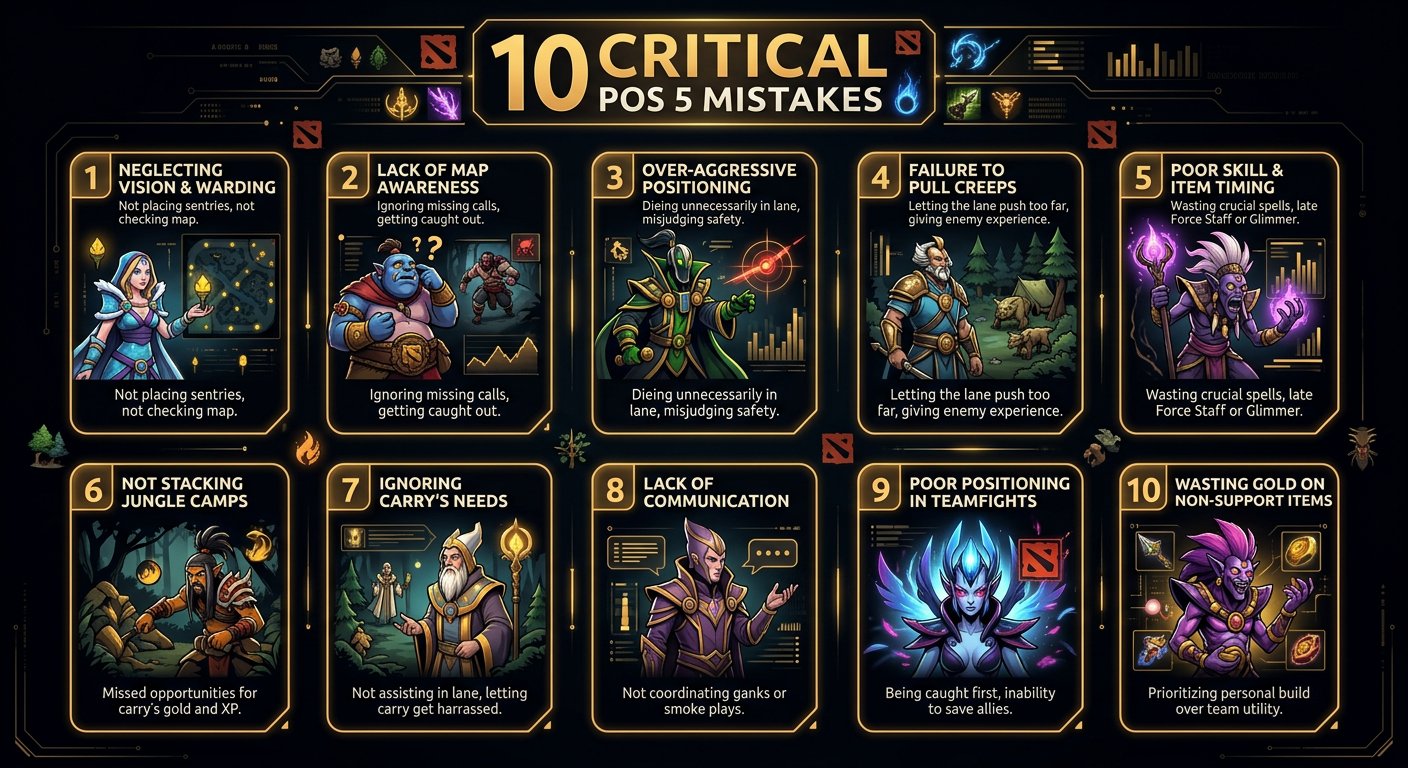
Mistake #1: Losing the Lane for Your Carry
This is the #1 most impactful mistake because it cascades through the entire game. If your carry loses lane, they farm slower, hit their power spike later, and the game becomes harder for everyone. At Divine, pos 5 players lose the lane through three common errors: (a) not trading hits aggressively enough, (b) pulling at the wrong time and leaving the carry alone against a kill lane, and (c) not managing the creep wave equilibrium.
The fix: treat the first 5 minutes of the game as a 1v2 lane where YOU are responsible for winning. Your carry is focused on last hitting — everything else is your job. Zone the enemy offlaner. Trade hits with the enemy pos 4. Pull when the wave pushes. Deny ranged creeps. The carry who has a 70+ CS at 10 minutes wins the game far more often than the carry who has 50 CS.
Mistake #2: Not Pulling Correctly
Pulling is the most technical aspect of pos 5 play and most Divine players don’t do it optimally. Common errors include: pulling without stacking the small camp first (which doesn’t kill the creep wave, pushing the lane harder), pulling the large camp when it would be better to pull the small camp, and pulling when the wave is already in a good position.
The rules for pulling at the Divine level:
- Pull the small camp if it’s stacked (full wave dies to a stacked small camp)
- Pull the large camp if the small camp isn’t stacked and you need the wave pulled
- Pull-through from small camp to large camp for a guaranteed full wave kill
- Only pull when the wave is pushing toward the enemy tower — pulling a balanced wave disrupts it for no benefit
- NEVER pull if the enemy can contest it and kill the creeps, giving them denied gold and XP
Mistake #3: Standing Behind Your Carry Doing Nothing
This is the most common wasted-time mistake at Divine. The pos 5 stands 500 units behind their carry, not trading, not pulling, not zoning — just existing. This is dead weight. If you’re not actively doing something in lane, you should be pulling, stacking, placing a ward, or rotating to gank mid.
The rule: if you’ve been standing behind your carry for 15 seconds without taking an action, you’re wasting time. Either zone the enemy, pull a camp, or leave the lane entirely. Dead time is dead MMR.
Mistake #4: Over-Investing in Personal Items
At Divine, pos 5 players sometimes save gold for their own items instead of spending it on team utility. They’ll have 1,500 gold sitting in their pocket “for Glimmer Cape” while carrying 0 wards, 0 dust, and 0 smoke. This is selfish play that costs games.
The priority order for pos 5 gold: TP scroll > Observer Wards > Sentry Wards > Dust/Smoke > Team consumables (salves for cores) > Personal items. Only invest in personal items AFTER all higher-priority items are covered. This doesn’t mean you never get items — it means you get them slowly, buying utility first.
Mistake #5: Warding the Same Spots Every Game
If you place the same ward spots every game, the enemy will deward you every game. At Divine, players know the common ward spots and carry sentries to deward them. Your warding needs to be adaptive and unpredictable.
Principles for advanced warding:
- Place wards in unusual spots that still provide useful vision — slightly offset from the common cliff ward, on different high ground, behind trees
- Vary your ward spots game to game, even in the same game state
- Ward for INFORMATION, not just vision — you want to know where the enemy is moving, not just see a random area of the map
- After getting dewarded, place the next ward in a completely different location — they’ll sentry the same area again and waste gold
Mistake #6: Not Dying for Your Carry When You Should
This sounds counter-intuitive, but sometimes the correct play is to die so your carry doesn’t. If the enemy gang is inevitable and someone is dying, it should be you — not your carry. Your death timer is less impactful, your gold bounty is smaller, and your carry being alive to farm is worth more than you being alive to place a ward.
The key word is “when you should.” Don’t run into fights and die for no reason. But when the enemy is ganking your carry, body-block for them. Tank tower shots if your carry is tower-diving for a kill. Use Force Staff to push your carry to safety even if it means you’re now in range of the enemy. Your life is expendable. Your carry’s is not.
Mistake #7: Not Managing Your Carry’s Lane
At Divine, pos 5 players leave the lane and forget about their carry. But managing your carry’s experience continues beyond the laning phase. When you’re in lane, you should be aware of how much farm your carry is getting and what you can do to improve it. This includes:
- Stacking camps for them between pulls
- Securing ranged creep denies to prevent the enemy from getting bonus gold
- Harassing the enemy offlaner to create farm space
- Communicating when you’re leaving so the carry can adjust their aggression level
Mistake #8: Using Abilities at the Wrong Time in Fights
Pos 5 abilities are high-impact but often have long cooldowns. Using your stun on the wrong target or your save too early can lose the fight. At Divine, pos 5 players tend to dump all their abilities immediately — they stun the nearest enemy, heal the nearest ally, and use their ultimate as soon as they can.
Immortal pos 5 players hold their abilities for the right moment. They save their stun for the enemy carry’s BKB wearing off. They hold their heal for when their carry is actually in danger, not just slightly damaged. They wait for the enemy to commit before using their ultimate. Patience with ability usage is one of the highest-value skills for pos 5.
Mistake #9: Ignoring the Enemy’s Vision
Dewarding is just as important as warding, and Divine pos 5 players don’t deward enough. If the enemy has a ward on your carry’s farming area, your carry is in danger. If the enemy has a ward at Roshan, your Rosh attempts will be contested. If the enemy has a ward at your jungle entrance, your smoke plays will be seen.
Carry sentries constantly. Use them proactively — when you suspect an enemy ward somewhere, sentry it. The 75 gold investment in a sentry is negligible compared to the value of removing an enemy ward that’s providing information about your team’s movements.
Mistake #10: Not Tracking Enemy Cooldowns
At the Immortal level, pos 5 players track enemy BKBs, ultimates, and key items mentally. They know that the enemy Tidehunter used Ravage 60 seconds ago, which means it’ll be up in 90 seconds. They know the enemy carry’s BKB has 6 seconds instead of 10 because they’ve seen it used twice.
This information is crucial for decision-making. If you know Ravage is on cooldown, your team can fight more aggressively. If you know the enemy carry’s BKB is short, your team can wait out the BKB duration and then re-engage. Tracking cooldowns is free information that massively improves fight outcomes.
Phase-by-Phase Guide: Laning Through Late Game
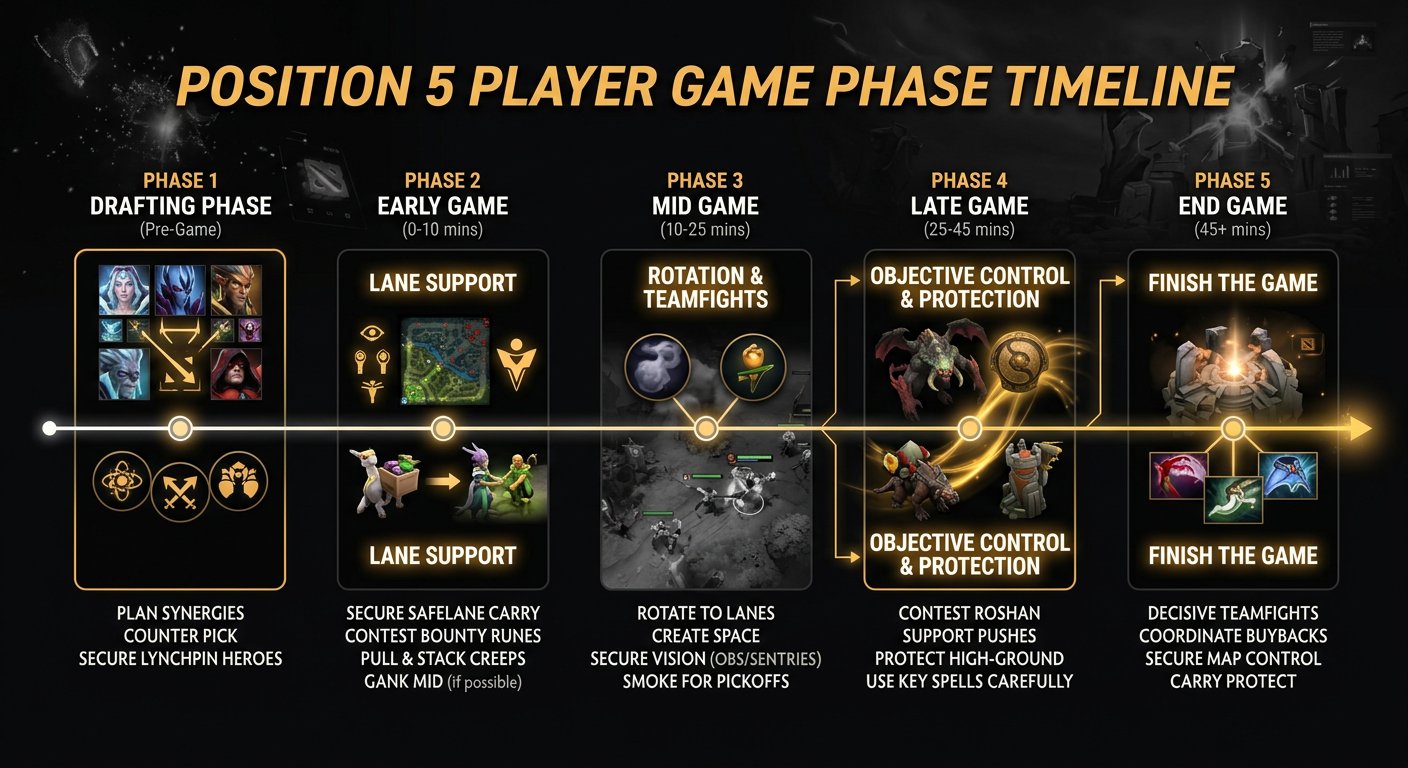
Pre-Game: The Buy Phase
Your starting items matter more than any other role. The standard pos 5 starting buy should include: 2 Observer Wards, 1 Sentry Ward, Tangoes (share 2 with mid), Healing Salve, Enchanted Mango, and a Clarity. Some heroes benefit from a Wind Lace or Orb of Venom instead.
Ward placement at 0:00: place an Observer Ward that covers the enemy’s likely approach to your carry’s lane. This prevents early rotations and gives your carry safe farming information. Place the Sentry to cover the most common enemy ward spot in your lane.
Laning Phase (0:00 – 7:00)
First wave: Position yourself between the enemy offlaner and the creep wave. Right-click the enemy every time they approach for a last hit or deny. Trade aggressively — your regen allows you to trade and recover, while the enemy offlaner’s regen is more limited.
Zoning vs. pulling: The decision between zoning and pulling depends on the wave state:
- If the wave is balanced and you’re winning trades: continue zoning
- If the wave is pushing toward the enemy tower: pull the small camp (stack first)
- If the wave is pushed under your tower: help your carry last hit under tower and wait for the wave to reset
- If the enemy offlaner is too strong to zone: pull-through from small camp to large camp
Regen management: Use your consumables efficiently. Don’t pop a Salve at 80% HP — save it for when you’re actually in danger. Clarities should be used while pulling or walking between camps, not while standing in lane where they’ll be canceled. Mangoes are emergency mana for kill attempts or saves.
When to leave lane: Leave to stack camps at X:55. Leave to place a mid ward at 2-3 minutes. Leave to check the rune at even-minute marks if your mid can’t contest it. But always return to lane quickly — your carry needs you for the first 7 minutes.
Transition Phase (7:00 – 15:00)
This is when pos 5 play becomes complex. You’re leaving the safelane (your carry should be able to farm alone now) and you need to decide where to be and what to do. The priority list:
- Stack camps for your carry or mid (highest gold-per-second value)
- Place wards that protect your carry’s farming area
- Rotate to mid for a gank if the opportunity exists
- Help your offlaner push a tower if they need support
- Deward aggressive enemy wards in your jungle
- Farm empty lanes that nobody else is taking
TP usage: Always have a TP available. The pos 5 TP is one of the most important resources in the game because it enables counter-ganks. If the enemy dives your mid, you TP and turn the fight. If the enemy pushes your offlane tower, you TP and defend. Your TP is a safety net for your entire team.
Economy during transition: This is the phase where you’re poorest. You’re buying wards, sentries, dust, and smoke while earning minimal gold. Accept it. Your items will come later. Focus on keeping your cores safe and creating information advantages through vision.
Mid-Game (15:00 – 30:00)
Team fight positioning: You are the backline. Your position in fights should be behind your carry, 1,200-1,500 units from the fight center. From here, you can cast your abilities on the right targets, use your items (Glimmer, Force Staff) to save cores, and avoid being focused down.
Vision for objectives: Your warding should shift from defensive (protecting your carry’s farm) to offensive (preparing for objective takes). Ward the enemy’s jungle entrance before your team pushes. Ward Roshan pit before Roshan attempts. Ward behind the enemy’s high ground before high ground pushes.
Smoke coordination: Unlike pos 4, you’re usually not the primary smoke user. But you should always carry smoke and use it to ward safely. Smoke yourself, place a deep ward, and get out. This is safer than walking into enemy territory without smoke.
Save item timing: Your first save item (Glimmer Cape or Force Staff) should be completed by 18-22 minutes. This is non-negotiable. A pos 5 without a save item at 20 minutes is a pos 5 who can’t protect their carry in team fights. If you need to skip boots to get Glimmer faster, do it. Glimmer Cape saves more lives than brown boots.
Late Game (30:00+)
The pos 5’s late game is entirely about two things: vision and saves.
Vision: Maintain ward coverage at all times. Every fight that happens with vision advantage is tilted in your favor. Every fight without vision is a coin flip. You are the difference between your team fighting with information and fighting blind.
Saves: Your Glimmer Cape, Force Staff, and hero abilities should be used exclusively on your carry during late-game fights. If your carry lives through the fight, you probably win. If your carry dies, you probably lose. Allocate all your resources to keeping them alive.
Positioning: In the late game, you are the most killable hero on the map. If the enemy catches you, you die in 1-2 hits. Your positioning needs to be immaculate — always behind terrain, always with an escape route planned, always within save range of your carry but outside the enemy’s kill range. If you get caught and die before the fight starts, your team fights 4v5 without saves. That’s often game-losing.
Buyback: At pos 5, your buyback might be the difference between winning and losing if you’re the only save on your team. Keep buyback gold after 35 minutes if you have Shallow Grave, False Promise, or a critical save ability. Otherwise, spend buyback gold on items.
The Teammate Problem: Account Buyers, Toxic Carries, and the Support’s Burden
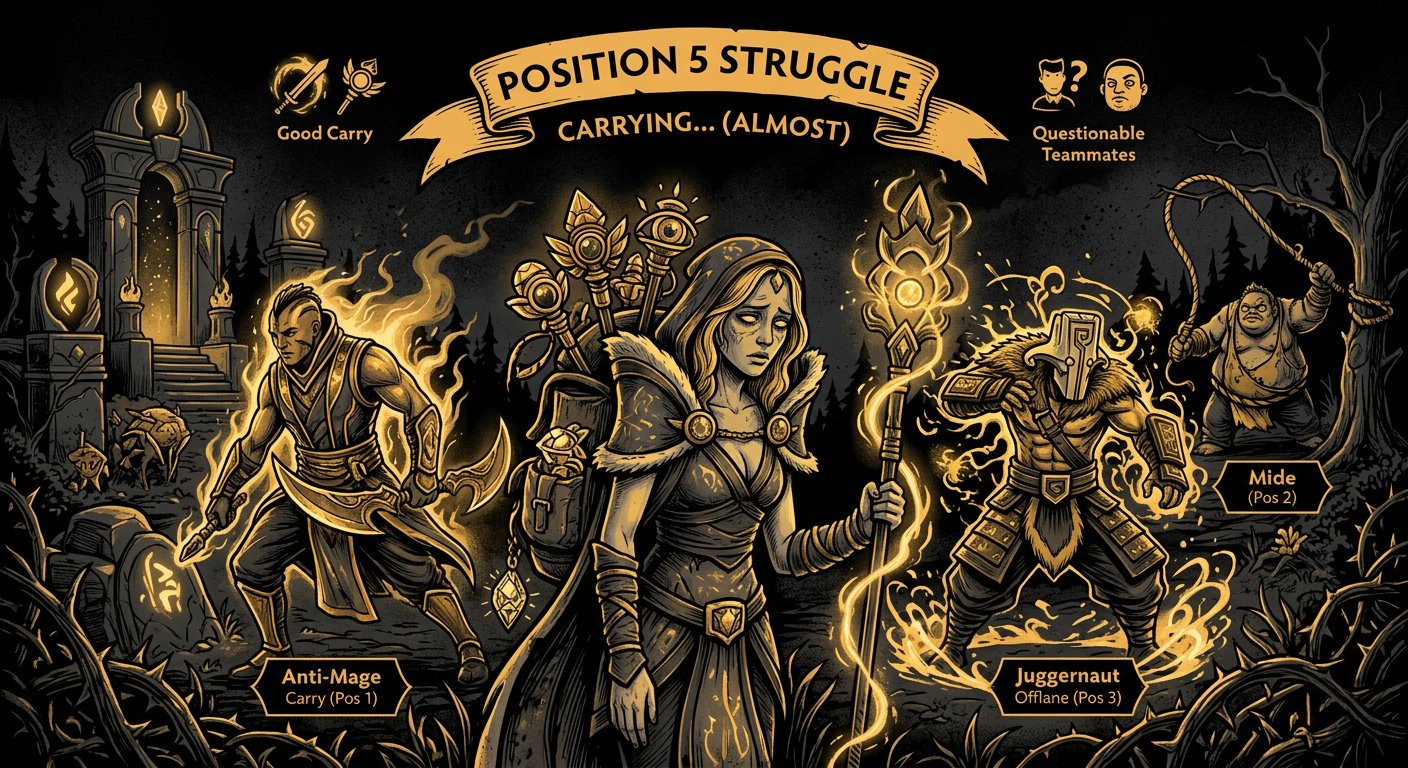
The pos 5 experience at Divine is often miserable because you’re directly tied to your carry’s performance, and you have no control over who your carry is. You might get a skilled Divine 5 carry who capitalizes on everything you do, or you might get an account buyer who misses 30% of last hits and never uses the farm space you created.
The Carry Lottery
Every game as pos 5, you’re essentially gambling on your carry being competent. This variance is the primary reason pos 5 is the slowest climbing role. You can play a perfect lane, give your carry free farm, stack camps, maintain perfect vision — and your carry still might not be good enough to carry the game.
The mental framework for dealing with this: play every game as if your carry is average, and be pleasantly surprised when they’re good. Don’t over-invest in any single game emotionally. Don’t tilt when your carry makes mistakes. View each game as one data point in a long-term statistical process. Your consistent high-quality play will show up in your win rate over hundreds of games, even if individual games feel random.
When Your Carry is Bad
Signs that your carry is significantly below bracket: missing more than 2-3 last hits per wave, not using creep aggro, buying incorrect items, dying to obvious ganks despite your ward coverage.
When you identify a bad carry, adjust your strategy:
- Shift your attention to your mid or offlaner. If the carry can’t use your support, find someone who can. Stack for the mid instead. Ward for the offlaner’s aggressive plays. Enable the player who can be enabled.
- Pick up items that provide independent value. If your team can’t capitalize on your saves, buy items that provide offensive value — Veil of Discord, Solar Crest, Spirit Vessel. These amplify your team’s damage without requiring your carry to be good.
- Play for the late game. Bad carries who can’t farm efficiently can still win fights at 45 minutes when everyone is six-slotted. If possible, stall the game and hope your carry catches up.
Toxic Teammates and Muting
Pos 5 is the most blamed role in Dota. When things go wrong, someone will blame the support. “Wards” “Where are the sentries” “Why didn’t you save me” Even when you’re playing perfectly, some teammate will find a reason to blame you.
The rule: mute the FIRST toxic message. Not the second. Not the third. The FIRST. Engaging with toxicity — even to defend yourself — tilts you and wastes mental energy. Your mental energy is your most valuable resource for climbing. Protect it ruthlessly.
Being the Team’s Emotional Anchor
This is the hidden superpower of great pos 5 players. When things go badly, you’re the one who keeps the team together. Type “it’s fine, we scale” after a bad fight. Type “good try, we’ll get them next time” after a failed Roshan attempt. Type “focus” when the team starts arguing. These simple messages prevent tilt cascades that lose games.
You don’t have to be everyone’s therapist. But a few words of encouragement or direction at key moments can be the difference between a team that tilts and a team that rallies. And rallying teams win games that should be losses.
Realistic Timeline: How Long Will This Take
The Honest Numbers
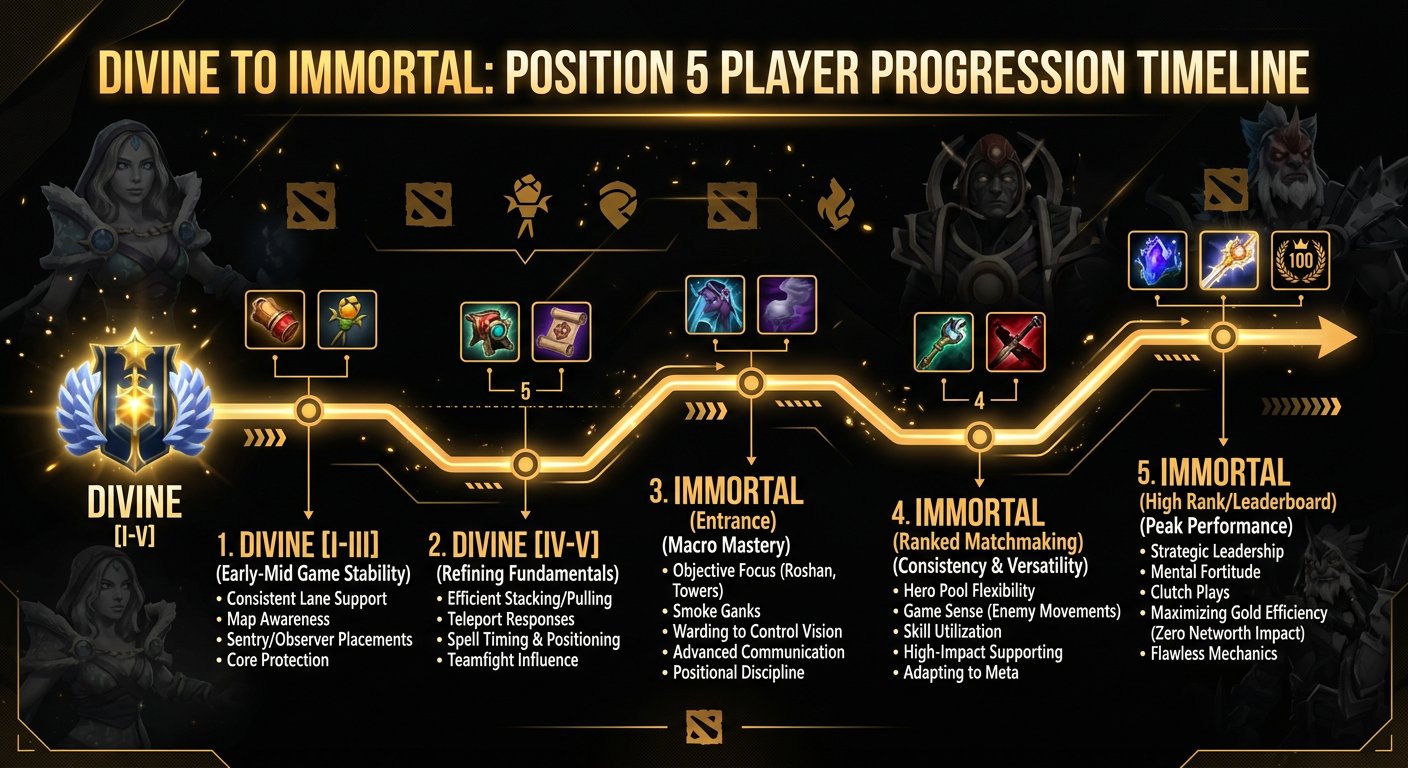
Pos 5 is the slowest climbing role in Dota. Here are realistic timelines based on win rates:
- At 54% win rate (3-4 games/day): ~12-15 months to climb 1,000 MMR. This is the reality for most pos 5 players who are slightly above their bracket.
- At 56% win rate (3-4 games/day): ~6-8 months.
- At 58% win rate (3-4 games/day): ~4-5 months.
- At 60%+ win rate (3-4 games/day): ~2-3 months. This requires playing significantly above your bracket.
The slow pace is why many pos 5 players burn out before reaching Immortal. The climb is a marathon, not a sprint. Prepare mentally for a months-long process.
Plateaus for Pos 5
First plateau: ~4,900-5,100 MMR. “Good laner, lost in the mid-game.” You win the lane for your carry but don’t know how to transition your impact into the mid-game. Fix: develop a mid-game action plan (stacking, warding, smoke plays).
Second plateau: ~5,300-5,500 MMR. “Good player, inconsistent.” You play Immortal-level games on good days and Divine-level games on bad days. Fix: mental consistency — same routine, same attitude, same decision-making regardless of how the last game went.
Third plateau: ~5,500-5,600 MMR. “Almost there but can’t close it out.” You’re on the doorstep of Immortal but can’t maintain the streak needed to cross the threshold. Fix: this is where coaching has the most value. A coach can identify the 2-3 specific habits preventing you from breaking through.
When the Grind Becomes Too Much
Let’s be honest: climbing 1,000 MMR as pos 5 can take 6-12 months of daily play. That’s a significant time investment, and not everyone has that time. If you’re stuck, burning out, or just want to play at the Immortal level without the months-long grind, MMR boosting is a practical solution. Many of our pos 5 clients use boosting to reach Immortal and then maintain the rank through their own play, which is easier than climbing to it.
Frequently Asked Questions
Yes. Statistically, pos 5 players have lower win rates at every skill level above their “true” MMR compared to core roles. This is because pos 5’s impact is indirect — you enable other players rather than directly winning the game. The variance in teammate quality affects your results more. It’s absolutely possible to climb as pos 5, but it takes more games and more patience.
Only if you genuinely enjoy and are skilled at a core role. Switching to carry because it’s “easier to climb” will backfire if you don’t have carry mechanics. Your best role is the one you play most consistently at a high level. If that’s pos 5, stick with it — the climb is slower but you’ll get there.
Watch Immortal pos 5 replays and focus on the first 5 minutes. Pay attention to: when they harass, when they pull, how they manage regen, where they stand relative to the creep wave, and when they leave lane. Then practice these patterns in your own games. Laning is the single most impactful skill for pos 5 climbing.
In order of priority: Wards/Detection > Boots > One save item (Glimmer or Force) > Second save item > Utility item (Aeon Disk, Ghost Scepter, etc.). Your first 20 minutes of gold should go to team items and one save item. After that, build whatever the game demands.
Accept that your impact is invisible and your credit will be minimal. Find satisfaction in the process — making the right decisions, executing clean lanes, placing perfect wards — rather than in external validation. If the emotional toll is too high, take breaks. Play some unranked games as a core. Come back to ranked when you’re refreshed and motivated.
Meta heroes are meta for a reason — they’re strong in the current patch. But a hero you’ve played 300 times at a high level is usually better than a meta hero you’ve played 30 times. Prioritize comfort and mastery over meta adherence. If your comfort pick IS a meta pick, even better.
Critical. Pos 5 is the team’s information hub — you should be the one calling out enemy movements, timing objectives, and coordinating plays. Simple callouts like “carry is farming top, we can smoke bot” or “they have ward here, sentry needed” are incredibly high-value. Communication is free impact.
Final Thoughts
Climbing from Divine to Immortal as a pos 5 hard support is the ultimate test of Dota knowledge and mental resilience. You won’t carry games through outplays or outfarming. You’ll carry them through superior decision-making, flawless vision control, clutch saves, and the quiet leadership that keeps your team functioning when everything else goes wrong.
The journey is long. There will be games that feel unwinnable. There will be carries who waste everything you give them. There will be losing streaks that make you question why you play support. But every Immortal pos 5 player has gone through this exact process. They persevered because they understood that their role — while thankless — is the foundation on which every successful team is built.
Master your lane. Control the vision. Save your carries. Lead your team with calm and confidence. And above all, stay consistent. Immortal is earned one good decision at a time.
If you’re ready to accelerate your climb, our Dota 2 coaching service specializes in pos 5 development with Immortal coaches who’ve made this exact climb. Or if you want to skip the grind entirely, our MMR Boost service can get you to Immortal while you focus on improvement.

Ready to Climb Start Your Journey Today
Team Smurf offers professional coaching with Divine and Immortal players, plus safe, reliable MMR boosting to help you reach your target rank.
Written by Team Smurf’s Immortal-rank analysts — Rankings last verified February 2026