How to Climb from Divine to Immortal as Pos 4 Soft Support

Position 4 is the most chaotic, creative, and mentally demanding role in Dota 2 — and at the Divine-to-Immortal threshold, it’s where the gap between “good player” and “great player” shows up most clearly. Pos 4 doesn’t have the mechanical clarity of carry (farm efficiently and fight), the strategic clarity of mid (win lane and control tempo), or the teamfight clarity of offlane (initiate and frontline). Instead, pos 4 requires you to do a little bit of everything — and do it all well.
The Divine bracket is full of pos 4 players who are good at one thing. They’re good roamers, or good laners, or good team fighters, or good warders. But they’re not good at all of these things simultaneously, and they don’t know when to prioritize which. That’s the gap. Immortal pos 4 players seamlessly shift between roles throughout the game, always doing whatever the current game state demands.
This guide is for the Divine pos 4 player who’s hit a wall. You know the basics, you can play your heroes, and your game sense is decent. What you need is the framework for making better decisions — specifically, the decisions about WHERE to be and WHAT to do at every stage of the game.
Table of Contents
- The Pos 4 Role at Divine — The Role Nobody Understands Fully
- Top 5 Heroes to Climb from Divine to Immortal as Pos 4
- 10 Critical Mistakes Divine Pos 4 Players Make
- Phase-by-Phase Guide: Laning Through Late Game
- The Teammate Problem: Account Buyers and Boosted Players
- Realistic Timeline: How Long Will This Take
- FAQ
The Pos 4 Role at Divine — The Role Nobody Understands Fully
Here’s what most Divine pos 4 players think their job is: “Lane with offlaner, then roam and make plays, then be a support in fights.” This is a surface-level understanding that misses the depth of what the role actually requires. The pos 4’s real job is to be the team’s most flexible resource — the player who fills whatever gap the team currently has.
The Flexibility Principle
In any given moment, there’s one thing that would benefit your team the most. Maybe it’s stacking the ancient camp. Maybe it’s ganking mid. Maybe it’s pulling the offlane wave. Maybe it’s warding the enemy jungle. Maybe it’s sitting behind your offlaner to counter a gank. The Immortal pos 4 identifies the highest-value action at every moment and does it. The Divine pos 4 defaults to whatever feels comfortable — usually following their offlaner or farming empty lanes.
This decision-making speed and accuracy is the core skill gap between Divine and Immortal pos 4 players. It’s not about mechanical skill (though that helps). It’s about mental processing — constantly scanning the map, evaluating options, and choosing the highest-impact play.
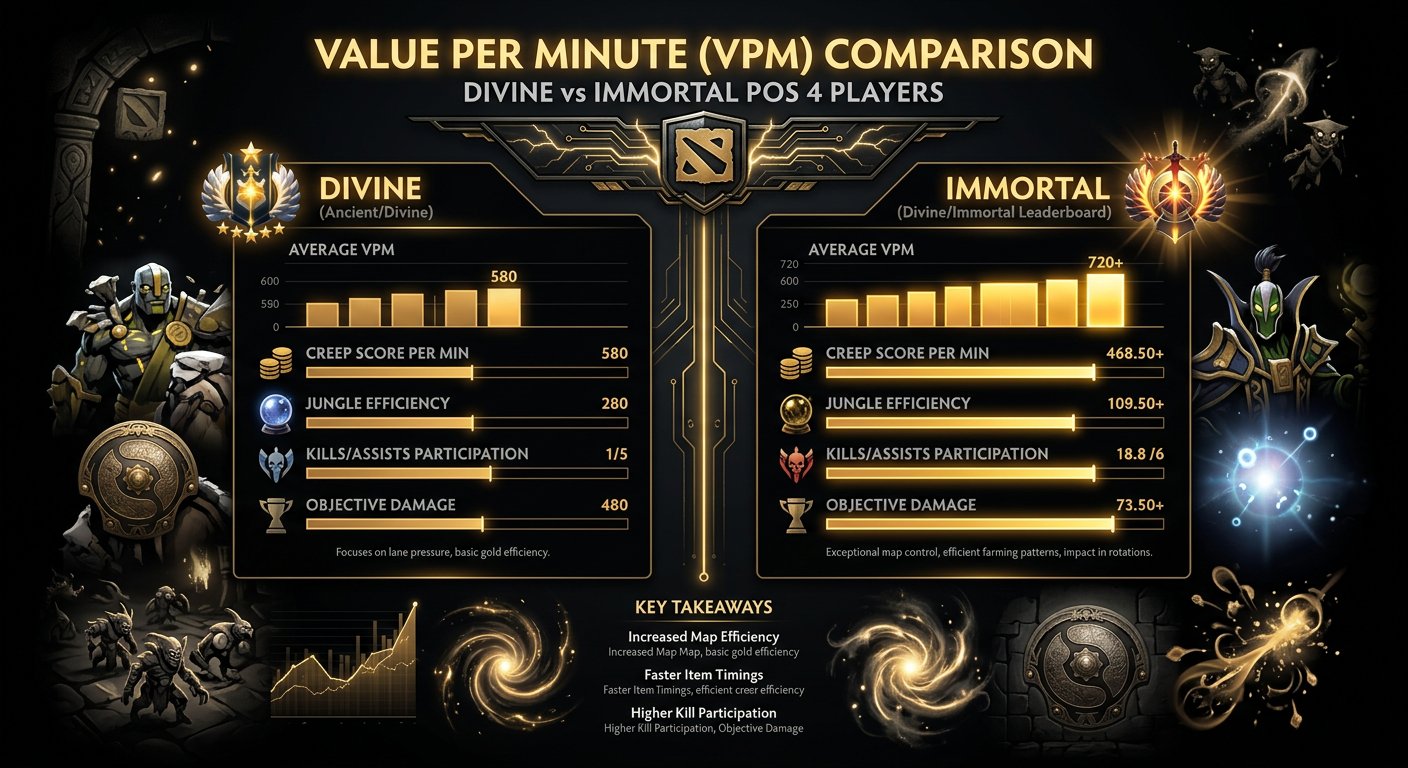
Value Per Minute
I use a concept I call “Value Per Minute” (VPM) to evaluate pos 4 play. Every minute, you should be generating value for your team. Value can be: gold from farm, experience from lane, information from vision, pressure from ganks, stacks from jungle camps, or saves from team fight abilities. The question is: how much value are you generating per minute, and is it the right TYPE of value for this moment
Divine pos 4 players average maybe 3-4 “high-value actions” per minute. They farm a wave, place a ward, join a fight. There’s a lot of dead time — walking between lanes without purpose, standing behind an ally doing nothing, sitting in trees waiting for a gank opportunity that never comes. Immortal pos 4 players average 5-6+ high-value actions per minute because they eliminate dead time. They stack while rotating. They ward while ganking. They harass while pulling. Every second counts.
The Vision Game at Divine
Vision is the pos 4’s primary strategic tool. At Divine, warding is decent — players know the common ward spots and they deward occasionally. But Immortal-level vision play is on another level entirely.
Immortal pos 4 players think about vision in terms of information asymmetry. Every ward you place should answer a specific question: “Where is the enemy carry farming” “Is the enemy going to Roshan” “Is a gank coming from this direction” If a ward doesn’t answer a useful question, it’s a wasted ward.
More importantly, Immortal pos 4 players think about REMOVING the enemy’s information. Dewarding isn’t just about the 100 gold — it’s about blinding the enemy. If you deward their jungle entrance ward, they don’t know when you’re invading. If you deward their Roshan ward, they don’t know when you’re taking Rosh. Dewarding is an offensive action, not a defensive one.
Economy Management
Pos 4 has the most complicated economy in Dota because you need to balance personal items with team utility purchases (wards, dust, smoke). At Divine, pos 4 players either over-invest in their own items (neglecting vision and utility) or over-invest in support items (being too underfarmed to contribute in fights).
The balance: always have vision items in your inventory. Always have a TP scroll. After meeting those requirements, invest in your own progression. Your goal is to have 2-3 core items (Blink, Force Staff, Glimmer Cape) while maintaining full ward coverage. If you have to choose between buying wards and completing your Blink, buy the wards. Your Blink timing matters less than your team’s vision.
Top 5 Heroes to Climb from Divine to Immortal as Pos 4
The best pos 4 heroes for climbing are the ones that create plays independently. You want heroes that can gank, initiate, and contribute to fights without relying heavily on team coordination.
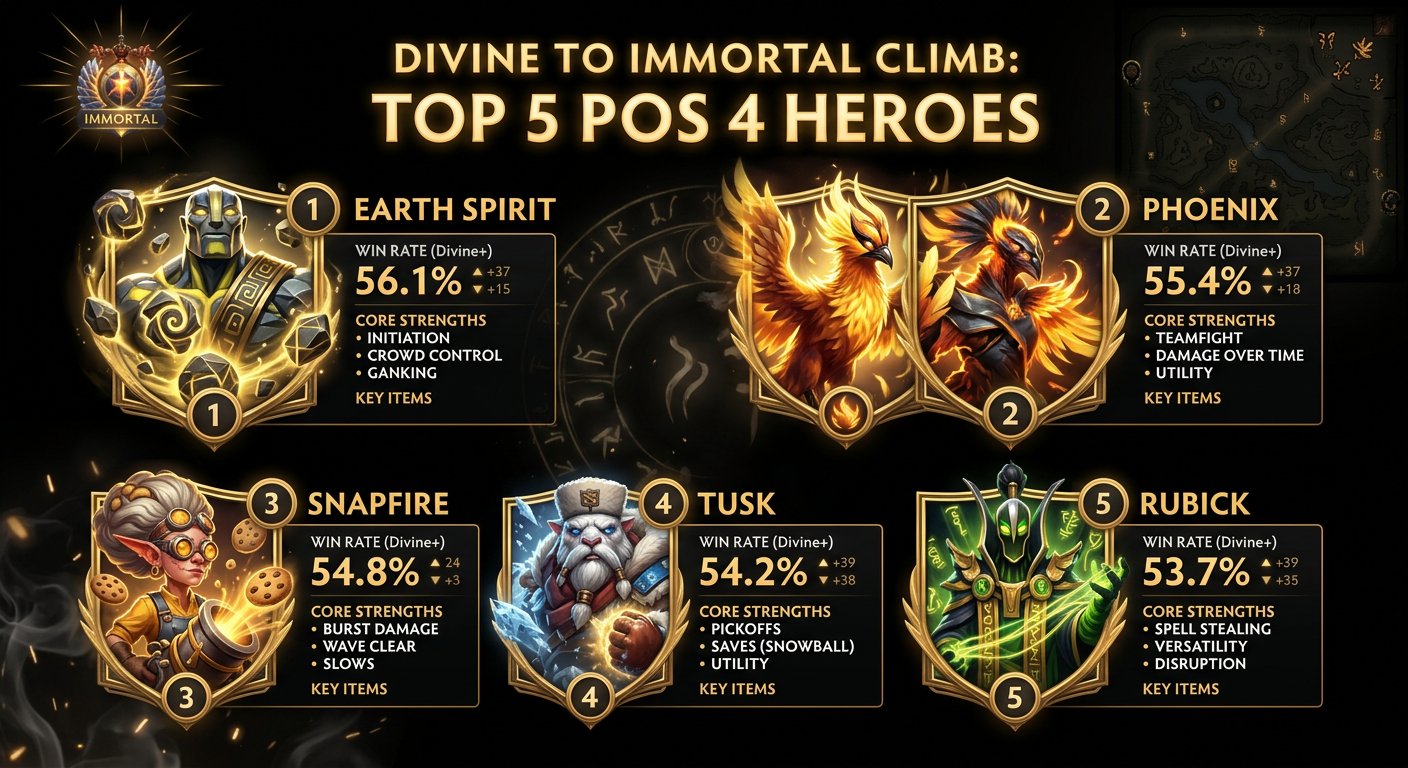
1. Earth Spirit
Earth Spirit is the highest skill-ceiling pos 4 in Dota and the poster child for “if you’re better than your bracket, you win.” His kit allows for roaming, saving, initiating, and killing — all from the pos 4 position. If you can play Earth Spirit at an Immortal level, climbing through Divine is one of the fastest possible routes.
Why he works at this bracket: ES punishes out-of-position heroes more effectively than almost any other support. At Divine, players still make positioning errors — they push waves too far, they walk through unjungled areas, they farm without TP. Earth Spirit turns every one of these mistakes into a kill. His silence is devastating against heroes who rely on their spells to escape (QoP, Storm, Ember), and his ultimate provides sustained damage in team fights that tips the balance.
Key timings: Level 3 is your first gank timing — Rolling Boulder + Boulder Smash is a long-range disable combo that guarantees kills with follow-up. Level 6 adds Magnetize, which provides solo kill potential on most heroes. Spirit Vessel by 12-14 minutes is your first item spike — it amplifies your Magnetize damage and provides healing reduction against tanky targets.
Advanced tip: Stone Remnant management is what makes or breaks Earth Spirit players. You have limited Remnants (recharging on a timer), and using them all offensively leaves you unable to save allies or escape. Immortal ES players always keep at least one Remnant in reserve for defensive purposes. They also place Remnants preemptively in locations where they anticipate needing them — behind enemy heroes for kick combos, in front of retreating allies for pulls, near objectives for quick rotations. Think of Remnants as your resource pool, not just projectiles.
2. Tusk
Tusk is the most aggressive pos 4 in Dota and one of the best heroes for creating early-game advantages. Snowball + Ice Shards is one of the most reliable gank combos in the game, and Walrus Punch adds kill potential throughout the mid-game.
Why he works at this bracket: Tusk creates chaotic, aggressive early games — and most Divine players don’t handle chaos well. When a Tusk player is constantly ganking, forcing rotations, and creating kills in the first 10 minutes, the enemy team’s game plan falls apart. And at Divine, once a game plan falls apart, many players tilt and the game spirals.
Key timings: Level 2 ganks are Tusk’s bread and butter — Snowball + Shards from fog is a near-guaranteed kill if your lane partner has any stun. Level 6 adds Walrus Punch, which gives you solo kill potential against squishy heroes. Blink Dagger by 15-18 minutes extends your initiation range dramatically.
Advanced tip: Ice Shards placement is the mechanical skill that separates good Tusk from great Tusk. Don’t aim Shards at the enemy — aim them BEHIND the enemy to cut off their retreat path. The ideal Shard placement creates a wall between the enemy hero and their tower/allies, trapping them in an area where your team can follow up. At higher levels, also use Shards to block camps, interrupt TPs by trapping heroes in the shard wall, and create choke points during team fights.
3. Rubick
Rubick is the most versatile pos 4 in Dota because his power scales with the spells available in each game. Against teams with big ultimates (Ravage, Black Hole, RP), Rubick is potentially the most impactful support in the game.
Why he works at this bracket: At Divine, players are good enough to use their big spells effectively but not always good enough to play around Spell Steal. They’ll Ravage when Rubick is nearby, or they’ll Black Hole without checking if Rubick has Linken’s. This creates windows for Rubick to steal game-changing abilities. One stolen Ravage can literally win the game.
Key timings: Rubick’s power spikes are less item-dependent and more level-dependent. Level 6 with Spell Steal is when you become dangerous. Aether Lens by 14-16 minutes increases your cast range for both Telekinesis and Spell Steal, making you more effective in fights. Blink Dagger by 20-22 minutes gives you the mobility to position for key steals.
Advanced tip: Spell priority is everything. Don’t just steal the last spell the enemy cast — steal the BEST spell available. This means positioning yourself to steal from specific enemies. If the enemy has Tidehunter and Sand King, position yourself near Tidehunter to steal Ravage, not near Sand King to steal Epicenter. The ability to prioritize steals and position accordingly is what makes Rubick an Immortal-level hero.
4. Clockwerk
Clockwerk is the best pick-off pos 4 in Dota. Hookshot’s massive range allows you to initiate on enemies anywhere on the map, and Power Cogs traps enemies in a confined space where they can’t escape. At Divine, isolated heroes die to Clockwerk consistently.
Why he works at this bracket: Divine players farm alone more often than they should. The carry farming the enemy jungle without vision. The mid pushing a wave too far. The support warding alone. Clockwerk punishes all of these behaviors with instant kills from across the map. One Hookshot on the enemy carry at 25 minutes can win the game.
Key timings: Level 6 with Hookshot is your first major power spike. Before 6, you play the lane aggressively with Battery Assault and Cogs. After 6, you’re a global threat. Blade Mail by 14-16 minutes makes your Cogs trap even more dangerous — enemies who attack you during Cogs take reflected damage while being battery-assaulted. Aghanim’s Shard gives you a second Hookshot charge, which doubles your initiation potential.
Advanced tip: Cog trapping is an art form at high levels. Don’t just Cog when you Hookshot — Cog IMMEDIATELY after landing, before the enemy can react. The timing window is about 0.3 seconds. If you delay Cogs, mobile heroes will Blink or dash out before the Cogs form. Also, use Cogs offensively by pushing enemies into your team or away from their allies. The knockback from Cogs can separate a support from their carry, creating isolated kill targets.
5. Spirit Breaker
Spirit Breaker is the simplest pos 4 hero mechanically but one of the most effective for climbing because his impact is constant and guaranteed. Charge of Darkness creates kill opportunities from anywhere on the map, and Nether Strike pierces BKB for a reliable disable in late-game fights.
Why he works at this bracket: Spirit Breaker creates permanent map pressure. The enemy always has to play as if SB might be charging them, which makes them farm less aggressively and group more defensively. This psychological pressure is worth hundreds of gold in reduced enemy farm, even when you’re not actively ganking. At Divine, this pressure often causes the enemy to over-rotate, leaving farm on the table.
Key timings: Spirit Breaker’s power is relatively flat — he’s relevant from minute 1. Level 6 adds Nether Strike for burst damage. Shadow Blade by 14-16 minutes allows you to charge while invisible, removing the visual indicator that tells enemies you’re coming. BKB by 22-25 minutes makes your initiations unstoppable.
Advanced tip: Charge target selection is the highest-impact decision SB makes. Don’t just charge the nearest visible enemy — charge the target whose death would have the most game impact. Charging the enemy carry while they’re farming alone is almost always better than charging the enemy support during a team fight. Also, cancel charges judiciously. If you see the enemy grouping up to receive your charge, cancel it and charge a different target. A wasted charge is better than a dead Spirit Breaker.
10 Critical Mistakes Divine Pos 4 Players Make
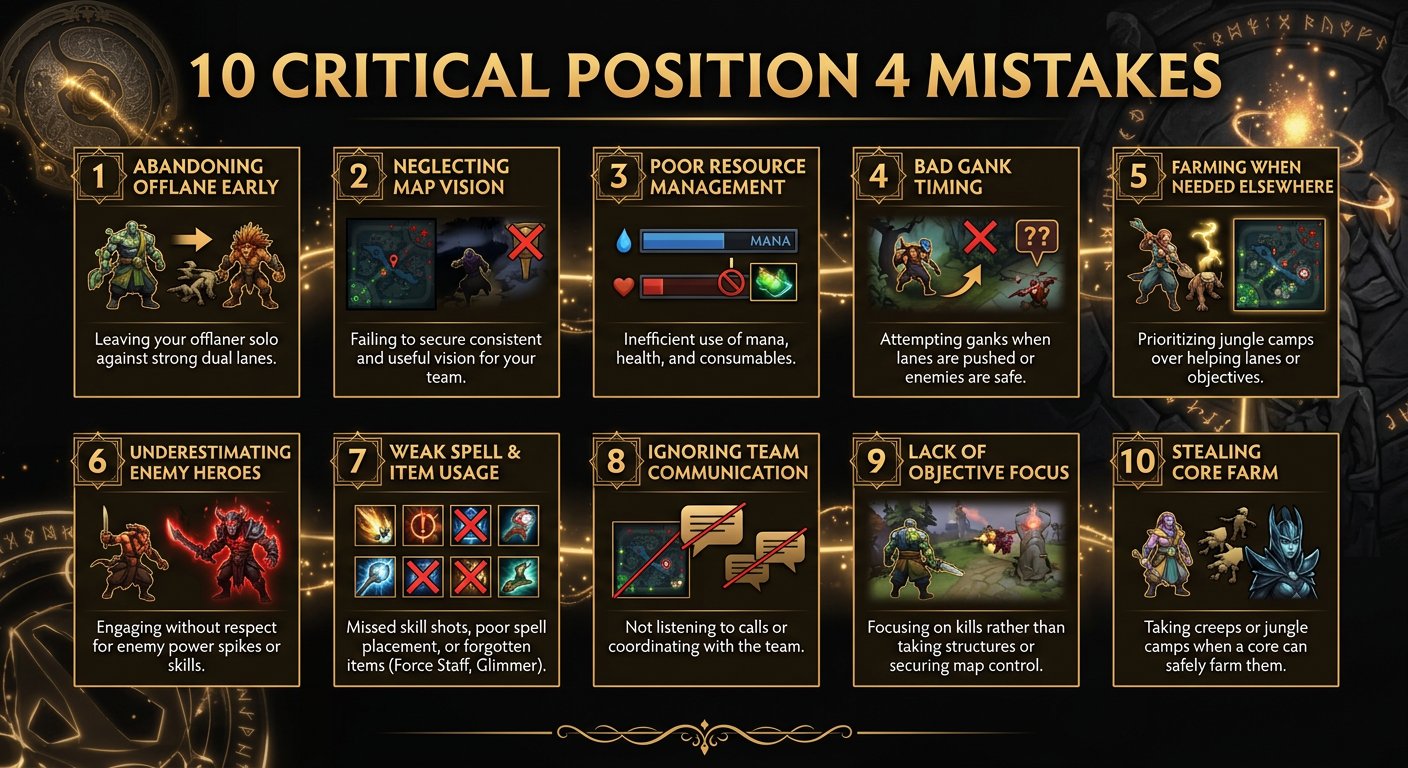
Mistake #1: Staying in the Offlane Too Long
This is the #1 mistake by a huge margin. Divine pos 4 players sit in the offlane for 8-10 minutes, leeching XP from their offlaner and providing only marginal value. The optimal time to leave the offlane is usually between minutes 3-5, once you’ve secured a kill or established lane dominance.
After leaving, you should be roaming. Check mid for a gank opportunity. Stack a camp. Place a ward. Check if the enemy carry’s support has left lane (making the carry vulnerable). Your value as a pos 4 comes from being active across the map, not from standing behind your offlaner watching them last hit.
Mistake #2: Not Stacking Camps
At Divine, pos 4 players average 2-3 stacks per game. At Immortal, they average 5-8. The difference in team gold is enormous — a triple-stacked ancient camp is worth 500+ gold to whoever clears it. That’s a free kill’s worth of gold that you created in 3 seconds of work.
Build stacking into your rotation. Every time the clock approaches X:53-X:55 and you’re near a camp, stack it. Set yourself reminders until it becomes automatic. Stacking is the highest gold-per-second-invested action a support can take, and not doing it is leaving free money on the table.
Mistake #3: Warding Reactively Instead of Proactively
Divine pos 4 players ward in response to what’s happening — they place a defensive ward after getting ganked, or a Roshan ward after the enemy takes Rosh. Immortal pos 4 players ward in advance of what’s GOING to happen — they place offensive wards before their team smokes, Roshan wards before Roshan is contested, and lane wards before their carry moves to a new farming area.
The principle: ward for the future, not the past. If you expect a team fight at Roshan in 3 minutes, ward Roshan now. If you expect the enemy to smoke through your jungle, deward and re-ward that area now. Anticipatory vision is worth ten times more than reactive vision.
Mistake #4: Poor Smoke Usage
Smoke of Deceit is the most powerful consumable in Dota, and Divine pos 4 players use it maybe 3-4 times per game. Immortal pos 4 players use it 6-10 times. Every smoke use should have a clear target and a clear objective. “We’re smoking to kill the enemy carry and take the mid tower” is a plan. “Let’s smoke and see what happens” is not a plan.
Buy smoke on cooldown. Ping it to your team. Call the target. Execute. Rinse and repeat. This single habit change — using more smokes with clear intentions — will improve your win rate by 2-3 percentage points, which is massive over hundreds of games.
Mistake #5: Not Carrying Detection
If the enemy has invisible heroes or Shadow Blade carriers, you need Dust and Sentries on you at ALL TIMES. Not sometimes. Not when you remember. ALL TIMES. At Divine, the number of kills lost because the pos 4 didn’t have dust is infuriating. One dust is 80 gold. One kill is 300+ gold. The ROI on carrying detection is astronomical.
Mistake #6: Taking Farm From Cores
The most tilting thing a pos 4 can do is farm a lane that a core needs. If your carry is farming the safe lane and you’re farming the nearby jungle camps, you’re taking gold that should be theirs. Pos 4 farm should come from camps that nobody else wants, from stacks that you’ve created, and from waves that are pushing into your tower and nobody else is nearby to take.
The exception: if your carry is dead and a wave is pushing into the tower, take it. Gold that goes to nobody benefits nobody. But if a core is alive and nearby, leave the farm for them.
Mistake #7: Dying in Vision Placement
Wards are worthless if you die placing them. At Divine, pos 4 players often walk into enemy territory alone to place deep wards and get killed. The ward you placed gives vision for 6 minutes. Your death gives the enemy 300+ gold and removes you from the map for 30+ seconds. That’s usually a bad trade.
The fix: ward during smokes, ward during team movements, and ward after winning fights. Don’t ward alone in dangerous territory. If you must place a deep ward, bring a teammate or use smoke. Your life is more valuable than any single ward.
Mistake #8: Not Playing Around Your Offlaner’s Power Spikes
Your offlaner hits level 6 before you. When they hit their key ability (Ravage, Call, Arena), that’s YOUR cue to play aggressively in the offlane. Set up kills by positioning yourself for follow-up when your offlaner initiates. Many Divine pos 4 players miss these windows because they’re on the wrong side of the map when their offlaner spikes.
Mistake #9: Poor Team Fight Positioning
As pos 4, your team fight positioning should be on the periphery — not in the front (that’s offlane), not behind the carry (that’s pos 5’s job), but on the flank where you can cast your spells on key targets without being immediately focused. Think of yourself as a sniper, not a tank. You dart in, cast your abilities, and dart out.
Divine pos 4 players often stand too close to the frontline and get caught in AoE, or they stand too far back and can’t contribute their abilities. The sweet spot is 800-1,200 units from the center of the fight, where you can reach key targets with your spells but aren’t in the main damage zone.
Mistake #10: Not Adapting Your Role Based on Game State
Sometimes the game needs you to be a ganker. Sometimes it needs you to be a warder. Sometimes it needs you to be a secondary initiator. Sometimes it needs you to be a save support. The best pos 4 players read the game state and become whatever the team needs. Divine pos 4 players pick one role and stick with it regardless of what the game demands.
Check in with yourself every 5 minutes: “What does my team need from me right now” The answer will change throughout the game, and your behavior should change with it.
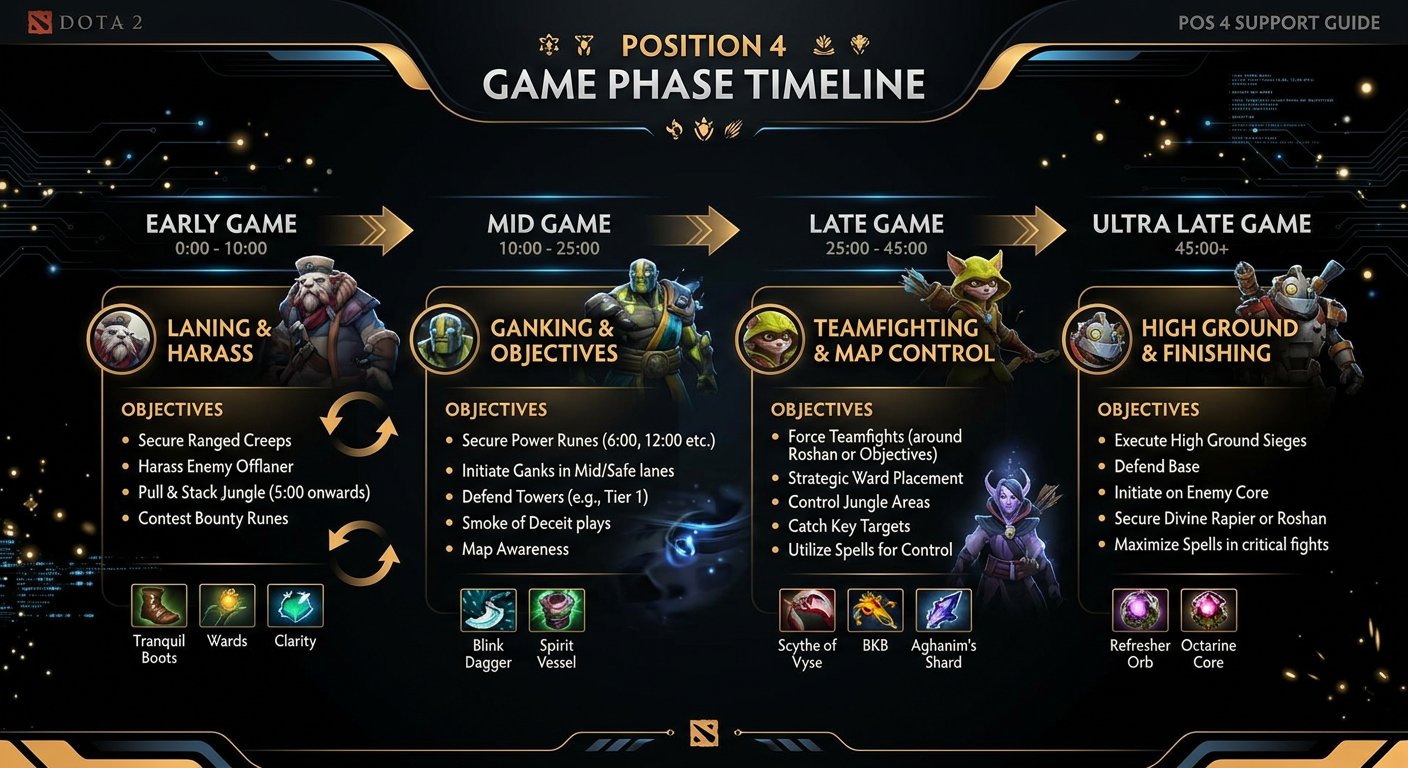
Phase-by-Phase Guide: Laning Through Late Game
Pre-Game: Draft Considerations
Your hero pick should complement your offlaner AND provide value across the map. Consider:
- Lane synergy: Does your hero combo with your offlaner Tusk + Axe (Snowball into Call), Clock + Mars (Hookshot into Arena), Earth Spirit + any stun hero — these combos create kill lanes.
- Roaming potential: Can you leave lane and gank effectively Heroes with reliable stuns or gap closers (Tusk, ES, Spirit Breaker) are better roamers than heroes who need setup (Rubick, Shadow Demon).
- Late-game utility: Will your hero still be useful at 40 minutes Heroes with scaling utility (Rubick’s Spell Steal, Clock’s Hookshot, ES’s save abilities) age better than heroes who fall off (Tusk, Bounty Hunter).
Laning Phase (0:00 – 5:00)
The first 2 minutes: Contest the lane. Trade hits with the enemy support. Secure ranged creep denies. Pull the large camp if the wave pushes. Your goal is to give your offlaner a comfortable lane or, ideally, a dominant one. Every last hit the enemy carry misses because of your pressure is a win.
Pulling mechanics: The offlane pull is one of the most powerful tools in your arsenal and one of the most underused at Divine. Pull the enemy’s hard camp through the trees to redirect the creep wave. This denies the enemy carry an entire wave of farm and XP while giving you farm and XP from the camp. The execution requires practice, but the payoff is enormous.
When to leave lane: Leave when (a) your offlaner can solo the lane, (b) you’ve secured a kill or lane advantage, or (c) a high-value gank opportunity exists on another lane. The optimal leave timing is usually between minutes 3-5. After leaving, your priorities are: gank mid stack camps check for rune return to offlane or gank safelane.
Roaming Phase (5:00 – 12:00)
This is pos 4’s highest-impact phase. Between minutes 5-12, you should be the most active hero on the map. Your rotation pattern should include:
- Ganking the enemy mid (walk from the side they have less vision on)
- Setting up kills on the enemy carry if their support has rotated
- Stacking camps for your mid or carry
- Placing offensive wards in the enemy jungle
- Checking rune spawns
Ganking efficiency: A gank attempt should take no more than 60 seconds including walking. If you walk to mid, wait in trees for 30 seconds, and the enemy doesn’t give you an opening, leave. Don’t waste 2 minutes on a gank that might not work. Your time is too valuable. Move on to the next play.
Communication during roams: Tell your team what you’re doing. “Smoking mid” / “Ganking carry” / “Stacking ancients.” This lets them adjust their play — your mid might play more aggressively knowing you’re coming, or your carry might hold their TP knowing you’re about to create pressure elsewhere.
Mid-Game (12:00 – 25:00)
Transition to team play. After the roaming phase, you shift from solo ganking to team-based plays. Your primary actions during this phase:
Vision warfare: This is when vision becomes most critical. The enemy is starting to smoke, starting to contest Roshan, and starting to group for pushes. Your wards need to cover the areas where these plays will happen. Ward the enemy’s jungle entrance to spot rotations. Ward Roshan pit 2 minutes before you expect a Roshan attempt. Ward behind the enemy T2 towers if your team is pushing.
Smoke initiations: As pos 4, you should be the one buying smokes and organizing smoke plays. After every successful gank or objective, immediately think “can we smoke for the next play” Maintaining momentum through consecutive plays is how games snowball at this bracket.
Save plays: Starting around minute 15, the enemy will start trying to pick off your carry or mid. This is where your save items (Glimmer, Force Staff) become crucial. Position yourself within cast range of your cores when fights might happen. A single Glimmer Cape save on your carry is worth more than any gank you could attempt.
Late Game (25:00+)
Your role simplifies in the late game: provide vision, save your cores, and use your abilities at the right time. That’s it. You’re not going to kill anyone 1v1 at 35 minutes. You’re not going to farm a major item. Your value comes entirely from decision-making and positioning.
Vision in late game: Late-game vision is about Roshan and high ground. Always have a Roshan ward up. Always have a ward covering the approach to your high ground. These two vision points prevent the most common game-losing plays at this bracket.
Team fight contribution: In late-game fights, your spells are used exactly once. One stun, one save, one disable. Make it count. Don’t waste your stun on the enemy support — save it for the enemy carry’s BKB timing or the channeled ability. One well-timed disable on the right target wins the fight. One poorly-timed disable on the wrong target is irrelevant.
Buyback considerations: As pos 4, your buyback is the least valuable on the team. If you can use buyback gold to buy a critical item (Aeon Disk, Ghost Scepter, Force Staff), do it. Your presence with the right item is usually worth more than your buyback.
The Teammate Problem: Account Buyers, Boosted Players, and the Pos 4 Dilemma
The pos 4 experience at Divine is uniquely frustrating because your performance is more team-dependent than any other role. A pos 4 can make perfect plays — perfect ganks, perfect vision, perfect saves — and still lose because their cores can’t capitalize. This creates a psychological challenge that’s as important as any mechanical skill.

The “I Set Up Everything and We Still Lost” Syndrome
This is the most common complaint from Divine pos 4 players, and it’s often legitimate. You ganked the enemy carry twice, you stacked camps, you placed perfect wards, your offlaner got a free lane — and then your carry still can’t farm efficiently, your mid takes bad fights, and you lose.
Here’s the hard truth: some games are unwinnable from the pos 4 position. You can play a perfect game and lose because your cores didn’t execute. The key is accepting this without tilting. Over 100 games, your consistent high-quality play WILL result in a positive win rate. But any individual game might be a loss despite your best efforts.
Adapting to Account Buyers
When you identify an account buyer or significantly underperforming core on your team, your strategy should shift:
- Invest in the stronger core. If your carry is bad but your mid is good, focus your rotations and stacks around the mid player. Enable the player who can carry, not the one who can’t.
- Play more selfishly. If both cores are struggling, it might be correct to take more farm yourself and play as a core-style pos 4. Heroes like Earth Spirit, Clockwerk, and Tusk can deal significant damage with items — if nobody else on your team can carry, you might need to try.
- Focus on vision and information. Even with bad cores, good vision gives your team a fighting chance. If your cores can at least avoid dying (thanks to your wards showing enemy movements), they’ll eventually hit their item timings and become useful.
Managing Your Offlaner
Your relationship with your offlaner is the most important interpersonal dynamic in the game for pos 4. A good offlane duo can dominate the lane and snowball the game. A bad duo can feed kills and lose the lane.
Tips for managing this relationship:
- Communicate your lane plan at the start: “I’ll harass, you last hit” or “We kill at level 3”
- If the lane is hard, offer to pull or rotate — don’t stubbornly stay and feed
- Coordinate power spike timing — ping when you’re about to hit a key level
- Don’t blame your offlaner if the lane goes badly — figure out what you can do differently
Realistic Timeline: How Long Will This Take
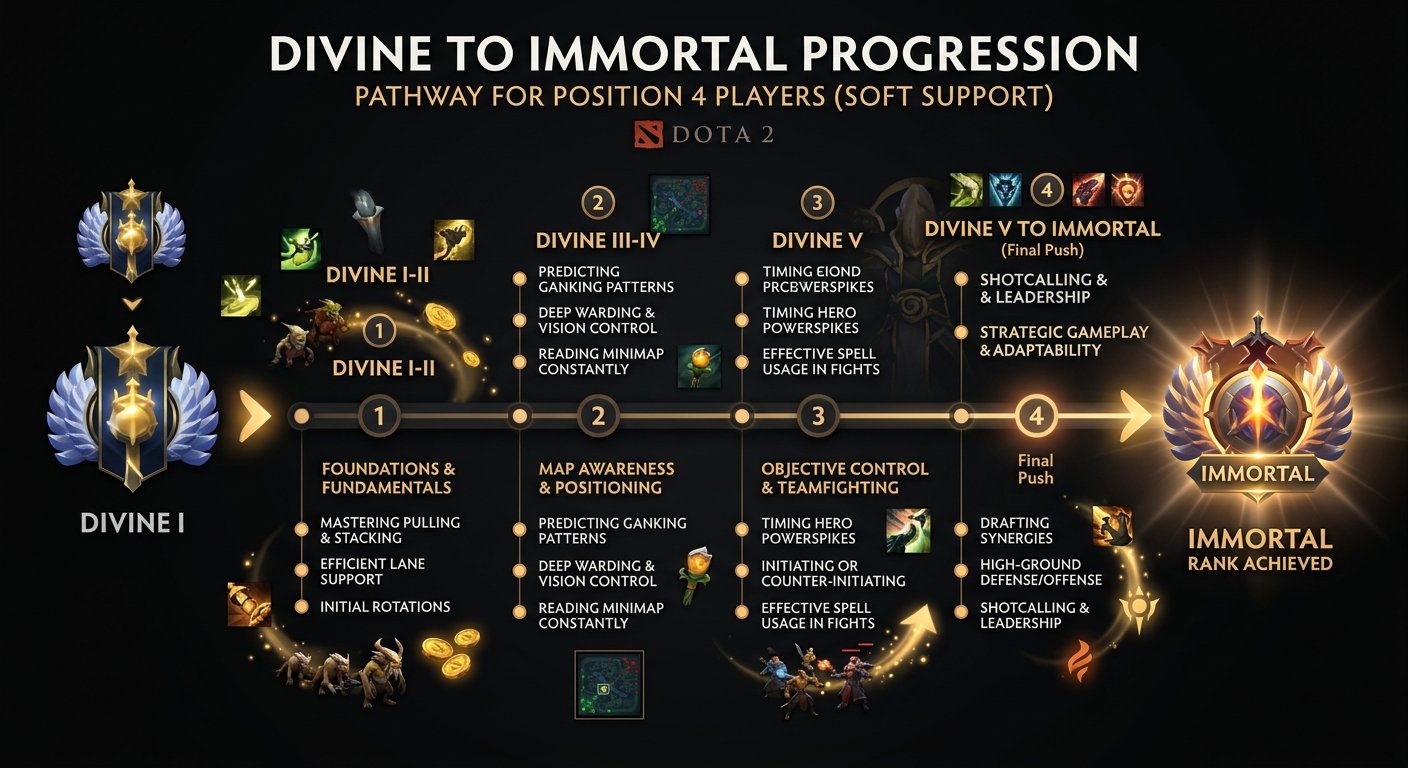
Pos 4 Climbing Speed
Pos 4 climbing speed is moderate — faster than pos 5 but slower than mid or carry. This is because pos 4 has high impact but it’s filtered through team execution. Your plays create opportunities, but your team needs to capitalize on them.
Realistic win rates and timelines:
- At 55% win rate (3-4 games/day): ~8-10 months to climb 1,000 MMR
- At 57% win rate (3-4 games/day): ~5-6 months
- At 60% win rate (3-4 games/day): ~2-3 months
Plateaus for Pos 4
First plateau: ~5,000 MMR. “Good laner, bad roamer.” You win the offlane but don’t create enough map-wide impact. Fix: develop roaming patterns and gank timings.
Second plateau: ~5,300-5,500 MMR. “Good mechanically, inconsistent decision-making.” You make great plays in some games and invisible plays in others. Fix: develop a decision-making framework (the VPM concept above) and apply it consistently.
If you’re stuck at a plateau, professional coaching from a high-MMR pos 4 specialist can identify your blind spots in one or two sessions. The investment in coaching at this stage pays for itself in months of climbing time saved.
Combining Improvement with Boosting
Many Divine pos 4 players find that the climb is frustratingly slow because individual game impact is diluted by team performance. If you’re improving but the MMR isn’t moving fast enough, MMR boosting can bridge the gap while you continue developing your skills. Get to Immortal, then focus on maintaining and improving from that baseline.
Frequently Asked Questions
Yes, but it requires patience. Pos 4 has high impact but the results are indirect — you create opportunities that others capitalize on. If you’re the type of player who gets frustrated when teammates don’t capitalize on your plays, pos 4 can be mentally challenging for climbing. But if you enjoy the creative, playmaking aspect and can stay positive through losses, pos 4 is an excellent climbing role.
Both, in sequence. Lane for the first 3-5 minutes, then transition to ganking and roaming. The mistake is doing either for too long — staying in lane past minute 5 wastes your roaming potential, and roaming before minute 3 abandons your offlaner in a potentially critical laning phase.
Context-dependent. In the early game (0-15 min), making plays is more valuable because kills create cascading advantages. In the late game (25+ min), saving your carry is more valuable because their death might lose the game. The transition point is around 15-20 minutes, when your carry has enough items to be worth protecting.
Focus on the least-lost lane. Don’t try to save every lane — identify which lane has the best chance of being salvaged and invest your time there. If all lanes are truly lost, shift to stacking camps, warding defensively, and waiting for the enemy to make a mistake. Even losing games have come-back potential if you maintain vision and don’t feed.
Important but secondary. You need enough gold for your key items (typically 2-3 items by 30 minutes), but you should never farm at the expense of creating plays or maintaining vision. The rough priority is: vision > plays > stacking > personal farm. Only farm when none of the higher-priority actions are available.
Communicate deliberately. Call out your plays (“smoking mid,” “stacking ancients”), share information (“enemy carry has BKB,” “3 missing bot”), and coordinate objectives (“Rosh in 1 minute”). Don’t narrate everything you do, but don’t play in silence either. Clear, concise communication is a competitive advantage at every bracket.
Final Thoughts
The pos 4 role at the Divine-to-Immortal threshold is the most demanding role in Dota in terms of decision-making breadth. You need to lane, roam, gank, ward, stack, save, initiate, and communicate — often within the same 5-minute window. The players who reach Immortal from this position are the ones who can process all of this simultaneously and always choose the highest-value action.
It’s not about making flashy plays. It’s about making the RIGHT play, every minute, for 40 minutes straight. Consistency of decision-making is what pushes you over the line.
Start by improving one aspect at a time. First, fix your stacking. Then, fix your warding. Then, fix your gank timing. Then, fix your team fight positioning. Layer improvements on top of each other until everything clicks.
If you want expert guidance on your specific weaknesses, our Dota 2 coaching service pairs you with Immortal pos 4 specialists. Or if you want to reach Immortal while you work on your game, check out our MMR Boost service.

Ready to Climb Start Your Journey Today
Team Smurf offers professional coaching with Divine and Immortal players, plus safe, reliable MMR boosting to help you reach your target rank.
Written by Team Smurf’s Immortal-rank analysts — Rankings last verified February 2026