Deny Mechanics: How 10 Extra Denies Wins Your Lane

Most Dota 2 players know denying is important. Almost nobody actually does it consistently. In ranked games below Divine, deny counts per lane rarely break 5 in the first 10 minutes — and that gap is costing real MMR. This guide breaks down exactly how deny mechanics work in the current patch, why the 50% XP reduction matters more than most players realize, and how consistently hitting 10 or more denies per laning phase shifts the lane math in your favor.
We cover the HP thresholds, the XP and gold calculations, tower deny rules, hero deny conditions, and the practical habits that separate players who deny from players who just think about denying. Every mechanic here has been verified against the current game state (patch 7.41d) — several values have shifted across major patches, so figures from guides written before 2025 should be treated with skepticism.
Whether you play carry, mid, or support, deny mechanics apply to you. A support who confidently denies their carry’s low-HP creeps under pressure is doing real work. A mid who denies consistently creates a compounding XP lead that can translate to an early Roshan window or a teamfight advantage your team should never have gotten without outplaying. Let’s get into the numbers.
Table of Contents
What Is a Deny?
A deny is the act of last-hitting one of your own allied units before the enemy team can. When a friendly unit dies by your hand (or an ally’s), the enemy team gains significantly reduced resources compared to what they would gain from killing that unit themselves. The denied unit still dies — but the economic and XP penalty for the enemy is real and measurable.
In Dota 2, denying applies to three categories of allied units, each with different HP thresholds and different effects on the enemy team:
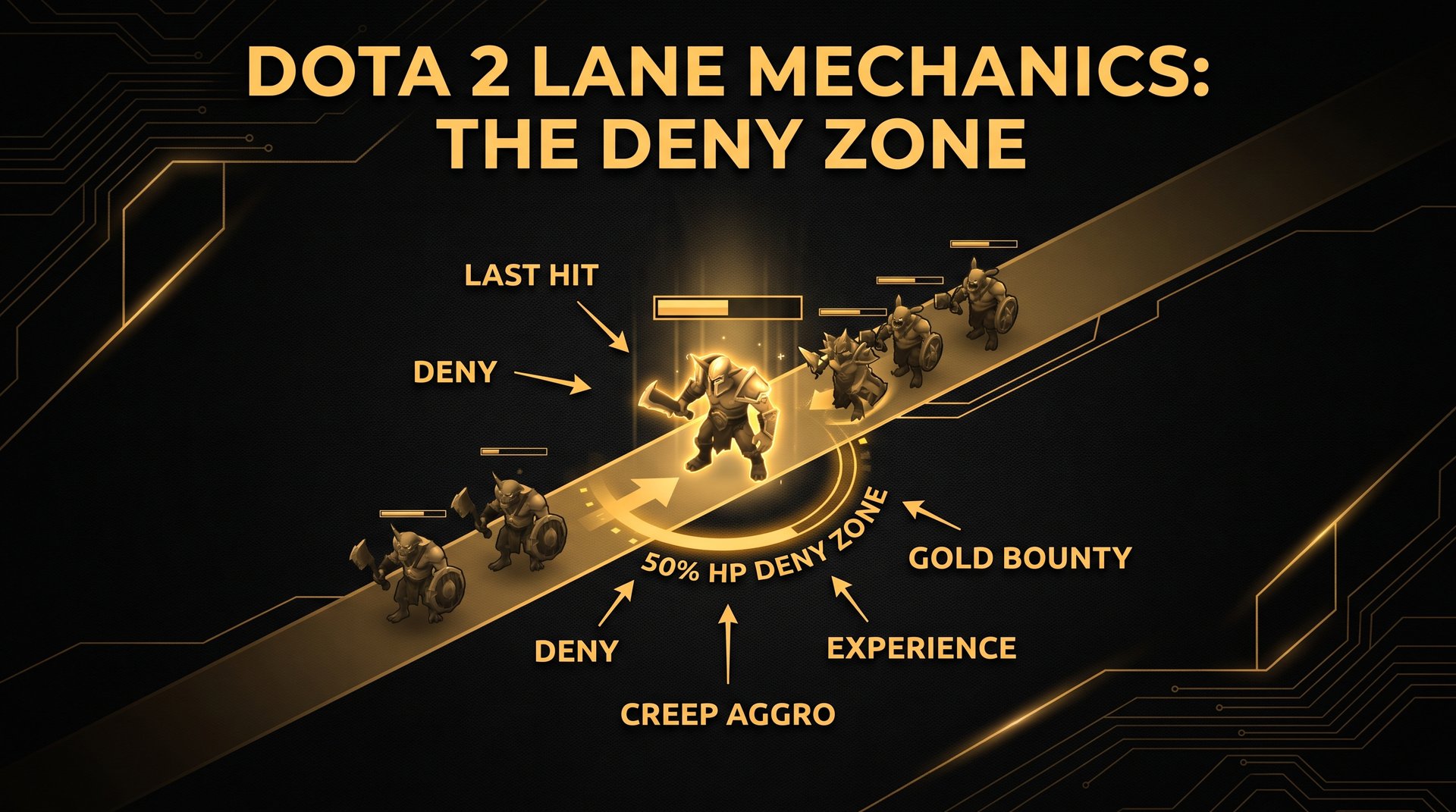
- Lane creeps and non-hero units — deniable below 50% current HP
- Allied heroes — deniable below 25% current HP, but only under specific conditions
- Allied towers — deniable below 10% current HP
Critically, the deny must be a player-initiated attack or ability. Creeps that die to environmental hazards or neutral aggro on their own do not count as denies and still grant the enemy their full resources.
HP Thresholds by Unit Type
The deny window opens at specific HP percentages. These values are current as of patch 7.41d, verified against Liquipedia and the Dota 2 wiki (both updated June-July 2026):
| Unit Type | Deny Threshold | Enemy XP | Enemy Gold | Denier Gets |
|---|---|---|---|---|
| Lane creep (melee) | Below 50% HP | 50% of normal | 0 gold | Nothing |
| Lane creep (ranged) | Below 50% HP | 50% of normal | 0 gold | Nothing |
| Siege creep | Below 50% HP | 50% of normal | 0 gold | Nothing |
| Neutral creep | Below 50% HP | 50% of normal | 0 gold | Nothing |
| Allied hero | Below 25% HP | 0% XP | 0 gold | Nothing |
| Allied tower | Below 10% HP | N/A (no XP) | 50% of bounty | 50% of bounty |
The tower deny rule is unique: both teams receive half the tower’s gold bounty when it is denied. The denying team does not keep the full bounty — it is split 50/50. This makes tower denies valuable purely as a way to reduce the enemy’s tower kill reward, not to gain extra gold yourself. You deny a tower to prevent the enemy from getting the full amount, accepting a smaller payout for your own team in exchange.
Understanding these thresholds cold is the first step. In practice, most players are too slow to act in the brief window between a creep hitting 50% and dying to enemy last-hits. Training this reflex is where deny skill development actually lives.
The XP Math — 50% Reduction Explained
The 50% XP figure sounds clean, but let’s look at what it actually means in a laning scenario. When a unit dies, all nearby allied heroes within experience range receive a share of the XP bounty. A denied lane creep grants 50% of its normal XP to enemies in range rather than zero XP. This is worth stressing: a denied creep does NOT deny 100% of the XP. It denies 50%. The remaining 50% still reaches the enemy.
So why does it matter? Because that 50% compounds across a full laning phase. Here is a simplified breakdown using approximate values from a standard early-game creep wave (these are illustrative; exact XP values scale slightly as the game progresses):
| Creep Type | Normal XP (full kill) | XP if denied (50%) | XP denied per creep |
|---|---|---|---|
| Melee creep | ~62 XP | ~31 XP | ~31 XP |
| Ranged creep | ~54 XP | ~27 XP | ~27 XP |
| Siege creep (minute 5+) | ~143 XP | ~72 XP | ~71 XP |
| Average early lane creep | ~60 XP | ~30 XP | ~30 XP |
In a standard 1v1 mid lane or contested safe lane scenario, a single hero is within range of all creep deaths. If you deny 10 lane creeps over the course of the laning phase, you are cutting the enemy’s XP income from those 10 creeps in half — denying roughly 300 XP compared to the alternative where those creeps died to enemy last-hits.
How significant is 300 XP? At early levels, the XP thresholds are approximately: Level 1 requires 0 XP at spawn, Level 2 costs 230 XP, Level 3 costs 370 XP (cumulative), Level 4 costs 530 XP, Level 5 costs 760 XP. A 300 XP deficit at level 3-4 represents a meaningful fraction of the XP needed for the next level. In mid-lane duels where both players are contesting the same creep wave, a consistent denier can maintain a half-level advantage simply from deny discipline, without any superior last-hit count.
Gold Denial — the Hidden Economy Edge
On top of the XP reduction, denied units grant the enemy zero gold. This is a full denial of the last-hit reward. In a lane where the enemy is farming efficiently, every creep they kill earns them 40-65 gold depending on creep type and any modifiers in play. A deny converts that gold to zero — not reduced, zero.
This makes denies more economically powerful than last-hits in one specific sense: a last-hit earns you gold, but a deny both earns you nothing AND prevents the enemy from earning. In economy terms, each deny is worth roughly the gold value of the denied creep in terms of relative advantage — you did not get the gold, but neither did they, and since you were the one spending time and attention to deny, you had the option to last-hit something else.
| Creep Type | Normal Gold Bounty | Gold if Denied | Effective Gold Swing |
|---|---|---|---|
| Melee creep (early) | ~48 gold | 0 gold | ~48 gold denied |
| Ranged creep (early) | ~38 gold | 0 gold | ~38 gold denied |
| Siege creep (minute 5) | ~72 gold | 0 gold | ~72 gold denied |
| Average early lane creep | ~46 gold | 0 gold | ~46 gold denied |
Ten denied creeps at approximately 46 gold each represents around 460 gold of income completely removed from the enemy. That is more than the cost of a Magic Wand (450 gold), essentially a full early-game component. Combined with the XP denial, the compound effect of consistent denying is one of the few laning mechanics that influences both gold economy and level advantage simultaneously without requiring any kills.
The 10-Deny Threshold — Why This Number Matters
Coaching communities and tracker tools that analyze pub replay data consistently flag deny count as one of the cleaner indicators of lane performance at all ranks. Based on community-analyzed data from pub matches, players who record 10 or more denies in the first 10 minutes of a lane show measurably better lane outcome metrics — lower enemy CS, larger last-hit differentials, and more frequent post-lane advantage states — compared to players with fewer than 5 denies in the same window.
Why 10 specifically? It sits at the intersection of what is realistically achievable with moderate attention and what actually creates a measurable gap. Getting 2 or 3 denies in a laning phase is almost accidental — it happens when a creep conveniently drops to low HP and you happen to notice. Getting 10 requires actual tracking: watching your creep HP bars, anticipating which creeps are being targeted by the enemy, and prioritizing the deny over your own last-hit when both are available at the same moment.
The math adds up quickly. If both you and your lane opponent start the game at equal farm and no hero advantages, and you deny 10 creeps over the laning phase while they deny 2:
- XP gap: approximately 240 extra XP denied by you (8 more denies x ~30 XP each)
- Gold gap: approximately 370 gold denied from the enemy (8 more denies x ~46 gold each)
- Combined effect: equivalent to hitting a partial level advantage and nearly a full early-game component ahead in timing
This does not account for the secondary effect: when the enemy lane is shorter (creep wave pushed back toward your tower due to deny pressure), they are in a more dangerous position and may miss additional farm due to positioning risk. The 10-deny threshold creates a cascade, not just a flat advantage.
Practical Execution — How to Actually Deny Consistently
Knowing the thresholds means nothing if your hands do not execute in the moment. Here is the practical breakdown of how consistent deniers approach the laning phase:
Watch the HP bars, not just the enemy
The most common failure is tunnel vision on enemy last-hits. Consistent deniers split their attention: they watch the HP bars of BOTH their own creeps and the enemy’s. The moment one of your own creeps drops below 50% HP, it should register as a potential deny target, not just background noise.
Use attack-move, not right-click deny
Most players try to right-click deny, which can accidentally attack the wrong target or miss the window if your hero is mid-animation. Binding attack-move (A + click) lets you click on the low-HP creep directly, and the game will only register the attack if the target is within the deny threshold. Using attack-move also reduces the chance of accidentally harassing an enemy hero instead of denying.
Prioritize siege creep denies
The siege creep that spawns roughly every 5 waves carries significantly more XP (approximately 143 XP) and more gold than standard melee or ranged creeps. A denied siege creep removes roughly 71 XP from the enemy — more than two standard melee deny denials combined. Siege creeps also have higher HP, which means the 50% threshold is a larger HP pool and easier to time.
Deny under tower pressure
One of the most valuable deny scenarios is when your wave is already under your tower and the enemy is diving to last-hit. A tower hit drops creep HP quickly, often opening deny windows that would not exist in open-field laning. Training yourself to track your lane state when you are under pressure is what separates reactive play from active deny discipline even in losing lane scenarios.
Use hero abilities to open deny windows
Several hero abilities can force a friendly creep below the deny threshold faster than waiting for natural HP loss. A slow-tick AoE that hits your own creeps, a misclick with a nuke, or abilities with friendly fire can all create deny windows you can then capitalize on. More on this in the abilities section below.
Tower Denies — the 10% Rule
Tower denies operate under different rules and require specific game awareness to execute. A tower becomes deniable once it drops below 10% of its maximum HP. At that point, any allied player within attack range can right-click the tower to initiate a deny attack.

When a tower is successfully denied:
- The enemy team receives 50% of the tower’s gold bounty (split among enemies who qualify)
- The denying team also receives 50% of the gold bounty
- Neither team receives the full gold reward a standard tower kill would provide
This is the only deny type where the denier’s team also receives gold — and it is purely a split, not a gain. You are reducing the enemy payout from 100% to 50%, while your own team receives 50% instead of nothing. In net terms, your team’s relative economy improves by a full 50% of the tower bounty by successfully denying versus allowing the full kill.
Tower bounties are substantial in the context of Dota 2 economy. Tier 1 towers carry a base bounty split among nearby heroes (typically 200-260 gold distributed), and denying one saves your team from giving up that full amount. In close games, a denied Tier 1 that would otherwise have given the enemy a 250-300 gold swing can preserve a comeback window.
Communicating tower deny attempts in team settings is also worth noting. If your support is in position to deny the tower but the carry is also within attack range, both players attempting to deny can interfere with each other’s attack timing. One player should call the deny and the other should hold — otherwise the attack animations compete and neither may land in the window.
Hero Denies — When Your Allies Can Be Denied
Hero denies are the least common deny type and only possible under specific conditions. An allied hero becomes deniable when all three of the following are true:
- The hero is below 25% of their maximum HP
- The hero is currently affected by a specific status condition that enables allied denial
- A friendly player (or sometimes the hero themselves) attacks the hero
The list of effects that enable hero denies includes abilities like Pudge’s Rot (self-inflicted magical damage), certain slow-and-damage effects, and historically hex effects from specific heroes. The exact list of valid “deny conditions” is maintained in the official wiki and shifts with patches as ability interactions are adjusted.
A successfully denied hero yields zero XP and zero gold to the enemy — unlike a death from enemy attacks, which gives full hero death bounty. This makes hero denies extremely valuable when they occur: in a scenario where your hero is certain to die (you are out of position, disabled, and the enemy is about to secure the kill), a self-deny or allied deny removes the full death bounty from the enemy economy.
Hero denies rarely happen in casual or lower-rank play because the conditions are narrow and require awareness under pressure. In high-level play, players sometimes deliberately position into Pudge’s Rot or similar effects specifically to deny themselves rather than give the enemy a kill bounty.
Hero Abilities That Help You Deny Lane Creeps
Some heroes have abilities that interact with deny mechanics better than others. Understanding which heroes are naturally superior deniers — and which abilities to leverage — helps you pick lanes where you can exploit this mechanic.
AoE damage abilities that hit friendlies
Heroes with ground-targeted AoE spells can sometimes clip their own creeps, ticking them below the 50% threshold. Pudge’s Rot, for example, damages allies within its area. A well-timed Rot during a creep clash can bring multiple allied creeps into deny range simultaneously. This is a high-skill interaction — it costs health and MP — but experienced mid players use it deliberately.
Shadow Demon’s Disruption (illusion deny)
Shadow Demon can Disrupt an ally, creating two illusions of that hero. When those illusions are below 25% HP during the Disruption duration, they can be denied. More relevantly, Shadow Demon can also use Disruption on enemy creeps to effectively remove them from the lane temporarily, controlling creep equilibrium — though this falls outside standard deny mechanics.
High base damage heroes
Heroes with high base damage (typically strength heroes or some ranged heroes with attack damage items) can one-shot low-HP creeps before the enemy can, making them naturally efficient deniers. Juggernaut, Dragon Knight, and Slardar all have the base attack damage early to regularly win the deny timing race against enemy attacks.
Ranged heroes vs. melee heroes
Ranged heroes have a mechanical advantage in denying because their attack can reach creeps from a safer distance, reducing the body-blocking and positioning risk that melee heroes face. However, ranged heroes typically deal lower early physical damage, so they may lose the deny race against melee creeps with still-substantial HP. The tradeoff varies by hero — track your hero’s attack damage on the stat screen and use it to evaluate which creep denies are realistically within your timing range.
Deny Discipline by Role and Lane
How much deny focus should differ by position and lane context:
| Role / Lane | Deny Priority | Key Focus | Common Floor (pub data) |
|---|---|---|---|
| Mid laner (1v1) | Very High | All denied creeps create XP gap; siege denies are critical | 8-15 denies in 10 min |
| Safe lane carry (2v2+) | High | Deny when it does not cost you a last-hit; tower deny if threatened | 4-10 denies in 10 min |
| Safe lane support | Medium-High | Deny creeps your carry cannot reach; deny under tower pressure | 2-8 denies in 10 min |
| Off-lane (1 or 2) | Medium | Deny own creeps when harassed to avoid giving enemy XP under bad conditions | 2-6 denies in 10 min |
| Jungle / roamer | Low | Not in a dedicated lane; neutral camp deny is niche | 0-2 per game |
The figures above represent approximate community-observed ranges from pub match tracking tools, not official statistics. Treat them as relative benchmarks for evaluating your own performance in post-game review.
For supports in the safe lane: a support who actively denies under tower pressure keeps the lane more favorable even when the team is losing the lane. Each denied creep in a losing scenario reduces the carry’s CS deficit compared to the enemy offlaner — and it also slows the enemy offlaner’s farm, buying time for rotations. Supports who focus purely on harass without denying are leaving a meaningful tool unused.
Common Deny Mistakes and How to Fix Them
Most denying errors fall into a few predictable categories:
- Watching the enemy instead of your own creep HP bars. Fix: add a habit of glancing at allied creep HP during every wave. It should become a background awareness check, not a deliberate distraction.
- Right-clicking the wrong target. When trying to deny while also last-hitting, clicks can misfire. Fix: use attack-move (A + left click on the deny target) to ensure the game registers the correct unit without misfiring onto the enemy hero.
- Waiting too long after the threshold opens. A creep at exactly 50% HP will die fast under normal attack patterns. The deny window can be less than one attack cycle wide. Fix: start the deny attack the moment HP drops below 50%, not after.
- Ignoring denies when behind in last-hits. Some players who are losing the CS race abandon deny attempts entirely. This compounds the deficit. Fix: denying is viable even when you are losing last-hits — each deny is a resource the enemy does not receive, and that matters more when you are already behind.
- Missing tower denies due to positioning. Being 200-300 units away from the tower when it reaches 10% HP means you cannot attack in time. Fix: when your tower is taking sustained damage from an enemy push, position yourself nearby in case the deny window opens.
- Over-denying at the expense of farm. In some matchups, attempting every possible deny causes you to miss last-hits on the opposing creep wave because your attention is split. Fix: prioritize the siege creep deny and ranged creep deny (higher XP value); skip a melee creep deny if you are at risk of losing multiple last-hits in exchange.
If you want to accelerate your lane mechanics improvement more directly, the coaching services at TeamSmurf include replay review sessions where a high-MMR coach specifically analyzes your laning phase deny habits, last-hit timing, and creep equilibrium. This kind of focused mechanical feedback is often faster than solo grinding at improving specific micro skills.
Want to Fix Your Laning Phase Faster?
TeamSmurf coaching puts you in a session with an Immortal-level player who reviews your actual replays and gives you specific mechanical targets — including deny count, CS differential, and wave management. It is one of the fastest ways to address lane mechanics without grinding hundreds of games hoping for improvement.