

How to Climb from Legend to Ancient as Pos 1 Carry in Dota 2 (2026 Guide)

You’ve ground your way through Archon. You’ve survived the chaos of Crusader. Now you’re sitting in Legend bracket — somewhere between 3,080 and 3,850 MMR — and the road to Ancient feels like it’s paved with glass. Every game feels coinflippy. You win lane, lose game. You farm well, but your team collapses. You pick the “right” hero and still can’t close it out.
Here’s the uncomfortable truth: Legend is where bad carry habits stop working. The things that got you here — hitting creeps, fighting when your BKB is up, hoping your team creates space — aren’t enough anymore. Ancient carries think differently. They farm with purpose, fight with timing, and pressure the map in ways that force the enemy to react.
This guide is your complete blueprint for climbing from Legend to Ancient as a Position 1 carry player. We’ll cover the heroes that punish Legend-bracket mistakes, the 10 errors keeping you stuck, a phase-by-phase breakdown of how to play each stage of the game, how to handle difficult teammates, a realistic timeline for your climb, and a full FAQ section. Let’s get into it.
Table of Contents
- Understanding the Legend Carry Player: What Makes This Bracket Unique
- Top 5 Heroes to Climb from Legend to Ancient as Carry
- 10 Mistakes That Keep Carry Players Stuck in Legend
- Phase-by-Phase Guide: Playing Carry from Legend to Ancient
- The Teammate Problem: How to Win When Your Team is Struggling
- Realistic Timeline: How Long Will It Take to Reach Ancient
- Frequently Asked Questions
- Ready to Start Your Climb
Understanding the Legend Carry Player: What Makes This Bracket Unique
Legend is the most populated bracket in Dota 2. It’s where players have developed real mechanical skill — last-hitting, basic spell usage, item builds — but haven’t yet developed the game sense that separates good players from truly effective ones. As a carry in Legend, you’re dealing with a very specific set of challenges:
The Legend Carry Profile
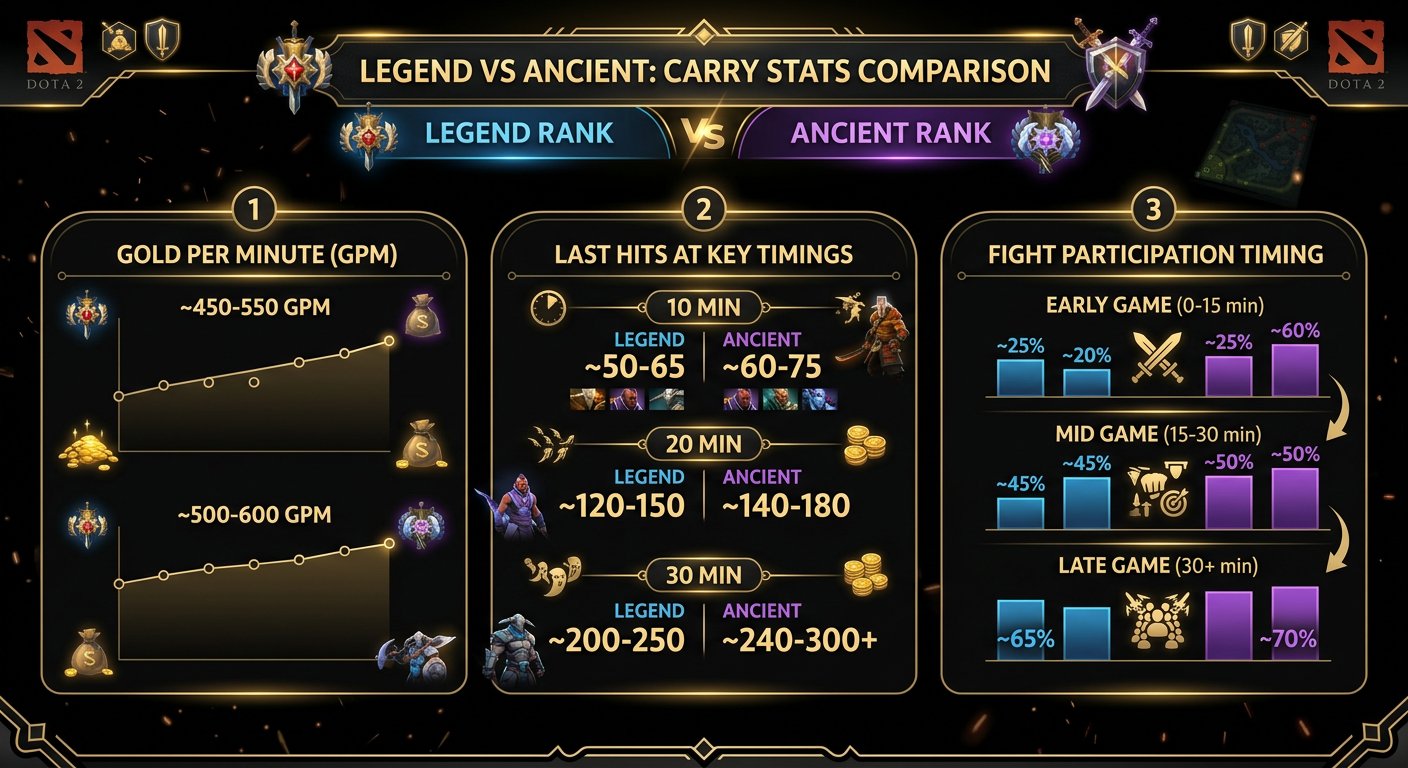
Mechanical skill: Above average. Most Legend carries can hit 60-70 last hits in 10 minutes in a free lane. They know their hero’s combos. They can execute teamfight patterns when the fight comes to them. This isn’t the problem.
Farm patterns: Predictable and passive. Here’s where it starts breaking down. Legend carries tend to farm in straight lines — they clear their safe lane, walk to the jungle, clear a camp or two, walk back to lane. There’s no triangle optimization, no aggressive farming on the enemy side of the map, no split-push pressure. They farm where it’s safe, even when being aggressive would create more gold AND more map pressure.
Fight timing: Reactive, not proactive. Legend carries join fights because they see green dots converging on the minimap. Ancient carries join fights because they’ve identified a timing — their BKB just completed, the enemy carry is visible farming bot, their team has a key cooldown ready. The difference between reactive and proactive fighting is worth 500+ MMR by itself.
Itemization: Template-based. If you’re building the same items every game, you’re leaving MMR on the table. Legend carries follow guides. Ancient carries adapt. That Manta Style is great against silences, but if nobody on the enemy team has a silence, maybe Sange and Yasha gives you more for less gold. That BKB might need to be your second item, not your third, if the enemy has a lot of magical lockdown.
Map awareness: Sporadic. Legend carries check the minimap, but they check it for threats, not for opportunities. They’re looking to see if someone is coming to kill them. They’re not looking to see where the enemy is to determine which part of the map is safe to farm aggressively.
What Ancient Carries Do Differently
The Ancient bracket (3,850-4,620 MMR) represents a significant jump in carry play. Here’s what changes:
- Farm efficiency jumps by 15-25%. Ancient carries consistently hit 80+ last hits in 10 minutes, and more importantly, they maintain that pace through the midgame. They’re clearing 3-4 camps between waves, not 1-2.
- They create pressure while farming. An Ancient carry farming the enemy jungle isn’t just getting gold — they’re pulling enemy heroes to respond to them, creating space for their team on the opposite side of the map.
- They identify win conditions before the game starts. During the picking phase, Ancient carries are already thinking about their game plan. “I’m Medusa against their lineup — I need to get to level 20 and Skadi before we take a serious fight. My win condition is a late-game teamfight where I can manfight their whole team.”
- They communicate their timings. “I have BKB in 1 minute, let’s smoke after.” This single sentence wins more games than any mechanical improvement.
Top 5 Heroes to Climb from Legend to Ancient as Carry
Hero selection matters enormously for climbing. You want heroes that are self-sufficient (because your supports won’t always be reliable), strong at multiple timings (because Legend games have unpredictable tempos), and punishing of common Legend mistakes (because the enemy team WILL make them).
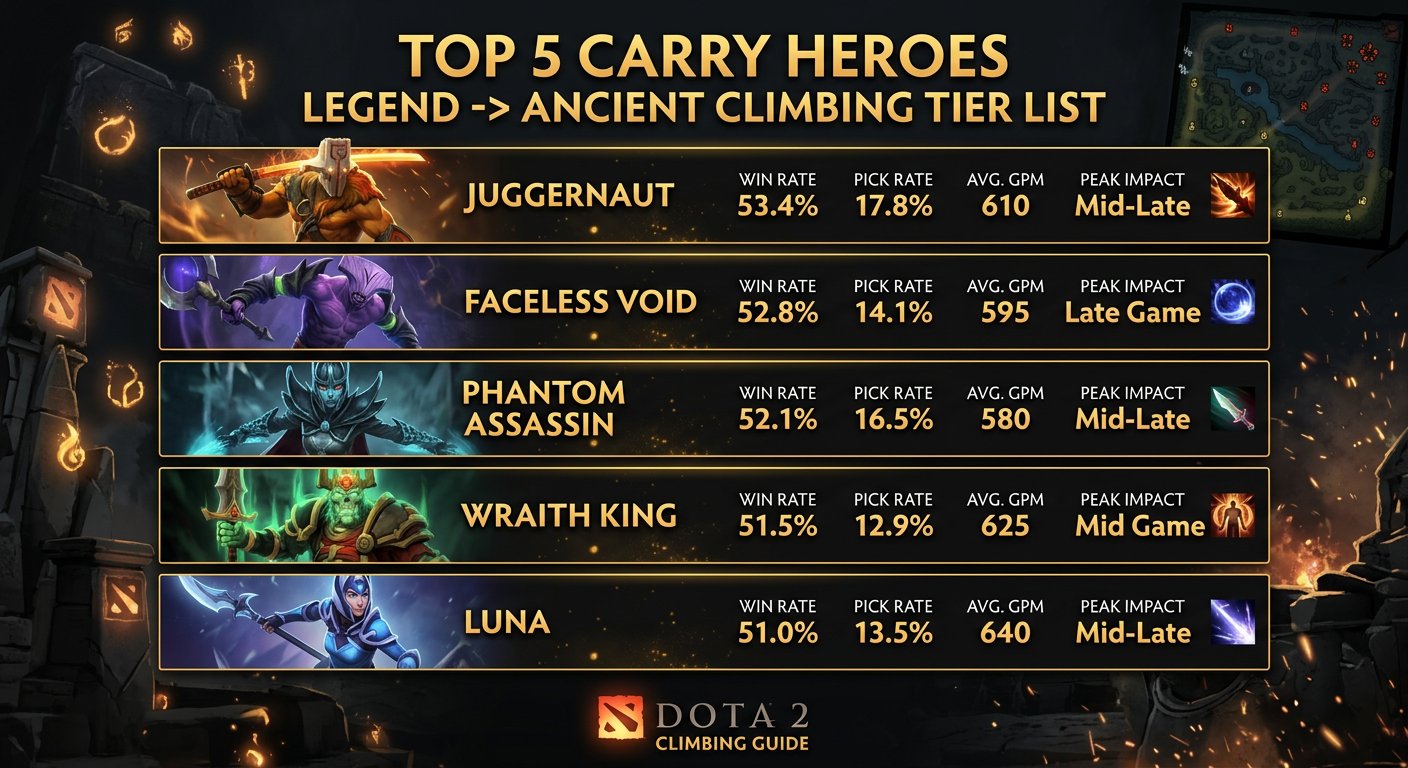
1. Juggernaut — The All-Purpose Climbing Machine
Why Juggernaut dominates Legend: Juggernaut is the ultimate “good at everything” carry for this bracket. His Blade Fury gives him magic immunity from level 1, making him nearly impossible to gank effectively in lane. His Healing Ward provides sustain that lets you stay in lane or jungle without relying on your support to buy regen. And his Omnislash is one of the most punishing ultimates against the scattered, disorganized teamfights that define Legend bracket.
How to play him for maximum MMR:
- Laning phase (0-10 min): Focus on last hits. Use Blade Fury aggressively at levels 1-3 to secure kills if your support sets one up, but don’t force it. Juggernaut’s kill threshold in lane is surprisingly high — Blade Fury + right clicks + Omnislash at 6 can kill almost any offlaner from 60% HP. Get Phase Boots and Maelstrom as your first items.
- Midgame farming (10-20 min): This is where Legend Juggernauts go wrong. They get Battlefury and AFK farm for 15 minutes. Don’t do that. With Maelstrom + Phase, you can fight AND farm. Clear waves, take a jungle camp, show up to fights when Omnislash is ready, then go back to farming. Your Healing Ward lets you sustain through jungle without going back to base.
- Late game (20+ min): Your item progression should look like Phase → Maelstrom → Sange and Yasha or Manta → BKB → Mjollnir → Butterfly or Abyssal. The key late-game decision is when to use Omnislash. In Legend, people waste it on full-HP targets in the middle of teamfights. Use it to finish off isolated heroes or to dodge key spells. Omnislash makes you invulnerable — it’s a defensive tool as much as an offensive one.
Juggernaut’s Legend bracket win rate: Consistently 53-55% in Legend, making him one of the most reliable climbing heroes at this MMR range.
2. Faceless Void — Punishing Uncoordinated Teams
Why Faceless Void dominates Legend: Chronosphere is the single most game-winning ability in Dota 2, and its effectiveness scales inversely with team coordination. In Legend, teams don’t position well. They group up. They stand on top of each other. A 3-4 man Chronosphere wins teamfights instantly, and Legend players walk into Chronospheres far more often than Ancient players do.
How to play him for maximum MMR:
- Laning phase: Void’s laning is mediocre. Accept this. Focus on getting every last hit you can, use Time Walk to escape ganks, and don’t try to be aggressive unless your support is setting up kills perfectly. Your goal is Phase Boots + Mask of Madness by 10-12 minutes.
- First Chronosphere timing (6-12 min): This is HUGE. Your first Chronosphere should result in a kill. Communicate with your team. Ping your ultimate. Ping the target. Then Chronosphere the offlaner and kill them. Every Chronosphere that results in a kill accelerates your farm by giving you gold AND space.
- Midgame (12-25 min): Farm aggressively with Mask of Madness. Clear jungle camps fast, shove waves, and watch the map for Chronosphere opportunities. You don’t need to be part of every fight — you need to be part of fights where Chronosphere wins them. Build Mjollnir for farm speed, then BKB.
- Late game (25+ min): This is Void’s territory. With Mjollnir, BKB, Daedalus/Butterfly, you can solo kill anyone inside Chronosphere. The key late-game skill is Chronosphere target selection. Catching 2-3 heroes is better than catching 5 (because you need your team to help damage them). Prioritize catching the enemy carry and one support.
Key tip for Legend Voids: Stop Chronosphering your own team. Seriously. Before you drop Chronosphere, take ONE second to check where your teammates are. A 2-man Chronosphere that doesn’t catch allies is infinitely better than a 4-man Chronosphere that traps your Tidehunter.
3. Phantom Assassin — The Snowball Specialist
Why PA dominates Legend: Phantom Assassin exploits two of Legend’s biggest weaknesses — poor defensive support play and inconsistent itemization. Legend supports don’t reliably buy Ghost Scepters or Glimmer Capes to deal with PA. And Legend players don’t consistently build Silver Edge or MKB to deal with her evasion, especially in the early-to-midgame window where she’s strongest.
How to play her for maximum MMR:
- Laning: PA has one of the strongest level 1-5 lanes in the game with Stifling Dagger. Last hit with Dagger, harass with Dagger, and look for kill opportunities with Phantom Strike once you have a few levels. Desolator rush is your standard build.
- Desolator timing (14-17 min): This is your power spike. With Phase Boots + Desolator, you kill supports in 2-3 hits and most cores in 4-5. The moment you have Deso, start looking for kills. Farm lanes aggressively, force the enemy to respond, and kill anyone who shows up alone.
- BKB timing: Get BKB as your second major item. Once you have Deso + BKB, you win almost every teamfight in Legend. Pop BKB, Phantom Strike the highest-value target, and crit them into dust.
- Late game: PA falls off against coordinated teams with MKB carriers, but in Legend, this coordination is rare. Your late-game build should include Satanic for sustain, Abyssal for lockdown, and potentially a Nullifier to dispel saves.
When NOT to pick PA: Against lineups with multiple natural MKB builders (Troll, Monkey King) or heavy magic burst that goes through BKB (Enigma, Faceless Void). PA is also weak against heavy armor lineups — if they have Slardar, Tidehunter, and a Dazzle, consider a different hero.
4. Wraith King — The Unkillable Farming Machine
Why Wraith King dominates Legend: WK exploits Legend’s biggest problem — inability to manage long, drawn-out fights. WK essentially has two lives. In Legend, teams blow all their cooldowns killing you the first time, then have nothing left when you revive. Plus, his Vampiric Spirit skeletons make him one of the fastest farmers in the game, compensating for any laning deficiencies.
How to play him for maximum MMR:
- Laning: WK’s laning got significantly better with skeletons. Use them to harass and zone, while you focus on last hits. Wraithfire Blast is an incredibly strong trading tool — 2 seconds of stun at level 1 is no joke. Get Armlet as your first major item.
- Armlet timing (10-12 min): Armlet toggling is the single biggest skill differential between Legend and Ancient WK players. Practice it. An Armlet toggle that saves you from death is worth 500+ gold of comeback gold denied and 30+ seconds of farm time saved.
- Midgame: Farm the Radiance if the game is going well, or go straight to Blink Dagger if you need to fight earlier. Blink + Stun + Armlet is a devastating initiation combo that Legend teams don’t expect from a carry.
- Late game: WK becomes nearly unkillable with Armlet, Radiance, AC/Shiva’s, and his ultimate. The key is managing your mana — Reincarnation costs mana, and smart enemies will try to burn it before killing you. Carry a clarity or two. Build items that give stats.
5. Luna — The Farming Speed Demon
Why Luna dominates Legend: Luna farms faster than almost any hero in the game, and in Legend bracket, the team that farms faster usually wins. Her Moon Glaives clear waves and camps at incredible speed, and Eclipse is devastating in the chaotic, grouped-up teamfights that Legend is famous for. She also takes towers faster than almost any carry, and taking towers is the single most reliable way to increase your net worth lead.
How to play her for maximum MMR:
- Laning: Luna has solid base damage and a strong nuke in Lucent Beam. Focus on last hits, use Lucent Beam to secure ranged creeps and harass, and look for kill potential at level 6. Eclipse at close range against a single target does enormous damage early.
- Mask of Madness timing: Get MoM by 8-9 minutes and start clearing jungle camps between waves. Your GPM should skyrocket. Aim for 600+ GPM by 15 minutes.
- Manta + BKB timing: This is your fighting window. With Manta and BKB, you can participate in teamfights, push towers with your illusions, and clear waves across the map.
- Late game: Luna’s late game is about positioning. Stay at the back of fights, let your team initiate, then right-click. Your Glaives will bounce and deal massive damage to the entire enemy team. Build Satanic, Butterfly, and Skadi for maximum late-game power.
10 Mistakes That Keep Carry Players Stuck in Legend
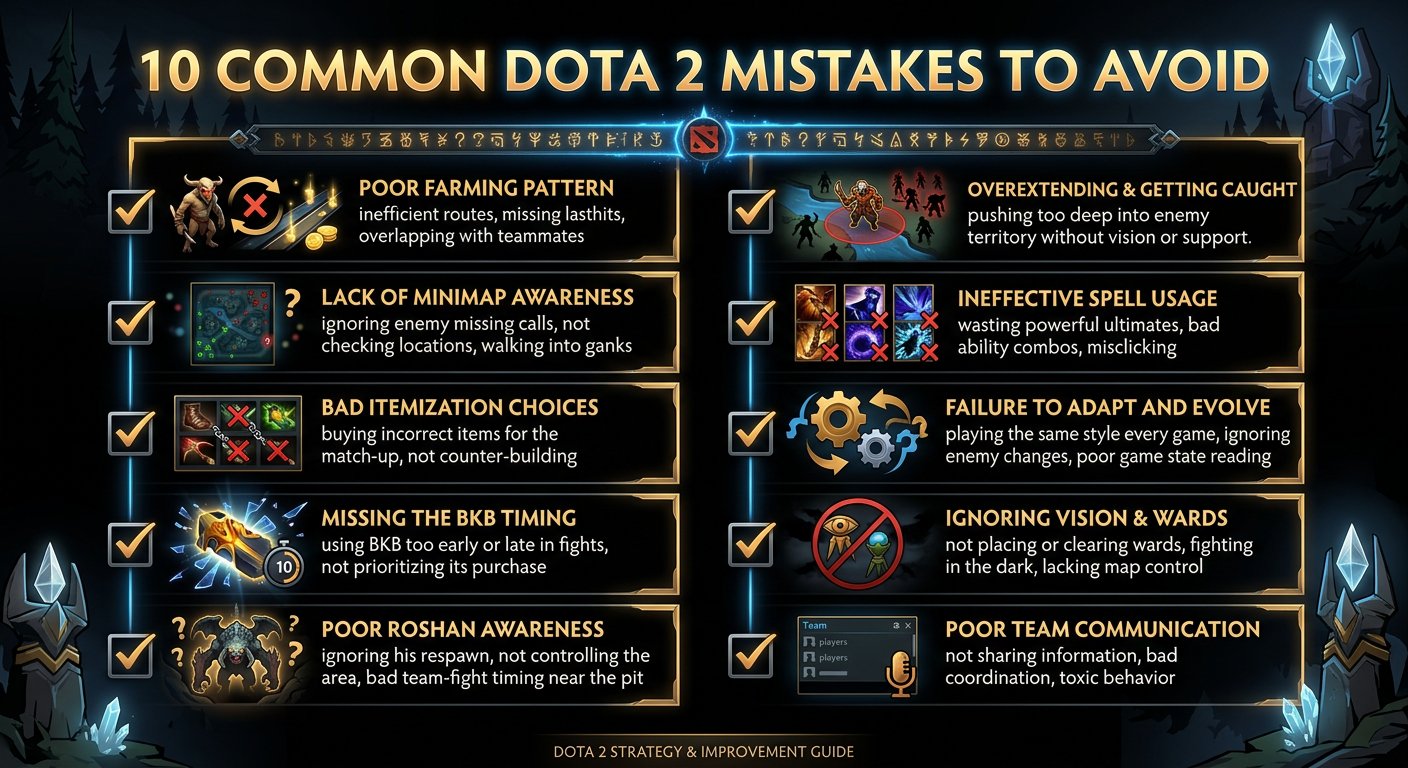
You can pick the right heroes and still lose if you’re making fundamental errors. These are the 10 most common mistakes I see from Legend carry players, ranked roughly in order of impact.
Mistake #1: Farming Without a Plan
This is the single biggest mistake in Legend. You’re farming, but you don’t know why. You’re clearing camps because they’re there, not because you’re working toward a specific item timing that enables a specific play. Every minute of farming should have a purpose. “I’m farming my BKB so we can take Roshan.” “I’m pushing this wave to force a TP so my team can fight 4v4 on the other side.” “I’m clearing my triangle so I can show on the enemy side of the map in 30 seconds.”
The fix: Before each game, identify your 2-3 major item timings and what play each item enables. Write them down if you have to. Then farm toward those timings with intention.
Mistake #2: Not Shoving Waves
Legend carries farm jungle camps and let lane creeps crash into towers. This is a massive gold and map control loss. Lane creeps give more gold and experience than jungle camps. More importantly, shoved waves create pressure. When you push a wave to the enemy tower, they have to respond — either a hero TPs to catch the wave, or they lose tower damage and gold. That hero TPing to catch the wave is one fewer hero threatening your team.
The fix: Your farming pattern should be wave → camp → camp → wave → camp → camp → wave. The wave is always the priority. Show in lane, clear the wave quickly, then retreat to jungle camps while the next wave builds up. This is called “cutting” your farm pattern, and it’s the single biggest farm efficiency improvement you can make.
Mistake #3: Fighting Too Early (or Too Late)
There are two types of Legend carries: those who fight at every opportunity (and die, falling behind in farm), and those who AFK farm for 35 minutes while their team plays 4v5 (and lose because the enemy snowballs out of control). Both are wrong.
The fix: Fight when you have a timing advantage. This usually means after completing a major item. Got your BKB Fight. Got your Daedalus Fight. Cooldown on your big ultimate Fight. Between timings Farm. The rhythm of a good carry game is: farm → item spike → fight → farm → item spike → fight. Not constant fighting, not constant farming.
Mistake #4: Poor BKB Timing
Two sub-mistakes here. First, buying BKB too late — many Legend carries build 3-4 damage items before considering BKB, then wonder why they die instantly in fights. Second, using BKB poorly — popping it before the enemy commits their spells, or saving it too long and dying before activating it.
The fix: BKB should be your second or third major item in 80% of games. Use it REACTIVELY — wait for the enemy to commit a key stun or silence, then BKB to purge or avoid followup. Don’t preemptively pop it while walking into a fight.
Mistake #5: Ignoring Roshan
Roshan wins games. Aegis on your carry is often worth more than any single item. Yet Legend carries routinely ignore Roshan timings, either because they don’t think about it or because they don’t feel “ready.” Here’s a secret: if you have BKB and lifesteal, you can kill Roshan. You don’t need a full inventory.
The fix: After every major teamfight win, ask yourself: “Can we Roshan” If you killed 2+ enemy heroes and you’re healthy, the answer is usually yes. Ping Roshan. Walk there. Take it. Don’t wait for your team to suggest it — lead the call. Also, take Roshan before major pushes. Aegis makes high-ground attempts far safer.
Mistake #6: Dying to Ganks You Could Have Avoided
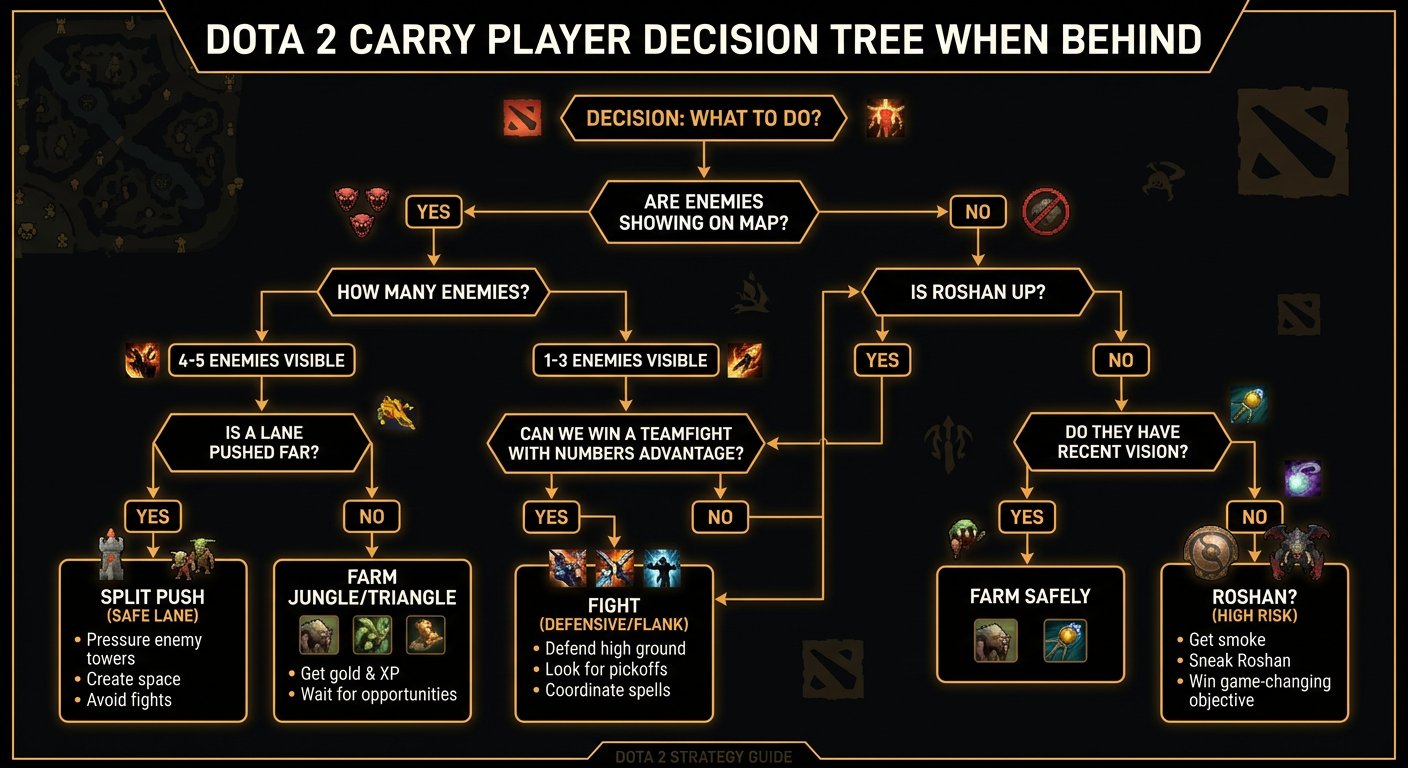
Legend carries die to ganks because they’re not watching the minimap. If you can’t see 3+ enemy heroes on the map, assume one of them is coming for you. If the enemy has a Spirit Breaker, Clockwerk, or Nyx Assassin, you should be farming with extra caution and staying close to your team or your tower.
The fix: Check the minimap every 3-5 seconds. Not for threats — for information. Count enemy heroes. If you can see all 5, farm aggressively. If you can only see 2-3, farm defensively. If you can see none, they’re smoking — back off and stay near your team. Buy a Ward yourself if your supports aren’t warding your farming areas.
Mistake #7: Inefficient Jungle Farming
Legend carries kill jungle camps slowly because they take unnecessary damage, use spells inefficiently, or farm the wrong camps. Small camps give terrible gold. Large camps and ancient camps give excellent gold. Yet Legend carries will clear a small camp between waves instead of walking 5 seconds further to clear a large camp.
The fix: Learn the optimal farming patterns for your hero. Know which camps you can stack and clear efficiently. Use your spells to clear camps faster — Juggernaut’s Blade Fury clears camps instantly, PA’s Dagger can soften camps before you walk to them, Luna’s Glaives clear multiple camps at once. Always prioritize large camps and ancient camps over small and medium camps.
Mistake #8: Not Adapting Item Builds
You follow the same build every game because DotaBuff or a guide told you to. But item builds should be reactive. Against heavy physical damage Get an early Assault Cuirass or Butterfly. Against magic burst Rush that BKB. Against a lineup that wants to kite you Blink Dagger or Abyssal Blade. Against heavy healing Spirit Vessel or Shiva’s Guard.
The fix: Before each item purchase, spend 5 seconds looking at the enemy lineup and asking, “What’s going to kill me, and what item prevents that” Build to counter THEIR gameplan, not just to maximize YOUR damage output.
Mistake #9: Tilting After a Bad Lane
You died twice in lane. Your support left at minute 3. The enemy offlaner is 2 levels ahead of you. You tilt, make bad decisions, and the game spirals. This happens to everyone, but Legend players handle it worse than Ancient players.
The fix: A bad lane is NOT a lost game. It’s a 5-minute setback. Go to jungle, farm safely, catch up. Many of the best carry heroes (WK, Void, PA, Luna) can recover from terrible lanes through efficient jungle farming. The 10-minute mark is when the laning phase ends — if you’re behind at 10 minutes, that’s okay. If you’re behind at 25 minutes, THAT’S the problem. Focus on efficient recovery, not on the fact that your lane went poorly.
Mistake #10: Not Communicating Timings
Your team doesn’t know when you want to fight. They don’t know when you’re ready for Roshan. They don’t know when you’re about to hit a power spike. And because they don’t know, they either fight without you or waste time waiting while you farm.
The fix: Use your microphone or chat wheel. “BKB in 1 minute, then let’s fight.” “I need 1200 gold for Daedalus, then we can push.” “Let’s Roshan after I get Aegis.” Communication is a free, zero-cost improvement that can win you 2-3 extra games per 20. That’s a massive MMR improvement over time.
Phase-by-Phase Guide: Playing Carry from Legend to Ancient
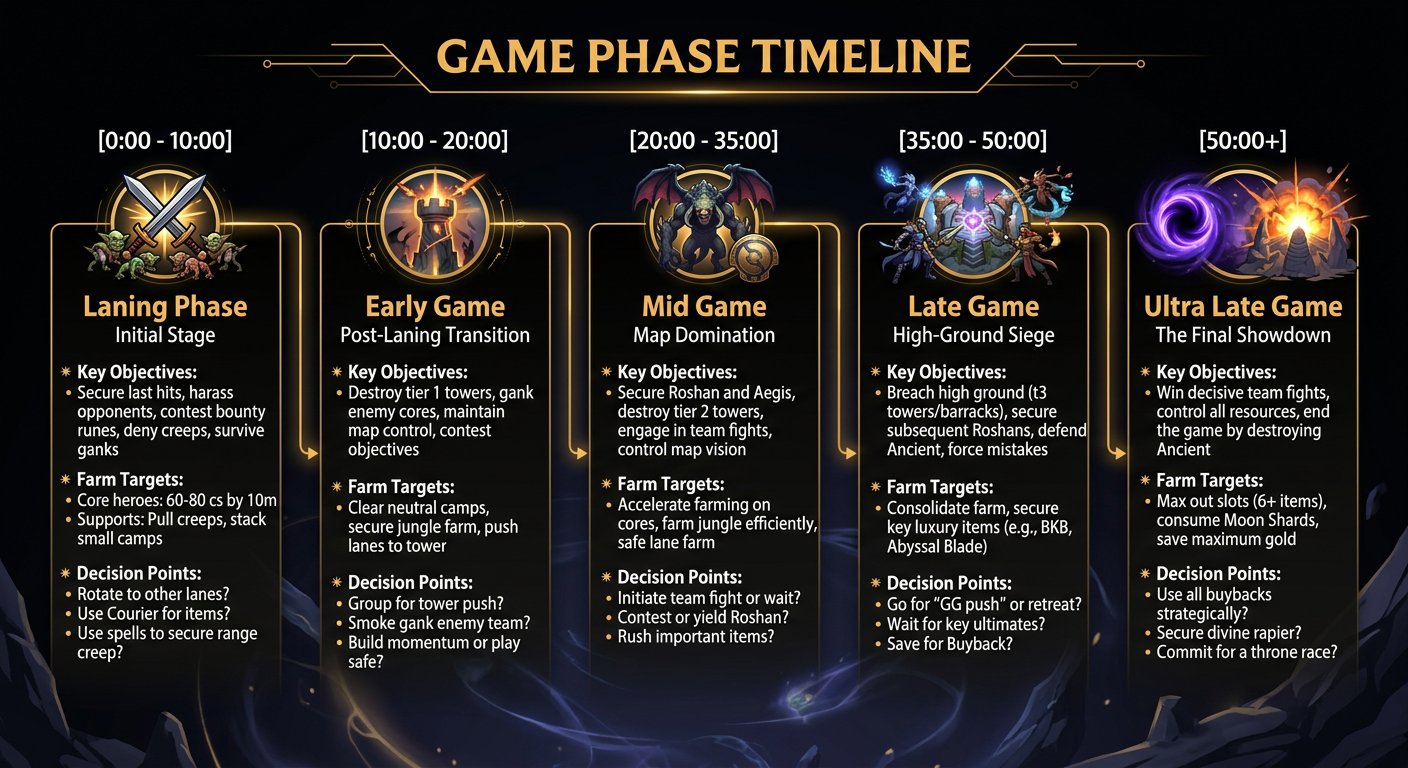
Now let’s break down exactly how you should approach each phase of the game as a Legend carry looking to climb.
Phase 1: The Draft (Before the Game Starts)
Your climb starts in the picking phase. Here’s what you should be thinking about:
- Pick for the game, not for the hero. Don’t first-pick your favorite carry. Wait to see the enemy offlane matchup and adjust. If they pick Axe + Skywrath, picking Phantom Assassin is suicidal. Pick Juggernaut or Lifestealer — heroes who can survive that lane.
- Identify your win condition. Before the horn blows, you should know: “My hero peaks at minute 25-30 with BKB + Daedalus. I need to be farming efficiently until then, fight when my ultimate is up, and push high ground when I have Aegis.”
- Identify the enemy’s win condition. If they picked Huskar + Dazzle, their win condition is ending the game by 25 minutes. Yours is surviving until then. Knowing this changes your entire game plan.
Phase 2: Laning Phase (0-10 Minutes)
The laning phase sets the tempo for the entire game. Here’s your checklist:
Minutes 0-2: Establish creep equilibrium. If the lane is pushing toward the enemy tower, stop attacking creeps and only last hit. If it’s pushing toward your tower, auto-attack to keep it near your tower (where it’s safer). Ideal lane position is just outside your tower range.
Minutes 2-5: Assess kill potential. Can you kill the enemy offlaner Do you have a stun + slow + enough damage If yes, look for the play at level 3-4 when you have your abilities online. If no, focus purely on last hits and denies. Don’t force trades you can’t win.
Minutes 5-7: Control rune spawns. Every 7 minutes (then 5 minutes later for each spawn), wisdom runes appear. Power runes spawn in the river. Keep an eye on these — a double damage rune on your carry at minute 6 can lead to a kill. More importantly, don’t let the enemy grab them for free.
Minutes 7-10: Transition to jungle. By minute 7-8, you should be moving between lane and jungle. Clear the wave, take a camp, come back for the next wave. If you have a farming item (Maelstrom, Battlefury, MoM), this transition accelerates. Your goal is 60-70 last hits by minute 10. If you’re hitting this number, you’re on pace.
Phase 3: Early Midgame (10-20 Minutes)
This is the most important phase for Legend carries and where most MMR is won or lost.
Minutes 10-15: Aggressive farming. Move beyond your safe lane triangle. Push waves on the enemy side of the map. Clear their jungle camps. This does two things: it accelerates your farm (you’re taking THEIR resources in addition to yours), and it creates pressure (they have to respond to you, giving your team space).
Key concept: “Farm toward the fight.” If your team is grouping near the enemy mid tower, don’t farm your own jungle. Farm the enemy safe lane and the camps near mid. That way, when the fight happens, you’re close enough to join. Farm TOWARD the action, not away from it.
Minutes 15-20: First major item timing. You should have your first 2-3 major items completed. This is usually something like Phase + Maelstrom + BKB, or Phase + Battlefury + Manta. Whatever your build, this is your first major power spike. USE IT. Take a fight. Take Roshan. Push a tower. Don’t keep farming when you’re at your strongest relative to the enemy.
Phase 4: Late Midgame (20-30 Minutes)
Minutes 20-25: Roshan and objectives. If you haven’t taken Roshan yet, now is the time. Aegis is the single most important resource in Dota 2 for pushing high ground. With Aegis, you can attempt a tower push with minimal risk — if you die, you come back and your team can disengage safely.
Minutes 25-30: High ground pressure. This is where Legend games are won or lost. Don’t rush high ground without Aegis. Don’t rush high ground without your team. Don’t rush high ground without vision. Set up wards near the enemy base, make sure your team is grouped, pop your BKB, and hit the tower. If you get a pickoff, push. If you don’t, back off and farm until your cooldowns are ready again.
Phase 5: Late Game (30+ Minutes)
Minutes 30-40: Full build optimization. You should be approaching your full 6-slot build. Start thinking about item replacements — sell your Mask of Madness for a Satanic, replace your Maelstrom upgrade with a Daedalus if you need more burst. Buy Moon Shard and consume it for the seventh slot.
Minutes 40+: Win or die trying. Games that go past 40 minutes in Legend are volatile. One teamfight decides everything. In this phase, NEVER be alone on the map. Stay with your team. Take every Roshan. Place aggressive wards. And when the fight happens, play it perfectly — use BKB at the right time, target the right hero, and position yourself to deal maximum damage while taking minimum risk.
One critical late-game tip: buyback management. Always have buyback gold after 30 minutes. Always. Dying without buyback in the late game loses games on the spot. If you can’t afford buyback, don’t fight — farm until you can.
The Teammate Problem: How to Win When Your Team is Struggling
Let’s address the elephant in the room. You’re the carry. You need farm. But your team is feeding. Your mid is 0-4. Your support is pulling when they should be zoning. Your offlaner is jungling at minute 5. How do you win
Accept What You Can’t Control
You cannot control your teammates. You can influence them, but you cannot control them. Spending mental energy on their mistakes is energy NOT spent on your own play. Every time you type in chat to flame your support, you’re missing last hits. Every time you tilt because your mid died, you’re making worse decisions. Focus on YOU.
Create Your Own Space
If your team is losing every lane, the enemy will be pushing toward your base. This actually creates farming opportunities for you — the enemy’s jungle is unoccupied. Push out waves safely, farm the enemy jungle, and let your team defend towers (they can do this even when behind, since tower defense in Dota 2 favors the defenders).
Be the Shotcaller
In Legend, most teams don’t have a leader. Someone needs to make calls — when to fight, when to farm, when to Roshan, when to push. Be that person. Even if your calls aren’t perfect, having a plan that everyone follows is better than 5 people doing 5 different things. Use voice chat. Ping objectives. Give timeframes: “Let me farm for 2 minutes, then we fight.”
Adjust Your Build
If your team is struggling, you might need to adjust your build to be more self-sufficient. Instead of a glass-cannon damage build, add survivability earlier. BKB before damage. Satanic before another attack item. A carry who survives and deals moderate damage wins more games than a carry who dies and deals maximum damage.
Win Through Efficiency, Not Fights
When your team is behind, fighting is usually the wrong call (unless you have a clear advantage like Aegis or a major cooldown). Instead, split-push and outfarm. Take every bit of available farm on the map. Push out every lane. Farm every camp. Eventually, you’ll outfarm the enemy carry (because Legend carries don’t farm efficiently), and your item advantage will overcome your team’s disadvantage.
Consider using our Dota 2 coaching service to get personalized advice on dealing with difficult team dynamics. A professional coach can review your replays and show you exactly where you could have created more space for yourself, even in games where your team was underperforming.
Realistic Timeline: How Long Will It Take to Reach Ancient
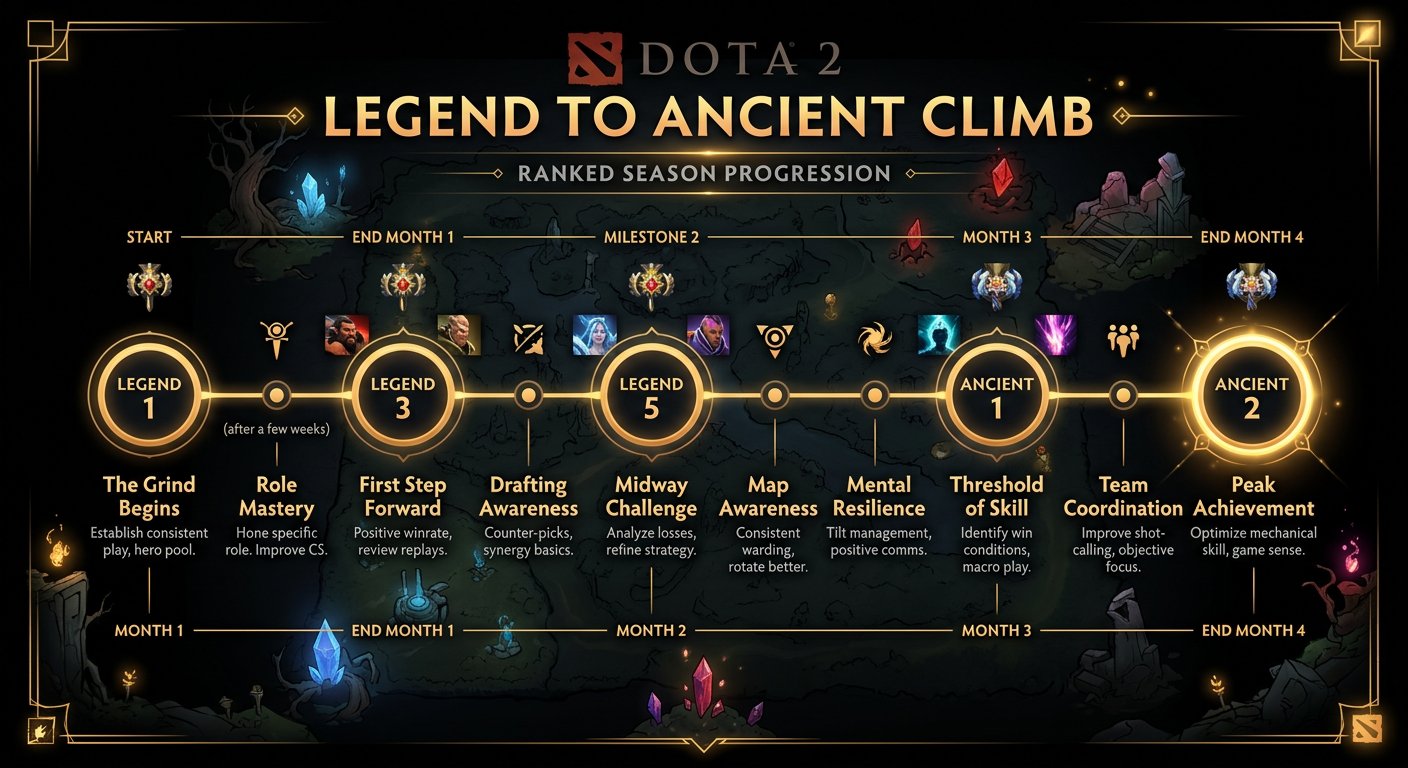
Let’s set honest expectations. The Legend bracket spans approximately 770 MMR (3,080 to 3,850). To reach Ancient, you need to gain that full amount. Here’s what a realistic timeline looks like:
The Math
- Average MMR per win: ~30 MMR (standard ranked match)
- Realistic win rate for an improving player: 53-56%
- Net MMR per 100 games at 55% win rate: (55 wins × 30) – (45 losses × 30) = 1,650 – 1,350 = 300 MMR
- Games needed to gain 770 MMR at 55% win rate: ~257 games
- At 3 games per day: ~86 days (~3 months)
- At 5 games per day: ~51 days (~2 months)
Factors That Speed Up the Climb
- Higher win rate: If you implement everything in this guide and your win rate jumps to 58-60%, you can cut the timeline in half.
- Win/loss streaks: Dota’s matchmaking system adjusts MMR gains during streaks. Win streaks can give you more than 30 MMR per game.
- Focused play sessions: Playing 3 games with full focus is better than playing 7 games while tilted and tired. Quality over quantity.
- Coaching: A professional coaching session can identify your specific weaknesses and accelerate your improvement dramatically. Many players report a 200-300 MMR jump within weeks of their first coaching session.
Factors That Slow Down the Climb
- Tilt queuing: Playing on a loss streak is the single fastest way to lose MMR. Take a break after 2 consecutive losses. Always.
- Hero pool too wide: Playing 15 different carries means you’re mediocre at all of them. Narrow it to 3-4 heroes and master them.
- Inconsistent play times: Playing 10 games one day and none for a week leads to rust. Consistent daily play (even just 2-3 games) builds muscle memory better than sporadic binges.
- Not reviewing replays: You can’t fix what you can’t see. Watch at least one replay per week, focusing on deaths — what could you have done differently
The Honest Truth
Most players who actively work on improvement and follow a structured approach can go from Legend 1 to Ancient 1 in 2-4 months. Some do it faster, especially with coaching. Some take longer, especially if they’re only playing a few games per week. The key is consistency and focus on improvement, not just grinding games on autopilot.
If you want to accelerate your climb or need a quick boost to get past a particularly frustrating MMR plateau, our MMR boosting service can help you get to the rank you deserve while you continue improving your skills.
Frequently Asked Questions
Ready to Start Your Climb
The journey from Legend to Ancient is one of the most rewarding climbs in Dota 2. You’re moving from “good player” to “genuinely skilled player,” and every game teaches you something new.
Written by Team Smurf’s Immortal-rank analysts — Rankings last verified February 2026



