


Captains Mode in Dota 2 Explained: Pick/Ban Order, Timers and Why Pros Use It

Captains Mode (CM) is the official competitive draft format used in every professional Dota 2 tournament, including The International. In CM, one designated “captain” per team controls all picks and bans, taking turns to ban heroes from the pool and select five heroes for their squad. The draft follows a fixed alternating sequence of ban phases and pick phases, with strict timers on every decision. The result is a calculated strategic layer played entirely before the game even loads — and it is the reason professional matches look fundamentally different from pub games.
This guide covers every detail: the exact pick/ban sequence step by step, how timers work, what the Radiant/Dire coin flip means, why pros prefer CM over any other format, and how you can use CM yourself in Battle Cup or custom lobbies to sharpen your competitive understanding.
Contents
What Is Captains Mode in Dota 2?
Captains Mode is a draft game mode in Dota 2 where each team designates one player as the captain. That captain is solely responsible for all ban and pick decisions during the pre-game draft. No other player can interfere. The two captains face off in a structured alternating sequence — banning heroes to deny the opponent’s best options, then picking heroes to build their own lineup. All professional Dota 2 play (Valve’s DPC leagues, Majors, and The International) exclusively uses Captains Mode.
The defining characteristic of CM is the controlled information structure: every ban and pick is visible to both teams in real time. There are no hidden picks (unlike Blind Pick formats in other games). This transparency transforms the draft into a chess match where captains must think several moves ahead — predicting what the enemy will pick next, threatening bans to force reactions, and concealing their own strategy until the last possible pick.
Understanding how CM works is essential for any player who wants to follow professional Dota 2, compete in Battle Cup, or simply develop a deeper strategic grasp of the game. If you want to understand hero pool meaning in a competitive context, this is the format where hero pools get stress-tested every single match.
The Full Pick/Ban Sequence
Captains Mode consists of six alternating phases — three ban phases and three pick phases — for a total of 20 draft actions per match. Each team makes 5 bans and 5 picks. The phases are interleaved so teams must draft with incomplete information: they ban before knowing some enemy picks, and pick before all bans are finished.
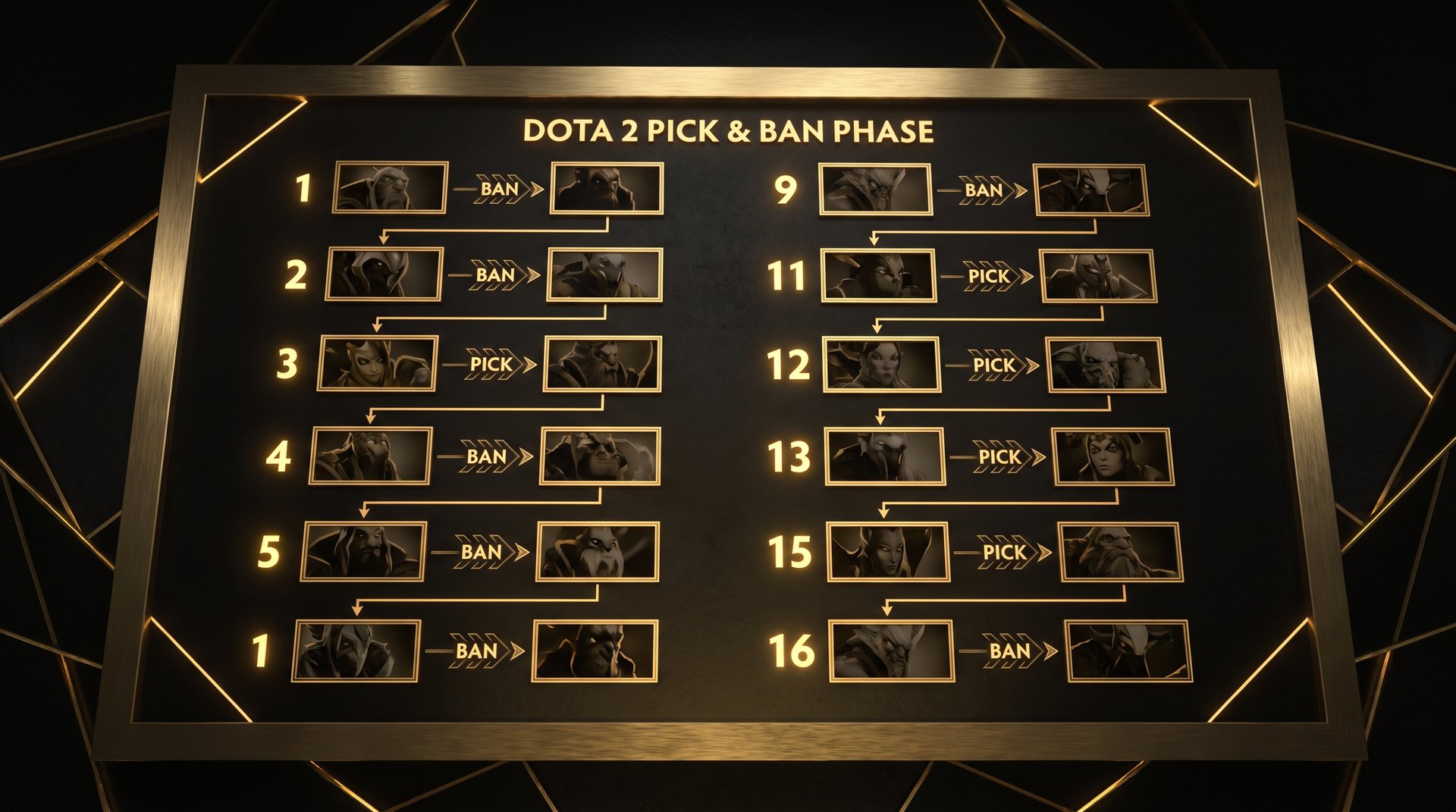
The sequence below uses “Team A” as the team that bans first in Phase 1 (Dire side by default in most competitive settings) and “Team B” as the team with first pick (Radiant side). The coin flip determines which team is A and which is B before the draft begins.
| Step | Action | Team | Phase | Timer |
|---|---|---|---|---|
| 1 | Ban | Team A (Dire) | Ban Phase 1 | 30s |
| 2 | Ban | Team B (Radiant) | Ban Phase 1 | 30s |
| 3 | Ban | Team A (Dire) | Ban Phase 1 | 30s |
| 4 | Ban | Team B (Radiant) | Ban Phase 1 | 30s |
| 5 | Pick | Team B (Radiant) | Pick Phase 1 | 40s |
| 6 | Pick | Team A (Dire) | Pick Phase 1 | 40s |
| 7 | Pick | Team A (Dire) | Pick Phase 1 | 40s |
| 8 | Pick | Team B (Radiant) | Pick Phase 1 | 40s |
| 9 | Ban | Team B (Radiant) | Ban Phase 2 | 30s |
| 10 | Ban | Team A (Dire) | Ban Phase 2 | 30s |
| 11 | Ban | Team B (Radiant) | Ban Phase 2 | 30s |
| 12 | Ban | Team A (Dire) | Ban Phase 2 | 30s |
| 13 | Pick | Team A (Dire) | Pick Phase 2 | 40s |
| 14 | Pick | Team B (Radiant) | Pick Phase 2 | 40s |
| 15 | Pick | Team B (Radiant) | Pick Phase 2 | 40s |
| 16 | Pick | Team A (Dire) | Pick Phase 2 | 40s |
| 17 | Ban | Team A (Dire) | Ban Phase 3 | 30s |
| 18 | Ban | Team B (Radiant) | Ban Phase 3 | 30s |
| 19 | Pick | Team B (Radiant) | Pick Phase 3 | 40s |
| 20 | Pick | Team A (Dire) | Pick Phase 3 | 40s |
Reading the Draft Pattern
Three patterns jump out when you look at this sequence in full:
- Consecutive double picks: In Pick Phase 1 (steps 6-7), Team A (Dire) picks two heroes back to back. In Pick Phase 2 (steps 14-15), Team B (Radiant) gets the same advantage. This double-pick slot is strategically critical — teams save powerful two-hero combination picks (like a carry + the support that enables them) for their consecutive turns so the opponent cannot ban either hero in between.
- Last pick advantage: Each team holds the very last pick in alternating phases, giving them the chance to counter the enemy’s penultimate pick. Step 20 gives Team A (Dire) the absolute final pick of the entire draft — widely considered the most powerful single draft asset.
- Phase transitions reset initiative: After Ban Phase 1, the team that held first pick (Team B) gives up banning initiative to Team A. After Pick Phase 1, banning initiative flips back. This push-pull structure prevents either team from dominating the entire draft.
Total Draft Summary
| Metric | Count | Detail |
|---|---|---|
| Total bans | 10 | 5 per team across 3 ban phases |
| Total picks | 10 | 5 per team across 3 pick phases |
| Total draft steps | 20 | Interleaved across 6 phases |
| Heroes remaining in pool | Varies | Full hero roster minus 10 bans |
| Minimum draft time | ~13 min | All 30s + 40s timers used fully |
Timer Rules: 30 Seconds for Bans, 40 Seconds for Picks
Every draft action in Captains Mode is time-limited. The timers are asymmetric by design — bans get 30 seconds, picks get 40 seconds — and the difference is intentional.
Ban Timer: 30 Seconds
Banning is a shorter decision. The captain must select one hero from the available pool and confirm the ban. Most experienced captains make ban decisions in under 15 seconds at the professional level. The 30-second window is more than sufficient unless a team runs into an unexpected situation mid-draft (such as the opponent picking in an unexpected direction).
If a captain fails to ban within 30 seconds, the game automatically bans a hero at random from the available pool. This “timeout ban” is treated as a mistake by the community and is almost never seen at professional level. In pub lobbies, timeout bans happen when players queue Captains Mode without a designated and attentive captain.
Pick Timer: 40 Seconds
Picking takes 10 extra seconds because the decision is higher stakes. Selecting the wrong hero for a slot can lose the game before it starts. The extra time lets captains process what the opponent has picked in the same phase, check their team’s preferred heroes, and confirm a pick that accounts for the full board state.
At professional level, the 40-second pick timer is often used nearly in full during critical consecutive pick slots (steps 6-7 and 14-15 in the table above). A captain picking confidently at second 5 signals either a scripted draft plan or an extremely strong read on the opponent. A captain burning 38 seconds signals deliberation — possibly a plan that changed mid-draft due to an unexpected enemy pick.
Bonus Time Bank
In official DPC leagues and major tournaments, a time bank is added on top of the base timers. Each team receives a pool of extra time (typically 60 to 90 seconds per series) that can be used across any draft decision in any game. A captain can hold the mouse during a critical pick and let bonus time count down instead of the base timer. Once the bank is empty, they revert to the base 30/40-second timers only. Managing the time bank well — not burning it on routine bans — is a mark of experienced captaincy.
Coin Flip — How Radiant and Dire Are Determined
Before the draft begins, the game executes a coin flip to assign Radiant and Dire sides to the two teams. In public lobbies, this is purely random. In official competitive matches, the process is more structured:
How It Works in Competitive Play
In DPC leagues and LAN events, the higher-seeded team (or the team with a better record in the current series) usually gets side selection — the choice of whether they want Radiant or Dire for a given game. The team that wins the map or series bracket typically chooses their preferred side for the next game. In a best-of-three, sides alternate between games with the loser of each game often choosing for the next.
Why Side Matters Beyond the Map
The Radiant/Dire assignment in CM does more than change spawn locations on the map. It determines draft role within the Captains Mode sequence:
- Radiant = First Pick side. Radiant (Team B in our table) gets the first pick in Pick Phase 1 (step 5). This means they reveal their first hero to the enemy before Dire picks, allowing Dire to counter — but Radiant also gets to lock in strong meta heroes before they can be taken.
- Dire = First Ban side. Dire (Team A) bans the very first hero of the draft (step 1). This lets Dire remove the single most dangerous hero before Radiant can pick it, but Dire will be responding to Radiant’s first pick rather than setting the pace of picks.
Coin Flip in Pub Lobbies
In custom pub lobbies, there is no side-selection process. The game randomly assigns Radiant and Dire at the start of the lobby countdown. If you are organizing a competitive lobby with friends, you can use the host settings to manually assign teams to each side before the draft. The coin flip mechanic in-client mirrors the randomness of a real coin — it is not weighted or influenced by MMR, rank, or previous game results.
Why Professional Dota 2 Players Use Captains Mode
Captains Mode is the exclusive competitive format in professional Dota 2 for well-defined reasons, not convention. Every element of its design serves competitive integrity.
Single Point of Responsibility
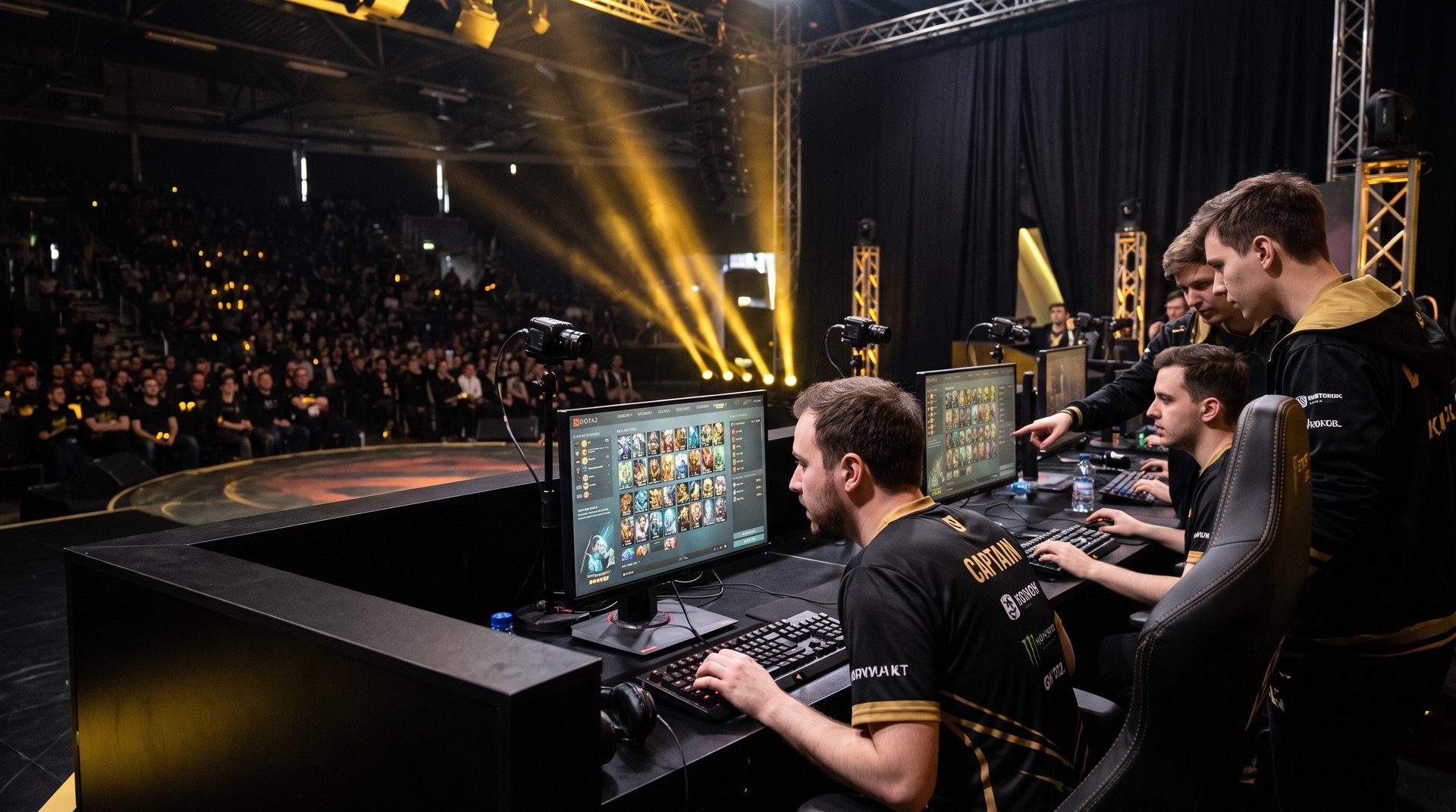
When one captain makes all five picks and bans, the team’s strategy becomes coherent. In All Pick, five players pick independently, and synergies happen by accident or require pre-game communication. In CM, every hero in the lineup was chosen by one person with full visibility of all other choices. The draft tells a story, and the captain is the author.
This single-author structure makes post-match analysis meaningful. Analysts can evaluate why a captain took a specific hero in a specific slot, which bans were responses to which threats, and whether the draft achieved its stated strategic goal. Without CM’s single captain, this level of analysis would be impossible.
Metagame Depth
Captains Mode creates a second game on top of the main game — the draft game. Teams invest hours studying opponent drafting tendencies, favorite hero pools, comfort picks, and “cheese” strategies that appear unexpected in the draft but unfold predictably in-game. A team’s draft book (their prepared responses to common enemy openings) is one of the most closely guarded assets in professional Dota 2.
If you have spent time with our Dota 2 Draft Guide, you will recognize that everything in that guide — how to counter-pick, when to flex-pick, how to set up for the last pick — applies specifically to Captains Mode, because CM is the only format that gives captains enough information and enough agency to make those decisions matter.
Counterpicking and Blind Picks
CM’s interleaved ban/pick phases create a tension between revealing your strategy too early and securing the heroes you need. Picking your most important carry in slot 1 (step 5) tells the enemy exactly what you are building around, giving them four remaining bans to dismantle your support pool. Waiting until your last pick (step 19 or 20) means taking the risk that a critical hero gets picked by the opponent.
This tension is what separates elite drafters from average ones. A captain who can pick “flex” heroes — heroes that fit multiple roles (like a hero who can function as carry OR offlane depending on what the enemy shows) — forces opponents to make bans based on incomplete information. This skill is a major reason professional teams pay significant attention to draft preparation alongside in-game mechanics.
Controlled Hero Diversity
With 10 bans per game, Captains Mode removes the top tier of the current patch from most games. If a hero is overpowered enough that both teams want to ban it, it simply will not appear. This keeps competitive play from degenerating into both teams running the same three broken heroes patch after patch. The ban phases function as a self-correcting competitive filter.
Captains Mode in Pub Games: Battle Cup and Custom Lobbies
Captains Mode is not only for professionals. It appears in two primary pub contexts in Dota 2 — Battle Cup and custom lobbies — and understanding how it functions in both makes you a more prepared player when you encounter it.
Battle Cup
Battle Cup is Valve’s amateur competitive tournament format that runs during Dota 2 seasons. Teams of five players register together and compete in single-elimination brackets. Battle Cup uses Captains Mode as its draft format, giving casual and semi-competitive players direct experience with the same pick/ban system used at TI.
Battle Cup has tiers based on the average MMR of your team. This directly ties into how your Battle Cup tier is set from your MMR. The higher your team’s average rank, the more intense the opposition — and the more important precise drafting becomes. Teams in the higher Battle Cup tiers will run prepared draft strategies, pre-planned bans, and specific hero pool coordination in exactly the same way professional teams do.
When you play Battle Cup, one player must serve as captain. Before the tournament, teams should agree on which player will captain and walk through their drafting priorities. A captain who freezes during the pick timer or bans the wrong hero at the wrong moment can cost the team the match before anyone has loaded into the game.
Custom Lobbies
In Dota 2, you can create a custom lobby and select Captains Mode under the game mode settings. This is the cleanest way for a 10-man group (two full teams) to practice competitive Dota. Custom lobbies with CM are standard practice for aspiring semi-professionals and team tryouts at every level from Regional League qualifiers down to organized Discord communities.
To access CM in a custom lobby: create a lobby, set it to Private, select “Captains Mode” as the game mode, and assign the two teams manually. Each team’s captain will be the player who enters the draft interface. All 20 draft steps will follow the sequence described in this guide.
Does CM Give MMR?
No. Custom lobbies with Captains Mode do not award MMR. Battle Cup has its own ranking system separate from your matchmaking MMR. If you want to understand which game modes actually affect your Dota 2 MMR, the answer is Ranked All Pick and Ranked Single Draft — not CM in a custom lobby. Battle Cup performance does not move your ranked MMR either.
Captains Mode vs Other Competitive Formats
Dota 2 has several game modes, but Captains Mode stands apart from all of them when it comes to competitive structure. Here is how CM compares to the formats most likely to come up in a serious competitive context:
| Format | Bans | Who Picks | Used In | Strategic Depth |
|---|---|---|---|---|
| Captains Mode | 10 total (5/side) | One designated captain | All pro play, Battle Cup | Maximum |
| Ranked All Pick | Voting-based (varies) | Each player picks their own | Normal ranked queue | Moderate |
| Captains Draft | 6 total (3/side) | One designated captain | Pub lobbies, older tournaments | High |
| Single Draft | 0 | Each player from 3 random heroes | Ranked (limited availability) | Low |
| All Random | 0 | Fully randomized | Pub/custom lobbies | None |
| Turbo | 5 total (voting) | Each player picks their own | Unranked (fast) | Low |
Captains Mode vs Captains Draft
Captains Draft (CD) is an older competitive format still available in custom lobbies. Both formats use a single captain, but CD only includes 6 bans (3 per team) and uses a smaller hero pool restricted to a random selection of heroes at draft time. The reduced ban count and restricted pool mean CD drafts have significantly less strategic variety than full CM. Most competitive communities consider CD a casual warm-up format rather than serious preparation for real competition.
Captains Mode vs Ranked All Pick
Ranked All Pick (RAP) is the game mode where your solo MMR lives. In RAP, there is a short voting phase where players suggest bans and the most-voted heroes are removed — but each player still picks their own hero independently. There is no captain, no coordinated drafting, and no interleaved ban/pick sequencing. Players learning from RAP for competitive readiness are learning only a fraction of what CM demands.
This is a key reason why players who perform well in ranked can still struggle in competitive Dota — their mechanics are there, but their understanding of the full draft game is underdeveloped. Studying CM even as a solo player makes you a better ranked player because you start recognizing enemy draft intentions and building more intentional lineup synergies.
Draft Strategy Fundamentals for Captains Mode
Understanding the sequence is only the first layer. Using it effectively is the real skill. Here are the fundamental concepts every CM captain needs to internalize:
The “Target Ban” vs “Safety Ban”
A target ban removes the single hero you fear most facing against the enemy. A safety ban removes a hero that would deny your team its most important pick. Phase 1 bans (steps 1-4) are almost always some combination of target bans and safety bans. The captain who bans a hero their team cannot play against (instead of the hero the enemy most wants to play) is making a defensive mistake that compounds over the next 16 draft steps.
Flex Picks and Commitment Timing
A flex pick is a hero with multiple viable role interpretations. By picking a flex hero in Pick Phase 1 (step 5 or 8), a captain forces the opponent to guess where it will play. If the opponent guesses wrong and picks around an assumption, the flex hero shifts roles in Pick Phase 3, and the opponent’s entire draft logic collapses.
Commitment timing — choosing when to “commit” by picking your key heroes — is the highest-level drafting concept. Committing too early (giving away your game plan in Phase 1) lets opponents construct specific counters. Committing too late means risking that your must-have hero gets picked or banned. Elite captains develop pattern recognition over thousands of CM drafts to know exactly when commitment is safe.
Reading the Enemy’s Second Pick
After step 6 (Team A’s first pick), Team A immediately picks again at step 7. These two consecutive picks are the most information-dense moment in the draft. By steps 6 and 7, both teams have revealed their first picks. A captain who correctly reads the role intention of both enemy picks can make their step 8 response directly counter both simultaneously.
This pattern-recognition skill — seeing a carry + pos-4 combination in an enemy’s first two picks and immediately knowing which offlane heroes shut them down — is exactly the kind of deep strategic understanding that Dota 2 coaching accelerates. A coach who has lived through thousands of CM drafts can teach you the enemy archetypes and counter-draft responses that would take years to develop solo.
The Last Pick Responsibility
Step 20 is Team A’s absolute last pick — the final hero selected in the entire draft. Last pick is a weapon: you see all nine other heroes on the board and choose something that counters the enemy’s last two picks simultaneously while filling the last gap in your own lineup. The captain holding last pick must prepare two or three contingency heroes for step 20 before the draft even starts, adapting to the board as it develops.
If your team’s last pick slot goes to an inexperienced player, the advantage of holding last pick disappears. This is one reason rosters designate their most strategically aware player as captain — not necessarily their best mechanical player.
Ban Sequencing to Protect Your Lineup
Ban Phase 2 (steps 9-12) comes after both teams have picked two heroes each. At this point, each team knows the enemy’s early direction. The Phase 2 bans are used to remove heroes that specifically counter the heroes already picked. A captain who fails to use Phase 2 bans defensively will often discover in Phase 2 picks that the enemy has found the exact hero that destroys their established lineup.
Reviewing professional drafts specifically at steps 9-12 is one of the highest-value analysis exercises. Ask: what did Team A just show in Phase 1? What heroes counter exactly that combination? Are those heroes getting banned in steps 9-12? The answer reveals how much each captain understood about their own lineup’s vulnerabilities.
For a deeper breakdown of pick and counter-pick logic, the Dota 2 Draft Guide covers the specific hero archetypes and counter relationships that repeat across CM drafts at every level of play.
The Value of MMR Boosting in Reaching CM Competence
There is an uncomfortable truth in competitive Dota 2: Captains Mode strategy is largely invisible in low-bracket ranked play. Opponents do not run structured drafts, team coordination is minimal, and a well-designed CM lineup loses to mechanical chaos in Crusader-Divine brackets. This means players who learn CM strategy need an actual competitive skill floor to execute it against.
Many players use Dota 2 boosting services or MMR boosting to reach brackets where structured play matters. At Immortal and high Divine, opponents run proper CM-style coordinated picks even in ranked All Pick. If your question is whether reaching that bracket is worth the effort for your competitive growth, the safety and legitimacy considerations for Dota 2 boosting cover everything you need to know about the practice.
Frequently Asked Questions
Master the Draft Before Your Next Battle Cup
Understanding CM structure is the theory — applying it under pressure against a live opponent is the skill. Our Dota 2 coaches have competed in and coached through hundreds of CM drafts at every bracket. One session covers your current hero pool, your flex-pick options, and how to read enemy draft intentions from the first four bans.



