

Does Dota 2 Track MMR Per Hero? The Hero-Rating Myth Checked

No, Dota 2 does not track MMR per hero. Ranked MMR in Dota 2 is a single account-wide number. It goes up when you win and down when you lose, regardless of which hero you played. There is no hidden “hero rating” running underneath the main number.
This guide explains where the myth comes from, what Valve actually does track on a per-hero basis (hint: it is not MMR), and what that means for how you should approach ranked play and hero selection. If you have been wondering whether playing your “best hero” earns you more MMR or whether losing on one hero hurts more than losing on another, you will have a definitive answer by the end of this post.
Contents
Where the Hero-MMR Myth Comes From
The idea that Dota 2 secretly tracks performance per hero has been circulating in the community since at least 2017. It resurfaces every time someone goes on a winning streak with one hero and a losing streak with another. The logic feels intuitive: if you win 12 games on Juggernaut but lose 10 on Phantom Assassin, something must be adjusting how the system treats you on those heroes.
There are three reasons the myth persists:
1. Your Dota Profile Shows Hero-Specific Stats
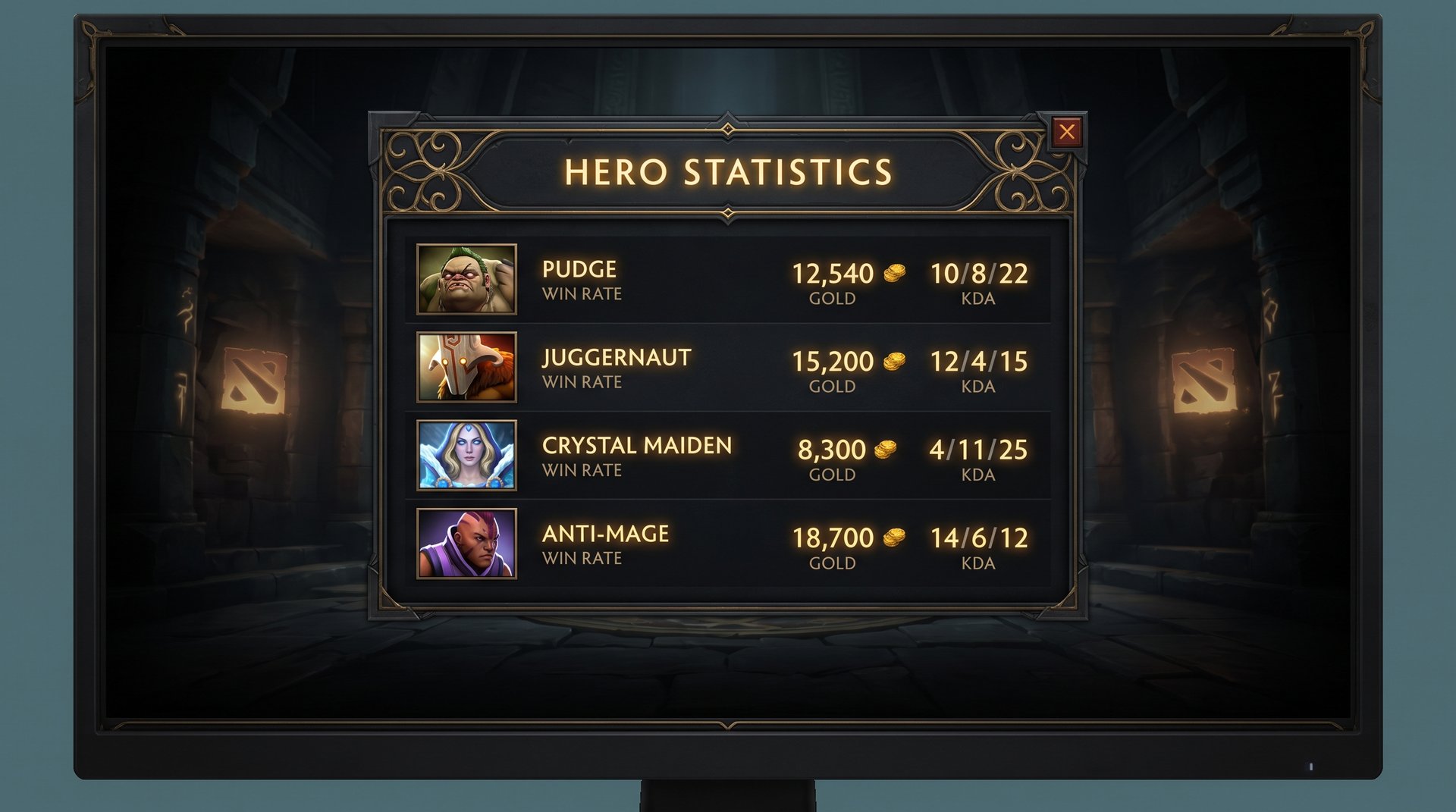
When you open your Dota 2 profile and navigate to the Heroes tab, you see a list of every hero you have played, along with win rate, games played, and KDA. This looks like a rating system. It is not. These are simple counters — wins, losses, kills, deaths, assists — aggregated and displayed for convenience. None of these numbers feed back into your MMR. They are read-only historical data.
2. Other Games Have Per-Champion Ratings
League of Legends displays individual champion mastery scores and separate ranked tiers for different queues. Overwatch 2 tracks separate SR for each role. Players who migrate from those games naturally assume Dota 2 works similarly. It does not. Valve has used a single account-wide MMR since the modern ranked system launched and has not added per-hero ratings.
3. Confirmation Bias on Streaks
When you win eight games in a row on Earthshaker and then lose three immediately after swapping to Razor, the natural conclusion is that the system “knows” you are weaker on Razor. In reality, you are dealing with variance, opponent quality, draft context, and your own mechanical form on the day. A sample size of 10-15 games on any single hero is too small to rule out normal randomness.
What Valve Actually Tracks Per Hero
Valve does collect detailed data per hero, but none of it affects your MMR number. Here is a breakdown of what is and is not tracked in the hero-specific data visible to players:
| Data Point | Tracked Per Hero? | Affects MMR? |
|---|---|---|
| Games played | Yes | No |
| Wins and losses | Yes | No (only total W/L matters for MMR) |
| Win rate percentage | Yes (calculated) | No |
| Average KDA | Yes | No |
| Last hit average | Yes | No |
| GPM average | Yes | No |
| Hero damage / healing | Yes (in match history) | No |
| MMR delta per match | No | N/A — only win/loss counts |
| Hero-specific “rating” | No | No — does not exist |
The hero statistics page on your profile is purely a personal record. It is similar to your Steam playtime counter: it grows as you play, but the number has no mechanical consequence in matchmaking or rating calculations.
What Third-Party Sites Like Dotabuff Show
Sites like Dotabuff, Stratz, and OpenDota pull match data from the Dota 2 API and display it in more detail than the in-game profile allows. You can see your win rate per hero, average MMR of your opponents per hero, and performance graphs over time. This is aggregated match data, not a hidden MMR sub-score. When Dotabuff shows “53% win rate on Anti-Mage across 80 games,” it is telling you your historical win rate on that hero — a useful metric for deciding which heroes to prioritize, but not a rating that Valve’s matchmaker uses.
How Ranked MMR Actually Works
Dota 2’s MMR system is account-wide. One number goes up when your team wins and down when your team loses. The fundamental rules are simple:
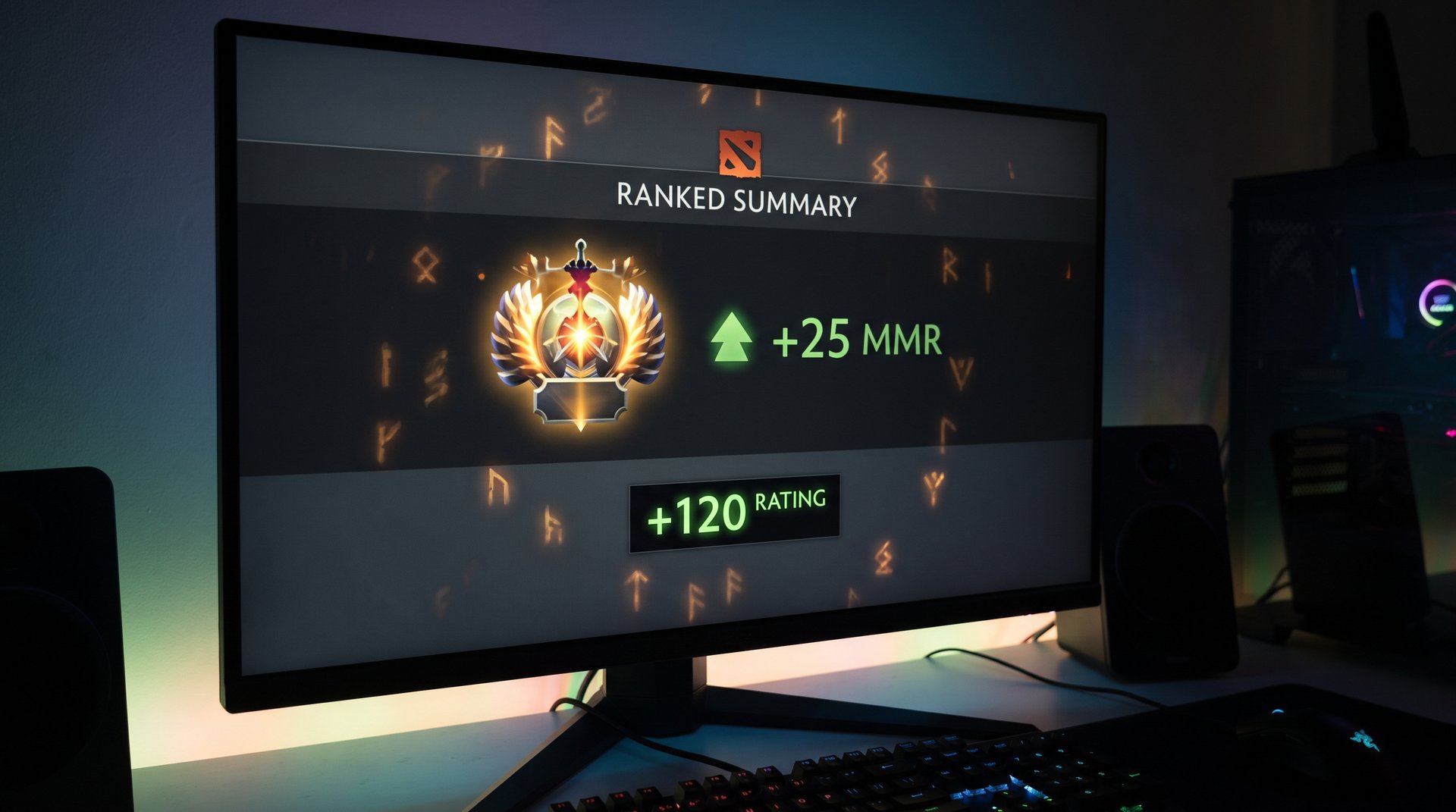
- Win a ranked match: your MMR increases (currently approximately +30 per win)
- Lose a ranked match: your MMR decreases (approximately -30 per loss)
- The hero you played: has no bearing on the size of the change
- Your personal performance: does not directly scale the +/- in standard ranked
Role MMR vs Core and Support MMR
Valve has split ranked into separate Core and Support tracks since 2019. When you queue as a core, your core MMR changes. When you queue as a support, your support MMR changes. The overall displayed MMR is the higher of the two. This role-specific split is sometimes confused with hero-specific MMR, but it is based on the role selector you choose at queue time, not on which hero you pick during the draft.
If you queue as core and play Pudge mid, you earn or lose core MMR. If you queue as support and play Pudge as a roaming support, you earn or lose support MMR. The hero is Pudge in both cases — the track that changes is determined by your role queue selection, not the hero.
| Scenario | MMR Track Changed | Hero Impact |
|---|---|---|
| Queue as carry, win on Juggernaut | Core MMR +~30 | None |
| Queue as carry, win on Wraith King | Core MMR +~30 | None |
| Queue as support, win on Rubick | Support MMR +~30 | None |
| Queue as support, lose on Crystal Maiden | Support MMR -~30 | None |
| Queue as carry, lose any hero | Core MMR -~30 | None |
Understanding this separation matters for how you approach MMR boosting. A booster working on a core account will queue core roles and select the highest win-rate hero available in the current patch, not the hero the account owner typically plays. That is the mechanically correct approach because the only variable the system rewards is wins.
Does Losing on Your Best Hero Hurt MMR More?
No. A loss on your best hero costs exactly the same MMR as a loss on a hero you have never played before. The system does not know or care that you have 800 games on Tinker. It processes one input: did your team win or lose?
The related belief — “I always lose more MMR when I perform well but still lose” — is also incorrect in standard ranked. Dota 2 does not have a performance-based MMR modifier in normal ranked. You are not penalized for a 20/4 Tidehunter on the losing side. You lose the flat amount.
Why People Feel Like Losing on Their Main Hurts More
There are two psychological explanations. First, you remember losses on your main hero more vividly because the emotional investment is higher. You expected to win, so the loss registers as a surprise and a failure. Second, because you play your main hero more often, you will naturally accumulate more losses on that hero in absolute terms. If you have 800 Tinker games, you have probably lost 340 of them — far more than the 30 games you played on Sniper (and lost 15). The bigger loss number on Tinker feels significant even though the win rate might be almost identical.
| Belief | Reality |
|---|---|
| Losing on your main hero costs more MMR | False — flat -30 regardless |
| A great personal performance can reduce MMR loss | False in standard ranked |
| Playing a hero you are bad at loses more MMR | False — outcomes not rated individually |
| Winning with a high win-rate hero earns extra MMR | False — same +30 as any win |
| MMR system tracks how often you die per hero | False — no hero-specific sub-score |
What does change your MMR trajectory is your actual win rate. If your win rate on Tinker is 55% and your win rate on Sniper is 40%, you should queue Tinker. Not because the system gives you more MMR per win on Tinker, but because you are statistically more likely to win the game when you play Tinker. Learn about safe ways to improve your MMR here.
Is There a Way to Check Hero MMR in Dota 2?
No, because hero MMR does not exist as a concept in Dota 2’s official system. There is nothing to check.
What you can check, and what is genuinely useful, is your hero-specific win rate data through the tools available:
In-Game: Your Profile Heroes Tab
Open your profile, click Heroes, and sort by games played or win rate. This shows your historical performance per hero based on your actual match history. It is the most direct view of which heroes you perform best on. The data only reflects matches where your account was tracked — it does not go back to before Dota 2’s match history API was available.
Third-Party: Dotabuff, Stratz, OpenDota
These sites pull from the Dota 2 API and offer more detailed views: win rate over time, win rate by bracket, win rate in recent patches, average match duration, average gold per minute, and performance comparisons against players at your MMR. The most useful metric for hero selection is your win rate in your most recent 100-200 games on each hero, filtered by the current patch. That is a reasonable sample size that reflects your current skill state.
What These Numbers Tell You
If Dotabuff shows you are 47% on Anti-Mage across 120 games in the last six months, that hero is probably not helping your MMR climb. If you are 58% on Wraith King across 80 games in the same period, Wraith King is a better investment. The mechanism is simple: higher personal win rate on a hero = more wins = more MMR gained over time. It has nothing to do with a hero-specific rating and everything to do with which heroes give you the most wins in your bracket.
How This Affects Boosting Strategy (and Why It Matters)
Understanding that MMR is account-wide and hero-agnostic has direct implications for how MMR boosting works and why it is effective when done by a professional.
When a player attempts to boost their own account by grinding ranked on their favorite hero — say, a hero they love but have a 45% win rate on — they are operating against themselves. Every game on that hero is statistically likely to lose MMR, regardless of how comfortable the hero feels.
A professional booster operates differently. They identify which heroes have the highest win rates at the account’s current bracket in the current patch (using resources like Stratz, Dotabuff, and their own experience). They queue into the role that matches those heroes. They play heroes that give them an actual 60-70%+ win rate at that bracket, not the owner’s favorite. The result is a consistent upward MMR trend, because wins are the only variable that matters.
The best Dota 2 boosting services assign boosters based on their expertise in the current meta, not based on mimicking the account owner’s hero pool. The booster may play heroes the account owner never touches. That is intentional and correct — the goal is wins, and wins are all the system rewards.
If you want your MMR to move upward efficiently, the right approach is to:
- Identify your 2-3 highest win-rate heroes in your most recent 100 games
- Check that those heroes are viable in the current patch (7.41f/7.42 meta)
- Play those heroes consistently in ranked rather than experimenting
- If you are stuck at a bracket for multiple seasons, consider professional MMR boosting to move through the stuck bracket and gain access to better-quality games
Want Faster MMR Progress? TeamSmurf Can Help
Our Dota 2-only boosters play optimal heroes for your bracket in the current patch — no random picks, no hero experimentation. Every game is played to win, because wins are the only thing that moves your number.



