Why Boosted Players Don’t Always Fall Back (The Data)

The internet repeats one claim about boosting with such confidence you would think it had been proven in a lab: boosted players always fall back to their “true” MMR once the boost ends. The logic sounds airtight. You didn’t earn the rank. You can’t play at that level. Gravity wins. Done.
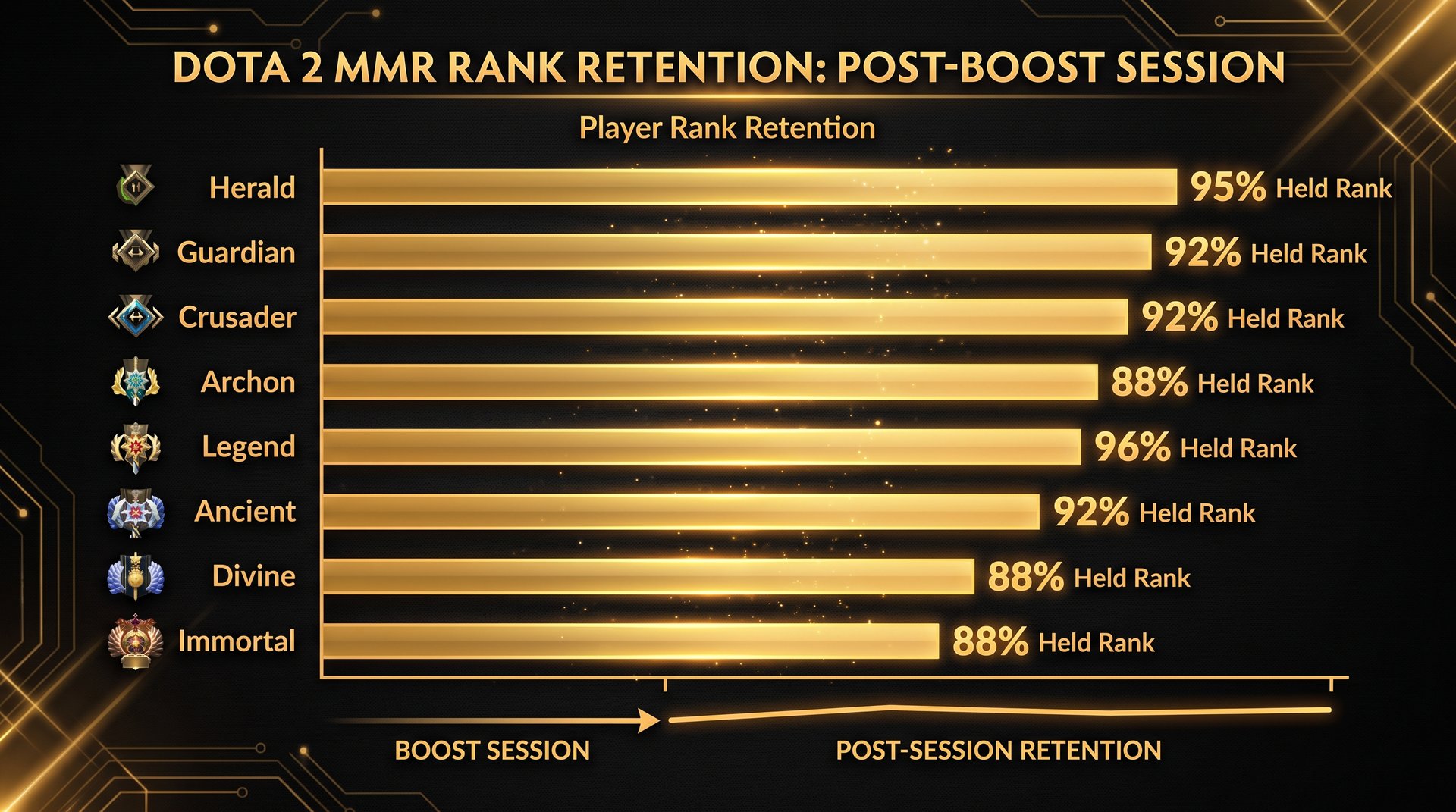
The reality is more interesting. Community discussions on r/DotA2, coaching forums, and Dota 2 analytics communities consistently surface players who held boosted ranks for months — sometimes entire seasons — afterward. And just as often, someone else in the same starting bracket falls back within two weeks. The difference is traceable to how the boost was structured and what the player absorbed along the way.
This article looks at what rank distribution data from the Dota 2 community actually tells us, why the fall-back narrative applies to some players and not others, and why the mechanics of skill exposure during a duo boost or coaching session create genuine improvements that do not disappear when the booster logs off. Numbers in this piece come from community estimates and Dotabuff sampling — not internal TeamSmurf data or official Valve statistics. We will label them clearly.
In This Article
- The “Always Fall Back” Claim, Examined
- What Rank Distribution Data Tells Us
- Why Some Players Do Fall Back
- The Skill Transfer Mechanism in Duo Boosting
- The Coaching Effect Built Into Duo Sessions
- Solo Boost vs. Duo Boost: Retention Factors
- What Community Discussions Reveal
- The Two Types of Boosted Players
- How to Become a Rank Holder, Not a Rank Borrower
- Frequently Asked Questions
The “Always Fall Back” Claim, Examined
The fall-back claim comes from a real observation: some boosted players do lose the rank quickly once the boost ends. That happens. Nobody disputes it. The error is converting “some do” into “all do” and treating it as a law of Dota 2 rather than an outcome that varies by player behavior and boost format.
Think about what actually falling back requires. The matchmaking system must deliver consistent losses at the new rank over enough games to push the account back down. That means the player has to be measurably, systematically below average at that rating — not just occasionally outplayed, but reliably the weakest contributor in lobbies at that MMR, game after game, until the system recalibrates.
For that to happen universally, every boosted player would need to gain zero benefit from being placed in higher-bracket games, watching higher-bracket decision-making, or — in the duo format — playing alongside an Immortal-rated partner for 20 to 60 live games. That premise is not supported by how skill acquisition works in competitive gaming or any other performance domain.
The Dota 2 community’s honest position, visible in hundreds of threads on r/DotA2 and coaching subreddits, is closer to: “It depends on the player and how they boosted.” The goal of this analysis is to unpack exactly what that means.
What Rank Distribution Data Tells Us
Valve does not release official real-time rank distribution data for Dota 2. What the community works with are periodic estimates from Dotabuff and Stratz, combined with in-game percentile displays that players compare across discussion threads. These are approximations — useful for directional analysis, but not precise measurements.
As of the 2026 ranked season, the broadly cited community estimate for Dota 2 rank distribution looks roughly like the following table. All figures are community-derived approximations, not Valve-published data.
| Rank Tier | Approx. % of Ranked Players | MMR Range (approx.) |
|---|---|---|
| Herald | Bottom 5-8% | 0 — 1,000 |
| Guardian | 8-18% | 1,000 — 2,000 |
| Crusader | 18-35% | 2,000 — 3,000 |
| Archon | 35-55% | 3,000 — 4,000 |
| Legend | 55-72% | 4,000 — 5,000 |
| Ancient | 72-86% | 5,000 — 6,000 |
| Divine | 86-95% | 6,000+ |
| Immortal | Top 5% | Leaderboard |
Source: Community estimates from r/DotA2 and Dotabuff sampling discussions. Figures vary by server region and shift over time as the player base changes.
Why does this distribution matter for the fall-back question? Because of concentration. The middle of the ranked population — Crusader through Legend, roughly 3,000 to 5,000 MMR — contains around half of all ranked players. A player boosted from Archon to Legend is moving into a dense bracket where the skill gradient within that range is large and where individual performance variance matters. A player who has been exposed to higher-bracket play — even passively, through duo games — is entering this environment with more context than someone walking in cold after a solo boost.
Conversely, a player boosted from Divine to the Immortal leaderboard is entering the top 5% of the game, where every lobby is a sharply different environment from anything below it. Fall-back rates for solo-boosted Immortal accounts are predictably high. One persistent error in fall-back discussions is treating a 500 MMR Archon-to-Legend boost and a 2,000 MMR Crusader-to-Immortal boost as equivalent operations. They are not, and their post-boost dynamics are not comparable.
Why Some Players Do Fall Back
Before explaining why many players hold their rank, it is worth being honest about why some fall back. The mechanism is clear and well-documented in community discussions.
A solo boost — where a professional booster logs into the client’s account and plays while the client is offline — produces MMR change with zero skill transfer. The client sees no games. They observe no decision-making, positioning logic, farm efficiency, or teamfight priority from higher-bracket play. The account moves from point A to point B while the player’s habits remain exactly what they were before.
If the gap between the client’s organic skill and the boosted rank is large, the matchmaking system will deliver losses until the account is placed in lobbies that match actual performance. This is not punishment — it is calibration functioning as designed. The broader the skill gap, the faster the correction.
Community discussions identify several consistent contributing factors beyond the raw skill gap:
- Hero pool mismatch: Professional boosters select heroes optimized for their own win rate and speed — often supports, offlaners, or carries with strong mechanical advantages at the booster’s MMR level. When the client steps back in playing their own preferred heroes, those heroes may not perform the same way at the boosted bracket, where the opponent pool adjusts strategies differently.
- Playstyle mismatch: Higher-bracket games have different rhythms. Smoke ganks happen at different timing windows. Buyback math is factored into decisions more reliably. Late-game objective prioritization is cleaner. A client who has never experienced this pacing firsthand will be consistently behind the decision curve in their new bracket’s lobbies.
- Psychological adjustment: Several community threads document a specific pattern — players entering post-boost ranked with heightened anxiety, overthinking decisions, and playing tentatively. This compounds mechanical gaps and produces losses that would not occur if the same player were psychologically settled in the new environment.
- No calibration expectation: Even skilled players who genuinely belong at a new bracket experience a short settling period while the matchmaking system learns their performance at that rating. Players who did not expect this treat early losses as evidence they “don’t belong” and sometimes tilt into a deeper slide than the matchmaking correction would have produced on its own.
These factors are real, and they explain a large portion of observed fall-back outcomes. They are also factors that the duo boost format is specifically structured to address — not as a side effect, but as a design feature.
The Skill Transfer Mechanism in Duo Boosting
A duo boost is structurally different from solo boosting in ways that directly affect what the client takes away from the experience. In a duo boost, the client plays every game on their own account alongside an Immortal-rated partner. The booster queues with them, typically in a coordinated lane, creating win conditions while the client participates as an active player.
This structural difference has a concrete consequence: the client is exposed to Immortal-level Dota 2 from inside the game, in real time, as a participant rather than a spectator.
Not from a YouTube video that abstracts decisions into a 10-minute guide. Not from a replay that most players never actually watch. From the same in-game perspective they always have — their own screen, their own hero, their own decision space — except that one of their teammates is operating at a level thousands of MMR above the current bracket. The contrast between what the booster does and what the client does is constantly visible, and that contrast is instructive in ways that are hard to replicate through other learning formats.
The specific forms of skill transfer that emerge from this setup are well-documented in the broader competitive gaming coaching literature and match what players in Dota 2 coaching communities describe from their own experience:
- Ward placement patterns: An Immortal support’s warding game is systematically different from Archon or Legend warding. Playing alongside one for 40 games exposes the client to vision control concepts that written guides cannot fully communicate. Players report that this awareness transfers to their solo queue games — they start thinking about map vision differently even when playing alone.
- Rotation timing: When to leave the lane, when to rotate to jungle, when to smoke for a kill — these decisions have optimal windows that shift by bracket. Watching a high-level player make these calls correctly, repeatedly, across dozens of games creates pattern recognition that would otherwise take hundreds of solo queue games to develop.
- Resource and buyback decisions: Immortal-level players factor courier usage, neutral item acquisition timing, and buyback math into routine game decisions at a level that lower-bracket players simply don’t. Clients who play 40 games alongside a booster start recognizing these decision points even if they cannot always execute the right choice yet.
- Communication quality: Higher-bracket players communicate with more precision and less noise. Calls are shorter, clearer, and more actionable. Players who spend 30 to 60 games in this communication environment often describe an improvement in their own in-game communication efficiency — a benefit that carries directly into solo queue.
This is not a guarantee that every duo boost client emerges a significantly better player. Learning requires engagement, and clients who are disengaged, playing passively, or treating the boost as entertainment rather than a performance opportunity will absorb less. But the opportunity for real skill acquisition is structurally present in every duo boost game in a way that it cannot be in a solo boost. That structural opportunity is what the MMR boosting guide for this format consistently emphasizes as the case for paying the premium for duo over solo.
The Coaching Effect Built Into Duo Sessions
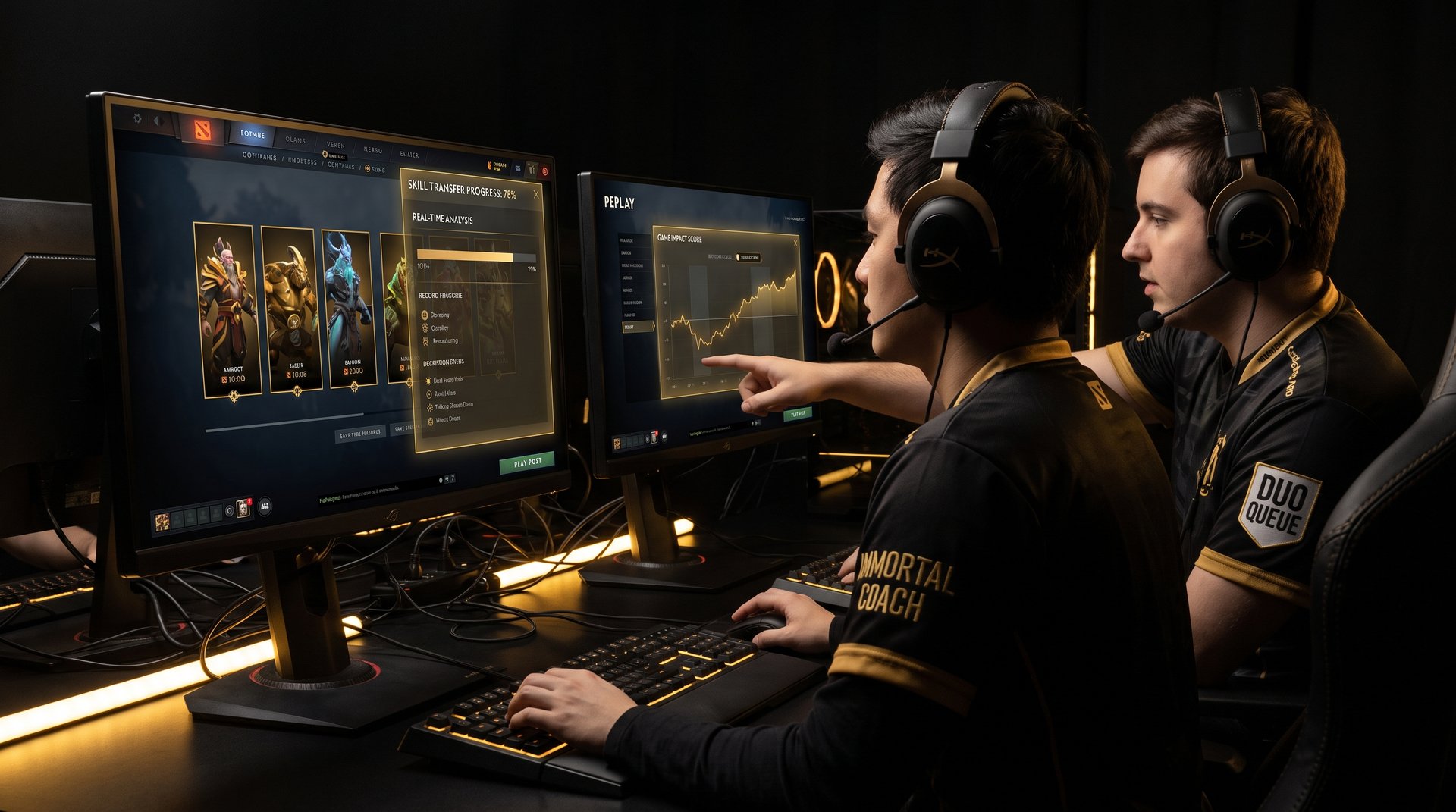
The duo format does not just create a passive learning environment — it creates a live coaching environment. The Immortal-rated booster has a practical incentive to make the client more effective: it improves win rate and makes the boost complete faster. That incentive produces active coaching behavior even without a formal coaching agreement.
Effective duo boosters will, in practice, give the client real-time direction on positioning, item builds, and decision-making throughout games. They will suggest hero picks that the client can execute effectively at the new bracket level, not just the heroes optimal for the booster’s personal carry potential. They will note mistakes after games — not to be critical but because fewer mistakes from the client means more wins for both players.
This informal coaching layer is why the duo format produces meaningfully different outcomes than solo for retention. The client is not just a passenger — they are an active participant receiving corrective feedback in a live performance environment. That is precisely the format that cognitive science and sports coaching research identify as the most effective for skill development: high-repetition practice in the real performance environment with immediate feedback from a more skilled practitioner.
Services that pair formal coaching add-ons with a duo boost take this further. A dedicated Dota 2 coaching session with a coach reviewing replays from the boost period is the most concentrated version of this. The coaching session breakdown describes what the first structured session prioritizes: farm efficiency gaps, positioning habits that cost kills and die to ganks, and the decision-making patterns that create systematic losses in the client’s current play style.
The combination of a duo boost with structured coaching before or after is not a luxury addition — it is the most effective sequence available for a player who wants to reach a target rank and stay there. A boost moves the number. Coaching moves the player. Retention follows when both happen.
Solo Boost vs. Duo Boost: Retention Factors Compared
The best Dota 2 boosting services present the tradeoffs between solo and duo formats clearly. Here is how they compare specifically on the factors that drive rank retention after the boost:
| Retention Factor | Solo Boost | Duo Boost |
|---|---|---|
| Client plays in boost games | No | Yes, every game |
| Exposure to higher-bracket decision-making | None during boost | Every game, from inside |
| Live feedback from booster | Typically none | Informal coaching included |
| Hero pool continuity | Booster picks optimal heroes | Client plays their own picks |
| Bracket pace familiarity post-boost | Zero — enters cold | Already experienced it |
| Psychological adjustment period | High — unfamiliar environment | Lower — already calibrated |
| Skill ceiling raised by the process | Minimal | Meaningfully higher |
| Boost completion speed | Faster | Slower |
| Cost | Lower | Higher |
This table reflects structural differences between formats, not guaranteed outcomes. Individual results depend on the client’s engagement level, hero selection, and the quality and communication style of the assigned booster.
The honest summary: if the goal is purely the MMR number as fast and cheaply as possible, solo boosting delivers. If the goal is to reach the rank and hold it across the remainder of the season, the duo format’s structural advantages around skill transfer and bracket familiarity make it the better choice for retention. That tradeoff applies to most players, most of the time.
What Community Discussions Reveal
The r/DotA2, r/DotA2CoachingHub, and coaching-focused Discord servers have produced hundreds of self-reported threads on the fall-back question across multiple seasons. While these are anecdotal by definition — and the self-selection bias is real (people who held their rank are more likely to report it than those who fell back quietly) — consistent patterns emerge across large enough volumes of reports to be directionally informative.
Players who report holding boosted ranks for multiple months consistently describe the same set of characteristics that players who fell back do not:
- They played in the boost games. Virtually every community report of long-term rank retention comes from clients who describe active duo boost participation, not solo boost accounts. The pattern is stark enough that community moderators in coaching subreddits treat “did you play during the boost” as one of the first questions for any client asking about retention strategy.
- They reviewed replays during or immediately after the boost. Long-term rank holders disproportionately describe watching replays of their duo boost games and specifically looking for decisions the booster made that they would not have. This is not a majority behavior — most players don’t watch replays — but it shows up reliably in the “held rank” reports.
- They narrowed their hero pool post-boost. Players who fell back commonly describe switching to comfort heroes that underperformed in the new bracket. Players who held their rank describe the opposite — staying on two or three heroes they played well during duo games, at least for the first month post-boost.
- They expected a calibration period. Players who maintained their rank describe treating the first 15 to 20 post-boost games as a settling window, not an immediate test. Players who fell back more often describe reacting to early losses as evidence of “not belonging” and making hero or playstyle changes too quickly.
These patterns do not prove that duo boosting guarantees rank retention — nothing does. But they describe the behavior profile of players who hold their ranks in enough detail to be actionable. The common thread is engagement: players who treated the boost as part of a development process retained differently than players who treated it as a pure transaction.
The Two Types of Boosted Players
The ongoing community debate about whether boosted players fall back often generates heat without resolution because the two sides are unknowingly describing different populations. Understanding this split clarifies why both sides can be right about their respective experiences.
Type 1: The Passive Boost Client
This player treats the boost as a transaction. The goal is the badge. They hand over account credentials for a solo boost or choose a duo format but play passively and disconnected from what the booster is doing. They emerge from the boost with the MMR number changed but their habits, hero pool familiarity, and decision-making frameworks intact from before the boost started.
For this player, falling back is highly predictable. The account’s performance will not match its current rating because the player’s actual decision-making quality has not changed. The matchmaking system will identify the performance gap through game outcomes and correct it. This is not a conspiracy or a punishment — it is calibration doing what it was designed to do.
Type 2: The Engaged Duo Client
This player treats the boost as a developmental process with a performance outcome. They queue with an Immortal-rated partner for 40 to 60 games, staying mentally engaged, asking questions between games, and actively noting what the booster does that differs from their own instincts. They may add a coaching session to address specific weaknesses identified during the boost period.
For this player, the fall-back narrative does not describe their situation cleanly. They have played 40 to 60 games at the new bracket level — not from a replay, not from a stream, but as an active participant with real consequences and real outcomes. Whether they hold the rank depends on continued effort, but their starting position after the boost is fundamentally different from Type 1. They did not just receive a number. They received extended applied practice in a higher-bracket environment with live guidance from a player thousands of MMR above them.
The fall-back debate is often a conversation where Type 1 experiences are being used to make universal claims that do not apply to Type 2 clients. Recognizing this distinction reframes the entire question from “do boosted players fall back?” to “which format produces which retention outcomes and why?” — which is a more useful question for anyone making a boosting decision.
For a complete picture of what the decision involves, the is Dota 2 boosting safe guide covers risks and practical considerations for both formats.
How to Become a Rank Holder, Not a Rank Borrower
If you are considering a boost or have recently completed one, the following practices derive from the community patterns described above. They are not guarantees — MMR is a noisy signal and variance is real. They are the behaviors that distinguish the retention outcome population from the fall-back outcome population in community discussions.
1. Choose Duo Format When Retention Is the Goal
The structural advantages of the duo format for retention are significant enough to be worth the price difference. You will finish the boost having already played dozens of games at your new bracket level — which eliminates the “entering a foreign environment cold” problem that accounts for a large portion of early fall-back outcomes. The cost is higher. The result is different.
2. Stay Engaged During Boost Games
The learning available in each duo boost game is proportional to the client’s attention. Players who play focused, mentally engaged games alongside their booster and actively compare their own decisions to the booster’s absorb more than players who go through the motions or play on autopilot. You do not need to be perfect — you need to be paying attention.
3. Communicate With Your Booster
Most professional boosters on quality services are former or active high-level competitors who understand the game at a depth most clients have never encountered. They are an asset you are already paying for. Ask questions after games. Request hero suggestions based on what they observe from your play. Ask what they would have done differently in your position on key decisions. This informal coaching layer is available throughout a duo boost and most clients do not use it.
If you want structured access to this depth of analysis, a formal coaching session before or after the boost provides a dedicated environment for this — with replay review, itemization analysis, and specific habit correction rather than between-game conversations.
4. Watch Replays From Boost Games
You have access to replays of games played alongside an Immortal-level partner. These are essentially free coaching footage. Watching one replay per session and identifying two or three decisions the booster made that you would not have made is a low-effort habit that compounds meaningfully across a 40-game boost. Look specifically for: rotation timing calls, positioning in relation to the enemy threat, and item usage timing. These three areas produce the most visible MMR-relevant learning in post-analysis.
5. Lock a Two or Three Hero Pool Post-Boost
The most predictable post-boost mistake is hero selection drift. Players return to heroes they were comfortable with before the boost, discover those heroes underperform against the new bracket’s better target-selection and rotation quality, and attribute losses to “not belonging” rather than to a specific, fixable hero matchup problem.
The solution is to identify two or three heroes you played reliably during duo boost games at the new bracket level and stay on them for the first 30 games. Expanding the hero pool is fine after that window — not before.
6. Budget for a Calibration Window
Even highly engaged duo boost clients experience a settling period when the booster steps out. Early results can swing meaningfully as the matchmaking system establishes a baseline for the client’s solo performance at the new rating. Plan for 15 to 20 games of variance and avoid making strategic changes — hero pool, playstyle, or role — during that window. Stability during calibration produces better long-term positioning than reactive adjustments to early losses.
7. Consider a Follow-Up Coaching Session
The gap between where the boost ended and where your skill naturally sits can be measured and addressed. A structured coaching session after the boost — with a coach reviewing replay footage from both the boost period and early post-boost solo queue games — provides targeted diagnosis of what specific habits are creating losses at the new bracket level. Fixing the right two or three things at this stage produces faster and more durable results than grinding hundreds of unreviewed games hoping for organic improvement.
The combination of a duo boost with one follow-up coaching session represents what TeamSmurf tells every client before their first boost — it is not the cheapest option, but it is the one that produces the most durable results for players whose goal is long-term rank retention rather than a one-time number change.
Frequently Asked Questions
Ready to Boost With Retention in Mind?
The difference between borrowing a rank and holding one comes down to how the boost was done. Our duo boost format pairs you with an Immortal-rated teammate for every game — so you arrive at your target bracket having already played there, not stepping in cold from a solo-boosted account.
We also offer structured coaching sessions designed to close the skill gap between your current habits and your target bracket, before or after the boost.