Coaching Session Breakdown: What an Immortal Coach Fixes First

Most players come into their first coaching session expecting the coach to tell them their mechanics are bad. They expect to hear that they need to last-hit better, react faster, or buy a different item build. They are almost always wrong about what gets fixed first.
An Immortal coach does not start with your mechanics. They start with your patterns — the repeating decisions you make without thinking, the habits that run on autopilot while your conscious mind is busy microing creeps. Those patterns are what separate a 3,000 MMR player from a 6,000 MMR player, and they are what a high-level coach locks onto within the first ten minutes of watching you play.
This guide breaks down exactly what happens inside a real coaching session: what the coach sees, what they prioritize, how the session is structured, and what changes fastest when you work with someone who has already climbed where you want to go.
Table of Contents
- What a Coach Sees Before You Even Play
- The 3 Mistakes Fixed in Session One
- How a Real Coaching Session Is Structured
- Resource Allocation — The Core Problem
- Positioning and Movement Patterns
- The Fastest Wins in Week One
- How to Prepare for Your First Session
- After the Session — the Practice Loop
- Coaching vs Boosting
- Frequently Asked Questions
What a Coach Sees Before You Even Play
Before a single match is played or reviewed, a coach who knows what they are doing runs a quick profile read. They look at your match history across the last 20 to 30 games and they are not scanning for win rate. They are looking for patterns in what you do when you lose — and more specifically, what you do in the five to seven minutes before a game becomes unwinnable.
This pre-session scan tells a coach four things almost immediately:
- Hero pool concentration — are you playing the same two heroes on autopilot, or are you chasing the patch?
- Role consistency — do you understand what your role demands from minute one, or does your GPM/XPM tell a different story?
- Timing signatures — at what minute do your losses typically tip over? Early collapse usually means laning problems. Mid-game collapses usually mean transition problems.
- Score line shape — are your losses 5-25 or 18-22? The gap tells you whether you are getting outplayed in isolation or getting out-macro’d as a team.
This profiling step takes an Immortal coach about three minutes. By the time they queue up your first replay, they already have a working hypothesis. The replay is not a discovery — it is a confirmation of what the numbers already suggested.
The 3 Mistakes Immortal Coaches Fix in Session One
Across hundreds of sessions, high-level coaches see the same three mistakes at the root of almost every stagnating rank. These are not flashy problems. They are not about missing a specific skill interaction or building the wrong item in one game. They are structural — built into how a player approaches every game, every laning phase, every teamfight.
1. Misallocated Attention in the Laning Phase
Below Immortal, most players spend their mental bandwidth watching the enemy hero. They are tracking whether the Axe is going to spin, whether the Storm will blink, whether the Slark has activated his passive. This feels correct — threats are dangerous, and danger demands attention.
But Immortal players watch the map. Their peripheral awareness of the enemy hero is handled by low-level pattern recognition that has been built through repetition. Their active attention goes to the minimap, to the side waves, to where the enemy midlaner disappeared sixty seconds ago. The laning phase is not a 1v1 — it is the setup for what happens at minute eight, and Immortal coaches know that players who lose their attention to the immediate threat lose the context that makes good decision-making possible.
The fix is not “watch the minimap more.” The fix is building a mental rotation: every 10 to 15 seconds, force a conscious glance at the minimap and ask one question — where are the people I cannot see? This becomes automatic with deliberate practice, but it has to be drilled with intention first.
2. Farm Abandonment During Power Spikes
The second mistake is more counterintuitive. Most players stop farming when they feel like they should be fighting — when their carry has a big item, when a teamfight was just won, when the enemy is scattered. This feels like good aggression. It is actually one of the most MMR-leaking habits in the game.
An Immortal player knows that farm efficiency and fight tempo run on parallel tracks. After winning a fight, there is almost always a 45-to-90-second window where the enemy respawns mean no fight can happen. That window is pure farm equity — camps that pay for the next item, waves that accelerate the next timing. Players who chase kills instead of taking those camps are paying for the same items on a longer schedule and arriving late to every subsequent fight.
Coaches call this “dead time awareness.” The fix is learning to read the respawn timers and map state immediately after a fight resolves — not from excitement, but from habit. Immortal players feel an almost physical discomfort at the idea of standing still while a camp is available.
3. Reacting to Information Instead of Creating It
The third mistake is the most subtle. Lower-ranked players play reactively — they respond to what the enemy does. An Immortal coach will spend a significant portion of session one showing a player the moments where they had enough information to force the enemy into a reaction instead of the other way around.
This shows up as: not using smokes because “we don’t know where they are,” not split-pushing because “they might have a TP,” not securing an objective because “we just won a fight and they might have buybacks.” All of these hesitations are rooted in treating uncertainty as a stop sign. Immortal players treat uncertainty as a lever — you create information pressure that forces the enemy to reveal themselves or concede ground.
How a Real Coaching Session Is Structured
A high-quality Dota 2 coaching session is not a lecture. It is not someone smarter than you explaining why you are bad. It is a structured diagnostic-and-treatment process, and understanding the structure helps you get more from every minute of coach time you spend.
Here is how a typical 60-minute session breaks down with an Immortal+ coach:
| Phase | Duration | What Happens | What You Should Do |
|---|---|---|---|
| Profile Read | 3-5 min | Coach reviews last 20-30 matches for patterns | Have your Dotabuff/OpenDota ready and open |
| Hypothesis Setting | 2-3 min | Coach states their working theory about root problems | Listen, do not defend — the theory is a starting point |
| Replay Review 1 | 15-20 min | Coach walks through a recent loss, pausing at key decision points | Ask “why” questions, not “what should I have done” questions |
| Pattern Confirmation | 5-8 min | Coach checks 2-3 more replays quickly to confirm patterns | Note the timestamps where the same mistake recurs |
| Drill Assignment | 5-7 min | Coach assigns 1-3 specific things to practice before next session | Write them down. Prioritize. Do not try to fix everything at once. |
| Live Game (optional) | 20-30 min | Coach watches you play a live game and calls out decisions in real time | Communicate your reasoning out loud as you play |
The ratio of replay review to live game observation varies by coach and by what stage you are at in the learning process. Early sessions tend to be more replay-heavy because the coach needs to build a complete pattern picture. Later sessions tend to include more live observation because the drills have been set and the coach is checking whether the habits are actually forming under pressure.

Resource Allocation — The Core Problem
If there is one area where the gap between Immortal and sub-Immortal players is most measurable, it is resource allocation. This includes gold, XP, time, and map control — the four currencies that determine who is ahead and by how much at any given moment in the game.
Sub-Immortal players think about resources reactively. They think about them when they notice they are behind. Immortal players think about them constantly, in every laning phase action, in every item timing, in every decision about whether to fight or farm. The difference is not intelligence — it is the depth of the habit.
Gold Efficiency in the Lane
An Immortal coach will typically pause a replay at minute four or five and ask: “What is your net worth compared to your lane opponent, and is the gap justified by what happened?” Most players can answer whether they are ahead or behind. Almost no one below Immortal can explain whether the gap is larger or smaller than it should be given the events of the lane.
This matters because it tells you whether you are winning your lane or just having a lane that has not been lost yet. A player who is 200 gold ahead after their opponent has been ganked twice is not winning — they are behind on a curve that should have them 600 gold ahead. That kind of misread compounds every minute of the game.
XP Distribution and the Deny Problem
Denies are another area where coaches find immediate leverage. Below Immortal, denies are treated as a secondary mechanic — nice to have, but optional. Immortal coaches know that a contested lane where one side denies consistently and the other does not creates an XP gap of 150 to 200 XP per denied creep. Over the course of a 10-minute laning phase with 10 to 15 deny opportunities, that is a potential XP gap of 2,000+ XP. That is a full level advantage — worth more than a gank in most lane contexts.
The fix is not just “deny more.” The fix is understanding when denying is worth contest and when last-hitting is the priority. An Immortal coach will show you the specific moments where you chose the wrong creep.
Map Control as a Resource
The most overlooked resource at sub-Immortal levels is map control — specifically, the value of having vision in key areas before you commit to an action. Players who move without vision lose the ability to read enemy responses and get caught out by rotations they had no reason to expect. Players who spend 75 to 150 gold on an observer ward at a key choke point before a fight change the information balance of the entire next three minutes.
Coaches at the Immortal level will often spend 15 minutes of a session on nothing but ward placement — not where wards “should” go according to a guide, but where wards need to go given the specific heroes on both sides and the specific objectives being contested at that moment in the game.
Positioning and Movement Patterns
Positioning is the area where Immortal coaches have the clearest vocabulary. There are specific, nameable patterns that lower-ranked players repeat, and a coach who has seen hundreds of replays can name them on sight.
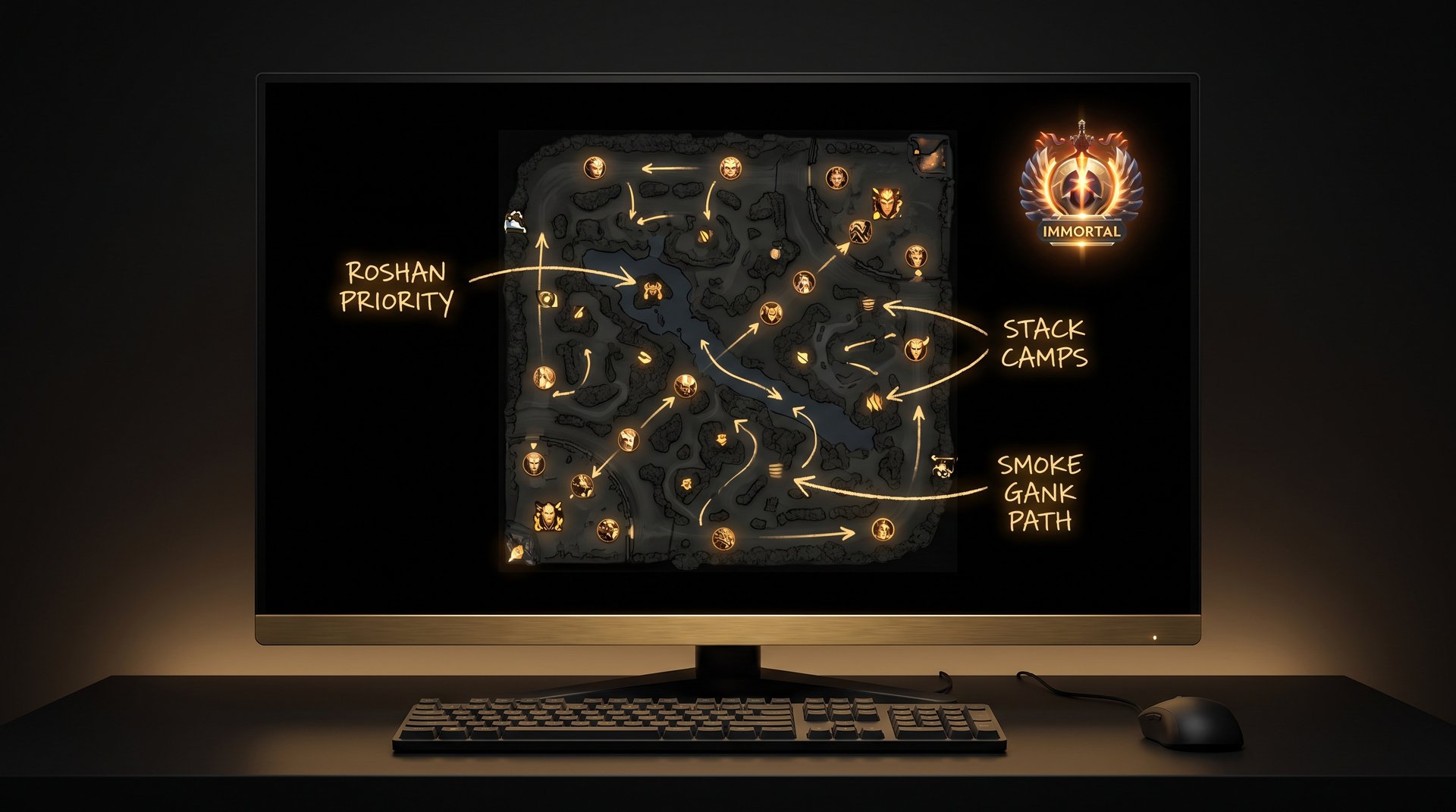
The “Safe Distance” Trap
One of the most common positioning mistakes is what coaches call the “safe distance trap.” A player positions themselves just far enough from a fight that they are not in danger, but close enough that they feel like they are participating. They are doing neither. They are at a distance where they cannot threaten the enemy but also cannot safely retreat if the fight turns. And because they are not committing, they are not generating the pressure that would make their presence meaningful.
Immortal players either commit to fights with an exit plan or they do not commit at all. There is no “comfortable middle distance” at the top of the bracket. That distance is a habit built by playing too cautiously for too long.
Movement Tells
High-level coaches pay close attention to movement tells — the predictable patterns in how you move around the map that opponents can read and exploit. The most common tell is the “predictable retreat”: a player who takes damage always retreats in the same direction, toward their tower. In low-pressure lanes this goes unpunished. In high-level play it is a pattern that the enemy will abuse with stuns, chokes, and cut-off angles.
The drill coaches assign for this is deliberate path variation. Every time you move to safety, choose a route you have not used recently. This sounds minor. In practice, it makes you significantly harder to catch because the enemy cannot preemptively cut you off.
Cooldown Positioning
Another pattern Immortal coaches catch quickly is positioning around ability cooldowns — specifically, the tendency to move aggressively when your strongest ability is available and retreat when it is on cooldown. This creates a visible rhythm that any aware opponent can exploit. Immortal players decouple their physical positioning from their ability cooldown status, making their movements harder to predict and their aggression harder to respond to in time.
The Fastest Wins in Week One
Coaching can feel overwhelming if you try to absorb everything at once. The most effective coaches assign a specific, prioritized list of 1 to 3 things to work on between sessions. Here are the improvements that consistently generate the fastest rank results in the first week of coaching.
- Minimap glance routine — setting a 10-to-15-second glance habit generates immediate decision improvements with no mechanical requirement
- Farming after fights — taking camps during enemy respawn windows instead of standing around adds 50 to 150 gold per incident, and there are 5 to 10 of these per game
- One ward before every objective contest — not a complex ward program, just one ward in the choke that matters before every Roshan or tier-two push
- Explicit deny windows — identifying the two or three creeps per wave where a deny is worth contesting and making those conscious instead of reactive
- Retreat path variation — changing exit routes each time you need to fall back from danger
The key insight here is that none of these require mechanical improvement. A player with average last-hit timing and no hero-specific mechanics can implement all of these changes in their next 10 games. The rank gains that follow are real and measurable — not because the player got better at Dota in some abstract sense, but because they stopped leaking equity on the specific decisions that hurt them most.
How to Prepare for Your First Coaching Session
The more prepared you are for a session, the more value you extract per minute of coach time. Here is what to do before you join a coaching call.
Pick 2 Recent Losses to Review
Choose two games you lost that felt unclear — not the ones where your team flamed you and you know it was not your fault, but the ones where you were not sure what you did wrong. Games where you felt like you played reasonably but still lost are the most instructive because they force you to look at your patterns rather than blaming obvious mistakes.
Write Down Your Questions Before the Session
Most players come into coaching sessions and let the coach drive everything. That is fine, but you will get more if you arrive with specific questions. Not “how do I get better” — but “I keep getting caught out in the midgame, and I do not understand what I am missing” or “I feel like my lane is going well but I am always behind at minute 15.” Specific confusion is worth an hour of vague questions.
Know Your Hero Pool
Have a clear sense of which 2 to 4 heroes you are most serious about improving on. Immortal coaches can give you generalized Dota advice, but the most targeted improvements come from hero-specific pattern analysis. A coach who knows you play Phantom Assassin carry and Earthshaker support will calibrate their observations very differently than if you show up with a 40-hero pool spread across four roles.
Be Ready to Be Wrong
The most common thing that blocks players from improving in coaching is defensiveness. You hired the coach because you want to rank up — not because you want confirmation that your decisions were correct. The more openly you can receive feedback that contradicts your intuition, the faster you will move through the first stage of improvement.
After the Session — the Practice Loop
A coaching session without a practice loop attached to it will give you a short-term rank bump at best. The real value of coaching is not the session — it is the habit formation that follows.
The standard practice loop that Immortal coaches assign looks like this:
- Play 3 to 5 games with one assigned drill as your primary focus — not winning, not your overall performance, just executing the drill with consistency
- Record a replay note after each game — one sentence: did you execute the drill, and if not, at what point did you break from it and why?
- Review your own replay before the next session — look specifically for the moments where the assigned drill was relevant and mark the timestamps
- Come to the next session with data, not feelings — “I executed the minimap glance routine in games 2 and 3 but lost it in game 1 when the teamfight happened at minute 14” is more valuable than “I tried to do the thing you said”
Players who follow this loop consistently see lasting rank improvement. Players who treat coaching as a one-time information injection usually plateau again within two to three weeks, because information without deliberate practice does not become habit.
Coaching vs Boosting — Different Tools for Different Goals
Players often wonder whether they should get coaching, get an MMR boost, or do both. The answer depends on what you are actually trying to solve.
MMR boosting gives you the rank number. It gets your account to a bracket where you want to play — where the games are more competitive, where teammates expect more, where the match quality is higher. For many players, playing in a higher-quality bracket is itself an accelerant for improvement, because you are exposed to better decision-making in every game you play.
Coaching gives you the understanding. It identifies and corrects the patterns that caused you to stagnate. Without coaching, a boosted player who has not addressed their root problems will climb back down. With coaching, a player who has internalized the corrections will hold the rank and push higher.
The most effective combination is coaching first, then boost to the bracket you have the skills to hold. If you use a reputable boosting service on an account that has been coached to understand the games at that MMR, you arrive at your target rank with both the number and the skill to keep it.
If budget requires a choice, the sequence that gives you the best long-term outcome is: coaching first, boosting second. The skills travel. The MMR is just a number that reflects them.
What Makes TeamSmurf Coaching Different
There are a lot of people who will offer you Dota 2 coaching. The difference is in the methodology — specifically, whether the coach has a systematic diagnostic process or whether they are just watching you play and saying things that sound smart.
TeamSmurf coaches are Immortal and above. More importantly, they have been trained on a specific coaching framework: profile read before session, pattern hypothesis before replay, drill assignment before the session ends. Every session is structured around the same fundamental question — what is the smallest change that produces the largest rank gain for this specific player at this specific moment in their development?
That question is harder to answer than it looks. It requires the coach to separate your permanent skill gaps from your temporary knowledge gaps, and to prioritize accordingly. Drills that address permanent gaps — habits built over thousands of games — require more repetition and take longer to show up in results. Drills that address knowledge gaps — things you did not know — can produce results in 5 to 10 games. Good coaches sequence these correctly: knowledge fixes first, habit rewiring second.
You can book a Dota 2 coaching session with TeamSmurf and work directly with an Immortal coach who has been through this process with dozens of students. Sessions are 60 minutes and include the full structure described in this post — profile read, replay analysis, drill assignment, and optional live game review.
Work With an Immortal Coach
Stop losing MMR to the same patterns every session. Our Immortal+ coaches use the exact framework described in this post — profile read, replay analysis, targeted drill assignment — to identify what is actually holding you back and give you a specific practice plan to fix it.
Sessions are 60 minutes. Coaches are Immortal rank, trained on a diagnostic methodology that produces measurable improvements in 10 to 20 games.