What’s a Good Winrate in Dota 2? By Rank and Role

Your winrate is one number every Dota 2 player checks after every session. But the number on its own means almost nothing without context. A 52% winrate at Divine is genuinely impressive. A 52% winrate at Herald 1 after 20 games could be noise. What counts as “good” depends entirely on your rank, your role, your hero pool, and how many games you have behind that number.
This guide breaks down exactly what constitutes a good winrate at each rank tier from Herald through Immortal, what to expect from each role position, why sample size is the most ignored factor in every winrate discussion, and what you should actually do if you want your number to move upward.
All winrate thresholds in this guide reflect community consensus and statistical patterns observed across millions of ranked games. Valve does not publish official “target” winrates by bracket — specific figures are labeled as community estimates throughout.
What’s in This Guide
Why 50% Is the Starting Point, Not the Goal
Dota 2 uses a matchmaking system — operating on Glicko-based principles since the major overhaul in patch 7.33 — that actively tries to put each player into matches where their team has roughly a 50% chance of winning. This is by design, not a coincidence or a conspiracy.
The logic is straightforward: if you are consistently winning more than you lose, the system registers that you are outperforming your bracket and pushes you upward. As you climb toward your true skill ceiling, match quality tightens and your winrate naturally trends back toward 50%. In theory, everyone who has played enough games and is correctly placed should sit very close to 50%.
This means that 50% is not a sign of mediocrity. It is the system working as intended. The question is not whether you can hold 50% — that is baseline — but whether you can sustain something above it over a meaningful sample of games.
What this means practically: if you have 50 games and a 60% winrate, the matchmaking has not yet calibrated fully to your skill level. If you have 2,000 games and a 60% winrate, you are operating at a level meaningfully above your bracket and should be climbing — or you are already climbing and just not at your true ceiling yet.
What Winrate Numbers Actually Mean
Before looking at rank-specific benchmarks, here is how the community broadly interprets different winrate ranges across a sufficient sample of games (100+ ranked games at minimum to draw any conclusions).
| Winrate Range | Interpretation | What It Suggests |
|---|---|---|
| Below 47% | Underperforming | You may be slightly above your correct bracket, or your play is inconsistent. Fundamentals review is worth prioritizing. |
| 47% — 52% | Correctly placed | Matchmaking has you roughly where you belong. Small improvements to decision-making can tilt this upward. |
| 52% — 55% | Above your bracket | You are consistently outperforming opponents at your current MMR. Rank gains are happening or should be coming. |
| 55% — 58% | Clearly stronger | Solid outperformance over a large sample. You are climbing or have a noticeable skill gap vs. your current bracket. |
| 58% — 62% | Strong stomper | Rare to maintain long-term. Either you are genuinely far above your bracket or you are early in a calibration window. |
| 62%+ | Exceptional or early calibration | Very rare over 300+ games. If sustained, represents extreme skill disparity with current opponents. |
These ranges reflect community consensus based on discussions on r/DotA2, r/TrueDoTA2, and r/learndota2 threads, as well as patterns observed on Dotabuff and Stratz. They are estimates, not hard thresholds defined by Valve.
The single most consistent data point from the community: 55% or above over 100 or more games is broadly considered “good.” Below that, you are in a zone where variance, sample size, and bracket placement all muddy the picture too much to make strong claims.

Good Winrate by Rank Tier (Community Estimates)
What counts as a good winrate shifts as you move up the ladder. At Herald, a 54% winrate after 50 games is easy for anyone with basic game knowledge who started recently. At Immortal top 1000, a 52% winrate over 500 games represents genuinely elite performance.
The table below reflects community estimates and patterns seen across Dotabuff and Stratz. These are not official Valve figures. Rank distribution data is based on Stratz Season 6 analysis (June 2026) across more than 7 million calibrated players.
| Rank | Est. MMR Range | Player Share | “Steady Climb” Winrate | “Fast Climb” Winrate |
|---|---|---|---|---|
| Herald 1-5 | ~0 — 770 | ~7.3% | 51-53% | 57%+ |
| Guardian 1-5 | ~770 — 1,540 | ~15.7% | 51-53% | 56%+ |
| Crusader 1-5 | ~1,540 — 2,310 | ~22.5% | 52-54% | 56%+ |
| Archon 1-5 | ~2,310 — 3,080 | ~22.7% | 52-54% | 56%+ |
| Legend 1-5 | ~3,080 — 3,850 | ~16.3% | 53-55% | 57%+ |
| Ancient 1-5 | ~3,850 — 4,620 | ~8.9% | 53-55% | 57%+ |
| Divine 1-5 | ~4,620 — 5,420 | ~4.6% | 54-56% | 58%+ |
| Immortal | 5,420+ | ~1.9% | 50-52% | 55%+ |
A few notes on how to read this table:
- Player Share is drawn from Stratz Season 6 data (June 2026) and rounds to one decimal.
- MMR ranges are community estimates. Since patch 7.33 introduced Glicko, precise bracket cutoffs shift seasonally and are not officially published by Valve.
- “Steady Climb” means you are gaining MMR, but slowly. You are winning more than you lose, which is all you need over time.
- “Fast Climb” means you are outpacing your bracket noticeably and will reach your true ceiling faster.
Herald and Guardian: High Variance, Low Sample Quality
At the bottom tiers, game quality fluctuates enormously from match to match. Disconnects, players who are unfamiliar with their heroes, and fundamental mechanical errors on both teams mean that individual skill expression is often less decisive than which team has fewer catastrophic mistakes.
A 55%+ winrate at Herald or Guardian over 100 games is excellent and means you are genuinely above these brackets. But even a 50-53% winrate here represents slow, steady progress upward. The key is consistency over a large sample rather than any single hot streak.
If you want to speed up the climb out of these brackets, a professional Dota 2 boosting service can help you skip past the most chaotic part of the ladder while you focus on improving your mechanics.
Crusader and Archon: The Most Populated Brackets
Together, Crusader and Archon account for roughly 45% of the entire ranked player population in Dota 2 — the single largest combined skill region in the game. Getting stuck here is extremely common, and a huge portion of the playerbase hovers between 1,500 and 3,000 MMR for months or years.
At this level, basic mechanics are mostly understood but decision-making — when to fight, when to farm, when to push — is wildly inconsistent. A player who can reliably make correct macro decisions will outperform this bracket even with average mechanics.
A 54%+ winrate at Crusader/Archon over 200+ games means you are genuinely better than most players in these brackets. If you are sitting between 50-53%, you are at your correct level and need to identify specific mistakes to climb further. Our full MMR boosting and climbing guide covers the most effective methods for breaking out of these brackets.
Legend and Ancient: Fundamentals Are Expected
From Legend upward, players generally understand the basic flow of games. Lanes are played correctly most of the time, item timings are reasonable, and macro decisions are more often correct than not. The gaps between players become smaller.
This means that sustaining a high winrate here is harder. A 54-55% winrate at Legend or Ancient means you have a genuine edge over your bracket. Below 52% at these ranks suggests either your bracket is close to correct or there are specific leaks in your game — decision-making at key moments, item mismatches, or poor hero pool choices.
Divine: Near the Top of the Ladder
Divine sits in the top 5-6% of all Dota 2 ranked players. Players here have strong fundamentals, deep hero knowledge, and consistent macro awareness. Outperforming at this rank takes real, high-level skill — not just avoided mistakes but actively winning lanes, exploiting advantages, and closing games efficiently.
A 54-56% winrate at Divine over 300+ games is a very strong result. If you are sustaining 57% or higher, you likely belong in Immortal or are close to the Immortal threshold. The climb here benefits enormously from a tight hero pool, consistent role discipline, and clean mental game — no tilting, no abandons, no three-loss nights where you keep queuing.
Immortal: Where 50% Is Enough
Immortal is the top 1.9% of all ranked players. At this level, every opponent understands the game at a high level, adapts quickly to your playstyle, and makes fewer unforced errors. The matchmaking here functions well because the talent pool is dense and the matchmaking uncertainty is lower.
A 50-52% winrate at Immortal over 500+ games is not a failure — it means you are holding your ground against elite competition. A 54-55% winrate here is exceptional. Sustained 57%+ at Immortal over many hundreds of games is essentially professional-level performance.
Good Winrate by Role
Winrate does not tell the same story for every position. Each role has a different relationship with team outcomes, and the “expected” winrate floor and ceiling shift depending on where you play.
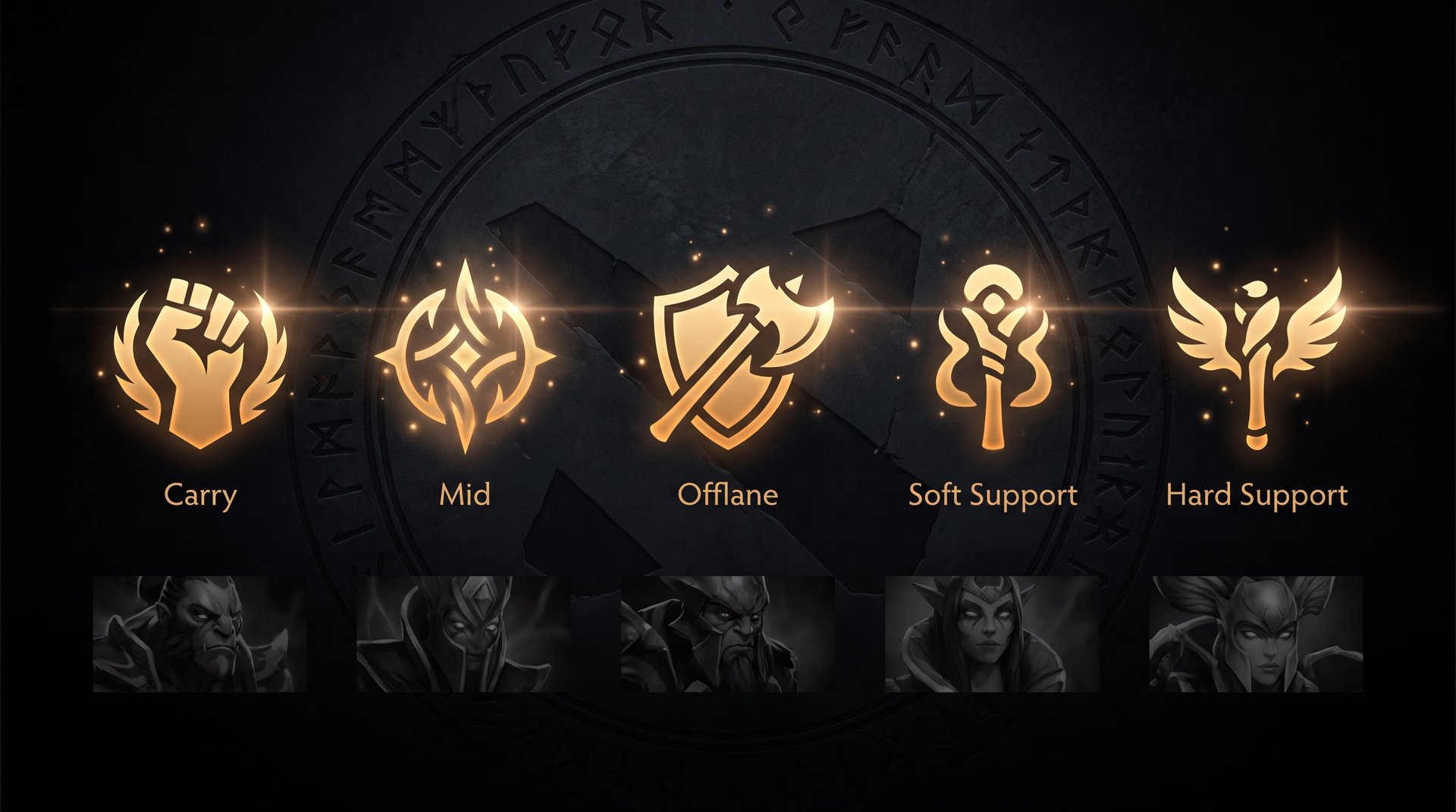
Position 1 — Carry
The carry role has high individual impact once the game reaches the midgame and lategame. A skilled carry who farms efficiently, avoids unnecessary deaths, and itemizes correctly can consistently swing game outcomes. However, carries are also the most farm-dependent role, meaning a bad early game or a disruptive lane can completely cut off your impact window.
At lower brackets (Herald through Archon), a skilled carry who can consistently get their core item timings regardless of lane results will outperform. At higher brackets (Ancient through Divine), the game is decided at earlier points and carries need to have a more proactive impact in the midgame rather than waiting for a clean 35-minute power spike.
Community estimate: Position 1 players in their correct bracket tend to see winrates cluster around 49-54%. A carry player with 55%+ at their bracket is farming efficiently and making good use of their item timings.
Position 2 — Midlane
Mid is frequently cited as the role with the highest individual carry potential in the current patch. The midlane hero controls map tempo from early levels, can rotate to influence both sidelanes, and — in the current 7.41d meta — tends to come online earlier than position 1 cores in many drafts.
A skilled midlane player who understands lane matchups, hits rotations at the right windows, and picks heroes that can solo-win games from the mid position can see sustained winrates above 55% even at high brackets. Players who identify their best mid hero pool and stick to it in solo queue tend to see the best results from this position.
Community estimate: Strong mid players often see winrates 1-3 percentage points above their equivalent skill-level carry player, particularly in lower and mid brackets where individual snowballing is easier.
Position 3 — Offlane
The offlane is the most team-dependent of the three core roles. An offlaner’s job is to absorb pressure in a difficult lane, create space for the carry, initiate fights, and provide frontline presence. How well you can execute this job depends heavily on your supports rotating at the right time and your carry taking advantage of the space you create.
This means that even highly skilled offlaners often see lower winrates than their equivalent carry or mid player, not because they are playing badly but because their contribution is harder for the matchmaking to isolate. A 52-54% winrate at your bracket as a committed offlaner is a very strong result.
Position 4 — Soft Support
Position 4 is a highly active role that requires strong map reading, vision control, and the ability to create picks and rotations throughout all three stages of the game. A skilled pos4 player makes enormous contributions that are invisible to the winrate column — wards that prevent ganks, smokes that create kills, rotations that save allies or kill enemies.
Because position 4 impact depends on coordinating with multiple teammates, winrate fluctuates more based on team composition and communication level. Solo queue pos4 winrates tend to be lower than coordinated party queue results. Community estimates suggest 50-54% at bracket as a reasonable range for a skilled soft support player.
Position 5 — Hard Support
Hard support has the lowest individual game impact of any role, by design. Your job is to enable your carry in lane, provide vision, offer utility in fights, and set up your cores to win. The outcome is heavily dependent on whether your carry and mid actually capitalize on what you provide.
This means that even elite pos5 players in solo queue often see lower winrates than their counterparts in other roles — not because they are worse players but because the role compounds team dependency. A skilled hard support with 51-53% winrate in solo queue is performing well. Getting significantly above 55% as a solo queue pos5 over a large sample suggests either exceptional game reading or a hero pool that has outsized individual carry potential (heroes like Treant Protector or Witch Doctor who can solo-win fights).
If you are a support player struggling to see your winrate climb despite strong individual game awareness, consider reviewing your performance through the lens of lane dominance and fight impact rather than overall outcome. You can also look at whether Dota 2 coaching makes more sense for your situation than raw MMR gain.
| Role | Position | Est. Winrate Range at Bracket | Primary Winrate Driver |
|---|---|---|---|
| Carry | Pos 1 | 49-54% | Farm efficiency and item timing |
| Midlane | Pos 2 | 50-55% | Lane dominance and rotation windows |
| Offlane | Pos 3 | 48-53% | Initiation quality and space creation |
| Soft Support | Pos 4 | 49-53% | Vision coverage and pick setups |
| Hard Support | Pos 5 | 48-52% | Lane enablement and fight utility |
All role winrate ranges in this table are community estimates. Actual winrates vary by bracket, hero pool, and solo vs. party queue context.
Hero Winrate vs Overall Winrate
Your overall winrate and your winrate on any given hero are two different metrics that tell different stories.
Overall winrate averages across every hero, every role, and every match condition. It is a broad signal of how well you perform in your bracket as a whole. Hero-specific winrate, on the other hand, tells you how well your hero choice interacts with your current skill level, the patch meta, and the matchups you face.
It is entirely possible to have a 52% overall winrate while having a 60%+ winrate on two or three specific heroes. The reverse is also common — players who pick a wide variety of heroes often have their overall winrate dragged down by heroes they have not put in enough games to understand properly.
What to Look For in Your Hero Winrates
- High winrate on low game count heroes (under 20 games): Not meaningful. Small samples are dominated by variance.
- Low winrate on high game count heroes (over 50 games): That hero may not match your playstyle, or you have a consistent mistake pattern with it worth reviewing.
- High winrate on mid-to-high game count heroes (30-100+ games): These are your “best heroes” — the ones where your mechanics and mental model align most closely with what the hero needs.
The practical implication: if you want your winrate to improve, identify the 2-3 heroes where you have the best results over 30+ games and make them your primary pool. Playing off-meta heroes or heroes you are learning in ranked is one of the fastest ways to artificially deflate your overall winrate.
Meta Winrate vs Pub Winrate
Hero winrates on Dotabuff and Stratz reflect millions of games across all skill brackets. A hero with a 52% winrate on Dotabuff is performing well in aggregate. But that number includes Herald players and Immortal players together.
When you filter by bracket — available on both platforms — the same hero might show a 48% winrate at Archon and a 56% winrate at Ancient. Complexity-heavy heroes like Invoker, Earth Spirit, and Meepo tend to have lower winrates at lower brackets and higher winrates at higher brackets, simply because they reward mastery more than simpler heroes do.
Choosing heroes with strong winrates at your specific bracket — rather than heroes that are dominant in professional play or in the Immortal bracket — is a consistently undervalued strategy for climbing. Check how to track your own stats weekly to spot which heroes are genuinely working for you.
Sample Size: Why Short-Term Stats Lie
This is the most important section for players who obsess over their winrate on a daily or weekly basis.
Over 10 games, variance can swing your winrate from 30% to 70% without your skill changing at all. Over 50 games, the noise is still significant. Over 100 games, meaningful signal starts to emerge. Over 300+ games, your winrate is a reliable indicator of your true performance relative to your bracket.
This has several practical implications:
Do Not Chase Short-Term Winrate
If you played 10 games today and went 4-6, your winrate dropped and you feel like you are playing badly. You might be — or you might have hit a sequence of unlucky matches, lopsided drafts, or disconnects. Over 10 games, you simply cannot know.
The players who improve fastest are the ones who track their winrate in 100-game blocks, not day-to-day. A rough week followed by a strong week is normal variance, not a signal that anything fundamental has changed.
The 100-Game Rule
The community standard, backed by statistical reasoning, is that you need at least 100 ranked games at a rank before you can make strong claims about your winrate there. Below 100 games, the margin of error is large enough that a 54% winrate and a 50% winrate are practically indistinguishable.
When someone on Reddit claims they have a 70% winrate, the first question should always be: over how many games? Forty games at 70% is a hot streak. Four hundred games at 70% would be one of the highest sustained winrates on the entire platform — essentially unheard of outside of calibration windows.
Calibration Games vs Established Winrate
The first calibration games after a seasonal reset or a fresh account tend to produce volatile winrates because the Glicko uncertainty for your MMR estimate is high. The system is making large adjustments per game while it figures out where to place you.
Once calibration settles — typically after 10-30 games depending on your history — the winrate you build over the next 100-300 games is your actual signal. Do not read too much into your calibration sequence either way.
How to Actually Improve Your Winrate
Checking your winrate does not improve it. Here are the methods that consistently produce real results.
1. Narrow Your Hero Pool
Pick 2-3 heroes per role, ideally 2-3 heroes that cover different draft scenarios (a safe pick, a comfort pick, and a counter-pick option). Practice these heroes extensively. Stop picking heroes because they are strong in the current meta if you do not have the reps on them to perform above average.
2. Review Your Own Replays — Not Just Deaths
Most players review their biggest deaths and worst moments. The more useful exercise is reviewing 2-3 minutes around a key lost fight and asking: what decision led to this outcome 3-4 minutes earlier? Most fight losses in sub-Immortal Dota are decided by positioning or timing errors several minutes before the fight happens, not during it.
For a structured process, look at our MMR diagnostic guide which walks through identifying the exact leaks in your game that are costing wins.
3. Stop Queuing After Two Consecutive Losses
This is simple but underappreciated. Tilt is real, and its effect on decision-making is measurable. If you play two games and lose both, your mental state is compromised relative to when you started. The expected value of continuing to queue while tilted is negative in the long run. Stop, do something else for an hour, and come back.
4. Focus on One Metric Per Week
Pick one thing to improve — your ward coverage, your last hit count at 10 minutes, your timing on a specific item, your death count per game — and track it explicitly for a week. Players who try to improve everything at once end up improving nothing. Micro-focused improvement over time compounds into macro change.
5. Use Professional Coaching for Faster Gains
Self-review catches some mistakes. A coach who plays at Divine or Immortal sees the mistakes you do not know you are making. The fastest bracket climbs typically involve at least a few sessions with a coach who specializes in your role, reviewing your replays live and pointing out the specific decision patterns that are costing you games.
TeamSmurf offers professional Dota 2 coaching from verified high-MMR players. If you are stuck in a bracket and your winrate has been flat for weeks despite grinding, a coaching session or a targeted MMR boost can break the cycle faster than continued solo grinding. You can also check our full guide to the best Dota 2 boosting services to understand what options exist and how to evaluate them.
Stuck at the Same MMR? Let Us Fix That.
TeamSmurf is a Dota 2-only service with verified high-MMR boosters and coaches. Whether you need a targeted MMR boost to escape a frustrating bracket or professional coaching to fix the habits holding you back, we have options for every situation.