

TP Scrolls in Dota 2: Cooldown, Channel Time, Tower TPs and When to Carry Two

The Town Portal Scroll is the single most important consumable in Dota 2, and also one of the most misunderstood. Players argue about whether the cooldown is shared, miscalculate when a second TP is worth carrying, and constantly get caught out by interrupts they did not see coming. This guide covers every TP scroll mechanic that matters in the current patch — exact numbers, verified for 7.41f.
Whether you are deciding between a second TP and an extra ward, wondering how Boots of Travel changes your rotation game, or trying to understand why your BKB did not save your channel, you will find the answers here.
What’s In This Guide
TP Scroll Cooldown: 65 Seconds Per Hero, Not Shared
The TP scroll cooldown is 65 seconds, and it is tracked individually for each hero. This is the single most important fact to understand about the item — the cooldown is not a team resource and it is not shared. If your support uses a TP, your carry’s TP is on a completely separate timer.
This matters in practice because it means every player on your team can teleport simultaneously if their individual cooldowns allow it. A five-man base defense where all five heroes arrive within 3 seconds of each other is mechanically possible and happens regularly in high-level play. It also means that when you see your support teleport to top lane, you cannot assume your own TP is on cooldown — it is not.
What “Individual Cooldown” Means for Your Build
Because the cooldown is per hero, buying a second TP scroll gives you a genuine backup — not a second charge of the same cooldown, but a genuinely separate item with its own 65-second timer. When you use your active TP, the used scroll is consumed. Your second scroll immediately becomes the active TP in your inventory, with zero cooldown. You can TP again the moment your channel finishes.
This is different from items that have charges on a shared cooldown. TP scrolls work more like two separate items stacked in one slot — the moment you use one, the next is ready.
| Item | Cooldown | Channel Time | Cost | Can Target Heroes |
|---|---|---|---|---|
| TP Scroll | 65 seconds | 3 seconds | 90 gold | No |
| Boots of Travel 1 | 40 seconds | 3 seconds | 2,500 gold | No |
| Boots of Travel 2 | 40 seconds | 3 seconds | 3,300 gold (total) | Yes (allied heroes) |
Note: values verified for patch 7.41f. The TP scroll cost was raised from 50 gold to 90 gold in patch 7.34d and has remained at 90 gold through 7.41f.
Cooldown Visibility and Communication
Your TP cooldown is visible to your teammates in the HUD — the TP scroll icon in the upper right panel shows which heroes have a TP available and which are on cooldown. This is the same information that experienced players use when deciding whether to smoke-gank or defend a tower. Learning to read your team’s TP availability is a core part of improving your map awareness — it tells you which teammates can realistically join a fight and which cannot.
In coordinated play, communicating your TP cooldown to your team is as important as calling your ultimate cooldown. “I have TP” tells your team they have a response available. “No TP, 30 seconds” tells them they are on their own until that timer is up.
Channel Time: What the 3-Second Rule Means in Practice
The TP scroll has a 3-second channel time. You must stand still and complete this full 3-second animation before teleportation occurs. Any interruption during those 3 seconds cancels the teleport and puts the scroll on its full 65-second cooldown.
Three seconds is both shorter and longer than most players feel it is. In a teamfight, 3 seconds is an eternity — you will almost certainly be hit. In a quiet moment backing from a jungle camp, 3 seconds feels instant. Understanding when 3 seconds is achievable versus when it is a death sentence is the skill gap between players who TP correctly and players who die while channeling.
What Interrupts a TP Channel
A TP channel is interrupted by any of the following:
- Taking damage from enemy spells or abilities — this is the most common interrupt. A single point of magical, physical, or pure damage from an enemy ability cancels the channel.
- Being affected by a disable (stun, hex, silence, root) — any crowd control applied by an enemy hero interrupts the channel immediately.
- Moving — issuing a move command (accidentally clicking the map, right-clicking a target) cancels the channel.
- Casting a spell or using an active item — using any ability or active item during the channel cancels it. This includes items like Force Staff (when it activates on yourself) and Blink Dagger.
- Dying — the channel stops if your hero dies, and the scroll is not consumed.
The key distinction is enemy damage and effects. Friendly effects do not interrupt the channel. A teammate casting Urn of Shadows on you, or a friendly Ogre Magi multicasting Bloodlust on you, will not cancel your TP.
| Interrupt Type | Cancels TP? | Consumes Scroll? |
|---|---|---|
| Enemy spell damage (any amount) | Yes | Yes |
| Enemy stun or hex | Yes | Yes |
| Enemy silence | Yes | Yes |
| Physical attack from enemy | Yes (deals damage) | Yes |
| Move command issued | Yes | Yes |
| Active item / spell cast | Yes | Yes |
| Friendly spell or heal | No | No |
| Hero dies mid-channel | Yes | No (scroll survives) |
When the scroll is consumed on interruption, you lose both the TP and the 90 gold. This is why watching for incoming projectiles and abilities before committing to the channel is a critical skill. Players who TP from dangerous positions — inside an enemy vision range, near heroes who have not used their gap-closers — are giving away 90 gold along with every failed channel.
Interrupts and Physical Attacks
Physical attacks from enemy heroes interrupt the TP because they deal damage. This is worth calling out explicitly because some players believe “damage immunity” items protect the channel. They do so only partially — see the BKB section below. A hero who is magic immune but standing in attack range of a physical carry will still have their TP interrupted the moment that carry lands a hit.

The Tower Defense TP Bonus: It Was Real, It Was Removed
For several years, Dota 2 had a mechanic where teleporting to a friendly tower that was under attack by enemy heroes within a certain range would reduce the channel time from 3 seconds to 2 seconds. This was called the “tower defense” TP bonus and it was designed to reward players who responded to tower dives quickly.
This mechanic no longer exists in patch 7.41f. Channel time is uniformly 3 seconds regardless of whether the destination tower is being attacked, how many enemies are nearby, or how low the tower’s health is. If you have seen old guides reference a 2-second tower TP, those guides are outdated. Plan for 3 seconds every time.
The removal of this mechanic changed how tower defenses work at high levels. Previously, a defender could TP into a tower siege with a meaningful timing advantage. Now the attacker and the defender both know the arriving hero needs exactly 3 clear seconds to land. This puts more emphasis on positioning before the channel, timing the TP start around the enemy’s available crowd control, and using smoke to close distance before a vulnerable tower is even targeted.
Boots of Travel vs TP Scroll: When the Upgrade Pays Off
Boots of Travel is a direct upgrade to the TP scroll that replaces your boots slot and adds a built-in teleport active. The key differences are the cooldown, the slot efficiency, and the late-game upgrade to hero targeting.
Cooldown Advantage: 40 Seconds vs 65 Seconds
Boots of Travel has a 40-second cooldown compared to the TP scroll’s 65 seconds. That is 25 seconds faster — more than a third of the TP scroll’s cooldown. In a game where fights and tower attacks can happen every few minutes, this difference compounds significantly. A carry with Boots of Travel can TP to defend top, return to farming a jungle camp, and have their boots TP ready again before a TP scroll user would.
For heroes who teleport frequently — any carry who needs to farm multiple parts of the map, supports who rotate constantly, and split-pushers — this cooldown reduction is genuinely impactful rather than a theoretical advantage.
Slot Efficiency
The most significant practical advantage of Boots of Travel over carrying two TP scrolls is the slot efficiency. Boots of Travel frees up one item slot because the teleport active is built into the boots. A hero carrying two TP scrolls is using two inventory slots on 180 gold worth of consumables. That same two-slot space with Boots of Travel holds a 2,500 gold item plus a free slot for anything else.
For carries who are already slot-constrained by their core items — a six-item carry spending late game with no free slots — Boots of Travel is almost always the right call. It lets you TP without surrendering an item slot to the consumable.
Boots of Travel 2: Teleporting to Allied Heroes
The level 2 upgrade (an additional 800 gold at the recipe) allows Boots of Travel to target allied heroes in addition to buildings. This is the ability that makes specific heroes — notably Nature’s Prophet, Anti-Mage, and carry players who want to join a fight from across the map — choose Boots of Travel 2 as a core item rather than a luxury.
The hero-targeting TP has the same 3-second channel time and 40-second cooldown as Boots of Travel 1. What it adds is the ability to teleport to a support who is already in position for a fight, or to a hero who has just smoked for a gank but needs backup, without requiring an existing building nearby.
| Comparison Point | TP Scroll x2 | Boots of Travel 1 | Boots of Travel 2 |
|---|---|---|---|
| Total gold cost | 180 gold | 2,500 gold | 3,300 gold |
| Inventory slots used | 2 slots | 0 extra slots (replaces boots) | 0 extra slots |
| Cooldown between TPs | 65 seconds | 40 seconds | 40 seconds |
| Can target allied heroes | No | No | Yes |
| Provides movement speed | No | Yes (+75 MS) | Yes (+75 MS) |
| Best phase | Early-mid game | Mid-late game | Late game |
When to Buy Boots of Travel
Boots of Travel becomes a strong purchase when you are farming multiple jungle camps or lanes per spawn cycle — situations where the 40-second cooldown lets you make a rotation, return, and TP again before a TP scroll user could. For most carries, this happens in the 25-35 minute range when the map is open and farm routes span multiple quadrants.
For supports, Boots of Travel 1 is a niche purchase unless your hero specifically benefits from frequent rotations (Tinker support used to run this; current meta pos 4 and 5 supports generally prefer Tranquil Boots plus a TP scroll). Check whether the cooldown advantage is worth the 2,500 gold investment at your current net worth before buying.
Understanding how TP rotations work is central to improving your overall game sense — players who climb ranks efficiently learn to see the map as a set of interconnected response points rather than individual lanes.
When to Carry Two TP Scrolls
Carrying two TP scrolls costs 180 gold and two inventory slots. That is a real cost. The benefit is having a backup TP available the moment you use your first one — meaning you can TP again within seconds rather than waiting 65 seconds. Here are the five situations where two TPs are worth the slot and gold investment.
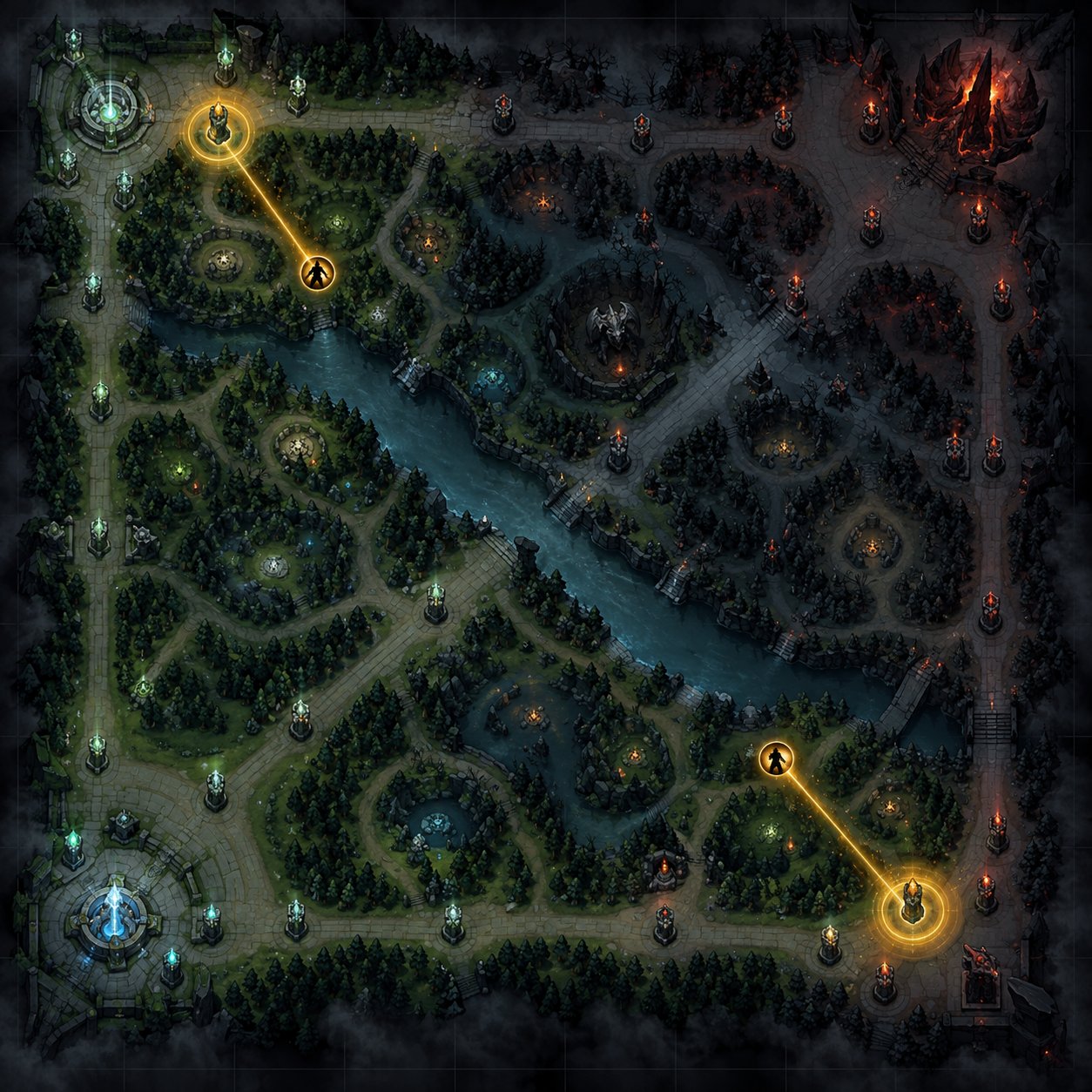
1. High Ward Pressure Situations
When the enemy team has aggressive sentries and detection deep in your jungle, your rotations become more dangerous. A TP that gets interrupted by an enemy hero who spotted you channeling wastes your scroll and puts you on cooldown. Carrying a second TP means an interrupt does not leave you stranded — you have a backup ready to channel from a safer position 10 seconds later.
Ward pressure situations are common in mid-to-late game when enemies are spending on vision to set up pickoffs. If you see enemies buying multiple detection items and pushing wards deep, carrying a second TP is a reasonable hedge against getting caught during a channel.
2. Split-Push Defense
Split-push defense is the situation where carrying two TPs has the clearest value. An enemy Nature’s Prophet or Anti-Mage is pushing one side of the map while the enemy team sieges another. You TP to defend one lane, spend time there, and immediately TP to the other threat. With one TP on a 65-second cooldown, you cannot do both — you defend one and sacrifice the other. With two TPs, you can chain the responses.
This is not hypothetical — it is the exact scenario that makes the “buy two TPs” advice relevant. Any time the enemy team has a split-push hero who you expect to be active simultaneously with the main push, having a second TP on standby is proactive rather than reactive. See the guide on how split-push heroes are used in the current patch for context on which heroes create this pressure.
3. Fighting Across the Map
When fights are happening on both sides of the map at the same time — a common late-game situation where your team is pressuring Dire’s base while Radiant’s top barracks is being pushed — the ability to respond and then re-respond is critical. One TP gets you to the fight. The second TP gets you out of trouble or to the next fight immediately after.
High-MMR cores who need to be relevant in multiple places simultaneously — carries in the 50-60 minute mark where the game can end in any lane — frequently hold a second TP specifically for this reason.
4. After a Risky Buyback
If you buy back after dying in a critical situation, you are in base with full gold spent and your TP on whatever cooldown it was on before you died. If your TP was recently used and is still on cooldown, you have no way to rejoin the fight without walking. Buying a second TP before you died specifically handles this scenario — the backup is available even if the primary cooldown has not reset.
This is a case where the buyback math guide intersects with TP management. One of the most costly mistakes players make is buying back with 2,500 gold but having no TP to rejoin the fight — the buyback becomes wasted gold. A spare TP in your inventory before the critical fight specifically prevents this outcome.
5. Heroes Who TP Frequently by Design
Some heroes are designed around frequent teleportation and benefit disproportionately from having a backup TP available before Boots of Travel is affordable:
- Tinker — Rearm refreshes item cooldowns, which means Tinker can reset his own TP cooldown with his ultimate. Tinker players commonly carry multiple scrolls to fuel this cycle in the early and mid game before Boots of Travel is online.
- Nature’s Prophet — Teleportation is Nature’s Prophet’s core mechanic and he uses TPs constantly to teleport around the map alongside his Sprout-TP combo. A second scroll is standard on Prophet builds before Boots of Travel.
- Alchemist — Chemical Rage increases movement speed dramatically but does not replace the need for TPs. During the period before Boots of Travel is purchased, Alchemist frequently carries two TPs to fuel his early global presence.
TP Rotations: Using Your Scroll for Map Control
The TP scroll is not just a defensive item. Used aggressively, it is the mechanism that lets you be in two places at once and creates the illusion of having more heroes than you do. Understanding TP rotations is central to climbing in any bracket — see how professional coaching improves map decision-making for how this skill is taught at higher levels.
The “Free Rotation” Principle
A rotation is only “free” if it does not cost you more than you gain. A carry who TPs to defend a tier 1 tower that is going to fall anyway loses farm and tempo. The same carry who TPs to punish an enemy who dove too deep or to secure a kill on a key support creates positive value.
The calculation before every TP is: what am I giving up (farm, time, potential to die during channel) versus what does my team gain (tower defended, kill secured, fight won). In most brackets below Ancient, players are not making this calculation at all — they either never TP or always TP, and both extremes lose them games.
Timing Your Channel to Avoid Interrupts
The single highest-leverage mechanical skill in TP usage is choosing when to start the channel. A hero who channels TP in a safe position — behind a tree, out of vision, just after an enemy used their interrupt ability — will complete almost every channel. A hero who channels in the open, within range of an enemy carry’s attack, or immediately after seeing an enemy blink-initiation hero will be interrupted constantly.
Practical pre-channel checklist:
- Are there enemy heroes on the minimap who could reach you in 3 seconds?
- Have those heroes used their interrupt abilities (storm hammer, stun, etc.) recently?
- Is there a tree, hill, or building blocking line of sight to enemy ranged heroes?
- Has your team confirmed the enemy team is occupied elsewhere?
If you can answer yes to conditions 3 and 4 — or confirm that condition 2 applies — your channel is likely safe. If none of these apply and you are in an open field with three enemies near you, do not press TP. Walk to safety first.
Counter-Initiation TPs
Counter-initiation is one of the strongest TP uses in the game. An enemy team smokes and initiates on one of your teammates. Your teammate lives (or buys time with items). You TP to the fight, arrive at the 3-second mark, and your team has the numbers advantage because the enemy team burned their cooldowns on the initiation. A well-timed counter-initiation TP effectively punishes the enemy for committing to a fight.
This works best when your team has a hero who can stall for 3 seconds after being jumped — heroes with escape abilities, strong defensive items (Linken’s, Eul’s), or reliable disables. The TP becomes a trap: “attack us in our jungle and our carry arrives in 3 seconds.”
Advanced TP Mechanics Worth Knowing
Canceling Your Own TP
You can cancel your own TP channel by issuing a move command during the animation. The scroll is consumed and goes on cooldown. There is no mechanic that refunds the scroll or resets the cooldown on a voluntary cancel — every cancel costs you the 90 gold and the 65-second timer. The only reason to cancel voluntarily is if your destination becomes invalid (the tower you were TPing to was destroyed mid-channel) or if you realize the situation has changed and the TP is no longer beneficial. In either case, you are accepting the cost.
Destination Validity: The Tower Must Exist
You cannot TP to a location where a friendly structure no longer exists. If you click a tower that dies before your 3-second channel completes, the TP is canceled and the scroll is consumed. This is a critical timing issue in base sieges — do not channel a TP to a tower that is below 10% health while the enemy team is actively attacking it. You will arrive to nothing and waste your scroll.
The same applies to barracks: if you TP to a barracks that dies mid-channel, the channel fails. When a base is actively being destroyed, TP to the fountain instead — it is guaranteed to exist unless the game is already over.
Multiple Heroes TPing to the Same Tower
Multiple heroes can TP to the same tower simultaneously. They each arrive at the same location, stacked on top of each other. There is no restriction on how many heroes can share a TP destination. This means a well-coordinated five-man TP defense — all heroes channeling at the same time to the same threatened tier 2 tower — is mechanically valid and lands all heroes at once 3 seconds later.
The risk of this is that the arriving heroes are all stacked in one place, which creates an ideal target for an enemy AOE ultimate like Echo Slam or Midnight Pulse. Defenders who know this spread out immediately after arriving. Attackers who see multiple TP channels starting should consider abandoning the tower attack and preparing for the arrival instead of fighting five sequential 1v1 battles.
TP and Aegis Interaction
If you die while channeling a TP and you have an Aegis of the Immortal, you respawn at the location where you died, not at the destination. The TP channel is canceled and the scroll is consumed. Aegis and TP are independent — Aegis handles death and respawn, TP handles teleportation, and a cancelled channel due to death triggers only the Aegis respawn mechanic.
Defensive Items That Protect the Channel
Several items interact with TP channels in ways that are worth understanding:
- Linken’s Sphere — blocks a single targeted spell. An enemy using a targeted stun on you while you channel will trigger Linken’s and save the channel — if the stun was targeted and Linken’s has not been used recently. Linken’s does not block AOE spells.
- Lotus Orb — reflects a targeted spell back at the caster. If an enemy uses a targeted stun on you during a TP channel, Lotus Orb reflects it, and you continue channeling (assuming no other interrupt lands). The reflection stuns the caster.
- Ghost Scepter — activating Ghost Scepter makes you ethereal and immune to physical attacks. This protects your TP channel from physical attack interrupts. You remain vulnerable to spell damage. Ghost Scepter can be activated without canceling the TP channel if done carefully.
Knowing which defensive item blocks which type of interrupt is the difference between a skilled TP and a dead hero. If your lane is being harassed by a ranged physical carry, Ghost Scepter is a better TP protector than anything else. If you are being targeted by single-target stun heroes, Linken’s or Lotus Orb handles that category better. Check our guide on defensive items by role for a full breakdown of what each item protects against.
For players who want to climb faster while developing these mechanics through actual high-level games, our Dota 2 coaching and boosting service connects you with players who apply these systems every game.
Frequently Asked Questions About TP Scrolls in Dota 2
Master Map Rotations With a Professional Coach
TP mechanics are easy to read about. Applying them in real games under pressure — knowing when the 3 seconds is achievable, when to carry two, when to buy Boots of Travel — is where coaching accelerates your climb. TeamSmurf coaches specialize in Dota 2 and nothing else.



