TI 2026 Group Stage Odds: Our Monte Carlo Results

We built our own Monte Carlo simulation of TI 2026’s Swiss group stage — from scratch, using real verified match data from six major 2026 LANs. Not a copy of anyone else’s model. Our numbers, our methodology, fully documented here.
Below you will find the full odds table for all 16 qualified teams, four data visualizations, an honest methodology breakdown including which teams we had to flag as low-confidence, and a direct comparison against our TI 2026 predictions guide pillar picks.
The simulation ran 100,000 times with a fixed random seed. Every input match result is sourced from Liquipedia and documented in the methodology section.
What’s in This Article
The TI 2026 Swiss Group Stage Format
The International 2026 group stage runs August 13-16 in an online Swiss bracket. All 16 qualified teams compete across multiple rounds of best-of-3 series. The format works like this:
- All matches are Bo3. No Bo1 group stage rounds — every series is a full best-of-three.
- Swiss pairing: teams with the same win-loss record play each other each round. A 2-1 team faces another 2-1 team where possible.
- Top 3 teams advance directly to the main event playoff bracket (Aug 20-23 in Shanghai).
- Teams finishing 4th through 13th play an elimination round. The top 5 records from that group advance; the bottom 5 are eliminated.
- Teams finishing 14th, 15th, or 16th are eliminated directly from the group stage without a second chance.
This structure means the group stage has three distinct outcomes: direct qualification to Shanghai, a second chance via the elimination round, or going home early. Our simulation models all three probabilities for every team.
A key strategic implication: the elimination round pairs the better-record teams (roughly 3-2 Swiss record) against the worse-record teams (2-3). A team at the 3-2 borderline has an advantage in that bracket — and our model accounts for this when calculating each team’s overall main event probability.
The official format was confirmed via Valve’s announcement and corroborated against the TI group stage seeding research we published on TeamSmurf earlier this summer.
How We Built the Model
The Data: 148 Verified Series from Five 2026 LANs
Every match result in our model comes from Liquipedia, verified by hand. We collected series-level results (not individual game scores) from the following events:
| Event | Dates | Format | Series Used |
|---|---|---|---|
| BLAST SLAM VI | Feb 3-15, 2026 | Group stage Bo1 + Playoffs Bo3/Bo5 | 30 |
| DreamLeague Season 28 | Feb 16 – Mar 1, 2026 | Group stage Bo2 + Playoffs Bo3 | 40 |
| ESL One Birmingham 2026 | Mar 22-29, 2026 | Group stage Bo2 + Playoffs Bo3/Bo5 | 28 |
| BLAST SLAM VII | Jun 4-7, 2026 | LCQ + Playoffs Bo3/Bo5 | 11 |
| EWC 2026 | Jul 7-19, 2026 | Survival format Bo3 + Playoffs Bo3/Bo5 | 27 |
| 1win Essence II (partial) | Jul 30 – Aug 1, 2026 | Group stage Bo2 | 12 |
148 total series. We filtered to only matches involving at least one TI 2026 qualified team. Matches between two non-TI teams were excluded. The 1win Essence II data covers only completed rounds through August 1 — the event was still in progress at time of publication.
The Elo Model
We used an Elo rating system — the same class of model used in chess ratings and competitive matchmaking. Here is how it works:
- Starting rating: every team begins at 1500.
- K-factors: K=32 for group stage series, K=48 for playoff series (higher K means bigger rating swings for elimination matches where teams are playing to win), K=16 for Bo1 matches (lower K reduces the influence of single-game outcomes which have more variance).
- Bo2 draws: a 1-1 draw (common in DreamLeague and ESL group stages) gives each team 0.5 credit — exactly like a draw in Elo chess ratings.
- Win probability formula: P(team A wins a Bo3) = p^2 * (3 – 2p), where p is the per-game win probability derived from the Elo rating difference. This is the standard formula for best-of-three under independent game probabilities.
- Chronological training: we processed match results in date order — BLAST SLAM VI first, then DreamLeague S28, ESL Birmingham, BLAST SLAM VII, EWC 2026, 1win Essence II. Earlier results have less influence on final ratings than more recent results, because later events update ratings on top of earlier ones.
The Swiss Simulation
We simulated the TI 2026 group stage 100,000 times using a fixed random seed (42) for full reproducibility. Each simulation run:
- Randomly pairs teams within the same win-loss record bracket each round.
- Uses the Elo-derived Bo3 win probability to determine each match outcome.
- Tracks win-loss records until teams reach qualification thresholds.
- Runs a separate elimination round simulation for the 4th-13th placed teams, pairing better-record teams against worse-record teams.
The final probabilities are the fraction of 100,000 simulations in which each outcome occurred. With 100k runs, sampling error is below 0.5 percentage points for all teams.
Low-Confidence Teams
Two of the 16 TI 2026 qualified teams have zero verified series against other TI-level opponents in our 2026 dataset:
- HULIGANI (previously L1GA TEAM): no major LAN appearances in 2026 against TI-qualified opponents. Assigned default Elo of 1500.
- Team Resilience: formed in April 2026, no major LAN results against TI-caliber teams before our cutoff. Assigned default Elo of 1500.
For these teams, our simulation is essentially guessing: at 1500 Elo they are treated as exactly average, which is probably not accurate in either direction. Treat their probabilities as a flat prior, not a prediction. All charts and tables flag these teams with an asterisk.
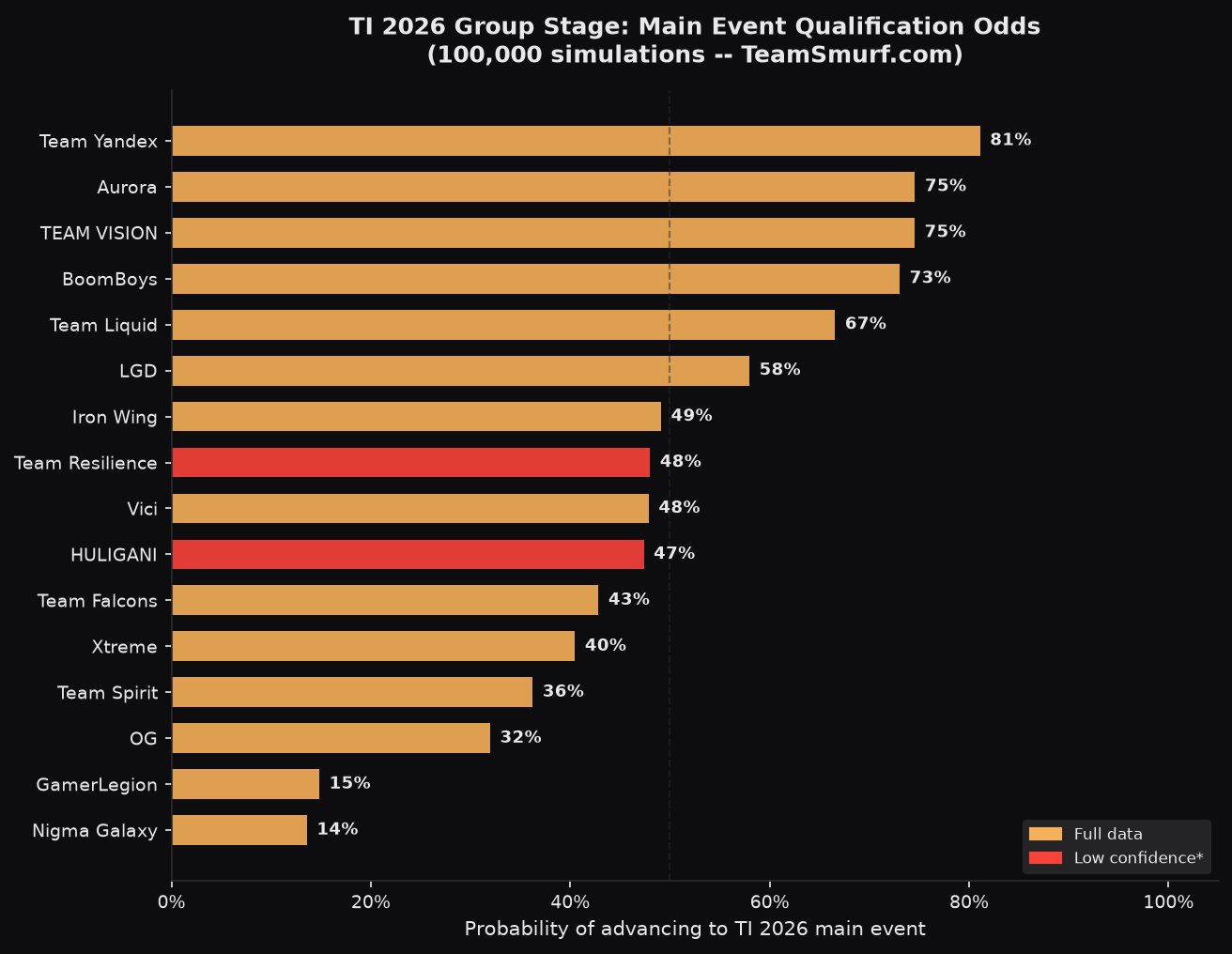
Full Results Table — All 16 Teams
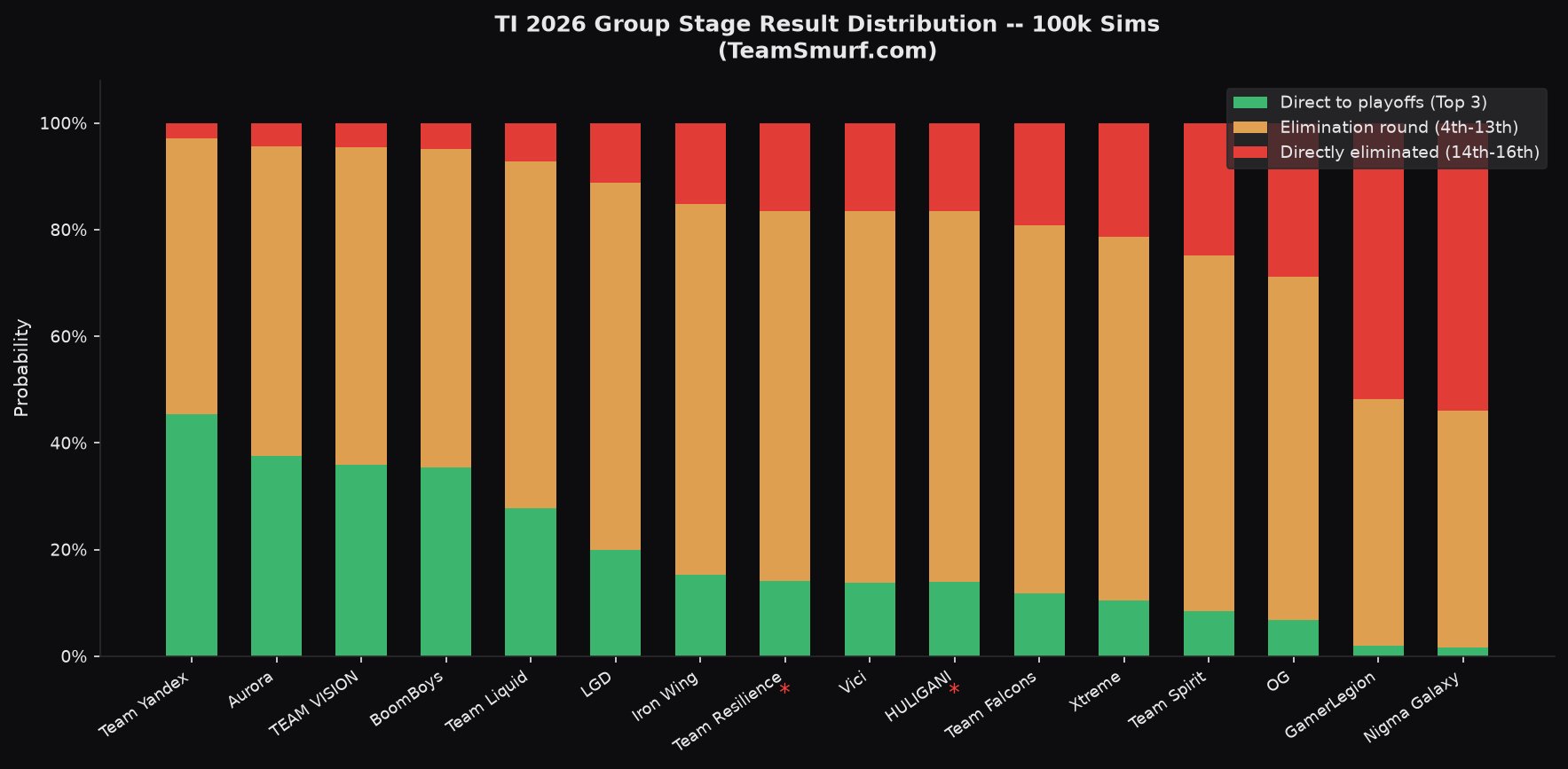
The table below shows our simulation results for all 16 TI 2026 qualified teams. Teams are ranked by P(main event) — the probability of reaching the main event (top 3 direct qualification plus advancing through the elimination round).
“Direct” = probability of finishing in the top 3 of the group stage and qualifying directly. “Elim Rd” = probability of finishing 4th-13th and competing in the elimination round. “Out” = probability of finishing 14th-16th and being eliminated directly. “4-0” = probability of going undefeated through the group stage. Asterisk (*) indicates low-confidence team.
| Team | Main Event | Direct Top 3 | Elim Round | Group Out | 4-0 | Elo |
|---|---|---|---|---|---|---|
| Team Yandex | 81.1% | 45.4% | 51.8% | 2.8% | 18.2% | 1592 |
| Aurora Gaming | 74.6% | 37.6% | 58.0% | 4.3% | 13.9% | 1573 |
| TEAM VISION | 74.5% | 35.8% | 59.5% | 4.6% | 13.0% | 1570 |
| BoomBoys | 73.0% | 35.3% | 59.8% | 4.9% | 12.7% | 1568 |
| Team Liquid | 66.6% | 27.8% | 65.0% | 7.3% | 9.3% | 1547 |
| LGD Gaming | 58.0% | 19.9% | 68.8% | 11.2% | 6.2% | 1524 |
| Iron Wing | 49.1% | 15.2% | 69.6% | 15.2% | 4.2% | 1505 |
| Vici Gaming | 47.9% | 13.8% | 69.6% | 16.6% | 3.9% | 1500 |
| HULIGANI * | 47.4% | 13.9% | 69.6% | 16.5% | 3.9% | 1500 |
| Team Resilience * | 48.0% | 14.0% | 69.4% | 16.5% | 4.0% | 1500 |
| Team Falcons | 42.8% | 11.8% | 69.0% | 19.2% | 3.3% | 1489 |
| Xtreme Gaming | 40.5% | 10.5% | 68.2% | 21.3% | 2.9% | 1482 |
| Team Spirit | 36.2% | 8.5% | 66.7% | 24.8% | 2.2% | 1472 |
| OG | 32.0% | 6.8% | 64.3% | 28.9% | 1.7% | 1460 |
| GamerLegion | 14.8% | 1.9% | 46.2% | 51.8% | 0.4% | 1402 |
| Nigma Galaxy | 13.6% | 1.7% | 44.3% | 54.0% | 0.4% | 1398 |
* Low confidence: zero Tier 1 series in our 2026 dataset. Assigned default Elo 1500.
The interactive version of this table — where you can select a team and see the full odds card — is available on our TI 2026 Team Odds tool page.
Interactive Team Odds Lookup
Use the tool below to check any individual team’s group stage odds from our simulation. Pick a team from the dropdown to see their main event probability, direct top-3 chance, 4-0 and 0-4 percentages, and their Elo rating from our model.
TI 2026 Group Stage Odds
Select a team to see Monte Carlo simulation results (100,000 runs, real 2026 LAN data).
Get coached for TI patch meta →
TeamSmurf Monte Carlo sim, 100k runs, fixed seed 42. Data: BLAST SLAM VI/VII, DreamLeague S28, ESL One Birmingham 2026, EWC 2026, 1win Essence II. Full methodology
Want a standalone version of this tool? See the TI 2026 Team Odds Calculator page.
Top Contenders Deep Dive
Team Yandex — 81.1% Main Event Probability
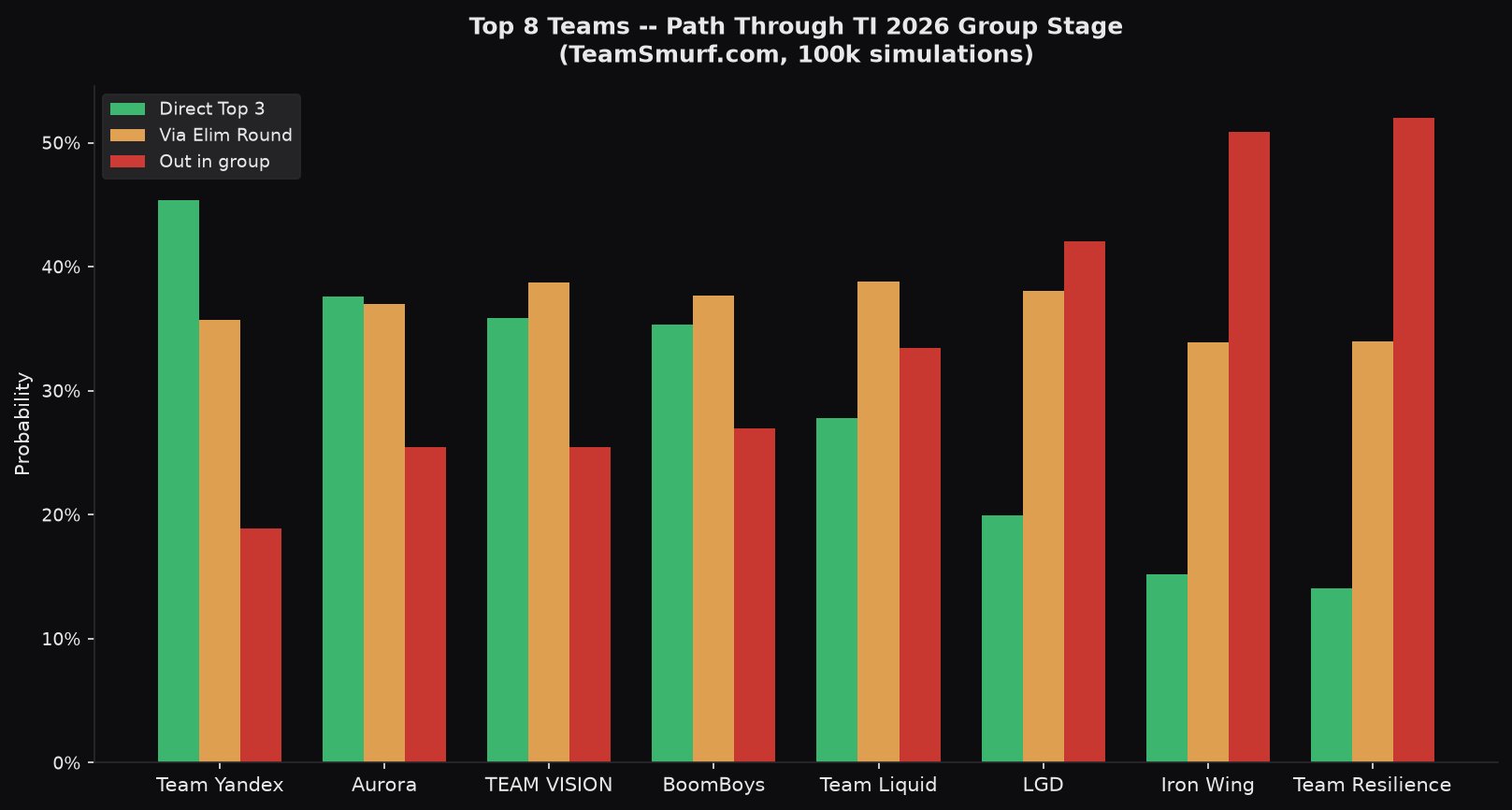
Team Yandex comes out as our simulation’s clear favorite with an 81.1% probability of reaching the main event. Their Elo of 1592 is the highest in our dataset, built on 30 verified series against TI-level opponents — the most data points of any team in the model.
What earns them that rating: BLAST SLAM VII championship (beating LGD Gaming 3-1 in the Grand Final), strong EWC performance (semifinal finish, including a 2-0 win over Team Spirit in the quarterfinals), and consistent Bo1 group stage results at BLAST SLAM VI. The model does not reward narrative — it rewards actual wins against the other teams in this field, and Yandex has them.
A 45.4% chance of finishing directly in the top 3 — nearly a coin flip toward skipping the elimination round entirely — speaks to how dominant their Elo gap is. Their 4-0 probability (18.2%) is also the field’s highest, meaning almost one in five simulations ends with Yandex going undefeated through the group.
The caveat: 2026 has been a year of roster shuffles across many regions. Elo models do not capture roster changes after the training window. If Yandex made significant late additions, their real ceiling might be different from what the historical record predicts. That said, based on what played out on LAN, no other team in this field has a comparable verified record.
Aurora Gaming, TEAM VISION, and BoomBoys — The Tier Just Below
Three teams cluster tightly between 73% and 75% main event probability: Aurora Gaming (74.6%), TEAM VISION (74.5%), and BoomBoys (73.0%). Their Elo ratings span just 6 points (1568-1573), meaning our model sees them as essentially equally matched with each other — and each has roughly a one-in-three chance of finishing directly in the top 3 of the group.
TEAM VISION (known on Liquipedia as PARIVISION, the EWC 2026 champions) earned their rating the hard way: winning the Grand Final at EWC against BoomBoys in a 3-1 Bo5 series. Thirteen verified series in our dataset. Their main event probability (74.5%) nearly matches Aurora despite fewer data points because the EWC win carries significant weight — it is the most prestigious event in our training set.
Aurora Gaming at 22 data series and a 1573 Elo has the most robust evidence base of the three. Their DreamLeague S28 group stage run, ESL Birmingham results, and BLAST SLAM VII run (winning the LB Quarterfinals over Team Falcons 2-1) all contributed positive Elo updates. The model trusts their rating.
BoomBoys (formerly BetBoom Team in some event documentation) comes in at 1568 Elo across 19 series. Their EWC run to the Grand Final (losing to TEAM VISION 1-3 in Bo5) is the signal the model weighted most heavily. They also went 2-0 over Nigma Galaxy in EWC quarterfinals and beat Team Falcons 2-0 in the BLAST SLAM VII upper bracket semifinals.
Team Liquid — 66.6% and the Consistency Bonus
Team Liquid is the most data-rich team in our model at 27 series. Their Elo (1547) reflects a team that consistently performs well but rarely dominates — strong DreamLeague runs, BLAST SLAM results, and ESL Birmingham participation. At 66.6% main event probability and 27.8% direct top 3, they are a solid bet for the middle of the pack and above, but not a heavy favorite for the direct seeding spots.
Team Falcons: The Biggest Surprise in Our Simulation
The result that most surprised us: Team Falcons comes out at just 42.8% main event probability — below the 50% mark, meaning our model thinks they are more likely to miss the main event than reach it. They are ranked 11th of 16 in our simulation. GosuGamers had them ranked #4 globally heading into TI 2026.
This is not a data artifact or a model error. It reflects what the 2026 LAN record actually shows:
- Lost to Vici Gaming 0-2 in the EWC 2026 quarterfinals — a result that tanked their Elo because Vici Gaming is not expected to beat Falcons at that Elo differential.
- Lost to BoomBoys 0-2 in the BLAST SLAM VII upper bracket semifinals.
- Lost to Aurora Gaming 1-2 in the BLAST SLAM VII lower bracket quarterfinals.
- Mixed group stage results across DreamLeague S28 and BLAST SLAM VI.
29 series in the dataset — the second most of any team — means Falcons’ 1489 Elo is well-earned, not a small-sample artefact. Their 2026 results simply do not match the expectations their fanbase and the global rankings have set.
Whether this is a temporary slump, a roster adjustment period, or a genuine shift in form is a question the sim cannot answer. The model knows only what happened on LAN. If Falcons arrive at TI 2026 having addressed whatever was driving their mid-2026 inconsistency, they could outperform this projection significantly. But based purely on the data, they are an underdog in this group stage.
Sim Results vs Our TI 2026 Predictions Guide
In our TI 2026 predictions guide, published before the full 2026 LAN dataset was in, we identified three teams as key reference points: Team Falcons, Team Yandex, and Team Spirit. Here is how our simulation compares against those assessments:
| Team | Guide Assessment | Sim Main Event % | Sim Elo | Verdict |
|---|---|---|---|---|
| Team Yandex | Top contender, #2 global ranking | 81.1% | 1592 | Confirmed — strongest team in our dataset |
| Team Falcons | Tier 1 favorite, #4 global ranking | 42.8% | 1489 | Below model average — 2026 form does not match billing |
| Team Spirit | Top-6 global, defending TI 2024 champion pedigree | 36.2% | 1472 | Danger zone — worst of the three by our numbers |
The Yandex assessment is the clearest agreement: both the guide and the sim flag them as the dominant team in this field, and the win at BLAST SLAM VII plus a strong EWC showing reinforces that.
The Falcons gap is the most significant disagreement. A global top-4 ranking versus an 11th-place simulation finish is not a minor deviation. It likely reflects a combination of rating system inertia (global rankings account for historical prestige and older results) versus our model’s strict 2026-only data window. If their 2025 form was exceptional, the global ranking captures that; our model does not.
Team Spirit at 36.2% is concerning if you had them penciled in as a top-6 finisher. Their 2026 LAN results against the other teams in this field have not been strong, and with 22 data points the model has reasonable confidence in that assessment. They have a 24.8% chance of being directly eliminated from the group stage without reaching the elimination round — that is a real risk.
The comparison highlights the core honest limitation of any simulation: it predicts based on what happened, not what might happen at TI when teams peak. Our numbers are a data-driven starting point, not a final verdict.
Elimination Round: Teams to Watch
The elimination round is where most TI stories are decided. Ten teams (4th-13th in the group stage) compete for five main event spots. Based on our simulation, the teams most likely to participate in the elimination round are Team Liquid (65.0%), LGD Gaming (68.8%), Iron Wing (69.6%), Vici Gaming (69.6%), and Team Falcons (69.0%).
That cluster around 69% is revealing: several teams are nearly certain to end up in the elimination round rather than qualifying directly. The format essentially guarantees that the group stage top 3 will be drawn from the top Elo tier, while a large middle group fights it out in the second chance bracket.
LGD Gaming at 58.0% main event probability despite only a 19.9% direct top-3 chance illustrates this: they are most likely to reach main event through the elimination round. Their BLAST SLAM VII runner-up finish (2nd place, losing the Grand Final to Yandex 1-3) shows they can compete at that level when it matters.
For Iron Wing (49.1% main event, only 4 series in our dataset), the low sample size means more uncertainty. They are flagged here as a team where the real result could deviate significantly in either direction from our 1505 Elo estimate.
Low-Confidence Teams and Model Limitations
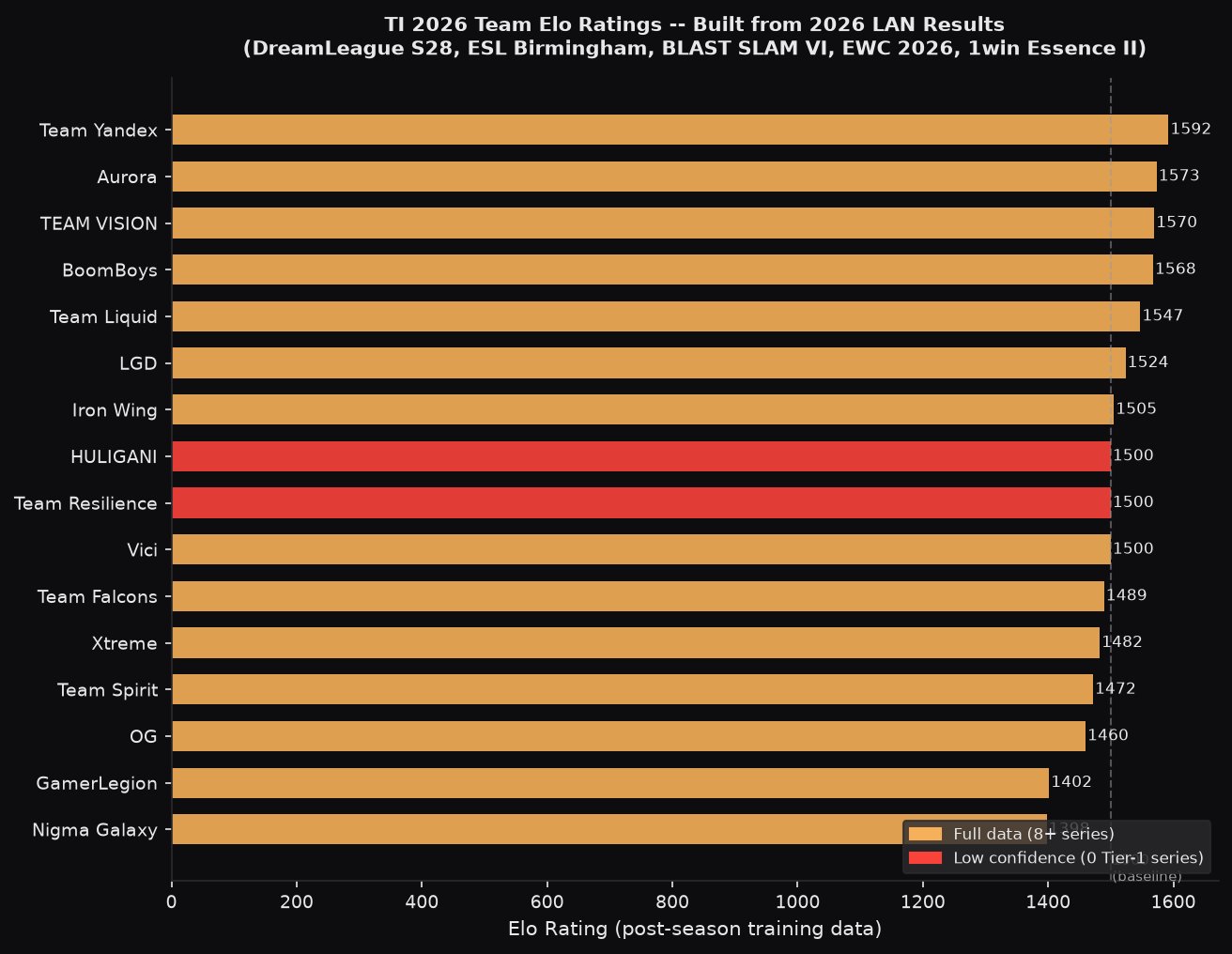
HULIGANI and Team Resilience each sit at exactly 1500 Elo with zero verified series against other TI-qualified teams. The sim assigns them a 47-48% main event probability — essentially a coin flip — because at average Elo, any outcome is roughly as likely as any other. This is our model saying: “we have no data, do not trust this number.”
Iron Wing (4 series, 1505 Elo) is borderline. Their data is thin but not zero — we include them without the low-confidence flag, but readers should treat their 49.1% main event probability with more skepticism than a team like Team Yandex (30 series) or Team Liquid (27 series).
An independent community simulation on Reddit — using their own methodology and data — reached broadly similar conclusions about the group stage favorites; you can read it at r/DotA2.
For personalized Dota 2 coaching from players who have been through multiple TI qualification cycles, see our Dota 2 coaching service. Understanding the group stage meta before it starts is exactly the kind of edge a good coach helps you build — even if you’re not competing at TI yourself.
Frequently Asked Questions
Want an Edge at TI 2026?
Our coaching team includes players who have attended multiple Internationals. Whether you want to understand the group stage meta, improve your own rank before the TI patch drops, or just stop throwing ranked games — we can help.
Get Coached by a TI-Experienced Player
Explore Boosting Options