

TI 2026 Fantasy Guide: Picks That Actually Score

The International 2026 runs August 13-23 in Shanghai and sixteen of the best Dota 2 rosters on the planet are competing for the Aegis. For fantasy managers, that field is a puzzle: some of those teams score enormous fantasy points every series, others grind methodical victories that barely register on the leaderboard. Picking the right players is not random. The scoring system rewards specific roles, specific playstyles, and specific match situations.
This guide breaks down who to pick, why they score, and how to structure a fantasy roster for TI 2026. All team and player information is sourced from Liquipedia, GosuGamers, and Dotesports as of July 2026. Fantasy mechanics referenced here are based on the TI 2025 compendium system — Valve has not officially released a TI 2026 compendium as of this writing, though game files and community sources point to a release around late July 2026. Once the 2026 compendium drops, verify any scoring rule changes before finalizing your picks.
The analysis below is editorial and speculative. These are picks we think score well based on demonstrated playstyle patterns. They are not guarantees. TI group stage is best-of-two, which creates variance. Use this as a framework, not a script.
Table of Contents
What Is TI Fantasy and Is a 2026 Compendium Confirmed?
Valve’s compendium fantasy system has been a staple of The International since TI3. The basic premise: you build a team of five professional players from the competing TI rosters, those players earn fantasy points based on their in-game performance across each series, and your total points determine your ranking on a global leaderboard. Top-ranked fantasy managers earn in-game rewards — historically Immortal item sets, Battle Pass levels, and physical Aegis discounts.
As of July 10, 2026, Valve has not made an official announcement about a TI 2026 compendium or fantasy league. However, community figures including content creator Misha have cited a source close to TeaGuvnor indicating the compendium is expected to release around July 24, 2026 — roughly three weeks before the TI 2026 group stage begins on August 13. Game file leaks have suggested a compendium window running from mid-July through September 1.
The fantasy system is typically bundled into the Battle Pass at no additional cost beyond the pass itself. You create daily rosters by selecting player cards, and the scoring system evaluates each player’s performance across whichever games they play in each series. If you have the 2026 Battle Pass and a TI compendium releases, fantasy should be included automatically.
The key reason fantasy at TI is so competitive: the player pool is small (just 80 players across 16 five-man rosters), the match schedule is compressed, and group stage best-of-twos create high variance in both game count and performance stats. Getting your picks right in the group stage matters because your daily roster compounds over time.
How TI Fantasy Scoring Works (Based on TI 2025 System)
In the TI 2025 compendium, each player earned a point score based on their single best game from a best-of-three series. In group stage best-of-twos, both games count individually, and your fantasy points come from whichever game each player performs best in. Winning or losing the series does not affect a player’s fantasy score — a player on a losing team who went 15/2/18 can outscore a player on the winning team who went 3/1/10.
The scoring categories that drove the most points in TI 2025 were:
| Stat Category | Fantasy Impact | Who Benefits Most |
|---|---|---|
| Kills | High — one of the biggest point drivers | Carries, aggressive mids |
| Creep Score (Last Hits) | Medium-High — GPM proxy | Carries, greedy mids |
| Tower Damage | High — often underrated by casual managers | Carries with right-click heroes, Offlaners |
| Stuns / Disable Time | Medium — favors support roles | Hard supports with heavy CC kits |
| Camps Stacked | Low-Medium — niche upside | Position 4 supports |
| Roshans | Medium — consistent bonus for teams that fight for Roshan | All roles on aggressive teams |
| Teamfight Contribution | Medium — measured by assists and fight involvement | Supports, teamfighting mids |
| Healing / Warding | Low — minor point bonus for support-only | Hard supports |
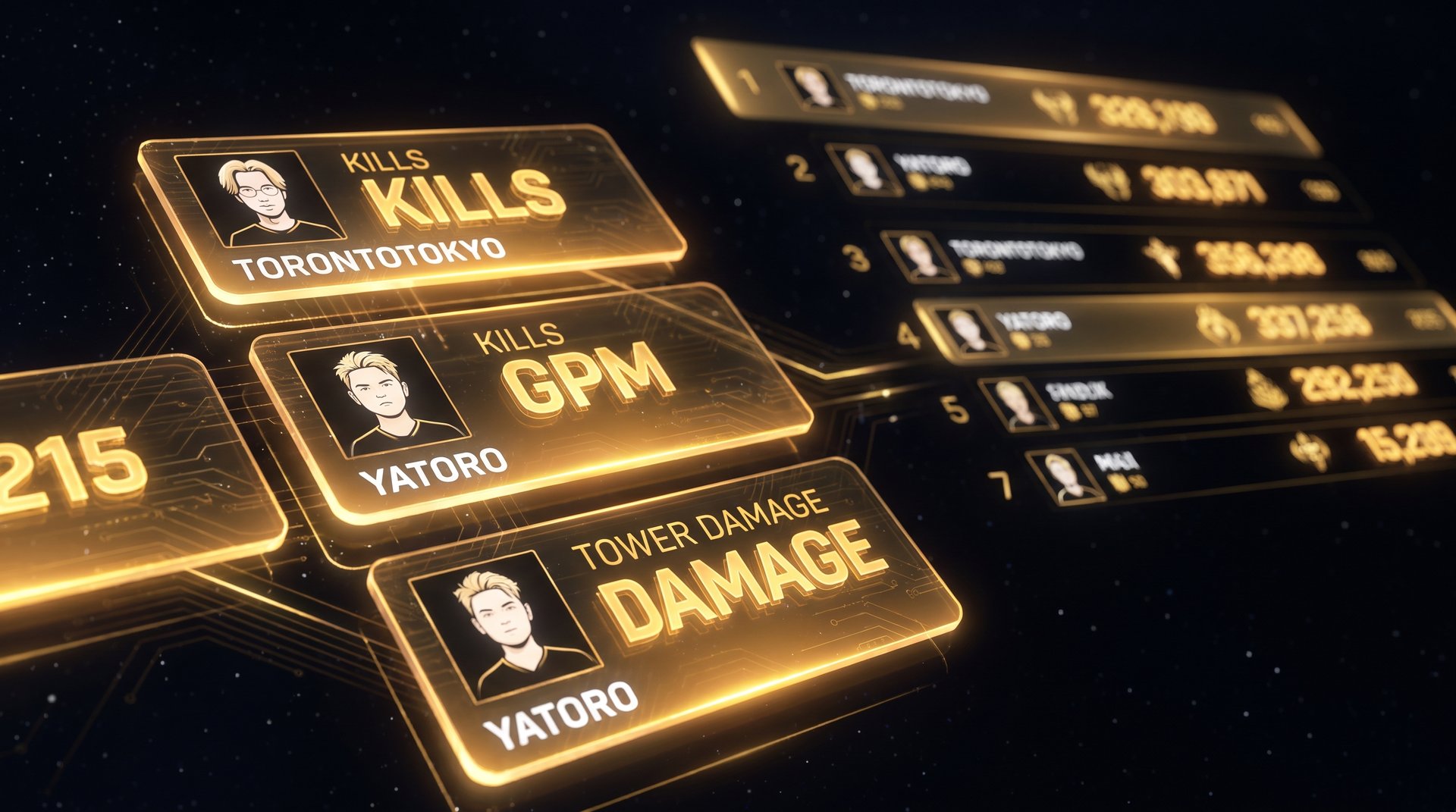
The practical takeaway: kills and tower damage are the two highest-return categories. A carry who farms fast, fights early, and destroys towers with right-click damage will outscore a carry who wins through clever itemization and a slow-creep economy strategy. Teams that play fast and aggressive will generate more fantasy points than teams that win on deathball timings or outright strategic strangulation.
Emblems are enhancements applied to your player cards that multiply scoring in specific categories. In TI 2025, players could apply a “Kills” emblem to a carry, doubling or tripling the fantasy value of every kill that player recorded. Allocating your highest-tier emblems to the right stats — and the right players — is what separates good fantasy managers from great ones.
One structural nuance worth understanding: the TI group stage uses a Swiss system in 2026 (confirmed by Valve). Swiss groups pair teams by record, so later rounds tend to match stronger teams against each other. By the time a team is 2-0 or 3-0, they are playing against other strong teams — those games tend to be more competitive and generate different stat distributions than early-round stomps. Players on teams that stomp early rounds can generate monster fantasy scores in those games. Adjust expectations as the bracket tightens.
The TI 2026 Field: All 16 Teams
The full 16-team field for TI 2026 in Shanghai is confirmed. Seven teams received direct invites based on season performance, and nine qualified through regional qualifiers. Here is the complete roster:
| Team | Path to TI | Region | Fantasy Ceiling |
|---|---|---|---|
| Team Falcons | Direct Invite | International | Very High |
| Team Liquid | Direct Invite | Europe/CIS | High |
| Aurora Gaming | Direct Invite | International | High |
| Xtreme Gaming | Direct Invite | China | High |
| Team Yandex | Direct Invite | CIS | High |
| Tundra Esports | Direct Invite | Europe | Medium-High |
| BoomBoys | Direct Invite | Southeast Asia | Medium |
| Team Spirit | Europe Qualifier | CIS | Very High |
| TEAM VISION | Europe Qualifier | Europe/CIS | Medium |
| HULIGANI | Europe Qualifier | CIS | Medium |
| Nigma Galaxy | Europe Qualifier | Europe | Medium-High |
| GamerLegion | NA Qualifier | North America | Medium |
| OG | SEA Qualifier | Southeast Asia | Medium-High |
| LGD Gaming | SA Qualifier | South America | Medium |
| Team Resilience | China Qualifier | China | Medium |
| Vici Gaming | China Qualifier | China | Medium |
Fantasy ceiling here means the realistic upper bound on point generation per series, not tournament outcome. A team can win TI with methodical, low-kill Dota and still be a bad fantasy pick. The teams rated “Very High” tend to play through kill pressure and fast tempo rather than through strategic attrition.
Top Carry Picks for TI 2026 Fantasy
Carries generate the largest raw fantasy scores in Dota 2 because they accumulate the most last hits, deal the most hero and tower damage, and — on aggressive teams — rack up significant kill totals. The best fantasy carries at TI 2026 combine high GPM profiles with a willingness to fight early and often.
Yatoro (Team Spirit)
Illya “Yatoro” Mulyarchuk is one of the most decorated carries in TI history. He is a two-time International champion with Team Spirit and has returned to their active lineup alongside offlaner Collapse. Yatoro’s farm efficiency is elite — he consistently hits high last-hit counts even in chaotic game states — and Team Spirit’s style of play centers on his ability to get items fast and convert them into fights.
From a fantasy perspective, Yatoro is a premium pick when Team Spirit draws favorable group stage opponents. His GPM and last-hit totals will be consistently high. His kill count depends on how aggressively Spirit forces fights, but in stomps, Yatoro can record double-digit kills. He is a core fantasy carry for any TI compendium draft.
skiter (Team Falcons)
Oliver “skiter” Lepko plays carry for the defending TI champions, Team Falcons. Falcons play one of the most aggressive early-game styles in the entire competitive scene. They pick fights before most teams are ready, and skiter’s hero pool — which leans heavily into right-click damage-dealers — means he accumulates both high kill counts and significant tower damage in winning games. In Falcons stomp scenarios, skiter is a high-ceiling carry pick. The downside is that Falcons’ all-in style means losses can be abrupt, limiting his per-game ceiling in dropped games.
Ghost (GamerLegion)
Ghost led GamerLegion through the North American qualifier without dropping a single map. NA qualifier performance does not always translate directly to TI main event performance, but Ghost’s statistical profile is worth noting. If GamerLegion matches up against other qualifier teams in the Swiss group stage, Ghost could produce outsized fantasy numbers in favorable game states.
Top Mid Picks for TI 2026 Fantasy
Mid players are the second-highest point generators in fantasy after carry. They generate kills, roam for assists, and in many current-meta games, mid heroes deal massive amounts of damage in teamfights. The best fantasy mids at TI 2026 play heroes with high kill potential rather than farming mids who focus purely on gold accumulation.
ATF / Ammar (Team Falcons)
Ammar “ATF” Al-Assaf plays offlane for Falcons, but his aggressive style and kill numbers are comparable to many mid players in the current meta. He is listed in the Falcons roster alongside Cr1t, Sneyking, skiter, and Malr1ne. ATF’s hero pool and willingness to take early fights generates significant fantasy upside in Falcons games. He is discussed further in the offlane section below.
SumaiL (Nigma Galaxy)
Sumail “SumaiL” Hassan’s return to the international stage with Nigma Galaxy is one of the narrative storylines of TI 2026. SumaiL is a former TI champion with significant mid-lane pedigree. His hero pool historically favors high-kill storm plays — Storm Spirit, Queen of Pain, and similar damage-centric mids that generate large amounts of hero damage and kill counts. In favorable matchups, SumaiL produces big fantasy numbers. The caveat is that Nigma Galaxy qualified through Europe and will face stiff competition in the Swiss group. Pick SumaiL selectively based on opponent analysis.
Xtreme Gaming Mid
Xtreme Gaming received a direct invite after strong campaigns across multiple tier-one tournaments. Chinese teams competing at home in Shanghai historically perform well, and Xtreme Gaming’s mid player in 2026 has demonstrated high kill-participation in their team’s aggressive rotations. Chinese teams at TI events tend to play fast-paced, high-tempo games that generate rich fantasy stats.
Top Offlane Picks for TI 2026 Fantasy
Offlane players are increasingly high-value fantasy picks in the current meta. The 2026 meta has seen offlane heroes take on more kill and damage responsibility, moving away from the pure initiation-and-die role of earlier TI eras. Good fantasy offlaners combine hero damage, tower damage, and moderate kill counts.
ATF (Team Falcons)
Ammar Al-Assaf is the standout offlane fantasy pick at TI 2026. His reputation for aggressive positioning and mechanical outplays results in kill counts that are unusual for the offlane role. In Falcons’ fast-tempo games, ATF will be actively hunting kills rather than simply initiating and retreating. He is a high-priority pick for any fantasy manager willing to bet on Falcons games going long enough to rack stats — or short enough that Falcons generate a decisive advantage quickly.
The risk with ATF: in close games where Falcons’ early aggression is matched, his fantasy numbers can be moderate. He is a high-upside, moderate-variance pick rather than a floor-consistent option.
Collapse (Team Spirit)
Magomed “Collapse” Khalilov is one of the most recognizable offlaners in Dota 2 history. His return to Team Spirit’s active roster alongside Yatoro restores one of the most feared offlane-carry duos in the game. Collapse’s hero pool — Mars, Magnus, and similar high-impact initiators — generates assists and fight involvement rather than raw kill counts. From a pure kill-score perspective, Collapse scores lower than ATF. However, if the 2026 compendium rewards stun time and teamfight participation heavily (as the TI 2025 system did), Collapse’s profile becomes significantly more attractive.
Top Support Picks for TI 2026 Fantasy
Support fantasy picks are the most misunderstood category. Many casual managers ignore supports entirely and stack carries and mids. The problem is that in TI 2025, the scoring categories that rewarded stun time, camps stacked, and teamfight assists meant that elite supports on the right teams could outscore mid players on slower teams. The key is finding supports on aggressive teams that play high-action games.
Cr1t (Team Falcons)
Andreas “Cr1t” Nielsen plays position 5 for Team Falcons. He is one of the most decorated supports in competitive Dota 2 history. Cr1t’s hero pool includes high-CC supports that generate significant stun time — a valued scoring category in TI fantasy. On a team as aggressive as Falcons, Cr1t participates in frequent teamfights, which compounds his assist count and teamfight score. He is the most compelling support fantasy pick at TI 2026 if the compendium rewards fight participation and disable time.
Sneyking (Team Falcons)
Jingjun “Sneyking” Wu fills the position 4 role for Falcons. Position 4 supports on aggressive teams can generate surprising fantasy numbers — camps stacked, early rotations that generate assists, and roam kills in the early game. Sneyking’s role in Falcons’ system involves early aggression and enabling the team’s offensive tempo. He is a secondary support pick worth considering if you are stacking Falcons players across your roster.
Team Spirit Support
Team Spirit’s support pairing with Yatoro and Collapse is built to enable that core’s aggressive peak timing. While their specific support players in 2026 have not been as individually profiled in public coverage as Cr1t, Spirit’s team-level style of forcing fights means their supports will accumulate assists and fight participation. If the 2026 compendium scoring rewards assist counts heavily, Spirit’s supports are undervalued picks.
Group Stage Value Plays: High Upside Picks
Value plays in TI fantasy are players who are likely available at lower “cost” or demand in your league’s draft — either because they play for less-famous teams or because their role is undervalued — but who have realistic paths to strong scoring in the group stage.
OG (SEA Qualifier)
The all-Filipino OG roster that qualified through the Southeast Asian qualifier represents genuine TI fantasy upside. Filipino Dota 2 has historically produced extremely aggressive, high-action gameplay. OG’s style tends to favor fights over slow resource control. Their carry and mid players could generate strong kill-based fantasy numbers, particularly against lower-seeded opponents in the early Swiss rounds. Because OG as an organization is associated with the European championship squad of prior years, their SEA qualifier roster may be underestimated by fantasy managers.
LGD Gaming (SA Qualifier)
LGD Gaming arrived at TI 2026 via the South American qualifier on what has been described as a former HEROIC roster. LGD is one of the most storied names in Chinese Dota 2, but this roster’s South American route means their individual player statistics may be unfamiliar to many fantasy managers. That unfamiliarity creates value. If their carry and mid players have strong individual ceilings, they could outperform their draft position in your fantasy league.
HULIGANI (EU Qualifier)
HULIGANI, formerly known as L1GA TEAM, pulled off a notable upset against Virtus.pro in the European qualifier. CIS-style Dota has historically been high-action and fight-heavy. If HULIGANI draws a favorable early-round matchup against a weaker group stage opponent, their aggressive playstyle could generate above-average fantasy numbers in a stomp scenario. They are a speculative pick rather than a core one, but the upside is real.
Team Stacks Worth Considering
Stacking — picking multiple players from the same team — is a valid fantasy strategy when that team is likely to generate high fantasy points across the whole roster in a given series. The correlation between players on an aggressive team means a team stomp lifts everyone’s numbers simultaneously.
Falcons Stack
The Falcons four-man or five-man stack is the highest-upside team stack at TI 2026. Their roster — skiter (carry), ATF (offlane), Cr1t (pos 5), Sneyking (pos 4), and a mid player — all participate in the team’s aggressive style. In a Falcons stomp, every single player racks points simultaneously. The risk is concentration: if Falcons drop a series to an opponent who plays disciplined defensive Dota, your whole lineup suffers. Given that Falcons are the defending champions and one of the most individually talented rosters at the event, the stomp upside is real and frequent.
Team Spirit Stack
The Yatoro and Collapse pairing is historically elite. In Spirit games where they assert early control, Yatoro’s farm numbers and Collapse’s teamfight impact both score well. Stacking these two with a Spirit support player gives you a balanced stack across carry and offlane — two of the highest-scoring positions — with support upside layered on top.
Fantasy Risks to Avoid at TI 2026
Avoiding bad picks is as important as selecting good ones. These are the traps that consistently burn fantasy managers at The International.
Slow, Strategic Teams at Peak Performance
Some teams win TI by being smarter, not by fighting more. If a team wins through optimal resource management, vision control, and objective trading, they will minimize the kill counts, hero damage, and explosive tower sequences that drive fantasy scores. A team that wins 40 minutes into a methodical slow game may leave your fantasy roster with mediocre numbers even in a victory. Research team playstyles before committing. Win rate and fantasy output are not the same thing.
Picking Supports from Slower Teams
If you are building support picks for their stun-time or assist potential, those categories only matter if the team is fighting frequently. A support on a slow, passive team may ward perfectly, run excellent rotations, and win the series — and still generate minimal fantasy points because the game never developed into the kind of extended teamfight sequence that stacks up disable time.
Overloading on Chinese Qualifier Teams
Chinese qualifier teams — Team Resilience and Vici Gaming — are genuinely capable, but their player-level statistics may be poorly tracked in English-language sources. If you cannot verify individual player performance history, you are guessing rather than analyzing. That is a risk worth being aware of before committing roster slots to unfamiliar players.
Ignoring the Swiss Format
The 2026 TI group stage uses a Swiss system. This means games are matched by record within each round. If your fantasy pick’s team goes 0-2 early, they are matched against other 0-2 teams for the rest of the group stage. Those games may still generate fantasy points, but the overall series count for an early elimination team is lower. Concentrate your picks on teams you expect to go deep in Swiss — they play more games and give your players more chances to score.
Draft Strategy and Daily Roster Management
TI fantasy requires active management. Most compendium systems allow daily roster changes, which means you should be updating your picks based on that day’s schedule rather than locking a static lineup for the entire event.
Match the Opponents, Not Just the Player
The best fantasy carry in the world playing against a disciplined, turtle-heavy defensive team will score less than a mediocre carry playing against an aggressive but disorganized opponent. Check the day’s group stage pairings before setting your daily lineup. Who your players are matched against matters as much as how strong those players are individually.
Emblem Allocation Hierarchy
If the 2026 compendium uses an emblem system similar to TI 2025, your highest-tier kill emblems should go to the player you most expect to have a high kill game. Typically, that is your primary carry pick. Your second-tier emblems should go to your mid player if they play a kill-hungry hero, or your offlane if they are on a team like Falcons where ATF regularly hits kill counts that other offlaners do not approach.
Do not waste top-tier emblems on supports unless the compendium specifically makes stun-time the highest-scoring category — in which case, a support like Cr1t with top-tier stun-time emblems becomes extremely high value. Read the emblem stat allocations carefully when the 2026 compendium releases.
Group Stage vs. Main Event Strategy
The group stage at TI 2026 runs August 13-16 and cuts the 16 teams to 8. The main event runs August 20-23. These are two separate windows, and your optimal roster composition may differ between them.
In the group stage, you want players on teams likely to stomp early-round opponents. Variance is your friend here — big wins generate big fantasy numbers. In the main event, the eight remaining teams are all strong. Game quality is higher, stat totals tend to be more contested, and picks based on pure aggression become less reliable. In the main event, lean toward players on teams with proven consistency and large individual ceilings even in competitive games — which points back to players like Yatoro and ATF who produce elite numbers even against top opposition.
Tracking Game Length
Longer games generate more fantasy points across every category. A 55-minute game will produce more kills, more tower damage, and more GPM accumulation than a 25-minute stomp. However, very long games do not always mean high kill counts — late-game strategic Dota can be low-kill. The optimal scenario for fantasy is a mid-length (30-40 minute) game that includes multiple teamfights. Teams like Falcons and Spirit tend to produce these scenarios through their fight-first approach.
Understanding the current Dota 2 meta is crucial for predicting which hero picks generate the highest fantasy output. For Dota 2 players who want to understand the professional meta more deeply — not just for fantasy but for improving their own ranked play — the MMR boosting guide covers how high-level play decisions translate across skill brackets. And if you are grinding ranked during the TI 2026 period and want to push MMR before the season resets, the best Dota 2 boosting services guide covers every legitimate option available. Understanding whether boosting is right for your situation is covered in our dedicated Dota 2 boosting safety guide.
FAQ
Climb Faster While You Watch TI 2026
TI 2026 is the best time to study how elite players win games and apply those lessons to your own ranked queue. If you want to skip the grind and jump straight to the bracket where the game makes sense, TeamSmurf’s Dota 2-only boosters play the same meta the TI teams are playing — no multi-game dilution, no guesswork.
Get MMR Boost Book Coaching



