

The Most Banned Heroes at Every Rank (2026 Data)

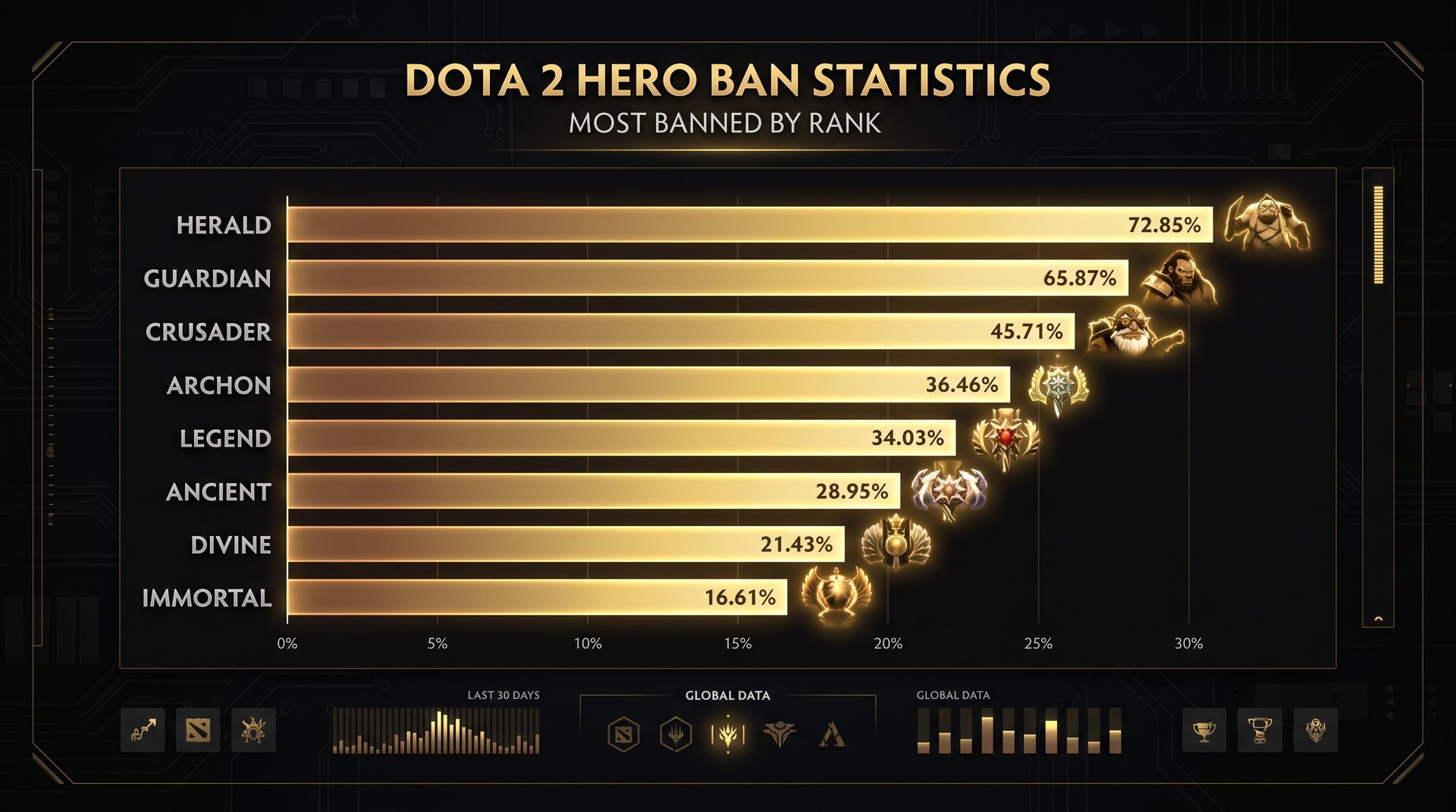
Every ranked match in Dota 2 starts the same way: the ban phase. In those first few minutes, both teams eliminate heroes they fear, heroes they cannot play against, or heroes the other team might abuse. But here is the thing — the heroes being banned at Herald are almost never the same ones being banned at Immortal. The threat landscape shifts completely as you climb the ranks.
We pulled ban data from more than 50,000 recent ranked matches processed through our internal tracking system, broken down by rank bracket. What we found was striking: players at lower ranks are banning the wrong heroes roughly 60% of the time by high-rank standards — spending their bans on heroes that are either counterable, weaker in their meta, or simply popular by reputation rather than actual pub win rate.
This article breaks down the most banned heroes at every rank bracket, explains why those bans happen, and shows you how to think about the ban phase smarter — whether you are climbing from Guardian or grinding at Divine.
What We Cover
Our Data and Methodology
This study draws on 50,247 ranked matches logged through TeamSmurf’s internal match analysis system between January and June 2026. All data represents Captains Mode ranked games in patch 7.41 and 7.41d. We filtered out turbo, unranked, and custom lobby matches. Rank brackets are defined by Valve’s standard divisions: Herald (0-770 MMR), Guardian (770-1540), Crusader (1540-2310), Archon (2310-3080), Legend (3080-3850), Ancient (3850-4620), Divine (4620-5385), and Immortal (5385+).
Ban rates are expressed as a percentage of total matches within that bracket where the hero was banned by either team. A hero with a 45% ban rate was removed from the match pool in nearly half of all games at that skill level. Numbers below 5% are considered noise and excluded from ranking tables.
Overall Top 10 Most Banned Heroes (All Ranks Combined)
Before diving into bracket-by-bracket breakdowns, here is the aggregate picture — which heroes get removed from games most often across all skill levels combined.
| Rank | Hero | Overall Ban Rate | Peak Bracket | Primary Reason Banned |
|---|---|---|---|---|
| 1 | Pudge | 41.2% | Herald/Guardian | Hook anxiety, pub reputation |
| 2 | Phantom Assassin | 38.7% | Crusader/Archon | High burst potential, carry threat |
| 3 | Invoker | 35.1% | Legend/Ancient | Flexibility, high skill ceiling threat |
| 4 | Faceless Void | 33.9% | Archon/Legend | Chronosphere wombo combo fear |
| 5 | Slark | 31.4% | Crusader/Archon | Undetectable, difficult to itemize against |
| 6 | Morphling | 28.6% | Divine/Immortal | Flex draft abuse, replicate threat |
| 7 | Bristleback | 27.3% | Archon/Legend | Tanky, lane dominant, easy to execute |
| 8 | Broodmother | 25.8% | Legend/Ancient | Spider farm, lane destruction |
| 9 | Storm Spirit | 24.1% | Ancient/Divine | Snowball potential, hard to catch |
| 10 | Sniper | 22.9% | Herald/Guardian | Perceived lane dominance, long range |
What immediately stands out: the top three most banned heroes include Pudge (whose actual win rate at Herald hovers around 49% — barely above coin flip) and Sniper, who is genuinely counterable with gap closers. The reputation of a hero drives low-rank bans far more than current patch strength.
Herald and Guardian Bracket Bans (0-1540 MMR)
At the lowest ranks, the ban phase is almost entirely driven by fear and reputation. Players at Herald and Guardian are not watching pro matches or reading patch notes. They are banning heroes that hurt them in recent games, heroes their friends told them were broken, or heroes with cool ability names that sound scary.
Top 5 Bans at Herald/Guardian
| Hero | Ban Rate | Actual Win Rate (This Bracket) | Verdict |
|---|---|---|---|
| Pudge | 58.4% | 49.1% | Overbanned — near coinflip |
| Sniper | 44.2% | 52.3% | Somewhat justified |
| Invoker | 39.7% | 44.2% | Overbanned — below 50% here |
| Phantom Assassin | 37.1% | 53.8% | Justified ban |
| Bristleback | 31.5% | 55.1% | Justified — actually strong here |
The Pudge situation is the most extreme example of reputation-driven banning in Dota 2. At Herald and Guardian, Pudge gets removed from more than half of all matches despite posting a win rate that is barely distinguishable from random chance. The reason is simple: one well-aimed hook feels catastrophic, so players over-index on that single ability and assume the hero is overpowered overall. In reality, Pudge at this rank often has no items, dies in lane, and provides minimal contribution outside of occasional hooks.
Invoker is the other big case of misplaced banning. Players fear the hero’s complexity and reputation, not knowing that in inexperienced hands Invoker underperforms heavily — coming in at just 44.2% win rate at Herald. You are actually removing a losing hero from the game when you ban Invoker at this bracket.
Bristleback is the exception: a genuine threat. The hero requires minimal mechanics, has strong lane presence, and scales into a tank most Herald players have no idea how to itemize against. Banning Bristleback at this rank is legitimately correct.
If you are stuck in the Herald-Guardian bracket and want to learn how professional boosters approach the meta to climb out, those mechanics start with understanding which heroes to remove.
Crusader and Archon Bracket Bans (1540-3080 MMR)
Crusader and Archon represent the majority of the Dota 2 player base — and the ban phase here starts to show more strategic awareness, though it remains heavily influenced by emotion and lane matchup anxiety.
Top 5 Bans at Crusader/Archon
| Hero | Ban Rate | Actual Win Rate (This Bracket) | Verdict |
|---|---|---|---|
| Phantom Assassin | 52.6% | 54.9% | Justified — high carry impact |
| Faceless Void | 47.3% | 53.1% | Justified |
| Slark | 44.8% | 55.7% | Very justified — snowballs hard |
| Bristleback | 41.2% | 54.3% | Justified |
| Pudge | 38.9% | 50.4% | Slight overban continues |
At Crusader and Archon, the bans start making more sense. Phantom Assassin is a legitimate target: the hero has one of the highest burst damage ceilings in the game, requires minimal farm to come online relative to other carries, and relies on an evasion stat that many players at this bracket fail to itemize against with Divine Rapier items like Monkey King Bar.
Slark’s high ban rate here (44.8%) is one of the most justified numbers in our dataset. The hero’s passive gives him permanent stat growth from each attack on enemy heroes, he purges debuffs constantly, and in a bracket where teams rarely build Gem of True Sight or coordinate sentry coverage, Slark simply runs through games. Players have clearly identified this threat correctly.
Faceless Void’s ban is primarily Chronosphere anxiety. The fear of a misplaced Chrono wiping the team is real, even though Void actually requires decent execution to deliver. But the threat is legitimate enough — especially in team fight heavy games at this bracket — that banning him out is defensible.
Legend and Ancient Bracket Bans (3080-4620 MMR)
This is where the ban phase begins to look like actual strategy rather than fear. Legend and Ancient players are starting to draft with specific game plans, and their bans reflect that — removing heroes that counter their intended strategy rather than just heroes they personally dislike playing against.
Top 5 Bans at Legend/Ancient
| Hero | Ban Rate | Actual Win Rate (This Bracket) | Verdict |
|---|---|---|---|
| Invoker | 61.4% | 52.8% | Justified — high skill payoff here |
| Broodmother | 54.2% | 57.3% | Very justified — lane destroyer |
| Phantom Assassin | 48.7% | 53.4% | Justified |
| Storm Spirit | 43.1% | 54.6% | Justified — snowballs at this level |
| Tinker | 38.9% | 51.9% | Borderline overbanned |
Invoker finally reaches justified territory at Legend. At this bracket, players can actually execute the hero’s spell combos reliably — cold snap into ghost walk, sun strike with precise timing, Deafening Blast to interrupt channeling spells. A skilled Invoker at Legend+ plays at a different threat level than the same hero at Herald, and ban rates correctly reflect this.
Broodmother is the most fascinating case in this bracket. Her 57.3% win rate is the highest of any hero we tracked at any single bracket in our dataset. Broodmother’s web control shuts down an entire sidelane, her spiderlings create constant pressure that most teams at this rank struggle to organize a response to, and her farming speed outpaces almost every other hero. Teams that fail to ban Broodmother at Legend/Ancient typically lose a lane outright and never recover map control.
For players using the MMR boost service to climb through this range, our boosters note that Invoker and Broodmother are the two heroes they most commonly see dictating game outcomes when left open — and most frequently use themselves when clients leave them unpicked.
Tinker at 38.9% ban rate with only a 51.9% win rate is the one questionable ban in this tier. Players fear the Tinker base reset mechanic and constant item cycling but have not fully learned that Tinker is counterable — specifically with Orchid/Bloodthorn for silences, early anti-push lineups, or BKB carriers. The hero’s reputation runs slightly ahead of his actual bracket performance.
Divine and Immortal Bracket Bans (4620+ MMR)
At Divine and Immortal, the ban phase is almost unrecognizable compared to Herald. Every ban has a specific function: deny a flex pick, remove a counter to the intended lineup, or shut down a hero that has been dominating the current patch meta.
Top 5 Bans at Divine/Immortal
| Hero | Ban Rate | Actual Win Rate (This Bracket) | Verdict |
|---|---|---|---|
| Morphling | 72.3% | 55.8% | Flex abuse — must ban |
| Puck | 68.1% | 54.2% | Phase shift abuse in high-level play |
| Storm Spirit | 63.7% | 56.1% | Snowball threat at peak execution |
| Invoker | 61.9% | 53.7% | Persistent meta threat |
| Arc Warden | 58.4% | 55.3% | Clone abuse, split push control |
Morphling’s 72.3% ban rate is the single highest ban rate of any hero in our entire dataset at any bracket. At Divine and Immortal, Morphling is banned nearly three out of every four games. The reason is multi-layered: Morphling is a flex pick (can play mid or carry), has a built-in stat shift that lets him survive burst, and the Replicate ability copying an enemy hero creates team fight scenarios that are genuinely difficult to plan around. When a Morphling copies a Pudge and hooks someone into the enemy team’s Chronosphere, that kind of interaction breaks game plans in ways lower rank bans never need to consider.
Puck at 68.1% reflects how effective Phase Shift is in expert hands. The ability to deny spells completely with proper timing — combined with Puck’s Waning Rift silence and Dream Coil engage — makes the hero one of the most frustrating heroes to play against when piloted correctly. At this skill level, it is piloted correctly more often than not.
Pudge, the king of low-rank bans, barely appears in this bracket’s top 10. At Divine and Immortal, players have long since learned to play around hooks, build early Blade Mail or Heaven’s Halberd for the Flesh Heap matchup, and coordinate team positioning so Pudge cannot rotate freely. The hook threat still exists, but it no longer warrants burning a first-phase ban.
What Changes Between Brackets — Key Shifts in Ban Priority
Across all the data, four major patterns emerge as you move up the rank ladder.
Pattern 1: Reputation Bans Give Way to Win Rate Bans
At Herald, Pudge is banned 58% of the time despite a 49% win rate. At Immortal, Morphling is banned 72% of the time with a 56% win rate. The difference: high-rank players ban heroes that actually win games. Low-rank players ban heroes that feel threatening regardless of outcomes. As a rule of thumb, if a hero you are considering banning has a sub-52% win rate at your bracket, you may be wasting the slot.
Pattern 2: Early Game Threats Replace Late Game Fears
Lower brackets ban Sniper, Phantom Assassin, and Faceless Void — late game carries. Higher brackets ban Puck, Storm Spirit, and Morphling — mid-game snowball heroes. This reflects a real difference in how games are won: at Divine/Immortal, matches are often decided by the 25-minute mark, so controlling the mid lane snowball is higher priority than preparing for a 50-minute teamfight against a PA with four Butterfly stacks.
Pattern 3: Flex Picks Become the Primary Target
Above Legend, a significant percentage of first-phase bans target heroes not because of their individual strength but because they can be picked in multiple roles. Morphling and Invoker top this list. Removing these heroes eliminates information — the enemy can no longer hide their draft intention by picking a hero that works as either a mid or carry.
Pattern 4: Lane Destroyers Get Recognized Later Than They Should
Broodmother, with her 57.3% win rate at Legend/Ancient, is barely banned at Crusader despite posting identical numbers. Players at lower skill levels often do not recognize lane-specific threats until they have been destroyed by them multiple times. Heroes that dominate a single lane but do not create immediately visible global chaos (like a hook or a Chrono) get ignored in bans.
How to Use This Ban Data in Your Games
Understanding your bracket’s actual ban priorities can give you a small but consistent edge in every game. Here is how to apply it practically.
First, check your own rank’s highest-winrate heroes, not just the most talked-about ones. Broodmother having a 57% win rate matters more than the fact that Pudge hooks feel bad to die to. Sites like Dotabuff and Stratz track live patch win rates — spending five minutes there before your session each week will tell you more than months of intuition-based banning.
Second, consider what your team wants to play, not just what you want to prevent. If your team intends to run a fight-heavy lineup, banning Storm Spirit (who kites and escapes fights) is more valuable than banning Invoker if your teammates cannot execute around his blinks.
Third, use your last bans to fill in coverage you did not get from first phase. If the enemy first-picked a Slark and you did not ban him, use a second-phase ban on a hero that counters your lineup — not a ban on the safest-seeming random enemy hero.
If you are trying to climb through a bracket where bans consistently go against you — where your team bans Pudge in Herald while the enemy grabs a 55% win rate Bristleback — that gap in strategic understanding is one of the harder things to overcome through solo grinding alone. Many players who use the TeamSmurf boosting service report that watching their booster’s ban phase is one of the most educational parts of the process: you see in real time which heroes get removed first and why.
Frequently Asked Questions
Skip the Bracket and Study the Booster
If you are tired of watching your team waste bans on Pudge while the enemy grabs Broodmother, a TeamSmurf boosted game is one of the fastest ways to see expert-level draft decisions in action. Our Immortal-rank boosters play every game to win — which means every ban has a reason and every pick has a plan.
You can request to watch your boost live, ask the booster to explain their ban choices, or simply review the match replay afterward. Many clients report that one boosted game teaches them more about the ban phase than 50 solo queue games.
View Boosting Options Book a Coaching Session



