Deranked After Calibration? Here’s Exactly How to Recover

You finished your calibration games, watched the results screen load, and landed somewhere you did not expect — maybe 150, 200, or even 300 MMR below your previous rank. The frustration is real. But before you queue into the next five games trying to claw it back through sheer anger, you need to understand exactly why this happened and which recovery approach will actually work for your situation.
This guide covers the mechanics behind calibration drops, the realistic range you should expect based on your recent performance, the fastest proven path back, and — critically — when grinding is the smart move versus when a professional MMR boost will get you where you need to be faster and with less mental damage along the way.
What You Will Learn
Why Calibration Deranking Happens: The Real Mechanics
Every time Dota 2 enters a new ranked season, Valve resets what the system calls its “confidence” in your displayed MMR. This is not punishment. It is the matchmaker acknowledging that players improve, decline, or change their habits between seasons, and a reset gives the system a fresh signal to work with.
The underlying algorithm — commonly known as a Glicko-style rating system in competitive gaming — tracks two values simultaneously. The first is your actual MMR score. The second is a confidence interval sometimes called Rating Deviation (RD) or, in Dota 2’s language, an “uncertainty” score. When that uncertainty value is high, each match result carries more MMR weight in both directions. When it is low after many games at a stable level, results move you less.
At the start of calibration, your uncertainty is deliberately inflated. This means the first several games are deciding more MMR per result than your normal ranked games do. Win four and lose four? You might end up close to where you started. But lose five of your first eight while playing new heroes or off-roles, and the algorithm interprets that as genuine evidence that your current skill level is lower than your stored MMR suggested.
Seasonal vs Mid-Season Calibration
Dota 2 runs calibration windows at major seasonal transitions. Each window typically consists of a set number of placement games — historically ranging from 10 games in older seasons to modified systems in more recent patches. The key point is that during the placement phase, your uncertainty value remains elevated throughout. Only after completing your placements does the system lock in your new baseline and start the slower normal-rate adjustment.
Players who miss calibration games by avoiding ranked during the window will eventually be pushed into a compressed calibration phase when they return, which can feel jarring. The system wants to collect enough data to feel confident about where you belong.
How Variance Amplifies Results
During calibration, a single game can move your MMR anywhere from roughly 20 points at the low end of uncertainty adjustment to over 60 points at the high end, depending on match quality signals and how much calibration progress you have completed. Compare that to normal ranked where you gain or lose roughly 20-30 MMR per game at most skill levels.
This variance amplification is the core reason players feel like they “got robbed” by calibration. You are not imagining it. The stakes per game genuinely are higher. Three losses in a row during calibration can cost you more than six losses in normal ranked.
Understanding Uncertainty Windows
The uncertainty window is essentially how wide a bracket the system thinks you could realistically belong in. A fresh-to-ranked player might have an uncertainty spanning 1,000 MMR. A long-term veteran with thousands of games played has a much narrower window — maybe 150 MMR in either direction from their current score.
When calibration starts, Valve partially inflates your uncertainty regardless of how many games you have played. The amount of inflation depends on how long since your last competitive games and what the system detected about your play patterns. Players who stopped playing ranked for months before calibration will see bigger swings than players who stayed active.
| Activity Level Before Calibration | Uncertainty Inflation | Expected MMR Swing per Game |
|---|---|---|
| Active ranked (less than 30 days break) | Low inflation | 25-35 MMR |
| Moderate break (1-3 months) | Medium inflation | 35-50 MMR |
| Long break (3+ months away) | High inflation | 45-65 MMR |
| First calibration on account | Maximum inflation | 50-80 MMR |
Understanding where you sit on this table matters for setting realistic expectations. If you came back after a 4-month break and lost 6 of 10 calibration games, a 300-400 MMR drop is completely within the expected range. It is not a glitch or unfair treatment — it is the system doing its job with high-variance inputs.
Typical Drop Range: What to Actually Expect
Community data from multiple seasons — aggregated from third-party stat sites and player forums — suggests the following typical calibration outcomes. These are based on players who enter calibration near their previous season’s rank:
| Calibration Win Rate | Typical MMR Change | Extreme Case Range |
|---|---|---|
| 8-10 wins (80-100%) | +50 to +200 MMR | Up to +350 in rare cases |
| 6-7 wins (60-70%) | -50 to +100 MMR | Mostly neutral outcome |
| 5 wins (50%) | -100 to -50 MMR | Near-neutral, slight negative |
| 3-4 wins (30-40%) | -150 to -250 MMR | Down to -350 possible |
| 0-2 wins (0-20%) | -250 to -450 MMR | Down to -600 in worst cases |
Most players who feel “destroyed” by calibration landed in the 3-4 wins range. A 200-250 MMR drop from a 30-40% calibration win rate is working as intended. It hurts, but it is recoverable — especially if you understand that the same high-variance mechanics that dropped you can lift you back up faster than normal ranked grinding would.
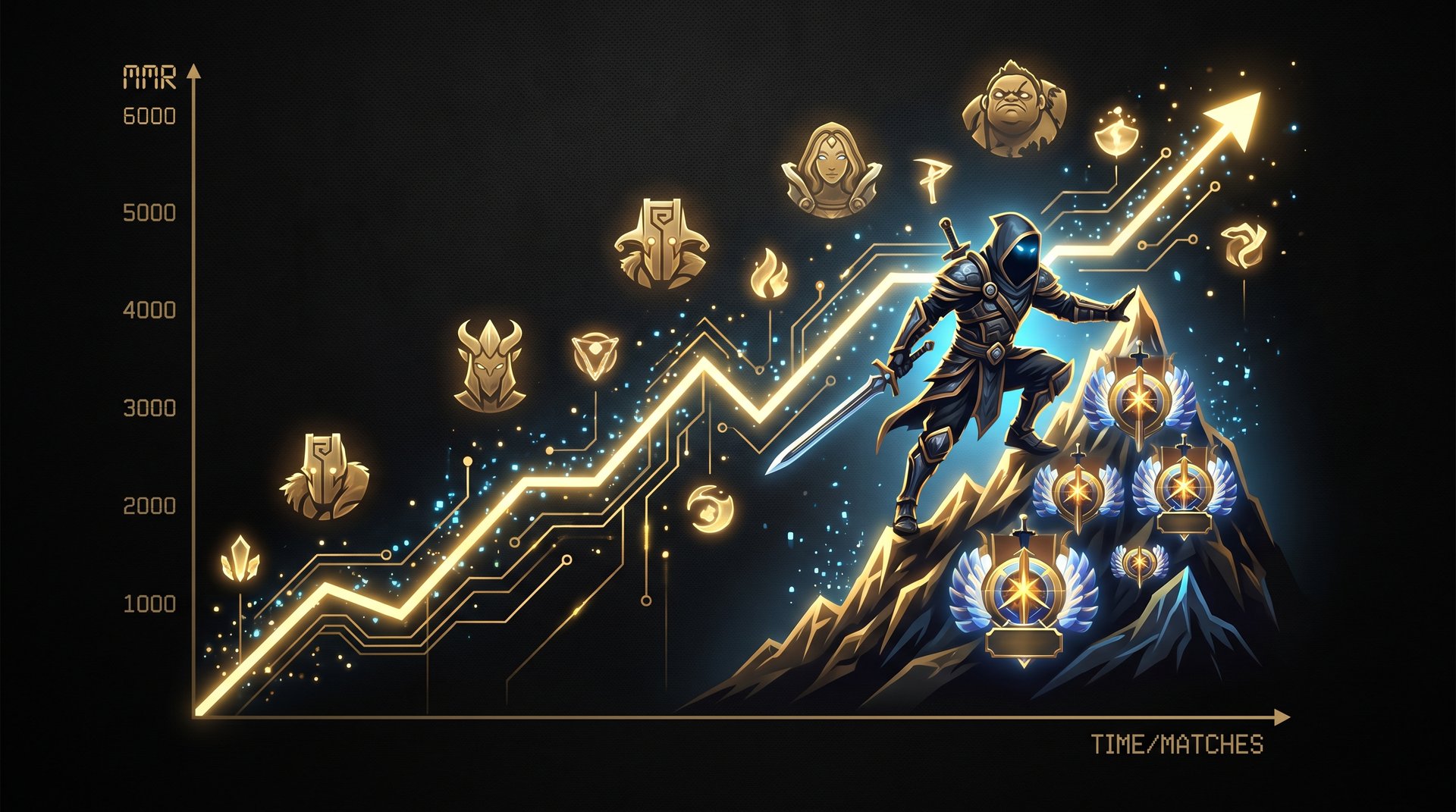
The Fastest Recovery Path: Three Principles
There is no single magic fix for recovering from a calibration drop, but the players who climb back fastest all share three behaviors. These are not abstract advice — they are the concrete changes that produce results within a 20-30 game window.
Principle 1: Accept the New MMR as Real Data
The most common mistake players make after calibration is queueing at full tilt, treating every loss as an injustice. That mindset produces the exact behavior — off-role plays, experimental hero picks, trying too hard to “carry” bad games — that extends the drop rather than reversing it.
Your new MMR bracket is your starting point. The opponents and teammates you have in this bracket are, statistically, similar to you right now given recent performance. Fighting that reality in your head costs you games. Accepting it and playing sharp, consistent Dota earns you back the MMR you lost within weeks rather than months.
Principle 2: Win Rate Efficiency Over Volume
Playing 15 games a day while tilted produces worse results than playing 5 games a day when mentally fresh. The post-calibration window has slightly elevated variance, which means your mental state affects outcomes more than during stable ranked play. Tired players make late-game macro errors. Frustrated players mistime teamfights. Rushed players draft badly.
The fastest path to MMR recovery involves fewer games played well rather than more games played badly. Set a session limit — 5 games maximum, or stop after 2 consecutive losses — and stick to it rigorously.
Principle 3: Stop Learning New Things During Recovery
Calibration aftermath is not the time to expand your hero pool, experiment with new builds, or practice a role you are less comfortable with. Every game you spend in unfamiliar territory during this period is a game with inflated downside risk. Save the experimentation for when you are back at your pre-calibration MMR or higher.
Hero Pool Narrowing: Your Fastest Recovery Lever
Of all the variables you control in Dota 2 ranked, hero pool is the one with the clearest correlation to win rate at most skill levels. Players with a narrow, well-practiced hero pool consistently outperform players of similar mechanical skill who spread their games across 20+ heroes.
The reason is compounding efficiency. When you play the same hero repeatedly:
- Your itemization decisions become faster and more automatic, freeing mental bandwidth for macro decisions
- You recognize matchup-specific threats earlier and respond more correctly
- You know exactly which timings to play around — when you are strong, when you are weak
- Your farming and positioning patterns are more consistent, producing more reliable gold and XP advantages
- You can draft confidently even under pressure, avoiding panic picks
How Narrow Is Narrow Enough?
For recovery purposes, the optimal pool is 2-3 heroes per role you play, with one “comfort pick” that you can fall back on in any draft situation. This gives you enough flexibility to avoid being completely countered while keeping your practice concentrated enough to produce results.
| Your Role | Recovery Pool Size | What to Prioritize |
|---|---|---|
| Carry (1) | 2-3 heroes | Strong laning, self-sufficient, forgiving team play |
| Mid (2) | 2-3 heroes | High kill threat, roam potential, can snowball solo |
| Offlane (3) | 2-3 heroes | Durable, teamfight value, does not require farm |
| Soft Support (4) | 2-3 heroes | High mobility, save abilities, good laning synergy |
| Hard Support (5) | 2-3 heroes | Vision control, setup, can win lane through aggression |
Your comfort pick should be a hero you have at least 50 games on with a win rate above 52% at your target MMR bracket. If you do not have a hero that meets that threshold, you have found the root cause of your calibration drop — and the solution is deliberate practice on one hero until you do.
What to Look for in a Recovery Hero
The best recovery heroes share these traits: they have high individual impact (you can win games even when your team underperforms), they are mechanically forgiving enough that tilt does not destroy your performance, and they are stable in the current meta. Patch-dependent heroes that require constant adjustment are higher risk during a recovery grind.
Check the current high-MMR meta before committing to your recovery pool. A hero that was dominant two patches ago may now be heavily countered or have been nerfed into irrelevance.
Role Lock: Why Playing One Role Accelerates Recovery
Multi-role players consistently recover from calibration drops more slowly than single-role specialists. The reason is decision depth — each role in Dota 2 has its own decision trees, timing knowledge, map movement patterns, and ward placements. Playing across two or three roles during recovery means you are never operating at your maximum depth in any of them.
For the duration of your recovery grind — defined as the period until you reach your pre-calibration MMR — commit to one role and select it every game. Do not flex to “fill” unless the draft is genuinely desperate. Filling tends to produce below-average performances on roles you are less practiced in, which at elevated post-calibration variance means disproportionate MMR losses.
Role Queue and Behavior Score
Dota 2’s role queue system rewards players who stay in their selected lanes with slightly better matchmaking quality over time. Players who consistently deviate from their role assignment accumulate behavior score penalties that result in worse teammates and longer queue times — a double punishment during a recovery grind.
Keep your behavior score above 9,000 during recovery. This means: no abandons, no negative chat, no feeding in frustration, and no grief reporting of teammates even when they make errors. Your matchmaking quality is a meaningful variable in your recovery speed, and behavior score directly affects it.
Duo Queue: When It Helps and When It Hurts
Playing with a reliable duo partner is one of the most consistent MMR recovery accelerators available to players who have a qualified partner. The key word is qualified — the wrong duo partner makes your recovery substantially harder.
What Makes a Good Recovery Duo Partner
- Complementary roles: Carry + support, or mid + offlane. Playing the same role as your partner forces one of you into a comfort-compromising position every game.
- Similar or slightly higher MMR: A partner 200-400 MMR above you will pull matchmaking quality slightly higher. A partner 500+ MMR above you in a smurf or boosted account situation creates lopsided matches that teach you nothing and win inconsistently.
- Calm communication: The single most common way duo queue backfires is mutual tilt — two friends feeding each other’s frustration amplifies every loss into a multi-game losing streak.
- Lane synergy: The pair that gets the most from duo queuing is carry + hard support in the safe lane. A reliable support who knows your timings and plays around your power spikes can produce a consistently winning lane that snowballs games.
See the full guide on duo queue role pairings for a breakdown of which combinations produce the highest win rates at each MMR bracket.
Duo Queue Pitfalls to Avoid
Two pitfalls are especially common during calibration recovery duo queues. The first is playing more games than you would solo — the social energy of playing with a friend removes the natural stopping point that solo fatigue creates, leading to late-night tilt sessions that undo days of progress. Set a joint session limit before you start playing.
The second pitfall is over-coordination. Spending more time on voice communication than on game decisions is a real thing. Keep communication lean: call missing enemies, call when you are going in, call your cooldowns. Avoid post-game analysis mid-session — save it for after you hit the session limit.
When a Boost Makes More Sense Than Grinding Back
This is the question players avoid asking themselves honestly, and it is worth addressing directly. The grind-back approach is the correct choice for most players who lost fewer than 150 MMR in calibration. The recovery path is short, the variance is still elevated so results come faster, and the games you play will genuinely help your improvement.
But there are specific situations where professional MMR boosting is a more efficient path:
Scenario 1: Large Calibration Drop (250+ MMR)
If you dropped 250 MMR or more — especially if you started from a bracket like Legend or Ancient where the game quality at your new MMR is noticeably worse — the grind-back timeline extends significantly. At a realistic 55% win rate, recovering 250 MMR takes roughly 80-100 games. That is 60-70 hours of Dota assuming average game length. For players with limited time, a targeted boost to your previous rank is often more efficient than a multi-month climb.
Scenario 2: Wrong Bracket, Wrong Game Quality
Calibration can occasionally push you below the bracket where your hero pool and decision-making naturally belong. When this happens, the game quality around you is genuinely mismatched — teammates make errors you did not experience at your previous rank, enemies require different counters, and the macro patterns you practiced no longer apply cleanly. Playing 80 games in a bracket that does not match your skill ceiling is frustrating and does not build the habits you need for your target rank.
Scenario 3: Time-Sensitive Goals
If you have a seasonal reward, team try-out, or personal milestone with a deadline — and calibration set you back far enough that the math does not work out for grinding — a professional boost removes the time variable entirely. Dota 2 boosting through TeamSmurf uses account-share with VPN protection and supports role and hero preferences to minimize visibility.
Scenario 4: Mental Health of the Grind
The most underacknowledged reason. A calibration drop that puts you 200-300 MMR below your previous rank, followed by a 60-80 game grind back, can genuinely degrade your relationship with the game. Some players exit the grind as worse Dota players — more tilted, more reactive, with worse habits ingrained from playing against mismatched opponents. If you feel that grind tilt is becoming a real problem, removing the obstacle through a professional service and returning to the game fresh at your correct rank is a legitimate and rational choice.
Recovery Timeline Comparison
| Recovery Method | 250 MMR Drop Timeline | Best For |
|---|---|---|
| Solo grind (55% WR) | 80-100 games (~60-70 hrs) | Players with time and improving skill |
| Duo queue grind (57% WR) | 65-80 games (~45-55 hrs) | Players with a reliable partner |
| Coaching + grind | 50-65 games (~35-45 hrs) | Players who want to improve + recover |
| Professional MMR boost | 2-4 days | Time-limited, large drops, bracket mismatch |
Skip the Grind. Get Back to Your Real MMR.
TeamSmurf uses verified high-MMR boosters, VPN protection on your account, and lets you specify hero and role preferences. Fast turnaround, guaranteed results, and 24/7 support throughout.
Building the Mental Framework for Recovery
Every player who successfully recovers from a calibration drop without a boost shares one mental trait: they treat the MMR number as a lagging indicator of their current performance, not as a measure of their identity or worth as a player. The number will follow good play. The job is to produce good play consistently, not to watch the number obsessively after every game.
Concrete actions that help maintain this framework:
- Track your own KDA and farming efficiency, not just wins and losses
- After each loss, identify one specific decision you would change — not a complaint about teammates, a concrete personal decision
- After each win, identify what you did well that caused the win — this builds replicable patterns
- Do not check your MMR total mid-session — check it at the end of a session, if at all
- Take a full rest day after a 3+ loss streak before returning to ranked
The players who recover fastest are not necessarily the most mechanically skilled — they are the most disciplined. Discipline in hero selection, discipline in session length, discipline in separating their emotional state from their in-game decision making.
The 20-Game Recovery Checkpoint
Set yourself a 20-game checkpoint after calibration. At that point, review your stats objectively:
- What is your win rate on your primary hero across those 20 games?
- Is your average KDA above your bracket’s typical midpoint?
- Are you winning or losing more lane phases than you are losing or winning teamfights? (This identifies whether your problem is early game or late game.)
- How many games did you play on off-heroes or off-roles?
If after 20 games your win rate is below 48% on your primary heroes and you cannot identify clear root causes from reviewing your own games, that is when an objective outside view — from a coach or from reviewing pro gameplay in your hero pool — pays the highest dividend. See the MMR stuck diagnostic framework for a structured way to diagnose whether your issue is mechanical, macro, or mental.