Rubick Guide Dota 2 (2026): Build, Steals & Spell Math

Updated: September 18, 2026. This guide covers Rubick in patch 7.41e — builds, facet choices, talent paths, and a full Mechanics FAQ answering the exact numbers players search for: Arcane Supremacy percentage, Fade Bolt damage at each level, and what stolen Meat Hook actually deals.
Rubick is Dota 2’s most mechanically demanding support. His entire identity is built around converting enemy abilities into weapons, then amplifying them with Arcane Supremacy. Get this right and you can swing teamfights with a single stolen spell. Get it wrong and you waste one of the highest-ceiling heroes in the support pool. This guide gives you the numbers and the decision framework to get it right at every MMR.
In This Guide
Rubick’s Abilities in Patch 7.41e
Rubick runs four abilities: Telekinesis (Q), Fade Bolt (W), Arcane Supremacy (E passive), and Spell Steal (R). His innate strength is the passive that makes every stolen ability hit harder than the original caster intended. Here is the complete stat table for patch 7.41e.
| Ability | Key Stat (Levels 1/2/3/4) | Notes |
|---|---|---|
| Telekinesis (Q) | Stun 0.9/1.1/1.3/1.5s | Lift + land stun; Shard lets you self-cast |
| Telekinesis Land | Landing damage 150 (all levels) | With max AS talent at L10: 171/177/183/189 |
| Fade Bolt (W) | Damage 100/175/250/325 | 6% damage reduction per bounce; attack debuff |
| Arcane Supremacy (E) | Spell amp 14/18/22/26% | Also adds 60/120/180/240 cast range |
| Spell Steal (R) | Duration 180/240/300s | 1 stolen spell; 2 with Aghanim’s Scepter |
Arcane Supremacy: The Exact Numbers (Patch 7.41e)
Arcane Supremacy is Rubick’s passive ability that amplifies every spell he casts and increases his cast range. The most common question is how much percentage it actually gives — here is the exact breakdown.
Arcane Supremacy at max level (level 4) gives 26% spell damage amplification. At earlier levels the bonus scales as follows:
| AS Level | Spell Damage Amp | Cast Range Bonus | Total Cast Range |
|---|---|---|---|
| Level 1 | 14% | +60 | varies by ability |
| Level 2 | 18% | +120 | varies by ability |
| Level 3 | 22% | +180 | varies by ability |
| Level 4 (max) | 26% | +240 | varies by ability |
The cast range bonus applies to all of Rubick’s abilities. Fade Bolt for example has a base cast range of 800; at max Arcane Supremacy it reaches 1040. Spell Steal has a base cast range of 1000; at max Arcane Supremacy it becomes 1240, letting you safely steal from the backline without walking into danger.
Arcane Supremacy amplifies spell damage regardless of the damage type (magical, physical, or pure) of the ability Rubick casts. It applies to his own spells AND to stolen abilities. This is why Rubick can turn enemy nukes into something even more deadly in his hands.
The level 25 talent “+40% Spell Amp For Stolen Spells” stacks on top of Arcane Supremacy specifically for stolen abilities. At max Arcane Supremacy (26%) with the level 25 talent, stolen spells receive a total of 66% spell damage amplification. This is why Rubick’s stolen nukes can one-shot supports in the late game.
Fade Bolt: Damage Numbers and the Attack Debuff (7.41e)
Fade Bolt is Rubick’s primary farming and harass tool. It bounces between nearby enemy units dealing damage that decreases 6% per bounce, and applies an attack damage reduction debuff to each unit it hits.
Fade Bolt base damage at each level (patch 7.41e): 100/175/250/325.
| Fade Bolt Level | Base Damage | With Max Arcane Supremacy | Attack Damage Reduction |
|---|---|---|---|
| Level 1 | 100 | 126 | 5% |
| Level 2 | 175 | 220.5 | 15% |
| Level 3 | 250 | 315 | 25% |
| Level 4 (max) | 325 | 409.5 | 35% |
The “with max Arcane Supremacy” column assumes level 4 Arcane Supremacy (26% amp). In practice during the laning phase you will have lower Arcane Supremacy levels, so the actual damage lands between the two columns.
The attack damage reduction debuff is often underrated. At max Fade Bolt, a 35% attack damage reduction on the enemy carry is game-changing — it reduces their physical output by more than a third for 10 seconds. This makes Fade Bolt not just a nuke but a team fight tool that lets your carry survive during exchanges.
With the Level 10 talent “-12% Fade Bolt Damage Reduction,” the debuff jumps to 47% at max Fade Bolt. A carry taking 47% reduced attack damage for 10 seconds is practically countered out of the fight.
Fade Bolt has infinite bounces (the wiki confirms it will bounce 75-94 times before reaching 1 damage at each level). In practice it stops bouncing when no new targets are in range. This makes it excellent for sieging waves and pushing out creeps under towers.
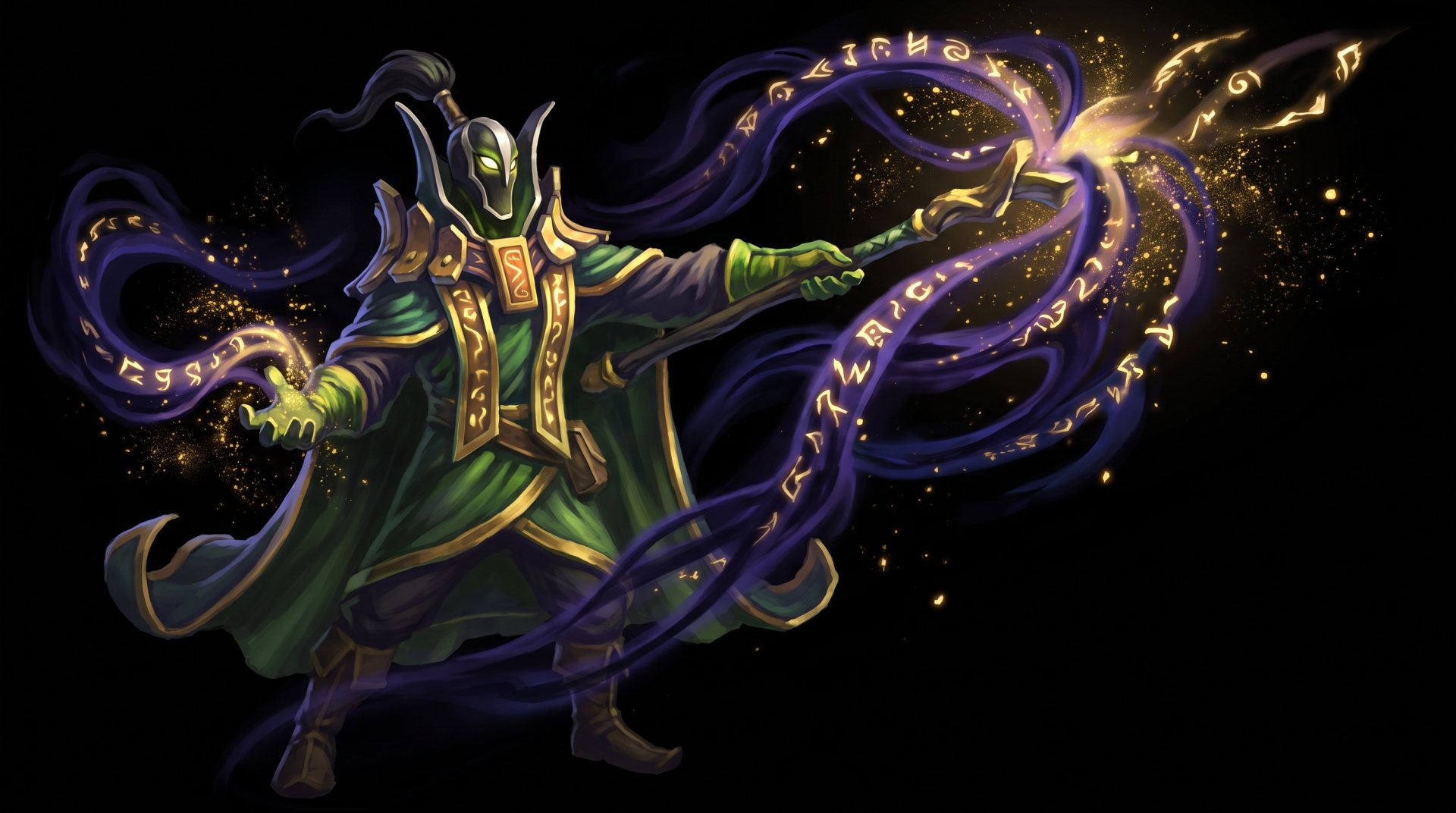
How Spell Steal Works: Rules and Interactions
Spell Steal (R) targets an enemy hero and steals the last eligible ability they cast. Rubick can use that ability as his own for a limited duration, retaining it even through death in some cases (until the timer runs out).
Core Spell Steal rules
- Steal duration: 180/240/300 seconds at levels 1/2/3 (3/4/5 minutes)
- Stolen spell level: matches the enemy’s current level of that ability
- Stolen spell cooldown: carries over from whatever the original hero had at the time of steal
- Aghanim’s Scepter upgrade: cast range increases to 1400 (from 1000 base), and Rubick can hold 2 stolen spells instead of 1
- Aghanim’s Shard upgrade: allows Telekinesis to target allies or self (separate from Spell Steal)
What can and cannot be stolen?
Rubick cannot steal passive abilities, item abilities, or active attack modifiers. He also cannot steal the following abilities specifically: Primal Companion (Beastmaster), Stone Remnant (Earth Spirit), Invoke (Invoker), Rearm (Tinker), Morph (Morphling), Mischief (Puck), Dispersion (Spectre with talent), and a handful of other kit-defining mechanics.
Rubick also cannot steal abilities that were cast as a toggle (only the non-toggled state counts). When multiple abilities were cast, Spell Steal takes the most recently cast eligible ability.
When Rubick steals an ability that has sub-abilities (for example, Void’s Chronosphere spawns a targetable area), the sub-abilities are automatically acquired alongside the main one. This is what makes steals like Black Hole, Chronosphere, or Ravage so powerful — you get the full package.
Spell Steal and debuff duration amplification
At Spell Steal levels 1/2/3, Rubick’s stolen debuffs last 10%/20%/30% longer than the original. A stolen Maledict, Slithereen Crush, or Shadow Poison will have its debuff duration extended. This scaling alone makes maxing Spell Steal worthwhile by level 11.
Stolen Spell Math: Meat Hook, Damage Nukes, and Key Interactions
The most common question — how much does Rubick’s stolen Meat Hook deal? Here is the complete math, plus a breakdown of the most impactful steals in 7.41e.
Stolen Meat Hook damage
Pudge’s Meat Hook deals pure damage at 100/200/300/400 across levels 1/2/3/4. Rubick steals it at whatever level Pudge currently has. Arcane Supremacy’s spell damage amplification applies to stolen abilities, so the damage is boosted by Arcane Supremacy.
| Hook Level (Pudge’s) | Base Damage | With Max AS (26%) | With Max AS + L25 Talent (66%) |
|---|---|---|---|
| Level 1 | 100 | 126 | 166 |
| Level 2 | 200 | 252 | 332 |
| Level 3 | 300 | 378 | 498 |
| Level 4 | 400 | 504 | 664 |
At level 4 stolen Meat Hook with max Arcane Supremacy and the level 25 talent, Rubick’s hook hits for 664 pure damage — significantly more than Pudge’s own 400 base. This is the core fantasy of playing Rubick: turning the enemy’s best ability into something deadlier than they can cast themselves.
Top stolen spells in 7.41e
The value of a stolen spell depends on the enemy lineup, the fight situation, and whether the spell is currently on cooldown when you steal it. Here are the highest-value steals by category.
| Stolen Spell | Why It Is Valuable | Key Note |
|---|---|---|
| Black Hole (Enigma) | 5-second full-team disable; Arcane Supremacy extends the debuff duration | Must position near enough to catch multiple enemies |
| Ravage (Tidehunter) | AoE stun that covers a huge radius; pairs with Rubick’s own disables | Stomp radius stays the same; does not inherit Aghs upgrades unless Rubick has one |
| Chaotic Offering (Warlock) | AoE stun + summons a Golem; Rubick’s Golem is his own | Strong in teamfight setups and pushing lanes |
| Laguna Blade (Lina) | Single-target nuke; with 66% amp at L25 it can delete a support instantly | Cooldown carries over — steal it just after Lina uses it so you get a fresh cast |
| Call Down (Gyrocopter) | Large AoE slow and damage; great for teamfights and wave clear | Can be tricky to land the second wave optimally |
| Meat Hook (Pudge) | Pure damage + displacement; hard to land but devastating when it connects | No Arcane Supremacy limitation — see full math above |
| Echo Slam (Earthshaker) | Scales with unit density; in a grouped fight it can exceed 2000 total damage | Wait for the enemy team to be grouped before casting |
What does NOT scale with Arcane Supremacy?
Arcane Supremacy does NOT amplify damage flagged as HP removal (life drain effects, some regen-related damage). It also does not amplify Rubick’s regular attack damage. If a stolen ability deals “HP removal” damage rather than “spell damage” in the Dota 2 damage system, Arcane Supremacy will not boost it. For the vast majority of stolen spells this is irrelevant, but it is worth knowing when theorycrafting exotic steals.

Rubick Item Build: Patch 7.41e
Rubick’s item build in 7.41e prioritizes positioning tools and cast range first, then transitions to whatever your team or the stolen spell situation demands. The core philosophy is: get Blink Dagger as fast as possible, then build around the stolen abilities you expect to be using.
| Phase | Items | Why |
|---|---|---|
| Starting | Tango, Healing Salve, 2x Clarity, Observer Ward, Branches | Rubick burns mana fast early; Clarity lets you cast repeatedly |
| Early (laning) | Boots of Speed, Magic Wand | Magic Wand gives burst mana/HP for the cast-heavy laning phase |
| Core mid-game | Blink Dagger, Arcane Boots | Blink is the most important item — enables steal & cast combos safely; Arcane Boots replenishes mana for your whole team |
| Core transition | Aether Lens (from Arcane Boots disassemble) | Disassemble Arcane Boots for the Energy Booster; Aether Lens adds cast range on top of Arcane Supremacy’s bonus |
| Situational | Aghanim’s Scepter | Enables holding 2 stolen spells; upgrades stolen spells if the enemy carries Aghs; lets you steal initiator + nuke simultaneously |
| Situational | Force Staff | Repositioning + extra intelligence; great if Blink is often canceled |
| Situational | Eul’s Scepter | Self-disjoint to dodge spells before stealing them; silence + set-up; good movement speed |
| Late game | Scythe of Vyse / Refresher Orb | Scythe adds instant disable; Refresher is situational when the stolen teamfight ultimate is worth casting twice |
Build path by game situation
Against heavy physical damage lineups: Rush Blink Dagger, then consider Eul’s Scepter or Glimmer Cape for survivability before Aether Lens. You will need to stay alive longer to get your steals off.
Against burst magic lineups: Null Talisman or early Bracer can help survive the laning phase. Ghost Scepter is a viable purchase before Aether Lens if you are being dove constantly.
When you have a stolen teamfight ultimate (Black Hole, Ravage, Echo Slam): Refresher Orb can win games by itself. Cast the stolen ultimate, then Refresher, then steal it again or use it a second time if the cooldown allows.
For players who are climbing MMR through support roles, Rubick with Blink and Aether Lens is one of the most impactful position 5 heroes in the game. The MMR climbing guide at TeamSmurf covers support carry strategies in more detail.
Rubick Facets: Which to Pick
Rubick has two facet choices that modify how Spell Steal and stolen abilities function. The choice changes your win condition depending on the enemy lineup.
Facet 1: Stolen Spells Cooldown Reduction
This facet reduces the cooldown of stolen spells by 25%. The practical effect is that stolen abilities with long cooldowns — initiating ultimates, high-cooldown disables, or signature nukes — become more spammable in Rubick’s hands than in the original caster’s.
Choose this facet when you expect to steal a high-cooldown teamfight ability (Black Hole has a 200-second cooldown at level 1; with 25% reduction, Rubick casts it on a 150-second cooldown) or when the stolen spell is a powerful but slow utility tool you want to use repeatedly throughout a fight.
Facet 2: Stolen Spells Spell Damage Amplification
This facet adds 40% spell damage amplification specifically to stolen abilities. This stacks with Arcane Supremacy. At max Arcane Supremacy (26%) with this facet, stolen spells receive a combined 66% damage amplification.
Choose this facet when you expect to steal a damage nuke (Laguna Blade, Finger of Death, Omnislash with spells, Leshrac nukes) or a damage-heavy teamfight ultimate. It turns Rubick into a pseudo-carry in teamfights when he has the right steal.
Facet recommendation for 7.41e pub games
In solo queue pub games, the damage amplification facet is generally stronger because pub fights are shorter and more chaotic — you rarely cast the same stolen spell twice in a teamfight. The flat damage boost makes your one stolen cast dramatically more impactful. In coordinated stacks or at higher MMRs where you can reliably re-steal, the cooldown reduction facet has more value.
Rubick Talent Tree (Patch 7.41e)
Rubick’s talent tree in 7.41e offers a mix of damage (Fade Bolt and stolen spell paths) and control (Telekinesis extensions). Here is the full breakdown with recommendations.
| Level | Left Option | Right Option | Recommendation |
|---|---|---|---|
| 10 | -12% Fade Bolt Damage Reduction | +150 Telekinesis Landing Damage | Left — the attack debuff from Fade Bolt to 47% is game-changing against physical carries |
| 15 | +0.4s Telekinesis Lift/Stun Duration | -25% Stolen Spells Cooldown | Right — 25% cooldown reduction on stolen spells often outweighs a slightly longer Telekinesis lift |
| 20 | -4s Telekinesis Cooldown | -5s Fade Bolt Cooldown | Right for farming/harassment focus; Left for fight-heavy lineups where the extra Telekinesis cast is critical |
| 25 | +40% Spell Amp For Stolen Spells | +400 Telekinesis Land Distance | Left almost always — 40% spell amp on stolen spells is the highest-impact talent in his tree at level 25 |
The level 25 “+40% Spell Amp For Stolen Spells” talent is the centerpiece of Rubick’s late-game identity. Combined with max Arcane Supremacy (26%), stolen spells deal 66% more damage than the original caster’s version. This is what makes Rubick a legitimate threat even deep into the late game when enemy heroes are item-complete.
Game Plan by Phase
Laning phase (levels 1-7)
Rubick plays position 5 support in the safe lane or as a roaming position 4. In lane, your job is to trade aggressively with Telekinesis and Fade Bolt. The Fade Bolt attack debuff shuts down right-click carries in trades. Cast it on the carry first, not the support — the attack damage reduction applies to whoever it hits, so hitting the carry reduces the enemy threat most.
Your steal target in the laning phase is usually the mid hero or a roaming support. Pay attention to what the enemy mid hero is casting so you know what you will get at level 6. A stolen Lina Laguna Blade or Invoker spell in the laning phase can swing a fight completely.
Prioritize maxing Fade Bolt first (levels 1-5 for W), then your first point in Telekinesis, then Spell Steal at 6. Arcane Supremacy gives enough cast range with one point — there is no urgency to level it until the mid-game.
Midgame (levels 8-17)
Once you have Blink Dagger and Arcane Boots or Aether Lens, Rubick becomes one of the most feared support heroes in the game. Your job is to find an enemy hero right after they use their ultimate, then steal it and immediately use it against their team in the same fight.
The fundamental Rubick play pattern is: wait for a key ability to be used, steal it the instant the animation finishes, Blink into position, cast the stolen ability. This requires map awareness, draft knowledge, and cooldown tracking. Keep mental notes on when each enemy hero used their ultimate.
Ward deep to identify enemy rotations. Rubick’s 1240 cast range on Spell Steal (with max Arcane Supremacy) means you can steal from the high ground without being in danger. Get value out of that range advantage.
Late game (levels 18+)
In the late game Rubick with Aghanim’s Scepter can hold two stolen spells simultaneously. This means you can have a teamfight ultimate in one slot and a utility spell in the other. Common late-game combinations: stolen Black Hole + stolen Ravage for double AoE, or stolen Laguna Blade + stolen Reaper’s Scythe for double execute.
Stolen spells inherit Rubick’s own Aghanim’s Scepter or Shard upgrades. If Rubick has Aghanim’s Scepter, stolen spells get upgraded to their Scepter version. This is a key reason why Aghanim’s is so powerful on him — you get both the two-spell functionality AND the upgraded stolen abilities.
At level 25 with the +40% stolen spell talent and max Arcane Supremacy, your stolen damage abilities deal 66% more than the original cast. A Pugna Nether Blast that does 250 damage per pulse hits for 415 in Rubick’s hands. Position yourself to maximize these casts and you will win fights even against item-complete enemies.
If you want to climb MMR faster than grinding individual games can accomplish, the safe boosting guide at TeamSmurf walks through the options available for support mains and explains what to look for in a legitimate service.
Mechanics FAQ
Want to Climb MMR as Rubick?
Rubick has a steep skill curve — but once you understand the steal timing, Arcane Supremacy math, and positioning fundamentals, he is one of the highest-impact supports in the game. If you want to see what high-level Rubick play looks like from a booster’s perspective, or want to climb faster while you learn the hero, TeamSmurf specializes exclusively in Dota 2.