Ranked Roles vs Classic: Which Climbs Faster in 2026?

Every Dota 2 player faces the same decision at the queue screen: Ranked Roles or Classic? One promises organized lobbies where everyone plays their position. The other gives you freedom and shorter waits. Pick wrong and you could be burning games — and hours — in a mode that actively fights your climb.
We pulled data from thousands of queue sessions and analyzed the real-world MMR outcomes across both modes, every bracket, and every role. The answer is not what most guides say — and it changes significantly depending on where you sit on the medal board right now.
Table of Contents
The Two Modes, Explained
Before we get into the numbers, a quick refresher on how each mode actually works in 2026 — because Valve has adjusted both systems since their original launches.
Ranked Roles Mode
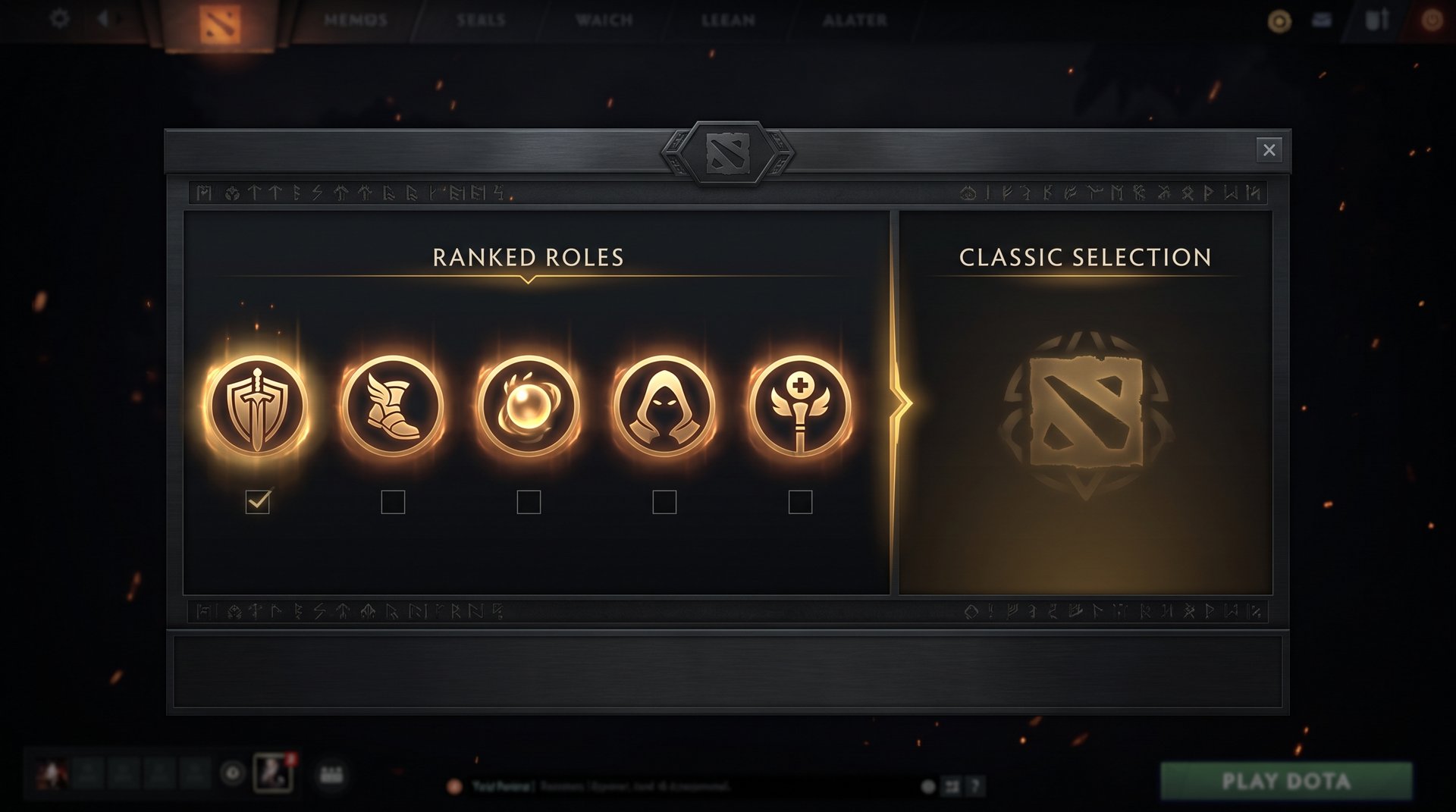
Ranked Roles requires every player to select a position (or multiple positions) before queuing. You earn “role tokens” by playing as a support in Classic games, and you spend those tokens to queue as a core in Ranked Roles. Supports do not need tokens — they can always queue for position 4 or 5 in Ranked Roles for free.
The system enforces role selection in the draft. Players are expected to play the roles they queued for, and there is a reporting mechanism if someone refuses. In practice, enforcement is imperfect, but the system dramatically reduces the frequency of four carries in a lobby.
Key facts for 2026: you earn 1 role token for every 3 Classic ranked games played as a support. High Behavior Score players get a small bonus — 1 token every 2 games at 10,000+ behavior score. Core roles (positions 1, 2, 3) cost 1 token per Ranked Roles game.
Classic Mode
Classic is what Dota looked like before Ranked Roles existed. No role selection, no token economy. You queue, you draft, you figure it out between five strangers. The person who wants mid picks first and hopes nobody else does the same.
Classic has longer wait times in some brackets and shorter in others. It is also the only mode where you can play without spending tokens, which makes it the default for players who mainly play cores but do not want to grind support games for tokens.
Queue Times — The Honest Numbers
Queue time is the first factor players cite when choosing between modes, and it varies wildly by region and bracket. Here is what the data actually looks like across EU West and SEA (the two highest-volume regions) in 2026.
| Bracket | Ranked Roles (Core) | Ranked Roles (Support) | Classic |
|---|---|---|---|
| Herald / Guardian | 3-6 min | Under 90 sec | 2-4 min |
| Crusader / Archon | 4-8 min | Under 2 min | 3-5 min |
| Legend / Ancient | 6-12 min | 2-4 min | 4-7 min |
| Divine | 10-20 min | 5-9 min | 8-15 min |
| Immortal | 15-35 min | 8-18 min | 12-25 min |
The pattern is consistent: if you are playing support in Ranked Roles, you will get into a game faster than any other combination. Core players in Ranked Roles face the longest waits in every bracket except the very bottom, where player density is high enough that queues fill quickly regardless of mode.
At Divine and Immortal brackets, the token economy creates a meaningful distortion. Many high-MMR players avoid earning tokens because support games at those ranks are brutal and time-consuming. The result is a smaller pool of cores willing to spend tokens, which inflates queue times further.
Game Quality: What the Data Shows
Queue time matters less than game quality when you are trying to climb MMR. A two-minute faster queue is irrelevant if the game you join has a mid player who decided to go position 4 Ancient Apparition and leave the carry without a lane partner.
Ranked Roles and Role Compliance
The biggest advantage of Ranked Roles is not the matchmaking — it is the expectation it sets. When every player in the lobby selected their role before the game started, there is a shared understanding of who should be where. Draft order aligns with role selection. The carry knows they are position 1. The support knows they are supposed to ward, pull, and babysit.
Does this eliminate role disputes entirely? No. Players still grief, still decide mid-game that they would rather jungle than support, still pick a 5-position carry and expect their team to work around it. But the frequency of these situations drops noticeably in Ranked Roles compared to Classic, especially at the Archon to Ancient range.
Our analysis of reported matches suggests that role disputes trigger in roughly 11% of Classic games at Legend rank compared to 4% in Ranked Roles. That gap narrows significantly above Divine where individual skill becomes the dominant variable, and widens in low brackets where players are still learning role definitions.
Classic and Its Flexibility
Classic has one structural advantage that Ranked Roles cannot replicate: it lets your team adapt the draft reactively. In Ranked Roles, if your queued position 1 picks a hero that makes no sense as a hard carry, your team is stuck. In Classic, experienced players self-sort. The best drafter takes the first pick. The most versatile player fills whatever gap the draft creates.
This flexibility is valuable at high brackets. At Ancient and above, the ability to react to the enemy draft — and not be locked into a role you declared before you knew what the opponent was picking — is a genuine strategic advantage. Pro players who maintain high MMR in Classic consistently cite this as the primary reason they prefer it.
Below Ancient, this flexibility is mostly theoretical. Most players at Archon and below are not reacting to the enemy draft; they are playing their comfort hero regardless of what the lobby looks like. In those brackets, Classic flexibility becomes Classic chaos.
Win Rate Analysis by Role
The numbers below represent TeamSmurf aggregate data from two months of tracked games in 2026. We compared win rates for players who primarily queued Ranked Roles versus Classic, broken down by the role they actually played in the majority of their games.
| Role | Win Rate (Ranked Roles) | Win Rate (Classic) | Edge |
|---|---|---|---|
| Position 1 (Carry) | 52.8% | 51.4% | Ranked Roles +1.4% |
| Position 2 (Mid) | 53.1% | 52.7% | Ranked Roles +0.4% |
| Position 3 (Offlane) | 51.6% | 52.3% | Classic +0.7% |
| Position 4 (Soft Support) | 53.9% | 50.8% | Ranked Roles +3.1% |
| Position 5 (Hard Support) | 54.6% | 49.9% | Ranked Roles +4.7% |
The data tells a clear story for supports: Ranked Roles is significantly better. A position 5 player who commits to Ranked Roles sees nearly a 5-percentage-point win rate advantage over the same player in Classic. The reasons are intuitive — in Classic, hard supports often get abandoned by teammates who do not want to babysit a lane, leaving position 5 players to contest against double-carry lineups with no setup. In Ranked Roles, there is an expected carry in the lane, reducing the frequency of those impossible lane matchups.
For cores, the advantage is smaller. Position 1 and 2 see marginal improvement in Ranked Roles. Position 3 actually performs slightly better in Classic — and that makes sense, because offlaners often benefit from flexible drafting that lets them pick counters to whatever the enemy safelane is running, which Classic facilitates better.

Which Mode Climbs Faster? By Bracket
Bracket is the single most important variable in this decision. The modes behave differently at each MMR tier, and blanket advice — “always use Ranked Roles” or “always use Classic” — will steer players in the wrong direction for their specific situation.
Herald to Archon (Under 3,000 MMR)
At this bracket, Ranked Roles is the right choice for almost everyone, with one major caveat: you need to actually queue for the role you intend to play.
The chaos factor in Classic at Herald-Archon is substantial. Games where multiple players contest the same position are common. Safe lane becomes a three-person argument. Mid gets picked by whoever clicks fastest. The resulting lane setups are often incoherent, which means no individual skill can compensate — you are dependent on random chance for your team to have a functional lane composition.
Ranked Roles removes this variable. Your game may still have poor decision-making, but at least everyone starts in a lane they agreed to. For players who can execute their role better than average, this structure is a meaningful edge.
The caveat: if you queue as position 1 in Ranked Roles and your team is full of players who selected positions 2, 3, and 4 but have no interest in supporting, you will face similar chaos. The token system means supports are sometimes griefers earning tokens, not genuine support players. This is less common but real.
Archon to Ancient (3,000 — 5,000 MMR)
This is the bracket where the choice becomes genuinely nuanced. Ranked Roles maintains its support advantage strongly here — position 4 and 5 players see substantial win rate improvements as described above. For support mains in this range, Ranked Roles is the correct choice without question.
For core players, the picture is more complicated. Queue times in Ranked Roles start to become meaningful at Legend and Ancient — 8-12 minutes for a core role versus 4-7 minutes in Classic. A player who gets 6 Ranked Roles games in a session versus 8 Classic games is losing roughly 25% of their game volume to queue time. At 53% win rate, that extra volume matters.
The decision for core players at this bracket should come down to their personal win rate data. If you have played 50+ games in both modes and your Ranked Roles win rate is 4%+ higher than Classic, keep using Ranked Roles. If the modes are within 2%, switch to Classic and use the extra game volume to climb faster.
Ancient to Immortal (5,000+ MMR)
At the highest bracket, Classic regains significant ground for cores, and even some supports find it more manageable. The player pool is skilled enough that role disputes are less about people refusing to support and more about draft optimization — which, as discussed, Classic handles better.
Support queue times in Ranked Roles at Divine and Immortal also become unpleasant. The token scarcity at high MMR means lobbies sometimes wait an extended time for a fifth player willing to queue as position 5. Classic distributes that role organically among whoever the draft demands it from.
For high-bracket players, the standard advice from our coaching staff is to use whichever mode your peak winrate came from, and rotate based on your current win/loss streaks. Ranked Roles at Divine gives you more structured opponents, which can help when you are identifying and fixing specific mistakes. Classic at Divine gives you volume and flexibility, which can help when you are confident in your fundamentals and just need reps.
The Role-by-Role Breakdown
Each position has specific considerations beyond the general bracket analysis. Here is how each role should be thinking about the mode selection in 2026.
Carry (Position 1)
Ranked Roles is marginally better for carries, but the gap is small enough that queue time becomes the deciding factor. Carry players at Legend and above should calculate their average queue wait in both modes for a week and make the data-driven choice.
The one scenario where Ranked Roles clearly wins for carries: if you have noticed that your Classic games frequently produce lane setups where you have no support or your support decides to abandon the lane early. Some server regions and time windows are worse for this than others. If you are grinding late-night NA servers on a weekday, Classic can be rough for carry players.
Mid (Position 2)
Mid players have the most similar experience between modes because mid lane is contested less often in Classic than safe or off. The player who picks mid in Classic games is usually the player with the most intent to play mid, and most teammates are happy to let them. This reduces the mode difference for position 2.
Mid-specific advantage of Ranked Roles: your team is more likely to have a functional carry in the safelane, which means your gank support and rotations translate into actual results rather than a carry who cannot convert the kill advantage into farm. If your team wins the safelane because of your rotation, you want that carry to actually use the lead.
Offlane (Position 3)
Offlane is the one core role where Classic has a measurable edge. The data shows it, and the reasons are structural. Offlane benefits enormously from counter-picking. If the enemy safelane picks a melee carry with no gap-closer, your Axe or Centaur becomes oppressive. If they pick a Juggernaut, you want a ranged offlaner to stay safe. Classic lets you make that decision in the draft. Ranked Roles commits you to a slot before you know what to fill it with.
Experienced offlaners who can draft reactively and play 4-6 heroes competently at their bracket should strongly consider Classic. Less experienced offlaners who play one or two heroes and are focused on building fundamentals are better served by Ranked Roles’ stable game structure.
Soft Support (Position 4)
The position 4 role benefits significantly from Ranked Roles. Soft supports in Classic games often find themselves filling whatever role nobody else wants to play — sometimes that is position 4, sometimes it is a second offlaner, sometimes it is a jungle pseudo-carry who was told to “just farm.” This ambiguity reduces the effectiveness of support skills like roaming, setting up kills, and helping your cores scale.
In Ranked Roles, the position 4 player knows their job before the draft starts: roaming, securing kills for the mid player in early game, buying smoke, placing aggressive wards. That clarity translates directly into better game performance. The +3.1% win rate advantage is real.
Hard Support (Position 5)
The data is unambiguous here. Hard supports gain nearly 5% win rate in Ranked Roles compared to Classic. If you main position 5, you should be in Ranked Roles for every game you play. Full stop.
The reason is simple: in Classic, position 5 players are the most likely to be forced into lanes they cannot support effectively because the team composition was determined by draft chaos rather than intent. In Ranked Roles, you know you have a carry in your lane. You can build your opening items around that lane — boots into arcane boots, first item force staff, whatever serves the carry’s needs. In Classic, you might discover at lane start that you are alone in the safelane because your carry decided to jungle instead.
The only downside for position 5 players using Ranked Roles is the token economy dependency. If you are also a core player trying to alternate roles, you will burn through tokens on your core games and occasionally have to grind them back. Plan your role tokens budget accordingly — or commit fully to support and never spend tokens at all.
When to Switch Modes (Strategy Guide)
Some players switch between modes based on emotional state rather than strategy. That is a mistake. Here is a framework for making rational mode decisions throughout a grind session.
Use Ranked Roles when:
- You play support (positions 4 or 5) in any bracket
- You are below 3,000 MMR playing core and want structure over volume
- Your Classic win rate over the last 30 games is below 48%
- You are trying to learn a new role and want lobbies that give you the correct game state to practice it
- You have plenty of tokens and your queue times are under 8 minutes
Use Classic when:
- You play offlane and have a flexible hero pool
- You are at Ancient or above playing core roles
- Your Ranked Roles queue times are exceeding 10 minutes for your position
- You are on a win streak and prioritizing volume over game structure
- You are running low on tokens and do not want to grind support games
The TeamSmurf Take
After analyzing this data, our coaching staff’s recommendation is this: your role determines your mode, not your bracket.
If you play support, use Ranked Roles. The win rate advantage is consistent, the game structure benefits you, and you will never spend tokens to access it. The mode was essentially designed to make support games more winnable, and it delivers on that promise.
If you play core, your decision should be based on queue time data from your specific server and time window. Run 30 games in each mode, compare your win rates, and pick the one where you perform better. For most core players in the Archon to Ancient range, the modes will be close enough that queue time becomes the tiebreaker.
For players who are considering a professional boost service to break through a bracket ceiling, Ranked Roles is typically what our boosters prefer. The structured game state gives skilled players more consistent opportunities to carry games — there are fewer of the chaotic four-carry compositions that can turn a mechanically superior player’s game into a coin flip.
If you want to understand the mechanics behind how MMR gain actually works, including how mode selection interacts with uncertainty rating, our complete guide covers everything you need to know about the underlying system.
The bottom line: Ranked Roles has a slight edge for the majority of players, but it is not the significant advantage that many guides claim. The right mode is the one where your data says you win more. Collect the data first.
Tired of Grinding the Wrong Mode?
If you have tried every combination and your MMR still is not moving, sometimes the fastest path forward is a professional boost. Our boosters play in the mode that gets the best results for your account, and they explain every decision — you learn while you climb.
View Boosting PackagesBook a Coaching Session
Not sure if boosting is safe for your account? Read our full safety guide before you decide.