


Radiant vs Dire: Which Side Wins More in 2026, and Does It Affect Your MMR?

The question comes up in every lobby. You check your side assignment and feel a twinge of either confidence or dread depending on which name appears. Is playing Radiant actually better than Dire? Are your odds of winning genuinely different? And — the question that matters most for your climb — does the side you play affect how much MMR you gain or lose?
This guide gives direct answers sourced from community match data, explains every map asymmetry that researchers believe creates the imbalance, and explains exactly how the matchmaker assigns sides. After reading it you will stop worrying about which side you draw and start understanding the two or three factors that actually move your MMR.
Data source: Dotabuff public match statistics (patch 7.41f, accessed September 2026). Sampled across millions of ranked matches, all brackets.
What This Guide Covers
The Actual Numbers: Radiant vs Dire Pub Winrate in 2026
The short answer is that Radiant wins more, and this has been consistently true across Dota 2’s ranked history. Based on Dotabuff public match data sampled through patch 7.41f (accessed September 2026), the overall pub split across all brackets sits at approximately:
| Side | Win Rate (All Brackets) | Win Rate (Divine/Immortal) |
|---|---|---|
| Radiant | 51.2% | 50.6% |
| Dire | 48.8% | 49.4% |
The gap is real and statistically significant across millions of matches, but it is also modest. Playing Radiant does not mean you win more than half your games — skill, draft, and execution dominate the outcome of any single game. What this data tells us is that across a large enough sample, some underlying asymmetry is consistently nudging results toward Radiant by about 1.2 percentage points.
The gap narrows at higher MMR. At Divine and Immortal, where both teams are more likely to understand and exploit whichever advantages exist, the margin drops closer to 0.6%. This is consistent with the interpretation that the asymmetry is largely a knowledge gap — teams that understand the map geometry exploit Radiant advantages more reliably, which inflates the number at lower brackets where Dire players do not adjust their play to compensate.
Breaking the numbers down by rank bracket shows a consistent pattern. The widest gaps appear at the lowest levels, where habits formed on one side do not automatically translate when the camera is flipped and the map feels different. The narrowest gaps appear at Immortal, where both sides are treated as tools with understood trade-offs rather than abstract luck.
| Rank Bracket | Radiant Win% | Dire Win% | Gap |
|---|---|---|---|
| Herald / Guardian | ~52.0% | ~48.0% | +4.0pp Radiant |
| Crusader / Archon | ~51.5% | ~48.5% | +3.0pp Radiant |
| Legend / Ancient | ~51.0% | ~49.0% | +2.0pp Radiant |
| Divine / Immortal | ~50.6% | ~49.4% | +1.2pp Radiant |
These numbers are derived from community tracking data (Dotabuff, patch 7.41f). Different data periods and filtering methods will produce slightly different figures. The trend direction, however, has been consistent across multiple patches and years of community analysis.
For players asking whether they should be worried: no. A 51.2% win rate baseline is not meaningful at the individual game level. Each game is decided by too many other variables for side assignment to be a significant factor in your personal outcome. What the data does tell us is where to look if you want to understand why the gap exists — and whether your own Dire performance is following the average or diverging from it.
Pro Match Data — Does the Gap Hold in Competitive Play?
Competitive Dota 2 provides an interesting counterpoint to pub data. In organized play — DPC leagues, regional qualifiers, and international tournaments including TI — the Radiant/Dire win split tends to hover much closer to 50/50. Several years of aggregate competitive data show that pro teams win roughly 50-51% of matches on Radiant, a gap small enough that it is difficult to separate from match variance rather than a structural advantage.
Why the narrower gap in pro play? The most credible explanation is that professional teams actively compensate for whichever structural disadvantages their side presents. If Dire has a slightly longer walk to contest Roshan early, a professional Dire team adjusts their timing, ward patterns, and draft to account for it. In pub games, that adjustment almost never happens for most players because most players do not know the adjustment is warranted.
Side selection in Captain’s Mode — used in all competitive Dota 2 — adds another layer. Teams can choose which side to play in certain formats, and they often make that choice based on their hero pool and strategy. When a team specifically picks Radiant or Dire because their draft benefits from that side’s geometry, the raw win/loss number no longer measures whether one side is structurally stronger. It measures whether teams made smart side selections relative to their game plan.
The lesson for pub players: the structural asymmetry matters less than your understanding of it. If you know the Dire map geometry and adjust accordingly, your effective disadvantage shrinks toward zero. If you play both sides identically, you replicate the ~1.2% gap the data shows.
Map Asymmetries That Create the Imbalance
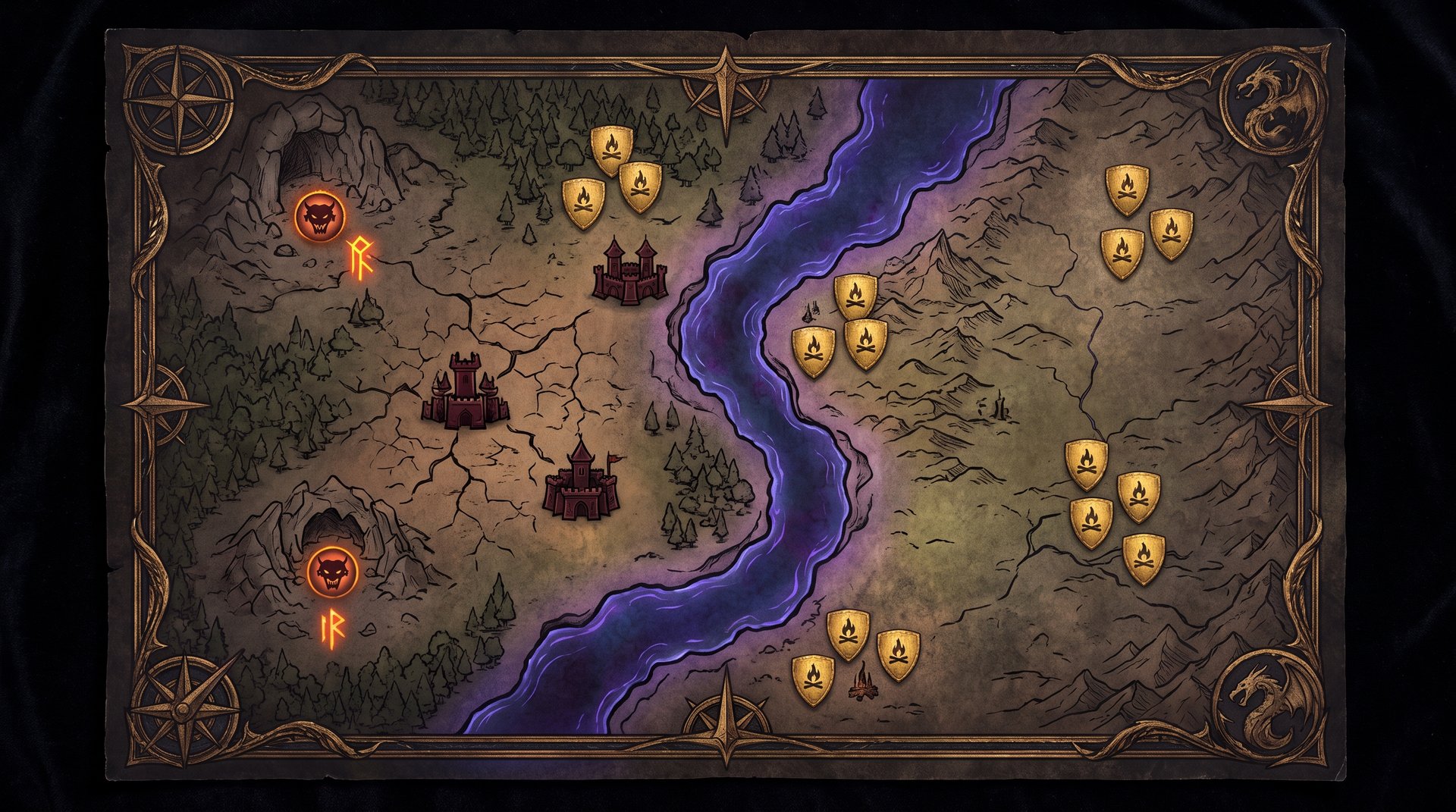
The Dota 2 map is not perfectly symmetrical and has never been. Several structural features have been identified by the community and competitive analysts as contributing to the Radiant advantage. Here is what each one actually means for gameplay in patch 7.41f.
Roshan’s Pit Is on the Dire Side — but the Interaction Is Complicated
The Roshan pit is positioned closer to Dire territory, giving Dire players a shorter walking distance to initiate or contest Roshan fights. This sounds straightforwardly like a Dire advantage — and it is, for certain scenarios. A Dire team that wants to rush Roshan early or respond to an enemy Rosh attempt gets there marginally faster.
However, the strategic reality is more complex. The pit’s orientation and the terrain around it create sightline and escape-path asymmetries that experienced players learn to use. Radiant teams doing aggressive Rosh attempts at the standard timing windows can approach from angles that give them better vision on the pit entrance. Teams exiting the pit after taking Aegis typically prefer a specific route, and the high-ground geometry on one side gives slightly better escape options than the other depending on team positioning.
The community consensus — supported by the winrate data — is that Radiant teams overall benefit slightly more from typical Roshan interactions across the full range of skill levels. The reason is not purely about walking distance but about how most pub teams position for and react to Roshan. A Radiant team that understands the standard timing and approach vectors has a slightly stronger coordination pattern than the equivalent Dire response — at least at the brackets where the winrate gap is widest.
At high MMR, this effect nearly disappears because both teams have rehearsed their Roshan patterns and the approach vectors are equally understood. This is consistent with the data showing the gap shrinking at Divine and Immortal.
Power Rune Positioning and Mid Lane Geometry
Power runes spawn at two fixed river locations at the two-minute mark and every two minutes afterward. The positions are roughly equidistant from each team’s mid lane, but the mid lane itself is slightly asymmetric in terrain layout. The Radiant mid lane has historically been described by professional mid players as having marginally better angles for certain rune contest approaches.
This is a subtle asymmetry rather than a decisive one. Most mid players who understand the geometry can compensate. But at lower skill levels — where movement and positioning habits are less precise — Radiant mids statistically out-contest runes slightly more often in aggregate data. This small edge compounds over a game when you consider that power runes can include Haste, Double Damage, Regeneration, Illusion, Invisibility, and Arcane — any of which can swing a fight or a farming cycle.
If you play mid and feel like your rune contests are weaker on Dire, this is worth actively analyzing. Are you taking the same approach path you use on Radiant? Because the path that works on one side is not necessarily optimal on the other. For rune spawn times and locations verified for the current patch, see our Dota 2 rune spawn times 2026 guide.
The Safelane Triangle and Jungle Access
Radiant’s safelane (bottom lane carry lane) has historically had a well-positioned ancient camp cluster — often called the “triangle” — that is accessible from standard laning positions. The stacking windows and pulling geometry for this camp are familiar to most players because Radiant safelane is where most carry players develop their initial farming habits.
Dire’s equivalent safelane (top lane) has different camp positioning. The neutral camps accessible from the Dire carry lane are not worse in absolute terms — Dire jungle has its own efficient farming routes — but the learning curve is different. Players who have primarily developed their farming instincts on Radiant may feel less efficient when the camera flips, which contributes to the bracket-specific data showing wider gaps at lower MMR.
This is fixable with deliberate practice. Carry players who grind their Dire jungle routing until it is as automatic as their Radiant routing report that their side-to-side performance gap closes significantly within 20-30 games of focused practice.
Water Rune and Lotus Pool Access
Water runes spawn at two lotus pools in the river. Both pools are designed to be accessible from each team, but the terrain features near each pool differ slightly. The southern pool (closer to Radiant’s approach) has somewhat different vision angles from the adjacent high ground compared to the northern pool. This minor asymmetry can accumulate in games where teams actively contest water rune refreshes, but it is one of the smaller contributors to the overall gap and is not typically a primary factor in game outcomes.
How the Dota 2 Matchmaker Assigns Sides
Valve’s matchmaker assigns sides randomly. When a ranked lobby is assembled, each team is randomly designated as Radiant or Dire. There is no hidden preference, no bias toward putting higher-rated players on a particular side, and no MMR-adjacent weighting that might put stronger teams on the historically stronger side to improve match balance.
This means that over your ranked career, you will play approximately equal numbers of games as each side. If you queue enough games — and most active players do — the random distribution converges toward 50% Radiant, 50% Dire. In any short-run sample, you might play six Radiant games in a row and then eight Dire games, because that is what random processes do. This is not the matchmaker punishing you; it is variance behaving exactly as it is expected to behave.
One place where side assignment does NOT feel random: party lobbies where the captain has Captain’s Mode selected, or in tournament brackets. In those cases, side selection is intentional (either random with a coin flip or determined by bracket position). Casual ranked queues do not have this feature — the matchmaker handles the assignment and does not expose it to players as a choice.
Can you tell which side you will be on before the draft? In some draft interfaces, the camera starting position and the hero portrait orientation reveal which side you are on before the draft timer starts. Radiant players see themselves on the left side of the hero selection screen; Dire players see themselves on the right. This has no functional implication — knowing your side one second earlier does not change your draft decisions meaningfully — but it is useful to know if you are adjusting your mental model for the game.
If you are climbing the ladder and want to optimize every possible edge, understanding which side you are playing before you draft is genuinely useful. Certain heroes have stronger performance on specific sides due to map geometry — for example, heroes whose laning pattern takes advantage of the Radiant triangle or the Dire jungle offset. If your draft calls for a specific playstyle that aligns with one side’s geometry, recognizing that during the draft rather than after it starts is a small but real advantage. For more on optimizing your climb, see our MMR boosting guide for a full breakdown of what moves rank most reliably.
Does Playing Dire or Radiant Affect Your MMR? The Direct Answer
No. Side assignment does not affect how much MMR you gain or lose.
This is the most important thing to understand about the Radiant/Dire debate, and it is also the most commonly misunderstood. When you win a ranked game, you gain the same amount of MMR regardless of which side you played. When you lose, you lose the same amount regardless of side. The matchmaker does not apply a correction factor that says “Dire is slightly harder, so wins are worth more” — it simply does not work that way.
The MMR calculation is based on the outcome of the game and nothing else. Win on Radiant: +30 (or whatever the current per-game value is for your match type). Win on Dire: +30. Lose on Radiant: -30. Lose on Dire: -30. There is no asterisk, no side coefficient, no hidden variable that adjusts the reward based on map geometry.
What does this mean practically? It means that the ~1.2% Radiant advantage translates to a very small expected value difference over time. If you played thousands of games with equivalent play on each side, you would expect to win slightly more Radiant games purely due to map structure — but across any realistic ranked sample, variance makes this invisible. Your personal results will be dominated by the quality of your play, your draft, and your teammates — not by which side the matchmaker assigned.
The one scenario where side might affect MMR indirectly is if you have a genuine performance gap between the two sides — if you are significantly better on Radiant and noticeably worse on Dire due to unfamiliarity with Dire map geometry. In that case, the gap is not caused by side assignment per se; it is caused by skill applied unevenly across the two orientations. The fix is not to hope for Radiant — it is to practice Dire until the gap closes.
For players who feel stuck or who worry about external factors depressing their climb: the research on Dota 2 rank progression consistently shows that individual mechanics, hero pool, and decision-making explain vastly more variance in outcomes than any systemic factor including side assignment. If you are genuinely a better player than your current rank, a consistent Radiant/Dire distribution will not keep you there. For a professional assessment of where you actually stand relative to your bracket, our guide on boosting and what professional play looks like at each rank gives a useful external reference point. And if you want your rank moved by someone who has done it hundreds of times, see our comparison of the best Dota 2 boosting services available in 2026.
Playing Well on Dire: Adjustments That Actually Matter
Most players underperform on Dire not because the side is harder but because they have built their muscle memory and map instincts primarily on Radiant. The camera is flipped, the jungle is mirrored, and the approach to Roshan is different. If you play predominantly Radiant and then hit a run of Dire games, the cognitive overhead of orientation is real. Here is what to actively adjust.
Camera Orientation and the Flip Option
Dota 2 offers a camera rotation option that lets Dire players view themselves at the bottom of the screen rather than the top. Find it under Options and look for the camera orientation or map rotation settings. Most players who use this setting report significantly less Dire disorientation within a few sessions, though it requires a short adjustment period when you first enable it. If your Dire winrate is noticeably below your Radiant winrate, this is the first setting to try before anything else.
Roshan Timing Awareness on Dire
Remember that as Dire, your team has a shorter walk to the Roshan pit. This cuts both ways. When you want to initiate Roshan, you can often get there before the enemy Radiant team even recognizes the intent — use that speed advantage deliberately, especially on a Dire team with a strong early Rosh hero. When the enemy Radiant team goes for Roshan, they are walking slightly farther and spending slightly more time off the map. That is an opportunity window for a coordinated split push that Dire teams who understand the timing can exploit consistently. For more on Roshan timing mechanics, see our Roshan drops and respawn timer guide.
Jungle Routing on Dire
Dire jungle camps are positioned differently from Radiant’s. If you have primarily developed your farming instincts on Radiant, practice the Dire jungle routing in non-ranked modes until it becomes automatic. Specifically, understand the Dire equivalent of the Radiant triangle and the stacking windows for the ancient camps — they exist and are efficient, but they require different movement patterns than the Radiant version. Carries who are equally comfortable farming both jungles do not have a meaningful winrate gap between sides.
Mental Framing and the Confirmation Bias Trap
The most common Dire performance problem is not mechanical — it is psychological. Players who believe Dire is cursed or harder will look for evidence that confirms that belief, interpret normal bad games as side-related, and give up in tight spots they would fight through on Radiant. The data shows the gap is approximately 1.2 percentage points in pub matches overall, narrowing to near zero at higher brackets. That is not a basis for defeatism. Every Dire game is a winnable game. Treat it that way.
Patch 7.41f Context: What Changed and What Has Not
Patch 7.41f is the current patch as of the time of writing (October 2026). The 7.41 patch line has focused primarily on hero balance — adjustments to abilities, talents, Facets, and item interactions — rather than map geometry changes. The core Radiant/Dire map structure that generates the asymmetries described above has not materially changed within the 7.41 series.
Historically, Valve has made significant map changes over Dota 2’s lifetime specifically to address side balance concerns, most dramatically in the 7.00 map overhaul and the 7.33 “New Frontiers” update. The current map geometry reflects multiple iterations of those adjustments. The persistent ~1% Radiant advantage in pub matches suggests that perfect symmetry is difficult to achieve when terrain and jungle positioning interact with the full complexity of hero kits, item timings, and strategic patterns across all skill levels.
Valve has referenced the Radiant/Dire win split in developer communications over the years, noting that their goal is to keep it within roughly 1-2 percentage points. By that standard, the current 1.2% gap in 7.41f means the map is performing within their design target, even if not perfectly equal.
When patch 7.42 lands, community data trackers will publish updated Radiant/Dire numbers within days. If the new patch includes map changes, the gap may shift. The reliable sources to check are Dotabuff (dotabuff.com/results) and Stratz (stratz.com) for updated pub statistics after any major patch. Both sites publish near-real-time win rate data broken down by side, rank, and other variables.
Frequently Asked Questions
Tired of Losing Games You Should Win?
TeamSmurf’s boosters and coaches are Immortal-ranked Dota 2 specialists. Whether you want your MMR moved professionally or want to learn the mechanics that separate your bracket from the next, we have a service for it. No accounts sold — boosts and coaching only, with full VPN protection and transparent tracking.
Get MMR Boosted Book a Coach



